


2 Samuel 10:16
Bible text: King James Version (1769 Blayney text) · Public domain
Bible text: King James Version with Strong's numbers · Public domain
Bible text: Berean Standard Bible · Public domain
Bible text: American Standard Version (1901) · Public domain
Bible text: World English Bible, Messianic edition · Public domain
Bible text: Geneva Bible (1599) · Public domain
Bible text: Young's Literal Translation · Public domain
- וַיִּשְׁלַחvai·yish·Lachand he sentH7971Conj-w ¦ V-Qal-ConsecImperf-3msVerb Qal Consecutive Imperfect 3rd Singular Masculineוַandיִּשְׁלַחhe sent
- הֲדַדְעֶזֶרha·dad·'E·zerHadadezerH1928N-proper-mNoun Proper Masculine
- וַיֹּצֵאvai·yo·Tze'and he brought outH3318Conj-w ¦ V-Hiphil-ConsecImperf-3msVerb Hiphil Consecutive Imperfect 3rd Singular Masculineוַandיֹּצֵאhe brought out
- אֶת'et<obj.>H853DirObjMParticle Object Indicator
- אֲרָם'a·RamAramH758N-properNoun Proper Location
- אֲשֶׁר'a·SherwhichH834RelParticle Relative
- מֵעֵבֶרme·'E·ver[was] from [the] other side ofH5676Prep-m ¦ N-mscNoun Singular Masculine Constructמֵ[was] fromעֵבֶר[the] other side of
- הַנָּהָרha·na·Harthe RiverH5104Art ¦ N-properNoun Proper LocationהַtheנָּהָרRiver
- וַיָּבֹאוּvai·ya·Vo·'uand they cameH935Conj-w ¦ V-Qal-ConsecImperf-3mpVerb Qal Consecutive Imperfect 3rd Plural Masculineוַandיָּבֹאוּthey came
- חֵילָםchei·LamHelamH2431N-properNoun Proper Location
- וְשׁוֹבַךְve·sho·Vakhand ShobachH7731Conj-w ¦ N-proper-mNoun Proper MasculineוְandשׁוֹבַךְShobach
- שַׂרsar[the] commander ofH8269N-mscNoun Singular Masculine Construct
- צְבָאtze·Va'[the] army ofH6635N-mscNoun Singular Masculine Construct
- הֲדַדְעֶזֶרha·dad·'E·zerHadadezerH1928N-proper-mNoun Proper Masculine
- לִפְנֵיהֶםlif·nei·Hem[was] <to> before themH6440Prep-l ¦ N-mpc ¦ 3mpNoun Plural Masculine Constructלִ[was] <to>פְנֵיbeforeהֶםthem
English is a literal word-by-word gloss of the Hebrew, not the KJV's wording. Why?
This is the original text the KJV's translators worked from — each Hebrew word with its own literal English meaning in this verse, prepared by scholars at Tyndale House, Cambridge. The KJV translates whole sentences, not word by word, so its wording differs: one Hebrew word can become several English words, and the KJV may choose “the LORD” where the gloss reads “Yahweh”. Both are faithful — they answer different questions. For the KJV's own rendering, switch to the KJV text.
Details
See on the biblical-era maps
Study this verse
Public-domain commentary
Matthew Henry
From his Commentary on the Whole Bible. Henry comments on passages, not single verses — this entry covers 2 Samuel 10:15–19.
Here is, 1. A new attempt of the Syrians to recover their lost honour and to check the progress of David's victorious arms. The forces that were lately dispersed rallied again, and gathered themselves together, Sa2 10:15. Even the baffled cause will make head as long as there is any life in it; the enemies of the Son of David do so, Matt, Sa2 22:34; Rev 19:19. These, being conscious of their insufficiency, called in the aid of their allies and dependencies on the other side of the river (Sa2 10:16), and, being thus recruited, they hoped to make their part good against Israel, but they knew not the thoughts of the Lord, for he gathered them as sheaves into the floor; see Mic 4:11-13. 2. The defeat of this attempt by the vigilance and valour of David, who, upon notice of their design, resolved not to stay till they attacked him, but went in person at the head of his army over Jordan (Sa2 10:17), and, in a pitched battle, routed the Syrians (Sa2 10:18), slew 7000 men, who belonged to 700 chariots, and 40,000 other soldiers, horse and foot, as appears by comparing Ch1 19:18. Their general was killed in the battle, and David came home in triumph, no doubt. 3. The consequence of this victory over the Syrians. (1.) David gained several tributaries, Sa2 10:19. The kings, or petty princes, that had been subject to Hadarezer, when they saw how powerful David was, very wisely made peace with Israel, whom they found they could not make war with, and served them, since they were able to give them protection. Thus the promise made to Abraham (Gen 15:18), and repeated to Joshua (Jos 1:4), that the borders of Israel should extend to the river Euphrates, was performed, at length. (2.) The Ammonites lost their old allies: The Syrians feared to help the children of Ammon, not because they had an unrighteous cause (justifying a crime which was a breach of the law of nations), but because they found it was an unsuccessful cause. It is dangerous helping those that have God against them; for, when they fall, their helpers will fall with them.
Jesus Christ, the Son of David, sent his ambassadors, his apostles and ministers, after all his servants the prophets, to the Jewish church and nation; but they treated them shamefully, as Hanun did David's ambassadors, mocked them, abused them, slew them; and it was this that filled the measure of their iniquity, and brought upon them ruin without remedy (Mat 21:35, Mat 21:41, Mat 22:7; compare Ch2 26:16); for Christ takes the affronts and injuries done to his ministers as done to himself and will avenge them accordingly.
Continue studying 2 Samuel 10:16 across the web’s major study libraries — every link below opens this exact verse, chapter, or book on the destination site.
Read & Compare
 BibleGatewayThis verse in more than 200 translations and 70 languages.
 Bible.comThe YouVersion reader — hundreds of translations, reading plans, and highlights.
 ESV.orgCrossway's official English Standard Version reader.
 NET BibleThe NET translation with 60,000+ translators' notes on every rendering decision.
 STEP BibleTyndale House's free study tool — original text, vocabulary, and scholarly resources.
 BibliaLogos Bible Software's free web reader.
 USCCBThe New American Bible (Revised Edition) with the U.S. bishops' study notes.
Commentaries
 BibleHub CommentariesDozens of classic commentaries on this verse, gathered on one page.
 StudyLightMore than 100 commentary sets — the largest collection on the web.
 BibleRefPlain-English commentary on what this verse means, verse by verse.
 Enduring WordDavid Guzik's free commentary on this chapter, widely used by Bible teachers.
 Bible Study ToolsVerse commentary alongside Greek and Hebrew study aids.
Original Language & Research
- BibleHub InterlinearThe verse word by word — original language, transliteration, and English.
- BibleHub LexiconEvery word's original-language definition and Strong's entry.
 Blue Letter BibleDeep-study tools — Strong's numbers, concordance, and word studies.
 SefariaThe Hebrew text with Rashi and centuries of Jewish commentary.
Sermons, Hymns & Audio


TrulyRandomVerse is not affiliated with these sites and doesn’t control their content. They’re linked because they’re genuinely useful.
Summary
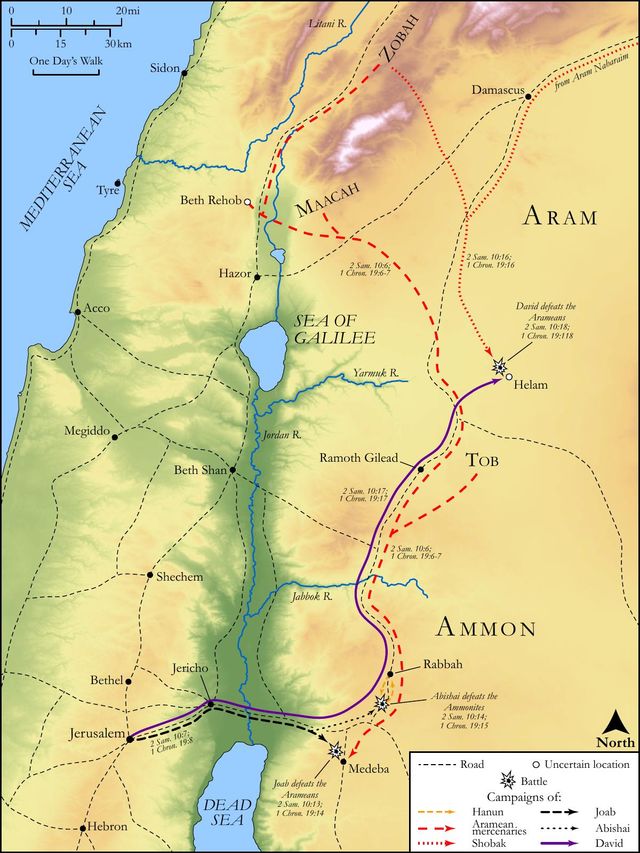
Second Samuel 10:16 describes a critical escalation in the conflict between Israel and the Aramean coalition led by Hadarezer, king of Zobah. Following an initial defeat, Hadarezer demonstrates his formidable power and unyielding resolve by mobilizing a vast new army, drawing troops from "beyond the river"—a clear reference to the Euphrates—and dispatching them under the command of his seasoned general, Shobach, to the strategic rendezvous point of Helam. This verse vividly portrays the immense scale of the opposition David faced, setting the stage for a decisive confrontation that would determine regional supremacy and the stability of Israel's burgeoning kingdom.
Context
ShowHideLiterary Context
This verse immediately follows the first phase of the Ammonite-Syrian war against Israel. The conflict was sparked by the Ammonite king Hanun's egregious insult to David's envoys, which prompted David to send Joab and Abishai to confront them (2 Samuel 10:1-5). Realizing their provocation, the Ammonites hired a vast mercenary force from various Aramean kingdoms, including the powerful Hadarezer of Zobah (2 Samuel 10:6). Despite being outnumbered, Joab and Abishai skillfully divided their forces and achieved a significant victory, routing both the Ammonites and their Syrian allies (2 Samuel 10:7-14). However, this initial setback did not deter Hadarezer. Instead, 2 Samuel 10:16 reveals his immediate and determined response, signaling his intention to renew and escalate the conflict, thereby setting the stage for the second, more decisive battle described in the subsequent verses, where David himself leads the army to a definitive triumph (2 Samuel 10:17-19).
Historical & Cultural Context
Hadarezer, the king of Zobah, was arguably the most dominant figure in ancient Syria during David's reign. His kingdom's influence stretched from the Orontes River to the Euphrates. His ability to "bring out the Syrians that were beyond the river" indicates his extensive influence and perhaps even dominion over distant Aramean states located east of the Euphrates, "the great river, the river Euphrates" of the promise to Abraham, a major geographical and political boundary often marking the extent of great empires. For Hadarezer to command forces from such a distant and strategically significant region underscores his immense power, his vast network of alliances, and the serious, almost imperial, threat he posed to David's burgeoning kingdom. The widespread use of mercenary armies was a common practice in this period, reflecting the fluid political landscape and the strategic alliances formed between various city-states and kingdoms. Helam, though its exact location is debated among scholars, served as a crucial staging ground for this massive military mobilization, highlighting the sophisticated logistical capabilities of Hadarezer's forces.
Key Themes
ShowHideThis verse powerfully contributes to several overarching themes within the book of 2 Samuel and the broader Deuteronomistic History. Firstly, it highlights the persistence and escalation of opposition against David's kingdom. Even after an initial victory, the enemy does not concede but regroups with greater force, underscoring the ongoing challenges faced by God's chosen king in establishing and securing His covenant people. Secondly, it emphasizes the formidable nature of David's adversaries and the vast scope of his military campaigns, demonstrating that the consolidation of Israel's kingdom involved significant struggle against powerful regional entities. Hadarezer's ability to summon troops from "beyond the river" showcases his vast resources and strategic acumen, solidifying his role as a major antagonist. Finally, this verse implicitly sets the stage for the theme of divine sovereignty and David's reliance on God. While Hadarezer mobilizes his forces, the broader narrative of David's reign consistently attributes Israel's ultimate victories not to military might alone, but to the Lord's presence and blessing, as seen in passages detailing David's earlier conquests (2 Samuel 8:6).
Exposition and Analysis
ShowHideKey Word Analysis
ShowHideMeaning "Hadar (or Hadad) is his help," Hadarezer was the powerful king of Zobah, a dominant Aramean kingdom in Syria. His name reflects the worship of the storm god Hadad, a prominent deity in the region. His repeated appearance in 2 Samuel and 1 Chronicles as a major antagonist to David underscores his significant regional power and his role as a primary obstacle to David's expansion and consolidation of Israel's kingdom. His actions here demonstrate his unyielding determination to assert his dominance despite previous defeats, highlighting his formidable status.
This phrase, derived from H5676 (ʻêber, meaning "a region across" or "opposite side") and H5104 (nâhâr, meaning "a stream" or "river"), is a crucial geographical marker that almost invariably refers to the Euphrates River in the Old Testament. Its inclusion here signifies the immense geographical reach and political influence of Hadarezer. His ability to summon forces from such a distant and strategically important region east of the Euphrates indicates the vastness of his confederacy or sphere of influence, presenting a threat of unprecedented scale to David's kingdom. It suggests an empire-like capacity, far exceeding that of a mere local king.
This phrase, utilizing H6440 (pânîym, meaning "face" or "presence"), indicates that Shobach, the captain of the host, was at the head of the army, leading them. The root pânâ means "to turn," implying a turning or facing forward. In this context, it signifies his position at the vanguard, demonstrating his leadership and the organized, purposeful movement of Hadarezer's forces towards Helam. This detail underscores the seriousness and professional organization of Hadarezer's renewed offensive, with his top general personally leading the charge.
Verse Breakdown
ShowHide"And Hadarezer sent, and brought out the Syrians that [were] beyond the river"
This clause emphasizes Hadarezer's proactive and determined response to his earlier defeat. He did not simply retreat but immediately initiated a massive mobilization, reaching out to distant allies or subject states across the Euphrates. The phrase "brought out" (H3318, yâtsâʼ) suggests a deliberate and organized call to arms, assembling a formidable new coalition of Aramean forces. This action underscores his power, his extensive network of alliances, and his unwavering resolve to confront David, signaling a significant escalation of the conflict.
"and they came to Helam"
This indicates the designated rendezvous point for Hadarezer's newly assembled forces. Helam, though its precise location is debated, served as a strategic gathering place, signifying the convergence of a vast, multi-regional army. The movement of these forces to a specific location demonstrates the organized and strategic nature of Hadarezer's military campaign, preparing for a decisive engagement with David's army rather than a mere skirmish.
"and Shobach the captain of the host of Hadarezer [went] before them"
This final clause highlights the leadership and military structure of Hadarezer's renewed offensive. Shobach (H7731, Shôwbâk), as the supreme commander (H8269, sar), leading the vanguard (H6440, pânîym as "before"), signifies the professional and serious nature of this military undertaking. His presence at the head of the army underscores the direct involvement of Hadarezer's top military leadership and the strategic importance of this second confrontation, implying a well-disciplined and formidable force ready for battle.
Literary Devices
ShowHideThe verse employs several literary devices to convey its message and heighten narrative tension. The most prominent is Escalation, as Hadarezer's actions represent a significant increase in the scale and intensity of the conflict. His summoning of forces from "beyond the river" dramatically expands the geographical scope and numerical strength of the enemy, making the threat to Israel far greater than before. This escalation serves to build narrative tension, Foreshadowing the major, decisive battle that is about to unfold between David's forces and this formidable coalition. The mention of specific geographical markers like "beyond the river" and "Helam" functions as Geographical Marker, grounding the narrative in a tangible, historical reality and emphasizing the vastness of the Aramean coalition and the immense logistical undertaking involved. Implicitly, there is also an element of Contrast between Hadarezer's persistent and escalating opposition and David's initial victory, setting up a profound test of David's reliance on God in the face of renewed and greater adversity.
Theological and Thematic Connections
ShowHideThe persistent and escalating opposition from Hadarezer in 2 Samuel 10:16 serves as a powerful theological motif, illustrating that even after significant victories, challenges to God's people and His anointed king do not always disappear but can regroup and return with greater force. This mirrors a broader biblical truth that the path of faith and the establishment of God's kingdom often involve sustained conflict against formidable adversaries. It highlights the reality of spiritual warfare, where the enemy, whether human or demonic, is relentless in its opposition to God's purposes. David's ultimate triumph over this immense coalition, as described later in the chapter, ultimately testifies to the Lord's sovereign power and His faithfulness to His covenant with David, ensuring that no earthly power can ultimately thwart His divine plan. This passage underscores that God's people are called to perseverance, trusting that divine strength will prevail over even the most overwhelming human or spiritual opposition.
Reflection and Application
ShowHideThe renewed and intensified opposition faced by King David in 2 Samuel 10:16 offers profound lessons for believers today. Just as Hadarezer refused to accept defeat and mobilized a greater force, we too can expect that challenges, whether personal, spiritual, or communal, may not vanish after an initial victory. This verse calls us to cultivate a spirit of vigilance and perseverance, recognizing that the Christian life is often a marathon, not a sprint, marked by ongoing battles. It reminds us not to become complacent in times of peace or discouraged by the resurgence of adversity. Instead, like David, whose ultimate victory was attributed to the Lord, we are called to deepen our reliance on God's strength and wisdom when facing escalating pressures. Understanding the nature of persistent opposition can help us remain steadfast in prayer, grounded in God's Word, and prepared to stand firm, knowing that our ultimate triumph rests in Christ and His sovereign power.
Questions for Reflection
ShowHideFAQ
ShowHideWho was Hadarezer and why was he so powerful?
ShowHideHadarezer was the king of Zobah, one of the most powerful Aramean (Syrian) kingdoms during David's reign. His power stemmed from his strategic location, controlling vital trade routes and possessing significant military might. He had established a wide sphere of influence, indicated by his ability to command forces from various Aramean states, including those "beyond the river" (the Euphrates). This made him a dominant regional player, often clashing with other emerging powers like Israel. His previous defeat by David, mentioned in 2 Samuel 8:3-8, did not diminish his ambition or capacity to raise a formidable army, as vividly demonstrated in 2 Samuel 10:16.
What is the significance of "beyond the river" in this verse?
ShowHideThe phrase "beyond the river" (Hebrew: mē‘ēḇer hannāhār) in the Old Testament almost exclusively refers to the Euphrates River. Its significance in 2 Samuel 10:16 is twofold: Firstly, it emphasizes the immense geographical reach and political influence of Hadarezer, indicating that his power extended far to the east, drawing allies or subject peoples from across this major waterway. This highlights the vastness and formidable nature of the army he assembled, representing a truly regional coalition. Secondly, it underscores the serious threat posed to David's kingdom. To face an enemy capable of mobilizing forces from such a distant region meant that David was confronting not just a local skirmish, but a major regional power with imperial ambitions, making his subsequent victory, achieved through God's strength, all the more remarkable.
Christ-Centered Fulfillment
ShowHideThe persistent and escalating opposition faced by King David in 2 Samuel 10:16 finds its ultimate Christ-centered fulfillment in the life and redemptive work of Jesus Christ, the true and eternal King of Israel. Just as Hadarezer, a powerful earthly king, relentlessly opposed God's anointed David, so too did earthly and spiritual powers conspire against Jesus, the Son of David. From the attempts to kill Him as an infant (Matthew 2:13-18) to the constant opposition from religious leaders (Matthew 12:14) and the ultimate betrayal and crucifixion (Luke 23:20-25), Christ faced an escalating and seemingly overwhelming opposition from forces both seen and unseen. However, just as David's God-given victory over Hadarezer established his kingdom, Christ's ultimate triumph over sin and death through His resurrection (Romans 6:9-10) and ascension (Ephesians 1:20-21) secured His eternal kingdom, which will never be defeated. The forces "beyond the river" that gathered against David foreshadow the "principalities and powers" that Christ disarmed and triumphed over by the cross (Colossians 2:15). Ultimately, Christ, the King of kings and Lord of lords (Revelation 19:16), will subdue all His enemies, and His reign will be forever (1 Corinthians 15:25-26), fulfilling the promise of an everlasting throne.