


1 Chronicles 18:7
Bible text: King James Version (1769 Blayney text) · Public domain
Bible text: Berean Standard Bible · Public domain
Bible text: American Standard Version (1901) · Public domain
Bible text: World English Bible, Messianic edition · Public domain
Bible text: Geneva Bible (1599) · Public domain
Bible text: Young's Literal Translation · Public domain
- וַיִּקַּחvai·yi·Kachand he tookH3947Conj-w ¦ V-Qal-ConsecImperf-3msVerb Qal Consecutive Imperfect 3rd Singular Masculineוַandיִּקַּחhe took
- דָּוִידda·VidDavidH1732N-proper-mNoun Proper Masculine
- אֵת'et<obj.>H853DirObjMParticle Object Indicator
- שִׁלְטֵיshil·Tei[the] shields ofH7982N-mpcNoun Plural Masculine Construct
- הַזָּהָבha·za·Hav<the> goldH2091Art ¦ N-msNoun Singular Masculine Absoluteהַ<the>זָּהָבgold
- אֲשֶׁר'a·SherwhichH834RelParticle Relative
- הָיוּha·Yuthey wereH1961V-Qal-Perf-3cpVerb Qal Perfect 3rd Plural common gender
- עַל'alonH5921PrepPreposition
- עַבְדֵי'av·Dei[the] servants ofH5650N-mpcNoun Plural Masculine Construct
- הֲדַדְעָזֶרha·dad·'A·zerHadadezerH1928N-proper-mNoun Proper Masculine
- וַיְבִיאֵםvay·vi·'Emand he brought themH935Conj-w ¦ V-Hiphil-ConsecImperf-3ms ¦ 3mpVerb Hiphil Consecutive Imperfect 3rd Singular Masculineוַandיְבִיאֵhe broughtםthem
- יְרוּשָׁלִָםye·ru·sha·LimJerusalemH3389N-properNoun Proper Location
English is a literal word-by-word gloss of the Hebrew, not the KJV's wording. Why?
This is the original text the KJV's translators worked from — each Hebrew word with its own literal English meaning in this verse, prepared by scholars at Tyndale House, Cambridge. The KJV translates whole sentences, not word by word, so its wording differs: one Hebrew word can become several English words, and the KJV may choose “the LORD” where the gloss reads “Yahweh”. Both are faithful — they answer different questions. For the KJV's own rendering, switch to the KJV text.
Details
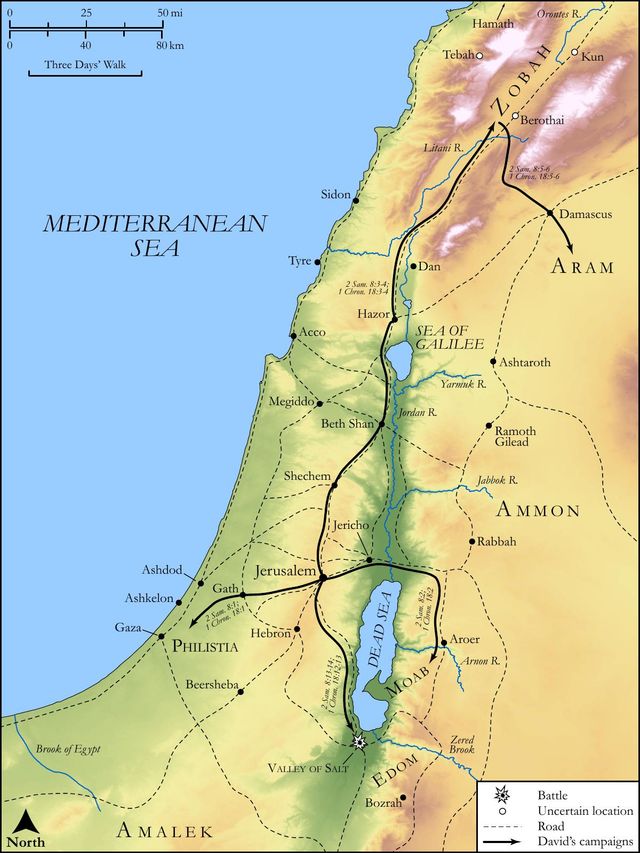
See on the biblical-era map
Study this verse
Public-domain commentary
Matthew Henry
From his Commentary on the Whole Bible. Henry comments on passages, not single verses — this entry covers 1 Chronicles 18:1–8.
After this, it is said (Ch1 18:1), David did those great exploits. After the sweet communion he had had with God by the word and prayer, as mentioned in the foregoing chapter, he went on his work with extraordinary vigour and courage, conquering and to conquer. Thus Jacob, after his vision, lifted up his feet, Gen 29:1.
We have taken a view of these victories before, and shall now only observe, 1. Those that have been long enemies to the Israel of God will be brought down at last. The Philistines had, for several generations, been vexatious to Israel, but now David subdued them, Ch1 18:1. Thus shall all opposing rule, principality, and power, be, at the end of time, put down by the Son of David, and the most inveterate enemies shall fall before him. 2. Such is the uncertainty of this world that frequently men lose their wealth and power when they think to confirm it. Hadarezer was smitten as he went to establish his dominion, Ch1 18:3. 3. A horse is a vain thing for safety, so David said (Psa 33:17), and it seems he believed what he said, for he houghed the chariot-horses, Ch1 18:4. Being resolved not to trust to them (Psa 20:7), he would not use them. 4. The enemies of God's church are often made to ruin themselves by helping one another, Ch1 18:5. The Syrians of Damascus were smitten when they came to help Hadarezer. When hand thus joins in hand they shall not only not go unpunished, but thereby they shall be gathered as the sheaves into the floor, Mic 4:11, Mic 4:12. 5. The wealth of the sinner sometimes proves to have been laid up for the just. The Syrians brought gifts, Ch1 18:6. Their shields of gold and their brass were brought to Jerusalem, Ch1 18:7, Ch1 18:8. As the tabernacle was built of the spoils of the Egyptians, so the temple of the spoils of other Gentile nations, a happy presage of the interest the Gentiles should have in the gospel church.
Continue studying 1 Chronicles 18:7 across the web’s major study libraries — every link below opens this exact verse, chapter, or book on the destination site.
Read & Compare
 BibleGatewayThis verse in more than 200 translations and 70 languages.
 Bible.comThe YouVersion reader — hundreds of translations, reading plans, and highlights.
 ESV.orgCrossway's official English Standard Version reader.
 NET BibleThe NET translation with 60,000+ translators' notes on every rendering decision.
 STEP BibleTyndale House's free study tool — original text, vocabulary, and scholarly resources.
 BibliaLogos Bible Software's free web reader.
 USCCBThe New American Bible (Revised Edition) with the U.S. bishops' study notes.
Commentaries
 BibleHub CommentariesDozens of classic commentaries on this verse, gathered on one page.
 StudyLightMore than 100 commentary sets — the largest collection on the web.
 BibleRefPlain-English commentary on what this verse means, verse by verse.
 Enduring WordDavid Guzik's free commentary on this chapter, widely used by Bible teachers.
 Bible Study ToolsVerse commentary alongside Greek and Hebrew study aids.
Original Language & Research
- BibleHub InterlinearThe verse word by word — original language, transliteration, and English.
- BibleHub LexiconEvery word's original-language definition and Strong's entry.
 Blue Letter BibleDeep-study tools — Strong's numbers, concordance, and word studies.
 SefariaThe Hebrew text with Rashi and centuries of Jewish commentary.
Sermons, Hymns & Audio


TrulyRandomVerse is not affiliated with these sites and doesn’t control their content. They’re linked because they’re genuinely useful.
Summary
This verse records a significant detail of King David's decisive military triumph over Hadarezer, the powerful King of Zobah. David's act of seizing the "shields of gold" from Hadarezer's elite servants and transporting them to Jerusalem not only symbolizes a comprehensive victory and the subjugation of a formidable foe but also signifies the substantial acquisition of valuable spoils of war, which would contribute immensely to the wealth, security, and future strategic projects of the burgeoning Israelite kingdom.
Context
ShowHideLiterary Context
1 Chronicles 18 is a pivotal chapter in the Chronicler's narrative of David's reign, meticulously detailing his extensive military campaigns and the establishment of his dominion over surrounding nations. This chapter serves to underscore God's unwavering faithfulness in fulfilling His covenant promises to David, particularly concerning the expansion and security of his kingdom. Following a major defeat of Hadarezer, King of Zobah, near Hamath, as recounted in 1 Chronicles 18:3-6, David proceeds to gather substantial plunder. Verse 7 specifically notes the capture of "shields of gold," a detail that emphasizes the immense value of the spoils and the completeness of Hadarezer's defeat, setting the stage for the dedication of these and other treasures to the Lord in 1 Chronicles 18:11. The Chronicler's emphasis here is on the divine enablement of David's victories and the subsequent dedication of the spoils, highlighting a theological purpose for the material gains.
Historical & Cultural Context
Hadarezer, King of Zobah, was a formidable regional power in ancient Syria, controlling a vast territory and commanding considerable military strength. His decisive defeat by David marked a significant shift in the balance of power among the nations round about, solidifying Israel's emerging dominance. In ancient warfare, the taking of spoils was a customary and crucial aspect of victory, serving not only as a reward for the conquering army but also as a means to enrich the victor's kingdom. The "shields of gold" were likely not standard battle equipment but rather ceremonial, ornamental, or symbolic items, perhaps belonging to Hadarezer's royal guard or high-ranking officials. Their composition of gold signifies their immense value and prestige, making their capture a profound symbol of the enemy's complete subjugation and the transfer of power. Bringing these treasures to Jerusalem further emphasized the city's role as the central hub of David's expanding kingdom, the repository of its wealth, and the seat of its political and religious authority, aligning with David's vision for the city.
Key Themes
ShowHideThis verse contributes significantly to several overarching themes within 1 Chronicles and the broader biblical narrative. Firstly, it highlights Divine Victory and Blessing, as David's consistent military success against formidable foes like Hadarezer is consistently presented as a direct result of God's favor and presence with him, explicitly stated in 1 Chronicles 18:6. Secondly, it underscores the Acquisition of Wealth and Resources, with the "shields of gold" representing significant material gain from military conquest, crucial for strengthening the kingdom's economy and supporting its infrastructure. Thirdly, it reinforces the Centralization in Jerusalem, as David's act of bringing these valuable items to the capital solidified its status as the political, economic, and eventually, the spiritual heart of Israel. Finally, and perhaps most importantly in the Chronicler's theological agenda, this accumulation of vast wealth from these campaigns, including items like these gold shields, was instrumental in David's Preparation for Temple Building. Although not explicitly stated in this verse, the Chronicler consistently links David's conquests and the resulting wealth to his extensive preparations for the building of God's Temple, a task later completed by his son Solomon, as detailed in 1 Chronicles 22:14. These treasures, along with other spoils, were later consecrated by David to the Lord, as seen in 1 Chronicles 18:11, demonstrating a theological purpose for the material gains.
Exposition and Analysis
ShowHideKey Word Analysis
ShowHideThe Hebrew word שֶׁלֶט (sheleṭ), plural שְׁלָטִים (shlatim), refers to a shield, specifically one that controls or protects the person. These were likely not ordinary battle shields but rather highly valuable, possibly ceremonial or ornamental pieces, indicative of the wealth and status of Hadarezer's elite guard or royal retinue. Their capture signifies a complete and humiliating defeat for Hadarezer, stripping him of symbols of his power and prestige.
The Hebrew word זָהָב (zâhâb) denotes gold, a precious metal highly prized among the nations for its beauty, durability, and intrinsic value. The mention of "gold" emphasizes the immense wealth and prestige associated with these shields, making them a significant acquisition. In the Chronicler's narrative, gold is also a key material used in the construction and adornment of sacred objects and structures, foreshadowing its later use in the Temple.
The name הֲדַרְעֶזֶר (Hădarʻezer) means "Hadar (Hadad) is his help," referring to the Syrian storm god Hadad. He was the powerful king of Zobah, a significant Aramean kingdom north of Damascus. His defeat by David was a major military and political achievement, expanding Israel's influence and securing its northern borders. The capture of his prized possessions further underscores his subjugation and the transfer of divine favor from the pagan god to Yahweh.
Verse Breakdown
ShowHide"And David took the shields of gold"
This opening clause immediately establishes David's agency and the nature of his victory. The act of "taking" signifies conquest, seizure of property, and the transfer of power from the defeated enemy to the victor. The specific mention of "shields of gold" highlights the valuable nature of the spoils, indicating not just a military victory but also a significant economic and symbolic gain. These were not mere weapons but symbols of royal authority and wealth.
"that were on the servants of Hadarezer"
This phrase identifies the origin and previous ownership of the gold shields. They belonged to the "servants" of Hadarezer, likely referring to his high-ranking officials, elite guard, or perhaps even his personal retinue. This detail emphasizes the humiliation of Hadarezer, as his most prestigious possessions, carried by his most trusted men, were seized, further underscoring the completeness of David's triumph over a formidable foe and the stripping away of his kingdom's glory.
"and brought them to Jerusalem"
This concluding clause specifies the destination of the captured treasures. Bringing them to Jerusalem was a deliberate act that served multiple purposes: it centralized the wealth within the capital, reinforcing Jerusalem's growing importance as the political and economic heart of the kingdom; it publicly displayed the fruits of David's victories, enhancing his prestige and legitimacy; and, from the Chronicler's perspective, it accumulated resources that would ultimately be dedicated to the Lord and used for the future building of the Temple, demonstrating a divine purpose for the spoils of war.
Literary Devices
ShowHideThe Chronicler employs several literary devices in this concise verse to convey significant meaning and reinforce his theological agenda. Metonymy or synecdoche is evident, as the "shields of gold" stand in for the broader wealth, power, and prestige of Hadarezer's kingdom. Their capture symbolizes the complete subjugation of a formidable enemy and the transfer of their glory to David. Symbolism is also profoundly at play: gold itself symbolizes immense wealth, divine favor, and the potential for sacred use, particularly in the context of the future Temple. Jerusalem, as the destination, symbolizes the centralized power, divine blessing, and spiritual heart of David's kingdom. The act of bringing the spoils to Jerusalem also represents David's consolidation of power and the establishment of Israel's dominion under God. The Chronicler's narrative economy is notable; with just a few words, he effectively communicates the magnitude of David's victory, the immense value of the spoils, and their ultimate destination and purpose, contributing to the overarching theme of God's blessing on David and the preparation for the Temple.
Theological and Thematic Connections
ShowHideDavid's capture of Hadarezer's gold shields and their transport to Jerusalem is a powerful testament to God's faithfulness in empowering His chosen king and establishing His kingdom. This act underscores the biblical principle that divine blessing often manifests in material prosperity and military success, not for selfish gain, but for the advancement of God's purposes. The accumulation of such wealth, explicitly consecrated to the Lord in 1 Chronicles 18:11, serves as a tangible resource for the future construction of the Temple, God's dwelling place among His people. This demonstrates a profound theological pattern where the spoils of earthly victories are consecrated for heavenly purposes, transforming the material into something sacred and purposeful for God's glory. It highlights God's sovereignty over nations and His ability to use the wealth and resources of the world to build His kingdom and fulfill His redemptive plan.
Reflection and Application
ShowHideThis account of David's victory and the acquisition of valuable gold shields offers profound lessons for contemporary believers regarding stewardship and the purpose of divine blessing. Just as God empowered David for military success and provided him with abundant resources, so too does He equip and bless us in our various endeavors—be they personal, professional, or spiritual. Our "victories" might not involve literal gold shields or military conquests, but they encompass our talents, resources, opportunities, achievements, and even the spiritual triumphs over sin and temptation. The critical application lies in how we respond to these blessings. Like David, who brought the spoils to Jerusalem and consecrated them to the Lord, we are called to acknowledge God's hand in our successes and to dedicate our "spoils"—our time, finances, abilities, influence, and spiritual gifts—for His glory and the advancement of His kingdom. This verse challenges us to consider whether our successes are merely for personal gain or if they are channeled towards God's greater purposes, contributing to the "building" of His spiritual temple, the Church, and the spread of His truth in the world. It encourages a mindset of faithful stewardship, recognizing that all we have is ultimately from God and should be used to honor Him and serve His eternal purposes.
Questions for Reflection
ShowHideFAQ
ShowHideWhat were these "shields of gold" used for?
ShowHideThese "shields of gold" were likely not primarily functional battle shields for combat but rather ceremonial, ornamental, or symbolic items. Among the kings of that day, such precious objects indicated immense wealth, high status, and the prestige of a king or his elite guard. They might have been used in royal processions, parades, or displayed as symbols of power and authority within the palace. Their capture by David signified not only the complete military defeat of Hadarezer but also the transfer of his kingdom's wealth and prestige to David's growing empire. This act was a profound public declaration of Hadarezer's subjugation and the shift in regional dominance.
Why is it significant that David "brought them to Jerusalem"?
ShowHideThe act of bringing the gold shields to Jerusalem was highly significant for several reasons. Firstly, it reinforced Jerusalem's rapidly growing importance as the political, economic, and future spiritual capital of Israel. By centralizing the spoils of war in the capital, David solidified the city's status as the heart of his expanding dominion. Secondly, it served as a public display of David's military prowess and God's favor, enhancing his prestige and consolidating his rule. Thirdly, and most importantly from the Chronicler's perspective, these valuable spoils, along with other treasures, were consecrated to the Lord (as seen in 1 Chronicles 18:11) and would later contribute to the vast resources David amassed for the construction of the Temple, a project ultimately completed by his son Solomon (1 Chronicles 22:14). This act demonstrated that the wealth gained through God's blessing was ultimately for God's purposes and the building of His dwelling place among His people.
Christ-Centered Fulfillment
ShowHideThe narrative of David's triumph over Hadarezer and the capture of the gold shields finds its ultimate and glorious fulfillment in the person and work of Jesus Christ. David, as a type of the Messiah, achieved earthly victories and accumulated material wealth for the building of a physical temple in Jerusalem. Christ, the true and greater Son of David, achieved the ultimate spiritual victory over the forces of sin, death, and the devil through His sacrificial death and glorious resurrection (Colossians 2:15). He disarmed and triumphed over the spiritual adversaries, taking their "spoils"—the souls redeemed from their dominion—and bringing them into His eternal kingdom. The gold shields, destined for the earthly temple, foreshadow the spiritual riches and the redeemed people who become living stones in the true Temple, which is the Church, the body of Christ (1 Peter 2:5). All the wealth and glory of the nations, prophesied to flow into Zion (Isaiah 60:11), are ultimately gathered into Christ, who is the true King of Kings (Revelation 19:16) and the ultimate repository of all spiritual blessings (Ephesians 1:3). His victory ensures that all true treasures, both spiritual and material, are ultimately consecrated to God and serve His eternal purposes in the New Jerusalem (Revelation 21:24), where He reigns supreme, and His people offer spiritual sacrifices.