


1 Kings 7:24
Bible text: King James Version (1769 Blayney text) · Public domain
Bible text: King James Version with Strong's numbers · Public domain
Bible text: Berean Standard Bible · Public domain
Bible text: American Standard Version (1901) · Public domain
Bible text: World English Bible, Messianic edition · Public domain
Bible text: Geneva Bible (1599) · Public domain
Bible text: Young's Literal Translation · Public domain
- וּפְקָעִיםu·fe·ka·'Imand gourdsH6497Conj-w ¦ N-mpNoun Plural Masculine Absoluteוּandפְקָעִיםgourds
- מִתַּחַתmi·Ta·chat[were] from underH8478Prep-m ¦ N-msNoun Singular Masculine Absoluteמִ[were] fromתַּחַתunder
- לִשְׂפָתוֹlis·fa·Toto its lipH8193Prep-l ¦ N-fsc ¦ 3msNoun Singular Feminine Constructלִtoשְׂפָתlipוֹits
- סָבִיבsa·Vivall aroundH5439N-csNoun Singular common gender Absolute
- סֹבְבִיםsoe·Vim[they were] surroundingH5437V-Qal-Prtcpl-mpVerb Qal Participle Plural Masculine Absolute
- אֹתוֹ'o·To<obj.> itH853DirObjM ¦ 3msParticle Object Indicatorאֹת<obj.>וֹit
- עֶשֶׂר'E·sertenH6235N-msNoun Singular Masculine Absolute
- בָּאַמָּהba·'a·Mahby the cubitH520Prep-b ¦ N-fsNoun Singular Feminine Absoluteבָּby theאַמָּהcubit
- מַקִּפִיםma·ki·Fim[they were] surroundingH5362V-Hiphil-Prtcpl-mpVerb Hiphil Participle Plural Masculine Absolute
- אֶת'et<obj.>H853DirObjMParticle Object Indicator
- הַיָּםhai·Yamthe seaH3220Art ¦ N-msNoun Singular Masculine Absoluteהַtheיָּםsea
- סָבִיבsa·Vivall aroundH5439N-csNoun Singular common gender Absolute
- שְׁנֵיshe·Nei[were] twoH8147N-cdcNoun Dual common gender Construct
- טוּרִיםtu·RimrowsH2905N-mpNoun Plural Masculine Absolute
- הַפְּקָעִיםha·pe·ka·'Imthe gourdsH6497Art ¦ N-mpNoun Plural Masculine Absoluteהַtheפְּקָעִיםgourds
- יְצֻקִיםye·tzu·Kim[they were] castH3332V-Qal-PassPrtcpl-mpVerb Qal Participle Passive Plural Masculine Absolute
- בִּיצֻקָתוֹbi·tzu·ka·Toin its castingH3333Prep-b ¦ N-fsc ¦ 3msNoun Singular Feminine Constructבִּinיצֻקָתcastingוֹits
English is a literal word-by-word gloss of the Hebrew, not the KJV's wording. Why?
This is the original text the KJV's translators worked from — each Hebrew word with its own literal English meaning in this verse, prepared by scholars at Tyndale House, Cambridge. The KJV translates whole sentences, not word by word, so its wording differs: one Hebrew word can become several English words, and the KJV may choose “the LORD” where the gloss reads “Yahweh”. Both are faithful — they answer different questions. For the KJV's own rendering, switch to the KJV text.
Details
See on the biblical-era maps

Study this verse
Public-domain commentary
Matthew Henry
From his Commentary on the Whole Bible. Henry comments on passages, not single verses — this entry covers 1 Kings 7:13–47. His four-level outline is real structure in the source text, so it is rendered as structure.
We have here an account of the brass-work about the temple. There was no iron about the temple, though we find David preparing for the temple iron for things of iron, Ch1 29:2. What those things were we are not told, but some of the things of brass are here described and the rest mentioned.
I.The brasier whom Solomon employed to preside in this part of the work was Hiram, or Huram (Ch2 4:11), who was by his mother's side an Israelite, of the tribe of Naphtali, by his father's side a man of Tyre, Kg1 7:14. If he had the ingenuity of a Tyrian, and the affection of an Israelite to the house of God (the head of a Tyrian and the heart of an Israelite), it was happy that the blood of the two nations mixed in him, for thereby he was qualified for the work to which he was designed. As the tabernacle was built with the wealth of Egypt, so the temple with the wit of Tyre. God will serve himself by the common gifts of the children of men.
II.The brass he made use of was the best he could get.
All the brazen vessels were of bright brass (Kg1 7:45), good brass, so the Chaldee, that which was strongest and looked finest. God, who is the best, must be served and honoured with the best.
III.The place where all the brazen vessels were cast was the plain of Jordan, because the ground there was stiff and clayey, fit to make moulds of for the casting of the brass (Kg1 7:46), and Solomon would not have this dirty smoky work done in or near Jerusalem.
IV.The quantity was not accounted for.
The vessels were unnumbered (so it may be read, Kg1 7:47, as well as unweighed), because they were exceedingly numerous, and it would have been an endless thing to keep the account of them; neither was the weight of the brass, when it was delivered to the workmen, searched or enquired into; so honest were the workmen, and such great plenty of brass they had, that there was no danger of wanting. We must ascribe it to Solomon's care that he provided so much, not to his carelessness that he kept no account of it.
V.Some particulars of the brass-work are described.
1.Two brazen pillars, which were set up in the porch of the temple (Kg1 7:21), whether under the cover of the porch or in the open air is not certain; it was between the temple and the court of the priests. These pillars were neither to hang gates upon nor to rest any building upon, but purely for ornament and significancy.
(1.)What an ornament they were we may gather from the account here given of the curious work that was about them, chequer-work, chain-work, net-work, lily-work, and pomegranates in rows, and all of bright brass, and framed no doubt according to the best rules of proportion, to please the eye.
(2.)Their significancy is intimated in the names given them (Kg1 7:21): Jachin - he will establish; and Boaz - in him is strength. Some think they were intended for memorials of the pillar of cloud and fire which led Israel through the wilderness: I rather think them designed for memorandums to the priests and others that came to worship at God's door,
[1.]To depend upon God only, and not upon any sufficiency of their own, for strength and establishment in all their religious exercises. When we come to wait upon God, and find our hearts wandering and unfixed, then by faith let us fetch in help from heaven: Jachin - God will fix this roving mind. It is a good thing that the heart be established with grace. We find ourselves weak and unable for holy duties, but this is our encouragement: Boaz - in him is our strength, who works in us both to will and to do. I will go in the strength of the Lord God. Spiritual strength and stability are to be had at the door of God's temple, where we must wait for the gifts of grace in the use of the means of grace.
[2.]It was a memorandum to them of the strength and establishment of the temple of God among them. Let them keep close to God and duty, and they should never lose their dignities and privileges, but the grant should be confirmed and perpetuated to them. The gospel church is what God will establish, what he will strengthen, and what the gates of hell can never prevail against. But, with respect to this temple, when it was destroyed particular notice was taken of the destroying of these pillars (Kg2 25:13, Kg2 25:17), which had been the tokens of its establishment, and would have been so if they had not forsaken God.
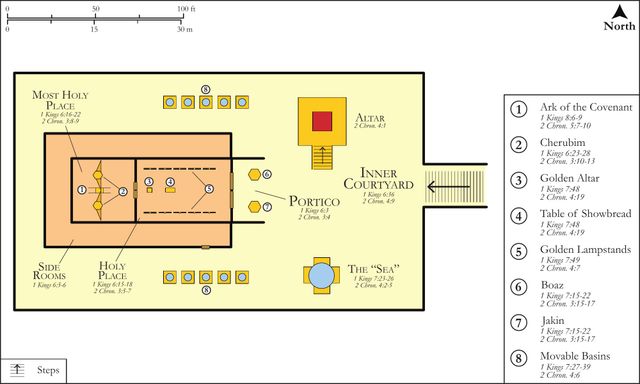
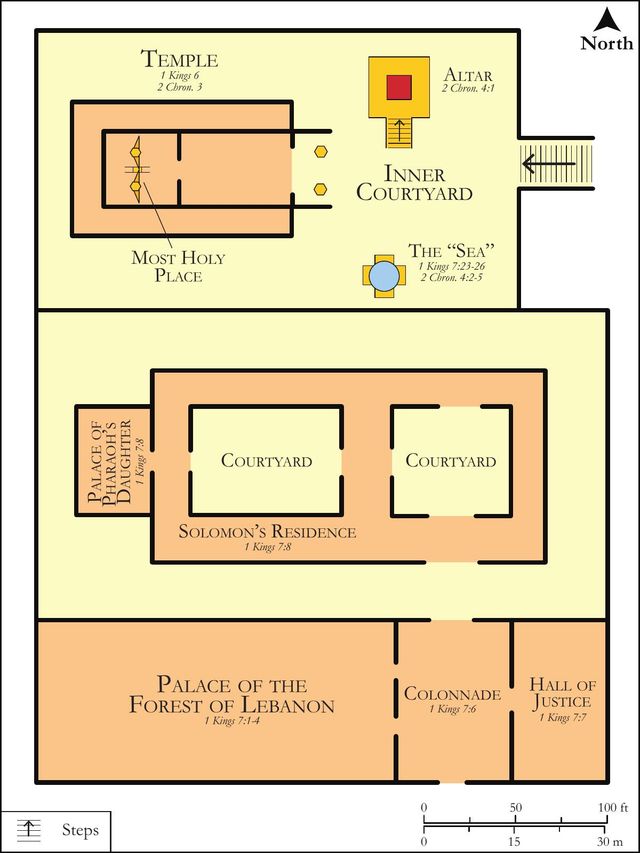
2.A brazen sea, a very large vessel, above five yards in diameter, and which contained above 500 barrels of water for the priests' use, in washing themselves and the sacrifices, and keeping the courts of the temple clean, Kg1 7:23, etc. It stood raised upon the figures of twelve oxen in brass, so high that either they must have stairs to climb up to it or cocks at the bottom to draw water from it. The Gibeonites, or Nethinim, who were to draw water for the house of God, had the care of filling it. Some think Solomon made the images of oxen to support this great cistern in contempt of the golden calf which Israel had worshipped, that (as bishop Patrick expresses it) the people might see there was nothing worthy of adoration in those figures; they were fitter to make posts of than to make gods of. Yet this prevailed not to prevent Jerusalem's setting up the calves for deities. In the court of the tabernacle there was only a laver of brass provided to wash in, but in the court of the temple a sea of brass, intimating that by the gospel of Christ much fuller preparation is made for our cleansing than was by the law of Moses. That had a laver, this has a sea, a fountain opened, Zac 13:1.
3.Ten bases, or stands, or settles, of brass, on which were put ten lavers, to be filled with water for the service of the temple, because there would not be room at the molten sea for all that had occasion to wash there. The bases on which the lavers were fixed are very largely described here, Kg1 7:27, etc. They were curiously adorned and set upon wheels, that the lavers might be removed as there was occasion; but ordinarily they stood in two rows, five on one side of the court and five on the other, Kg1 7:39. Each laver contained forty baths, that is, about ten barrels, Kg1 7:38. Those must be very clean that bear the vessels of the Lord. Spiritual priests and spiritual sacrifices must be washed in the laver of Christ's blood and of regeneration. We must wash often, for we daily contract pollution, must cleanse our hands and purify our hearts. Plentiful provision is made for our cleansing; so that if we have our lot for ever among the unclean it will be our own fault.
4.Besides these, there was a vast number of brass pots made to boil the flesh of the peace-offerings in, which the priests and offerers were to feast upon before the Lord (see Sa1 2:14); also shovels, wherewith they took out the ashes of the altar. Some think the word signifies flesh-hooks, with which they took meat out of the pot. The basins also were made of brass, to receive the blood of the sacrifices. These are put for all the utensils of the brazen altar, Exo 38:3. While they were about it they made abundance of them, that they might have a good stock by them when those that were first in use wore out and went to decay. Thus Solomon, having wherewithal to do so, provided for posterity.
Historical interpretation
Historical reception
1 surviving comment on this verse from the historical church.
“And a carved work under its brim surrounded it, encircling the sea for ten cubits. There were two rows cast of chamfered sculptures.” Since it has been said above that a line of thirty cubits encircled the sea and it is now added that this carved work under the brim went around it for ten cubits, it is obvious from both accounts that the vessel was bent backwards and spread out like a bowl, because from a circumference of thirty cubits, which it measured at the brim, it narrowed to ten cubits. The chamfered sculpture is one that represents some historical events. Hence also the chamfered sculptures surrounding the sea rightly denote examples of former times that we must judiciously ponder to see by what works the saints have pleased God from the beginning and with what obstinacy the reprobate persisted in crimes and with what wickedness they perished because of their crimes; how in the beginning of the nascent world Cain was condemned for the malice of envy and Abel crowned for the merit of his uprightness; how Lamech was cursed for his adultery and murder and Enoch brought back to paradise for the grace of his piety; how after the flood Ham was detested by his father for his lack of filial piety and the peoples of Shem and Japheth were granted a perpetual blessing for their reverential obedience; how Abraham was made the heir of the divine promise in recognition of his faith while the numerous other nations were left in their ancestral unbelief; how when the Lord came in the flesh, Judea was rejected for the offense of unbelief and the Gentiles brought back to salvation by the grace of faith, and other things of the kind in both Testaments, which, when judiciously and devoutly contemplated, are of great profit to all earnest-minded people. And that perhaps is the reason why two orders of chamfered sculptures were made in the bronze sea, namely, that those who were immersed in the font of baptism may listen carefully to the stories of both Testaments; and the reason why they were ten cubits in circumference was that they might strive to imitate whomsoever they perceived in these stories to have been committed to carrying out the heavenly commands and totally rapt in the pursuit of heavenly rewards.
Continue studying 1 Kings 7:24 across the web’s major study libraries — every link below opens this exact verse, chapter, or book on the destination site.
Read & Compare
 BibleGatewayThis verse in more than 200 translations and 70 languages.
 Bible.comThe YouVersion reader — hundreds of translations, reading plans, and highlights.
 ESV.orgCrossway's official English Standard Version reader.
 NET BibleThe NET translation with 60,000+ translators' notes on every rendering decision.
 STEP BibleTyndale House's free study tool — original text, vocabulary, and scholarly resources.
 BibliaLogos Bible Software's free web reader.
 USCCBThe New American Bible (Revised Edition) with the U.S. bishops' study notes.
Commentaries
 BibleHub CommentariesDozens of classic commentaries on this verse, gathered on one page.
 StudyLightMore than 100 commentary sets — the largest collection on the web.
 BibleRefPlain-English commentary on what this verse means, verse by verse.
 Enduring WordDavid Guzik's free commentary on this chapter, widely used by Bible teachers.
 Bible Study ToolsVerse commentary alongside Greek and Hebrew study aids.
Original Language & Research
- BibleHub InterlinearThe verse word by word — original language, transliteration, and English.
- BibleHub LexiconEvery word's original-language definition and Strong's entry.
 Blue Letter BibleDeep-study tools — Strong's numbers, concordance, and word studies.
 SefariaThe Hebrew text with Rashi and centuries of Jewish commentary.
Sermons, Hymns & Audio


TrulyRandomVerse is not affiliated with these sites and doesn’t control their content. They’re linked because they’re genuinely useful.
Summary
First Kings 7:24 offers a meticulous description of the ornamental "knops" adorning the brim of the Molten Sea, a monumental bronze basin in Solomon's Temple. This verse precisely details their arrangement—ten per cubit, cast in two rows—underscoring the extraordinary craftsmanship and the profound attention to aesthetic and structural detail that characterized the construction of this sacred edifice. It highlights how even the decorative elements were integral to the Temple's grandeur, reflecting the divine call for excellence in all aspects of worship and the sacred space dedicated to God.
Context
ShowHideLiterary Context
This verse is intricately woven into the broader narrative of 1 Kings 6-7, which provides a comprehensive account of the construction of Solomon's Temple and its elaborate furnishings. Following the detailed architectural blueprint and construction of the Temple structure itself in 1 Kings 6, chapter 7 shifts focus to the magnificent bronze work crafted by Hiram of Tyre, a master artisan. Specifically, 1 Kings 7:23 introduces the Molten Sea, describing its immense size, circular shape, and its foundation upon twelve bronze oxen. Verse 24 then zooms in with remarkable precision on the decorative elements, providing exact measurements and the arrangement of the "knops" that adorned its brim. This granular level of detail emphasizes the meticulous nature of the entire construction process, reflecting the divine blueprint given to David and passed to Solomon, ensuring that every component, no matter how small, was fashioned with precision and artistry for God's dwelling place. The transition from grand architectural statements to minute decorative particulars showcases the holistic pursuit of perfection in the Temple's design.
Historical & Cultural Context
The construction of Solomon's Temple, including the monumental Molten Sea, represents a zenith of Israelite architecture and metallurgy. Bronze work was a highly specialized and valued craft, requiring significant skill in smelting, casting, and finishing large-scale objects. The explicit mention of Hiram of Tyre, a master craftsman from a region renowned for its artisans and technological prowess (2 Samuel 5:11), underscores the international collaboration and the high caliber of expertise employed. Large bronze castings like the Molten Sea were monumental undertakings, demonstrating the immense wealth, organizational capacity, and technological sophistication of Solomon's kingdom. The use of natural motifs like "knops" (gourds or buds) followed the tabernacle's candlestick, with its knops and flowers, and often symbolized fertility, life, or abundance. Their integration into sacred architecture, alongside cherubim and palm trees (as seen in 1 Kings 6:29), reflects a deep reverence for God's creation and its inherent beauty. The Molten Sea itself served a crucial practical purpose for priestly ablutions, emphasizing the cultural and religious importance of ritual purity in approaching the divine, a concept central to Israelite worship.
Key Themes
ShowHideFirst Kings 7:24 contributes to several overarching themes within the book and the broader biblical narrative. Firstly, it powerfully illustrates Exquisite Craftsmanship and Excellence, demonstrating that God's dwelling place was to be adorned with the finest materials and most meticulous artistry, reflecting His glory and worthiness of the absolute best. The precise measurements ("ten in a cubit") and the casting "in two rows" speak to a deliberate pursuit of perfection in every detail. Secondly, the verse subtly reinforces the theme of Divine Ordination and Design. While Hiram executed the work, the overall design of the Temple and its furnishings was not arbitrary but divinely inspired, passed down through generations, as evidenced by the detailed instructions for the Tabernacle (e.g., Exodus 25:9). This suggests that even the decorative elements were part of a larger, sacred schema intended to glorify God. Lastly, although focused on decoration, the Molten Sea's primary function for Ritual Purity is implicitly underscored. The beauty and grandeur of the basin would have emphasized the sacredness and importance of the cleansing it facilitated, a concept central to Old Testament worship and a foreshadowing of the deeper spiritual purity required to approach God, as explored in passages like Psalm 24:3-4.
Exposition and Analysis
ShowHideKey Word Analysis
ShowHideFrom an unused root meaning "to burst," this term refers to an architectural ornament resembling a semi-globe, often interpreted as gourds or wild cucumbers. Such natural motifs, like the knops of the tabernacle's candlestick, frequently symbolized fertility, life, or abundance. Their application to the Molten Sea suggests a connection to natural forms, perhaps signifying the life-giving nature of God's presence or the flourishing of His people. The detailed description of their arrangement ("ten in a cubit," "in two rows") indicates that these were not random embellishments but part of a meticulously planned, symmetrical, and aesthetically pleasing design, contributing to the overall grandeur and sacred beauty of the Temple.
This was a standard unit of measurement in Israel, typically derived from the length of the forearm, approximately 18-21 inches (45-53 cm). The specification "ten in a cubit" highlights the precise and uniform spacing of the knops, demonstrating the meticulous attention to detail and the high level of engineering and artistic skill involved in the Temple's construction. This precision underscores the value placed on order, exactness, and divine standards within the sacred space, reflecting the character of God Himself.
A primitive root meaning "to pour out," and by implication, "to melt or cast as metal." The verse states the knops "were cast in two rows, when it was cast" (using the related passive participle yᵉtsuqâh, H3333). This indicates that the knops were not merely affixed to the Molten Sea after its primary casting but were an integral part of the original molten process. This detail speaks volumes about the advanced metallurgical techniques employed by Hiram and his team, highlighting the seamless integration of decoration and structure, and emphasizing the deliberate, high-quality, and unified creation of the entire sacred vessel.
Verse Breakdown
ShowHide"And under the brim of it round about [there were] knops compassing it"
This initial clause immediately establishes the location and general nature of the ornamentation. The "brim" or "lip" of the colossal Molten Sea was adorned with distinctive decorative elements called "knops," which encircled the entire basin. This sets the visual scene, drawing attention to the intricate details beneath the main edge of the vessel.
"ten in a cubit, compassing the sea round about"
This phrase provides the specific density and arrangement of the knops. For every cubit of the brim's circumference, there were precisely ten knops. The repetition of "compassing the sea round about" (from the previous clause and implied here) emphasizes the continuous, unbroken decorative band, highlighting the meticulous and comprehensive nature of the design, ensuring uniformity and aesthetic perfection throughout.
"the knops [were] cast in two rows, when it was cast"
This final and crucial phrase reveals the method of creation and the specific layered arrangement of the knops. They were not merely attached post-production but were an inherent part of the original casting process, indicating a sophisticated level of metallurgical skill and foresight. Furthermore, their arrangement in "two rows" suggests a layered or multi-dimensional aesthetic, adding depth, texture, and richness to the visual appeal of the Molten Sea, making its beauty even more profound and intentional.
Literary Devices
ShowHideThe verse employs several literary devices to convey its message of meticulous craftsmanship and divine order. Precision and Detailing are paramount, as the text provides exact measurements ("ten in a cubit") and specific arrangements ("in two rows"), immersing the reader in the extraordinary craftsmanship. Repetition is also evident in the phrase "compassing... round about," which appears twice (once explicitly, once implied by context), emphasizing the circular, continuous nature of the ornamentation and the thoroughness of the design. The repeated mention of "knops" and "cast" further reinforces the focus on these specific decorative elements and their integrated creation. While not a direct metaphor, the Molten Sea itself can be seen as a Symbol of purification and the sacred space, and the knops, by extension, contribute to this symbolism by adding to its grandeur and sacred beauty. The detailed description serves to impress upon the reader the magnificence and divine worthiness of the Temple and its furnishings, reflecting the character of the God who commanded its construction.
Theological and Thematic Connections
ShowHideThe meticulous detail given to the Molten Sea's ornamentation in 1 Kings 7:24 speaks volumes about God's value for excellence, beauty, and order in worship. It demonstrates that sacred spaces and objects were not merely functional but were to reflect the glory and majesty of the God they served, crafted with the highest skill and attention to detail. This principle extends beyond physical structures, inviting believers to offer their "best" in all aspects of their lives and worship, recognizing that God is worthy of nothing less than our wholehearted devotion and the finest expression of our gifts. The beauty of the Molten Sea, though decorative, contributed to the reverence and awe associated with the acts of purification performed there, underscoring the seriousness and sanctity of approaching a holy God. It teaches us that even the "small" details in our service to God matter, contributing to the overall beauty and integrity of our offering.
Reflection and Application
ShowHideThe meticulous detail given to the "knops" on the Molten Sea, seemingly a minor decorative element, offers profound insights for contemporary believers. It reminds us that God is a God of detail, beauty, and excellence, who delights in the finest expressions of human skill offered in His service. This challenges us to consider the quality of our own offerings—whether in worship, service, or daily life. Are we content with mediocrity, or do we strive for excellence, recognizing that our work, when done unto the Lord, is an act of worship? Furthermore, the Molten Sea's primary function for purification, adorned with such beauty, speaks to the profound truth that holiness is not merely functional but is also beautiful and glorious in God's eyes. Our pursuit of purity, facilitated by Christ, should be marked by intentionality and a desire to reflect the beauty of His character. This verse encourages us to cultivate a life that is both functionally righteous and aesthetically pleasing to God, characterized by integrity, diligence, and a heart devoted to His glory in every small detail, understanding that our entire being is an offering to Him.
Questions for Reflection
ShowHideFAQ
ShowHideWhat are "knops" and what is their significance in this context?
ShowHideThe "knops" (Hebrew: peqa'im) mentioned in 1 Kings 7:24 are ornamental gourds or buds. These natural forms, like the knops of the tabernacle's candlestick, were decorative motifs often symbolizing life, growth, or abundance. Their inclusion on the Molten Sea, a sacred vessel, indicates that even the decorative elements of the Temple were carefully chosen to contribute to its overall beauty and symbolic richness. Their precise arrangement ("ten in a cubit," "in two rows") highlights the meticulous craftsmanship and the high value placed on aesthetic detail in the construction of God's dwelling place. They were not merely functional but added to the grandeur and sacred artistry of the Molten Sea, underscoring that God deserves the highest quality and beauty in His worship.
What was the primary purpose of the Molten Sea in Solomon's Temple?
ShowHideThe Molten Sea, described in 1 Kings 7:23-26 and 2 Chronicles 4:2-5, was a massive bronze basin primarily used by the priests for ritual ablutions. Before ministering in the Temple or offering sacrifices, priests would wash their hands and feet in its waters to purify themselves, symbolizing the necessity of holiness and cleanliness when approaching a holy God. It also served for washing the implements used in Temple service. Its immense size and prominent placement underscored the paramount importance of purity in Israelite worship, a theme central to the Old Testament sacrificial system and the entire Mosaic Law, as seen in passages like Leviticus 16:4.
Christ-Centered Fulfillment
ShowHideThe Molten Sea, with its intricate knops and primary function of purification, finds its ultimate and perfect fulfillment in Jesus Christ. The detailed craftsmanship and inherent beauty of the Molten Sea, meticulously designed for ritual cleansing, foreshadow the perfect and complete purification offered through the Lamb of God, who takes away the sin of the world. While the Molten Sea provided external washing for priests, Christ's singular sacrifice provides internal, spiritual cleansing for all who believe, making them truly fit to approach a holy God. As Hebrews 9:14 powerfully declares, "How much more shall the blood of Christ, who through the eternal Spirit offered himself without spot to God, purge your conscience from dead works to serve the living God?" The entire Temple, with all its magnificent details and sacred furnishings, pointed to Christ as the true and ultimate Temple, the very dwelling place of God among humanity (John 2:19-21). The "knops" and other precise decorations, reflecting God's demand for excellence and beauty in His dwelling, ultimately find their perfect expression in the flawless character, perfect life, and complete atoning work of Christ, who is the radiance of God's glory and the exact representation of His being. Through Him, we are not merely cleansed but are made part of a spiritual temple, built together as a dwelling place for God by the Spirit.