


1 Kings 6:18
- וְאֶרֶזve·'E·rezand cedarH730Conj-w ¦ N-msNoun Singular Masculine Absoluteוְandאֶרֶזcedar
- אֶל'el[was] toH413PrepPreposition
- הַבַּיִתha·Ba·yitthe houseH1004Art ¦ N-msNoun Singular Masculine Absoluteהַtheבַּיִתhouse
- פְּנִימָהpe·Ni·mahwithinH6441AdvAdverb
- מִקְלַעַתmik·La·'atcarving ofH4734N-fscNoun Singular Feminine Construct
- פְּקָעִיםpe·ka·'ImgourdsH6497N-mpNoun Plural Masculine Absolute
- וּפְטוּרֵיu·fe·tu·Reiand spread out [things] ofH6362Conj-w ¦ V-Qal-PassPrtcpl-mpVerb Qal Participle Passive Plural Masculine Constructוּandפְטוּרֵיspread out [things] of
- צִצִּיםtzi·TzimflowersH6731N-mpNoun Plural Masculine Absolute
- הַכֹּלha·Kol<the> everythingH3605Art ¦ N-msNoun Singular Masculine Absoluteהַ<the>כֹּלeverything
- אֶרֶז'E·rez[was] cedarH730N-msNoun Singular Masculine Absolute
- אֵין'einnotH369N-mscNoun Singular Masculine Construct
- אֶבֶן'E·venstoneH68N-fsNoun Singular Feminine Absolute
- נִרְאָהnir·'Ah[was] visibleH7200V-Niphal-Perf-3msVerb Niphal Perfect 3rd Singular Masculine
English is a literal word-by-word gloss of the Hebrew, not the KJV's wording. Why?
This is the original text the KJV's translators worked from — each Hebrew word with its own literal English meaning in this verse, prepared by scholars at Tyndale House, Cambridge. The KJV translates whole sentences, not word by word, so its wording differs: one Hebrew word can become several English words, and the KJV may choose “the LORD” where the gloss reads “Yahweh”. Both are faithful — they answer different questions. For the KJV's own rendering, switch to the KJV text.
Details
See on the biblical-era map
Study this verse
Public-domain commentary
Matthew Henry
From his Commentary on the Whole Bible. Henry comments on passages, not single verses — this entry covers 1 Kings 6:15–38. His three-level outline is real structure in the source text, so it is rendered as structure.
Here, I. We have a particular account of the details of the building.
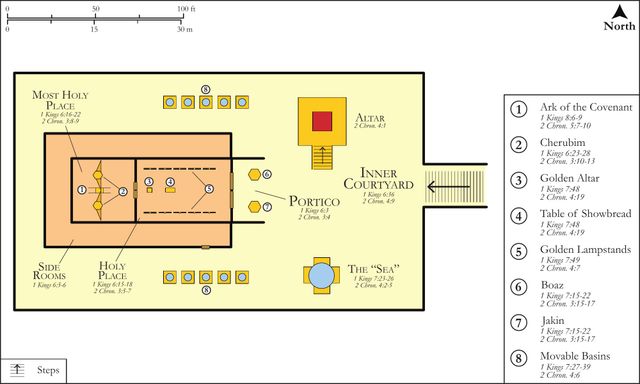
1.The wainscot of the temple. It was of cedar (Kg1 6:15), which was strong and durable, and of a very sweet smell. The wainscot was curiously carved with knops (like eggs or apples) and flowers, no doubt as the fashion then was, Kg1 6:18.
2.The gilding. It was not like ours, washed over, but the whole house, all the inside of the temple (Kg1 6:22), even the floor (Kg1 6:30), he overlaid with gold, and the most holy place with pure gold, Kg1 6:21. Solomon would spare no expense necessary to make it every way sumptuous. Gold was under foot there, as it should be in all the living temples: the abundance of it lessened its worth.
3.The oracle, or speaking-place (for so the word signifies), the holy of holies, so called because thence God spoke to Moses, and perhaps to the high priest, when he consulted with the breast-plate of judgment. In this place the ark of the covenant was to be set, Kg1 6:19. Solomon made every thing new, and more magnificent than it had been, except the ark, which was still the same that Moses made, with its mercy-seat and cherubim; that was the token of God's presence, which is always the same with his people whether they meet in tent or temple, and changes not with their condition.
4.The cherubim. Besides those at the ends of the mercy-seat, which covered the ark,
(1.)Solomon set up two more, very large ones, images of young men (as some think), with wings made of olive-wood, and all overlaid with gold, Kg1 6:23, etc. This most holy place was much larger than that in the tabernacle, and therefore the ark would have seemed lost in it, and the dead wall would have been unsightly, if it had not been thus adorned.
(2.)He carved cherubim upon all the walls of the house, Kg1 6:29. The heathen set up images of their gods and worshipped them; but these were designed to represent the servants and attendants of the God of Israel, the holy angels, not to be themselves worshipped (see thou do it not), but to show how great he is whom we are to worship.
5.The doors. The folding doors that led into the oracle were but a fifth part of the wall (Kg1 6:31), those into the temple were a fourth part (Kg1 6:33); but both were beautified with cherubim engraven on them, Kg1 6:32, Kg1 6:35.
6.The inner court, in which the brazen altar was at which the priests ministered. This was separated from the court where the people were by a low wall, three rows of hewn stone tipped with a cornice of cedar (Kg1 6:36), that over it the people might see what was done and hear what the priests said to them; for, even under that dispensation, they were not kept wholly either in the dark or at a distance.
7.The time spent in this building. It was but seven years and a half from the founding to the finishing of it, Kg1 6:38. Considering the vastness and elegance of the building, and the many appurtenances to it which were necessary to fit it for use, it was soon done. Solomon was in earnest in it, had money enough, had nothing to divert him from it, and many hands made quick work. He finished it (as the margin reads it) with all the appurtenances thereof, and with all the ordinances thereof, not only built the place, but set forward the work for which it was built.
II.Let us now see what was typified by this temple.
1.Christ is the true temple; he himself spoke of the temple of his body, Joh 2:21. God himself prepared him his body, Heb 10:5. In him dwelt the fulness of the Godhead, as the Shechinah in the temple. In him meet all God's spiritual Israel. Through him we have access with confidence to God. All the angels of God, those blessed cherubim, have a charge to worship him.
2.Every believer is a living temple, in whom the Spirit of God dwells, Co1 3:16. Even the body is such by virtue of its union with the soul, Co1 6:19. We are not only wonderfully made by the divine providence, but more wonderfully made anew by the divine grace. This living temple is built upon Christ as its foundation and will be perfected in due time.
3.The gospel church is the mystical temple; it grows to a holy temple in the Lord (Eph 2:21), enriched and beautified with the gifts and graces of the Spirit, as Solomon's temple with gold and precious stones. Only Jews built the tabernacle, but Gentiles joined with them in building the temple. Even strangers and foreigners are built up a habitation of God, Eph 2:19, Eph 2:22. The temple was divided into the holy place and the most holy, the courts of it into the outer and inner; so there are the visible and the invisible church. The door into the temple was wider than that into the oracle. Many enter into profession that come short of salvation. This temple is built firm, upon a rock, not to be taken down as the tabernacle of the Old Testament was. The temple was long in preparing, but was built at last. The top-stone of the gospel church will, at length, be brought forth with shoutings, and it is a pity that there should be the clashing of axes and hammers in the building of it. Angels are ministering spirits, attending the church on all sides and all the members of it.
4.Heaven is the everlasting temple. There the church will be fixed, and no longer movable. The streets of the new Jerusalem, in allusion to the flooring of the temple, are said to be of pure gold, Rev 21:21. The cherubim there always attend the throne of glory. The temple was uniform, and in heaven there is the perfection of beauty and harmony. In Solomon's temple there was no noise of axes and hammers. Every thing is quiet and serene in heaven; all that shall be stones in that building must in the present sate of probation and preparation be fitted and made ready for it, must be hewn and squared by divine grace, and so made meet for a place there.
Historical interpretation
Historical reception
1 surviving comment on this verse from the historical church.
We have said of cedarwood that it betokened the unsurpassable beauty of the virtues. Now the entire house is covered inside with this wood when the hearts of the righteous begin to shine with nothing but the love of good works, and the house has its turnings made of cedar boards and its joints skillfully wrought when these elect are joined to each other by the most beautiful bond of charity so that, though the multitude of the faithful is innumerable, they can nevertheless, with good reason, be said to have one heart and one soul on account of the community of the faith and love they share. For the turnings that were attached to the joints of the planks in order that they might all make one partition are the very services of charity by which the holy brotherhood is bound together and formed into one house of Christ all over the world. Moreover, this house has carvings standing in relief when, far from covering and hiding their works of virtue, the saints, by a clear outward expression, show forth to all, as an example for living, what they themselves are like and what they do, as did the apostle Paul who not only by preaching Christ to the Gentiles and by personally suffering for Christ showed how outstanding he was, but also in his letters addressed to the churches declared how many perils he underwent for Christ and by what great revelations he was raised aloft in a blessed glorification. And when he said to his listeners without any hesitation, “Be imitators of me, just as I am of Christ,” what did he show them but the carvings standing in relief in the house of the Lord, which by the exceptional eminence of his virtue showed itself to be within the power of all to imitate?
Continue studying 1 Kings 6:18 across the web’s major study libraries — every link below opens this exact verse, chapter, or book on the destination site.
Read & Compare
 BibleGatewayThis verse in more than 200 translations and 70 languages.
 Bible.comThe YouVersion reader — hundreds of translations, reading plans, and highlights.
 ESV.orgCrossway's official English Standard Version reader.
 NET BibleThe NET translation with 60,000+ translators' notes on every rendering decision.
 STEP BibleTyndale House's free study tool — original text, vocabulary, and scholarly resources.
 BibliaLogos Bible Software's free web reader.
 USCCBThe New American Bible (Revised Edition) with the U.S. bishops' study notes.
Commentaries
 BibleHub CommentariesDozens of classic commentaries on this verse, gathered on one page.
 StudyLightMore than 100 commentary sets — the largest collection on the web.
 BibleRefPlain-English commentary on what this verse means, verse by verse.
 Enduring WordDavid Guzik's free commentary on this chapter, widely used by Bible teachers.
 Bible Study ToolsVerse commentary alongside Greek and Hebrew study aids.
Original Language & Research
- BibleHub InterlinearThe verse word by word — original language, transliteration, and English.
- BibleHub LexiconEvery word's original-language definition and Strong's entry.
 Blue Letter BibleDeep-study tools — Strong's numbers, concordance, and word studies.
 SefariaThe Hebrew text with Rashi and centuries of Jewish commentary.
Sermons, Hymns & Audio


TrulyRandomVerse is not affiliated with these sites and doesn’t control their content. They’re linked because they’re genuinely useful.
Summary
1 Kings 6:18 offers a meticulous description of the interior of Solomon's Temple, emphasizing the lavish and comprehensive use of cedar wood. This verse details how the entire inner sanctuary was intricately carved with decorative "knops and open flowers," executed with such thoroughness that the underlying stone structure was completely concealed. This powerful depiction conveys the unparalleled dedication, immense resources, and profound artistry invested in constructing a dwelling place for God that was not only structurally sound but also aesthetically perfect, symbolizing the Israelites' deep reverence and their commitment to honoring the Divine with the absolute finest materials and craftsmanship.
Context
ShowHideLiterary Context
This verse is situated within the extensive narrative of the Temple's construction, primarily detailed in 1 Kings chapters 5-8. Following the initial preparations for the building and the laying of its foundation, 1 Kings 6 shifts its focus to the architectural structure and, more specifically, the exquisite interior finishing. Verse 18 provides a crucial detail about the ornate decoration of the inner sanctuary, encompassing both the Holy Place and the Most Holy Place, which were the focal points of divine presence. It follows the unique description of the Temple's construction method, where all stones were prepared off-site, ensuring that "no hammer, nor axe, nor any tool of iron was heard in the house, while it was in building" (1 Kings 6:7). Thus, verse 18 emphasizes the final, perfected state of the interior, where the rough-hewn, silent stone was completely covered and transformed by refined, beautiful materials, creating a seamless and awe-inspiring sacred space.
Historical & Cultural Context
Solomon's Temple represented the zenith of Israelite national identity and religious devotion during his prosperous reign (c. 970-931 BC), fulfilling a long-held desire to establish a permanent dwelling for God's presence, replacing the portable Tabernacle. The extensive use of cedar, specifically "cedar of Lebanon," was a powerful symbol of immense wealth, luxury, and durability in the ancient Near East. This highly prized, aromatic wood was imported from Phoenicia (modern-day Lebanon) through elaborate trade agreements that Solomon forged with King Hiram of Tyre (1 Kings 5:1-12). The intricate carvings of "knops and open flowers" were common decorative motifs in ancient Near Eastern sacred architecture, frequently symbolizing life, fertility, creation, and divine blessing, reflecting a shared artistic vocabulary across the region. The sheer scale, opulence, and meticulous detail underscored the Temple's significance as the central place of worship and the tangible seat of God's presence among His people.
Key Themes
ShowHideThe meticulous description in 1 Kings 6:18 powerfully contributes to several overarching themes within the book of Kings and the broader biblical narrative. Firstly, it highlights Opulence and Unreserved Dedication to God, demonstrating Israel's commitment to offering their very best in worship and service. The phrase "all was cedar; there was no stone seen" underscores the extraordinary expense and effort, symbolizing profound reverence and a desire to honor God with ultimate beauty. Secondly, the verse emphasizes Intricate Craftsmanship and Aesthetic Perfection, showcasing the highest level of artistic skill employed in God's dwelling. This attention to beauty reflected the theological conviction that God deserved a sanctuary that was not only structurally sound but also visually magnificent and flawless. Thirdly, it speaks to the theme of God's Dwelling Place and Immanence, as the Temple was designed to house the Ark of the Covenant and serve as the locus of divine presence, where the "glory of the Lord filled the house" upon its completion (1 Kings 8:10-11). The transformation of raw stone into a seamless, beautiful cedar interior can also subtly foreshadow the transformative power of God's presence, which beautifies and perfects.
Exposition and Analysis
ShowHideKey Word Analysis
ShowHideThis term denotes a dwelling place in its broadest sense, encompassing a physical structure, family, or even a palace or temple. In 1 Kings 6:18, it specifically refers to the sacred edifice of the Temple, emphasizing its primary function as God's designated dwelling place among His people. The use of "house within" (H6441, pᵉnîymâh) further specifies the inner sanctuary, highlighting its sacred and exclusive nature.
This word refers to a sculpture, likely in bas-relief, indicating intricate and skilled artistic work. The presence of "carved" designs signifies the deliberate and painstaking effort involved in adorning the Temple's interior. It speaks to a high level of craftsmanship, where the raw material of cedar was transformed into detailed, meaningful artwork, elevating the aesthetic and symbolic value of the sanctuary.
This architectural term refers to a semi-globe or a rounded, swelling ornament. In the context of the Temple's carvings, these were likely bulbous, fruit-like designs, possibly resembling pomegranates or gourds. These motifs, along with "open flowers," were common in ancient Near Eastern sacred art and often symbolized fruitfulness, abundance, life, and divine blessing, visually enriching the sacred space with natural imagery.
This phrase combines H6362 (pâṭar, "to cleave or burst through, to emit") and H6731 (tsîyts, "a flower, blossom"). Together, they describe fully bloomed or blossoming flowers that have "burst forth." These were likely stylized representations of natural flora, such as lilies or palm tree motifs, conveying beauty, growth, and the flourishing of life. Their presence alongside "knops" created a vibrant, organic aesthetic that connected the divine dwelling with the beauty and vitality of God's creation.
Verse Breakdown
ShowHide"And the cedar of the house within [was] carved"
This initial clause establishes the primary material used for the Temple's interior—cedar—and the method of its adornment—carving. "The house within" specifically refers to the inner chambers of the Temple, namely the Holy Place and the Most Holy Place, underscoring that the most sacred areas received this lavish treatment. The act of carving implies meticulous, skilled craftsmanship, transforming raw wood into intricate, deliberate artistry.
"with knops and open flowers"
This specifies the particular decorative motifs applied to the cedar. "Knops" (bulbous, fruit-like forms) and "open flowers" (fully bloomed blossoms) represent natural, organic designs. These were not merely superficial decorations but likely carried profound symbolic weight, evoking themes of life, growth, beauty, and the abundance of God's creation, bringing the vibrancy and fertility of the natural world into the sacred space.
"all [was] cedar; there was no stone seen"
This powerful concluding statement emphasizes the complete and seamless covering of the interior. Despite the underlying structure being meticulously prepared stone (as noted in 1 Kings 6:7), it was entirely concealed by the cedar paneling and carvings. This detail highlights the extraordinary opulence and the desire for aesthetic perfection, creating a unified, warm, and visually stunning environment that transcended the raw materials, presenting a finished product of unparalleled beauty, dedication, and sacredness.
Literary Devices
ShowHideThe description in 1 Kings 6:18 employs several potent literary devices to convey its profound message. Imagery is paramount, as the verse paints a vivid sensory picture of the Temple's interior, allowing the reader to visualize the rich, aromatic cedar and the intricate "knops and open flowers." This detailed sensory description emphasizes the beauty, grandeur, and sacredness of the sanctuary. The phrase "all was cedar; there was no stone seen" functions as a form of Hyperbole, an intentional exaggeration used for emphatic effect. While the underlying structure was indeed stone, the statement underscores the overwhelming and complete presence of cedar, conveying a sense of seamless luxury, total transformation, and absolute dedication. This hyperbole also contributes to the rich Symbolism embedded within the verse. The cedar itself symbolizes durability, royalty, and sacredness, while the natural motifs of "knops and open flowers" symbolize life, growth, fertility, and divine beauty, connecting the created world with the Creator's dwelling. Furthermore, the complete covering of the rough, unhewn stone by the refined, beautiful cedar can be seen as a subtle Metaphor for spiritual transformation, where the ordinary, raw, or unrefined is made beautiful, perfect, and sacred by divine purpose and presence.
Theological and Thematic Connections
ShowHideThe meticulous detail and lavish materials described in 1 Kings 6:18 serve as a profound theological statement about the nature of God and humanity's response to Him. The Temple's unparalleled beauty and costliness were a testament to God's supreme worthiness of the absolute best, reflecting a theology where the physical dwelling place of God was to be a microcosm of heavenly perfection and glory, inspiring awe and reverence. This dedication of the finest resources for God's house foreshadows the ultimate offering of Christ, who perfectly embodies divine glory and beauty. While the New Covenant shifts from a physical temple to a spiritual one, the principle of giving our best, striving for excellence, and dedicating our lives as living sacrifices remains central, as our bodies become temples of the Holy Spirit.
Reflection and Application
ShowHideThe description of Solomon's Temple in 1 Kings 6:18 offers timeless lessons for contemporary believers, challenging us to consider the quality and intentionality of our own offerings to God. The Israelites spared no expense, dedicating the most precious materials and skilled craftsmanship to God's dwelling. This prompts us to examine whether we are giving God our "cedar"—our finest time, talents, and resources—or merely our "stone"—our leftovers or minimal effort. The emphasis on beauty and perfection in the Temple's design also reminds us that excellence in worship, whether expressed through music, art, service, or personal conduct, can profoundly enhance our reverence and draw us into deeper communion with God. Furthermore, just as the rough stone was completely covered and transformed by the beautiful cedar, so too can God's presence and grace transform our lives, making something beautiful and sacred out of what might otherwise seem ordinary or unrefined. This transformation is not merely superficial but indicative of a deep, inner work that covers our imperfections and makes us fit dwelling places for His Spirit, reflecting His glory to the world.
Questions for Reflection
ShowHideFAQ
ShowHideWhy was so much cedar used in the Temple, and what was the significance of the "no stone seen" detail?
ShowHideThe extensive use of cedar in Solomon's Temple, particularly cedar of Lebanon, was highly significant for several reasons. Cedar (H730, ʼerez) was an exceptionally valuable, durable, and aromatic wood, symbolizing wealth, prestige, and longevity in the ancient world. Its import from Phoenicia, facilitated by King Hiram of Tyre (1 Kings 5:1-12), underscored the immense resources and international cooperation dedicated to God's house. The detail "no stone seen" (H68, ʼeben; H7200, râʼâh) emphasizes the complete covering of the underlying stone structure with this precious wood. This served multiple purposes: it created a seamless, aesthetically perfect, and luxurious interior, reflecting the highest honor given to God. It also symbolically transformed the raw, earthly materials into something refined and sacred, perhaps alluding to the spiritual transformation that occurs in God's presence. Furthermore, it subtly connects to 1 Kings 6:7, where stones were prepared off-site to ensure silence during construction; the cedar then provided the final, beautiful, and quiet finish, creating an atmosphere of profound reverence.
What is the symbolic meaning of the "knops and open flowers" carved into the cedar?
ShowHideThe "knops" (H6497, peqaʻ) and "open flowers" (H6362, pâṭar; H6731, tsîyts) carved into the cedar were not merely decorative but carried rich symbolic meaning, common in ancient Near Eastern sacred architecture. "Knops," often interpreted as gourds or buds, represented fruitfulness, abundance, and the promise of life. "Open flowers," likely stylized lilies or palm tree motifs, symbolized beauty, growth, flourishing, and the vibrant life of creation. Together, these natural designs imbued the sacred space with a sense of vitality and divine blessing. They connected the Temple, as a dwelling place for God, to the broader themes of God's creative power and His desire for His people to thrive and bear fruit, making the interior a visual testament to life and beauty in God's presence, reflecting the glory of the Creator.
Christ-Centered Fulfillment
ShowHideThe exquisite beauty and meticulous craftsmanship of Solomon's Temple, particularly the seamless cedar interior described in 1 Kings 6:18, finds its ultimate fulfillment in Jesus Christ. The physical Temple, though magnificent, was but a shadow and a type of the true dwelling place of God. Christ Himself is the ultimate Temple, the perfect embodiment of God's presence among humanity, where the "Word became flesh and dwelt among us, and we have seen his glory" (John 1:14). Just as the Temple's interior was completely covered in precious cedar, hiding the rough stone, so too does Christ's perfection and atoning sacrifice entirely cover our imperfections and sin, making us beautiful and acceptable in God's sight. He is the flawless "Lamb of God, who takes away the sin of the world!" (John 1:29) whose righteousness is graciously imputed to us. Furthermore, the Temple's role as a place where God's glory dwelt is supremely fulfilled in Christ, who declared, "Destroy this temple, and in three days I will raise it up" (John 2:19), speaking of His own resurrected body. Through Christ, believers are transformed from "rough stone" into living stones, becoming part of a spiritual house (1 Peter 2:5), indwelt by the Holy Spirit, thus becoming the new "temple of God" (1 Corinthians 3:16). The ultimate vision of the New Jerusalem in Revelation reveals that there will be no need for a physical temple, "for its temple is the Lord God the Almighty and the Lamb" (Revelation 21:22), signifying that the direct, unmediated, and perfect presence of God in Christ is the eternal reality.