


1 Kings 6:17
- וְאַרְבָּעִיםve·'ar·ba·'Imand fortyH705Conj-w ¦ N-mpNoun Plural Masculine Absoluteוְandאַרְבָּעִיםforty
- בָּאַמָּהba·'a·Mahby the cubitH520Prep-b ¦ N-fsNoun Singular Feminine Absoluteבָּby theאַמָּהcubit
- הָיָהha·Yahit wasH1961V-Qal-Perf-3msVerb Qal Perfect 3rd Singular Masculine
- הַבָּיִתha·Ba·yitthe houseH1004Art ¦ N-msNoun Singular Masculine Absoluteהַtheבָּיִתhouse
- הוּאhu'thatH1931Pro-3msPronoun Personal 3rd Singular Masculine
- הַהֵיכָלha·hei·Khal[is] the templeH1964Art ¦ N-msNoun Singular Masculine Absoluteהַ[is] theהֵיכָלtemple
- לִפְנָיlif·Nai<to> before meH6440Prep-l ¦ N-mpc ¦ 1csNoun Plural Masculine Constructלִ<to>פְנָbeforeיme
English is a literal word-by-word gloss of the Hebrew, not the KJV's wording. Why?
This is the original text the KJV's translators worked from — each Hebrew word with its own literal English meaning in this verse, prepared by scholars at Tyndale House, Cambridge. The KJV translates whole sentences, not word by word, so its wording differs: one Hebrew word can become several English words, and the KJV may choose “the LORD” where the gloss reads “Yahweh”. Both are faithful — they answer different questions. For the KJV's own rendering, switch to the KJV text.
Details
See on the biblical-era map

Study this verse
Public-domain commentary
Matthew Henry
From his Commentary on the Whole Bible. Henry comments on passages, not single verses — this entry covers 1 Kings 6:15–38. His three-level outline is real structure in the source text, so it is rendered as structure.
Here, I. We have a particular account of the details of the building.
1.The wainscot of the temple. It was of cedar (Kg1 6:15), which was strong and durable, and of a very sweet smell. The wainscot was curiously carved with knops (like eggs or apples) and flowers, no doubt as the fashion then was, Kg1 6:18.
2.The gilding. It was not like ours, washed over, but the whole house, all the inside of the temple (Kg1 6:22), even the floor (Kg1 6:30), he overlaid with gold, and the most holy place with pure gold, Kg1 6:21. Solomon would spare no expense necessary to make it every way sumptuous. Gold was under foot there, as it should be in all the living temples: the abundance of it lessened its worth.
3.The oracle, or speaking-place (for so the word signifies), the holy of holies, so called because thence God spoke to Moses, and perhaps to the high priest, when he consulted with the breast-plate of judgment. In this place the ark of the covenant was to be set, Kg1 6:19. Solomon made every thing new, and more magnificent than it had been, except the ark, which was still the same that Moses made, with its mercy-seat and cherubim; that was the token of God's presence, which is always the same with his people whether they meet in tent or temple, and changes not with their condition.
4.The cherubim. Besides those at the ends of the mercy-seat, which covered the ark,
(1.)Solomon set up two more, very large ones, images of young men (as some think), with wings made of olive-wood, and all overlaid with gold, Kg1 6:23, etc. This most holy place was much larger than that in the tabernacle, and therefore the ark would have seemed lost in it, and the dead wall would have been unsightly, if it had not been thus adorned.
(2.)He carved cherubim upon all the walls of the house, Kg1 6:29. The heathen set up images of their gods and worshipped them; but these were designed to represent the servants and attendants of the God of Israel, the holy angels, not to be themselves worshipped (see thou do it not), but to show how great he is whom we are to worship.
5.The doors. The folding doors that led into the oracle were but a fifth part of the wall (Kg1 6:31), those into the temple were a fourth part (Kg1 6:33); but both were beautified with cherubim engraven on them, Kg1 6:32, Kg1 6:35.
6.The inner court, in which the brazen altar was at which the priests ministered. This was separated from the court where the people were by a low wall, three rows of hewn stone tipped with a cornice of cedar (Kg1 6:36), that over it the people might see what was done and hear what the priests said to them; for, even under that dispensation, they were not kept wholly either in the dark or at a distance.
7.The time spent in this building. It was but seven years and a half from the founding to the finishing of it, Kg1 6:38. Considering the vastness and elegance of the building, and the many appurtenances to it which were necessary to fit it for use, it was soon done. Solomon was in earnest in it, had money enough, had nothing to divert him from it, and many hands made quick work. He finished it (as the margin reads it) with all the appurtenances thereof, and with all the ordinances thereof, not only built the place, but set forward the work for which it was built.
II.Let us now see what was typified by this temple.
1.Christ is the true temple; he himself spoke of the temple of his body, Joh 2:21. God himself prepared him his body, Heb 10:5. In him dwelt the fulness of the Godhead, as the Shechinah in the temple. In him meet all God's spiritual Israel. Through him we have access with confidence to God. All the angels of God, those blessed cherubim, have a charge to worship him.
2.Every believer is a living temple, in whom the Spirit of God dwells, Co1 3:16. Even the body is such by virtue of its union with the soul, Co1 6:19. We are not only wonderfully made by the divine providence, but more wonderfully made anew by the divine grace. This living temple is built upon Christ as its foundation and will be perfected in due time.
3.The gospel church is the mystical temple; it grows to a holy temple in the Lord (Eph 2:21), enriched and beautified with the gifts and graces of the Spirit, as Solomon's temple with gold and precious stones. Only Jews built the tabernacle, but Gentiles joined with them in building the temple. Even strangers and foreigners are built up a habitation of God, Eph 2:19, Eph 2:22. The temple was divided into the holy place and the most holy, the courts of it into the outer and inner; so there are the visible and the invisible church. The door into the temple was wider than that into the oracle. Many enter into profession that come short of salvation. This temple is built firm, upon a rock, not to be taken down as the tabernacle of the Old Testament was. The temple was long in preparing, but was built at last. The top-stone of the gospel church will, at length, be brought forth with shoutings, and it is a pity that there should be the clashing of axes and hammers in the building of it. Angels are ministering spirits, attending the church on all sides and all the members of it.
4.Heaven is the everlasting temple. There the church will be fixed, and no longer movable. The streets of the new Jerusalem, in allusion to the flooring of the temple, are said to be of pure gold, Rev 21:21. The cherubim there always attend the throne of glory. The temple was uniform, and in heaven there is the perfection of beauty and harmony. In Solomon's temple there was no noise of axes and hammers. Every thing is quiet and serene in heaven; all that shall be stones in that building must in the present sate of probation and preparation be fitted and made ready for it, must be hewn and squared by divine grace, and so made meet for a place there.
Historical interpretation
Historical reception
1 surviving comment on this verse from the historical church.
We have said that the temple itself before the doors of the oracle was a type of the present church. Hence it was rightly forty cubits long, for this number is often used to signify the present labor of the faithful, just as the number fifty stands for the rest and peace to come. For the number ten contains the precepts, the observance of which leads to life. Likewise the number ten signifies that very eternal life that we desire and for which we live. But the world in which we strive to attain that life is a square. Hence too the psalmist, foreseeing the church that was to be assembled from the nations said, “He has gathered them out of the countries from the rising and from the setting of the sun, from the north and from the sea.” Now ten multiplied by four makes forty. Hence the people liberated from Egypt as a figure of the present church were subjected to many hardships for forty years in the desert, but at the same time they were also regaled with heavenly bread, and in this way they finally reached the land promised them of old. They were subjected to trials for forty years in order to draw attention to the hardships with which the church contends throughout the whole world in observing the law of God; they were fed on manna from heaven for those forty years to demonstrate that the very sufferings that the church endures in the hope of the heavenly denarius, that is, of eternal happiness, are to be alleviated when those “who now hunger and thirst for righteousness will have their fill,” and as the same church sings to its Redeemer, “But as for me, I will appear before your sight in righteousness; I shall be satisfied when your glory shall appear.” In the same way then the people of God is both subjected to adversities and regaled with manna to confirm the saying of the apostle: “Rejoicing in hope, patient in tribulation.” In this figure too our Lord fasted forty days before his bodily death and feasted forty more with his disciples after his bodily resurrection “appearing to them by many proofs and speaking of the kingdom of God, and eating together with them.” For by fasting he showed in himself our toil, but by eating and drinking with his disciples he showed his consolation in our midst. While he was fasting he was crying out, as it were, “Take heed lest perhaps your hearts be weighed down with dissipation and drunkenness and the cares of this life,” whereas while he was eating and drinking he was crying out, as it were, “Behold, I am with you all days even to the consummation of the world”; and “But I will see you again, and your heart shall rejoice, and your joy no one shall take from you.” For as soon as we set our feet on the way of the Lord we both fast from the vanity of the present world and are cheered with the promise of the world to come, not setting our heart on the life here below but feeding our heart on the life up there.
Continue studying 1 Kings 6:17 across the web’s major study libraries — every link below opens this exact verse, chapter, or book on the destination site.
Read & Compare
 BibleGatewayThis verse in more than 200 translations and 70 languages.
 Bible.comThe YouVersion reader — hundreds of translations, reading plans, and highlights.
 ESV.orgCrossway's official English Standard Version reader.
 NET BibleThe NET translation with 60,000+ translators' notes on every rendering decision.
 STEP BibleTyndale House's free study tool — original text, vocabulary, and scholarly resources.
 BibliaLogos Bible Software's free web reader.
 USCCBThe New American Bible (Revised Edition) with the U.S. bishops' study notes.
Commentaries
 BibleHub CommentariesDozens of classic commentaries on this verse, gathered on one page.
 StudyLightMore than 100 commentary sets — the largest collection on the web.
 BibleRefPlain-English commentary on what this verse means, verse by verse.
 Enduring WordDavid Guzik's free commentary on this chapter, widely used by Bible teachers.
 Bible Study ToolsVerse commentary alongside Greek and Hebrew study aids.
Original Language & Research
- BibleHub InterlinearThe verse word by word — original language, transliteration, and English.
- BibleHub LexiconEvery word's original-language definition and Strong's entry.
 Blue Letter BibleDeep-study tools — Strong's numbers, concordance, and word studies.
 SefariaThe Hebrew text with Rashi and centuries of Jewish commentary.
Sermons, Hymns & Audio


TrulyRandomVerse is not affiliated with these sites and doesn’t control their content. They’re linked because they’re genuinely useful.
Summary
1 Kings 6:17 meticulously details a specific architectural dimension of Solomon's magnificent Temple, specifying that the main sanctuary, known as the Holy Place or Nave, measured forty cubits in length. This precise measurement is an integral part of the exhaustive description of the Temple's construction, underscoring the divine blueprint and the profound theological significance of this sacred edifice as the central dwelling place for God's manifest presence among His covenant people, Israel.
Context
ShowHideLiterary Context
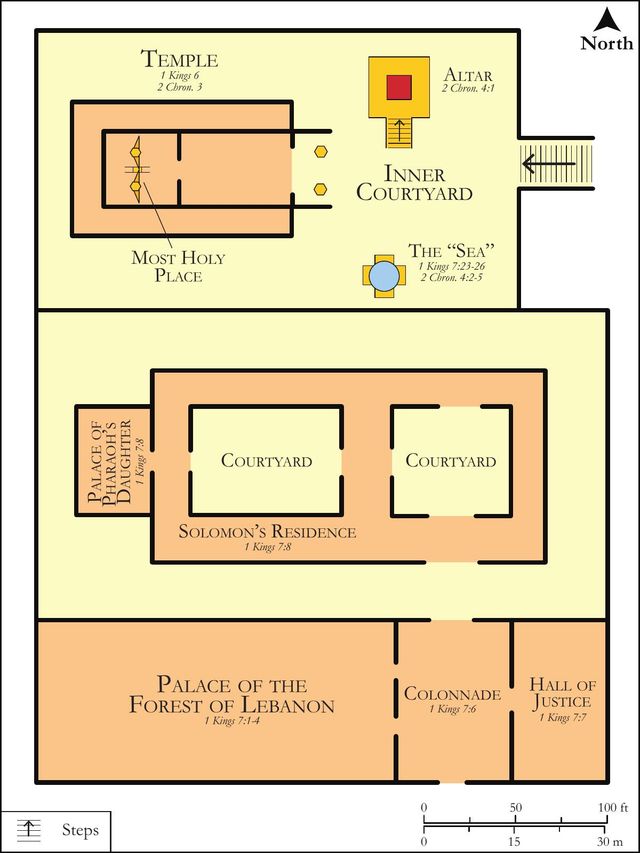
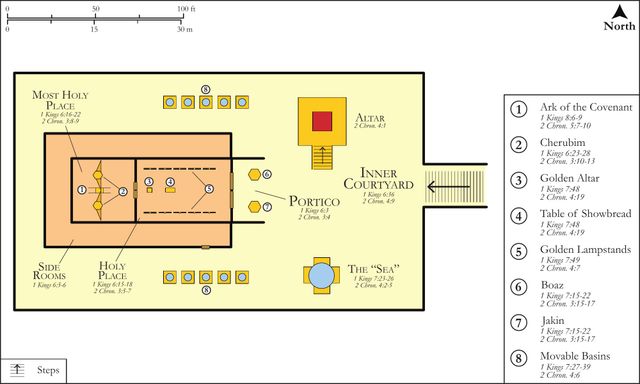
This verse is deeply embedded within 1 Kings 6, a chapter singularly devoted to the intricate construction of Solomon's Temple in Jerusalem. Following the initial statement of the Temple's commencement in 1 Kings 6:1 and general dimensions in 1 Kings 6:2-3, the narrative transitions into a detailed architectural blueprint. Verse 17 specifically delineates the length of the heikal, the main hall or Holy Place, which served as the primary area accessible to priests for daily service. This section is carefully distinguished from the Temple's porch (ulam) and the innermost sanctuary, the Most Holy Place (debir), whose dimensions are provided subsequently in 1 Kings 6:19-20. The meticulous enumeration of these measurements throughout the chapter emphasizes the divine precision and inherent sacredness of the entire structure, portraying it not merely as a building but as a divinely ordained sanctuary.
Historical & Cultural Context
The construction of Solomon's Temple represented the zenith of his reign, fulfilling the fervent desire of his father, King David, to establish a permanent dwelling for the Ark of the Covenant and a singular, central place of worship for the burgeoning nation of Israel. This monumental undertaking spanned seven years (1 Kings 6:38), involving vast resources and skilled labor. Culturally, temples across the ancient Near East were universally regarded as the earthly abodes of deities, and their construction often adhered to precise, ritually significant dimensions, believed to reflect cosmic order. For Israel, the Temple transcended a mere edifice; it was the tangible manifestation of God's covenant presence among His people, serving as the divinely appointed successor to the portable Tabernacle, whose detailed instructions are found in Exodus 25-40. The "cubit" was a standard unit of measurement throughout the region, typically ranging from 18 to 21 inches (approximately 45-53 cm), making forty cubits a substantial length of roughly 60-70 feet (18-21 meters), indicative of the Temple's impressive scale.
Key Themes
ShowHide1 Kings 6, including verse 17, profoundly contributes to several overarching themes within the book of 1 Kings and the broader biblical narrative. Firstly, it underscores the theme of Divine Order and Precision. The exhaustive and exact measurements, such as the forty cubits of the main hall, strongly imply a divinely inspired design, echoing the meticulous instructions God provided for the Tabernacle in Exodus 26. Secondly, the sheer grandeur and immense scale of the Temple highlight the Glory and Majesty of God, for whom such an awe-inspiring structure was consecrated, thereby reflecting both Israel's profound devotion and Solomon's unparalleled wisdom and wealth. Lastly, this verse contributes significantly to the theme of Sacred Space and Separation. By precisely defining the dimensions of the Holy Place, it delineates a distinct area specifically designated for priestly service, set apart from the outer courts and the Most Holy Place. This spatial arrangement emphasizes the progressive levels of holiness inherent within God's dwelling place, reinforcing the sanctity and reverence required for approaching the divine.
Exposition and Analysis
ShowHideKey Word Analysis
ShowHideThis common Hebrew term broadly denotes a dwelling or habitation. In the context of 1 Kings 6:17, while it can refer to the entire Temple complex, the subsequent clarification "that is, the temple before it" narrows its scope to the specific sacred structure. In theological contexts, bayith frequently signifies a dwelling place consecrated to God, often translated as "house of the Lord" or "house of God," thereby emphasizing a locus of divine presence, worship, and covenantal relationship.
This term more specifically refers to a large public building, such as a palace or, as in this instance, the main sanctuary or nave of the Temple. The hêykâl was the larger, outer chamber of the sacred edifice, situated immediately preceding the innermost Holy of Holies. This precise distinction is vital for accurately comprehending the architectural layout, functional purpose, and symbolic hierarchy of the various components within Solomon's Temple.
And H520 respectively, "forty" is a number often imbued with symbolic significance in biblical numerology, frequently representing periods of testing, purification, divine judgment, or completion (e.g., forty years of wilderness wandering, forty days of the flood, Jesus' forty days of temptation). While here it functions as a literal measurement, its presence within such a pivotal sacred structure may subtly evoke these deeper theological resonances, hinting at the journey of faith or divine purpose. A cubit (ʼammâh) was an ancient unit of length, typically derived from the forearm, measuring approximately 18-21 inches (45-53 cm), rendering the main hall a substantial length of roughly 60-70 feet (18-21 meters).
Verse Breakdown
ShowHide"And the house, that [is], the temple before it"
This initial phrase serves to precisely identify the specific architectural component of the Temple being described. "The house" (referring to the overall Temple building) is immediately clarified by the parenthetical "that [is], the temple before it." This clarification points to the heikal, the Holy Place or Nave. This grand chamber was the primary area where the priests performed their daily sacred duties, including burning incense on the golden altar, tending to the lampstand, and arranging the showbread on its table. It was situated "before" or in front of the innermost and most sacred sanctuary, the Most Holy Place (the debir).
"was forty cubits [long]"
This clause provides the exact linear dimension of the heikal. This level of architectural specificity is characteristic of the entire description of the Temple's construction in 1 Kings 6, emphasizing a meticulous adherence to a divinely revealed blueprint. The length of forty cubits would have created an impressively spacious and imposing hall, perfectly suited for the solemn and elaborate sacred rituals performed within its confines, and reflective of the grandeur and majesty of the God for whom it was constructed.
Literary Devices
ShowHideThe prevailing literary device employed in 1 Kings 6:17, and indeed pervasive throughout the entire sixth chapter of 1 Kings, is Architectural Detail. The text meticulously enumerates precise measurements, materials, and structural components, thereby constructing a vivid and intricate mental blueprint of Solomon's Temple. This exhaustive description transcends mere architectural record-keeping; it functions as a profound theological statement, underscoring the Divine Precision and Order inherent in God's design for His sacred dwelling place. The exactness of "forty cubits" contributes significantly to a sense of Realism and Verifiability, firmly grounding the sacred narrative in tangible and quantifiable dimensions. Furthermore, the intense focus on specific measurements can be interpreted as a form of Symbolism, where the physical dimensions implicitly reflect deeper spiritual truths about God's character (e.g., His orderliness, His majesty, His holiness) and the profound sacredness of the space consecrated to Him. The entire chapter, through its cumulative effect of detailed descriptions, functions as an Extended Description, progressively building a comprehensive and awe-inspiring picture of a structure of unparalleled beauty and spiritual significance.
Theological and Thematic Connections
ShowHide1 Kings 6:17, by meticulously detailing the dimensions of the Temple's main sanctuary, profoundly underscores the theological significance of sacred space and the nature of divine presence. The precise and elaborate design reflects God's inherent desire for order, excellence, and beauty in worship, echoing the detailed instructions previously given for the Tabernacle, which served as a portable sanctuary before the Temple's construction. This emphasis on a physical dwelling place for God's manifest presence highlights the dynamic covenant relationship between God and Israel, where His glory would tangibly reside among His people. The Temple served as the indispensable focal point for national worship, sacrificial atonement, and communal prayer, symbolizing both God's accessibility to His people and His transcendent holiness, as only certain individuals were permitted to enter specific, progressively sacred areas.
Reflection and Application
ShowHideThe meticulous detail presented in 1 Kings 6:17, which precisely describes the forty-cubit length of the Temple's main sanctuary, compels us to reflect deeply on the nature of our own worship and service to God. Just as Solomon's Temple was constructed with unparalleled precision and excellence, intended to reflect the very glory of God, so too should our spiritual lives be characterized by intentionality, reverence, and a pursuit of excellence. This verse serves as a powerful reminder that God is a God of order, who values careful attention to detail not only in monumental projects but also in the daily, seemingly mundane disciplines of faith. While we no longer worship in a physical temple of stone, the enduring principles of sacred space and divine presence remain profoundly relevant. We are now called to honor God with our very best, recognizing that our bodies have become the temple of the Holy Spirit, and our entire lives are to be presented as living sacrifices. This profound truth calls us to a steadfast commitment to holiness, integrity, and a relentless pursuit of excellence in our spiritual disciplines, our relationships, and our vocations, thereby transforming our entire existence into a dwelling place for God's manifest glory.
Questions for Reflection
ShowHideFAQ
ShowHideWhat was the specific function of the "forty cubits" section of the Temple mentioned in 1 Kings 6:17?
ShowHideThe "forty cubits" section refers to the precise length of the hêykâl, which is also known as the Holy Place or the Nave. This was the larger of the two sacred chambers within the main Temple building, situated directly preceding the innermost sanctuary. Its primary function was to serve as the designated area where the priests performed their daily sacred duties and rituals. These duties included burning incense on the golden altar, meticulously tending to the seven-branched lampstand (menorah), and regularly placing the showbread on its table. The Holy Place was the chamber that worshippers would conceptually approach, though they did not enter it, before the Most Holy Place (or Holy of Holies). The Most Holy Place was separated by a veil and was accessible only to the High Priest, and then only once a year on the Day of Atonement, as detailed in Leviticus 16. The precise measurement of the hêykâl underscored the sacredness, specific function, and divinely ordained nature of this dedicated space within God's dwelling.
Christ-Centered Fulfillment
ShowHideWhile 1 Kings 6:17 describes a tangible, physical structure, its ultimate and profound fulfillment is unequivocally found in the person of Jesus Christ. The Temple, with its precise dimensions, sacred spaces, and intricate rituals, served as a powerful prefigurement of the dwelling of God among humanity, a reality fully and perfectly realized in Jesus. He is the ultimate "house" or dwelling place of God, the one in whom "all the fullness of God was pleased to dwell" bodily (Colossians 1:19; Colossians 2:9). Jesus Himself prophetically declared, "Destroy this temple, and in three days I will raise it up," clarifying that He was speaking of "the temple of his body" (John 2:19-21). The meticulously measured forty-cubit length of the Holy Place, a dedicated space for priestly service, finds its perfect and eternal counterpart in Christ, our Great High Priest. He entered not an earthly sanctuary, but the true, heavenly sanctuary "once for all" through the offering of His own precious blood, thereby securing eternal redemption for all who believe (Hebrews 9:11-12). Furthermore, through Christ's redemptive work, believers are transformed into living stones, being "built up as a spiritual house," a "holy temple in the Lord" (Ephesians 2:21-22; 1 Peter 2:5), where God's Spirit now intimately dwells. This new covenant reality fulfills the promise of God's abiding presence among His people in a profoundly personal and spiritual way, far surpassing the temporal glory of Solomon's physical edifice.