


1 Kings 6:23
Bible text: King James Version (1769 Blayney text) · Public domain
Bible text: Berean Standard Bible · Public domain
Bible text: American Standard Version (1901) · Public domain
Bible text: World English Bible, Messianic edition · Public domain
Bible text: Geneva Bible (1599) · Public domain
Bible text: Young's Literal Translation · Public domain
- וַיַּעַשׂvai·Ya·'asand he madeH6213Conj-w ¦ V-Qal-ConsecImperf-3msVerb Qal Consecutive Imperfect 3rd Singular Masculineוַandיַּעַשׂhe made
- בַּדְּבִירba·de·Virin the innermost roomH1687Prep-b ¦ N-msNoun Singular Masculine Absoluteבַּin theדְּבִירinnermost room
- שְׁנֵיshe·NeitwoH8147N-cdcNoun Dual common gender Construct
- כְרוּבִיםkhe·ru·VimcherubimH3742N-mpNoun Plural Masculine Absolute
- עֲצֵי'a·tzeiwood<s> ofH6086N-mpcNoun Plural Masculine Construct
- שָׁמֶןSha·menoliveH8081N-msNoun Singular Masculine Absolute
- עֶשֶׂר'E·ser[was] tenH6235N-mscNoun Singular Masculine Construct
- אַמּוֹת'a·MotcubitsH520N-fpNoun Plural Feminine Absolute
- קוֹמָתוֹko·ma·Toits heightH6967N-fsc ¦ 3msNoun Singular Feminine Constructקוֹמָתheightוֹits
English is a literal word-by-word gloss of the Hebrew, not the KJV's wording. Why?
This is the original text the KJV's translators worked from — each Hebrew word with its own literal English meaning in this verse, prepared by scholars at Tyndale House, Cambridge. The KJV translates whole sentences, not word by word, so its wording differs: one Hebrew word can become several English words, and the KJV may choose “the LORD” where the gloss reads “Yahweh”. Both are faithful — they answer different questions. For the KJV's own rendering, switch to the KJV text.
Details
See on the biblical-era maps
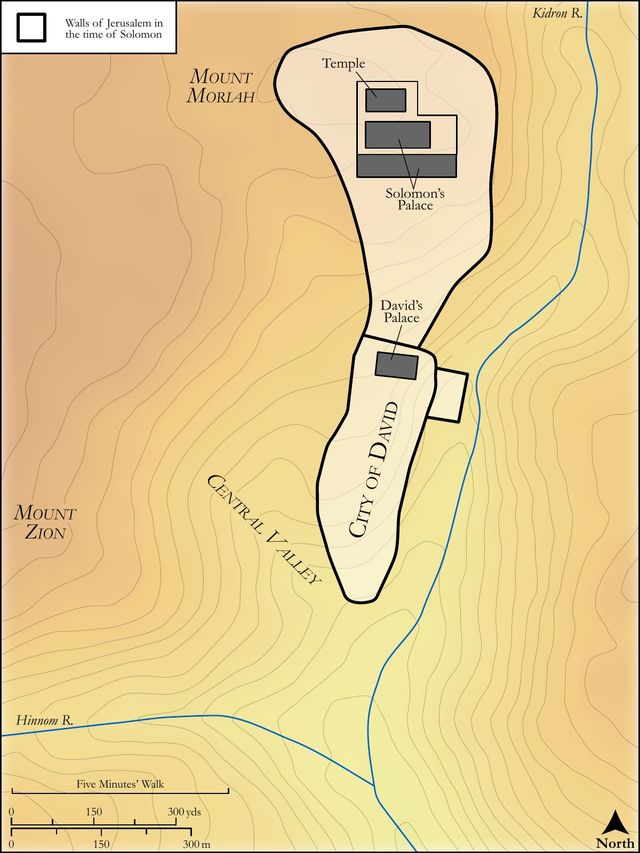
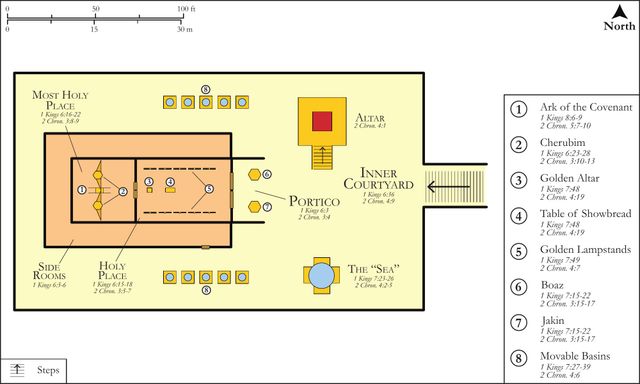
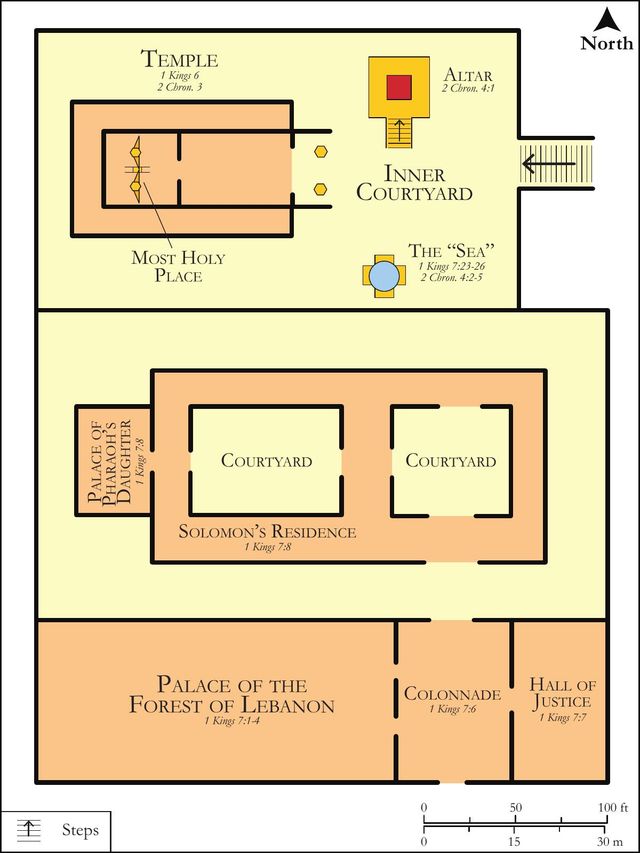
Study this verse
Public-domain commentary
Matthew Henry
From his Commentary on the Whole Bible. Henry comments on passages, not single verses — this entry covers 1 Kings 6:15–38. His three-level outline is real structure in the source text, so it is rendered as structure.
Here, I. We have a particular account of the details of the building.
1.The wainscot of the temple. It was of cedar (Kg1 6:15), which was strong and durable, and of a very sweet smell. The wainscot was curiously carved with knops (like eggs or apples) and flowers, no doubt as the fashion then was, Kg1 6:18.
2.The gilding. It was not like ours, washed over, but the whole house, all the inside of the temple (Kg1 6:22), even the floor (Kg1 6:30), he overlaid with gold, and the most holy place with pure gold, Kg1 6:21. Solomon would spare no expense necessary to make it every way sumptuous. Gold was under foot there, as it should be in all the living temples: the abundance of it lessened its worth.
3.The oracle, or speaking-place (for so the word signifies), the holy of holies, so called because thence God spoke to Moses, and perhaps to the high priest, when he consulted with the breast-plate of judgment. In this place the ark of the covenant was to be set, Kg1 6:19. Solomon made every thing new, and more magnificent than it had been, except the ark, which was still the same that Moses made, with its mercy-seat and cherubim; that was the token of God's presence, which is always the same with his people whether they meet in tent or temple, and changes not with their condition.
4.The cherubim. Besides those at the ends of the mercy-seat, which covered the ark,
(1.)Solomon set up two more, very large ones, images of young men (as some think), with wings made of olive-wood, and all overlaid with gold, Kg1 6:23, etc. This most holy place was much larger than that in the tabernacle, and therefore the ark would have seemed lost in it, and the dead wall would have been unsightly, if it had not been thus adorned.
(2.)He carved cherubim upon all the walls of the house, Kg1 6:29. The heathen set up images of their gods and worshipped them; but these were designed to represent the servants and attendants of the God of Israel, the holy angels, not to be themselves worshipped (see thou do it not), but to show how great he is whom we are to worship.
5.The doors. The folding doors that led into the oracle were but a fifth part of the wall (Kg1 6:31), those into the temple were a fourth part (Kg1 6:33); but both were beautified with cherubim engraven on them, Kg1 6:32, Kg1 6:35.
6.The inner court, in which the brazen altar was at which the priests ministered. This was separated from the court where the people were by a low wall, three rows of hewn stone tipped with a cornice of cedar (Kg1 6:36), that over it the people might see what was done and hear what the priests said to them; for, even under that dispensation, they were not kept wholly either in the dark or at a distance.
7.The time spent in this building. It was but seven years and a half from the founding to the finishing of it, Kg1 6:38. Considering the vastness and elegance of the building, and the many appurtenances to it which were necessary to fit it for use, it was soon done. Solomon was in earnest in it, had money enough, had nothing to divert him from it, and many hands made quick work. He finished it (as the margin reads it) with all the appurtenances thereof, and with all the ordinances thereof, not only built the place, but set forward the work for which it was built.
II.Let us now see what was typified by this temple.
1.Christ is the true temple; he himself spoke of the temple of his body, Joh 2:21. God himself prepared him his body, Heb 10:5. In him dwelt the fulness of the Godhead, as the Shechinah in the temple. In him meet all God's spiritual Israel. Through him we have access with confidence to God. All the angels of God, those blessed cherubim, have a charge to worship him.
2.Every believer is a living temple, in whom the Spirit of God dwells, Co1 3:16. Even the body is such by virtue of its union with the soul, Co1 6:19. We are not only wonderfully made by the divine providence, but more wonderfully made anew by the divine grace. This living temple is built upon Christ as its foundation and will be perfected in due time.
3.The gospel church is the mystical temple; it grows to a holy temple in the Lord (Eph 2:21), enriched and beautified with the gifts and graces of the Spirit, as Solomon's temple with gold and precious stones. Only Jews built the tabernacle, but Gentiles joined with them in building the temple. Even strangers and foreigners are built up a habitation of God, Eph 2:19, Eph 2:22. The temple was divided into the holy place and the most holy, the courts of it into the outer and inner; so there are the visible and the invisible church. The door into the temple was wider than that into the oracle. Many enter into profession that come short of salvation. This temple is built firm, upon a rock, not to be taken down as the tabernacle of the Old Testament was. The temple was long in preparing, but was built at last. The top-stone of the gospel church will, at length, be brought forth with shoutings, and it is a pity that there should be the clashing of axes and hammers in the building of it. Angels are ministering spirits, attending the church on all sides and all the members of it.
4.Heaven is the everlasting temple. There the church will be fixed, and no longer movable. The streets of the new Jerusalem, in allusion to the flooring of the temple, are said to be of pure gold, Rev 21:21. The cherubim there always attend the throne of glory. The temple was uniform, and in heaven there is the perfection of beauty and harmony. In Solomon's temple there was no noise of axes and hammers. Every thing is quiet and serene in heaven; all that shall be stones in that building must in the present sate of probation and preparation be fitted and made ready for it, must be hewn and squared by divine grace, and so made meet for a place there.
Historical interpretation
Historical reception
1 surviving comment on this verse from the historical church.
“Cherubim,” as the prophet Ezekiel explicitly declares, is a title of dignity, and in the singular number the form cherub is used, but cherubim in the plural. Hence the figures of the cherubim that were made in the oracle can be appropriately taken to mean the angelic retinues that always wait on their Creator in heaven. And they are properly said to have been made of olive wood because, of course, angelic virtues are anointed with the grace of the Holy Spirit lest they should ever grow arid in the love of God. For they are those fellow companions of ours of whom the prophet speaks in his praise of Christ: “God your God has anointed you with the oil of gladness above your fellows.” In figurative terms it was quite right that those whom their Creator later filled with the light of heavenly wisdom were made of olive wood. That is why he wanted them called cherub, which means in Latin “a great store of knowledge.” And they are ten cubits high because they enjoy the denarius of eternal life having preserved ever untarnished in themselves the image of their Creator by the sanctity and uprightness and truth that they received in the first creation. For a denarius is worth ten obols and customarily bore the name and likeness of the king. Consequently, it also makes a very fitting metaphor for the kingdom of heaven where, on the one hand, the holy angels ever remain in their Creator’s likeness according to which they were made, and on the other hand, the human elect receive his image that they had lost by sinning. For “we know,” he says, “that when he appears we shall be like him [and] see him as he is.”
Continue studying 1 Kings 6:23 across the web’s major study libraries — every link below opens this exact verse, chapter, or book on the destination site.
Read & Compare
 BibleGatewayThis verse in more than 200 translations and 70 languages.
 Bible.comThe YouVersion reader — hundreds of translations, reading plans, and highlights.
 ESV.orgCrossway's official English Standard Version reader.
 NET BibleThe NET translation with 60,000+ translators' notes on every rendering decision.
 STEP BibleTyndale House's free study tool — original text, vocabulary, and scholarly resources.
 BibliaLogos Bible Software's free web reader.
 USCCBThe New American Bible (Revised Edition) with the U.S. bishops' study notes.
Commentaries
 BibleHub CommentariesDozens of classic commentaries on this verse, gathered on one page.
 StudyLightMore than 100 commentary sets — the largest collection on the web.
 BibleRefPlain-English commentary on what this verse means, verse by verse.
 Enduring WordDavid Guzik's free commentary on this chapter, widely used by Bible teachers.
 Bible Study ToolsVerse commentary alongside Greek and Hebrew study aids.
Original Language & Research
- BibleHub InterlinearThe verse word by word — original language, transliteration, and English.
- BibleHub LexiconEvery word's original-language definition and Strong's entry.
 Blue Letter BibleDeep-study tools — Strong's numbers, concordance, and word studies.
 SefariaThe Hebrew text with Rashi and centuries of Jewish commentary.
Sermons, Hymns & Audio


TrulyRandomVerse is not affiliated with these sites and doesn’t control their content. They’re linked because they’re genuinely useful.
Summary
1 Kings 6:23 provides a precise architectural detail of Solomon's Temple, describing the construction of two colossal cherubim within the innermost sanctuary, known as the "oracle" or Holy of Holies. These magnificent figures, meticulously carved from olive wood and standing at an impressive height of ten cubits, were central to the most sacred space of God's dwelling, profoundly emphasizing the divine presence, the awe-inspiring holiness, and the restricted access to the Almighty within His earthly abode.
Context
ShowHideLiterary Context
This verse is situated within the highly detailed account of King Solomon's construction of the First Temple in Jerusalem, specifically within 1 Kings 6, which meticulously outlines the architectural blueprint of the sacred edifice. Following general descriptions of the Temple's dimensions, materials, and overall structure (e.g., 1 Kings 6:1-22), verse 23 shifts focus to the innermost and most sacred chamber: the "oracle" or Holy of Holies. This precise description of the cherubim prepares the reader for subsequent details of their placement, their expansive wingspan, and their overlaying with gold (as seen in 1 Kings 6:24-28), all culminating in the ultimate placement of the Ark of the Covenant within this sanctified space (1 Kings 8:6-9). The narrative consistently emphasizes the meticulous adherence to divine instruction in creating a dwelling fitting for God's holy presence.
Historical & Cultural Context
Solomon's Temple, built in the 10th century BCE, represented the culmination of Israel's desire for a permanent dwelling place for God, succeeding the portable Tabernacle. It became the undisputed epicenter of Israelite worship and national identity. The cherubim, guardians of sacred space and attendants to the divine throne, were already known in Scripture: set at the east of the garden of Eden to keep the way of the tree of life, wrought in gold upon the mercy seat, and woven into the curtains of the tabernacle. In Israel they were distinctively associated with Yahweh's unique majesty and holiness, never worshipped themselves but always pointing to the divine. Olive wood, from which these cherubim were carved, was highly valued for its durability, resistance to decay, fine grain, and its association with anointing oil, symbolizing consecration, divine blessing, and peace. Its use here signifies the permanence, richness, and consecrated nature of the Temple's most sacred elements, particularly those related to God's immediate presence.
Key Themes
ShowHideThe construction of these cherubim within the oracle directly contributes to several overarching themes foundational to Israelite theology. Firstly, Divine Presence and Holiness is paramount; the cherubim, consistently linked with God's glory and throne (e.g., Ezekiel 1:5-12), signify the profound sanctity and awe-inspiring nature of God's dwelling. Their placement in the Holy of Holies underscored the restricted access to God, permitted only to the High Priest on the Day of Atonement. Secondly, they represent Guardians of the Sacred; from their role guarding the Tree of Life in Eden to their presence atop the Ark of the Covenant, cherubim consistently delineate and protect holy space, preventing unauthorized access to divine glory. Finally, the sheer Temple Symbolism conveyed by their massive size (ten cubits high, approximately 15 feet) and precious material (olive wood, later overlaid with gold as per 1 Kings 6:28) highlights the immense value, reverence, and spiritual significance attributed to God's earthly abode, reflecting the glory of the One who dwells within.
Exposition and Analysis
ShowHideKey Word Analysis
ShowHideThis term (H1687) specifically designates the innermost sanctuary of the Temple, also known as the Holy of Holies. It derives from a root meaning "to speak," suggesting it was the place where God spoke or communicated with His people, particularly through the High Priest. It was the most sacred and restricted area, separated by a veil, where the Ark of the Covenant resided, symbolizing the concentrated presence of God and the point of divine revelation.
The plural form of "cherub" (H3742), these are celestial or angelic beings. In biblical theology, cherubim are consistently associated with God's glory, His throne, and His presence, often depicted with wings and multiple faces (though not described in detail here, other passages like Ezekiel 1:5-12 provide more elaborate descriptions). Their primary function is to guard divine holiness, mediate access to God, and serve as a visible reminder of His majesty and transcendence.
This phrase combines ʻêts (H6086), meaning "tree" or "wood," and shemen (H8081), meaning "oil" or "fat," specifically referring to the olive tree or its wood. This material was highly prized for its durability, resistance to decay, and fine grain, making it suitable for carving. Symbolically, the olive tree is deeply associated with anointing oil, which was used for consecration, divine blessing, and sacred purposes. Its use for the cherubim signifies not only the Temple's richness and permanence but also the sacredness and divine appointment of these figures.
Verse Breakdown
ShowHide"And within the oracle"
This phrase precisely locates the cherubim within the debîr, the innermost and most sacred chamber of the Temple. This emphasizes the profound holiness and restricted nature of the space, accessible only to the High Priest, and even then, only once a year on the Day of Atonement. The placement signifies that these figures are intimately connected with the very heart of God's dwelling, where His glory was most concentrated.
"he made two cherubims [of] olive tree"
"He" refers to Solomon, acting under divine instruction and supervision. The creation of "two" cherubim suggests symmetry, completeness, and a mirroring of the two cherubim on the mercy seat of the Ark of the Covenant, reinforcing their role as guardians of the divine presence. The choice of "olive tree" (olive wood) is highly significant, denoting durability, beauty, and symbolic associations with anointing, consecration, and divine blessing, highlighting the preciousness and sacred purpose of these figures within the Temple.
"[each] ten cubits high"
This detail specifies the monumental scale of these cherubim. Ten cubits is approximately 15 feet (4.5 meters), making them towering, imposing figures that would have dominated the Holy of Holies. Their immense size would have filled the chamber, creating an overwhelming sense of awe, reverence, and even fear, further emphasizing the majesty of God and the profound sanctity of His immediate presence.
Literary Devices
ShowHideThe verse employs several significant literary devices to convey its profound theological meaning. Precision and Detail are paramount, reflecting the meticulous nature of the Temple's construction as divinely ordained, where every measurement and material choice carries deep theological weight, underscoring the importance and sacredness of God's dwelling. Symbolism is rich and pervasive, with the cherubim themselves symbolizing divine presence, guardianship of holiness, and the inaccessibility of God to sinful humanity. The specific choice of olive wood further symbolizes permanence, anointing, and the sacredness of the Temple's most holy elements. The sheer scale implied by "ten cubits high" evokes a powerful sense of Awe and Grandeur, contributing to the overall atmosphere of reverence and majesty that surrounds God's dwelling place, designed to inspire profound respect for the transcendent God.
Theological and Thematic Connections
ShowHideThe construction of these cherubim in the Holy of Holies profoundly illustrates God's transcendent holiness and His desire for fellowship, yet also His necessary separation from sinful humanity. Their imposing presence, guarding the most sacred space, reiterates the biblical truth that access to God's unmediated presence is both a profound privilege and a dangerous endeavor for the unholy. They serve as a physical representation of the spiritual barriers that sin creates between humanity and a holy God, necessitating a divinely appointed means of access and atonement. This concept of guarded access and the need for mediation is a consistent theme throughout salvation history, from the expulsion from Eden to the elaborate Temple rituals.
Reflection and Application
ShowHideWhile the physical Temple and its cherubim no longer stand, the spiritual truths they represent endure with profound relevance for believers today. This verse reminds us of the awesome holiness of God and the profound reverence due to Him. It challenges us to consider how we approach God, recognizing that His presence is not to be taken lightly or treated casually. For believers in the New Covenant, the New Testament teaches that our bodies are individually the temple of the Holy Spirit, and collectively, the church is God's dwelling place on earth (Ephesians 2:19-22). This spiritual reality calls us to a life of holiness, purity, and intentional reverence, understanding that God truly dwells among us and within us. The cherubim, guarding access, powerfully foreshadowed the ultimate mediator who would open the way, prompting us to cherish the direct and unhindered access we now have to God's throne of grace through Christ.
Questions for Reflection
ShowHideFAQ
ShowHideWhat was the purpose of the cherubim in the Holy of Holies?
ShowHideThe cherubim in the Holy of Holies served multiple profound and interconnected purposes. Primarily, they functioned as guardians of divine holiness, symbolizing the sacredness and restricted nature of God's immediate presence. Just as cherubim guarded the Tree of Life in Eden after the fall, these Temple cherubim visually reinforced that access to God's unmediated presence was not to be taken lightly and was limited to the High Priest, and even then, only once a year on the Day of Atonement. Secondly, they symbolized God's throne and glory, often depicted in scripture as attendants to His divine chariot-throne (e.g., Ezekiel 1:5-12). Though they were not worshipped themselves, their imposing presence instilled awe and reverence, directing all attention to the transcendent majesty of the God who dwelt between them. They were a constant, visual reminder of the profound separation between a holy God and sinful humanity, highlighting the absolute necessity for atonement and divine mediation.
Christ-Centered Fulfillment
ShowHideThe cherubim in Solomon's Temple, guarding the Holy of Holies and symbolizing the restricted access to God's presence, find their ultimate fulfillment and transformation in the person and work of Jesus Christ. In the Old Covenant, these majestic figures stood as a perpetual reminder of the formidable barrier between a holy God and sinful humanity, a barrier that only the High Priest could briefly and ritually cross once a year, through the shedding of animal blood. However, Jesus, by His perfect life, atoning death, and glorious resurrection, became the ultimate and eternal High Priest (Hebrews 4:14) and the perfect, once-for-all sacrifice (Hebrews 9:11-14). His crucifixion saw the Temple veil torn in two from top to bottom (Matthew 27:51), a dramatic and symbolic act signifying that the way into God's presence, once guarded by cherubim and a physical barrier, was now permanently opened through Him. Jesus Himself declared, "Destroy this temple, and in three days I will raise it up," speaking of the temple of His body (John 2:19-21), revealing that He is the true dwelling place of God, the embodiment of divine presence. Through Christ, believers are now invited to "draw near with a true heart in full assurance of faith" into the very Holy of Holies (Hebrews 10:19-22), no longer needing cherubim to guard access, but rather having direct, unhindered access to God's throne of grace through the Lamb of God who takes away the sin of the world (John 1:29).