


1 Kings 6:30
Bible text: King James Version (1769 Blayney text) · Public domain
Bible text: Berean Standard Bible · Public domain
Bible text: American Standard Version (1901) · Public domain
Bible text: World English Bible, Messianic edition · Public domain
Bible text: Geneva Bible (1599) · Public domain
Bible text: Young's Literal Translation · Public domain
- וְאֶתve·'Etand <obj.>H853Conj-w ¦ DirObjMParticle Object Indicatorוְandאֶת<obj.>
- קַרְקַעkar·Ka'[the] floor ofH7172N-mscNoun Singular Masculine Construct
- הַבַּיִתha·Ba·yitthe houseH1004Art ¦ N-msNoun Singular Masculine Absoluteהַtheבַּיִתhouse
- צִפָּהtzi·Pahhe overlaidH6823V-Piel-Perf-3msVerb Piel Perfect 3rd Singular Masculine
- זָהָבza·HavgoldH2091N-msNoun Singular Masculine Absolute
- לִפְנִימָהlif·Ni·mahto withinH6441Prep-l ¦ AdvAdverbלִtoפְנִימָהwithin
- וְלַחִיצוֹןve·la·chi·Tzonand to the outerH2435Conj-w ¦ Prep-l ¦ Adj-msAdjective Singular Masculine Absoluteוְandלַto theחִיצוֹןouter
English is a literal word-by-word gloss of the Hebrew, not the KJV's wording. Why?
This is the original text the KJV's translators worked from — each Hebrew word with its own literal English meaning in this verse, prepared by scholars at Tyndale House, Cambridge. The KJV translates whole sentences, not word by word, so its wording differs: one Hebrew word can become several English words, and the KJV may choose “the LORD” where the gloss reads “Yahweh”. Both are faithful — they answer different questions. For the KJV's own rendering, switch to the KJV text.
Details
See on the biblical-era maps
Study this verse
Public-domain commentary
Matthew Henry
From his Commentary on the Whole Bible. Henry comments on passages, not single verses — this entry covers 1 Kings 6:15–38. His three-level outline is real structure in the source text, so it is rendered as structure.
Here, I. We have a particular account of the details of the building.
1.The wainscot of the temple. It was of cedar (Kg1 6:15), which was strong and durable, and of a very sweet smell. The wainscot was curiously carved with knops (like eggs or apples) and flowers, no doubt as the fashion then was, Kg1 6:18.
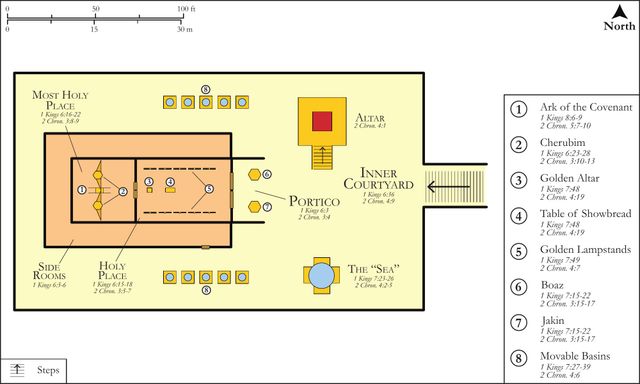
2.The gilding. It was not like ours, washed over, but the whole house, all the inside of the temple (Kg1 6:22), even the floor (Kg1 6:30), he overlaid with gold, and the most holy place with pure gold, Kg1 6:21. Solomon would spare no expense necessary to make it every way sumptuous. Gold was under foot there, as it should be in all the living temples: the abundance of it lessened its worth.
3.The oracle, or speaking-place (for so the word signifies), the holy of holies, so called because thence God spoke to Moses, and perhaps to the high priest, when he consulted with the breast-plate of judgment. In this place the ark of the covenant was to be set, Kg1 6:19. Solomon made every thing new, and more magnificent than it had been, except the ark, which was still the same that Moses made, with its mercy-seat and cherubim; that was the token of God's presence, which is always the same with his people whether they meet in tent or temple, and changes not with their condition.
4.The cherubim. Besides those at the ends of the mercy-seat, which covered the ark,
(1.)Solomon set up two more, very large ones, images of young men (as some think), with wings made of olive-wood, and all overlaid with gold, Kg1 6:23, etc. This most holy place was much larger than that in the tabernacle, and therefore the ark would have seemed lost in it, and the dead wall would have been unsightly, if it had not been thus adorned.
(2.)He carved cherubim upon all the walls of the house, Kg1 6:29. The heathen set up images of their gods and worshipped them; but these were designed to represent the servants and attendants of the God of Israel, the holy angels, not to be themselves worshipped (see thou do it not), but to show how great he is whom we are to worship.
5.The doors. The folding doors that led into the oracle were but a fifth part of the wall (Kg1 6:31), those into the temple were a fourth part (Kg1 6:33); but both were beautified with cherubim engraven on them, Kg1 6:32, Kg1 6:35.
6.The inner court, in which the brazen altar was at which the priests ministered. This was separated from the court where the people were by a low wall, three rows of hewn stone tipped with a cornice of cedar (Kg1 6:36), that over it the people might see what was done and hear what the priests said to them; for, even under that dispensation, they were not kept wholly either in the dark or at a distance.
7.The time spent in this building. It was but seven years and a half from the founding to the finishing of it, Kg1 6:38. Considering the vastness and elegance of the building, and the many appurtenances to it which were necessary to fit it for use, it was soon done. Solomon was in earnest in it, had money enough, had nothing to divert him from it, and many hands made quick work. He finished it (as the margin reads it) with all the appurtenances thereof, and with all the ordinances thereof, not only built the place, but set forward the work for which it was built.
II.Let us now see what was typified by this temple.
1.Christ is the true temple; he himself spoke of the temple of his body, Joh 2:21. God himself prepared him his body, Heb 10:5. In him dwelt the fulness of the Godhead, as the Shechinah in the temple. In him meet all God's spiritual Israel. Through him we have access with confidence to God. All the angels of God, those blessed cherubim, have a charge to worship him.
2.Every believer is a living temple, in whom the Spirit of God dwells, Co1 3:16. Even the body is such by virtue of its union with the soul, Co1 6:19. We are not only wonderfully made by the divine providence, but more wonderfully made anew by the divine grace. This living temple is built upon Christ as its foundation and will be perfected in due time.
3.The gospel church is the mystical temple; it grows to a holy temple in the Lord (Eph 2:21), enriched and beautified with the gifts and graces of the Spirit, as Solomon's temple with gold and precious stones. Only Jews built the tabernacle, but Gentiles joined with them in building the temple. Even strangers and foreigners are built up a habitation of God, Eph 2:19, Eph 2:22. The temple was divided into the holy place and the most holy, the courts of it into the outer and inner; so there are the visible and the invisible church. The door into the temple was wider than that into the oracle. Many enter into profession that come short of salvation. This temple is built firm, upon a rock, not to be taken down as the tabernacle of the Old Testament was. The temple was long in preparing, but was built at last. The top-stone of the gospel church will, at length, be brought forth with shoutings, and it is a pity that there should be the clashing of axes and hammers in the building of it. Angels are ministering spirits, attending the church on all sides and all the members of it.
4.Heaven is the everlasting temple. There the church will be fixed, and no longer movable. The streets of the new Jerusalem, in allusion to the flooring of the temple, are said to be of pure gold, Rev 21:21. The cherubim there always attend the throne of glory. The temple was uniform, and in heaven there is the perfection of beauty and harmony. In Solomon's temple there was no noise of axes and hammers. Every thing is quiet and serene in heaven; all that shall be stones in that building must in the present sate of probation and preparation be fitted and made ready for it, must be hewn and squared by divine grace, and so made meet for a place there.
Historical interpretation
Historical reception
1 surviving comment on this verse from the historical church.
Inside and outside mean in the oracle and in the temple itself. Now we have said above that the evenness of the floor denoted the humble harmony of the holy brotherhood where, though there are Jews and Gentiles, barbarians and Scythians, freeborn and slaves, highborn and lowborn, they all boast of being brothers in Christ, all boast of having the same Father who is in heaven, for no one may doubt the perfectly harmonious humility of the heavenly citizens. The reason why Solomon overlaid the floor of the house with gold inside and outside is that our king of peace has filled the angels and the souls of the righteous in heaven perfectly and fully with the gift of love and has set apart the citizens of the same heavenly homeland who are in pilgrimage in this world from the baseness of the rest of mortals by the hallmark of love, saying, “By this shall all know that you are my disciples, if you have love one for another.”
Continue studying 1 Kings 6:30 across the web’s major study libraries — every link below opens this exact verse, chapter, or book on the destination site.
Read & Compare
 BibleGatewayThis verse in more than 200 translations and 70 languages.
 Bible.comThe YouVersion reader — hundreds of translations, reading plans, and highlights.
 ESV.orgCrossway's official English Standard Version reader.
 NET BibleThe NET translation with 60,000+ translators' notes on every rendering decision.
 STEP BibleTyndale House's free study tool — original text, vocabulary, and scholarly resources.
 BibliaLogos Bible Software's free web reader.
 USCCBThe New American Bible (Revised Edition) with the U.S. bishops' study notes.
Commentaries
 BibleHub CommentariesDozens of classic commentaries on this verse, gathered on one page.
 StudyLightMore than 100 commentary sets — the largest collection on the web.
 BibleRefPlain-English commentary on what this verse means, verse by verse.
 Enduring WordDavid Guzik's free commentary on this chapter, widely used by Bible teachers.
 Bible Study ToolsVerse commentary alongside Greek and Hebrew study aids.
Original Language & Research
- BibleHub InterlinearThe verse word by word — original language, transliteration, and English.
- BibleHub LexiconEvery word's original-language definition and Strong's entry.
 Blue Letter BibleDeep-study tools — Strong's numbers, concordance, and word studies.
 SefariaThe Hebrew text with Rashi and centuries of Jewish commentary.
Sermons, Hymns & Audio


TrulyRandomVerse is not affiliated with these sites and doesn’t control their content. They’re linked because they’re genuinely useful.
Summary
Vividly describes the extraordinary opulence of Solomon's Temple, noting that even its floor was meticulously overlaid with gold, "within and without." This detail underscores the unparalleled lavishness and meticulous dedication invested in constructing a dwelling place for the Lord, reflecting both the immense wealth of King Solomon and the profound theological significance attributed to the sacred space as a testament to God's supreme glory and worthiness, emphasizing that no part of God's sanctuary was deemed too common for the most precious adornment.
Context
ShowHideLiterary Context
This verse is situated within a highly detailed architectural account of the construction of Solomon's Temple, spanning 1 Kings 6 through 1 Kings 8. Following the initial description of the Temple's dimensions and basic structure in 1 Kings 6:2-6, the narrative shifts to the elaborate materials and intricate adornments used. The preceding verses, such as 1 Kings 6:21-22, describe the gold overlay of the inner sanctuary (the Holy of Holies) and the altar. Verse 30 extends this lavishness to the very floor, emphasizing the comprehensive nature of the gold application throughout the sacred structure, leaving no surface untouched by this precious metal. This meticulous detail serves to highlight the unprecedented scale and cost of the project, setting the stage for the Temple's dedication and the subsequent filling of the house with the glory of the Lord in 1 Kings 8:10-11.
Historical & Cultural Context
The construction of the Temple occurred during the Golden Age of the Israelite monarchy under King Solomon, a period characterized by immense wealth, political stability, and extensive international trade. Solomon's kingdom stretched from the Euphrates to the border of Egypt, and his economic power was legendary, as evidenced by the vast quantities of gold and silver mentioned in 1 Kings 10:21-23. Gold was highly prized in Israel, as in the furnishings of the tabernacle, symbolizing royalty, divinity, purity, and enduring value. The tabernacle had been adorned with precious metals, but the sheer scale of gold used in Solomon's Temple, even on the floor, would have been exceptional. This signaled Israel's unique relationship with its God and reflected the cultural understanding that the most valuable materials were fitting for divine dwellings. The Temple was not merely a building but a central institution for Israelite worship, embodying their covenant relationship with Yahweh and serving as a visible manifestation of His presence among His people, a structure meant to inspire awe and reverence in all who beheld it.
Key Themes
ShowHideThe meticulous description of the Temple's construction, particularly the pervasive use of gold, contributes to several overarching themes in 1 Kings. Firstly, it underscores the Unparalleled Opulence and Dedication to God. The decision to overlay the floor with gold, a surface constantly walked upon, speaks volumes about the immense resources Solomon commanded and the extraordinary devotion given to building a house for the Lord. It signifies that no expense was spared in honoring God, reflecting the command to give God the "firstfruits" and the "best" (Deuteronomy 26:10). Secondly, the Temple's breathtaking grandeur, particularly its golden interior, was designed to reflect the Glory and Majesty of God Himself. Gold, universally recognized for its purity, beauty, and enduring value, was a fitting symbol for the dwelling place of the Most High, emphasizing His supreme worthiness and the awe-inspiring nature of His presence, as seen when the "glory of the Lord filled the house" (1 Kings 8:11). Finally, the pervasive use of gold highlights the Holiness and Set-Apartness of the sacred space. Every part of the Temple, from its foundation to its roof, and even its floor, was consecrated and set apart for sacred use. The gold overlay underscored the profound holiness of the space, distinguishing it from all other structures and signifying where God's unique presence would reside among His people, a place where even the ground underfoot was sanctified.
Exposition and Analysis
ShowHideKey Word Analysis
ShowHideTogether, "within and without" (H6441 and H2435) function as a merism, emphasizing the thoroughness and completeness of the gold overlay. It indicates that all visible floor surfaces, from the innermost sanctuary (the Holy of Holies and the Holy Place) to the outer porch or entrance areas of the main Temple structure, were completely covered. This conveys a sense of pervasive and complete luxury, leaving no part of the sacred floor untouched by the precious metal.
Verse Breakdown
ShowHide"And the floor of the house"
This phrase identifies the specific part of the Temple being described – the ground surface or walking area of the primary edifice. The "house" (H1004, bayith) is the Temple itself, the central structure of worship. The explicit mention of the floor is significant because it highlights an area typically considered mundane or less ornate, yet here it receives the same lavish treatment as more prominent surfaces.
"he overlaid with gold"
This clause describes the action taken by King Solomon, or more accurately, by the skilled craftsmen under his direction. The verb "overlaid" (H6823, tsâphâh) indicates that sheets or plates of gold were meticulously applied as a covering onto the underlying wooden floorboards. This process created a seamless, gleaming surface, visually transforming the entire floor into a radiant expanse of precious metal, symbolizing ultimate value and devotion.
"within and without"
This critical phrase specifies the comprehensive extent of the gold overlay. "Within" (H6441, pᵉnîymâh) refers to the interior spaces, including the Holy Place and the Holy of Holies. "Without" (H2435, chîytsôwn) refers to the outer portions of the main Temple building, such as the porch or vestibule. This detail underscores that the dedication and lavishness were not confined to the most sacred inner chambers but permeated the entire structure, signifying a complete and unreserved consecration of the entire sacred space to God.
Literary Devices
ShowHideThe verse employs several Literary Devices to convey its profound message. The most prominent is Symbolism, where gold itself profoundly symbolizes divine glory, purity, holiness, and immeasurable value. Its application to the floor suggests that every aspect of God's dwelling, even the most mundane or trodden upon, is elevated to a state of sacred splendor and worthiness. The phrase "within and without" functions as a powerful Merism, a figure of speech in which two contrasting parts are used to represent a complete whole. Here, it emphasizes the totality and comprehensiveness of the gold overlay, implying that no part of the Temple's floor, from its innermost sanctum to its outermost accessible areas, was left unadorned. This pervasive extravagance can also be interpreted as a form of Hyperbole, as the sheer dedication and wealth involved in covering an entire floor with gold, a surface constantly walked upon, creates an image of unparalleled magnificence that transcends ordinary human construction, underscoring the extraordinary nature of the Temple as God's dwelling.
Theological and Thematic Connections
ShowHideThe lavish gold overlay of the Temple floor in 1 Kings 6:30 powerfully communicates that God is worthy of the absolute best, and that His dwelling place, however conceived, should reflect His supreme glory and holiness. This principle extends beyond physical structures to the spiritual reality of God's presence among His people. Just as every part of the Temple was consecrated and adorned, so too are believers called to offer their entire lives as a holy and pleasing sacrifice to God, recognizing that His presence transforms and sanctifies everything it touches. This verse challenges us to consider the quality of our devotion and offerings, reminding us that nothing is too valuable or too 'common' to be consecrated to the Lord, for His presence elevates and hallows all that is surrendered to Him.
Reflection and Application
ShowHideWhile believers today do not build physical temples of gold, the principle behind 1 Kings 6:30 remains profoundly relevant. The lavishness of the Temple's floor teaches us that nothing is too valuable or too 'common' to be consecrated to the Lord. It calls us to examine the quality of our devotion and the entirety of our lives. If even the floor of God's dwelling was deemed worthy of such preciousness, how much more should our lives, which are now temples of the Holy Spirit, reflect His glory and worthiness? This verse challenges us to offer our "gold" – our time, talents, resources, and even our everyday actions and attitudes – in a way that honors God completely, without reservation or cheapening. It reminds us that God's presence makes any place, or any life, holy and valuable, urging us to live lives that are "overlaid with gold" in the sense of being fully dedicated and consecrated to Him, reflecting His beauty and majesty in every sphere of existence, from our public worship to our private thoughts.
Questions for Reflection
ShowHideFAQ
ShowHideWhy was the floor, a surface walked upon, also covered in gold?
ShowHideThe decision to cover the floor with gold, even though it would be walked upon, underscores several critical points about the Temple's purpose and significance. Firstly, it emphasizes the unparalleled holiness and set-apartness of the Temple. Every single surface, from the most visible to the most trodden, was consecrated to God, signifying that the entire structure was permeated with divine presence and purity. This meant that the very ground upon which the priests walked was sanctified, distinguishing it from any other earthly space. Secondly, it demonstrated the immense wealth and dedication of King Solomon and the nation of Israel. No expense was spared in honoring God, indicating that God was worthy of the absolute best and most precious materials available. Culturally, gold symbolized divinity and royalty, so covering the floor ensured that the entire space radiated the glory and majesty fitting for the dwelling place of the Most High God, leaving no part of the sacred structure untouched by this ultimate expression of reverence and devotion.
Christ-Centered Fulfillment
ShowHideThe gold-covered floor of Solomon's Temple, a place where God's presence was manifested, finds its ultimate fulfillment in Jesus Christ. While the Temple was a magnificent physical structure, it was merely a shadow pointing to the true dwelling place of God. Jesus declared, "Destroy this temple, and in three days I will raise it up," speaking of the temple of His body (John 2:19-21). In Christ, the very glory and holiness that the Temple's gold symbolized are embodied perfectly. He is the ultimate "Holy of Holies," the place where God's presence fully dwells among humanity (Colossians 2:9). Furthermore, through Christ, believers are transformed into living temples of the Holy Spirit (1 Corinthians 6:19), consecrated and set apart, not by external gold, but by the indwelling presence of God Himself. The lavishness of the Temple's gold foreshadows the immeasurable value and purity of Christ's perfect sacrifice, which cleanses and consecrates us, making us fit dwelling places for God's Spirit, a reality far more precious than any earthly gold (1 Peter 1:18-19). Thus, the physical dedication of the Temple's floor finds its spiritual and eternal reality in the person and work of Jesus, who makes us, His followers, a truly golden and pure dwelling for God, reflecting His glory from within.