


Exodus 37:22
Bible text: King James Version (1769 Blayney text) · Public domain
Bible text: Berean Standard Bible · Public domain
Bible text: American Standard Version (1901) · Public domain
Bible text: World English Bible, Messianic edition · Public domain
Bible text: Geneva Bible (1599) · Public domain
Bible text: Young's Literal Translation · Public domain
- כַּפְתֹּרֵיהֶםkaf·to·rei·Hemtheir bulbsH3730N-mpc ¦ 3mpNoun Plural Masculine Constructכַּפְתֹּרֵיbulbsהֶםtheir
- וּקְנֹתָםu·ke·no·Tamand their branchesH7070Conj-w ¦ N-fpc ¦ 3mpNoun Plural Feminine Constructוּandקְנֹתָbranchesםtheir
- מִמֶּנָּהmi·Me·nahfrom itH4480Prep ¦ 3fsPreposition Definiteמִמֶּfromנָּהit
- הָיוּha·Yuthey wereH1961V-Qal-Perf-3cpVerb Qal Perfect 3rd Plural common gender
- כֻּלָּהּku·Lahall of itH3605N-msc ¦ 3fsNoun Singular Masculine Constructכֻּלָּall ofהּit
- מִקְשָׁהmik·Shah[was] hammered workH4749N-fsNoun Singular Feminine Absolute
- אַחַת'a·ChatoneH259Adj-fsAdjective Numerical Singular Feminine Absolute
- זָהָבza·HavgoldH2091N-msNoun Singular Masculine Absolute
- טָהוֹרta·HorpureH2889Adj-msAdjective Singular Masculine Absolute
English is a literal word-by-word gloss of the Hebrew, not the KJV's wording. Why?
This is the original text the KJV's translators worked from — each Hebrew word with its own literal English meaning in this verse, prepared by scholars at Tyndale House, Cambridge. The KJV translates whole sentences, not word by word, so its wording differs: one Hebrew word can become several English words, and the KJV may choose “the LORD” where the gloss reads “Yahweh”. Both are faithful — they answer different questions. For the KJV's own rendering, switch to the KJV text.
Details
See on the biblical-era maps

Study this verse
Public-domain commentary
Matthew Henry
From his Commentary on the Whole Bible. Henry comments on passages, not single verses — this entry covers Exodus 37:10–24.
Here is, 1. The making of the table on which the show-bread was to be continually placed. God is a good householder, that always keeps a plentiful table. Is the world his tabernacle? His providence in it spreads a table for all the creatures: he provides food for all flesh. Is the church his tabernacle? His grace in it spreads a table for all believers, furnished with the bread of life. But observe how much the dispensation of the gospel exceeds that of the law. Though here was a table furnished, it was only with show-bread, bread to be looked upon, not to be fed upon, while it was on this table, and afterwards only by the priests; but to the table which Christ has spread in the new covenant all real Christians are invited guests; and to them it is said, Eat, O friends, come eat of my bread. What the law gave but a sight of at a distance, the gospel gives the enjoyment of, and a hearty welcome to. 2. The making of the candlestick, which was not of wood overlaid with gold, but all beaten work of pure gold only, Exo 37:17, Exo 37:22. This signified that light of divine revelation with which God's church upon earth (which is his tabernacle among men) has always been enlightened, being always supplied with fresh oil from Christ the good Olive, Zac 4:2, Zac 4:3. God's manifestations of himself in this world are but candle-light compared with the daylight of the future state. The Bible is a golden candlestick; it is of pure gold, Psa 19:10. From it light is diffused to every part of God's tabernacle, that by it his spiritual priests may see to minister unto the Lord, and to do the service of his sanctuary. This candlestick has not only its bowls for necessary use, but its knops and flowers for ornament; there are many things which God saw fit to beautify his word with which we can no more give a reason for than for these knops and flowers, and yet we are sure that they were added for a good purpose. Let us bless God for this candlestick, have an eye to it continually, and dread the removal of it out of its place.
Continue studying Exodus 37:22 across the web’s major study libraries — every link below opens this exact verse, chapter, or book on the destination site.
Read & Compare
 BibleGatewayThis verse in more than 200 translations and 70 languages.
 Bible.comThe YouVersion reader — hundreds of translations, reading plans, and highlights.
 ESV.orgCrossway's official English Standard Version reader.
 NET BibleThe NET translation with 60,000+ translators' notes on every rendering decision.
 STEP BibleTyndale House's free study tool — original text, vocabulary, and scholarly resources.
 BibliaLogos Bible Software's free web reader.
 USCCBThe New American Bible (Revised Edition) with the U.S. bishops' study notes.
Commentaries
 BibleHub CommentariesDozens of classic commentaries on this verse, gathered on one page.
 StudyLightMore than 100 commentary sets — the largest collection on the web.
 BibleRefPlain-English commentary on what this verse means, verse by verse.
 Enduring WordDavid Guzik's free commentary on this chapter, widely used by Bible teachers.
 Bible Study ToolsVerse commentary alongside Greek and Hebrew study aids.
Original Language & Research
- BibleHub InterlinearThe verse word by word — original language, transliteration, and English.
- BibleHub LexiconEvery word's original-language definition and Strong's entry.
 Blue Letter BibleDeep-study tools — Strong's numbers, concordance, and word studies.
 SefariaThe Hebrew text with Rashi and centuries of Jewish commentary.
Sermons, Hymns & Audio


TrulyRandomVerse is not affiliated with these sites and doesn’t control their content. They’re linked because they’re genuinely useful.
Summary
Exodus 37:22 provides a meticulous description of the Tabernacle's golden lampstand (menorah), highlighting its extraordinary craftsmanship and divine standard. This verse specifies that the decorative "knops" (buds or cups) and "branches" were not separately attached but were formed as "one beaten work" from a single, continuous piece of "pure gold." This singular, unified construction underscored the lampstand's purity, integrity, and its symbolic role as the sole source of illumination in the Holy Place, reflecting God's demand for perfection in worship and His indivisible presence.
Context
ShowHideLiterary Context
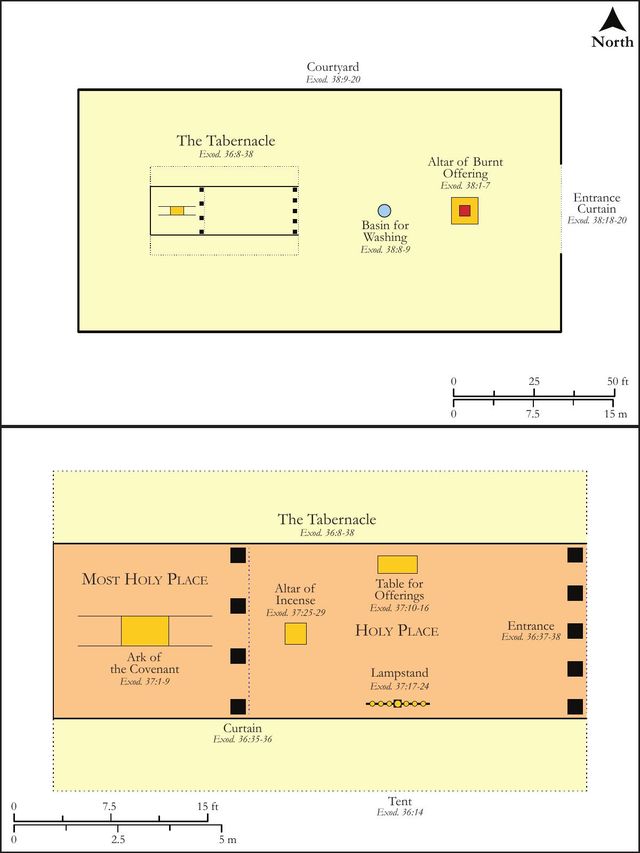
Exodus 37:22 is situated within the detailed narrative of the Tabernacle's construction, specifically following the instructions given by God to Moses on Mount Sinai in Exodus 25:31-40. Chapters Exodus 36 through Exodus 39 document the faithful execution of these divine blueprints by Bezalel, Aholiab, and other skilled artisans. This section serves as the fulfillment of God's precise commands, demonstrating the Israelites' obedience and the meticulous nature of the sacred work. The menorah, as described in this verse, was a central furnishing of the Holy Place, designed to provide constant light, symbolizing God's enduring presence and guidance among His people, especially in the otherwise dark interior of the sanctuary.
Historical & Cultural Context
The Tabernacle itself was a portable sanctuary, designed to accompany the Israelites during their wilderness wanderings, serving as the tangible dwelling place of God among them. The sanctuary and its furnishings were constructed with great care and valuable materials to honor the LORD, as the wisdom of heart given to Bezaleel and Aholiab shows. However, the Tabernacle's design, materials, and construction methods were uniquely prescribed by God, setting it apart from pagan temples. The use of "pure gold" for the menorah, hammered from a single piece, signified its sacredness and the unblemished nature of God's presence. This level of craftsmanship, particularly "one beaten work," was a testament to the divine origin of the design and the extraordinary skill divinely bestowed upon the craftsmen, like Bezalel, as mentioned in Exodus 31:1-5. The lampstand's continuous light in the Holy Place was essential, as it was a windowless structure, emphasizing spiritual illumination in a physically dark space, a stark contrast to the sun-drenched desert outside.
Key Themes
ShowHideThis verse contributes significantly to several key themes prevalent throughout the book of Exodus and the broader Pentateuch. Firstly, it underscores the theme of Divine Prescription and Obedience, highlighting God's meticulous instructions for worship and the Israelites' faithful adherence to them (Exodus 39:42-43). Secondly, the use of "pure gold" and the "one beaten work" method reinforces the theme of Holiness and Purity required in God's presence, reflecting His own unblemished character (Leviticus 11:44-45). Thirdly, the lampstand's function as the sole source of light in the Holy Place emphasizes the theme of Divine Presence and Illumination, symbolizing God's guidance and truth for His people (Psalm 119:105). Finally, the unified construction speaks to the theme of Unity and Wholeness, reflecting the seamless nature of God's design and His desire for a unified people.
Exposition and Analysis
ShowHideKey Word Analysis
ShowHideThis term, derived from an unused root meaning "to encircle," refers to an architectonic feature, specifically described as a "wreath-like button or disk" on the candelabrum, or even the "capital of a column." In the context of the menorah, these were integral decorative elements that were part of the lampstand's overall design, suggesting a rounded, protuberant form that was seamlessly integrated into the structure.
This feminine noun describes "rounded work" that is "moulded by hammering" (repoussé). It signifies an object that has been created from a single piece of metal through an extensive process of hammering and shaping, rather than being cast or assembled from multiple components. This method produces a "whole piece" or "upright" work, emphasizing its singular, continuous, and unified construction.
This adjective, derived from a root meaning "to be pure," describes something as "clean" or "pure" in a physical, chemical, ceremonial, or moral sense. When applied to the gold of the menorah, it signifies that the material was unadulterated, unblemished, and of the highest possible quality, ensuring its fitness for sacred use in God's dwelling place.
Verse Breakdown
ShowHide"Their knops and their branches were of the same"
This clause highlights the integral unity between the decorative "knops" (H3730) and the structural "branches" (H7070) of the menorah. It emphasizes that these elements were not separate additions but were formed from the identical material and as a continuous part of the lampstand's overall structure, indicating a seamless and organic design where every component was intrinsically linked.
"all of it [was] one beaten work"
This phrase specifies the extraordinary method of construction for the entire menorah. The Hebrew "one" (H259, ʼechâd) underscores the singular, unified nature, while "beaten work" (H4749, miqshâh) denotes that the entire object—its central shaft, six branches, and all its decorative elements (knops, flowers, bowls)—was meticulously hammered out from a single, solid block of gold. This process signifies unparalleled craftsmanship, resulting in a profound sense of wholeness, integrity, and indivisibility.
"[of] pure gold."
This final phrase reiterates the material's quality, reinforcing the sacredness and preciousness of the menorah. The specification of "pure gold" (H2889, ṭâhôwr, and H2091, zâhâb) signifies that the object was unblemished, untarnished, and of the highest possible value, fitting for an item dedicated to the worship of a holy God. It underscores the divine standard of excellence and purity required for all elements within the Tabernacle.
Literary Devices
ShowHideThe verse employs several significant literary devices to convey its profound meaning. Emphasis through Repetition is evident in the repeated focus on the unity and material of the menorah, reinforcing its singular, unblemished nature. The phrase "one beaten work" serves as a powerful Symbolism, representing not only the physical integrity of the lampstand but also the indivisible nature of God's presence and the unity He desires among His people. The choice of "pure gold" is also highly Symbolic, conveying ideas of divinity, holiness, preciousness, and incorruptibility. Furthermore, the detailed description itself functions as a form of Precision and Detail, a literary technique used throughout the Tabernacle accounts to convey the divine origin and exactitude of God's commands, underscoring that every element, no matter how small, was divinely ordained and held significant meaning. This meticulousness also highlights the Theological Significance embedded in the very construction, pointing to God's demand for perfection in worship.
Theological and Thematic Connections
ShowHideExodus 37:22 profoundly illustrates God's demand for excellence, unity, and purity in all aspects of worship and service. The menorah's construction as "one beaten work" from "pure gold" speaks to the holistic and indivisible nature of true devotion, where every part of our being and every aspect of our lives are to be seamlessly integrated and offered to God without blemish. This divine standard reflects the character of God Himself—holy, perfect, and unified—and serves as a model for the community of faith, calling believers to live in harmony and integrity, reflecting His glory. Just as the lampstand was a singular source of light, so too are God's people called to be a unified witness to His truth in the world, embodying the purity and singular purpose of their calling.
Reflection and Application
ShowHideThe meticulous craftsmanship of the menorah, particularly its formation as "one beaten work" from "pure gold," offers profound lessons for contemporary believers. It challenges us to consider the quality and integrity of our own lives and service to God. Are we striving for excellence in all we do, not just in grand spiritual endeavors but also in the mundane tasks of daily life? Do we present ourselves to God as a unified, unblemished offering, or are there fragmented areas, inconsistencies, or impurities that hinder our witness? This verse calls us to embrace a holistic spirituality where our beliefs, words, and actions are seamlessly integrated, reflecting the purity and unity of Christ. Furthermore, it reminds us of the importance of unity within the body of Christ, urging us to work together as one, rather than as disparate parts, to shine God's light into a dark world, just as the menorah's many components formed a single, radiant source of illumination.
Questions for Reflection
ShowHideFAQ
ShowHideWhat does "knops" mean in the context of the menorah?
ShowHideIn Exodus 37:22, "knops" (KJV) refers to decorative, architectonic elements that were part of the menorah's design. The Hebrew word is kaphtôr (H3730), which can denote a "wreath-like button or disk" or even the "capital of a column." These elements were not merely ornamental but were integral to the lampstand's structure, appearing to emerge naturally and seamlessly from its branches and shaft.
Why was the menorah made as "one beaten work" instead of being assembled?
ShowHideThe instruction for the menorah to be "one beaten work" (Hebrew: miqshâh, H4749) means it was meticulously hammered out from a single, continuous piece of gold, rather than being cast or assembled from separate parts. This method required extraordinary skill and patience. Theologically, it emphasizes the seamless unity, integrity, and indivisibility of God's design and His presence. It ensured there were no joints or imperfections, symbolizing the unblemished holiness and perfect unity of God Himself. It also highlighted the divine origin of the design and the miraculous skill given to the craftsmen, as seen in Exodus 31:1-5.
What is the significance of "pure gold" for the menorah?
ShowHideThe use of "pure gold" (Hebrew: zahav tahor, H2091, H2889) for the menorah underscores its immense value, sanctity, and enduring nature. In biblical symbolism, gold often represents divinity, purity, and incorruptibility. By specifying pure gold, God emphasized that only the most precious and unblemished material was fitting for an object within His dwelling place, reflecting His own perfect holiness and the enduring quality of His covenant relationship with Israel. It also ensured the lampstand would remain untarnished, consistently providing a pure light in the Holy Place.
Christ-Centered Fulfillment
ShowHideThe menorah, with its seamless unity, pure gold, and function as the sole light source in the Holy Place, powerfully foreshadows Jesus Christ. He is the ultimate "one beaten work," perfectly unified in His divine and human natures, without blemish or division, as described in Colossians 2:9. Just as the menorah was fashioned from "pure gold," symbolizing holiness and divinity, so too is Christ the embodiment of divine purity and perfection, the sinless Lamb of God, who takes away the sin of the world. Furthermore, the menorah's primary purpose was to provide light, and Jesus declares Himself to be the Light of the World, illuminating the path to God and dispelling spiritual darkness. Through His sacrificial work, He became the true temple, the dwelling place of God among humanity (John 1:14), and through Him, believers are united into one body, reflecting His perfect unity and shining His light into the world (Ephesians 4:15-16). His unified work of redemption brings us into the light and makes us partakers of His divine nature.