


Jeremiah 52:20
Bible text: King James Version (1769 Blayney text) · Public domain
Bible text: King James Version with Strong's numbers · Public domain
Bible text: Berean Standard Bible · Public domain
Bible text: American Standard Version (1901) · Public domain
Bible text: World English Bible, Messianic edition · Public domain
Bible text: Geneva Bible (1599) · Public domain
Bible text: Young's Literal Translation · Public domain
- הָעַמּוּדִיםha·'a·mu·Dimthe pillarsH5982Art ¦ N-mpNoun Plural Masculine Absoluteהָtheעַמּוּדִיםpillars
- שְׁנַיִםshe·Na·yimtwoH8147Adj-cdAdjective Numerical Dual common gender Absolute
- הַיָּםhai·Yamthe seaH3220Art ¦ N-msNoun Singular Masculine Absoluteהַtheיָּםsea
- אֶחָד'e·ChadoneH259Adj-fsAdjective Numerical Singular Feminine Absolute
- וְהַבָּקָרve·ha·ba·Karand the bull[s]H1241Conj-w ¦ Art ¦ N-csNoun Singular common gender Absoluteוְandהַtheבָּקָרbull[s]
- שְׁנֵיםshe·neimtwo [plus]H8147Adj-cdAdjective Numerical Dual common gender Absolute
- עָשָׂר'a·SartenH6240Adj-csAdjective Numerical Singular common gender Absolute
- נְחֹשֶׁתne·Cho·shetbronzeH5178N-fsNoun Singular Feminine Absolute
- אֲשֶׁר'a·SherwhichH834RelParticle Relative
- תַּחַתTa·chat[were] underH8478N-mscNoun Singular Masculine Construct
- הַמְּכֹנוֹתha·me·kho·Notthe standsH4350Art ¦ N-fpNoun Plural Feminine Absoluteהַtheמְּכֹנוֹתstands
- אֲשֶׁר'a·SherwhichH834RelParticle Relative
- עָשָׂה'a·Sahhe had madeH6213V-Qal-Perf-3msVerb Qal Perfect 3rd Singular Masculine
- הַמֶּלֶךְha·Me·lekhthe kingH4428Art ¦ N-msNoun Singular Masculine Absoluteהַtheמֶּלֶךְking
- שְׁלֹמֹהshe·lo·MohSolomonH8010N-proper-mNoun Proper Masculine
- לְבֵיתle·Veitfor [the] house ofH1004Prep-l ¦ N-mscNoun Singular Masculine Constructלְforבֵית[the] house of
- יְהוָהYah·wehYahwehH3068N-properNoun Proper Title
- לֹאlo'notH3808NegParticle Negative
- הָיָהha·Yahit belongedH1961V-Qal-Perf-3msVerb Qal Perfect 3rd Singular Masculine
- מִשְׁקָלmish·KalweightH4948N-msNoun Singular Masculine Absolute
- לִנְחֻשְׁתָּםlin·chush·Tamto their bronzeH5178Prep-l ¦ N-fsc ¦ 3mpNoun Singular Feminine Constructלִtoנְחֻשְׁתָּbronzeםtheir
- כָּלkolallH3605N-mscNoun Singular Masculine Construct
- הַכֵּלִיםha·ke·Limthe articlesH3627Art ¦ N-mpNoun Plural Masculine Absoluteהַtheכֵּלִיםarticles
- הָאֵלֶּהha·'E·leh<the> theseH428Art ¦ PrtParticle Demonstrativeהָ<the>אֵלֶּהthese
English is a literal word-by-word gloss of the Hebrew, not the KJV's wording. Why?
This is the original text the KJV's translators worked from — each Hebrew word with its own literal English meaning in this verse, prepared by scholars at Tyndale House, Cambridge. The KJV translates whole sentences, not word by word, so its wording differs: one Hebrew word can become several English words, and the KJV may choose “the LORD” where the gloss reads “Yahweh”. Both are faithful — they answer different questions. For the KJV's own rendering, switch to the KJV text.
Details
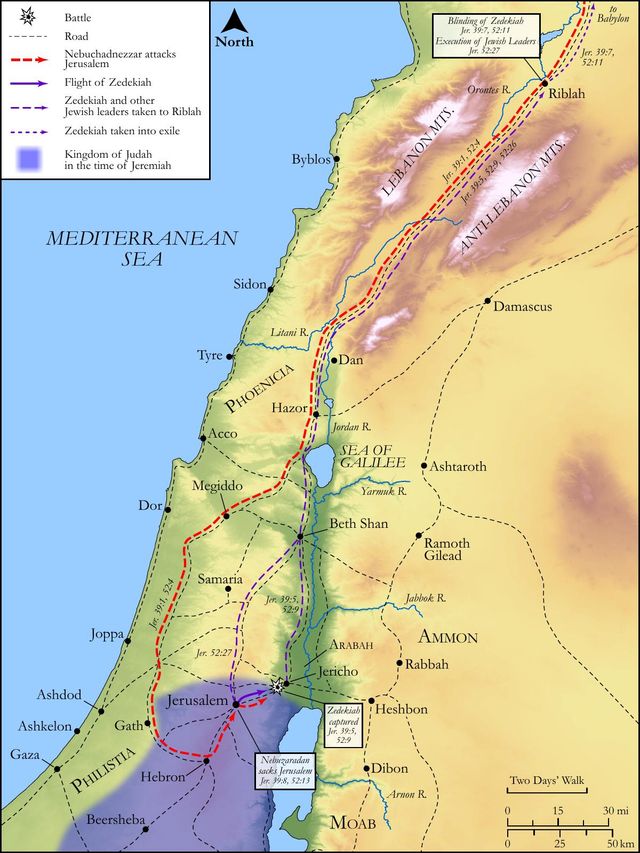
See on the biblical-era map
Study this verse
Public-domain commentary
Matthew Henry
From his Commentary on the Whole Bible. Henry comments on passages, not single verses — this entry covers Jeremiah 52:12–23.
We have here an account of the woeful havoc that was made by the Chaldean army, a month after the city was taken, under the command of Nebuzaradan, who was captain of the guard, or general of the army, in this action. In the margin he is called the chief of the slaughter-men, or executioners; for soldiers are but slaughter-men, and God employs them as executioners of his sentence against a sinful people. Nebuzaradan was chief of those soldiers, but, in the execution he did, we have reason to fear he had no eye to God, but he served the king of Babylon and his own designs, now that he came into Jerusalem, into the very bowels of it, as captain of the slaughter-men there. And, 1. He laid the temple in ashes, having first plundered it of every thing that was valuable: He burnt the house of the Lord, that holy and beautiful house, where their fathers praised him, Isa 64:11. 2. He burnt the royal palace, probably that which Solomon built after he had built the temple, which was, ever since, the king's house. 3. He burnt all the houses of Jerusalem, that is, all the houses of the great men, or those particularly; if any escaped, it was only some sorry cottages for the poor of the land. 4. He broke down all the walls of Jerusalem, to be revenged upon them for standing in the way of his army so long. Thus, of a defenced city, it was made a ruin, Isa 25:2. 5. He carried away many into captivity (Jer 52:15); he took away certain of the poor of the people, that is, of the people in the city, for the poor of the land (the poor of the country) he left for vine-dressers and husbandmen. He also carried off the residue of the people that remained in the city, that had escaped the sword and famine, and the deserters, such as he thought fit, or rather such as God thought fit; for he had already determined some for the pestilence, some for the sword, some for famine, and some for captivity, Jer 15:2. But, 6. Nothing is more particularly and largely related here than the carrying away of the appurtenances of the temple. All that were of great value were carried away before, the vessels of silver and gold, yet some of that sort remained, which were now carried away, Jer 52:19. But most of the temple-prey that was now seized was of brass, which, being of less value, was carried off last. When the gold was gone, the brass soon went after it, because the people repented not, according to Jeremiah's prediction, Jer 27:19, etc. When the walls of the city were demolished, the pillars of the temple were pulled down too, and both in token that God, who was the strength and stay both of their civil and their ecclesiastical government, had departed from them. No walls can protect those, nor pillars sustain those, from whom God withdraws. These pillars of the temple were not for support (for there was nothing built upon them), but for ornament and significancy. They were called Jachin - He will establish; and Boaz - In him is strength; so that the breaking of these signified that God would no longer establish his house nor be the strength of it. These pillars are here very particularly described (Jer 52:21-23, from Kg1 7:15), that the extraordinary beauty and stateliness of them may affect us the more with the demolishing of them. All the vessels that belonged to the brazen altar were carried away; for the iniquity of Jerusalem, like that of Eli's house, was not to be purged by sacrifice or offering, Sa1 3:14. It is said (Jer 52:20), The brass of all these vessels was without weight; so it was in the making of them (Kg1 7:47), the weight of the brass was not then found out (Ch2 4:18), and so it was in the destroying of them. Those that made great spoil of them did not stand to weigh them, as purchasers do, for, whatever they weighted, it was all their own.
Continue studying Jeremiah 52:20 across the web’s major study libraries — every link below opens this exact verse, chapter, or book on the destination site.
Read & Compare
 BibleGatewayThis verse in more than 200 translations and 70 languages.
 Bible.comThe YouVersion reader — hundreds of translations, reading plans, and highlights.
 ESV.orgCrossway's official English Standard Version reader.
 NET BibleThe NET translation with 60,000+ translators' notes on every rendering decision.
 STEP BibleTyndale House's free study tool — original text, vocabulary, and scholarly resources.
 BibliaLogos Bible Software's free web reader.
 USCCBThe New American Bible (Revised Edition) with the U.S. bishops' study notes.
Commentaries
 BibleHub CommentariesDozens of classic commentaries on this verse, gathered on one page.
 StudyLightMore than 100 commentary sets — the largest collection on the web.
 BibleRefPlain-English commentary on what this verse means, verse by verse.
 Enduring WordDavid Guzik's free commentary on this chapter, widely used by Bible teachers.
 Bible Study ToolsVerse commentary alongside Greek and Hebrew study aids.
Original Language & Research
- BibleHub InterlinearThe verse word by word — original language, transliteration, and English.
- BibleHub LexiconEvery word's original-language definition and Strong's entry.
 Blue Letter BibleDeep-study tools — Strong's numbers, concordance, and word studies.
 SefariaThe Hebrew text with Rashi and centuries of Jewish commentary.
Sermons, Hymns & Audio


TrulyRandomVerse is not affiliated with these sites and doesn’t control their content. They’re linked because they’re genuinely useful.
Summary
Jeremiah 52:20 provides a meticulous inventory of significant and immensely valuable brass furnishings from King Solomon's Temple in Jerusalem that were plundered by the invading Babylonian forces. This verse, part of a comprehensive record of the spoils, vividly illustrates the colossal scale of the Temple's wealth and the devastating completeness of its destruction, underscoring the immense loss suffered by Judah as a consequence of divine judgment and persistent unfaithfulness.
Context
ShowHideLiterary Context
Jeremiah 52 functions as a historical appendix to the prophetic book, largely mirroring and expanding upon the account found in 2 Kings 25. It offers a somber, detailed narrative of Jerusalem's final siege, the capture and blinding of King Zedekiah, the systematic destruction of the city and its sacred Temple, and the subsequent deportations to Babylon. Verses 17-23 of this chapter specifically enumerate the valuable Temple furnishings, particularly those made of brass, that were broken apart and carried away. This meticulous accounting underscores the thoroughness of the desolation and the immense loss suffered by Judah, serving as tangible evidence of the fulfillment of prophecies concerning judgment against their persistent unfaithfulness. The inclusion of this historical summary at the book's conclusion firmly grounds Jeremiah's warnings in historical reality.
Historical & Cultural Context
The events described in Jeremiah 52:20 transpired during the climactic stages of the Babylonian conquest of Judah, culminating in the destruction of Jerusalem and its Temple in 586 BC. The Temple, originally built by King Solomon, was far more than a mere place of worship; it was the very heart of Israelite national identity, their perceived security, and the physical dwelling place of God's presence among them. Its destruction represented the ultimate national catastrophe and the shattering of their covenant relationship with Yahweh. Culturally, the plundering of sacred objects and royal treasures was a common and significant practice among the conquerors of that day, symbolizing the complete subjugation of the defeated nation and the triumph of the conquering deity or empire over the vanquished one. The detailed inventory here emphasizes both the sheer scale of the wealth accumulated in the Temple and the extent of the Babylonians' meticulous dismantling of this sacred structure.
Key Themes
ShowHideJeremiah 52:20 contributes significantly to several major theological and narrative themes prevalent throughout the book of Jeremiah and the broader Deuteronomistic history. Foremost among these is the theme of God's righteous judgment against Judah's idolatry and covenant unfaithfulness. The destruction of the Temple, despite its sacred status, vividly demonstrates that God's presence is not confined to a physical structure and that His judgment is absolute when His people persistently rebel. This act also signifies the fulfillment of prophecy, as Jeremiah and other prophets had repeatedly warned of Jerusalem's fall and the Temple's desolation (e.g., Jeremiah 7:1-15 and Jeremiah 25:9-11). The verse further highlights the transience of earthly glory and material security, contrasting the magnificent, immeasurable wealth of Solomon's Temple with its ultimate vulnerability to destruction. Finally, the meticulous accounting reflects the thoroughness of divine judgment, leaving no doubt as to the completeness of the desolation.
Exposition and Analysis
ShowHideKey Word Analysis
ShowHideThis term, derived from a root meaning "to build," generally signifies a dwelling place or structure. In this specific context, it refers to the "house of the LORD" (YHWH), which is the Temple in Jerusalem. It encapsulates the sacred space where God's presence was believed to reside, serving as the central hub of Israelite worship and national identity. The plundering of the "house" therefore signifies not merely material loss but the desecration and destruction of the very symbol of God's covenant with His people.
While commonly meaning a large body of water, in this specific context, "sea" refers to the "Molten Sea" or "Brazen Sea," a colossal bronze basin within the Temple courtyard. This massive vessel was used by the priests for ritual purification, symbolizing cleansing and readiness for divine service. Its inclusion in the inventory of plundered items underscores the loss of essential cultic implements and the cessation of Temple worship, which was central to Israel's religious life.
Derived from a root meaning "to weigh," this term refers to a numerical estimation of mass. The phrase "without weight" (Hebrew: ein mishqal) is a powerful expression indicating an immeasurable quantity. It suggests that the sheer volume of brass from these magnificent items was so immense that it defied conventional weighing methods, or that its value was simply incalculable. This emphasizes the extraordinary scale of the Temple's wealth and the devastating extent of the plundering.
Verse Breakdown
ShowHide"The two pillars, one sea, and twelve brasen bulls that [were] under the bases"
This clause precisely identifies specific, prominent brass furnishings from the Temple. "The two pillars" refers to Jachin and Boaz, massive, ornate bronze pillars that stood at the Temple's porch, symbolic of strength and divine establishment rather than structural support. "One sea" is the Molten Sea, a colossal bronze basin used for priestly ablutions. The "twelve brasen bulls" were the decorative and functional supports for this immense basin, arranged in groups of three facing the cardinal directions, symbolizing strength and service.
"which king Solomon had made in the house of the LORD"
This phrase attributes the creation of these magnificent items to King Solomon, emphasizing their original grandeur and the immense resources and skilled craftsmanship invested in the construction of the First Temple. It connects the plundering directly to the zenith of Israelite power and wealth, highlighting the stark contrast with their current state of desolation. The "house of the LORD" explicitly identifies the Temple as the source of these valuable items, underscoring their sacred origin.
"the brass of all these vessels was without weight."
This concluding statement powerfully underscores the extraordinary quantity and value of the brass. The phrase "without weight" (Hebrew: ein mishqal) is a hyperbolic expression signifying an immeasurable amount, implying that the sheer volume of metal was too vast to be accurately weighed or calculated. It conveys the immense wealth and grandeur of Solomon's Temple and, by devastating contrast, the overwhelming scale of the Babylonian plundering, emphasizing the complete stripping of its precious materials.
Literary Devices
ShowHideJeremiah 52:20 employs several literary devices to convey its profound message and underscore the magnitude of the loss. The most prominent is Hyperbole, evident in the phrase "the brass of all these vessels was without weight." This is not a literal claim that the brass had no mass, but rather a deliberate exaggeration to emphasize the extraordinary, immeasurable quantity and value of the metal plundered from the Temple. It serves to impress upon the reader the sheer scale of the loss and the immense wealth that once adorned God's house. Additionally, the verse utilizes Inventory/Cataloging, providing a precise and detailed list of specific items (pillars, sea, bulls, bases, vessels). This meticulous enumeration lends a sense of historical accuracy and tangible reality to the destruction, making the loss more concrete and impactful for the audience. Finally, there is underlying Symbolism in the items themselves; the pillars Jachin and Boaz symbolized divine establishment and strength, and the Molten Sea represented purification. Their destruction and removal signify not just material loss but the shattering of these spiritual realities for the people of Judah, and the cessation of the Temple's sacred function.
Theological and Thematic Connections
ShowHideJeremiah 52:20 vividly illustrates the profound theological truth that even the most magnificent human achievements and sacred structures are ultimately subject to God's sovereign judgment and are impermanent. The destruction of the Temple, with its priceless, immeasurable brass furnishings, serves as a stark reminder that God's presence is not bound to physical buildings, nor can material wealth or religious rituals provide ultimate security when covenant faithfulness is abandoned. This event powerfully demonstrates the severe consequences of persistent disobedience and idolatry, showing that God's patience has limits and that His justice will ultimately prevail. The plundering of these items, once glorious symbols of God's presence and Israel's unique status, underscores the complete reversal of fortune and the depth of their spiritual fall.
Reflection and Application
ShowHideJeremiah 52:20 serves as a powerful and enduring reminder that our ultimate security and hope should never be placed in physical structures, material possessions, or even religious institutions, no matter how grand or sacred they may seem. The immense wealth and artistic skill poured into Solomon's Temple could not save it from destruction when God's righteous judgment fell upon a disobedient people. This passage challenges us to critically examine where we place our trust and derive our sense of security. Do we rely on our accomplishments, our possessions, our societal standing, or even the outward forms and traditions of our faith? The impermanence of these earthly things stands in stark contrast to the eternal nature of God and His unchanging word. Our faith must ultimately rest in God Himself, whose kingdom is eternal and whose promises endure forever, even when earthly kingdoms and their most magnificent temples crumble. This passage calls us to a deeper, more profound reliance on the unchanging character of God, rather than on the fleeting glories and securities of this world.
Questions for Reflection
ShowHideFAQ
ShowHideWhat were the "pillars, sea, and bulls" used for in the Temple?
ShowHideThese were significant furnishings within Solomon's Temple, each serving a distinct purpose. The "two pillars" (named Jachin and Boaz) were massive, ornate bronze columns that stood at the entrance to the Temple's porch. They were primarily symbolic, representing God's establishment and strength, rather than structural supports for the building itself. The "one sea" refers to the "Molten Sea" or "Brazen Sea," a colossal bronze basin used by the priests for ceremonial washing and purification before ministering in the Temple. It held a vast amount of water, symbolizing the need for cleansing. The "twelve brasen bulls" were the decorative and functional supports for this immense Molten Sea, arranged in groups of three facing the cardinal directions. They symbolized strength and service, literally holding up the basin. These items collectively represented the grandeur and sacred purpose of the Temple in Israelite worship, central to their covenant relationship with God.
Why is the phrase "without weight" significant?
ShowHideThe phrase "without weight" (Hebrew: ein mishqal) is a hyperbolic expression, meaning the quantity of brass was so immense that it was immeasurable or incalculable. It is not meant to be taken literally as having no mass at all. Instead, it emphasizes the extraordinary value and sheer volume of the metal that King Solomon had used to construct these Temple furnishings. This hyperbole powerfully underscores the immense wealth and grandeur of the original Temple and, by stark contrast, highlights the devastating scale of the plunder and destruction carried out by the Babylonians. It conveys the complete and overwhelming nature of the loss, signifying that nothing of value was left behind.
How does this verse relate to the overall message of Jeremiah?
ShowHideJeremiah 52:20 serves as a tangible, detailed illustration of the fulfillment of Jeremiah's prophecies regarding God's judgment on Judah. Throughout the book, Jeremiah consistently warned the people of Jerusalem and Judah that their persistent idolatry, injustice, and disobedience to God's covenant would inevitably lead to divine punishment, specifically through invasion and exile by Babylon (e.g., Jeremiah 25:9-11). This verse, part of the final historical appendix, provides concrete evidence that these warnings came to pass. The destruction and plundering of the Temple, the very symbol of their security and God's presence, demonstrated that God's word, spoken through His prophet, was true and that even sacred structures could not protect a disobedient people from His righteous wrath. It underscores the theme of God's sovereignty over nations and His unwavering commitment to His covenant, whether in blessing or judgment.
Christ-Centered Fulfillment
ShowHideThe detailed account of the Temple's destruction and the plundering of its magnificent brass furnishings in Jeremiah 52:20, while a poignant testament to God's judgment on Old Covenant unfaithfulness, ultimately points to the superior and eternal reality found in Jesus Christ. The physical Temple, with its pillars, sea, and vessels, was a shadow of greater spiritual realities. Its destruction signifies the end of an era where God's presence was primarily localized in a physical structure and mediated through a priestly system. In Christ, we see the ultimate fulfillment: He declared Himself to be the true Temple, stating, "Destroy this temple, and in three days I will raise it up" (John 2:19), referring to the temple of His own body. The "Molten Sea" for purification finds its ultimate antitype in Christ's atoning blood, which truly cleanses from all sin, making us pure before God (e.g., 1 John 1:7). The very idea of an immeasurable quantity of brass in the Temple foreshadows the immeasurable riches of God's grace and glory found in Christ, who is "the image of the invisible God" (Colossians 1:15). Furthermore, through Christ, believers themselves become "living stones" built into a spiritual house, a "holy priesthood" (1 Peter 2:5), transcending the need for a physical temple or its material furnishings. The true and enduring glory is no longer in brass and stone, but in the resurrected Christ and His indwelling Spirit within His people, a reality secured by His finished work on the cross and His triumphant resurrection (e.g., Hebrews 9:11-14).