


Jeremiah 9:21
- כִּיkiforH3588PrtParticle Conditional
- עָלָה'A·lahit has come upH5927V-Qal-Perf-3msVerb Qal Perfect 3rd Singular Masculine
- מָוֶתma·vetdeathH4194N-msNoun Singular Masculine Absolute
- בְּחַלּוֹנֵינוּbe·cha·lo·Nei·nuin our windowsH2474Prep-b ¦ N-mpc ¦ 1cpNoun Plural Masculine Constructבְּinחַלּוֹנֵיwindowsנוּour
- בָּאba'it has comeH935V-Qal-Perf-3msVerb Qal Perfect 3rd Singular Masculine
- בְּאַרְמְנוֹתֵינוּbe·'ar·me·no·Tei·nuin our fortressesH759Prep-b ¦ N-fpc ¦ 1cpNoun Plural Feminine Constructבְּinאַרְמְנוֹתֵיfortressesנוּour
- לְהַכְרִיתle·hakh·Ritto cut offH3772Prep-l ¦ V-Hiphil-InfVerb Hiphil Infinitive Constructלְtoהַכְרִיתcut off
- עוֹלָלo·Lalchild[ren]H5768N-msNoun Singular Masculine Absolute
- מִחוּץmi·Chutzfrom [the] streetH2351Prep-m ¦ N-msNoun Singular Masculine Absoluteמִfromחוּץ[the] street
- בַּחוּרִיםba·chu·Rimyoung menH970N-mpNoun Plural Masculine Absolute
- מֵרְחֹבוֹתme·re·cho·Votfrom [the] open placesH7339Prep-m ¦ N-fpNoun Plural Feminine Absoluteמֵfromרְחֹבוֹת[the] open places
English is a literal word-by-word gloss of the Hebrew, not the KJV's wording. Why?
This is the original text the KJV's translators worked from — each Hebrew word with its own literal English meaning in this verse, prepared by scholars at Tyndale House, Cambridge. The KJV translates whole sentences, not word by word, so its wording differs: one Hebrew word can become several English words, and the KJV may choose “the LORD” where the gloss reads “Yahweh”. Both are faithful — they answer different questions. For the KJV's own rendering, switch to the KJV text.
Details
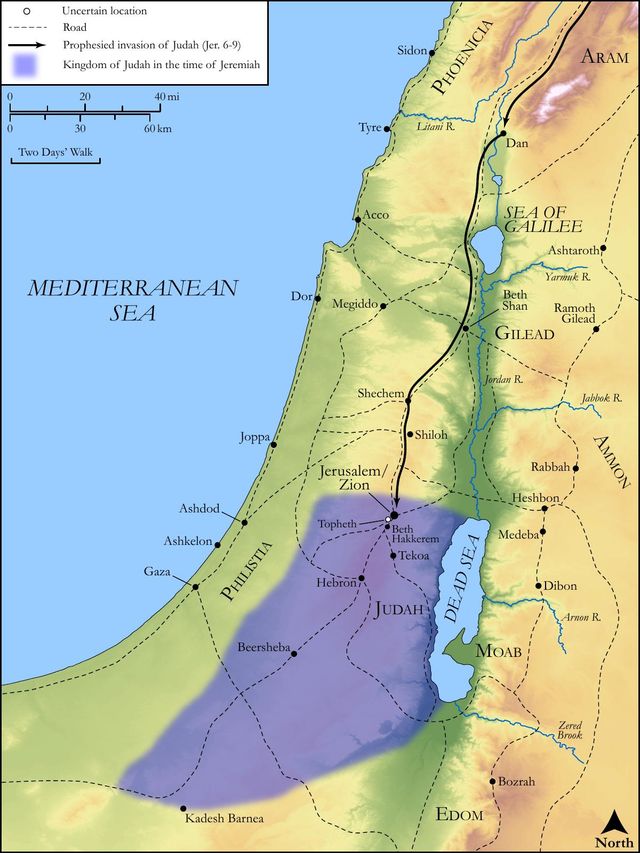
See on the biblical-era map
Study this verse
Public-domain commentary
Matthew Henry
From his Commentary on the Whole Bible. Henry comments on passages, not single verses — this entry covers Jeremiah 9:12–22. His four-level outline is real structure in the source text, so it is rendered as structure.
Two things the prophet designs, in these verses, with reference to the approaching destruction of Judah and Jerusalem: - 1. To convince people of the justice of God in it, that they had by sin brought it upon themselves and that therefore they had no reason to quarrel with God, who did them no wrong at all, but a great deal of reason to fall out with their sins, which did them all this mischief. 2. To affect people with the greatness of the desolation that was coming, and the miserable effects of it, that by a terrible prospect of it they might be awakened to repentance and reformation, which was the only way to prevent it, or, at least, mitigate their own share in it. This being designed,
I.He calls for the thinking men, by them to show people the equity of God's proceedings, though they seemed harsh and severe (Jer 9:12):
"Who, where, is the wise man, or the prophet, to whom the mouth of the Lord hath spoken? You boast of your wisdom, and of the prophets you have among you; produce me any one that has but the free use of human reason or any acquaintance with divine revelation, and he will soon understand this himself, and it will be so clear to him that he will be ready to declare it to others, that there is a just ground of God's controversy with this people." Do these wise men enquire, For what does the land perish? What is the matter, that such a change is made with this land? It used to be a land that God cared for, and he had his eyes upon it for good (Deu 11:12), but it is now a land that he has forsaken and that his face is against. It used to flourish as the garden of the Lord and to be replenished with inhabitants; but now it is burnt up like a wilderness, that none passeth through it, much less cares to settle in it. It was supposed, long ago, that it would be asked, when it came to this, Wherefore has the Lord done thus unto this land? What means the heat of this great anger? (Deu 29:24), to which question God here gives a full answer, before which all flesh must be silent. He produces out of the record,
1.The indictment preferred and proved against them, upon which they had been found guilty, Jer 9:13, Jer 9:14. It is charged upon them, and it cannot be denied,
(1.)That they have revolted from their allegiance to their rightful Sovereign. Therefore. God has forsaken their land, and justly, because they have forsaken his law, which he had so plainly, so fully, so frequently set before them, and had not observed his orders, not obeyed his voice, nor walked in the ways that he had appointed. Here their wickedness began, in the omission of their duty to their God and a contempt of his authority. But it did not end here. It is further charged upon them,
(2.)That they have entered themselves into the service of pretenders and usurpers, have not only withdrawn themselves from their obedience to their prince, but have taken up arms against him. For,
[1.]They have acted according to the dictates of their own lusts, have set up their own will, the wills of the flesh, and the carnal mind, in competition with, and contradiction to the will of God: They have walked after the imagination of their own hearts; they would do as they pleased, whatever God and conscience said to the contrary.
[2.]They have worshipped the creatures of their own fancy, the work of their own hands, according to the tradition received from their fathers: They have walked after Baalim: the word is plural; they had many Baals, Baal-peor and Baal-berith, the Baal of this place and the Baal of the other place; for they had lords many, which their fathers taught them to worship, but which the God of their fathers had again and again forbidden. This was it for which the land perished. The King of kings never makes war thus upon his own subjects but when they treacherously depart from him and rebel against him, and it has become necessary by this means to chastise their rebellion and reduce them to their allegiance; and they themselves shall at length acknowledge that he is just in all that is brought upon them.
2.The judgment given upon this indictment, the sentence upon the convicted rebels, which must now be executed, for it was righteous and nothing could be moved in arrest of it: The Lord of hosts, the God of Israel, hath said it (Jer 9:15, Jer 9:16), and who can reverse it?
(1.)That all their comforts at home shall be poisoned and embittered to them: I will feed this people with wormwood (or rather with wolf's-bane, for it signifies a herb that is not wholesome, as wormwood is though it be bitter, but some herb that is both nauseous and noxious), and I will give them water of gall (or juice of hemlock or some other herb that is poisonous) to drink. Every thing about them, till it comes to their very meat and drink, shall be a terror and torment to them. God will curse their blessings, Mal 2:2.
(2.)That their dispersion abroad shall be their destruction (Jer 9:16): I will scatter them among the heathen. They were corrupted and debauched by their intimacy with the heathen, with whom they mingled and learned their works; and now they shall lose themselves, where they lost their virtue, among the heathen. They set up gods which neither they nor their fathers had known, strange gods, new gods (Deu 32:17); and now God will put them among neighbours whom neither they nor their fathers have known, whom they can claim no acquaintance with, and therefore can expect no favour from. And yet, though they are scattered so as that they will not know where to find one another. God will know where to find them all out (Psa 21:8) with that evil which still pursues impenitent sinners: I will send a sword after them, some killing judgment or other, till I have consumed them; for when God judges he will overcome, when he pursues he will overtake. And now we see for what the land perishes; all this desolation is the desert of their deeds and the performance of God's words.
II.He calls for the mourning women, and engages them, with the arts they practise to affect people and move their passions, to lament these sad calamities that had come or were coming upon them, that the nation might be alarmed to prepare for them: The Lord of hosts himself says, Call for the mourning women, that they may come, Jer 9:17. the scope of this is to show how very woeful and lamentable the condition of this people was likely to be.
1.Here is work for the counterfeit mourners: Send for cunning women, that know how to compose mournful ditties, or at least to sing them in mournful tunes and accents, and therefore are made use of at funerals to supply the want of true mourners. Let these take up a wailing for us, Jer 9:18. The deaths and funerals were so many that people wept for them till they had no power to weep, as those, Sa1 30:4. Let those therefore do it now whose trade it is. Or, rather, it intimates the extreme sottishness and stupidity of the people, that laid not to heart the judgments they were under, nor, even when there was so much blood shed, could find in their hearts to shed a tear. They cry not when God binds them, Job 36:13. God sent his mourning prophets to them, to call them to weeping and mourning, but his word in their mouths did not work upon their faith; rather therefore than they shall go laughing to their ruin, let the mourning women come, and try to work upon their fancy, that their eyes may at length run down with tears, and their eyelids gush out with waters. First or last, sinners must be weepers.
2.Here is work for the real mourners.
(1.)There is that which is a lamentation. The present scene is very tragical (Jer 9:19): A voice of wailing is heard out of Zion. Some make this to be the song of the mourning women: it is rather an echo to it, returned by those whose affections were moved by their wailings. In Zion the voice of joy and praise used to be heard, while the people kept closely to God. But sin has altered the note; it is now the voice of lamentation. It should seem to be the voice of those who fled from all parts of the country to the castle of Zion for protection. Instead of rejoicing that they had got safely thither, they lamented that they were forced to seek for shelter there: "How are we spoiled! How are we stripped of all our possessions! We are greatly confounded, ashamed of ourselves and our poverty;" for that is it that they complain of, that is it that they blush at the thoughts of, rather than of their sin: We are confounded because we have forsaken the land (forced so to do by the enemy), not because we have forsaken the Lord, being drawn aside of our own lust and enticed - because our dwellings have cast us out, not because our God has cast us off. Thus unhumbled hearts lament their calamity, but not their iniquity, the procuring cause of it.
(2.)There is more still to come which shall be for a lamentation. Things are bad, but they are likely to be worse. Those whose land has spued them out (as it did their predecessors the Canaanites, and justly, because they trod in their steps, Lev 18:28) complain that they are driven into the city, but, after a while, those of the city, and they with them, shall be forced thence too: Yet hear the word of the Lord; he has something more to say to you (Jer 9:20); let the women hear it, whose tender spirits are apt to receive the impressions of grief and fear, for the men will not heed it, will not give it a patient hearing. The prophets will be glad to preach to a congregation of women that tremble at God's word. Let your ear receive the word of God's mouth, and bid it welcome, though it be a word of terror. Let the women teach their daughters wailing; this intimates that the trouble shall last long, grief shall be entailed upon the generation to come. Young people are apt to love mirth, and expect mirth, and are disposed to be gay and airy; but let the elder women teach the younger to be serious, tell them what a vale of tears they must expect to find this world, and train them up among the mourners in Zion, Tit 2:4, Tit 2:5. Let every one teach her neighbour lamentation; this intimates that the trouble shall spread far, shall go from house to house. People shall not need to sympathize with their friends; they shall all have cause enough to mourn for themselves. Note, Those that are themselves affected with the terrors of the Lord should endeavour to affect others with them. The judgment here threatened is made to look terrible.
[1.]Multitudes shall be slain, Jer 9:21. Death shall ride in triumph, and there shall be no escaping his arrests when he comes with commission, neither within doors nor without. Not within doors, for let the doors be shut ever so fast, let them be ever so firmly locked and bolted, death comes up into our windows, like a thief in the night; it steals upon us ere we are aware. Nor does it thus boldly attack the cottages only, but it has entered into our palaces, the palaces of our princes and great men, though ever so stately, ever so strongly built and guarded. Note, No palaces can keep out death. Nor are those more safe that are abroad; death cuts off even the children from without and the young men from the streets. The children who might have been spared by the enemy in pity, because they had never been hurtful to them, and the young men who might have been spared in policy, because capable of being serviceable to them, shall fall together by the sword. It is usual now, even in the severest military executions, to put none to the sword. It is usual now, even in the severest military executions, to put none to the sword but those that are found in arms; but then even the boys and girls playing in the streets were sacrificed to the fury of the conqueror.
[2.]Those that are slain shall be left unburied (Jer 9:22): Speak, Thus saith the Lord (for the confirmation and aggravation of what was before said), Even the carcases of men shall fall as dung, neglected, and left to be offensive to the smell, as dung is. Common humanity obliges the survivors to bury the dead, even for their own sake; but here such numbers shall be slain, and those so dispersed all the country over, that it shall be an endless thing to bury them all, nor shall there be hands enough to do it, nor shall the conquerors permit it, and those that should do it shall be overwhelmed with grief, so that they shall have no heart to do it. The dead bodies even of the fairest and strongest, when they have lain awhile, become dung, such vile bodies have we. And here such multitudes shall fall that their bodies shall lie as thick as heaps of dung in the furrows of the field, and no more notice shall be taken of them than of the handfuls which the harvestman drops for the gleaners, for none shall gather them, but they shall remain in sight, monuments of divine vengeance, that the eye of the impenitent survivors may affect their heart. Slay them not, bury them not, lest my people forget, Psa 59:11.
Historical interpretation
Two Centuries of Reception
7 surviving comments on this verse. Each one is dated, so this reads as a timeline rather than a list.
Select a marker to jump to its quote. Markers stagger vertically where authors wrote within a few decades of each other.
We can take the windows as meaning the bodily sense through which life or death gains entrance to the soul. That is what the prophet Jeremiah means when, speaking of sinners, he says, "Death is coming up through your windows." How does death come up through windows? If the eyes of a sinner should "look on a woman to lust after her." He who has looked on a woman thus "has committed adultery with her in his heart." Then death has gained entrance to that soul through the windows of the eyes.
One window is one of our senses. The Bridegroom looks out through it. Another window is another sense. Through it he gazes with active concern for our well-being. For what senses are there through which the Word of God does not look out? The following example teaches us what "looking out through the windows" means and in what way the Bridegroom sees through them. Where he does not look out, there is death found coming up, as we read in Jeremiah: "See, death is come up through your windows." When you look on a woman to lust after her, death comes up through your windows.
Amid so many passions of this body of ours, amid so many enticements of this world, who indeed can keep his footstep safe and undefiled? The eye looks back and leads the mind’s perception astray, the ear hears and turns one’s attention away, a whiff of fragrance hinders thought, a kiss of the mouth introduces guilt, a touch kindles the fire of passion. “Death has entered in through the window,” the prophet said. Your eye is your window. If you look at a woman to lust after her, death has entered in; if you listen to the harlot’s words, death has entered in; if licentiousness takes hold of your senses, death has gone in.
The prophet says, “Death is come up through the windows.” Surely he does not mean actual windows—otherwise we could shut our windows and never die. But the bodily senses—sight, hearing, and so on—are windows to us and death enters us through them if we sin with them.
O Lord, keep watch over my mouth, for it is written, “Death and life are in the power of the tongue.” Again, you have declared, “I tell you, that of every idle word people speak, they shall give account on the day of judgment.” The prophet prays, therefore, that his words may not be vain but holy and pleasing to God. “Set a guard at the door of my lips.” He is asking for a guard around his lips like the rampart of a castle, that he may never capitulate to sin. It is Jeremiah who says, “Death has come up through our windows.” A person has five windows: sight, hearing, taste, smell and touch. If I look at a woman to lust after her, I have already committed adultery in my heart, and death has come through my window of sight. If the sound of the harp, organ or flute unnerves me, death has entered my soul through the sense of hearing. Again, if I touch something soft and supple, and wantonness breaks down the resistance of my flesh, death has entered through touch, and so down the line.
(Verse 20, 21.) Therefore, listen, women, to the word of the Lord, and let your ears receive the speech of His mouth, and teach your daughters lamentation, and each one her neighbor mourning. For death has entered through our windows, it has come into our houses: to destroy the children from outside, the young men from the streets. In the previous chapter, He had said: call for the mourning women to come, and send for the wise women, and let them hurry: now He speaks as if they were present, in condemnation of the priests and the teachers and all men: so that when they cease from teaching, these women may hear the word of the Lord, and receive the words of His mouth, and teach their daughters and neighbors the causes of mourning and the reasons for tears: For death has entered through our windows, it has come into our houses. Although it can be understood spiritually, because through all the senses death enters the soul's destruction of sins; yet it can also be understood about the attack of the Babylonians: that their strength and swiftness in fighting is so great that they do not wait to unlock doors; but they climb through windows and rooftops, to lay waste to the houses of Jerusalem. And the children who are outside perish, and leave Jerusalem; and the young ones, to whom John also writes, who do not enter through the narrow and restricted path that leads to life; but they walk through the streets, of which it is written: How broad and spacious is the path that leads to death (Matthew 7:13).
By “windows” he refers to the error of their thinking: through them they gave entrance to the error and the blow inflicted by it. You would not be wide of the mark to call the body’s senses “windows”—sight, taste, smell, hearing and touch. Both life and death can enter through these. For example, the person who looks with restraint reaps life, while the one looking immoderately gains death. The truthful tongue procures salvation for the soul, while the lying one brings about ruin; and likewise with the rest, as you can easily learn.
Continue studying Jeremiah 9:21 across the web’s major study libraries — every link below opens this exact verse, chapter, or book on the destination site.
Read & Compare
 BibleGatewayThis verse in more than 200 translations and 70 languages.
 Bible.comThe YouVersion reader — hundreds of translations, reading plans, and highlights.
 ESV.orgCrossway's official English Standard Version reader.
 NET BibleThe NET translation with 60,000+ translators' notes on every rendering decision.
 STEP BibleTyndale House's free study tool — original text, vocabulary, and scholarly resources.
 BibliaLogos Bible Software's free web reader.
 USCCBThe New American Bible (Revised Edition) with the U.S. bishops' study notes.
Commentaries
 BibleHub CommentariesDozens of classic commentaries on this verse, gathered on one page.
 StudyLightMore than 100 commentary sets — the largest collection on the web.
 BibleRefPlain-English commentary on what this verse means, verse by verse.
 Enduring WordDavid Guzik's free commentary on this chapter, widely used by Bible teachers.
 Bible Study ToolsVerse commentary alongside Greek and Hebrew study aids.
Original Language & Research
- BibleHub InterlinearThe verse word by word — original language, transliteration, and English.
- BibleHub LexiconEvery word's original-language definition and Strong's entry.
 Blue Letter BibleDeep-study tools — Strong's numbers, concordance, and word studies.
 SefariaThe Hebrew text with Rashi and centuries of Jewish commentary.
Sermons, Hymns & Audio


TrulyRandomVerse is not affiliated with these sites and doesn’t control their content. They’re linked because they’re genuinely useful.
Summary
Jeremiah 9:21 delivers a stark prophetic warning, vividly portraying death as an active, invasive force that breaches all societal defenses. It depicts an inescapable judgment sweeping through Judah, penetrating even the most secure and private dwellings, ultimately targeting and eliminating the nation's most vulnerable—its children and young men—thereby signifying a complete societal collapse and the eradication of future hope, a direct consequence of Judah's unrepentant rebellion against God.
Context
ShowHideLiterary Context
This verse is embedded within Jeremiah's profound laments and stern prophecies against Judah, particularly in a chapter that mourns the nation's spiritual and moral decay. Jeremiah 9 opens with the prophet expressing deep sorrow over his people's unfaithfulness and deceit, wishing his head were "a spring of tears" to weep over their slain, as seen in Jeremiah 9:1. The preceding verses detail Judah's pervasive idolatry, treachery, and refusal to truly know the Lord, a theme emphasized in Jeremiah 9:3-6. The imagery of death invading homes and streets in verse 21 serves as a chilling culmination of the divine judgment promised for such persistent rebellion, directly following warnings of desolation for the land and its inhabitants, as articulated in Jeremiah 9:11. It is a direct consequence of Judah's covenant breaking, echoing the severe curses outlined in the Mosaic Law for disobedience.
Historical & Cultural Context
Jeremiah prophesied during the tumultuous final decades of the Kingdom of Judah (late 7th to early 6th century BCE), a period marked by profound political instability, the rise of the Neo-Babylonian Empire, and the impending exile. Jerusalem and Judah were caught between the regional superpowers of Egypt and Babylon, often making ill-advised alliances that further alienated them from God's protection. Culturally, Judah had deeply backslid into idolatry, adopting Canaanite religious practices and neglecting the covenant with Yahweh. Socially, there was widespread injustice, deceit, and a disregard for God's laws, even among the religious and political leaders. The imagery of death entering "windows" and "palaces" speaks to a siege scenario, where traditional defenses are useless, and even the most fortified structures and privileged individuals are vulnerable. The "streets" were public gathering places, signifying that no public or private space would be safe from the impending catastrophe, which would manifest as war, famine, and pestilence, common instruments of divine judgment in the ancient Near East.
Key Themes
ShowHideThe verse powerfully contributes to several overarching themes in Jeremiah and the broader Old Testament. Firstly, it underscores the theme of Pervasive Divine Judgment, illustrating that God's justice is inescapable and comprehensive, reaching every corner of society, from the common home to the royal palace. This judgment is not arbitrary but is presented as the inevitable Consequence of Persistent Sin and unrepentant rebellion against God's covenant, as seen throughout Jeremiah's prophecies and the warnings in Deuteronomy 28. Secondly, the specific targeting of "children" and "young men" highlights the tragic theme of the Annihilation of Future Generations. This signifies not merely a loss of life but a complete societal breakdown, a severing of the nation's future, and the extinguishing of hope for continuity, emphasizing the utter devastation that Judah's unfaithfulness would bring upon itself.
Exposition and Analysis
ShowHideKey Word Analysis
ShowHideFrom מוּת; death (natural or violent); concretely, the dead, their place or state (hades); figuratively, pestilence, ruin; (be) dead(-ly), death, die(-d). In Jeremiah 9:21, mâveth is profoundly personified, acting as an active, invading entity, not merely a state of being. This personification elevates it from a passive outcome to an aggressive, terrifying agent of divine judgment, emphasizing its relentless and inescapable nature as it sweeps through the land.
A primitive root; to ascend, intransitively (be high) or actively (mount); used in a great variety of senses, primary and secondary, literal and figurative; arise (up), (cause to) ascend up, at once, break (the day) (up), bring (up), (cause to) burn, carry up, cast up, [phrase] shew, climb (up), (cause to, make to) come (up), cut off, dawn, depart, exalt, excel, fall, fetch up, get up, (make to) go (away, up); grow (over) increase, lay, leap, levy, lift (self) up, light, (make) up, [idiom] mention, mount up, offer, make to pay, [phrase] perfect, prefer, put (on), raise, recover, restore, (make to) rise (up), scale, set (up), shoot forth (up), (begin to) spring (up), stir up, take away (up), work. The verb ʻâlâh here suggests an unnatural and terrifying ascent, implying that death is not merely present but actively "climbing" or "mounting" over barriers, specifically through windows, to gain access. This active verb underscores the unstoppable, pervasive, and insidious nature of the impending judgment.
A primitive root; to cut (off, down or asunder); by implication, to destroy or consume; specifically, to covenant (i.e. make an alliance or bargain, originally by cutting flesh and passing between the pieces); be chewed, be con-(feder-) ate, covenant, cut (down, off), destroy, fail, feller, be freed, hew (down), make a league (covenant), [idiom] lose, perish, [idiom] utterly, [idiom] want. The term kârath is a strong and decisive verb, signifying complete severance, destruction, or annihilation. In this context, it implies a total eradication of the young, not merely death, but a definitive end to their existence and, by extension, the nation's future. Its profound connection to "covenant" (also kârath) is deeply ironic, as the breaking of God's covenant by Judah leads directly to the "cutting off" of the people.
Verse Breakdown
ShowHide"For death is come up into our windows,"
This clause introduces the primary agent of destruction, "death," powerfully personified as an active invader. The imagery of death "coming up into our windows" (H2474, challôwn, a window as perforated) is particularly chilling. Windows, typically points of light, ventilation, and connection to the outside, become unexpected and vulnerable entry points for the ultimate enemy. This suggests a profound breach of security and privacy, indicating that no domestic space, however intimate or protected, is safe from the impending calamity. It speaks to an unnatural, pervasive, and inescapable judgment that bypasses all conventional defenses.
"and is entered into our palaces,"
Following the invasion of private homes via windows, death proceeds to "enter into our palaces" (H759, ʼarmôwn, a citadel or castle from its height). This signifies that neither the common people nor the elite, the poor nor the rich, the weak nor the powerful, are exempt from this judgment. Even the most fortified and privileged segments of society, those who might expect protection due to their status or wealth, are utterly vulnerable. This emphasizes the universality, totality, and indiscriminacy of the divine judgment, which spares no one.
"to cut off the children from without,"
The grim purpose of death's invasion is explicitly stated: "to cut off" (H3772, kârath, to destroy or consume) "the children" (H5768, ʻôwlêl, a suckling, babe, infant, little one) "from without" (H2351, chûwts, outside, outdoors, field, street). This specifies the tragic target: the youngest and most innocent members of society. The phrase "from without" could refer to children playing outside the homes, or more broadly, those who are not yet within the protective confines of adulthood or the home. This highlights the devastating impact on the nation's future and the loss of its most vulnerable members, signifying a profound generational catastrophe.
"and the young men from the streets."
Complementing the previous clause, this specifies the "young men" (H970, bâchûwr, properly selected, i.e., a youth, often collective) who are cut off "from the streets" (H7339, rᵉchôb, a width, avenue, or area; broad place, street). The "streets" were public gathering places, often bustling with life, commerce, and social interaction. The targeting of young men, who represent the strength, vitality, and future military and economic backbone of the nation, further underscores the complete annihilation of Judah's hope for continuity and survival. The judgment is total, impacting both the nascent and the burgeoning generations, leaving the nation with no future.
Literary Devices
ShowHideJeremiah 9:21 employs several powerful literary devices to convey its chilling message of impending doom. Foremost is Personification, where "death" (מָוֶת, mâveth) is not merely an abstract concept or a passive state of being, but an active, malevolent agent. It is depicted as "coming up," "entering," and "cutting off," actions typically attributed to a living, intentional being. This personification intensifies the sense of terror and inevitability, making death an unstoppable, relentless invader rather than a natural end. The verse also utilizes vivid Imagery, painting a stark and terrifying picture of the invasion: death scaling windows, breaching the walls of palaces, and sweeping indiscriminately through the bustling streets. This imagery creates a palpable sense of dread and vulnerability, emphasizing that no place or person, regardless of status or security, is safe from the impending judgment. Furthermore, there is an element of Hyperbole in the complete and indiscriminate nature of the destruction. While the judgment was indeed severe, the language used—death entering every dwelling and cutting off all children and young men—underscores the overwhelming scale and totality of the impending catastrophe, serving as a powerful, urgent warning to a rebellious nation.
Theological and Thematic Connections
ShowHideJeremiah 9:21 serves as a profound theological statement on the devastating consequences of unrepentant sin and the comprehensive nature of divine judgment. It underscores God's absolute sovereignty, demonstrating that even the most secure human constructs and societal defenses cannot withstand His righteous wrath when His covenant is continually violated. The pervasiveness of death's invasion signifies that God's judgment is comprehensive, affecting all strata of society and leaving no one untouched. This passage highlights the tragic reality that societal moral decay and spiritual rebellion inevitably lead to devastating physical and demographic consequences, severing the very lifeline of a nation by targeting its future generations. It is a stark reminder that God's justice, though patient, is ultimately inescapable and thorough, fulfilling the warnings given throughout the Old Testament regarding covenant faithfulness and the dire outcomes of disobedience.
Reflection and Application
ShowHideJeremiah 9:21, though rooted in ancient Judah's tragic history, resonates with timeless spiritual lessons for contemporary believers and societies. It serves as a somber reminder that persistent rebellion against God's truth and justice, whether individually or corporately, carries severe and far-reaching consequences. The vivid image of death breaching secure spaces and indiscriminately targeting the young compels us to consider the vulnerability of our own lives and communities when we drift from divine principles. It challenges us to examine the "windows" and "palaces" of our own lives—our private thoughts, our public actions, our societal structures, our aspirations—and ask if they are truly aligned with God's will. The verse calls for a deep introspection into the spiritual health of our families, churches, and nations, urging us to heed God's warnings and pursue genuine repentance and faithfulness before judgment becomes inevitable. It reminds us that true security is found not in physical fortifications, worldly power, or human ingenuity, but in faithful obedience and humble reliance on the Lord.
Questions for Reflection
ShowHideFAQ
ShowHideWhat does "death is come up into our windows" mean literally?
ShowHideThis phrase is highly metaphorical and personifies death (H4194, mâveth) as an active, invading entity. Literally, it suggests an unnatural and terrifying breach of security. Windows (H2474, challôwn) were not typically used for entry, especially not by an invading force. The imagery conveys that death, whether through pestilence, famine, or the sword, would bypass conventional defenses and infiltrate every private dwelling, signifying an inescapable and pervasive judgment that leaves no home safe. It emphasizes the totality, unexpected nature, and horrific intimacy of the impending doom, highlighting that no one could hide from God's judgment.
Why are "children" and "young men" specifically mentioned as targets?
ShowHideThe specific mention of "children" (H5768, ʻôwlêl, infants and young children) and "young men" (H970, bâchûwr, youth and prime-aged males) underscores the devastating impact of the judgment on the nation's future and continuity. Children represent the nascent generation, the hope for continuity and future prosperity, while young men represent the strength, vitality, and future leadership and military backbone of the community. Their being "cut off" (H3772, kârath) signifies a complete societal collapse and the eradication of hope for the nation's survival and legacy. This highlights the extreme severity of God's judgment, which would leave Judah without a future generation to carry on its heritage or rebuild. This tragic outcome echoes the curses of the covenant found in Deuteronomy 28:32, where children are taken captive.
Christ-Centered Fulfillment
ShowHideWhile Jeremiah 9:21 paints a bleak picture of pervasive death and judgment as a consequence of sin, its ultimate fulfillment, and profound reversal, are found in Jesus Christ. The Old Testament repeatedly warns of the consequences of sin, culminating in death, both physical and spiritual, a pervasive enemy that invades every aspect of human existence. However, Christ enters this narrative as the ultimate conqueror of the very "death" that invaded Judah's homes and streets. He did not merely escape death but willingly "entered into our palaces" of human existence, taking on flesh and dwelling among us (John 1:14), to confront the power of sin and death head-on. His crucifixion was the ultimate act of being "cut off" for the sake of humanity (Isaiah 53:8), bearing the judgment and spiritual death that humanity deserved. Through His glorious resurrection, Jesus decisively "swallowed up death in victory" (1 Corinthians 15:54), disarming its power and opening the "windows" of eternal life to all who believe. He is the Lamb of God who takes away the sin of the world (John 1:29), offering redemption from the spiritual death that sin brings and promising resurrection and new life to those who are "in Christ" (Romans 6:23). Thus, the pervasive death prophesied in Jeremiah is ultimately overcome by the life-giving power of Christ, who offers true and lasting hope where there was once only desolation and despair.