


Jeremiah 9:22
- דַּבֵּרda·BerspeakH1696V-Piel-Imp-2msVerb Piel Imperative 2nd Singular Masculine
- כֹּהkohthusH3541AdvAdverb
- נְאֻםne·'um[the] utterance ofH5002N-mscNoun Singular Masculine Construct
- יְהוָהYah·wehYahwehH3068N-properNoun Proper Title
- וְנָפְלָהve·na·fe·Lahand it will fallH5307Conj-w ¦ V-Qal-ConsecPerf-3fsVerb Qal Consecutive Perfect 3rd Singular Feminineוְandנָפְלָהit will fall
- נִבְלַתniv·Lat[the] corpse[s] ofH5038N-fscNoun Singular Feminine Construct
- הָאָדָםha·'a·Dam<the> peopleH120Art ¦ N-msNoun Singular Masculine Absoluteהָ<the>אָדָםpeople
- כְּדֹמֶןke·Do·menlike dungH1828Prep-k ¦ N-msNoun Singular Masculine Absoluteכְּlikeדֹמֶןdung
- עַל'alonH5921PrepPreposition
- פְּנֵיpe·Nei[the] surface ofH6440N-mpcNoun Plural Masculine Construct
- הַשָּׂדֶהha·sa·Dehthe field[s]H7704Art ¦ N-msNoun Singular Masculine Absoluteהַtheשָּׂדֶהfield[s]
- וּכְעָמִירu·khe·'a·Mirand like cut grainH5995Conj-w ¦ Prep-k ¦ N-msNoun Singular Masculine Absoluteוּandכְlikeעָמִירcut grain
- מֵאַחֲרֵיme·'a·cha·Reifrom behindH310Prep-m ¦ Adj-mpcAdjective Numerical Plural Masculine Constructמֵfromאַחֲרֵיbehind
- הַקֹּצֵרha·ko·Tzerthe reaperH7114Art ¦ V-Qal-Prtcpl-msVerb Qal Participle Singular Masculine Absoluteהַtheקֹּצֵרreaper
- וְאֵיןve·'Einand there notH369Conj-w ¦ N-mscNoun Singular Masculine Constructוְandאֵיןthere not
- מְאַסֵּףme·'a·Sef[will be one who] gathersH622V-Piel-Prtcpl-msVerb Piel Participle Singular Masculine Absolute
English is a literal word-by-word gloss of the Hebrew, not the KJV's wording. Why?
This is the original text the KJV's translators worked from — each Hebrew word with its own literal English meaning in this verse, prepared by scholars at Tyndale House, Cambridge. The KJV translates whole sentences, not word by word, so its wording differs: one Hebrew word can become several English words, and the KJV may choose “the LORD” where the gloss reads “Yahweh”. Both are faithful — they answer different questions. For the KJV's own rendering, switch to the KJV text.
Details
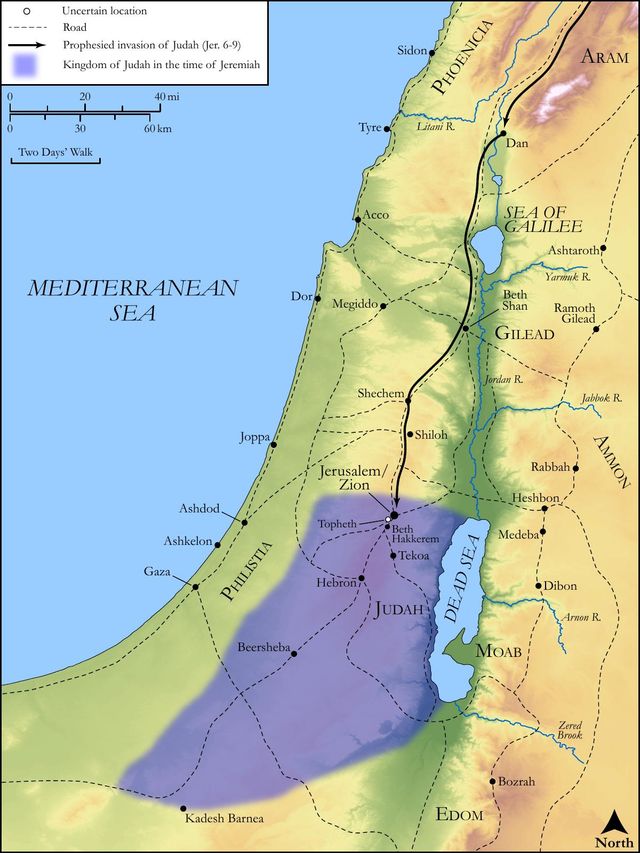
See on the biblical-era map
Study this verse
Public-domain commentary
Matthew Henry
From his Commentary on the Whole Bible. Henry comments on passages, not single verses — this entry covers Jeremiah 9:12–22. His four-level outline is real structure in the source text, so it is rendered as structure.
Two things the prophet designs, in these verses, with reference to the approaching destruction of Judah and Jerusalem: - 1. To convince people of the justice of God in it, that they had by sin brought it upon themselves and that therefore they had no reason to quarrel with God, who did them no wrong at all, but a great deal of reason to fall out with their sins, which did them all this mischief. 2. To affect people with the greatness of the desolation that was coming, and the miserable effects of it, that by a terrible prospect of it they might be awakened to repentance and reformation, which was the only way to prevent it, or, at least, mitigate their own share in it. This being designed,
I.He calls for the thinking men, by them to show people the equity of God's proceedings, though they seemed harsh and severe (Jer 9:12):
"Who, where, is the wise man, or the prophet, to whom the mouth of the Lord hath spoken? You boast of your wisdom, and of the prophets you have among you; produce me any one that has but the free use of human reason or any acquaintance with divine revelation, and he will soon understand this himself, and it will be so clear to him that he will be ready to declare it to others, that there is a just ground of God's controversy with this people." Do these wise men enquire, For what does the land perish? What is the matter, that such a change is made with this land? It used to be a land that God cared for, and he had his eyes upon it for good (Deu 11:12), but it is now a land that he has forsaken and that his face is against. It used to flourish as the garden of the Lord and to be replenished with inhabitants; but now it is burnt up like a wilderness, that none passeth through it, much less cares to settle in it. It was supposed, long ago, that it would be asked, when it came to this, Wherefore has the Lord done thus unto this land? What means the heat of this great anger? (Deu 29:24), to which question God here gives a full answer, before which all flesh must be silent. He produces out of the record,
1.The indictment preferred and proved against them, upon which they had been found guilty, Jer 9:13, Jer 9:14. It is charged upon them, and it cannot be denied,
(1.)That they have revolted from their allegiance to their rightful Sovereign. Therefore. God has forsaken their land, and justly, because they have forsaken his law, which he had so plainly, so fully, so frequently set before them, and had not observed his orders, not obeyed his voice, nor walked in the ways that he had appointed. Here their wickedness began, in the omission of their duty to their God and a contempt of his authority. But it did not end here. It is further charged upon them,
(2.)That they have entered themselves into the service of pretenders and usurpers, have not only withdrawn themselves from their obedience to their prince, but have taken up arms against him. For,
[1.]They have acted according to the dictates of their own lusts, have set up their own will, the wills of the flesh, and the carnal mind, in competition with, and contradiction to the will of God: They have walked after the imagination of their own hearts; they would do as they pleased, whatever God and conscience said to the contrary.
[2.]They have worshipped the creatures of their own fancy, the work of their own hands, according to the tradition received from their fathers: They have walked after Baalim: the word is plural; they had many Baals, Baal-peor and Baal-berith, the Baal of this place and the Baal of the other place; for they had lords many, which their fathers taught them to worship, but which the God of their fathers had again and again forbidden. This was it for which the land perished. The King of kings never makes war thus upon his own subjects but when they treacherously depart from him and rebel against him, and it has become necessary by this means to chastise their rebellion and reduce them to their allegiance; and they themselves shall at length acknowledge that he is just in all that is brought upon them.
2.The judgment given upon this indictment, the sentence upon the convicted rebels, which must now be executed, for it was righteous and nothing could be moved in arrest of it: The Lord of hosts, the God of Israel, hath said it (Jer 9:15, Jer 9:16), and who can reverse it?
(1.)That all their comforts at home shall be poisoned and embittered to them: I will feed this people with wormwood (or rather with wolf's-bane, for it signifies a herb that is not wholesome, as wormwood is though it be bitter, but some herb that is both nauseous and noxious), and I will give them water of gall (or juice of hemlock or some other herb that is poisonous) to drink. Every thing about them, till it comes to their very meat and drink, shall be a terror and torment to them. God will curse their blessings, Mal 2:2.
(2.)That their dispersion abroad shall be their destruction (Jer 9:16): I will scatter them among the heathen. They were corrupted and debauched by their intimacy with the heathen, with whom they mingled and learned their works; and now they shall lose themselves, where they lost their virtue, among the heathen. They set up gods which neither they nor their fathers had known, strange gods, new gods (Deu 32:17); and now God will put them among neighbours whom neither they nor their fathers have known, whom they can claim no acquaintance with, and therefore can expect no favour from. And yet, though they are scattered so as that they will not know where to find one another. God will know where to find them all out (Psa 21:8) with that evil which still pursues impenitent sinners: I will send a sword after them, some killing judgment or other, till I have consumed them; for when God judges he will overcome, when he pursues he will overtake. And now we see for what the land perishes; all this desolation is the desert of their deeds and the performance of God's words.
II.He calls for the mourning women, and engages them, with the arts they practise to affect people and move their passions, to lament these sad calamities that had come or were coming upon them, that the nation might be alarmed to prepare for them: The Lord of hosts himself says, Call for the mourning women, that they may come, Jer 9:17. the scope of this is to show how very woeful and lamentable the condition of this people was likely to be.
1.Here is work for the counterfeit mourners: Send for cunning women, that know how to compose mournful ditties, or at least to sing them in mournful tunes and accents, and therefore are made use of at funerals to supply the want of true mourners. Let these take up a wailing for us, Jer 9:18. The deaths and funerals were so many that people wept for them till they had no power to weep, as those, Sa1 30:4. Let those therefore do it now whose trade it is. Or, rather, it intimates the extreme sottishness and stupidity of the people, that laid not to heart the judgments they were under, nor, even when there was so much blood shed, could find in their hearts to shed a tear. They cry not when God binds them, Job 36:13. God sent his mourning prophets to them, to call them to weeping and mourning, but his word in their mouths did not work upon their faith; rather therefore than they shall go laughing to their ruin, let the mourning women come, and try to work upon their fancy, that their eyes may at length run down with tears, and their eyelids gush out with waters. First or last, sinners must be weepers.
2.Here is work for the real mourners.
(1.)There is that which is a lamentation. The present scene is very tragical (Jer 9:19): A voice of wailing is heard out of Zion. Some make this to be the song of the mourning women: it is rather an echo to it, returned by those whose affections were moved by their wailings. In Zion the voice of joy and praise used to be heard, while the people kept closely to God. But sin has altered the note; it is now the voice of lamentation. It should seem to be the voice of those who fled from all parts of the country to the castle of Zion for protection. Instead of rejoicing that they had got safely thither, they lamented that they were forced to seek for shelter there: "How are we spoiled! How are we stripped of all our possessions! We are greatly confounded, ashamed of ourselves and our poverty;" for that is it that they complain of, that is it that they blush at the thoughts of, rather than of their sin: We are confounded because we have forsaken the land (forced so to do by the enemy), not because we have forsaken the Lord, being drawn aside of our own lust and enticed - because our dwellings have cast us out, not because our God has cast us off. Thus unhumbled hearts lament their calamity, but not their iniquity, the procuring cause of it.
(2.)There is more still to come which shall be for a lamentation. Things are bad, but they are likely to be worse. Those whose land has spued them out (as it did their predecessors the Canaanites, and justly, because they trod in their steps, Lev 18:28) complain that they are driven into the city, but, after a while, those of the city, and they with them, shall be forced thence too: Yet hear the word of the Lord; he has something more to say to you (Jer 9:20); let the women hear it, whose tender spirits are apt to receive the impressions of grief and fear, for the men will not heed it, will not give it a patient hearing. The prophets will be glad to preach to a congregation of women that tremble at God's word. Let your ear receive the word of God's mouth, and bid it welcome, though it be a word of terror. Let the women teach their daughters wailing; this intimates that the trouble shall last long, grief shall be entailed upon the generation to come. Young people are apt to love mirth, and expect mirth, and are disposed to be gay and airy; but let the elder women teach the younger to be serious, tell them what a vale of tears they must expect to find this world, and train them up among the mourners in Zion, Tit 2:4, Tit 2:5. Let every one teach her neighbour lamentation; this intimates that the trouble shall spread far, shall go from house to house. People shall not need to sympathize with their friends; they shall all have cause enough to mourn for themselves. Note, Those that are themselves affected with the terrors of the Lord should endeavour to affect others with them. The judgment here threatened is made to look terrible.
[1.]Multitudes shall be slain, Jer 9:21. Death shall ride in triumph, and there shall be no escaping his arrests when he comes with commission, neither within doors nor without. Not within doors, for let the doors be shut ever so fast, let them be ever so firmly locked and bolted, death comes up into our windows, like a thief in the night; it steals upon us ere we are aware. Nor does it thus boldly attack the cottages only, but it has entered into our palaces, the palaces of our princes and great men, though ever so stately, ever so strongly built and guarded. Note, No palaces can keep out death. Nor are those more safe that are abroad; death cuts off even the children from without and the young men from the streets. The children who might have been spared by the enemy in pity, because they had never been hurtful to them, and the young men who might have been spared in policy, because capable of being serviceable to them, shall fall together by the sword. It is usual now, even in the severest military executions, to put none to the sword. It is usual now, even in the severest military executions, to put none to the sword but those that are found in arms; but then even the boys and girls playing in the streets were sacrificed to the fury of the conqueror.
[2.]Those that are slain shall be left unburied (Jer 9:22): Speak, Thus saith the Lord (for the confirmation and aggravation of what was before said), Even the carcases of men shall fall as dung, neglected, and left to be offensive to the smell, as dung is. Common humanity obliges the survivors to bury the dead, even for their own sake; but here such numbers shall be slain, and those so dispersed all the country over, that it shall be an endless thing to bury them all, nor shall there be hands enough to do it, nor shall the conquerors permit it, and those that should do it shall be overwhelmed with grief, so that they shall have no heart to do it. The dead bodies even of the fairest and strongest, when they have lain awhile, become dung, such vile bodies have we. And here such multitudes shall fall that their bodies shall lie as thick as heaps of dung in the furrows of the field, and no more notice shall be taken of them than of the handfuls which the harvestman drops for the gleaners, for none shall gather them, but they shall remain in sight, monuments of divine vengeance, that the eye of the impenitent survivors may affect their heart. Slay them not, bury them not, lest my people forget, Psa 59:11.
Historical interpretation
Historical reception
5 surviving comments on this verse. Each one is dated, so this reads as a timeline rather than a list.
Select a marker to jump to its quote. Markers stagger vertically where authors wrote within a few decades of each other.
Amid so many passions of this body of ours, amid so many enticements of this world, who indeed can keep his footstep safe and undefiled? The eye looks back and leads the mind’s perception astray, the ear hears and turns one’s attention away, a whiff of fragrance hinders thought, a kiss of the mouth introduces guilt, a touch kindles the fire of passion. “Death has entered in through the window,” the prophet said. Your eye is your window. If you look at a woman to lust after her, death has entered in; if you listen to the harlot’s words, death has entered in; if licentiousness takes hold of your senses, death has gone in.
The prophet says, “Death is come up through the windows.” Surely he does not mean actual windows—otherwise we could shut our windows and never die. But the bodily senses—sight, hearing, and so on—are windows to us and death enters us through them if we sin with them.
O Lord, keep watch over my mouth, for it is written, “Death and life are in the power of the tongue.” Again, you have declared, “I tell you, that of every idle word people speak, they shall give account on the day of judgment.” The prophet prays, therefore, that his words may not be vain but holy and pleasing to God. “Set a guard at the door of my lips.” He is asking for a guard around his lips like the rampart of a castle, that he may never capitulate to sin. It is Jeremiah who says, “Death has come up through our windows.” A person has five windows: sight, hearing, taste, smell and touch. If I look at a woman to lust after her, I have already committed adultery in my heart, and death has come through my window of sight. If the sound of the harp, organ or flute unnerves me, death has entered my soul through the sense of hearing. Again, if I touch something soft and supple, and wantonness breaks down the resistance of my flesh, death has entered through touch, and so down the line.
(Verse 22.) Speak these things, says the Lord, and the mortality of man (or the corpses of men) will fall like dung on the face of the region (or the field) and like hay behind the reaper, and there is no one to gather. The Hebrew word, which is written with three letters Daleth, Beth, Res (for it does not have vowels in the middle), signifies speech for a consequence and at the discretion of the reader if it is read as Dabar (), it signifies a word; if Deber, it signifies death; if Daber, it signifies speak. And both the Septuagint and Theodotion joined that previous chapter, so that they said, 'They will scatter the little ones outside, and the young men will die in the streets.' But Aquila and Symmachus translated λάλησον, which means 'speak': so that God commands the Prophet to speak what follows: Thus says the Lord, and the rest. And the meaning is: When death ascends through our windows, and enters the houses of Jerusalem, and the little ones and young men outside perish in the streets: then there will be their death, or the corpses of the dead, like dung on the face of the earth, and like straw that is left behind by those who have reaped, and is not collected as useless. He wants to show by these things that such a great slaughter will happen in Jerusalem and around the city that there will be no one to bury the fallen.
By “windows” he refers to the error of their thinking: through them they gave entrance to the error and the blow inflicted by it. You would not be wide of the mark to call the body’s senses “windows”—sight, taste, smell, hearing and touch. Both life and death can enter through these. For example, the person who looks with restraint reaps life, while the one looking immoderately gains death. The truthful tongue procures salvation for the soul, while the lying one brings about ruin; and likewise with the rest, as you can easily learn.
Continue studying Jeremiah 9:22 across the web’s major study libraries — every link below opens this exact verse, chapter, or book on the destination site.
Read & Compare
 BibleGatewayThis verse in more than 200 translations and 70 languages.
 Bible.comThe YouVersion reader — hundreds of translations, reading plans, and highlights.
 ESV.orgCrossway's official English Standard Version reader.
 NET BibleThe NET translation with 60,000+ translators' notes on every rendering decision.
 STEP BibleTyndale House's free study tool — original text, vocabulary, and scholarly resources.
 BibliaLogos Bible Software's free web reader.
 USCCBThe New American Bible (Revised Edition) with the U.S. bishops' study notes.
Commentaries
 BibleHub CommentariesDozens of classic commentaries on this verse, gathered on one page.
 StudyLightMore than 100 commentary sets — the largest collection on the web.
 BibleRefPlain-English commentary on what this verse means, verse by verse.
 Enduring WordDavid Guzik's free commentary on this chapter, widely used by Bible teachers.
 Bible Study ToolsVerse commentary alongside Greek and Hebrew study aids.
Original Language & Research
- BibleHub InterlinearThe verse word by word — original language, transliteration, and English.
- BibleHub LexiconEvery word's original-language definition and Strong's entry.
 Blue Letter BibleDeep-study tools — Strong's numbers, concordance, and word studies.
 SefariaThe Hebrew text with Rashi and centuries of Jewish commentary.
Sermons, Hymns & Audio


TrulyRandomVerse is not affiliated with these sites and doesn’t control their content. They’re linked because they’re genuinely useful.
Summary
Jeremiah 9:22 delivers a profoundly stark and graphic prophecy of divine judgment against Judah, depicting a catastrophic loss of life so severe that bodies will lie unburied and dishonored, scattered across the land like refuse. This chilling imagery underscores the absolute certainty and devastating consequences of God's wrath upon a people who persistently rejected His covenant and refused to repent, highlighting the profound indignity and desolation that awaits their unfaithfulness and serving as a grim testament to the wages of rebellion.
Context
ShowHideLiterary Context
Jeremiah 9:22 is situated within a broader section of lament and prophecy concerning Judah's impending destruction at the hands of the Babylonians. The preceding verses (Jeremiah 9:17-21) describe the call for professional mourners to lament the widespread death, emphasizing that "death has come up into our windows" (Jeremiah 9:21). This verse intensifies the imagery, moving from the fact of death to its degrading aftermath. It follows a powerful declaration about true wisdom not being found in human strength, riches, or wisdom, but in knowing the Lord (Jeremiah 9:23-24), providing a stark contrast between human pride and the divine judgment that humbles it. The verse serves as a grim fulfillment of the curses outlined in the covenant for disobedience, particularly those found throughout Deuteronomy 28.
Historical & Cultural Context
Jeremiah prophesied during the tumultuous final decades of the Kingdom of Judah, from the reign of Josiah through the Babylonian exile (c. 627-586 BC). Judah was caught between the declining Assyrian Empire and the rising powers of Egypt and Babylon. Despite Jeremiah's fervent pleas for repentance and a return to the Lord, the people, including kings, priests, and false prophets, largely persisted in idolatry, oppression, and spiritual apathy. The cultural significance of burial in the ancient Near East cannot be overstated; proper burial was a sacred duty and a mark of respect, ensuring the deceased's peace in the afterlife. To be left unburied, as depicted in this verse, was the ultimate curse, a profound dishonor, and a sign of utter abandonment by both man and God, often reserved for criminals or enemies. This was a common motif in prophetic warnings of judgment, as seen in the fate of Jezebel in 2 Kings 9:37.
Key Themes
ShowHideThis verse powerfully contributes to several key themes pervasive in Jeremiah's prophecy. Foremost is the theme of Divine Judgment and Retribution, illustrating God's unwavering justice against persistent sin and rebellion. The graphic imagery underscores the severity of this judgment, emphasizing the Consequences of Disobedience to the covenant. It highlights the theme of Desolation and Loss, portraying a society utterly devastated by war and pestilence, where the sheer number of dead overwhelms any capacity for proper burial. Furthermore, it speaks to the Indignity of Unbelief, as those who rejected God's warnings are stripped of even the most basic human dignity in death. This aligns with the lament over Judah's spiritual sickness and the Lord's decision to bring calamity upon them, as described in Jeremiah 6:19.
Exposition and Analysis
ShowHideKey Word Analysis
ShowHideThis term refers to a "flabby thing," specifically a carcase or carrion, often used collectively. It carries strong connotations of defilement and disgrace, particularly when unburied. In Jeremiah 9:22, its use emphasizes the utter degradation of the dead, reduced to mere refuse, devoid of honor or respect, highlighting the profound dishonor inflicted by divine judgment.
This word denotes a human being, an individual or mankind in general. Its inclusion here specifies that the "carcases" are not animals but human beings, underscoring the tragic scale of human loss and the direct impact of divine judgment on the population of Judah, emphasizing the widespread nature of the impending calamity.
This term means manure or dung. It is a highly visceral and repulsive image, signifying something utterly worthless, disgusting, and fit only for disposal. Its comparison to fallen bodies emphasizes the extreme indignity and complete lack of value or care for the deceased, highlighting the depth of their dishonor and the severity of God's contempt for their unrepentant sin.
Verse Breakdown
ShowHide"Speak, Thus saith the LORD"
This opening phrase establishes the divine authority and certainty of the pronouncement. Jeremiah is commanded to speak God's direct word, leaving no doubt that this is a prophetic declaration from the sovereign Lord, not merely human speculation or opinion. It underscores the divine origin and unwavering truth of the impending judgment.
"Even the carcases of men shall fall as dung upon the open field"
This is the central, horrifying image of the verse. It prophesies an overwhelming number of deaths, so vast that bodies will not be buried but will lie exposed and decaying on the ground, treated with the same contempt and worthlessness as animal waste. This signifies total societal collapse, profound dishonor, and the complete stripping away of human dignity.
"and as the handful after the harvestman, and none shall gather [them]"
This vivid agricultural metaphor further emphasizes the scale of destruction and abandonment. Just as a harvestman might leave behind a few insignificant stalks or a small "handful" of grain, deemed not worth the effort to gather, so too will the dead bodies be left uncollected and unburied. This implies that the sheer number of casualties will be so immense that there will be no one left, or no capacity, to perform the customary rites of burial, highlighting the complete desolation and lack of human care or reverence.
Literary Devices
ShowHideJeremiah 9:22 employs powerful Simile and vivid Imagery to convey its message of impending doom. The comparison of human "carcases" to "dung upon the open field" is a stark and repulsive simile that immediately evokes a sense of extreme degradation, worthlessness, and defilement. This visceral imagery is further reinforced by the second simile, "as the handful after the harvestman," which uses an agricultural context to illustrate the overwhelming quantity of the dead and their utter abandonment, portraying them as insignificant remnants. This Metaphorical Language effectively communicates the scale of the disaster and the profound dishonor awaiting the unrepentant. The verse also utilizes Hyperbole to emphasize the severity of the judgment, portraying a scene of such widespread death and neglect that it borders on the unimaginable, yet serves to underscore the absolute certainty and totality of God's wrath.
Theological and Thematic Connections
ShowHideJeremiah 9:22 serves as a stark reminder of the biblical principle that persistent rebellion against God's covenant commands inevitably leads to severe consequences. It underscores God's holiness and justice, demonstrating that while He is merciful and patient, He is also righteous and will not tolerate unrepentant sin indefinitely. The complete dishonor and abandonment depicted for the dead reflect the ultimate spiritual abandonment that results from rejecting the Lord, where even the most basic human dignity is lost. This passage highlights the gravity of divine judgment, emphasizing that God's warnings are not idle threats but certain pronouncements of His will when His people turn away from Him, ultimately revealing the profound cost of spiritual apostasy.
Reflection and Application
ShowHideJeremiah 9:22, though a somber prophecy of judgment, offers profound lessons for contemporary believers. It compels us to seriously consider the gravity of our relationship with God and the consequences of spiritual apathy or outright rebellion. This verse serves as a powerful call to heed God's warnings in Scripture, reminding us that His commands are not arbitrary but are for our ultimate good and flourishing. It challenges us to examine our own hearts for any areas of idolatry—anything that takes precedence over our devotion to the Lord—or unrepentant sin. Understanding the severity of God's justice should not lead to paralyzing fear, but to a deeper appreciation for His boundless grace and mercy, prompting us to live lives of genuine repentance, humility, and obedience. It encourages us to cultivate a heart that truly knows the Lord, finding our ultimate security and wisdom not in fleeting worldly achievements, but in Him alone, for in Him is true life and dignity.
Questions for Reflection
ShowHideFAQ
ShowHideWhy is the imagery of unburied bodies so significant in this verse?
ShowHideThe imagery of unburied bodies in Jeremiah 9:22 is profoundly significant because, in ancient Near Eastern culture, a proper burial was considered a sacred duty and a vital act of respect for the deceased. To be left unburied was the ultimate disgrace and a severe curse, signifying utter abandonment, dishonor, and the complete absence of human compassion. This fate was often reserved for criminals or those utterly rejected. By prophesying that bodies would lie like "dung upon the open field," the verse emphasizes the extreme indignity and complete desolation that would befall Judah as a consequence of their persistent rebellion against God. It highlights the depth of God's judgment and the stripping away of all human dignity when His covenant is broken, as also warned in Deuteronomy 28:26.
Christ-Centered Fulfillment
ShowHideWhile Jeremiah 9:22 vividly portrays the consequences of sin and rebellion under the Old Covenant, its ultimate fulfillment and resolution are found in Jesus Christ. The horrific image of bodies left ungathered and dishonored points to the profound spiritual death and separation from God that sin brings, a state from which humanity cannot rescue itself. Yet, the New Testament reveals a different "gathering" and a different "harvest." Jesus, the Lamb of God who takes away the sin of the world, came not to condemn the world, but to save it (John 3:17). Through His sacrificial death and resurrection, Christ gathered those who were scattered and spiritually dead, offering them new life and eternal dignity. He became the ultimate "dung" (Philippians 3:8), taking on the shame and curse of sin, so that believers might be reconciled to God and receive an imperishable body (1 Corinthians 15:42-44). The judgment depicted in Jeremiah, while real, foreshadows the greater spiritual judgment averted for those who trust in Christ, who ensures that His redeemed will never be abandoned but will be gathered into His glorious eternal kingdom (Matthew 24:31).