


Jeremiah 9:18
- וּתְמַהֵרְנָהu·te·ma·He·re·nahand they may hastenH4116Conj-w ¦ V-Piel-ConjImperf-3fpVerb Piel Conjunction+Imperfect 3rd Plural Feminineוּandתְמַהֵרְנָהthey may hasten
- וְתִשֶּׂנָהve·ti·Se·nahand they may take upH5375Conj-w ¦ V-Qal-ConjImperf-3fpVerb Qal Conjunction+Imperfect 3rd Plural Feminineוְandתִשֶּׂנָהthey may take up
- עָלֵינוּ'a·Lei·nuon usH5921Prep ¦ 1cpPreposition Definiteעָלֵיonנוּus
- נֶהִיNe·hiwailingH5092N-msNoun Singular Masculine Absolute
- וְתֵרַדְנָהve·te·Rad·nahso they may run downH3381Conj-w ¦ V-Qal-ConjImperf-3fpVerb Qal Conjunction+Imperfect 3rd Plural Feminineוְsoתֵרַדְנָהthey may run down
- עֵינֵינוּ'ei·Nei·nuour eyesH5869N-fdc ¦ 1cpNoun Dual Feminine Constructעֵינֵיeyesנוּour
- דִּמְעָהdim·'Ahtear[s]H1832N-fsNoun Singular Feminine Absolute
- וְעַפְעַפֵּינוּve·'af·'a·Pei·nuand our eyelidsH6079Conj-w ¦ N-mpc ¦ 1cpNoun Plural Masculine Constructוְandעַפְעַפֵּיeyelidsנוּour
- יִזְּלוּyi·ze·luthey may flowH5140V-Qal-Imperf-3mpVerb Qal Imperfect 3rd Plural Masculine
- מָיִםMa·yimwaterH4325N-mpNoun Plural Masculine Absolute
English is a literal word-by-word gloss of the Hebrew, not the KJV's wording. Why?
This is the original text the KJV's translators worked from — each Hebrew word with its own literal English meaning in this verse, prepared by scholars at Tyndale House, Cambridge. The KJV translates whole sentences, not word by word, so its wording differs: one Hebrew word can become several English words, and the KJV may choose “the LORD” where the gloss reads “Yahweh”. Both are faithful — they answer different questions. For the KJV's own rendering, switch to the KJV text.
Details
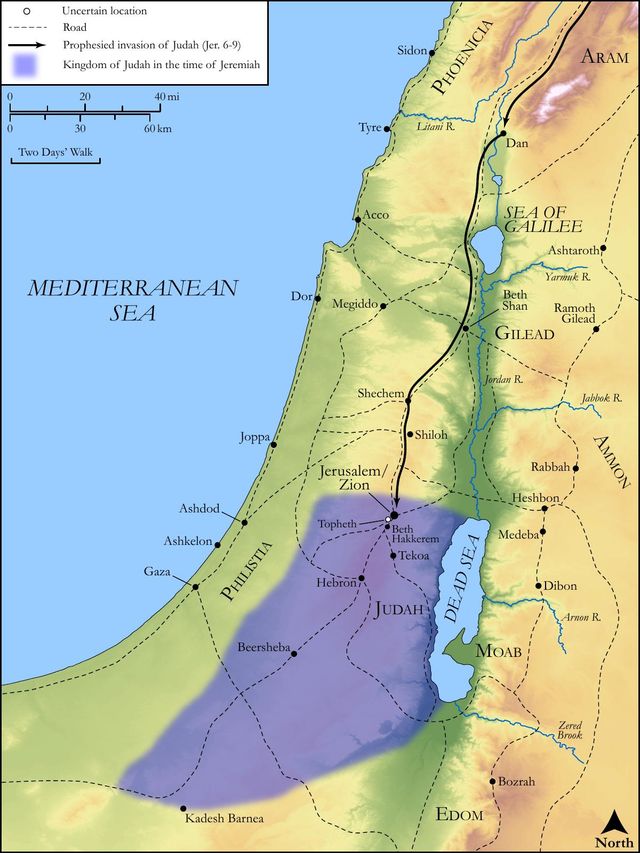
See on the biblical-era map
Study this verse
Public-domain commentary
Matthew Henry
From his Commentary on the Whole Bible. Henry comments on passages, not single verses — this entry covers Jeremiah 9:12–22. His four-level outline is real structure in the source text, so it is rendered as structure.
Two things the prophet designs, in these verses, with reference to the approaching destruction of Judah and Jerusalem: - 1. To convince people of the justice of God in it, that they had by sin brought it upon themselves and that therefore they had no reason to quarrel with God, who did them no wrong at all, but a great deal of reason to fall out with their sins, which did them all this mischief. 2. To affect people with the greatness of the desolation that was coming, and the miserable effects of it, that by a terrible prospect of it they might be awakened to repentance and reformation, which was the only way to prevent it, or, at least, mitigate their own share in it. This being designed,
I.He calls for the thinking men, by them to show people the equity of God's proceedings, though they seemed harsh and severe (Jer 9:12):
"Who, where, is the wise man, or the prophet, to whom the mouth of the Lord hath spoken? You boast of your wisdom, and of the prophets you have among you; produce me any one that has but the free use of human reason or any acquaintance with divine revelation, and he will soon understand this himself, and it will be so clear to him that he will be ready to declare it to others, that there is a just ground of God's controversy with this people." Do these wise men enquire, For what does the land perish? What is the matter, that such a change is made with this land? It used to be a land that God cared for, and he had his eyes upon it for good (Deu 11:12), but it is now a land that he has forsaken and that his face is against. It used to flourish as the garden of the Lord and to be replenished with inhabitants; but now it is burnt up like a wilderness, that none passeth through it, much less cares to settle in it. It was supposed, long ago, that it would be asked, when it came to this, Wherefore has the Lord done thus unto this land? What means the heat of this great anger? (Deu 29:24), to which question God here gives a full answer, before which all flesh must be silent. He produces out of the record,
1.The indictment preferred and proved against them, upon which they had been found guilty, Jer 9:13, Jer 9:14. It is charged upon them, and it cannot be denied,
(1.)That they have revolted from their allegiance to their rightful Sovereign. Therefore. God has forsaken their land, and justly, because they have forsaken his law, which he had so plainly, so fully, so frequently set before them, and had not observed his orders, not obeyed his voice, nor walked in the ways that he had appointed. Here their wickedness began, in the omission of their duty to their God and a contempt of his authority. But it did not end here. It is further charged upon them,
(2.)That they have entered themselves into the service of pretenders and usurpers, have not only withdrawn themselves from their obedience to their prince, but have taken up arms against him. For,
[1.]They have acted according to the dictates of their own lusts, have set up their own will, the wills of the flesh, and the carnal mind, in competition with, and contradiction to the will of God: They have walked after the imagination of their own hearts; they would do as they pleased, whatever God and conscience said to the contrary.
[2.]They have worshipped the creatures of their own fancy, the work of their own hands, according to the tradition received from their fathers: They have walked after Baalim: the word is plural; they had many Baals, Baal-peor and Baal-berith, the Baal of this place and the Baal of the other place; for they had lords many, which their fathers taught them to worship, but which the God of their fathers had again and again forbidden. This was it for which the land perished. The King of kings never makes war thus upon his own subjects but when they treacherously depart from him and rebel against him, and it has become necessary by this means to chastise their rebellion and reduce them to their allegiance; and they themselves shall at length acknowledge that he is just in all that is brought upon them.
2.The judgment given upon this indictment, the sentence upon the convicted rebels, which must now be executed, for it was righteous and nothing could be moved in arrest of it: The Lord of hosts, the God of Israel, hath said it (Jer 9:15, Jer 9:16), and who can reverse it?
(1.)That all their comforts at home shall be poisoned and embittered to them: I will feed this people with wormwood (or rather with wolf's-bane, for it signifies a herb that is not wholesome, as wormwood is though it be bitter, but some herb that is both nauseous and noxious), and I will give them water of gall (or juice of hemlock or some other herb that is poisonous) to drink. Every thing about them, till it comes to their very meat and drink, shall be a terror and torment to them. God will curse their blessings, Mal 2:2.
(2.)That their dispersion abroad shall be their destruction (Jer 9:16): I will scatter them among the heathen. They were corrupted and debauched by their intimacy with the heathen, with whom they mingled and learned their works; and now they shall lose themselves, where they lost their virtue, among the heathen. They set up gods which neither they nor their fathers had known, strange gods, new gods (Deu 32:17); and now God will put them among neighbours whom neither they nor their fathers have known, whom they can claim no acquaintance with, and therefore can expect no favour from. And yet, though they are scattered so as that they will not know where to find one another. God will know where to find them all out (Psa 21:8) with that evil which still pursues impenitent sinners: I will send a sword after them, some killing judgment or other, till I have consumed them; for when God judges he will overcome, when he pursues he will overtake. And now we see for what the land perishes; all this desolation is the desert of their deeds and the performance of God's words.
II.He calls for the mourning women, and engages them, with the arts they practise to affect people and move their passions, to lament these sad calamities that had come or were coming upon them, that the nation might be alarmed to prepare for them: The Lord of hosts himself says, Call for the mourning women, that they may come, Jer 9:17. the scope of this is to show how very woeful and lamentable the condition of this people was likely to be.
1.Here is work for the counterfeit mourners: Send for cunning women, that know how to compose mournful ditties, or at least to sing them in mournful tunes and accents, and therefore are made use of at funerals to supply the want of true mourners. Let these take up a wailing for us, Jer 9:18. The deaths and funerals were so many that people wept for them till they had no power to weep, as those, Sa1 30:4. Let those therefore do it now whose trade it is. Or, rather, it intimates the extreme sottishness and stupidity of the people, that laid not to heart the judgments they were under, nor, even when there was so much blood shed, could find in their hearts to shed a tear. They cry not when God binds them, Job 36:13. God sent his mourning prophets to them, to call them to weeping and mourning, but his word in their mouths did not work upon their faith; rather therefore than they shall go laughing to their ruin, let the mourning women come, and try to work upon their fancy, that their eyes may at length run down with tears, and their eyelids gush out with waters. First or last, sinners must be weepers.
2.Here is work for the real mourners.
(1.)There is that which is a lamentation. The present scene is very tragical (Jer 9:19): A voice of wailing is heard out of Zion. Some make this to be the song of the mourning women: it is rather an echo to it, returned by those whose affections were moved by their wailings. In Zion the voice of joy and praise used to be heard, while the people kept closely to God. But sin has altered the note; it is now the voice of lamentation. It should seem to be the voice of those who fled from all parts of the country to the castle of Zion for protection. Instead of rejoicing that they had got safely thither, they lamented that they were forced to seek for shelter there: "How are we spoiled! How are we stripped of all our possessions! We are greatly confounded, ashamed of ourselves and our poverty;" for that is it that they complain of, that is it that they blush at the thoughts of, rather than of their sin: We are confounded because we have forsaken the land (forced so to do by the enemy), not because we have forsaken the Lord, being drawn aside of our own lust and enticed - because our dwellings have cast us out, not because our God has cast us off. Thus unhumbled hearts lament their calamity, but not their iniquity, the procuring cause of it.
(2.)There is more still to come which shall be for a lamentation. Things are bad, but they are likely to be worse. Those whose land has spued them out (as it did their predecessors the Canaanites, and justly, because they trod in their steps, Lev 18:28) complain that they are driven into the city, but, after a while, those of the city, and they with them, shall be forced thence too: Yet hear the word of the Lord; he has something more to say to you (Jer 9:20); let the women hear it, whose tender spirits are apt to receive the impressions of grief and fear, for the men will not heed it, will not give it a patient hearing. The prophets will be glad to preach to a congregation of women that tremble at God's word. Let your ear receive the word of God's mouth, and bid it welcome, though it be a word of terror. Let the women teach their daughters wailing; this intimates that the trouble shall last long, grief shall be entailed upon the generation to come. Young people are apt to love mirth, and expect mirth, and are disposed to be gay and airy; but let the elder women teach the younger to be serious, tell them what a vale of tears they must expect to find this world, and train them up among the mourners in Zion, Tit 2:4, Tit 2:5. Let every one teach her neighbour lamentation; this intimates that the trouble shall spread far, shall go from house to house. People shall not need to sympathize with their friends; they shall all have cause enough to mourn for themselves. Note, Those that are themselves affected with the terrors of the Lord should endeavour to affect others with them. The judgment here threatened is made to look terrible.
[1.]Multitudes shall be slain, Jer 9:21. Death shall ride in triumph, and there shall be no escaping his arrests when he comes with commission, neither within doors nor without. Not within doors, for let the doors be shut ever so fast, let them be ever so firmly locked and bolted, death comes up into our windows, like a thief in the night; it steals upon us ere we are aware. Nor does it thus boldly attack the cottages only, but it has entered into our palaces, the palaces of our princes and great men, though ever so stately, ever so strongly built and guarded. Note, No palaces can keep out death. Nor are those more safe that are abroad; death cuts off even the children from without and the young men from the streets. The children who might have been spared by the enemy in pity, because they had never been hurtful to them, and the young men who might have been spared in policy, because capable of being serviceable to them, shall fall together by the sword. It is usual now, even in the severest military executions, to put none to the sword. It is usual now, even in the severest military executions, to put none to the sword but those that are found in arms; but then even the boys and girls playing in the streets were sacrificed to the fury of the conqueror.
[2.]Those that are slain shall be left unburied (Jer 9:22): Speak, Thus saith the Lord (for the confirmation and aggravation of what was before said), Even the carcases of men shall fall as dung, neglected, and left to be offensive to the smell, as dung is. Common humanity obliges the survivors to bury the dead, even for their own sake; but here such numbers shall be slain, and those so dispersed all the country over, that it shall be an endless thing to bury them all, nor shall there be hands enough to do it, nor shall the conquerors permit it, and those that should do it shall be overwhelmed with grief, so that they shall have no heart to do it. The dead bodies even of the fairest and strongest, when they have lain awhile, become dung, such vile bodies have we. And here such multitudes shall fall that their bodies shall lie as thick as heaps of dung in the furrows of the field, and no more notice shall be taken of them than of the handfuls which the harvestman drops for the gleaners, for none shall gather them, but they shall remain in sight, monuments of divine vengeance, that the eye of the impenitent survivors may affect their heart. Slay them not, bury them not, lest my people forget, Psa 59:11.
Historical interpretation
Historical reception
2 surviving comments on this verse. Each one is dated, so this reads as a timeline rather than a list.
Select a marker to jump to its quote. Markers stagger vertically where authors wrote within a few decades of each other.
Because they had not been enlightened by the many exhortations he had delivered in Jerusalem, he wept for their blindness. The prophets also did this. Let us now do so as well. Now is the time to mourn and weep and lament. It is timely also for us to say now, “Call for the mourning women, and send to them that are wise women, and let them speak.” Perhaps we shall thus be able to drive the disease of avarice from those who are building elaborate homes, from those who are securing fields for themselves by fraud.
(Verse 17, 18.) Thus says the Lord of hosts: Consider (or understand) and call for the mourning women, that they may come; and send for the wise women, that they may hurry, and let them take up a lamentation for us (or for you), and let our (or your) eyes shed tears, and let our (or your) eyelids flow with water; for the voice of lamentation is heard from Zion (or in Zion). Because of the future captivity and destruction of Jerusalem, he orders the mourners to be called, who are accustomed to wailing, striking their chests with a lamenting voice, to provoke the people to tears. For this custom remains in Judaea even to this day, that women with their hair scattered and their breasts exposed, with a melodious voice, stir everyone to weeping. And God joins Himself with compassionate feeling, or the Prophet, so that whatever the people endure, he may declare that he himself endures and feels it. But what follows is: Because the voice of lamentation is heard from Zion, immediately follows what this voice is.
Continue studying Jeremiah 9:18 across the web’s major study libraries — every link below opens this exact verse, chapter, or book on the destination site.
Read & Compare
 BibleGatewayThis verse in more than 200 translations and 70 languages.
 Bible.comThe YouVersion reader — hundreds of translations, reading plans, and highlights.
 ESV.orgCrossway's official English Standard Version reader.
 NET BibleThe NET translation with 60,000+ translators' notes on every rendering decision.
 STEP BibleTyndale House's free study tool — original text, vocabulary, and scholarly resources.
 BibliaLogos Bible Software's free web reader.
 USCCBThe New American Bible (Revised Edition) with the U.S. bishops' study notes.
Commentaries
 BibleHub CommentariesDozens of classic commentaries on this verse, gathered on one page.
 StudyLightMore than 100 commentary sets — the largest collection on the web.
 BibleRefPlain-English commentary on what this verse means, verse by verse.
 Enduring WordDavid Guzik's free commentary on this chapter, widely used by Bible teachers.
 Bible Study ToolsVerse commentary alongside Greek and Hebrew study aids.
Original Language & Research
- BibleHub InterlinearThe verse word by word — original language, transliteration, and English.
- BibleHub LexiconEvery word's original-language definition and Strong's entry.
 Blue Letter BibleDeep-study tools — Strong's numbers, concordance, and word studies.
 SefariaThe Hebrew text with Rashi and centuries of Jewish commentary.
Sermons, Hymns & Audio


TrulyRandomVerse is not affiliated with these sites and doesn’t control their content. They’re linked because they’re genuinely useful.
Summary
Jeremiah 9:18 presents an urgent and desperate plea for professional mourners to commence a profound lamentation, reflecting the prophet's overwhelming sorrow and the impending or ongoing national catastrophe facing Judah. The verse vividly portrays an anticipated flood of tears, underscoring the depth of despair and the magnitude of the divine judgment that has befallen the nation due to its persistent sin and rebellion against God. It is a poignant expression of communal grief for a people on the brink of desolation and spiritual ruin.
Context
ShowHideLiterary Context
This verse is deeply embedded within a larger section of Jeremiah's prophecies (Jeremiah 9:10-22) that articulates a profound lament over the desolation of Judah and Jerusalem. Immediately preceding this passage, Jeremiah expresses his personal anguish and desire to weep incessantly for his people's destruction, longing for his head to be a "fountain of tears" in Jeremiah 9:1. The verses that follow continue to describe the severity of God's judgment, detailing how the land will become a desolate wilderness and the people will be scattered among nations they do not know (Jeremiah 9:11-16). The call for mourners in verse 18 is therefore not an isolated cry but a direct response to the prophet's understanding of the irreversible judgment and the dire need for a national expression of grief, a theme that continues into the subsequent verses (Jeremiah 9:19-22 which speak of the lament being heard from Zion.
Historical & Cultural Context
Jeremiah prophesied during a tumultuous period in Judah's history, spanning the reigns of several kings, from Josiah to Zedekiah, leading up to the Babylonian exile (circa 627-586 BCE). The nation was steeped in idolatry, oppression, and a superficial religiosity, despite repeated warnings from prophets like Jeremiah. The "wailing" called for in this verse reflects the ancient Near Eastern practice of employing professional mourners, typically women, to lead public lamentations during times of death or national calamity. These mourners were skilled in composing and performing dirges, helping communities express and process overwhelming grief. Their presence underscored the severity of the loss, elevating it from a private sorrow to a public, communal tragedy. The call to "make haste" suggests an immediate, urgent need for this ritualistic expression of grief, indicating that the disaster was either imminent or already unfolding.
Key Themes
ShowHideJeremiah 9:18 powerfully contributes to several overarching themes in the book of Jeremiah. Firstly, it highlights the Profound Grief and Lamentation that characterizes much of the prophet's ministry, earning him the title "the weeping prophet." His personal anguish over Judah's fate, as seen in his longing for a "fountain of tears" in Jeremiah 9:1, is here extended to a national call for lament. Secondly, the verse underscores the theme of Divine Judgment and Consequence of Sin. The need for such intense wailing is a direct result of Judah's persistent rebellion against God's covenant, leading to the devastating consequences foretold throughout the book. This judgment is not arbitrary but a righteous response to their spiritual adultery and idolatry, as detailed in passages like Jeremiah 7 and Jeremiah 8. Lastly, it touches upon the Communal Nature of Suffering, emphasizing that the calamity affects the entire nation, necessitating a collective expression of sorrow and repentance, even if that repentance comes too late to avert the physical destruction.
Exposition and Analysis
ShowHideKey Word Analysis
ShowHideThis primitive root (H4116) signifies "to hurry" or "to be swift," often used adverbially to mean "promptly" or "quickly." In Jeremiah 9:18, the imperative "let them make haste" conveys an urgent, immediate demand for the mourners to begin their work. It emphasizes the critical and pressing nature of the impending or unfolding disaster, suggesting that there is no time to lose in expressing the profound national sorrow. It implies a sudden, overwhelming need for this ritual.
Derived from a root meaning "to lament" (H5092), this noun refers specifically to an elegy or a mournful lamentation, often sung or chanted as a dirge. It is a formal, public expression of grief, distinct from mere crying. The call to "take up a wailing" indicates the need for a structured, communal outpouring of sorrow, signifying a loss so immense it requires a professional, ritualized expression of deep mourning for the nation's spiritual and physical demise.
This primitive root (H5140) means "to drip" or "shed by trickling," but also "to flow," "flood," or "pour down." When paired with "waters" in the context of "eyelids," it intensifies the imagery of weeping. It describes an uncontrolled, abundant, and continuous flow of tears, far beyond simple crying, portraying an overwhelming and unrestrained sorrow that cannot be contained. It emphasizes the sheer volume and unceasing nature of the weeping, like a flood.
Verse Breakdown
ShowHide"And let them make haste,"
This opening phrase is an urgent command, an imperative call for immediate action. It reflects the prophet's sense of extreme urgency and the dire nature of the situation, demanding that the professional mourners (implied by the context of "wailing") begin their lament without delay. The speed underscores the imminence or present reality of the catastrophe.
"and take up a wailing for us,"
This specifies the action required: to initiate a formal, public lamentation. The phrase "for us" indicates that this is not a private sorrow but a communal one, a wail on behalf of the entire nation of Judah, signifying the collective catastrophe they face. It highlights the shared experience of impending doom and the need for a collective expression of grief.
"that our eyes may run down with tears,"
This clause describes the desired outcome and the depth of the anticipated grief. The imagery of eyes "running down" with tears portrays an abundant, continuous flow, suggesting an overwhelming sorrow that cannot be held back. It is a physical manifestation of profound anguish, indicating a grief so immense it overflows the eyes.
"and our eyelids gush out with waters."
This final clause intensifies the previous image, using a stronger verb ("gush out") and a more general noun ("waters" instead of "tears") to emphasize the sheer volume and unceasing nature of the weeping. "Eyelids gushing out" is a vivid hyperbole, conveying an uncontrollable torrent of sorrow, signifying grief beyond measure for the desolation of the nation, a sorrow that cannot be contained or stopped.
Literary Devices
ShowHideJeremiah 9:18 is rich in Imagery, painting a vivid picture of overwhelming sorrow through the description of eyes "running down with tears" and eyelids "gushing out with waters." This visual and sensory language powerfully conveys the depth of the nation's despair. The verse employs Hyperbole, an exaggeration for emphasis, particularly in the phrases "run down with tears" and "gush out with waters." These are not literal descriptions of tear flow but emphasize an unimaginable, unending torrent of grief, highlighting the extreme nature of the national tragedy. The use of the Imperative Mood ("let them make haste," "take up") creates a sense of urgency and command, reflecting the prophet's desperate plea. Furthermore, there is an element of Metonymy, where "eyes" and "eyelids" stand in for the people themselves, collectively experiencing and expressing this profound sorrow. The entire verse functions as a Lament, a poetic expression of grief and sorrow, characteristic of much of Jeremiah's prophetic message concerning Judah's destruction.
Theological and Thematic Connections
ShowHideJeremiah 9:18 stands as a stark theological statement on the devastating consequences of national apostasy and disobedience to God's covenant. The profound sorrow and the desperate call for lamentation are not merely emotional outbursts but a direct reflection of divine judgment against a people who have forsaken the living God for idols and injustice. This intense grief underscores the gravity of sin, revealing how turning away from the Lord leads to spiritual desolation and physical ruin. The prophet's anguish serves as a poignant reminder that God's warnings are not empty threats but expressions of His righteous character, and His justice, though delayed, will ultimately prevail. The collective weeping signifies a recognition, albeit perhaps too late, of the spiritual death of the nation and the bitter fruit of their rebellion.
Reflection and Application
ShowHideJeremiah 9:18 serves as a profound and sobering call to introspection, urging us to consider the gravity of sin and its far-reaching consequences, not only for individuals but for communities and nations. The prophet's desperate plea for overwhelming lamentation reminds us that spiritual decline and disobedience inevitably lead to deep sorrow and desolation. For believers today, this verse challenges us to cultivate a holy grief over sin—both our own and that of the world around us—and to recognize the pain it inflicts upon God's heart and creation. It compels us to respond with genuine repentance and to heed divine warnings before judgment becomes inevitable. Furthermore, it fosters compassion for those who suffer the consequences of spiritual brokenness, prompting us to intercede and work for righteousness, understanding that true peace and flourishing come only through faithful adherence to God's ways. It is a reminder that a lack of lament in the face of sin can indicate a hardened heart, while true spiritual vitality often begins with a recognition of our brokenness and a turning towards God.
Questions for Reflection
ShowHideFAQ
ShowHideWhat is the significance of professional mourners in this context?
ShowHideIn ancient Near Eastern cultures, professional mourners were typically women hired to lead and intensify public lamentations during funerals or national calamities. Their presence in Jeremiah 9:18 signifies the extraordinary depth and public nature of the sorrow. It indicates that the impending or ongoing disaster was so catastrophic that the natural grief of the people was deemed insufficient to express the magnitude of the loss. By employing these skilled lamenters, the community sought to fully acknowledge and externalize the overwhelming despair and the collective "death" of their national well-being and spiritual health. This practice is also alluded to in other biblical texts, such as 2 Chronicles 35:25 regarding the death of King Josiah, and Amos 5:16.
Why does Jeremiah use such extreme language to describe the weeping?
ShowHideJeremiah, often called the "weeping prophet," frequently employed vivid and hyperbolic language to convey the depth of his anguish and the severity of God's judgment. Phrases like "eyes may run down with tears, and our eyelids gush out with waters" are not meant to be taken literally as a physical description of tear production. Instead, they are powerful literary devices (hyperbole) used to emphasize the overwhelming, uncontrollable, and unending nature of the sorrow. This extreme imagery communicates the profound national tragedy, the spiritual devastation, and the utter despair that has engulfed Judah due to their persistent rebellion against God, making it clear that this is a grief beyond ordinary measure. His personal lament in Jeremiah 13:17 uses similar intense imagery, demonstrating his deep emotional connection to the fate of his people.
Christ-Centered Fulfillment
ShowHideWhile Jeremiah 9:18 vividly portrays the devastating consequences of sin and the profound sorrow it brings, its ultimate fulfillment and resolution are found in Jesus Christ. The lamentation for a nation lost to sin foreshadows the ultimate grief of God over humanity's rebellion, a grief perfectly embodied in Christ. Just as Jeremiah wept over Jerusalem's impending destruction, so too did Jesus weep over Jerusalem, knowing their rejection of Him would lead to their desolation (Luke 19:41-44). The "gushing out with waters" of sorrow finds its counterpoint in the "living water" that Jesus offers, which quenches spiritual thirst and brings eternal life (John 4:10-14). The tears shed for sin's destructive power are ultimately wiped away by the Lamb of God, who bore the full weight of humanity's sin and its consequences on the cross (Revelation 21:4). Through His atoning sacrifice, Christ not only takes away the sin that causes such lament but also offers a new covenant where true repentance leads not to despair, but to forgiveness, reconciliation, and the promise of eternal joy. The weeping over a nation's spiritual death is transformed into the hope of resurrection and new life in Christ, the one who experienced the ultimate sorrow that we might know ultimate peace (Isaiah 53:3-5; John 16:20-22).