


Jeremiah 9:14
- וַיֵּלְכוּvai·Ye·le·Khuand they have walkedH1980Conj-w ¦ V-Qal-ConsecImperf-3mpVerb Qal Consecutive Imperfect 3rd Plural Masculineוַandיֵּלְכוּthey have walked
- אַחֲרֵי'a·cha·ReiafterH310Adj-mpcAdjective Numerical Plural Masculine Construct
- שְׁרִרוּתshe·ri·Rut[the] stubbornness ofH8307N-fscNoun Singular Feminine Construct
- לִבָּםli·Bamtheir own heartH3820N-msc ¦ 3mpNoun Singular Masculine Constructלִבָּown heartםtheir
- וְאַחֲרֵיve·'a·cha·Reiand afterH310Conj-w ¦ Adj-mpcAdjective Numerical Plural Masculine Constructוְandאַחֲרֵיafter
- הַבְּעָלִיםha·be·'a·Limthe BaalsH1168Art ¦ N-mpNoun Title Plural Masculine AbsoluteהַtheבְּעָלִיםBaals
- אֲשֶׁר'a·SherwhichH834RelParticle Relative
- לִמְּדוּםli·me·Dumthey taught themH3925V-Piel-Perf-3cp ¦ 3mpVerb Piel Perfect 3rd Plural common genderלִמְּדוּthey taughtםthem
- אֲבוֹתָם'a·vo·Tamtheir ancestorsH1N-fpc ¦ 3mpNoun Plural Feminine Constructאֲבוֹתָancestorsםtheir
English is a literal word-by-word gloss of the Hebrew, not the KJV's wording. Why?
This is the original text the KJV's translators worked from — each Hebrew word with its own literal English meaning in this verse, prepared by scholars at Tyndale House, Cambridge. The KJV translates whole sentences, not word by word, so its wording differs: one Hebrew word can become several English words, and the KJV may choose “the LORD” where the gloss reads “Yahweh”. Both are faithful — they answer different questions. For the KJV's own rendering, switch to the KJV text.
Details
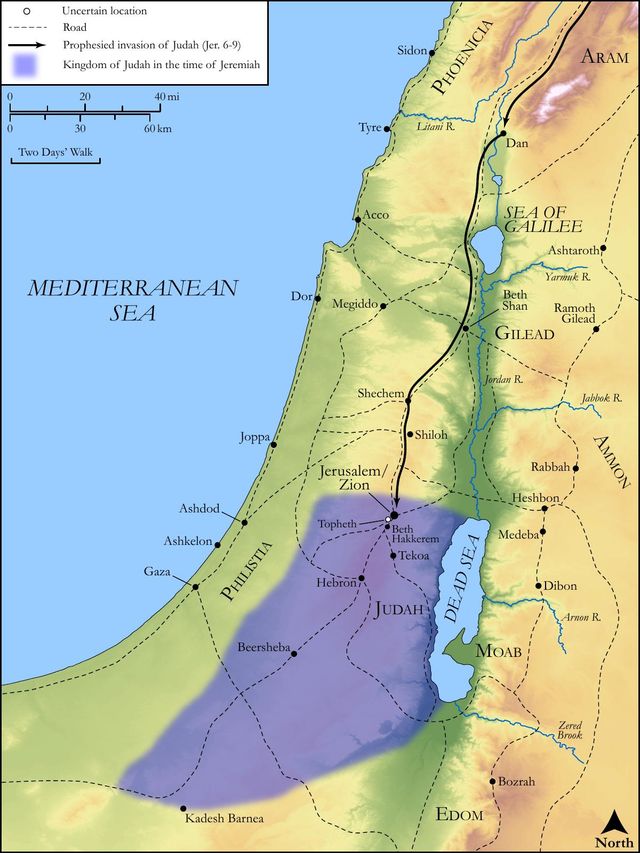
See on the biblical-era map
Study this verse
Public-domain commentary
Matthew Henry
From his Commentary on the Whole Bible. Henry comments on passages, not single verses — this entry covers Jeremiah 9:12–22. His four-level outline is real structure in the source text, so it is rendered as structure.
Two things the prophet designs, in these verses, with reference to the approaching destruction of Judah and Jerusalem: - 1. To convince people of the justice of God in it, that they had by sin brought it upon themselves and that therefore they had no reason to quarrel with God, who did them no wrong at all, but a great deal of reason to fall out with their sins, which did them all this mischief. 2. To affect people with the greatness of the desolation that was coming, and the miserable effects of it, that by a terrible prospect of it they might be awakened to repentance and reformation, which was the only way to prevent it, or, at least, mitigate their own share in it. This being designed,
I.He calls for the thinking men, by them to show people the equity of God's proceedings, though they seemed harsh and severe (Jer 9:12):
"Who, where, is the wise man, or the prophet, to whom the mouth of the Lord hath spoken? You boast of your wisdom, and of the prophets you have among you; produce me any one that has but the free use of human reason or any acquaintance with divine revelation, and he will soon understand this himself, and it will be so clear to him that he will be ready to declare it to others, that there is a just ground of God's controversy with this people." Do these wise men enquire, For what does the land perish? What is the matter, that such a change is made with this land? It used to be a land that God cared for, and he had his eyes upon it for good (Deu 11:12), but it is now a land that he has forsaken and that his face is against. It used to flourish as the garden of the Lord and to be replenished with inhabitants; but now it is burnt up like a wilderness, that none passeth through it, much less cares to settle in it. It was supposed, long ago, that it would be asked, when it came to this, Wherefore has the Lord done thus unto this land? What means the heat of this great anger? (Deu 29:24), to which question God here gives a full answer, before which all flesh must be silent. He produces out of the record,
1.The indictment preferred and proved against them, upon which they had been found guilty, Jer 9:13, Jer 9:14. It is charged upon them, and it cannot be denied,
(1.)That they have revolted from their allegiance to their rightful Sovereign. Therefore. God has forsaken their land, and justly, because they have forsaken his law, which he had so plainly, so fully, so frequently set before them, and had not observed his orders, not obeyed his voice, nor walked in the ways that he had appointed. Here their wickedness began, in the omission of their duty to their God and a contempt of his authority. But it did not end here. It is further charged upon them,
(2.)That they have entered themselves into the service of pretenders and usurpers, have not only withdrawn themselves from their obedience to their prince, but have taken up arms against him. For,
[1.]They have acted according to the dictates of their own lusts, have set up their own will, the wills of the flesh, and the carnal mind, in competition with, and contradiction to the will of God: They have walked after the imagination of their own hearts; they would do as they pleased, whatever God and conscience said to the contrary.
[2.]They have worshipped the creatures of their own fancy, the work of their own hands, according to the tradition received from their fathers: They have walked after Baalim: the word is plural; they had many Baals, Baal-peor and Baal-berith, the Baal of this place and the Baal of the other place; for they had lords many, which their fathers taught them to worship, but which the God of their fathers had again and again forbidden. This was it for which the land perished. The King of kings never makes war thus upon his own subjects but when they treacherously depart from him and rebel against him, and it has become necessary by this means to chastise their rebellion and reduce them to their allegiance; and they themselves shall at length acknowledge that he is just in all that is brought upon them.
2.The judgment given upon this indictment, the sentence upon the convicted rebels, which must now be executed, for it was righteous and nothing could be moved in arrest of it: The Lord of hosts, the God of Israel, hath said it (Jer 9:15, Jer 9:16), and who can reverse it?
(1.)That all their comforts at home shall be poisoned and embittered to them: I will feed this people with wormwood (or rather with wolf's-bane, for it signifies a herb that is not wholesome, as wormwood is though it be bitter, but some herb that is both nauseous and noxious), and I will give them water of gall (or juice of hemlock or some other herb that is poisonous) to drink. Every thing about them, till it comes to their very meat and drink, shall be a terror and torment to them. God will curse their blessings, Mal 2:2.
(2.)That their dispersion abroad shall be their destruction (Jer 9:16): I will scatter them among the heathen. They were corrupted and debauched by their intimacy with the heathen, with whom they mingled and learned their works; and now they shall lose themselves, where they lost their virtue, among the heathen. They set up gods which neither they nor their fathers had known, strange gods, new gods (Deu 32:17); and now God will put them among neighbours whom neither they nor their fathers have known, whom they can claim no acquaintance with, and therefore can expect no favour from. And yet, though they are scattered so as that they will not know where to find one another. God will know where to find them all out (Psa 21:8) with that evil which still pursues impenitent sinners: I will send a sword after them, some killing judgment or other, till I have consumed them; for when God judges he will overcome, when he pursues he will overtake. And now we see for what the land perishes; all this desolation is the desert of their deeds and the performance of God's words.
II.He calls for the mourning women, and engages them, with the arts they practise to affect people and move their passions, to lament these sad calamities that had come or were coming upon them, that the nation might be alarmed to prepare for them: The Lord of hosts himself says, Call for the mourning women, that they may come, Jer 9:17. the scope of this is to show how very woeful and lamentable the condition of this people was likely to be.
1.Here is work for the counterfeit mourners: Send for cunning women, that know how to compose mournful ditties, or at least to sing them in mournful tunes and accents, and therefore are made use of at funerals to supply the want of true mourners. Let these take up a wailing for us, Jer 9:18. The deaths and funerals were so many that people wept for them till they had no power to weep, as those, Sa1 30:4. Let those therefore do it now whose trade it is. Or, rather, it intimates the extreme sottishness and stupidity of the people, that laid not to heart the judgments they were under, nor, even when there was so much blood shed, could find in their hearts to shed a tear. They cry not when God binds them, Job 36:13. God sent his mourning prophets to them, to call them to weeping and mourning, but his word in their mouths did not work upon their faith; rather therefore than they shall go laughing to their ruin, let the mourning women come, and try to work upon their fancy, that their eyes may at length run down with tears, and their eyelids gush out with waters. First or last, sinners must be weepers.
2.Here is work for the real mourners.
(1.)There is that which is a lamentation. The present scene is very tragical (Jer 9:19): A voice of wailing is heard out of Zion. Some make this to be the song of the mourning women: it is rather an echo to it, returned by those whose affections were moved by their wailings. In Zion the voice of joy and praise used to be heard, while the people kept closely to God. But sin has altered the note; it is now the voice of lamentation. It should seem to be the voice of those who fled from all parts of the country to the castle of Zion for protection. Instead of rejoicing that they had got safely thither, they lamented that they were forced to seek for shelter there: "How are we spoiled! How are we stripped of all our possessions! We are greatly confounded, ashamed of ourselves and our poverty;" for that is it that they complain of, that is it that they blush at the thoughts of, rather than of their sin: We are confounded because we have forsaken the land (forced so to do by the enemy), not because we have forsaken the Lord, being drawn aside of our own lust and enticed - because our dwellings have cast us out, not because our God has cast us off. Thus unhumbled hearts lament their calamity, but not their iniquity, the procuring cause of it.
(2.)There is more still to come which shall be for a lamentation. Things are bad, but they are likely to be worse. Those whose land has spued them out (as it did their predecessors the Canaanites, and justly, because they trod in their steps, Lev 18:28) complain that they are driven into the city, but, after a while, those of the city, and they with them, shall be forced thence too: Yet hear the word of the Lord; he has something more to say to you (Jer 9:20); let the women hear it, whose tender spirits are apt to receive the impressions of grief and fear, for the men will not heed it, will not give it a patient hearing. The prophets will be glad to preach to a congregation of women that tremble at God's word. Let your ear receive the word of God's mouth, and bid it welcome, though it be a word of terror. Let the women teach their daughters wailing; this intimates that the trouble shall last long, grief shall be entailed upon the generation to come. Young people are apt to love mirth, and expect mirth, and are disposed to be gay and airy; but let the elder women teach the younger to be serious, tell them what a vale of tears they must expect to find this world, and train them up among the mourners in Zion, Tit 2:4, Tit 2:5. Let every one teach her neighbour lamentation; this intimates that the trouble shall spread far, shall go from house to house. People shall not need to sympathize with their friends; they shall all have cause enough to mourn for themselves. Note, Those that are themselves affected with the terrors of the Lord should endeavour to affect others with them. The judgment here threatened is made to look terrible.
[1.]Multitudes shall be slain, Jer 9:21. Death shall ride in triumph, and there shall be no escaping his arrests when he comes with commission, neither within doors nor without. Not within doors, for let the doors be shut ever so fast, let them be ever so firmly locked and bolted, death comes up into our windows, like a thief in the night; it steals upon us ere we are aware. Nor does it thus boldly attack the cottages only, but it has entered into our palaces, the palaces of our princes and great men, though ever so stately, ever so strongly built and guarded. Note, No palaces can keep out death. Nor are those more safe that are abroad; death cuts off even the children from without and the young men from the streets. The children who might have been spared by the enemy in pity, because they had never been hurtful to them, and the young men who might have been spared in policy, because capable of being serviceable to them, shall fall together by the sword. It is usual now, even in the severest military executions, to put none to the sword. It is usual now, even in the severest military executions, to put none to the sword but those that are found in arms; but then even the boys and girls playing in the streets were sacrificed to the fury of the conqueror.
[2.]Those that are slain shall be left unburied (Jer 9:22): Speak, Thus saith the Lord (for the confirmation and aggravation of what was before said), Even the carcases of men shall fall as dung, neglected, and left to be offensive to the smell, as dung is. Common humanity obliges the survivors to bury the dead, even for their own sake; but here such numbers shall be slain, and those so dispersed all the country over, that it shall be an endless thing to bury them all, nor shall there be hands enough to do it, nor shall the conquerors permit it, and those that should do it shall be overwhelmed with grief, so that they shall have no heart to do it. The dead bodies even of the fairest and strongest, when they have lain awhile, become dung, such vile bodies have we. And here such multitudes shall fall that their bodies shall lie as thick as heaps of dung in the furrows of the field, and no more notice shall be taken of them than of the handfuls which the harvestman drops for the gleaners, for none shall gather them, but they shall remain in sight, monuments of divine vengeance, that the eye of the impenitent survivors may affect their heart. Slay them not, bury them not, lest my people forget, Psa 59:11.
Historical interpretation
Historical reception
2 surviving comments on this verse. Each one is dated, so this reads as a timeline rather than a list.
Select a marker to jump to its quote. Markers stagger vertically where authors wrote within a few decades of each other.
(Verse 12 onwards) Who is the wise man who understands this, and to whom is the word of the Lord spoken, that he may declare it: why has the land perished and become scorched like a desert, because there is no one to pass through it? And the Lord said: Because they have forsaken my law that I gave to them, and have not listened to my voice, and have not walked in it, but have followed the stubbornness of their own hearts and after the Baals, which they learned from their fathers. He interrogates the Prophet, if anyone among the wise in Jerusalem is able to find, and those to whom the word of God is spoken, and who are able to announce the will of the Lord, and to provide reasons why Judah has been reduced to a desolation, and with everyone killed, there is no one remaining who can pass through it. And the Lord responds and provides reasons: because they have forsaken His Law that He gave to them, and have not listened to His voice, nor have they done what they should have done; but they have gone after the wickedness of their own hearts. Therefore, it is necessary to confess not according to our will, but in the Lord. For the heart is corrupt in all things. And from our heart come evil thoughts. And after the Baals, they went, as it is said, whom they learned from their fathers. Baal is the idol of the Sidonians, and Baalim is the plural number. Therefore, neither the error of our parents nor of our ancestors should be followed, but rather the authority of the Scriptures and the command of God, who teaches us.
I was then about sixteen years of age. I did not know the true God. I was taken as a captive to Ireland with many thousands of people, and deservedly so, because we had turned away from God and did not keep his commandments and did not obey our priests, who used to remind us of our salvation. The Lord brought over us the wrath of his anger and scattered us among many nations, even unto the utmost part of the earth, where now my insignificance is placed among strangers.
Continue studying Jeremiah 9:14 across the web’s major study libraries — every link below opens this exact verse, chapter, or book on the destination site.
Read & Compare
 BibleGatewayThis verse in more than 200 translations and 70 languages.
 Bible.comThe YouVersion reader — hundreds of translations, reading plans, and highlights.
 ESV.orgCrossway's official English Standard Version reader.
 NET BibleThe NET translation with 60,000+ translators' notes on every rendering decision.
 STEP BibleTyndale House's free study tool — original text, vocabulary, and scholarly resources.
 BibliaLogos Bible Software's free web reader.
 USCCBThe New American Bible (Revised Edition) with the U.S. bishops' study notes.
Commentaries
 BibleHub CommentariesDozens of classic commentaries on this verse, gathered on one page.
 StudyLightMore than 100 commentary sets — the largest collection on the web.
 BibleRefPlain-English commentary on what this verse means, verse by verse.
 Enduring WordDavid Guzik's free commentary on this chapter, widely used by Bible teachers.
 Bible Study ToolsVerse commentary alongside Greek and Hebrew study aids.
Original Language & Research
- BibleHub InterlinearThe verse word by word — original language, transliteration, and English.
- BibleHub LexiconEvery word's original-language definition and Strong's entry.
 Blue Letter BibleDeep-study tools — Strong's numbers, concordance, and word studies.
 SefariaThe Hebrew text with Rashi and centuries of Jewish commentary.
Sermons, Hymns & Audio


TrulyRandomVerse is not affiliated with these sites and doesn’t control their content. They’re linked because they’re genuinely useful.
Summary
Jeremiah 9:14 delivers a profound indictment against the people of Judah, exposing the deep-seated spiritual rebellion that serves as the root cause for God's impending judgment. This verse articulates how the nation has deliberately turned away from divine instruction, choosing instead to pursue the stubborn inclinations of their own hearts and the widespread, generationally perpetuated worship of false deities, specifically the Baalim. It precisely encapsulates the fundamental reasons for their pervasive spiritual apostasy and the inevitable divine discipline that follows.
Context
ShowHideLiterary Context
Jeremiah 9:14 is strategically placed within a broader prophetic lament and stern warning (chapters 7-10), where the prophet Jeremiah directly confronts Judah's persistent sinfulness and pronounces God's righteous judgment. The verses immediately preceding it (Jeremiah 9:12-13) explicitly declare that the land lies desolate because the people have abandoned God's law and refused to heed His voice. Therefore, this verse serves as the crucial, damning explanation for why they have forsaken the Lord: their self-willed disobedience and entrenched idolatry. The subsequent verses continue to elaborate on the severity and comprehensive nature of the coming judgment, underscoring the nation's complete moral decay and the certainty of their exile. Jeremiah's profound anguish over his people's spiritual blindness and their impending doom permeates this entire section, vividly expressed in his yearning for a "fountain of tears" in Jeremiah 9:1.
Historical & Cultural Context
Jeremiah's prophetic ministry unfolded during a highly turbulent period in Judah's history, spanning the reigns of kings from Josiah to Zedekiah (approximately 627-586 BC). This era was characterized by significant political instability, the decline of the mighty Assyrian Empire, and the formidable rise of Babylon as the dominant regional power. Despite King Josiah's earnest reforms, which aimed to purify the land of idolatry and restore covenant faithfulness (as extensively chronicled in 2 Kings 22-23), the spiritual revival proved largely superficial and tragically short-lived, particularly after Josiah's untimely death. The worship of "Baalim" (the plural of Baal) represented a deeply entrenched Canaanite religious practice, often involving abhorrent fertility rites, sacred prostitution, and even child sacrifice. These practices had insidiously infiltrated Israelite religion for centuries, despite explicit prohibitions articulated in the Mosaic Law (e.g., Deuteronomy 12:31). The poignant phrase "their fathers taught them" powerfully emphasizes the generational nature of this apostasy, indicating that these pagan customs were not recent innovations but had become an ingrained part of Judahite culture, meticulously passed down through families and communities.
Key Themes
ShowHideThis verse powerfully contributes to several overarching themes central to the book of Jeremiah and the broader Old Testament narrative. Firstly, it vividly illustrates the theme of Covenant Disobedience and Apostasy. God had established a sacred covenant with Israel, promising abundant blessings for obedience and severe curses for disobedience (e.g., Deuteronomy 28). Judah's actions, as meticulously described in this verse, represent a flagrant and deliberate violation of this covenant, particularly the foundational first two commandments against idolatry (Exodus 20:3-6). Secondly, it profoundly emphasizes the theme of Stubbornness of Heart. The "imagination of their own heart" points to an internal disposition of unyielding rebellion and self-will, a resolute refusal to submit to divine authority, which is a recurring lament throughout Jeremiah's prophetic messages (e.g., Jeremiah 7:24). Finally, the verse powerfully underscores the theme of Generational Sin and Its Consequences. The fact that idolatry was "taught" by their fathers vividly illustrates how sin patterns can become deeply rooted and perpetuated within a society, leading to collective guilt and inevitable judgment, a concept also explored with poignant clarity in passages such as Lamentations 5:7.
Exposition and Analysis
ShowHideKey Word Analysis
ShowHideDerived from a root meaning "twisted" or "firm," this word denotes an unyielding obstinacy, stubbornness, or hardness of heart. It signifies not merely a fleeting thought or idea, but a firm, perverse resolve to follow one's own desires and inclinations, regardless of God's revealed will. It speaks to a deep-seated, unyielding self-will that actively resists and rejects divine correction and guidance.
This is the plural form of "Baal," a prominent Phoenician and Canaanite deity widely worshipped in the ancient Near East, often associated with storm, fertility, and kingship. The plural "Baalim" refers to the various local manifestations, cults, or diverse forms of Baal worship prevalent across the land of Judah, indicating the widespread and pervasive nature of their idolatrous practices.
This primitive root means "to goad" or, by implication, "to teach." It suggests a deliberate process of instruction, habituation, or training. In this context, it underscores that the worship of Baalim was not a spontaneous or accidental development but was actively imparted, learned, and instilled from one generation to the next, thereby solidifying its entrenched hold on the people's spiritual life.
Verse Breakdown
ShowHide"But have walked after the imagination of their own heart,"
This initial clause precisely identifies the internal, fundamental source of Judah's profound apostasy. Their "walking after" signifies a deliberate, chosen lifestyle, a habitual course of action, and a sustained pursuit. The "imagination of their own heart" points to a deep-seated obstinacy, an unyielding self-will, and a stubborn refusal to submit to God's revealed will. It highlights that their disobedience originated from an internal disposition of rebellion, where they prioritized their own desires and perverse inclinations above divine instruction and covenant faithfulness.
"and after Baalim,"
This phrase specifies the external, tangible manifestation and consequence of their internal rebellion. "Baalim" refers to the various forms of Baal worship, the prominent Canaanite fertility deity. This indicates widespread, pervasive idolatry that directly violated the first commandment of the Decalogue, unequivocally demonstrating their profound unfaithfulness to the covenant God, Yahweh. Their active pursuit of these false gods was a direct and inevitable consequence of their self-willed, rebellious hearts.
"which their fathers taught them:"
This final clause illuminates the historical depth and generational perpetuation of their sin. The idolatry and self-will were not recent phenomena but deeply ingrained practices that had been systematically passed down through successive generations. It implies a tragic legacy of spiritual corruption, where the errors, unfaithfulness, and pagan practices of the ancestors were actively perpetuated and instilled in the succeeding generations, thereby solidifying the nation's profound and enduring departure from the Lord.
Literary Devices
ShowHideJeremiah 9:14 skillfully employs several potent literary devices to convey its stark message of rebellion and judgment. Metaphor is central, as the phrase "walked after" functions as a metaphor for a chosen way of life or a consistent pattern of behavior, indicating a deliberate and sustained pursuit. The "imagination of their own heart" serves as a powerful metonymy for their stubborn will and rebellious disposition, where "imagination" represents the entire inner being's corrupt inclination and unyielding resolve. The depiction of the heart's "imagination" as so utterly dominant that it dictates their entire life's path also carries an element of hyperbole, emphasizing the totality and pervasive nature of their self-will. The use of "Baalim," the plural form of Baal, functions as a synecdoche, where a specific, prominent idol represents the broader spectrum of pagan worship and pervasive idolatry that had permeated the land of Judah. Finally, the verse's structure, meticulously linking internal rebellion ("imagination of their own heart") with its external manifestation ("Baalim") and then tracing it back to its generational roots ("which their fathers taught them"), creates a compelling sense of causality and consequence, vividly illustrating the deep-seated and inherited nature of their profound apostasy.
Theological and Thematic Connections
ShowHideJeremiah 9:14 profoundly articulates the core theological problem inherent in humanity's fallen nature: the pervasive propensity to reject divine authority and instead pursue self-will and idolatry. It underscores that true spiritual rebellion is not merely a series of external sinful acts but originates from a heart that is stubbornly and resolutely set against God's will. This verse highlights God's unwavering commitment to His covenant, even as His people repeatedly and flagrantly break it, leading to the necessary and just consequence of judgment. It also speaks to the pervasive and insidious nature of sin, which can become deeply embedded in cultural and familial patterns, making genuine repentance and a return to God a profound and challenging endeavor. The Lord's deep lament throughout Jeremiah is not solely about their actions, but fundamentally about the hardened, unyielding heart that produces those actions, revealing His profound sorrow over their self-inflicted spiritual blindness and impending doom.
Reflection and Application
ShowHideJeremiah 9:14 serves as a timeless and convicting mirror, inviting us to critically examine the true allegiance of our own hearts. In a contemporary world saturated with endless choices and the pervasive emphasis on self-expression, the temptation to "walk after the imagination of our own heart" remains incredibly potent. This means subtly or overtly prioritizing our own desires, personal comfort, career ambitions, social validation, political ideologies, or even our own subjective understanding of truth over God's revealed and authoritative Word. Modern "Baals" may not be physical statues; instead, they can manifest as materialism, an insatiable pursuit of career success, the allure of social media validation, an unquestioning adherence to political ideologies, or any pursuit that subtly or overtly displaces God from His rightful, supreme position in our lives. This verse also profoundly challenges us to consider the spiritual heritage we are both receiving from past generations and actively passing on to future ones. Are we inadvertently perpetuating cycles of spiritual apathy, self-reliance, compromise with worldly values, or are we actively seeking to break free from ungodly patterns and instill a vibrant, obedient, and Christ-centered faith in the next generation? True spiritual health, profound freedom, and genuine flourishing are found not in self-assertion or stubborn independence, but in humbly submitting our hearts, wills, and imaginations to the loving authority of God, allowing His transformative truth to shape our desires and guide our every step.
Questions for Reflection
ShowHideFAQ
ShowHideWhat does "imagination of their own heart" truly mean in this context?
ShowHideThe phrase "imagination of their own heart" (Hebrew: shᵉrîyrûwth lêb) signifies much more than mere thought, creativity, or fleeting desire. It refers to a deep-seated stubbornness, an unyielding obstinacy, or a profound hardness of heart. It implies a firm, perverse, and unyielding resolve to follow one's own desires and inclinations, regardless of God's revealed will, warnings, or covenant demands. It represents a deliberate and unyielding self-will that actively resists divine correction and inevitably leads to spiritual rebellion, as powerfully conveyed in other passages like Jeremiah 7:24.
Who were the "Baalim" and why were they significant?
ShowHide"Baalim" is the plural form of "Baal," a prominent Canaanite storm and fertility deity widely worshipped throughout the ancient Near East. The plural form indicates the worship of various local manifestations, cults, or diverse forms associated with this pagan god across different regions. Baal worship was a grave and direct offense against the Lord, Yahweh, as it directly violated the first commandment of the Decalogue, which prohibits having other gods before Him (Exodus 20:3). Its profound significance lies in its direct competition with the exclusive worship of Yahweh, often involving immoral rituals, sacred prostitution, and even abhorrent child sacrifice, practices that were utterly detestable to God and inevitably led to severe divine judgment.
How could their "fathers" have "taught" them to worship idols?
ShowHideThe phrase "which their fathers taught them" indicates that idolatry was not a spontaneous or isolated act but a deeply ingrained cultural and familial practice that had been systematically passed down through generations. This "teaching" would have occurred through various pervasive means: parental example and instruction, active participation in pagan rituals from early childhood, the perpetuation of communal traditions, and the general societal acceptance and normalization of Baal worship. It highlights the pervasive nature of apostasy, where unfaithfulness to God became a learned, inherited, and deeply entrenched tradition, solidifying the nation's spiritual decline over an extended period, a lament also echoed in Psalm 78:8.
Christ-Centered Fulfillment
ShowHideJeremiah 9:14, with its stark and uncompromising portrayal of humanity's stubborn heart and innate propensity for idolatry, finds its ultimate answer, fulfillment, and redemptive solution in the person and work of Jesus Christ. The "imagination of their own heart" that inevitably leads to rebellion and the worship of "Baalim" vividly reveals the deep-seated sinfulness that permeates all of humanity since the Fall, a universal condition from which no one is exempt (Romans 3:23). While the Old Testament law, including its stringent prohibitions against idolatry, powerfully exposed this sin, it lacked the inherent power to fundamentally change the rebellious human heart (Romans 8:3). Jesus, however, came not only to perfectly fulfill the law but, more profoundly, to address the very root of the problem: the human heart itself. He spoke of the indispensable need for a new heart and a new spirit (Ezekiel 36:26), a radical spiritual transformation that only He, through the power of the Holy Spirit, can accomplish. Through His substitutionary and atoning sacrifice on the cross, Jesus bore the righteous judgment for our self-willed idolatry and rebellion, offering complete forgiveness and imparting the empowering presence of the Holy Spirit to enable a genuine and lasting turning from self and idols to the living and true God (Acts 17:30-31). He is the true Lamb of God who takes away the sin of the world, including the grievous sin of walking after our own imagination and worshipping false gods. In Christ, believers are given a new nature, empowered to walk not after the dictates of the flesh (the "imagination of their own heart") but after the Spirit, thereby serving the one true God and breaking free from the generational curses of idolatry and self-will (Galatians 5:16).