


1 Kings 12:26
Bible text: King James Version (1769 Blayney text) · Public domain
Bible text: Berean Standard Bible · Public domain
Bible text: American Standard Version (1901) · Public domain
Bible text: World English Bible, Messianic edition · Public domain
Bible text: Geneva Bible (1599) · Public domain
Bible text: Young's Literal Translation · Public domain
- וַיֹּאמֶרvai·Yo·merand he saidH559Conj-w ¦ V-Qal-ConsecImperf-3msVerb Qal Consecutive Imperfect 3rd Singular Masculineוַandיֹּאמֶרhe said
- יָרָבְעָםya·ra·ve·'AmJeroboamH3379N-proper-mNoun Proper Masculine
- בְּלִבּוֹbe·li·Boin his heartH3820Prep-b ¦ N-msc ¦ 3msNoun Singular Masculine Constructבְּinלִבּheartוֹhis
- עַתָּה'a·TahnowH6258AdvAdverb
- תָּשׁוּבta·Shuvit will returnH7725V-Qal-Imperf-3fsVerb Qal Imperfect 3rd Singular Feminine
- הַמַּמְלָכָהha·mam·la·Khahthe kingdomH4467Art ¦ N-fsNoun Singular Feminine Absoluteהַtheמַּמְלָכָהkingdom
- לְבֵיתle·Veitto [the] house ofH1004Prep-l ¦ N-mscNoun Singular Masculine Constructלְtoבֵית[the] house of
- דָּוִדda·VidDavidH1732N-proper-mNoun Proper Masculine
English is a literal word-by-word gloss of the Hebrew, not the KJV's wording. Why?
This is the original text the KJV's translators worked from — each Hebrew word with its own literal English meaning in this verse, prepared by scholars at Tyndale House, Cambridge. The KJV translates whole sentences, not word by word, so its wording differs: one Hebrew word can become several English words, and the KJV may choose “the LORD” where the gloss reads “Yahweh”. Both are faithful — they answer different questions. For the KJV's own rendering, switch to the KJV text.
Details
See on the biblical-era maps
Study this verse
Public-domain commentary
Matthew Henry
From his Commentary on the Whole Bible. Henry comments on passages, not single verses — this entry covers 1 Kings 12:25–33. His four-level outline is real structure in the source text, so it is rendered as structure.
We have here the beginning of the reign of Jeroboam. He built Shechem first and then Penuel - beautified and fortified them, and probably had a palace in each of them for himself (Kg1 12:25), the former in Ephraim, the latter in Gad, on the other side Jordan. This might be proper; but he formed another project for the establishing of his kingdom which was fatal to the interests of religion in it.
I.That which he designed was by some effectual means to secure those to himself who had now chosen him for their king, and to prevent their return to the house of David, Kg1 12:26, Kg1 12:27. It seems,
1.He was jealous of the people, afraid that, some time or other, they would kill him and go again to Rehoboam. Many that have been advanced in one tumult have been hurled down in another. Jeroboam could not put any confidence in the affections of his people, though now they seemed extremely fond of him; for what is got by wrong and usurpation cannot be enjoyed nor kept with any security or satisfaction.
2.He was distrustful of the promise of God, could not take his word that, if he would keep close to his duty, God would build him a sure house (Kg1 11:38); but he would contrive ways and means, and sinful ones too, for his own safety. A practical disbelief of God's all-sufficiency is at the bottom of all our treacherous departures from him.
II.The way he took to do this was by keeping the people from going up to Jerusalem to worship.
That was the place God had chosen, to put his name there. Solomon's temple was there, which God had, in the sight of all Israel, and in the memory of many now living, taken solemn possession of in a cloud of glory. At the altar there the priest of the Lord attended, there all Israel were to keep the feasts, and thither they were to bring their sacrifices. Now,
1.Jeroboam apprehended that, if the people continued to do this, they would in time return to the house of David, allured by the magnificence both of the court and of the temple. If they cleave to their old religion, they will go back to their old king. We may suppose, if he had treated with Rehoboam for the safe conduct of himself and his people to and from Jerusalem at the times appointed for their solemn feasts, it would not have been denied him; therefore he fears not their being driven back by force, but their going back voluntarily to Rehoboam.
2.He therefore dissuaded them from going up to Jerusalem, pretending to consult their ease: "It is too much for you to go so far to worship God, Kg1 12:28. It is a heavy yoke, and it is time to shake it off; you have gone long enough to Jerusalem" (so some read it); "the temple, now that you are used to it, does not appear so glorious and sacred as it did at first" (sensible glories wither by degrees in men's estimation); "you have greed yourselves from other burdens, free yourselves from this: why should we now be tied to one place any more than in Samuel's time?"
3.He provided for the assistance of their devotion at home. Upon consultation with some of his politicians, he came to this resolve, to set up two golden calves, as tokens or signs of the divine presence, and persuade the people that they might as well stay at home and offer sacrifice to those as go to Jerusalem to worship before the ark: and some are so charitable as to think they were made to represent the mercy-seat and the cherubim over the ark; but more probably he adopted the idolatry of the Egyptians, in whose land he had sojourned for some time and who worshipped their god Apis under the similitude of a bull or calf.
(1.)He would not be at the charge of building a golden temple, as Solomon had done; two golden calves are the most that he can afford.
(2.)He intended, no doubt, by these to represent, or rather make present, not any false god, as Moloch or Chemosh, but the true God only, the God of Israel, the God that brought them up out of the land of Egypt, as he declares, Kg1 12:28. So that it was no violation of the first commandment, but the second. And he chose thus to engage the people's devotion because he knew there were many among them so in love with images that for the sake of the calves they would willingly quit God's temple, where all images were forbidden.
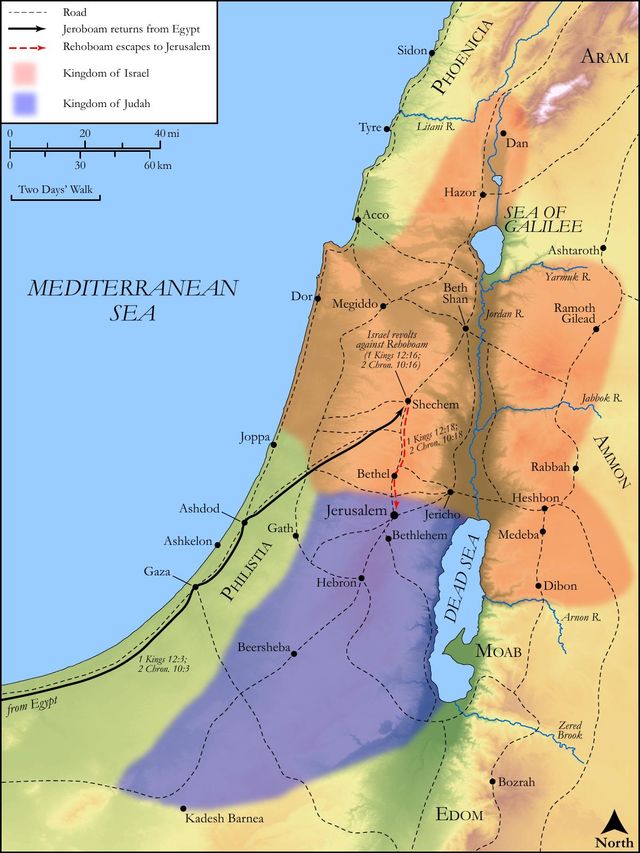
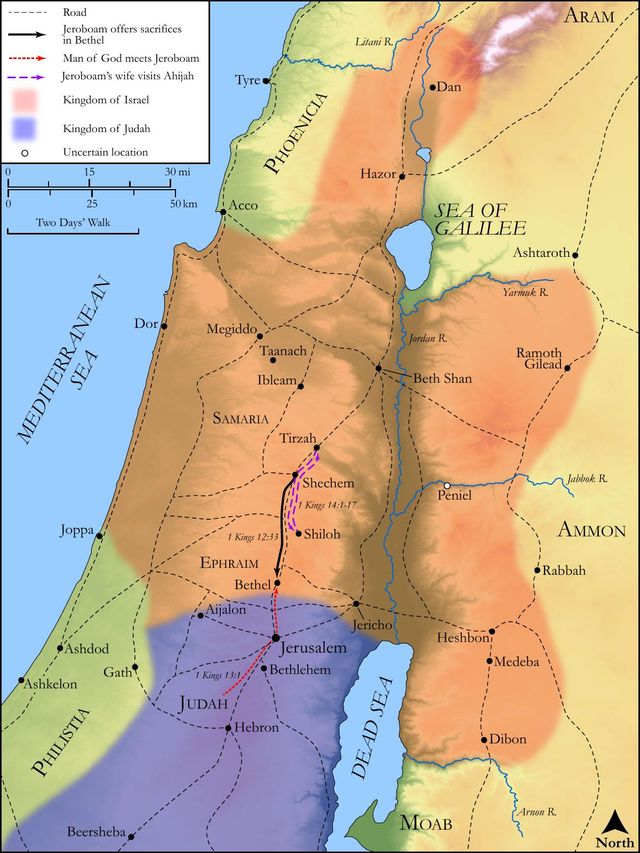
(3.)He set up two, by degrees to break people off from the belief of the unity of the godhead, which would pave the way to the polytheism of the Pagans. He set up these two at Dan and Beth-el (one the utmost border of his country northward), the other southward, as if they were the guardians and protectors of the kingdom. Beth-el lay close to Judah. He set up one there, to tempt those of Rehoboam's subjects over to him who were inclined to image-worship, in lieu of those of his subjects that would continue to go to Jerusalem. He set up the other at Dan, for the convenience of those that lay most remote, and because Micah's images had been set up there, and great veneration paid to them for many ages, Jdg 18:30, Jdg 18:31. Beth-el signifies the house of God, which gave some colour to the superstition; but the prophet called it Beth-aven, the house of vanity, or iniquity.
4.The people complied with him herein, and were fond enough of the novelty: They went to worship before the one, even unto Dan (Kg1 12:30), to that at Dan first because it was first set up, or even to that at Dan, though it lay such a great way off. Those that thought it much to go to Jerusalem, to worship God according to his institution, made no difficulty of going twice as far, to Dan, to worship him according to their own inventions. Or they are said to go to one of the calves at Dan because Abijah, king of Judah, within twenty years, recovered Beth-el (Ch2 13:19), and it is likely removed the golden calf, or forbade the use of it, and then they had only that at Dan to go to. This became a sin; and a great sin it was, against the express letter of the second commandment. God had sometimes dispensed with the law concerning worshipping in one place, but never allowed the worship of him by images. Hereby they justified their fathers in making the calf at Horeb, though God had so fully shown his displeasure against them for it and threatened to visit for it in the day of visitation (Exo 32:34), so that it was as great a contempt of God's wrath as it was of his law; and thus they added sin to sin. Bishop Patrick quotes a saying of the Jews, That till Jeroboam's time the Israelites sucked but one calf, but from that time they sucked two.
5.Having set up the gods, he fitted up accommodations for them; and wherein he varied from the divine appointment we are here told, which intimates that in other things he imitated what was done in Judah (Kg1 12:32) as well as he could. See how one error multiplied into many.
(1.)He made a house of high-places, or of altars, one temple at Dan, we may suppose, and another at Beth-el (Kg1 12:31), and in each many altars, probably complaining of it as an inconvenience that in the temple at Jerusalem there was but one. The multiplying of altars passed with some for a piece of devotion, but God, by the prophet, puts another construction upon it, Hos 8:11. Ephraim has made many altars to sin.
(2.)He made priests of the lowest of the people; and the lowest of the people were good enough to be priests to his calves, and too good. He made priests from the extremest parts of the people, that is, some out of every corner of the country, whom he ordered to reside among their neighbours, to instruct them in his appointments and reconcile them to them. Thus were they dispersed as the Levites, but were not of the sons of Levi. But the priests of the high-laces, or altars, he ordered to reside in Beth-el, as the priests at Jerusalem (Kg1 12:32), to attend the public service.
(3.)The feast of tabernacles, which God had appointed on the fifteenth day of the seventh month, he adjourned to the fifteenth day of the eighth month (Kg1 12:32), the month which he devised of his own heart, to show his power in ecclesiastical matters, Kg1 12:33. The passover and pentecost he observed in their proper season, or did not observe them at all, or with little solemnity in comparison with this.
(4.)He himself assuming a power to make priests, no marvel if he undertook to do the priests' work with his own hands: He offered upon the altar. This is twice mentioned (Kg1 12:32, Kg1 12:33), as also that he burnt incense. This was connived at in him because it was of a piece with the rest of his irregularities; but in king Uzziah it was immediately punished with the plague of leprosy. He did it himself, to make himself look great among the people and to get the reputation of a devout man, also to grace the solemnity of his new festival, with which, it is likely, at this time he joined the feast of the dedication of his altar. And thus,
[1.]Jeroboam sinned himself, yet perhaps excused himself to the world and his own conscience with this, that he did not do so ill as Solomon did, who worshipped other gods.
[2.]He made Israel to sin, drew them off from the worship of God and entailed idolatry upon their seed. And hereby they were punished for deserting the thrones of the house of David. The learned Mr. Whiston, in his chronology, for the adjusting of the annals of the two kingdoms of Judah and Israel, supposes that Jeroboam changed the calculation of the year and made it to contain but eleven months, and that by those years the reigns of the kings of Israel are measured till Jehu's revolution and no longer, so that during this interval eleven years of the annals of Judah answer to twelve in those of Israel.
Continue studying 1 Kings 12:26 across the web’s major study libraries — every link below opens this exact verse, chapter, or book on the destination site.
Read & Compare
 BibleGatewayThis verse in more than 200 translations and 70 languages.
 Bible.comThe YouVersion reader — hundreds of translations, reading plans, and highlights.
 ESV.orgCrossway's official English Standard Version reader.
 NET BibleThe NET translation with 60,000+ translators' notes on every rendering decision.
 STEP BibleTyndale House's free study tool — original text, vocabulary, and scholarly resources.
 BibliaLogos Bible Software's free web reader.
 USCCBThe New American Bible (Revised Edition) with the U.S. bishops' study notes.
Commentaries
 BibleHub CommentariesDozens of classic commentaries on this verse, gathered on one page.
 StudyLightMore than 100 commentary sets — the largest collection on the web.
 BibleRefPlain-English commentary on what this verse means, verse by verse.
 Enduring WordDavid Guzik's free commentary on this chapter, widely used by Bible teachers.
 Bible Study ToolsVerse commentary alongside Greek and Hebrew study aids.
Original Language & Research
- BibleHub InterlinearThe verse word by word — original language, transliteration, and English.
- BibleHub LexiconEvery word's original-language definition and Strong's entry.
 Blue Letter BibleDeep-study tools — Strong's numbers, concordance, and word studies.
 SefariaThe Hebrew text with Rashi and centuries of Jewish commentary.
Sermons, Hymns & Audio


TrulyRandomVerse is not affiliated with these sites and doesn’t control their content. They’re linked because they’re genuinely useful.
Summary
First Kings 12:26 offers a critical insight into the heart and motivations of Jeroboam, the newly appointed king over the ten northern tribes of Israel. This verse reveals his profound political insecurity and a deep-seated distrust in God's sovereign provision, which ultimately compelled him to deviate from divinely ordained worship practices. His private thought, "Now shall the kingdom return to the house of David," marks a pivotal moment, precipitating the Northern Kingdom's tragic descent into idolatry and centuries of spiritual apostasy, thereby severing its connection to the unified worship of Yahweh in Jerusalem.
Context
ShowHideLiterary Context
This verse immediately follows the dramatic and prophesied division of the united Israelite monarchy. After the death of Solomon, his son Rehoboam's harsh and unyielding policies led ten tribes to reject his rule, fulfilling the divine word delivered by the prophet Ahijah to Jeroboam in 1 Kings 11:29-39. Jeroboam, having been explicitly promised the kingship over these ten tribes by God Himself, is now established in his new role. The narrative swiftly transitions from the political establishment of Jeroboam's reign to his internal deliberations, which serve as the direct catalyst for the subsequent religious innovations. This internal monologue sets the stage for Jeroboam's pivotal, and ultimately disastrous, decision to establish alternative worship centers, detailed in 1 Kings 12:27-33, solely to secure his throne.
Historical & Cultural Context
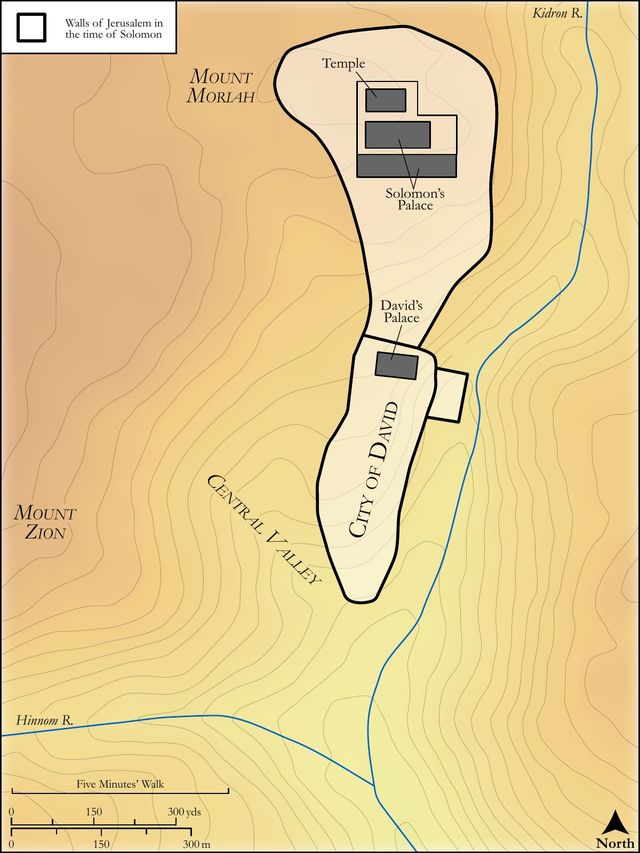
The newly divided monarchy presented a significant challenge to Jeroboam's political stability. Jerusalem, the capital of the Southern Kingdom of Judah, was not merely the political seat of the Davidic dynasty but also the sole legitimate place of worship for all Israel, housing the Temple built by Solomon. The Mosaic Law explicitly mandated that all Israelite males were to make pilgrimages to Jerusalem three times a year for major festivals, as commanded in Deuteronomy 16:16. For Jeroboam, allowing his subjects to continue these pilgrimages posed a direct and existential threat to his nascent kingdom. Their continued interaction with the Southern Kingdom and its Davidic king, Rehoboam, could easily rekindle their loyalty to the established, divinely covenanted dynasty, especially given God's eternal promise to the house of David. Jeroboam's fear was deeply rooted in the powerful historical, political, and religious pull that Jerusalem exerted over the Israelite people.
Key Themes
ShowHideJeroboam's internal monologue in 1 Kings 12:26 encapsulates several profound themes that resonate throughout the biblical narrative. Firstly, it highlights the profound tension between divine promise and human insecurity. Despite God's explicit and unconditional promise of the kingdom, Jeroboam's fear of losing political control overrides his faith, compelling him to devise human strategies rather than trusting in divine faithfulness. Secondly, it underscores the grave danger of political expediency overriding divine mandate. Jeroboam prioritizes the perceived stability and security of his kingdom over obedience to the Lord's established worship practices, demonstrating a profound lack of trust in God's ability to uphold His own word. Finally, this verse serves as the root of idolatry and spiritual compromise in the Northern Kingdom. His fear directly precipitates the establishment of golden calves in Dan and Bethel, creating alternative worship centers that initiated centuries of spiritual decline and separation from God's blessing for the northern tribes, a tragic pattern vividly depicted throughout the book of 1 Kings.
Exposition and Analysis
ShowHideKey Word Analysis
ShowHideFrom the primitive root H559, this word denotes more than a simple utterance; it encompasses a wide range of communication, including appointing, commanding, declaring, and thinking. In this context, combined with "in his heart," it signifies a deep, internal deliberation or a firm conclusion reached within one's mind, indicating a calculated and deliberate decision rather than a fleeting thought.
This term refers to the innermost being of a person—the seat of emotions, will, intellect, and moral character. When Jeroboam "said in his heart," it reveals that his fear and subsequent plan originated from his core being, his deepest convictions and anxieties, rather than merely an external suggestion or an impulsive reaction. It signifies a profound internal plotting.
This word refers to dominion, either abstractly as the estate or rule of a king, or concretely as the country or realm itself. Jeroboam's concern is specifically about the political entity and authority he has just received. His fear is that this very "kingdom," which God had granted him, would revert to the previous dynasty, indicating his focus on the earthly, political dimension rather than the divine source of his authority.
Verse Breakdown
ShowHide"And Jeroboam said in his heart,"
This opening clause immediately draws the reader into Jeroboam's private thoughts, offering a window into his inner motivation and the genesis of his subsequent actions. It emphasizes that his decisions are not impulsive but the result of a calculated, fear-driven assessment of his political vulnerability. The phrase highlights the personal and internal nature of his decision-making process, which, though unspoken, carries immense weight for the future spiritual and political trajectory of Israel.
"Now shall the kingdom return to the house of David:"
This is the core of Jeroboam's profound fear and the rationale for his future apostasy. He perceives a direct and imminent threat to his newly acquired kingdom. The word "return" implies that the people's loyalty, which had temporarily shifted to him, would inevitably revert to the divinely established Davidic dynasty if they continued to engage in worship at Jerusalem. This fear, though understandable from a human political perspective given the historical context and the centrality of Jerusalem, demonstrates a profound lack of faith in God's explicit promise to him and His ability to sustain his rule.
Literary Devices
ShowHideThe verse primarily employs Internal Monologue (or soliloquy), as Jeroboam "said in his heart." This device is crucial, as it allows the narrator to reveal the character's deepest fears, motivations, and strategic thinking, providing essential insight into the psychological underpinnings of his subsequent actions. It highlights the private nature of his decision, which will paradoxically have public and devastating consequences for an entire nation. Furthermore, the verse functions as a powerful piece of Foreshadowing. Jeroboam's expressed fear directly anticipates and explains his forthcoming establishment of alternative worship sites and the introduction of idolatry, setting the stage for the spiritual decline and eventual destruction of the Northern Kingdom. There is also a subtle yet profound Irony at play: God had explicitly given Jeroboam the kingdom and promised to establish his dynasty if he walked in obedience; yet, Jeroboam's lack of trust in this divine mandate leads him to take actions that ultimately undermine the very kingdom God had established for him, ensuring its eventual downfall.
Theological and Thematic Connections
ShowHideJeroboam's internal fear in 1 Kings 12:26 serves as a stark theological warning against the dangers of prioritizing human security and political pragmatism over divine faithfulness and obedience. Despite God's clear and conditional promise to establish his dynasty if he walked in God's ways (1 Kings 11:38), Jeroboam's political anxieties led him to doubt God's ability to maintain his rule without his own manipulative intervention. This illustrates a common human failing: the temptation to "help" God fulfill His promises through ungodly means, rather than patiently trusting in His sovereign plan. His fear of losing control ultimately led him to compromise fundamental spiritual truths, initiating a pattern of idolatry that plagued the Northern Kingdom for centuries and ultimately led to its destruction. This verse underscores that true security is found not in human schemes or political maneuvering, but in unwavering trust in the Lord's provision and faithfulness.
Reflection and Application
ShowHideJeroboam's story is a timeless cautionary tale for all who are given positions of leadership or responsibility, and indeed for every believer. His internal struggle mirrors our own temptations to rely on our own wisdom, strategies, or control rather than fully trusting God's promises and provision. When faced with uncertainty, perceived threats, or the pressure to maintain control, it is easy to allow fear to dictate our decisions, leading us to compromise our values or deviate from God's revealed will. Jeroboam's "solution" to his political insecurity—setting up rival worship centers and introducing idolatry—was a direct affront to God's command and led to generations of spiritual decay and national judgment. This prompts us to examine our own hearts: are we truly trusting God with our future, our security, our careers, and our callings, or are we secretly devising our own plans, driven by fear, that might lead us away from His perfect path? Genuine faith means resting in God's sovereignty, even when circumstances seem precarious, and allowing His commands, not our anxieties, to guide our actions.
Questions for Reflection
ShowHideFAQ
ShowHideWhy was Jeroboam afraid if God had promised him the kingdom?
ShowHideJeroboam's fear, despite God's explicit promise in 1 Kings 11:38, highlights a common human struggle: the gap between intellectual assent to God's word and deep, abiding trust in His faithfulness. While God had promised him a lasting dynasty if he obeyed, Jeroboam's fear was rooted in the immediate, practical political reality. The people of Israel had a long-standing allegiance to the Davidic dynasty and the central place of worship in Jerusalem. Jeroboam feared that if his subjects continued to make pilgrimages to the Temple in Jerusalem, their loyalty would inevitably shift back to Rehoboam and the "house of David," thereby undermining his own fledgling kingdom. His fear was a profound lack of faith in God's ability to sustain His own promise in the face of political and cultural pressures, leading him to resort to human, sinful means to secure what God had already given him by grace.
Christ-Centered Fulfillment
ShowHideJeroboam's profound insecurity and his desperate attempt to secure his kingdom through human manipulation stand in stark contrast to the perfect trust and unwavering faithfulness of Jesus Christ. Jeroboam feared the kingdom returning to the "house of David," a prophetic lineage that ultimately pointed to the Messiah, the true and eternal King. Yet, Jeroboam's actions demonstrated a fundamental failure to grasp that true kingship and ultimate security rest not in human power plays, but in God's eternal plan. Jesus, the true Son of David and the King of kings, never feared losing His kingdom, for His kingdom is "not of this world" (John 18:36), nor is it established by human will. While Jeroboam sought to divert worship from Jerusalem and introduce idolatry, Jesus Himself is the ultimate Temple, the one through whom true worship in spirit and truth is offered (John 4:23-24). His reign is not established by human decree or secured by political maneuvering, but by His perfect obedience, sacrificial death, and glorious resurrection (Philippians 2:8-11). Unlike Jeroboam, who compromised God's commands for earthly gain, Jesus perfectly fulfilled the Law and established an eternal kingdom that will never return to any other house, but will endure forever, bringing all things under His gracious and sovereign rule (Hebrews 1:8).