


1 Chronicles 18:1
Bible text: King James Version (1769 Blayney text) · Public domain
Bible text: Berean Standard Bible · Public domain
Bible text: American Standard Version (1901) · Public domain
Bible text: World English Bible, Messianic edition · Public domain
Bible text: Geneva Bible (1599) · Public domain
Bible text: Young's Literal Translation · Public domain
- וַיְהִיvay·Hiand it wasH1961Conj-w ¦ V-Qal-ConsecImperf-3msVerb Qal Consecutive Imperfect 3rd Singular Masculineוַandיְהִיit was
- אַחֲרֵי'a·cha·reiafterH310Adj-mpcAdjective Numerical Plural Masculine Construct
- כֵןKhenthusH3651AdvAdverb
- וַיַּךְvai·Yakhand he struck downH5221Conj-w ¦ V-Hiphil-ConsecImperf-3msVerb Hiphil Consecutive Imperfect 3rd Singular Masculineוַandיַּךְhe struck down
- דָּוִידda·VidDavidH1732N-proper-mNoun Proper Masculine
- אֶת'et<obj.>H853DirObjMParticle Object Indicator
- פְּלִשְׁתִּיםpe·lish·Tim[the] PhilistinesH6430N-mpNoun Gentilic Plural Masculine Absolute
- וַיַּכְנִיעֵםvai·yakh·ni·'Emand he subdued themH3665Conj-w ¦ V-Hiphil-ConsecImperf-3ms ¦ 3mpVerb Hiphil Consecutive Imperfect 3rd Singular Masculineוַandיַּכְנִיעֵhe subduedםthem
- וַיִּקַּחvai·yi·Kachand he tookH3947Conj-w ¦ V-Qal-ConsecImperf-3msVerb Qal Consecutive Imperfect 3rd Singular Masculineוַandיִּקַּחhe took
- אֶת'et<obj.>H853DirObjMParticle Object Indicator
- גַּתgatGathH1661N-properNoun Proper Location
- וּבְנֹתֶיהָu·ve·no·Tei·haand its daughtersH1323Conj-w ¦ N-fpc ¦ 3fsNoun Plural Feminine Constructוּandבְנֹתֶיdaughtersהָits
- מִיַּדmi·Yadfrom [the] hand ofH3027Prep-m ¦ N-cscNoun Singular common gender Constructמִfromיַּד[the] hand of
- פְּלִשְׁתִּיםpe·lish·Tim[the] PhilistinesH6430N-mpNoun Gentilic Plural Masculine Absolute
English is a literal word-by-word gloss of the Hebrew, not the KJV's wording. Why?
This is the original text the KJV's translators worked from — each Hebrew word with its own literal English meaning in this verse, prepared by scholars at Tyndale House, Cambridge. The KJV translates whole sentences, not word by word, so its wording differs: one Hebrew word can become several English words, and the KJV may choose “the LORD” where the gloss reads “Yahweh”. Both are faithful — they answer different questions. For the KJV's own rendering, switch to the KJV text.
Details
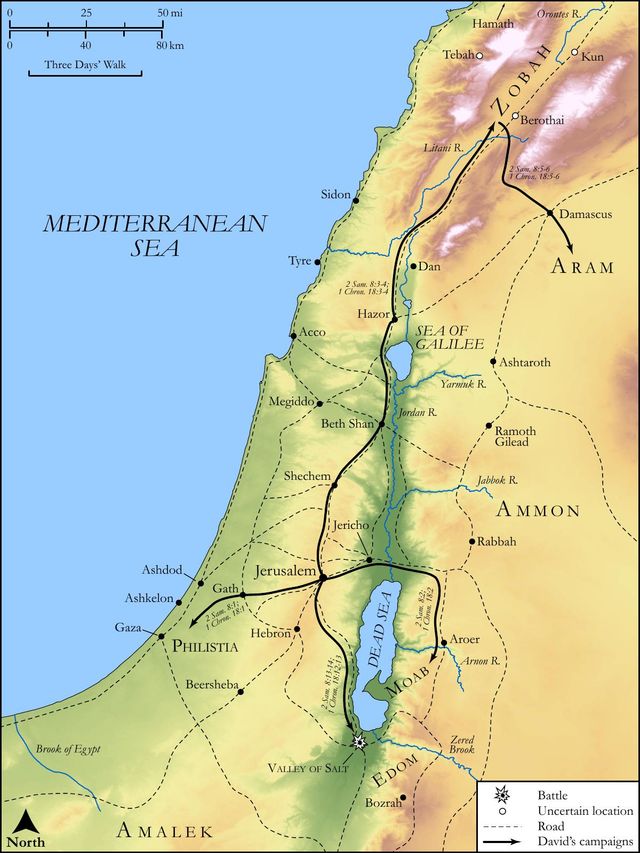
See on the biblical-era map
Study this verse
Public-domain commentary
Matthew Henry
From his Commentary on the Whole Bible. Henry comments on passages, not single verses — this entry covers 1 Chronicles 18:1–8.
After this, it is said (Ch1 18:1), David did those great exploits. After the sweet communion he had had with God by the word and prayer, as mentioned in the foregoing chapter, he went on his work with extraordinary vigour and courage, conquering and to conquer. Thus Jacob, after his vision, lifted up his feet, Gen 29:1.
We have taken a view of these victories before, and shall now only observe, 1. Those that have been long enemies to the Israel of God will be brought down at last. The Philistines had, for several generations, been vexatious to Israel, but now David subdued them, Ch1 18:1. Thus shall all opposing rule, principality, and power, be, at the end of time, put down by the Son of David, and the most inveterate enemies shall fall before him. 2. Such is the uncertainty of this world that frequently men lose their wealth and power when they think to confirm it. Hadarezer was smitten as he went to establish his dominion, Ch1 18:3. 3. A horse is a vain thing for safety, so David said (Psa 33:17), and it seems he believed what he said, for he houghed the chariot-horses, Ch1 18:4. Being resolved not to trust to them (Psa 20:7), he would not use them. 4. The enemies of God's church are often made to ruin themselves by helping one another, Ch1 18:5. The Syrians of Damascus were smitten when they came to help Hadarezer. When hand thus joins in hand they shall not only not go unpunished, but thereby they shall be gathered as the sheaves into the floor, Mic 4:11, Mic 4:12. 5. The wealth of the sinner sometimes proves to have been laid up for the just. The Syrians brought gifts, Ch1 18:6. Their shields of gold and their brass were brought to Jerusalem, Ch1 18:7, Ch1 18:8. As the tabernacle was built of the spoils of the Egyptians, so the temple of the spoils of other Gentile nations, a happy presage of the interest the Gentiles should have in the gospel church.
Continue studying 1 Chronicles 18:1 across the web’s major study libraries — every link below opens this exact verse, chapter, or book on the destination site.
Read & Compare
 BibleGatewayThis verse in more than 200 translations and 70 languages.
 Bible.comThe YouVersion reader — hundreds of translations, reading plans, and highlights.
 ESV.orgCrossway's official English Standard Version reader.
 NET BibleThe NET translation with 60,000+ translators' notes on every rendering decision.
 STEP BibleTyndale House's free study tool — original text, vocabulary, and scholarly resources.
 BibliaLogos Bible Software's free web reader.
 USCCBThe New American Bible (Revised Edition) with the U.S. bishops' study notes.
Commentaries
 BibleHub CommentariesDozens of classic commentaries on this verse, gathered on one page.
 StudyLightMore than 100 commentary sets — the largest collection on the web.
 BibleRefPlain-English commentary on what this verse means, verse by verse.
 Enduring WordDavid Guzik's free commentary on this chapter, widely used by Bible teachers.
 Bible Study ToolsVerse commentary alongside Greek and Hebrew study aids.
Original Language & Research
- BibleHub InterlinearThe verse word by word — original language, transliteration, and English.
- BibleHub LexiconEvery word's original-language definition and Strong's entry.
 Blue Letter BibleDeep-study tools — Strong's numbers, concordance, and word studies.
 SefariaThe Hebrew text with Rashi and centuries of Jewish commentary.
Sermons, Hymns & Audio


TrulyRandomVerse is not affiliated with these sites and doesn’t control their content. They’re linked because they’re genuinely useful.
Summary
1 Chronicles 18:1 records the immediate and powerful fulfillment of God's covenant promises to King David, as he decisively defeats the Philistines, Israel's long-standing adversaries. This pivotal verse marks the commencement of a period of military consolidation and territorial expansion for David's kingdom, vividly demonstrating divine faithfulness and David's divinely empowered leadership in bringing security and dominion to Israel by completely subduing a major enemy stronghold like Gath.
Context
ShowHideLiterary Context
The phrase "Now after this" in 1 Chronicles 18:1 serves as a direct and crucial narrative link to the preceding chapter, 1 Chronicles 17. In that chapter, God, through the prophet Nathan, establishes an unconditional and eternal covenant with David, promising him a lasting dynasty, a secure kingdom, and, significantly, rest from all his enemies (1 Chronicles 17:9-10). This verse immediately demonstrates the commencement of that promised rest and the tangible manifestation of God's faithfulness. The Chronicler's primary purpose throughout the book is to legitimize the Davidic dynasty and the Jerusalem temple, emphasizing God's covenant loyalty and David's role as the divinely chosen king who brings stability and prepares for the temple's construction. Thus, David's military successes are presented not merely as human achievements but as divine acts of fulfillment, validating God's promises and David's reign.
Historical & Cultural Context
The Philistines were a formidable, non-Semitic "Sea Peoples" who settled in the southwestern coastal plain of Canaan around the 12th century BC. Organized into a powerful Pentapolis (five major cities: Gaza, Ashkelon, Ashdod, Ekron, and Gath), they posed a constant and significant military threat to Israel throughout the periods of the Judges and early monarchy. Their advanced iron technology and superior military organization often gave them a distinct advantage over the Israelites, as vividly seen in battles like those described in 1 Samuel 4 and the iconic confrontation in 1 Samuel 17. Gath, specifically mentioned here, was one of their most prominent and strategically important cities, often serving as a staging ground for their incursions into Israelite territory. Its capture by David was not just a minor skirmish but a monumental blow to Philistine power, symbolizing Israel's ascendance and the consolidation of David's kingdom, paving the way for a period of relative peace and prosperity.
Key Themes
ShowHideThis verse powerfully underscores several key themes central to the book of Chronicles and the broader biblical narrative. Foremost is Divine Faithfulness – God's unwavering commitment to His covenant promises, particularly those made to David in 1 Chronicles 17:10-14. David's victory is presented as a direct result of God's action, not merely human strength or strategy. This also highlights David's Divinely Appointed Kingship and Ascendancy, portraying him as the instrument through whom God brings security and expansion to His people. The theme of Conquest and Dominion is evident in the subjugation of the Philistines and the capture of Gath, signifying the establishment of Israel's secure borders and its supremacy over traditional adversaries, leading to a period of "rest" (as promised in 1 Chronicles 17:9) necessary for the future building of the Temple.
Exposition and Analysis
ShowHideKey Word Analysis
ShowHideThis verb signifies a decisive and forceful striking, often implying a comprehensive defeat or a fatal blow. In military contexts, as used here, it denotes a crushing victory, indicating that David's triumph over the Philistines was total and their power was effectively broken.
This word means "to bend the knee," "to humiliate," or "to vanquish." It conveys the idea of complete subjugation and mastery. David not only defeated the Philistines in battle but also brought them under his control, effectively neutralizing their threat and incorporating their territory or influence into his dominion. This concept of "subduing" resonates with the creation mandate given in Genesis 1:28 for humanity to exercise dominion.
While a common verb meaning "to take" or "to seize," in this specific military context, it refers to the capture and permanent acquisition of a city or territory. The act of "taking Gath and her towns" signifies a significant territorial expansion and solidification of David's control over a region previously dominated by the Philistines, marking a permanent shift in geopolitical power.
Verse Breakdown
ShowHide"¶ Now after this it came to pass"
This introductory phrase immediately links the military successes of chapter 18 to the divine covenant established in 1 Chronicles 17. It functions as a temporal and theological bridge, signaling that the events unfolding are a direct consequence and fulfillment of God's promises, emphasizing divine orchestration rather than mere human initiative. The Chronicler frequently employs such connectors to highlight the unfolding of God's sovereign plan.
"that David smote the Philistines, and subdued them"
This clause describes the decisive military action and its comprehensive outcome. "Smote" indicates a crushing defeat in battle, signifying the breaking of Philistine military might. "Subdued them" points to the subsequent establishment of dominance and control, implying that the Philistines were brought into a state of submission. This was not a temporary victory but a fundamental shift in power, bringing the long-standing Philistine threat to an end and securing Israel's borders, highlighting David's role as God's chosen warrior-king.
"and took Gath and her towns out of the hand of the Philistines"
This final clause provides a specific and highly significant detail of the victory. Gath, as one of the five principal Philistine cities, was a symbol of their power and a strategic stronghold. Its capture, along with its surrounding settlements ("her towns"), represents a major territorial gain and a profound blow to the Philistine confederacy, signifying the expansion and consolidation of David's kingdom. The phrase "out of the hand of the Philistines" powerfully underscores the complete liberation of this territory from enemy control and the transfer of dominion to David.
Literary Devices
ShowHideThe Chronicler employs several literary devices in this verse to convey its profound theological significance. Narrative Parallelism is evident, as this account closely mirrors 2 Samuel 8:1, emphasizing the historical veracity and importance of David's victory. However, the Chronicler's specific phrasing and strategic placement immediately after the covenant in chapter 17 highlight a strong Fulfillment Motif. The victory is presented not merely as a historical event but as a direct and immediate manifestation of God's faithfulness to His promises, underscoring divine causality. Furthermore, Symbolism is powerfully at play, particularly with the mention of Gath. Gath represents the formidable and persistent threat of the Philistines, and its capture symbolizes the complete subjugation of Israel's enemies and the establishment of divine rest and security for the kingdom. The verse is concise yet potent, using precise and impactful verbs to convey the totality of David's divinely-empowered triumph.
Theological and Thematic Connections
ShowHide1 Chronicles 18:1 stands as a powerful testament to the unwavering faithfulness of God to His covenant promises. Following the divine assurance of a lasting dynasty and rest from enemies in 1 Chronicles 17, this verse immediately demonstrates God's active involvement in the affairs of His people, fulfilling His word through David's military prowess. It underscores that true security and dominion for Israel came not from human strength alone, but from God's sovereign power working through His chosen king. This victory over a long-standing and formidable enemy like the Philistines, culminating in the capture of a key stronghold like Gath, solidifies David's reign and establishes the conditions for the peace and stability necessary for the future construction of the Temple.
Reflection and Application
ShowHideThe narrative of David's decisive victory over the Philistines in 1 Chronicles 18:1 offers profound encouragement for believers today. Just as God faithfully fulfilled His promises to David, bringing rest from his enemies and establishing his kingdom, so too does He remain faithful to His people in every generation. We often face "Philistines" in our lives—long-standing challenges, persistent struggles, or seemingly insurmountable obstacles that threaten our peace and progress. This verse reminds us that divine promises often unfold through human action, requiring courage, obedience, and strategic engagement, but the ultimate victory belongs to God. It calls us to trust in God's power to overcome our "giants," to lean on His covenant faithfulness when we feel overwhelmed, and to recognize that true rest and security come from His sovereign hand. Our battles, whether spiritual, emotional, or circumstantial, are not fought in our own strength but through the power of God who goes before us, empowering us to overcome and experience His promised peace.
Questions for Reflection
ShowHideFAQ
ShowHideWhy is Gath specifically mentioned in this verse?
ShowHideGath was one of the five principal cities of the Philistine Pentapolis and a major stronghold, often serving as a base for Philistine incursions into Israelite territory. Its specific mention signifies a particularly important and symbolic victory. Capturing Gath represented a decisive blow to Philistine power and a significant territorial expansion for Israel, demonstrating David's complete subjugation of this long-standing enemy. It was a strategic and symbolic conquest, solidifying Israel's dominion over its traditional adversaries, as also recounted in 2 Samuel 8:1.
How does this account in Chronicles relate to the parallel narrative in 2 Samuel?
ShowHideThe account in 1 Chronicles 18:1 is very similar to 2 Samuel 8:1, indicating a shared historical tradition. However, the Chronicler's purpose differs from that of the author of Samuel. While Samuel focuses on the rise and fall of kings and the establishment of the monarchy, Chronicles emphasizes the Davidic dynasty's legitimacy, the importance of the Temple, and God's covenant faithfulness. The Chronicler places this victory immediately after God's covenant with David in 1 Chronicles 17 to highlight that David's military successes are direct fulfillments of God's promises, demonstrating divine blessing and preparing the way for the Temple's construction under Solomon.
Christ-Centered Fulfillment
ShowHideDavid's decisive victory over the Philistines and the establishment of "rest" in 1 Chronicles 18:1 serves as a profound foreshadowing of the ultimate victory and eternal rest brought by Jesus Christ, the greater Son of David. Just as David, a king chosen by God, subdued Israel's physical enemies and established a kingdom of peace, so Christ, the King of kings, has triumphed over the ultimate spiritual enemies: sin, death, and the powers of darkness. His cross was the decisive "smoting" of evil, and His resurrection the ultimate "subduing" of death's power, as powerfully declared in Colossians 2:15, where it states He disarmed the spiritual rulers and authorities. The "rest" David brought was temporal and physical, a temporary respite from earthly conflict, but Christ offers a spiritual and eternal rest for all who believe, a true Sabbath rest for the people of God that transcends all earthly struggles and anxieties, as beautifully described in Hebrews 4:9-10. David's capture of Gath, a symbol of formidable enemy strongholds, points to Christ's complete conquest of every spiritual stronghold that holds humanity captive, ushering in His eternal kingdom where He reigns supreme, a kingdom that will know no end, as promised to Mary concerning her Son in Luke 1:32-33.