


1 Samuel 5:8
- וַיִּשְׁלְחוּvai·yish·le·Chuand they sentH7971Conj-w ¦ V-Qal-ConsecImperf-3mpVerb Qal Consecutive Imperfect 3rd Plural Masculineוַandיִּשְׁלְחוּthey sent
- וַיַּאַסְפוּvai·ya·'as·Fuand they gatheredH622Conj-w ¦ V-Qal-ConsecImperf-3mpVerb Qal Consecutive Imperfect 3rd Plural Masculineוַandיַּאַסְפוּthey gathered
- אֶת'et<obj.>H853DirObjMParticle Object Indicator
- כָּלkolallH3605N-mscNoun Singular Masculine Construct
- סַרְנֵיsar·Nei[the] rulers ofH5633N-mpcNoun Plural Masculine Construct
- פְלִשְׁתִּיםfe·lish·Tim[the] PhilistinesH6430N-mpNoun Gentilic Plural Masculine Absolute
- אֲלֵיהֶם'a·lei·Hemto themH413Prep ¦ 3mpPreposition Definiteאֲלֵיtoהֶםthem
- וַיֹּאמְרוּvai·yo·me·Ruand they saidH559Conj-w ¦ V-Qal-ConsecImperf-3mpVerb Qal Consecutive Imperfect 3rd Plural Masculineוַandיֹּאמְרוּthey said
- מַהmahwhat?H4100InterrogPronoun Interrogative
- נַּעֲשֶׂהna·'a·Sehwill we doH6213V-Qal-Imperf-1cpVerb Qal Imperfect 1st Plural common gender
- לַאֲרוֹןla·'a·rOnto [the] ark ofH727Prep-l ¦ N-mscNoun Singular Masculine Constructלַtoאֲרוֹן[the] ark of
- אֱלֹהֵי'e·lo·Hei[the] God ofH430N-mpcNoun Plural Masculine Construct
- יִשְׂרָאֵלYis·ra·'ElIsraelH3478N-properNoun Proper Location
- וַיֹּאמְרוּvai·Yo·me·Ruand they saidH559Conj-w ¦ V-Qal-ConsecImperf-3mpVerb Qal Consecutive Imperfect 3rd Plural Masculineוַandיֹּאמְרוּthey said
- גַּתgatGathH1661N-properNoun Proper Location
- יִסֹּבyi·Solet it go roundH5437V-Qal-Imperf-3msVerb Qal Imperfect 3rd Singular Masculine
- אֲרוֹן'a·Ron[the] ark ofH727N-mscNoun Singular Masculine Construct
- אֱלֹהֵי'e·lo·Hei[the] God ofH430N-mpcNoun Plural Masculine Construct
- יִשְׂרָאֵלYis·ra·'ElIsraelH3478N-properNoun Proper Location
- וַיַּסֵּבּוּvai·yas·Se·buand they brought roundH5437Conj-w ¦ V-Hiphil-ConsecImperf-3mpVerb Hiphil Consecutive Imperfect 3rd Plural Masculineוַandיַּסֵּבּוּthey brought round
- אֶת'et<obj.>H853DirObjMParticle Object Indicator
- אֲרוֹן'a·Ron[the] ark ofH727N-mscNoun Singular Masculine Construct
- אֱלֹהֵי'e·lo·Hei[the] God ofH430N-mpcNoun Plural Masculine Construct
- יִשְׂרָאֵלYis·ra·'ElIsraelH3478N-properNoun Proper Location
English is a literal word-by-word gloss of the Hebrew, not the KJV's wording. Why?
This is the original text the KJV's translators worked from — each Hebrew word with its own literal English meaning in this verse, prepared by scholars at Tyndale House, Cambridge. The KJV translates whole sentences, not word by word, so its wording differs: one Hebrew word can become several English words, and the KJV may choose “the LORD” where the gloss reads “Yahweh”. Both are faithful — they answer different questions. For the KJV's own rendering, switch to the KJV text.
Details
See on the biblical-era map
Study this verse
Public-domain commentary
Matthew Henry
From his Commentary on the Whole Bible. Henry comments on passages, not single verses — this entry covers 1 Samuel 5:6–12.
The downfall of Dagon (if the people had made a good use of it, and had been brought by it to repent of their idolatries and to humble themselves before the God of Israel and seek his face) might have prevented the vengeance which God here proceeds to take upon them for the indignities done to his ark, and their obstinate adherence to their idol, in defiance of the plainest conviction. Lord, when thy hand is lifted up they will not see, but they shall see, Isa 26:11. And, if they will not see the glory, they shall feel the weight, of God's hand, for so the Philistines did. The hand of the Lord was heavy upon them (Sa1 5:6), and he not only convinced them of their folly, but severely chastised their insolence. 1. He destroyed them, that is, cut many of them off by sudden death, those, we may suppose, that had most triumphed in the captivity of the ark. This is distinguished from the disease with which others were smitten. At Gath it is called a great destruction (Sa1 5:9), a deadly destruction, Sa1 5:11. And it is expressly said (Sa1 5:12) that those who were smitten with the emerods were the men that died not by the other destruction, which probably was the pestilence. They boasted of the great slaughter which their sword had made among the Israelites, Sa1 4:10. But God lets them know that though he does not see fit to draw Israel's sword against them (they were unworthy to be employed), yet God had a sword of his own, with which he could make a no less dreadful execution among them, which if he whet, and his hand take hold on judgment, he will render vengeance to his enemies, Deu 32:41, Deu 32:42. Note, Those that contend with God, his ark, and his Israel, will infallibly be ruined at last. If conviction conquer not, destruction shall. 2. Those that were not destroyed he smote with emerods (Sa1 5:6), in their secret parts (Sa1 5:9), so grievous that (Sa1 5:12) the cry went up to heaven, that is, it might be heard a great way off, and perhaps, in the extremity of their pain and misery, they cried, not to Dagon, but to the God of heaven. The Psalmist, speaking of this sore judgment upon the Philistines, describes it thus: God smote his enemies in the hinder parts, and put them to a perpetual reproach, Psa 78:66. The emerods (which we call the piles, and perhaps it was then a more grievous disease than it is now) is threatened among the judgments that would be the fruit of the curse, Deu 28:27. It was both a painful and shameful disease; a vile disease for vile deserts. By it God would humble their pride, and put contempt upon them, as they had done upon his ark. The disease was epidemical, and perhaps, among them, a new disease. Ashdod was smitten, and the coasts thereof, the country round. For contempt of God's ordinances, many are weak and sick, and many sleep, Co1 11:30. 3. The men of Ashdod were soon aware that it was the hand of God, the God of Israel, Sa1 5:7. Thus they were constrained to acknowledge his power and dominion, and confess themselves within his jurisdiction, and yet they would not renounce Dagon and submit to Jehovah; but rather, now that he touched their bone and their flesh, and in a tender part, they were ready to curse him to his face, and instead of making their peace with him, and courting the stay of his ark upon better terms, they desired to get clear of it, as the Gadarenes, who, when they had lost their swine, desired Christ to depart out of their coasts. Carnal hearts, when they smart under the judgments of God, would rather, if it were possible, put him far from them than enter into covenant and communion with him, and make him their friend. Thus the men of Ashdod resolve, The ark of the God of Israel shall not abide with us. 4. It is resolved to change the place of its imprisonment. A great council was called, and the question proposed to all the lords was, "What shall be we with the ark?" And at last it was agreed that it should be carried to Gath, Sa1 5:8. Some superstitious conceit they had that the fault was in the place, and that the ark would be better pleased with another lodging, further off from Dagon's temple; and therefore, instead of returning it, as they should have done, to its own place, they contrive to send it to another place. Gath is pitched upon, a place famed for a race of giants, but their strength and stature are no fence against the pestilence and the emerods: the men of that city were smitten, both great and small (Sa1 5:9), both dwarfs and giants, all alike to God's judgments; none so great as to over-top them, none so small as to be over-looked by them. 5. They were all at last weary of the ark, and very willing to get rid of it. It was sent from Gath to Ekron, and, coming by order of council, the Ekronites could not refuse it, but were much exasperated against their great men for sending them such a fatal present (Sa1 5:10): They have sent it to us to slay us and our people. The ark had the tables of the law in it; and nothing more welcome to faithful Israelites than the word of God (to them it is a savour of life unto life), but to uncircumcised Philistines, that persist in enmity to God, nothing more dreadful nor unwelcome: to them it is a savour of death unto death. A general assembly is instantly called, to advise about sending the ark again to its place, Sa1 5:11. While they are consulting about it, the hand of God is doing execution; and their contrivances to evade the judgment do but spread it. Many drop down dead among them. Many more are raging ill of the emerods, Sa1 5:12. What shall they do? Their triumphs in the captivity of the ark are soon turned into lamentations, and they are as eager to quit it as ever they had been to seize it. Note, God can easily make Jerusalem a burdensome stone to all that heave at it, Zac 12:3. Those that fight against God will soon have enough of it, and, first or last, will be made to know that none ever hardened their hearts against him and prospered. The wealth that is got by fraud and injustice, especially that which is got by sacrilege and robbing God, though swallowed greedily, and rolled under the tongue as a sweet morsel, must be vomited up again; for, till it be, the sinner shall not feel quietness in his belly, Job 20:15-20.
Historical interpretation
Historical reception
1 surviving comment on this verse from the historical church.
And the Gittites replied: Let the ark of the God of Israel be carried around, etc. And this carrying around of the ark suits the present time of our age, where each of the weak desires the difficult words of the Lord to be fulfilled by others rather than by themselves. But even barbarian nations, which have recently accepted the faith of Christ, soon become enfeebled by soft desires, thinking this charge should be given to others rather than be exercised among themselves for longer.
Continue studying 1 Samuel 5:8 across the web’s major study libraries — every link below opens this exact verse, chapter, or book on the destination site.
Read & Compare
 BibleGatewayThis verse in more than 200 translations and 70 languages.
 Bible.comThe YouVersion reader — hundreds of translations, reading plans, and highlights.
 ESV.orgCrossway's official English Standard Version reader.
 NET BibleThe NET translation with 60,000+ translators' notes on every rendering decision.
 STEP BibleTyndale House's free study tool — original text, vocabulary, and scholarly resources.
 BibliaLogos Bible Software's free web reader.
 USCCBThe New American Bible (Revised Edition) with the U.S. bishops' study notes.
Commentaries
 BibleHub CommentariesDozens of classic commentaries on this verse, gathered on one page.
 StudyLightMore than 100 commentary sets — the largest collection on the web.
 BibleRefPlain-English commentary on what this verse means, verse by verse.
 Enduring WordDavid Guzik's free commentary on this chapter, widely used by Bible teachers.
 Bible Study ToolsVerse commentary alongside Greek and Hebrew study aids.
Original Language & Research
- BibleHub InterlinearThe verse word by word — original language, transliteration, and English.
- BibleHub LexiconEvery word's original-language definition and Strong's entry.
 Blue Letter BibleDeep-study tools — Strong's numbers, concordance, and word studies.
 SefariaThe Hebrew text with Rashi and centuries of Jewish commentary.
Sermons, Hymns & Audio


TrulyRandomVerse is not affiliated with these sites and doesn’t control their content. They’re linked because they’re genuinely useful.
Summary
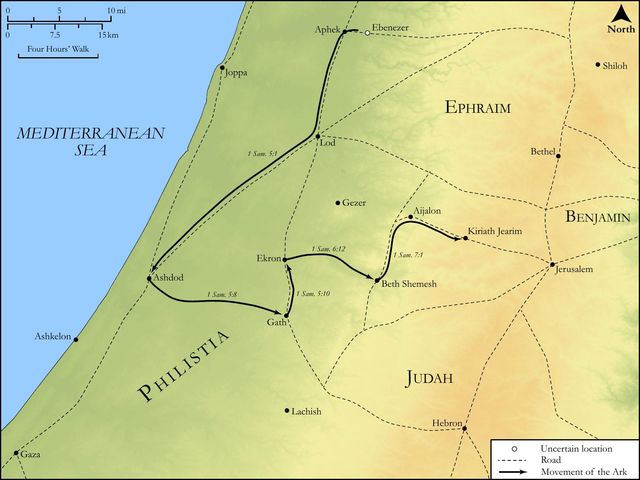
1 Samuel 5:8 records the desperate and collective decision of the Philistine lords to relocate the Ark of the Covenant from Ashdod to Gath. Following the public humiliation of their god Dagon and the outbreak of severe, divinely-sent plagues among the Ashdodites, the Philistine rulers, recognizing the Ark's undeniable connection to the "God of Israel" and the source of their escalating woes, convened to transfer the problem, revealing their profound theological misunderstanding of divine sovereignty and their futile attempts to manage God's uncontainable power through mere geographical relocation.
Context
ShowHideLiterary Context
This verse serves as a critical turning point within the narrative of the Ark's capture and its subsequent devastating impact on the Philistines, a sequence detailed across 1 Samuel 4-6. Chapter 4 sets the stage with Israel's defeat, the tragic deaths of Eli's sons, Hophni and Phinehas, and the capture of the Ark itself by the Philistines. Chapter 5 then recounts the Ark's arrival in Ashdod, where it was defiantly placed in the temple of Dagon. The narrative vividly describes the divine judgment against Dagon, resulting in the idol's repeated collapse and eventual mutilation before the Ark, as detailed in 1 Samuel 5:1-5. This unprecedented religious humiliation was swiftly followed by a severe plague of tumors (or emerods) afflicting the people of Ashdod, along with a "deadly destruction" (1 Samuel 5:6). Faced with these escalating and undeniable calamities, the Philistine leaders are compelled to act, leading directly to the consultation and decision recorded in 1 Samuel 5:7-8. The decision to move the Ark to Gath, rather than return it, sets the stage for the continuation of divine judgment in other Philistine cities, ultimately leading to its forced return to Israel in 1 Samuel 6.
Historical & Cultural Context
The Philistines were a formidable confederacy of five prominent city-states—Ashdod, Gaza, Ashkelon, Gath, and Ekron—situated along the southwestern coast of Canaan. Their society was highly organized, governed by a council of "lords" (Hebrew: sarne Pelištîm), who held significant authority within their respective cities and made collective decisions, as powerfully demonstrated in this passage. Their religious landscape was polytheistic, with Dagon being a particularly prominent deity, often depicted with a fish-like lower body. In the broader ancient Near East, it was a common practice for victorious nations to seize the idols or sacred objects of their defeated adversaries, viewing such acts as tangible proof of their own gods' superiority. The Philistines undoubtedly intended to display the Ark as a grand trophy, symbolizing Dagon's triumph over the God of Israel. However, the events recounted in 1 Samuel 5 dramatically subvert this expectation, unequivocally demonstrating Yahweh's unique and absolute sovereignty over all other gods and His active, uncontainable presence, even when seemingly "captured." The plagues were universally understood as expressions of divine judgment, and the Philistines' response—moving the Ark—reflects a common ancient strategy to appease or redirect a deity's wrath, rather than an act of genuine repentance or submission.
Key Themes
ShowHideThis passage profoundly illustrates several critical theological themes. Firstly, it underscores God's Uncontainable Sovereignty; even when the Ark, representing His covenant presence, is physically in enemy territory, God remains actively and powerfully in control, demonstrating His inherent authority independent of human location, manipulation, or understanding. He cannot be confined to temples or human strategies, and His holiness actively works to expose and dismantle anything that opposes Him. Secondly, it highlights The Futility of Opposing God; the Philistines' desperate attempts to manage, contain, or simply transfer the "God of Israel" proved utterly ineffective. Moving the Ark from city to city was not a viable solution but a superstitious and ultimately powerless reaction to a problem they could neither comprehend nor control, showcasing the ultimate impotence of human or pagan forces when arrayed against the true and living God. Thirdly, there is a compelling theme of Acknowledging, Yet Resisting, God's Power; the Philistines clearly recognize the Ark as belonging to "the God of Israel" and directly associate the escalating plagues with Him. However, instead of repenting, humbling themselves, or submitting to this powerful deity, they seek to merely transfer the problem, revealing their deep-seated resistance to truly acknowledge His supremacy and their profound inability to grasp the full implications of His absolute holiness.
Exposition and Analysis
ShowHideKey Word Analysis
ShowHideThis term (H5633) refers to the "peers" or "princes" who governed the five principal Philistine city-states (Ashdod, Gaza, Ashkelon, Gath, and Ekron). Their collective gathering and unanimous decision-making underscore the pan-Philistine nature of the crisis. It was not merely a local problem for Ashdod but a widespread threat perceived across the entire Philistine confederacy, necessitating a unified response from their highest authorities. This highlights the widespread fear and concern among these powerful city-states in the face of an unprecedented divine judgment.
This plural noun (H430), used here with the article, specifically refers to the supreme God, Yahweh, the God of Israel. The Philistines' consistent use of "the God of Israel" indicates their clear recognition of the Ark's divine association and its origin. Despite their polytheistic worldview, they attribute the calamities directly to this specific deity, acknowledging His unique power and connection to Israel. This phrase emphasizes that they are dealing not with a mere object, but with the active, judgmental presence of Yahweh, the one true God.
The primitive root (H5437) implies to "revolve," "surround," or "turn about." Here, in its hiphil stem (causative), it suggests a desperate, almost superstitious attempt to transfer or bypass the problem rather than confront its root cause. The Philistines are not seeking to return the Ark to its rightful place or to repent; instead, they are attempting to "pass the buck," hoping that by moving the source of the plague, they can escape its effects. This reveals their profound spiritual blindness and their failure to understand the nature of God's holiness and judgment, believing they can outmaneuver the divine.
Verse Breakdown
ShowHide"They sent therefore and gathered all the lords of the Philistines unto them,"
This opening clause emphasizes the urgency and collective nature of the crisis. The severity of the plagues and the public humiliation of Dagon in Ashdod necessitated an immediate, unified response from the highest political authorities of the Philistine confederacy. The gathering signifies a major council of war or crisis management meeting, underscoring the widespread panic and the perceived existential threat posed by the Ark's presence.
"and said, What shall we do with the ark of the God of Israel?"
This question reveals the Philistines' perplexity, fear, and desperation. They acknowledge the Ark's divine origin and its direct connection to the calamities afflicting them, but they are utterly at a loss for how to deal with this powerful, uncontainable force. Their question is not one of repentance or submission to Yahweh, but rather a pragmatic, strategic problem-solving inquiry aimed at mitigating a perceived threat to their cities and people.
"And they answered, Let the ark of the God of Israel be carried about unto Gath."
The Philistines' proposed solution is a geographical relocation. Instead of returning the Ark to Israel, seeking the God of Israel's favor, or acknowledging His supremacy, they decide to move it to another major city within their confederacy, Gath. This demonstrates their fundamental misunderstanding of God's omnipresence and sovereignty; they mistakenly believe they can simply shift the problem rather than address the divine judgment it represents, treating God's presence as a localized contagion.
"And they carried the ark of the God of Israel about [thither]."
This final clause indicates the immediate and decisive execution of their plan. The swift action underscores their desperation and their misguided belief that merely moving the Ark would resolve their predicament. This act, however, only serves to extend the divine judgment to another Philistine city, further highlighting the utter futility and spiritual blindness of their efforts to control or escape the sovereign God.
Literary Devices
ShowHideThe passage employs several potent literary devices that amplify its theological message. Irony is profoundly prominent, as the Philistines, having captured the Ark as a symbol of their military victory over Israel, find that this very "trophy" becomes the instrument of their own undoing and humiliation. What they intended as a sign of triumph is transformed into a source of terror, plague, and judgment. There is also clear Foreshadowing, as the decision to move the Ark to Gath anticipates the continuation of the divine plagues and the Ark's subsequent journey through other Philistine cities (Ekron), culminating in its forced and costly return to Israel. This relentless movement illustrates the unstoppable and pervasive nature of God's active presence and judgment. Furthermore, the narrative employs powerful Contrast between the inert, repeatedly broken, and ultimately powerless idol of Dagon and the dynamic, judgmental, and sovereign power of Yahweh, the God of Israel. Dagon's inability to stand before the Ark, coupled with the escalating plagues afflicting Dagon's worshipers, vividly portrays the stark difference between a powerless man-made deity and the living, omnipotent God.
Theological and Thematic Connections
ShowHideThis episode profoundly illustrates that God's holiness and sovereignty cannot be contained, manipulated, or trifled with by human or pagan powers. The Philistines, despite their military might, their organized governance, and their polytheistic beliefs, are utterly helpless before the active, unyielding presence of the God of Israel. Their attempts to manage the Ark's presence by relocating it only serve to extend the divine judgment, demonstrating unequivocally that God's power is not bound by geography, human strategy, or the limitations of their pagan worldview. This narrative serves as a powerful testament to the futility of idolatry and the ultimate, unchallenged authority of Yahweh over all creation and every false god. It teaches us that true peace, deliverance, and cessation of divine judgment come not from trying to avoid or control God's influence, but from humble submission, genuine repentance, and obedient acknowledgment of His supreme will.
Reflection and Application
ShowHideThe Philistines' desperate decision to move the Ark from Ashdod to Gath serves as a timeless cautionary tale for all humanity. It highlights our natural inclination to try and "manage" God, to relocate His influence to a more convenient, less challenging, or less confronting sphere of our lives, rather than submitting to His absolute sovereignty. We, too, can be tempted to treat God's presence as a problem to be contained or moved when it confronts our idols, our comfortable sins, our self-sufficient plans, or our preferred way of life. This passage powerfully reminds us that God cannot be confined to our religious boxes, relegated to a corner of our schedules, or domesticated to suit our preferences. When His holiness confronts our unholiness, our pride, or our rebellion, the only true and lasting solution is not to shift the problem, but to humble ourselves, genuinely repent, and truly submit to His authority. Real peace, profound blessing, and lasting deliverance flow not from trying to avoid or escape God's presence, but from embracing His full, unhindered presence in every aspect of our existence, allowing Him to expose, dismantle, and transform anything that stands in opposition to His divine will.
Questions for Reflection
ShowHideFAQ
ShowHideWhy did the Philistines move the Ark to Gath specifically?
ShowHideThe biblical text doesn't explicitly state why Gath was chosen over other Philistine cities, but it was one of the five major Philistine city-states (the Pentapolis), alongside Ashdod, Gaza, Ashkelon, and Ekron. It's highly plausible that after the devastating events in Ashdod—the humiliation of Dagon and the severe plague—the Philistines hoped that moving the Ark to a different major location, perhaps one with a different local deity or a different urban layout, would somehow alleviate the curse or redirect the divine wrath. Their decision reflects a desperate, trial-and-error approach born out of intense fear and a fundamental misunderstanding of the God of Israel. They were attempting to transfer the problem geographically, not solve it spiritually, by simply moving the Ark to another major city within their confederacy, hoping for a different outcome in their futile efforts to contain Yahweh's power.
What was the significance of the "lords of the Philistines" in this decision?
ShowHideThe "lords" (Hebrew: sarne Pelištîm) were the collective rulers or princes of the five principal Philistine cities. Their gathering, as described in 1 Samuel 5:8, signifies that the crisis was not merely a local issue confined to Ashdod but a widespread, pan-Philistine emergency that threatened the entire confederacy. Their collective decision-making highlights the severity of the situation and their unified, albeit misguided, attempt to resolve it. It underscores that the power of the God of Israel was impacting the entire Philistine confederacy, forcing its highest authorities to convene and deliberate on how to respond to this unprecedented and terrifying divine judgment, demonstrating their recognition of the Ark's potent, destructive power.
Did the Philistines understand who the "God of Israel" was?
ShowHideWhile the Philistines clearly recognized Him as a powerful deity specifically associated with Israel and the direct cause of their affliction, their actions demonstrate that they did not grasp His unique, incomparable nature as the one true God, distinct from their pagan pantheon. They treated Him as another powerful local deity whose wrath needed to be appeased or redirected by physical means (moving the Ark), rather than the sovereign Lord of all creation who cannot be manipulated or contained. Their response reveals a superficial acknowledgment of His power without true understanding or submission to His exclusive divinity. They failed to grasp that the God of Israel was not merely a national deity but the universal, transcendent God whose holiness demanded absolute reverence and whose power extended far beyond their geographical or theological boundaries, as seen in the subsequent plagues in Gath and Ekron (1 Samuel 5:9-12).
Christ-Centered Fulfillment
ShowHideThe narrative of the Ark's journey among the Philistines, particularly the desperation of the lords in 1 Samuel 5:8, powerfully foreshadows the uncontainable and sovereign presence of God, ultimately and perfectly fulfilled in Jesus Christ. The Ark, representing God's active presence and holiness, brought judgment and disruption to those who defiled it or sought to control it for their own purposes. Similarly, Jesus, as the incarnate presence of God—"God with us" (Matthew 1:23)—cannot be contained by human systems, religious institutions, or political powers. Just as the Ark's presence exposed the futility and powerlessness of Dagon, Christ's coming exposed the utter impotence of sin, death, and all spiritual principalities and powers, triumphing over them on the cross (Colossians 2:15). The Philistines sought to move the "problem" of God's presence, hoping to evade its consequences, but Christ's mission was not to be moved or evaded, but to confront and conquer sin at its very root. He is the ultimate "Lamb of God, who takes away the sin of the world!" (John 1:29), offering a true and lasting solution to humanity's spiritual "plague" that no amount of human relocation, strategizing, or religious ritual could ever achieve. His victorious resurrection demonstrates that even death itself could not contain God's ultimate presence, securing eternal life and true peace for all who believe in Him (Romans 6:9-10).