


1 Samuel 5:9
- וַיְהִיvay·Hiand it wasH1961Conj-w ¦ V-Qal-ConsecImperf-3msVerb Qal Consecutive Imperfect 3rd Singular Masculineוַandיְהִיit was
- אַחֲרֵי'a·cha·ReiafterH310Adj-mpcAdjective Numerical Plural Masculine Construct
- הֵסַבּוּhe·Sa·buthey had brought roundH5437V-Hiphil-Perf-3cpVerb Hiphil Perfect 3rd Plural common gender
- אֹתוֹ'o·To<obj.> itH853DirObjM ¦ 3msParticle Object Indicatorאֹת<obj.>וֹit
- וַתְּהִיva·te·Hiand it wasH1961Conj-w ¦ V-Qal-ConsecImperf-3fsVerb Qal Consecutive Imperfect 3rd Singular Feminineוַandתְּהִיit was
- יַדyad[the] hand ofH3027N-cscNoun Singular common gender Construct
- יְהוָהYah·wehYahwehH3068N-properNoun Proper Title
- בָּעִירba·'Iron the cityH5892Prep-b ¦ N-fsNoun Singular Feminine Absoluteבָּon theעִירcity
- מְהוּמָהme·hu·MahpanicH4103N-fsNoun Singular Feminine Absolute
- גְּדוֹלָהge·do·LahgreatH1419Adj-fsAdjective Singular Feminine Absolute
- מְאֹדme·'OdexceedinglyH3966Adj-msAdjective Numerical Singular Masculine Absolute
- וַיַּךְvai·yaKhand he struckH5221Conj-w ¦ V-Hiphil-ConsecImperf-3msVerb Hiphil Consecutive Imperfect 3rd Singular Masculineוַandיַּךְhe struck
- אֶת'et<obj.>H853DirObjMParticle Object Indicator
- אַנְשֵׁי'an·Shei[the] men ofH582N-mpcNoun Plural Masculine Construct
- הָעִירha·'Irthe cityH5892Art ¦ N-fsNoun Singular Feminine Absoluteהָtheעִירcity
- מִקָּטֹןmi·ka·Tonfrom youngH6996Prep-m ¦ Adj-msAdjective Singular Masculine Absoluteמִfromקָּטֹןyoung
- וְעַדve·'adand untoH5704Conj-w ¦ PrepPrepositionוְandעַדunto
- גָּדוֹלga·Dol[the] oldH1419Adj-msAdjective Singular Masculine Absolute
- וַיִּשָּׂתְרוּvai·yi·sa·te·Ruand they broke outH8368Conj-w ¦ V-Niphal-ConsecImperf-3mpVerb Niphal Consecutive Imperfect 3rd Plural Masculineוַandיִּשָּׂתְרוּthey broke out
- לָהֶםla·Hemto <the> themPrep-l ¦ 3mpSuffix Personal 3rd Plural Masculineלָto <the>הֶםthem
- טְחֹרִיםo·fa·limtumorsH2914N-mpNoun Plural Masculine Absolute
English is a literal word-by-word gloss of the Hebrew, not the KJV's wording. Why?
This is the original text the KJV's translators worked from — each Hebrew word with its own literal English meaning in this verse, prepared by scholars at Tyndale House, Cambridge. The KJV translates whole sentences, not word by word, so its wording differs: one Hebrew word can become several English words, and the KJV may choose “the LORD” where the gloss reads “Yahweh”. Both are faithful — they answer different questions. For the KJV's own rendering, switch to the KJV text.
Details
See on the biblical-era map
Study this verse
Public-domain commentary
Matthew Henry
From his Commentary on the Whole Bible. Henry comments on passages, not single verses — this entry covers 1 Samuel 5:6–12.
The downfall of Dagon (if the people had made a good use of it, and had been brought by it to repent of their idolatries and to humble themselves before the God of Israel and seek his face) might have prevented the vengeance which God here proceeds to take upon them for the indignities done to his ark, and their obstinate adherence to their idol, in defiance of the plainest conviction. Lord, when thy hand is lifted up they will not see, but they shall see, Isa 26:11. And, if they will not see the glory, they shall feel the weight, of God's hand, for so the Philistines did. The hand of the Lord was heavy upon them (Sa1 5:6), and he not only convinced them of their folly, but severely chastised their insolence. 1. He destroyed them, that is, cut many of them off by sudden death, those, we may suppose, that had most triumphed in the captivity of the ark. This is distinguished from the disease with which others were smitten. At Gath it is called a great destruction (Sa1 5:9), a deadly destruction, Sa1 5:11. And it is expressly said (Sa1 5:12) that those who were smitten with the emerods were the men that died not by the other destruction, which probably was the pestilence. They boasted of the great slaughter which their sword had made among the Israelites, Sa1 4:10. But God lets them know that though he does not see fit to draw Israel's sword against them (they were unworthy to be employed), yet God had a sword of his own, with which he could make a no less dreadful execution among them, which if he whet, and his hand take hold on judgment, he will render vengeance to his enemies, Deu 32:41, Deu 32:42. Note, Those that contend with God, his ark, and his Israel, will infallibly be ruined at last. If conviction conquer not, destruction shall. 2. Those that were not destroyed he smote with emerods (Sa1 5:6), in their secret parts (Sa1 5:9), so grievous that (Sa1 5:12) the cry went up to heaven, that is, it might be heard a great way off, and perhaps, in the extremity of their pain and misery, they cried, not to Dagon, but to the God of heaven. The Psalmist, speaking of this sore judgment upon the Philistines, describes it thus: God smote his enemies in the hinder parts, and put them to a perpetual reproach, Psa 78:66. The emerods (which we call the piles, and perhaps it was then a more grievous disease than it is now) is threatened among the judgments that would be the fruit of the curse, Deu 28:27. It was both a painful and shameful disease; a vile disease for vile deserts. By it God would humble their pride, and put contempt upon them, as they had done upon his ark. The disease was epidemical, and perhaps, among them, a new disease. Ashdod was smitten, and the coasts thereof, the country round. For contempt of God's ordinances, many are weak and sick, and many sleep, Co1 11:30. 3. The men of Ashdod were soon aware that it was the hand of God, the God of Israel, Sa1 5:7. Thus they were constrained to acknowledge his power and dominion, and confess themselves within his jurisdiction, and yet they would not renounce Dagon and submit to Jehovah; but rather, now that he touched their bone and their flesh, and in a tender part, they were ready to curse him to his face, and instead of making their peace with him, and courting the stay of his ark upon better terms, they desired to get clear of it, as the Gadarenes, who, when they had lost their swine, desired Christ to depart out of their coasts. Carnal hearts, when they smart under the judgments of God, would rather, if it were possible, put him far from them than enter into covenant and communion with him, and make him their friend. Thus the men of Ashdod resolve, The ark of the God of Israel shall not abide with us. 4. It is resolved to change the place of its imprisonment. A great council was called, and the question proposed to all the lords was, "What shall be we with the ark?" And at last it was agreed that it should be carried to Gath, Sa1 5:8. Some superstitious conceit they had that the fault was in the place, and that the ark would be better pleased with another lodging, further off from Dagon's temple; and therefore, instead of returning it, as they should have done, to its own place, they contrive to send it to another place. Gath is pitched upon, a place famed for a race of giants, but their strength and stature are no fence against the pestilence and the emerods: the men of that city were smitten, both great and small (Sa1 5:9), both dwarfs and giants, all alike to God's judgments; none so great as to over-top them, none so small as to be over-looked by them. 5. They were all at last weary of the ark, and very willing to get rid of it. It was sent from Gath to Ekron, and, coming by order of council, the Ekronites could not refuse it, but were much exasperated against their great men for sending them such a fatal present (Sa1 5:10): They have sent it to us to slay us and our people. The ark had the tables of the law in it; and nothing more welcome to faithful Israelites than the word of God (to them it is a savour of life unto life), but to uncircumcised Philistines, that persist in enmity to God, nothing more dreadful nor unwelcome: to them it is a savour of death unto death. A general assembly is instantly called, to advise about sending the ark again to its place, Sa1 5:11. While they are consulting about it, the hand of God is doing execution; and their contrivances to evade the judgment do but spread it. Many drop down dead among them. Many more are raging ill of the emerods, Sa1 5:12. What shall they do? Their triumphs in the captivity of the ark are soon turned into lamentations, and they are as eager to quit it as ever they had been to seize it. Note, God can easily make Jerusalem a burdensome stone to all that heave at it, Zac 12:3. Those that fight against God will soon have enough of it, and, first or last, will be made to know that none ever hardened their hearts against him and prospered. The wealth that is got by fraud and injustice, especially that which is got by sacrilege and robbing God, though swallowed greedily, and rolled under the tongue as a sweet morsel, must be vomited up again; for, till it be, the sinner shall not feel quietness in his belly, Job 20:15-20.
Historical interpretation
Historical reception
2 surviving comments on this verse. Each one is dated, so this reads as a timeline rather than a list.
However, while they were carrying it around, the hand of the Lord came down, etc. Those who receive faith transiently and without fixed intention not only gain no advantage by believing, but also wretchedly deserve eternal punishment for the price of salvation.
And their prominent entrails spoiled. And the meditation of their inner heart fell back into blind and dirty matters of the present life, full of foul dung and blood of vices, appearing before all; a type of affliction to which the madness of the heretics can be compared, as shown even by the death of Arius; who, with his bowels pouring out through his backside, miserably found an end to his heretical teaching and the beginning of punishments worthy of heretics.
Continue studying 1 Samuel 5:9 across the web’s major study libraries — every link below opens this exact verse, chapter, or book on the destination site.
Read & Compare
 BibleGatewayThis verse in more than 200 translations and 70 languages.
 Bible.comThe YouVersion reader — hundreds of translations, reading plans, and highlights.
 ESV.orgCrossway's official English Standard Version reader.
 NET BibleThe NET translation with 60,000+ translators' notes on every rendering decision.
 STEP BibleTyndale House's free study tool — original text, vocabulary, and scholarly resources.
 BibliaLogos Bible Software's free web reader.
 USCCBThe New American Bible (Revised Edition) with the U.S. bishops' study notes.
Commentaries
 BibleHub CommentariesDozens of classic commentaries on this verse, gathered on one page.
 StudyLightMore than 100 commentary sets — the largest collection on the web.
 BibleRefPlain-English commentary on what this verse means, verse by verse.
 Enduring WordDavid Guzik's free commentary on this chapter, widely used by Bible teachers.
 Bible Study ToolsVerse commentary alongside Greek and Hebrew study aids.
Original Language & Research
- BibleHub InterlinearThe verse word by word — original language, transliteration, and English.
- BibleHub LexiconEvery word's original-language definition and Strong's entry.
 Blue Letter BibleDeep-study tools — Strong's numbers, concordance, and word studies.
 SefariaThe Hebrew text with Rashi and centuries of Jewish commentary.
Sermons, Hymns & Audio


TrulyRandomVerse is not affiliated with these sites and doesn’t control their content. They’re linked because they’re genuinely useful.
Summary
1 Samuel 5:9 powerfully depicts the severe divine judgment unleashed upon the Philistine city of Gath after the Ark of the Covenant was brought within its walls. This verse underscores the absolute sovereignty and unapproachable holiness of God, demonstrating that His sacred presence, even when seemingly held captive by pagan enemies, carries overwhelming power and demands reverence from all, irrespective of their understanding or allegiance. The swift and devastating affliction upon Gath served as an undeniable testament to the living God's defense of His own name and glory against any who would treat His holy symbols with irreverence or as mere trophies, revealing the futility of human attempts to control divine power.
Context
ShowHideLiterary Context
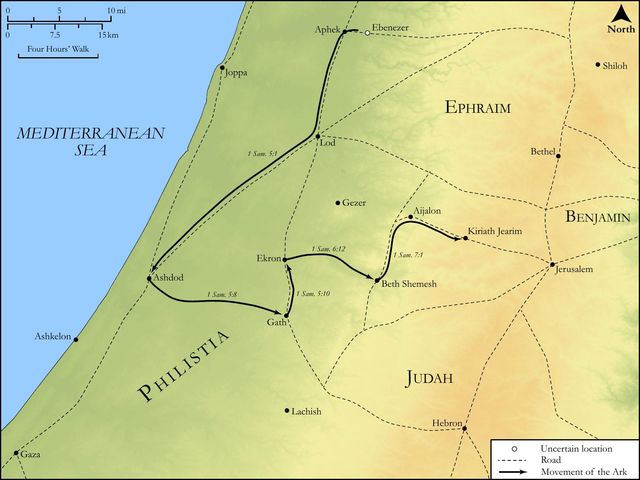
This verse is situated within a critical narrative arc in 1 Samuel, immediately following the Philistine capture of the Ark of the Covenant from Israel during a battle, a devastating defeat for Israel recounted in 1 Samuel 4:11. The Philistines, intending to parade their victory and perhaps integrate the Ark into their pantheon, first brought it to Ashdod and placed it in the temple of their chief deity, Dagon. There, God's direct intervention resulted in the repeated humiliation of Dagon's idol and a severe plague of tumors afflicting the people of Ashdod, as detailed in 1 Samuel 5:1-7. Faced with this escalating calamity, the Philistine lords decided to move the Ark to Gath, hoping to escape the divine wrath. However, 1 Samuel 5:9 reveals that God's judgment was not confined to Ashdod but relentlessly followed the Ark, demonstrating that His power was not geographically limited and that His holiness could not be contained or controlled by human schemes. The narrative thus builds a compelling case for the Ark's inherent power and God's active presence, even in its captivity, setting the stage for the Philistines' eventual decision to return it to Israel.
Historical & Cultural Context
The Philistines were a formidable maritime people who had settled on the southwestern coast of Canaan, establishing a pentapolis of major cities: Ashdod, Gaza, Ashkelon, Gath, and Ekron. They were a significant military and political threat to Israel during the period of the Judges and early monarchy. Their polytheistic religion included a chief deity, Dagon, a grain god often depicted as a merman. For the Philistines, capturing the Ark of the Covenant would have been perceived as a profound victory, signifying the triumph of their god Dagon over Yahweh, the God of Israel. In ancient Near Eastern warfare, it was common practice to seize the cultic objects or deities of a conquered people as a symbol of subjugation. However, the events in 1 Samuel 5, culminating in the judgment described in 1 Samuel 5:9, dramatically subvert this cultural understanding, revealing that the God of Israel was not a regional deity subject to human capture but the sovereign Lord over all nations and their gods. The specific nature of the plague, "emerods in their secret parts," was not only physically debilitating but culturally humiliating, striking at the very core of their vitality and public dignity, further emphasizing the divine hand at work.
Key Themes
ShowHideThe events surrounding the Ark's presence in Philistia, including the judgment in Gath, powerfully articulate several foundational themes. First, God's Unchallengeable Sovereignty is paramount; despite Israel's defeat and the Ark's capture, Yahweh demonstrates His absolute control over all creation, including pagan nations and their deities. The Philistines, with all their military might, are utterly powerless before the divine hand, as affirmed in Psalm 115:3. Second, the narrative highlights The Seriousness of Disrespecting God's Holiness. The Ark was not merely a war trophy but the symbol of God's holy presence, and the Philistines' irreverent treatment of it brought swift and devastating consequences, underscoring that God's glory cannot be trifled with, a principle also seen in Leviticus 10:1-3. Third, there is a clear theme of Divine Judgment Against Idolatry. While the immediate cause of the plague in Gath is the Ark's presence, the broader context of Dagon's humiliation in Ashdod and the subsequent plagues across Philistine cities serves as a powerful vindication of Yahweh's supremacy over false gods. God actively defends His name and demonstrates the impotence of idols, a truth vividly portrayed in Isaiah 44:9-20.
Exposition and Analysis
ShowHideKey Word Analysis
ShowHideThis common biblical idiom, "the hand of the LORD" (יַד יְהוָה, yad Yahweh), signifies divine power, intervention, or, as in this context, judgment. It emphasizes that the calamity was not accidental or a natural disaster, but a direct, intentional act of God. The phrase underscores God's active involvement and control over events, demonstrating an irresistible force that no human or pagan power can withstand, especially when His holiness is challenged.
The adjective גָּדֹול (gâdôwl), meaning "great" in any sense, is intensified here by the adverb מְאֹד (mᵉʼôd), "very." The combination "very great destruction" (מְהוּמָה גְּדוֹלָה מְאֹד, m'humah g'dolah m'od) emphasizes the overwhelming scale and severity of the divine judgment. It describes a calamity that was not merely significant but immense in its impact, affecting the entire city comprehensively and creating profound terror.
The term טְחֹר (ṭᵉchôr) refers to a boil or ulcer, specifically a tumor in the anus or pudenda (the piles). This affliction was not only excruciatingly painful and debilitating but also profoundly humiliating, striking at a sensitive and private part of the body. In an ancient culture, such a condition would be considered shameful and unclean, making the plague a clear and undeniable sign of divine judgment tailored to inflict both physical suffering and public disgrace, forcing the Philistines to acknowledge the source of their suffering.
Verse Breakdown
ShowHide"And it was [so], that, after they had carried it about,"
This introductory phrase sets the scene, indicating the Ark's arrival and subsequent movement within Gath. The Philistines, having witnessed the devastation in Ashdod, likely moved the Ark around the city, perhaps in a vain attempt to find a place where its presence would not bring affliction, or simply as part of their initial process of integrating it. The phrase highlights the Philistines' agency in transporting the Ark, yet simultaneously underscores their ignorance of the true nature of what they possessed and the futility of their efforts to control divine power.
"the hand of the LORD was against the city with a very great destruction:"
This is the core declaration of divine judgment. "The hand of the LORD" explicitly identifies God as the active agent behind the calamity, signifying His direct and powerful intervention. The "very great destruction" (מְהוּמָה גְּדוֹלָה מְאֹד) signifies a widespread and severe affliction that brought chaos, panic, and devastation upon the entire city of Gath, indicating a comprehensive divine assault that transcended mere human understanding or resistance, demonstrating God's absolute sovereignty.
"and he smote the men of the city, both small and great,"
This clause emphasizes the universality and indiscriminateness of the judgment within Gath. "Small and great" is a merism, indicating that the plague affected everyone—from the lowest to the highest in society, young and old, rich and poor. This highlights that no one in the city was exempt from the consequences of the Ark's presence and the affront to God's holiness, ensuring that the divine message of judgment was received by all.
"and they had emerods in their secret parts."
This specifies the precise nature of the affliction. The "emerods" (painful tumors or boils, likely hemorrhoids or buboes) were not only physically agonizing but also deeply humiliating, striking at a sensitive and private part of the body. This particular plague served as a clear, unmistakable sign of divine displeasure, designed to be both physically debilitating and spiritually convicting, forcing the Philistines to acknowledge the true source of their suffering and the potent, unyielding holiness of the God of Israel.
Literary Devices
ShowHideThe passage employs several potent literary devices to convey its message. Anthropomorphism is evident in the phrase "the hand of the LORD," attributing a human characteristic (a hand) to God to describe His direct and powerful intervention. This device makes God's action more tangible and comprehensible to the reader, emphasizing His active, personal role in the events and His irresistible might. Hyperbole is suggested by "a very great destruction," which, while literally true in terms of divine power, evokes an image of overwhelming and comprehensive devastation that goes beyond typical human experience of calamity, underscoring the extreme severity of God's wrath and the futility of resistance. Irony pervades the entire narrative: the Philistines capture the Ark as a symbol of their triumph, yet it becomes the instrument of their torment, turning their supposed victory into a source of profound suffering and humiliation. This highlights the ultimate futility of human attempts to control or disrespect divine power. Finally, the Symbolism of the Ark as the physical representation of God's presence is central; its very presence, even in captivity, carries the weight of God's holiness and judgment, demonstrating that God cannot be confined or desecrated without consequence. The "emerods" themselves become a symbolic plague, a painful and humiliating sign of God's direct and specific judgment against those who oppose Him and His sacred presence.
Theological and Thematic Connections
ShowHideThe events in Gath vividly illustrate the profound theological truth that God's holiness is not a passive attribute but an active, consuming force that demands reverence and cannot be trifled with. The Philistines, in their ignorance and arrogance, treated the Ark of the Covenant as a mere war trophy, failing to grasp its profound significance as the dwelling place of God's presence. This narrative serves as a stark reminder that God is not like the impotent idols of human devising; He is the living, sovereign Lord who actively defends His name and glory. The judgment upon Gath underscores that God's power transcends geographical boundaries and human understanding, and His justice will inevitably fall upon those who defiantly oppose His divine majesty, whether through direct idolatry or through irreverent treatment of what is sacred to Him. This passage therefore calls all people to a posture of awe and fear before the Lord, recognizing that His nature demands worship and obedience.
Reflection and Application
ShowHideThe account of God's judgment in Gath serves as a timeless and sobering reminder of the absolute necessity of reverencing God and His holy presence. It teaches us that God's glory and holiness are not abstract concepts but active realities that cannot be trifled with, and He will indeed defend His own name against all who would disrespect it. For believers today, while we do not interact with a physical Ark, the principle remains: God's presence is real, whether in His Word, in His Spirit dwelling within us, or in the gathered community of His people. Ignoring, disrespecting, or treating spiritual truths and holy things with irreverence, even out of ignorance, can lead to severe spiritual consequences. This narrative calls us to cultivate a profound sense of awe and respect for God's majesty, understanding that His nature demands reverence and obedience. It challenges us to examine our own hearts and lives: Do we approach God with the reverence due His name? Do we take His Word seriously? Do we honor His presence in our lives and in our churches? God's power transcends all human limitations and geographical boundaries; His judgment is not limited to one place or people, and His holiness is unchanging, demanding a response of humble submission and worship from all.
Questions for Reflection
ShowHideFAQ
ShowHideWhy did God punish the Philistines so severely for possessing the Ark?
ShowHideGod punished the Philistines severely not merely for possessing the Ark, but for their irreverent and idolatrous treatment of it, and by extension, of Him. The Ark was the most sacred symbol of God's presence among His people, representing His throne and covenant. When the Philistines captured it, they treated it as a war trophy, placing it in the temple of their god Dagon, effectively challenging Yahweh's supremacy, as seen in 1 Samuel 5:2. The severe plagues, including the "emerods," were God's direct response to this affront, demonstrating His absolute sovereignty over all false gods and nations. It was a vindication of His holy name and a clear message that He cannot be confined, controlled, or disrespected without devastating consequence. The punishment served to teach the Philistines, and indeed all who would hear the account, that Yahweh is the living God, unlike their impotent idols, and that His holiness demands absolute reverence.
What is the significance of the "emerods" as the specific plague inflicted upon the Philistines?
ShowHideThe "emerods" (painful tumors or boils, likely hemorrhoids or buboes) were a highly significant and deliberate choice of plague. Firstly, they were physically debilitating and caused immense suffering, making it clear that a powerful, supernatural force was at work. Secondly, and perhaps more importantly, they were deeply humiliating. Afflicting people in their "secret parts" was a culturally shameful and undignified affliction, particularly in ancient societies. This specific judgment served to mock the Philistines' pride and power, striking at their very vitality and public image. It was a direct, unmistakable sign from God that He was the one causing their suffering, forcing them to acknowledge His hand. The Philistines later recognized this, offering golden models of these "emerods" as a trespass offering when they returned the Ark, explicitly linking the plague to their offense against God, as recorded in 1 Samuel 6:4-5.
Christ-Centered Fulfillment
ShowHideThe dramatic events in Gath, where God's unapproachable holiness brought judgment upon those who disrespected His presence, find their ultimate fulfillment and transformation in Jesus Christ. The Ark of the Covenant, though a powerful symbol of God's presence, was a physical object, confined to a specific place, and its holiness was so potent that it brought death to those who touched it irreverently, as tragically seen with Uzzah in 2 Samuel 6:6-7. In contrast, Jesus Christ is the living embodiment of God's presence, the very Word made flesh who "dwelt among us" and revealed God's glory, as proclaimed in John 1:14. He is the true temple, the ultimate dwelling place of God, in whom "all the fullness of the Godhead dwells bodily" (Colossians 2:9). While the Ark brought judgment to the Philistines for their sin, Christ, as the Lamb of God, takes away the sin of the world (John 1:29). Through His perfect life, atoning death, and glorious resurrection, Jesus has reconciled humanity to a holy God, removing the barrier of sin and making it possible for us to approach God's throne of grace with confidence, not fear (Hebrews 4:16). The judgment seen in 1 Samuel 5:9 highlights God's unchangeable holiness, a holiness that is now satisfied and upheld by Christ's sacrifice, allowing believers to experience God's presence not as a source of terrifying judgment, but as a fountain of grace and life through the indwelling Holy Spirit (Romans 8:1-2).