


1 Samuel 5:6
- וַתִּכְבַּדva·tikh·Badand it was heavyH3513Conj-w ¦ V-Qal-ConsecImperf-3fsVerb Qal Consecutive Imperfect 3rd Singular Feminineוַandתִּכְבַּדit was heavy
- יַדyad[the] hand ofH3027N-cscNoun Singular common gender Construct
- יְהוָהYah·wehYahwehH3068N-properNoun Proper Title
- אֶל'elagainstH413PrepPreposition
- הָאַשְׁדּוֹדִיםha·'ash·do·Dimthe AshdoditesH796Art ¦ N-mpNoun Gentilic Plural Masculine AbsoluteהָtheאַשְׁדּוֹדִיםAshdodites
- וַיְשִׁמֵּםvay·shi·Memand he devastated themH8074Conj-w ¦ V-Hiphil-ConsecImperf-3ms ¦ 3mpVerb Hiphil Consecutive Imperfect 3rd Singular Masculineוַandיְשִׁמֵּhe devastatedםthem
- וַיַּךְvai·Yakhand he struckH5221Conj-w ¦ V-Hiphil-ConsecImperf-3msVerb Hiphil Consecutive Imperfect 3rd Singular Masculineוַandיַּךְhe struck
- אֹתָם'o·Tam<obj.> themH853DirObjM ¦ 3mpParticle Object Indicatorאֹתָ<obj.>םthem
- בַּטְּחֹרִיםbat·cho·Rimwith <the> tumorsH2914Prep-b ¦ N-mpNoun Plural Masculine Absoluteבַּwith <the>טְּחֹרִיםtumors
- אֶת'et<obj.>H853DirObjMParticle Object Indicator
- אַשְׁדּוֹד'ash·DodAshdodH795N-properNoun Proper Location
- וְאֶתve·'Etand <obj.>H853Conj-w ¦ DirObjMParticle Object Indicatorוְandאֶת<obj.>
- גְּבוּלֶיהָge·vu·Lei·haits territoriesH1366N-mpc ¦ 3fsNoun Plural Masculine Constructגְּבוּלֶיterritoriesהָits
English is a literal word-by-word gloss of the Hebrew, not the KJV's wording. Why?
This is the original text the KJV's translators worked from — each Hebrew word with its own literal English meaning in this verse, prepared by scholars at Tyndale House, Cambridge. The KJV translates whole sentences, not word by word, so its wording differs: one Hebrew word can become several English words, and the KJV may choose “the LORD” where the gloss reads “Yahweh”. Both are faithful — they answer different questions. For the KJV's own rendering, switch to the KJV text.
Details
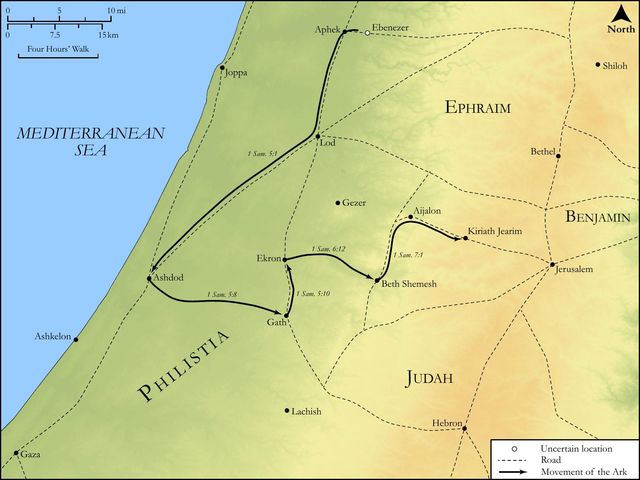
See on the biblical-era map
Study this verse
Public-domain commentary
Matthew Henry
From his Commentary on the Whole Bible. Henry comments on passages, not single verses — this entry covers 1 Samuel 5:6–12.
The downfall of Dagon (if the people had made a good use of it, and had been brought by it to repent of their idolatries and to humble themselves before the God of Israel and seek his face) might have prevented the vengeance which God here proceeds to take upon them for the indignities done to his ark, and their obstinate adherence to their idol, in defiance of the plainest conviction. Lord, when thy hand is lifted up they will not see, but they shall see, Isa 26:11. And, if they will not see the glory, they shall feel the weight, of God's hand, for so the Philistines did. The hand of the Lord was heavy upon them (Sa1 5:6), and he not only convinced them of their folly, but severely chastised their insolence. 1. He destroyed them, that is, cut many of them off by sudden death, those, we may suppose, that had most triumphed in the captivity of the ark. This is distinguished from the disease with which others were smitten. At Gath it is called a great destruction (Sa1 5:9), a deadly destruction, Sa1 5:11. And it is expressly said (Sa1 5:12) that those who were smitten with the emerods were the men that died not by the other destruction, which probably was the pestilence. They boasted of the great slaughter which their sword had made among the Israelites, Sa1 4:10. But God lets them know that though he does not see fit to draw Israel's sword against them (they were unworthy to be employed), yet God had a sword of his own, with which he could make a no less dreadful execution among them, which if he whet, and his hand take hold on judgment, he will render vengeance to his enemies, Deu 32:41, Deu 32:42. Note, Those that contend with God, his ark, and his Israel, will infallibly be ruined at last. If conviction conquer not, destruction shall. 2. Those that were not destroyed he smote with emerods (Sa1 5:6), in their secret parts (Sa1 5:9), so grievous that (Sa1 5:12) the cry went up to heaven, that is, it might be heard a great way off, and perhaps, in the extremity of their pain and misery, they cried, not to Dagon, but to the God of heaven. The Psalmist, speaking of this sore judgment upon the Philistines, describes it thus: God smote his enemies in the hinder parts, and put them to a perpetual reproach, Psa 78:66. The emerods (which we call the piles, and perhaps it was then a more grievous disease than it is now) is threatened among the judgments that would be the fruit of the curse, Deu 28:27. It was both a painful and shameful disease; a vile disease for vile deserts. By it God would humble their pride, and put contempt upon them, as they had done upon his ark. The disease was epidemical, and perhaps, among them, a new disease. Ashdod was smitten, and the coasts thereof, the country round. For contempt of God's ordinances, many are weak and sick, and many sleep, Co1 11:30. 3. The men of Ashdod were soon aware that it was the hand of God, the God of Israel, Sa1 5:7. Thus they were constrained to acknowledge his power and dominion, and confess themselves within his jurisdiction, and yet they would not renounce Dagon and submit to Jehovah; but rather, now that he touched their bone and their flesh, and in a tender part, they were ready to curse him to his face, and instead of making their peace with him, and courting the stay of his ark upon better terms, they desired to get clear of it, as the Gadarenes, who, when they had lost their swine, desired Christ to depart out of their coasts. Carnal hearts, when they smart under the judgments of God, would rather, if it were possible, put him far from them than enter into covenant and communion with him, and make him their friend. Thus the men of Ashdod resolve, The ark of the God of Israel shall not abide with us. 4. It is resolved to change the place of its imprisonment. A great council was called, and the question proposed to all the lords was, "What shall be we with the ark?" And at last it was agreed that it should be carried to Gath, Sa1 5:8. Some superstitious conceit they had that the fault was in the place, and that the ark would be better pleased with another lodging, further off from Dagon's temple; and therefore, instead of returning it, as they should have done, to its own place, they contrive to send it to another place. Gath is pitched upon, a place famed for a race of giants, but their strength and stature are no fence against the pestilence and the emerods: the men of that city were smitten, both great and small (Sa1 5:9), both dwarfs and giants, all alike to God's judgments; none so great as to over-top them, none so small as to be over-looked by them. 5. They were all at last weary of the ark, and very willing to get rid of it. It was sent from Gath to Ekron, and, coming by order of council, the Ekronites could not refuse it, but were much exasperated against their great men for sending them such a fatal present (Sa1 5:10): They have sent it to us to slay us and our people. The ark had the tables of the law in it; and nothing more welcome to faithful Israelites than the word of God (to them it is a savour of life unto life), but to uncircumcised Philistines, that persist in enmity to God, nothing more dreadful nor unwelcome: to them it is a savour of death unto death. A general assembly is instantly called, to advise about sending the ark again to its place, Sa1 5:11. While they are consulting about it, the hand of God is doing execution; and their contrivances to evade the judgment do but spread it. Many drop down dead among them. Many more are raging ill of the emerods, Sa1 5:12. What shall they do? Their triumphs in the captivity of the ark are soon turned into lamentations, and they are as eager to quit it as ever they had been to seize it. Note, God can easily make Jerusalem a burdensome stone to all that heave at it, Zac 12:3. Those that fight against God will soon have enough of it, and, first or last, will be made to know that none ever hardened their hearts against him and prospered. The wealth that is got by fraud and injustice, especially that which is got by sacrilege and robbing God, though swallowed greedily, and rolled under the tongue as a sweet morsel, must be vomited up again; for, till it be, the sinner shall not feel quietness in his belly, Job 20:15-20.
Historical interpretation
Historical reception
2 surviving comments on this verse. Each one is dated, so this reads as a timeline rather than a list.
Select a marker to jump to its quote. Markers stagger vertically where authors wrote within a few decades of each other.
And this explains how they died. It is said that each one died when he went out to purge his bowels and was bitten in the inner part of his buttocks by mice. Now this wound is shown here in a literal fashion, but it is united with an allegorical exposition. For in its literal meaning, it refers to the illness caused by the hand of the Lord and the bites of the mice, which led to the outcome of death. It is said that the hand of the Lord weighed heavily upon the inhabitants of Ashdod because they were being killed by the mouse bites. In giving this passage its spiritual meaning, however, we recognize two kinds of deaths: the first kind of death is that by which sinners die to righteousness when they sin; the second kind of death is that by which the righteous deliver themselves from the sins in which they had lived and repent of them. The first kind of death enters into human hearts whenever the devil persuades someone to sin. The second kind of death is effected by the virtue of almighty God. Therefore, we must give attention to both kinds of death in this place as they are alluded to spiritually. The one type of death, by which sinners arise when they repent of their sins is alluded to by the words “The hand of the Lord was heavy upon the inhabitants of Ashdod.” But that type of death by which the Gentiles offered themselves as slaves to impurity and sin is alluded to when the people of Ashdod were bitten by the mice and died. A mouse, after all, is an unclean animal and could not be eaten according to the law. Therefore, what else could the mice refer to except to demons? And what else is being bitten by mice except being wounded by the penalty for sin? But they were bitten by the mice when they went out to purge their bowels. Now what does it mean to purge one’s bowels other than to reveal the stench of a wretched reputation by one’s obedience to sin? Thus, whoever went out to purge his bowels died by the bites of the mice, for by his sinning in plain sight of others he showed them an example of depravity, and he himself was also detained for eternal death by his dire obligations to the demons.
But the hand of the Lord was heavy upon the Ashdodites, etc. Those who, having taken up the ark of God, grieve for Dagon's destruction and set up his ruin, are struck in their hind parts, and their land is ravaged by mice. For those who, having been taught the recognition of faith or even mysteries, either do not endure the idols to be cast down, or allow themselves to be forbidden from vices, because they look back, do not abandon the uncleanness of their old life, and reclaim those things which they ought to have forgotten and regarded as dung, as the Apostle says (Philippians 3). They are punished by the things they choose, and that becomes the cause of punishment to the wretched, which was the pleasure of their guilt. But even if they seem to produce any good, those who keep the eyes of their mind turned backwards, the root of their thought and the fruit of their action are destroyed by unclean spirits. The Lord struck not only Ashdod where Dagon was, but all the borders of Ashdod because he condemns and rejects not only the capital crimes in which the manifest work of the devil is evident, but also the small ones which appear minor or light sins to men, by the sentence of the strict judge. Ultimately, every idle word that men shall speak, they shall give account thereof in the day of judgment (Matthew 12).
Continue studying 1 Samuel 5:6 across the web’s major study libraries — every link below opens this exact verse, chapter, or book on the destination site.
Read & Compare
 BibleGatewayThis verse in more than 200 translations and 70 languages.
 Bible.comThe YouVersion reader — hundreds of translations, reading plans, and highlights.
 ESV.orgCrossway's official English Standard Version reader.
 NET BibleThe NET translation with 60,000+ translators' notes on every rendering decision.
 STEP BibleTyndale House's free study tool — original text, vocabulary, and scholarly resources.
 BibliaLogos Bible Software's free web reader.
 USCCBThe New American Bible (Revised Edition) with the U.S. bishops' study notes.
Commentaries
 BibleHub CommentariesDozens of classic commentaries on this verse, gathered on one page.
 StudyLightMore than 100 commentary sets — the largest collection on the web.
 BibleRefPlain-English commentary on what this verse means, verse by verse.
 Enduring WordDavid Guzik's free commentary on this chapter, widely used by Bible teachers.
 Bible Study ToolsVerse commentary alongside Greek and Hebrew study aids.
Original Language & Research
- BibleHub InterlinearThe verse word by word — original language, transliteration, and English.
- BibleHub LexiconEvery word's original-language definition and Strong's entry.
 Blue Letter BibleDeep-study tools — Strong's numbers, concordance, and word studies.
 SefariaThe Hebrew text with Rashi and centuries of Jewish commentary.
Sermons, Hymns & Audio


TrulyRandomVerse is not affiliated with these sites and doesn’t control their content. They’re linked because they’re genuinely useful.
Summary
1 Samuel 5:6 vividly recounts the immediate and severe divine judgment inflicted upon the Philistine city of Ashdod after they captured the Ark of the Covenant and placed it in the temple of their idol, Dagon. This verse underscores the active and undeniable presence of God, who, despite His Ark being in enemy hands, powerfully defended His holiness and sovereignty, demonstrating His supremacy over all false gods and human defiance. The affliction served as an unmistakable sign of His righteous indignation and an assertion of His unchallengeable authority, forcing the Philistines to confront the reality of Yahweh's unparalleled power.
Context
ShowHideLiterary Context
This verse is a direct continuation of the narrative detailing the Philistines' capture of the Ark of the Covenant, as described in 1 Samuel 4. Following Israel's devastating defeat at Ebenezer and the tragic deaths of Eli's sons, Hophni and Phinehas, the Ark was taken as a trophy of war by the Philistines. 1 Samuel 5:1-5 establishes the immediate preceding events, where the Philistines brought the Ark to Ashdod and placed it in the temple of their chief deity, Dagon. The miraculous toppling and subsequent shattering of Dagon before the Ark on two consecutive mornings served as a preliminary, symbolic humiliation of the Philistine deity. Verse 6 then escalates the divine judgment from the idol to its worshippers, indicating that God's active presence, though unseen, was powerfully at work, moving from a demonstration of sovereignty over a false god to direct, physical affliction upon the people who dared to profane His sacred presence. This progression highlights the escalating nature of God's wrath against those who defy Him.
Historical & Cultural Context
In the ancient Near East, the capture of a deity's cultic image or sacred object was often seen as a decisive victory over the god itself, signifying the vanquished god's weakness and the victor's god's superiority. The Philistines, a powerful maritime people with origins likely from the Aegean region, worshipped a pantheon of gods, with Dagon often considered their chief deity, associated with grain, fertility, and sometimes fish. Their act of placing the Ark in Dagon's temple was a triumphal assertion of Dagon's supposed dominance over Yahweh, a common practice among conquering nations. However, the events of 1 Samuel 5 directly challenged this worldview, demonstrating that the God of Israel was not a localized or limited deity who could be captured, but a sovereign power who acted independently of human control or geographical location. The "emerods" (tumors/boils) described were a form of plague, a common divine judgment in ancient texts, often interpreted as a sign of divine displeasure and a direct challenge to the authority of local gods who were supposed to protect their people from such afflictions. Such plagues were seen as undeniable proof of a deity's power and wrath.
Key Themes
ShowHideThe events surrounding 1 Samuel 5:6 powerfully articulate several core biblical themes. Firstly, God's Absolute Sovereignty and Power is paramount; even when His people failed and His sacred Ark was in enemy hands, God Himself remained uncaptured and supremely active, demonstrating His power independently of human circumstances or the perceived strength of His enemies. Secondly, it highlights God's Uncompromising Holiness; the Ark, representing His presence, was sacred, and its profanation by the Philistines invoked immediate and severe consequences, underscoring that God's holiness demands reverence and cannot be treated lightly or as a mere object. Thirdly, the narrative serves as a stark warning against Idolatry and Disrespect for God's Name; the Philistines' reverence for Dagon and their contempt for the Ark brought direct divine retribution, echoing the first commandment found in Exodus 20:3, which prohibits having other gods before Yahweh. Finally, the account illustrates the principle of Divine Retribution, where God directly intervenes to judge those who dishonor Him, proving that His justice is active and His purposes will prevail despite human defiance.
Exposition and Analysis
ShowHideKey Word Analysis
ShowHide"a primitive word; in distinction from כַּף, the closed one); used (as noun, adverb, etc.) in a great variety of applications, both literally and figuratively, both proximate and remote...a hand (the open one (indicating power, means, direction, etc.)." In the phrase "the hand of the LORD," this term is an anthropomorphism signifying God's direct, active, and powerful intervention. It denotes agency, authority, and the execution of divine will, often implying a forceful or overwhelming manifestation of God's presence, whether in judgment or blessing.
"a primitive root; to be heavy, i.e. in a bad sense (burdensome, severe, dull) or in a good sense (numerous, rich, honorable; causatively, to make weighty (in the same two senses)." When applied to God's hand, "heavy" signifies a severe, oppressive, and burdensome manifestation of divine power. It conveys the idea of a crushing weight of judgment, indicating that the affliction was not light or coincidental but a profound and inescapable act of God's sovereign will, causing immense suffering and distress.
"from an unused root meaning to burn; a boil or ulcer (from the inflammation), especially a tumor in the anus or pudenda (the piles)." This term, also linked to H6076 ('ôphel, "a tumor; also a mound, i.e. fortress"), refers to painful, often humiliating, tumors, boils, or swellings. While sometimes interpreted as hemorrhoids, the broader consensus among scholars suggests a severe, debilitating plague characterized by painful buboes or glandular swellings, possibly bubonic plague. The nature of the affliction was designed to be both physically agonizing and deeply shameful, fitting for a divine judgment intended to humble and punish those who had dishonored God and His sacred Ark.
Verse Breakdown
ShowHide"But the hand of the LORD was heavy upon them of Ashdod"
This opening clause immediately establishes the divine agency behind the catastrophe. The "hand of the LORD" is a powerful anthropomorphic idiom, signifying God's direct, powerful, and inescapable intervention. The word "heavy" (כָּבְדָה, kaveda) conveys the oppressive, burdensome, and severe nature of this divine presence, indicating that the people of Ashdod experienced God's power as a crushing weight of judgment, not a mere misfortune.
"and he destroyed them"
This phrase describes the devastating effect of God's heavy hand. While not necessarily implying total annihilation of the city's inhabitants, it indicates a widespread and severe affliction that brought about significant death and ruin. The verb "destroyed" (וַיַּשְׁחִתֵם, wayyashḥitem, from H8074 shâmêm) carries the nuance of ruin, devastation, or causing desolation, emphasizing the destructive capacity of God's judgment when His holiness is profaned.
"and smote them with emerods"
This specifies the particular nature of the affliction, identifying the "emerods" (painful tumors or boils) as the primary physical manifestation of God's judgment. The verb "smote" (וַיַּךְ, wayyak, from H5221 nâkâh) denotes a direct, forceful blow, underscoring that this was a deliberate act of divine punishment, not a natural occurrence. The humiliation and suffering caused by this specific disease were integral to the judgment, designed to expose the impotence of Dagon and the supremacy of Yahweh.
"[even] Ashdod and the coasts thereof"
This final phrase clarifies the expansive scope of the judgment, indicating that the plague was not confined to the city proper but extended to the surrounding territories or borders (H1366 gᵉbûwl). This demonstrates the pervasive and inescapable reach of God's wrath, suggesting that the entire region associated with Ashdod, and thus with the profanation of the Ark, fell under God's heavy hand, leaving no doubt about the source and extent of the calamity.
Literary Devices
ShowHideThe passage in 1 Samuel 5:6 employs several potent literary devices to convey its theological message with impactful clarity. Anthropomorphism is prominently featured in the phrase "the hand of the LORD was heavy," attributing a human body part and action (a "heavy hand") to God. This device makes God's powerful and direct intervention more comprehensible and impactful to the human mind, emphasizing His active presence and personal involvement in the affairs of humanity. There is also a strong element of Irony at play: the Philistines believed they had captured Yahweh by taking His Ark, treating Him as a vanquished deity, but the narrative dramatically reverses this, showing that God was not captured but was actively judging His captors from within their own territory. This ironic reversal highlights God's absolute sovereignty over all human endeavors and pagan deities. Furthermore, the description of the widespread destruction and the specific, humiliating nature of the "emerods" could be seen as a form of Hyperbole, emphasizing the extreme severity and undeniable nature of the divine judgment, ensuring that the Philistines and the audience understood the gravity of disrespecting God's holiness. The Ark itself functions as a powerful Symbolism, representing God's presence and holiness, making its profanation and the subsequent judgment all the more significant as a divine response.
Theological and Thematic Connections
ShowHide1 Samuel 5:6 serves as a profound theological statement on the nature of God, particularly His holiness, sovereignty, and justice. It reveals that God is not a passive deity confined to a temple or a specific geographical location, nor is He limited by human actions or perceived victories. Even when His people, Israel, failed to defend His honor, God Himself actively intervened to vindicate His name and demonstrate His supreme authority over all false gods and human arrogance. The severe plague inflicted upon Ashdod underscores the inviolability of God's holiness; His presence, even when symbolized by an object like the Ark, cannot be treated with irreverence or contempt without dire consequences. This event powerfully illustrates that God's glory is not to be shared with idols, and He will not tolerate any challenge to His unique position as the one true God. It is a testament to His active involvement in history, ensuring that His purposes are ultimately fulfilled and His glory is upheld, regardless of human faithfulness or unfaithfulness.
Reflection and Application
ShowHideThe account of God's heavy hand upon Ashdod in 1 Samuel 5:6 offers timeless lessons for believers today. It serves as a stark reminder that God is not a tame deity, nor is He a concept to be manipulated or ignored. His holiness is absolute, and His sovereignty is unwavering. For us, this means cultivating a profound reverence for God, understanding that His presence, though unseen, is active and demands our utmost respect and obedience. We must guard against any form of idolatry in our lives, whether it be the worship of material possessions, personal achievements, or even our own opinions, recognizing that anything that takes God's rightful place in our hearts is an affront to His glory. This passage calls us to examine our attitudes towards God's commands and His character, prompting us to live in a manner that honors His name and acknowledges His supreme authority. It also offers comfort, knowing that the God who defended His honor so fiercely is the same God who watches over His people, even when circumstances seem dire. His power is not dependent on our strength, but on His own unchangeable nature, providing a foundation of security and trust.
Questions for Reflection
ShowHideFAQ
ShowHideWhat was the nature of the "emerods" that afflicted the Philistines?
ShowHideThe Hebrew word for "emerods" (ṭᵉchôr) refers to painful tumors, boils, or swellings. While some ancient translations and later traditions associate it specifically with hemorrhoids, modern scholarship often interprets it more broadly as a severe and debilitating plague characterized by painful, possibly ulcerating, swellings, similar to bubonic plague. This affliction was not only physically agonizing but also deeply humiliating, consistent with a divine judgment designed to humble those who had profaned God's sacred presence. The severity of the plague is further emphasized by the widespread death it caused, as hinted at in 1 Samuel 5:11.
Why did God punish the Philistines so severely for taking the Ark?
ShowHideGod's severe punishment of the Philistines was not merely for taking the Ark, but for their profound disrespect and profanation of His holiness and sovereignty. They treated the Ark, which symbolized God's very presence, as a mere war trophy and placed it in the temple of their pagan god, Dagon, as if Dagon had triumphed over Yahweh. This act was a direct affront to God's unique and supreme authority. The escalating judgments—first the humiliation of Dagon in 1 Samuel 5:1-5, then the plague on Ashdod, and subsequently on Gath and Ekron in 1 Samuel 5:7-12—demonstrated that God is not a localized or defeated deity, but the sovereign Lord who cannot be mocked or contained. His actions underscored His absolute holiness and His intolerance of idolatry and irreverence.
Does God still act in such direct and physically punishing ways today?
ShowHideWhile God is unchanging in His character and holiness, His methods of intervention and judgment have evolved, especially after the coming of Christ. In the Old Testament, physical plagues and direct retributions were often visible manifestations of God's justice, serving as clear signs to a people learning about His nature and power and to surrounding nations. In the New Covenant, God's primary mode of dealing with sin and rebellion is through the redemptive work of Jesus Christ, offering grace and a call to repentance (e.g., Acts 17:30). While direct divine judgment can still occur (e.g., Acts 5:1-11), the emphasis is on spiritual transformation and the ultimate, eschatological judgment to come (e.g., Hebrews 9:27). Believers are now called to understand God's holiness through Christ's sacrifice and to live in reverence, rather than primarily fearing immediate physical plagues, though natural consequences of sin and spiritual discipline remain.
Christ-Centered Fulfillment
ShowHideThe narrative of God's "heavy hand" on Ashdod in 1 Samuel 5:6 finds its ultimate fulfillment and resolution in Jesus Christ. The Ark of the Covenant, representing God's holy presence among His people, foreshadowed Christ, who is the true dwelling place of God among humanity, the very Word made flesh (e.g., John 1:14). The judgment on Ashdod for profaning the Ark underscores God's uncompromising holiness and His intolerance of sin and idolatry. This same divine holiness and justice, which demands a perfect response to sin, is fully satisfied not through a plague on humanity, but through the sacrificial death of Christ on the cross. He became the ultimate object of God's "heavy hand" of judgment against sin, bearing its full weight so that those who believe might be spared (e.g., Isaiah 53:4-6). Through His victory over sin and death, Christ disarmed the spiritual powers that held humanity captive, much as God humiliated Dagon and afflicted the Philistines (e.g., Colossians 2:15). He is the ultimate High Priest, who, unlike the Old Testament priests, entered the true holy place with His own blood, cleansing us from dead works and making us holy (e.g., Hebrews 9:11-14). Therefore, the terrifying holiness that brought judgment upon Ashdod is now, in Christ, the very source of our reconciliation and peace, allowing us to approach God with confidence, not fear, because His righteous demands have been perfectly met in the person and work of our Lord Jesus Christ.