


1 Samuel 5:7
- וַיִּרְאוּvai·yir·'Uand they sawH7200Conj-w ¦ V-Qal-ConsecImperf-3mpVerb Qal Consecutive Imperfect 3rd Plural Masculineוַandיִּרְאוּthey saw
- אַנְשֵׁי'an·shei[the] people ofH582N-mpcNoun Plural Masculine Construct
- אַשְׁדּוֹד'ash·DodAshdodH795N-properNoun Proper Location
- כִּיkithatH3588PrtParticle Conditional
- כֵןKhensoH3651AdvAdverb
- וְאָמְרוּve·'a·me·Ruand they saidH559Conj-w ¦ V-Qal-ConsecPerf-3cpVerb Qal Consecutive Perfect 3rd Plural common genderוְandאָמְרוּthey said
- לֹאlo'notH3808NegParticle Negative
- יֵשֵׁבye·Shevit will remainH3427V-Qal-Imperf-3msVerb Qal Imperfect 3rd Singular Masculine
- אֲרוֹן'a·Ron[the] ark ofH727N-mscNoun Singular Masculine Construct
- אֱלֹהֵי'e·lo·Hei[the] God ofH430N-mpcNoun Plural Masculine Construct
- יִשְׂרָאֵלYis·ra·'ElIsraelH3478N-properNoun Proper Location
- עִמָּנוּ'i·Ma·nuwith usH5973Prep ¦ 1cpPreposition Definiteעִמָּwithנוּus
- כִּיkiforH3588PrtParticle Conditional
- קָשְׁתָהka·she·Tahit is hardH7185V-Qal-Perf-3fsVerb Qal Perfect 3rd Singular Feminine
- יָדוֹya·Dohis handH3027N-csc ¦ 3msNoun Singular common gender Constructיָדhandוֹhis
- עָלֵינוּ'a·Lei·nuon usH5921Prep ¦ 1cpPrepositionעָלֵיonנוּus
- וְעַלve·'Aland onH5921Conj-w ¦ PrepPrepositionוְandעַלon
- דָּגוֹןda·GonDagonH1712N-properNoun Proper Title
- אֱלֹהֵינוּ'e·lo·Hei·nuour GodH430N-mpc ¦ 1cpNoun Plural Masculine ConstructאֱלֹהֵיGodנוּour
English is a literal word-by-word gloss of the Hebrew, not the KJV's wording. Why?
This is the original text the KJV's translators worked from — each Hebrew word with its own literal English meaning in this verse, prepared by scholars at Tyndale House, Cambridge. The KJV translates whole sentences, not word by word, so its wording differs: one Hebrew word can become several English words, and the KJV may choose “the LORD” where the gloss reads “Yahweh”. Both are faithful — they answer different questions. For the KJV's own rendering, switch to the KJV text.
Details
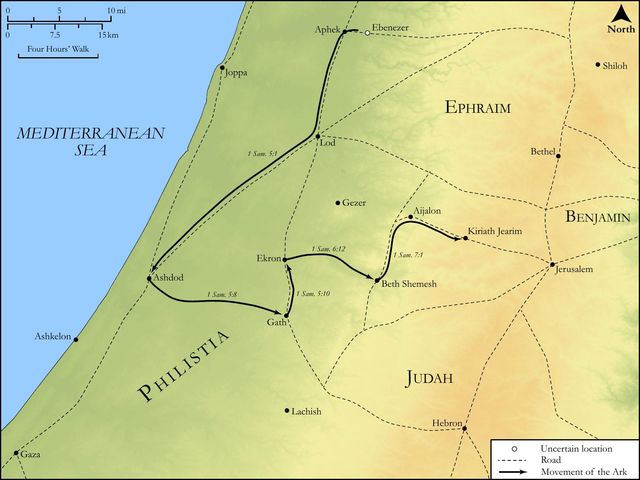
See on the biblical-era map
Study this verse
Public-domain commentary
Matthew Henry
From his Commentary on the Whole Bible. Henry comments on passages, not single verses — this entry covers 1 Samuel 5:6–12.
The downfall of Dagon (if the people had made a good use of it, and had been brought by it to repent of their idolatries and to humble themselves before the God of Israel and seek his face) might have prevented the vengeance which God here proceeds to take upon them for the indignities done to his ark, and their obstinate adherence to their idol, in defiance of the plainest conviction. Lord, when thy hand is lifted up they will not see, but they shall see, Isa 26:11. And, if they will not see the glory, they shall feel the weight, of God's hand, for so the Philistines did. The hand of the Lord was heavy upon them (Sa1 5:6), and he not only convinced them of their folly, but severely chastised their insolence. 1. He destroyed them, that is, cut many of them off by sudden death, those, we may suppose, that had most triumphed in the captivity of the ark. This is distinguished from the disease with which others were smitten. At Gath it is called a great destruction (Sa1 5:9), a deadly destruction, Sa1 5:11. And it is expressly said (Sa1 5:12) that those who were smitten with the emerods were the men that died not by the other destruction, which probably was the pestilence. They boasted of the great slaughter which their sword had made among the Israelites, Sa1 4:10. But God lets them know that though he does not see fit to draw Israel's sword against them (they were unworthy to be employed), yet God had a sword of his own, with which he could make a no less dreadful execution among them, which if he whet, and his hand take hold on judgment, he will render vengeance to his enemies, Deu 32:41, Deu 32:42. Note, Those that contend with God, his ark, and his Israel, will infallibly be ruined at last. If conviction conquer not, destruction shall. 2. Those that were not destroyed he smote with emerods (Sa1 5:6), in their secret parts (Sa1 5:9), so grievous that (Sa1 5:12) the cry went up to heaven, that is, it might be heard a great way off, and perhaps, in the extremity of their pain and misery, they cried, not to Dagon, but to the God of heaven. The Psalmist, speaking of this sore judgment upon the Philistines, describes it thus: God smote his enemies in the hinder parts, and put them to a perpetual reproach, Psa 78:66. The emerods (which we call the piles, and perhaps it was then a more grievous disease than it is now) is threatened among the judgments that would be the fruit of the curse, Deu 28:27. It was both a painful and shameful disease; a vile disease for vile deserts. By it God would humble their pride, and put contempt upon them, as they had done upon his ark. The disease was epidemical, and perhaps, among them, a new disease. Ashdod was smitten, and the coasts thereof, the country round. For contempt of God's ordinances, many are weak and sick, and many sleep, Co1 11:30. 3. The men of Ashdod were soon aware that it was the hand of God, the God of Israel, Sa1 5:7. Thus they were constrained to acknowledge his power and dominion, and confess themselves within his jurisdiction, and yet they would not renounce Dagon and submit to Jehovah; but rather, now that he touched their bone and their flesh, and in a tender part, they were ready to curse him to his face, and instead of making their peace with him, and courting the stay of his ark upon better terms, they desired to get clear of it, as the Gadarenes, who, when they had lost their swine, desired Christ to depart out of their coasts. Carnal hearts, when they smart under the judgments of God, would rather, if it were possible, put him far from them than enter into covenant and communion with him, and make him their friend. Thus the men of Ashdod resolve, The ark of the God of Israel shall not abide with us. 4. It is resolved to change the place of its imprisonment. A great council was called, and the question proposed to all the lords was, "What shall be we with the ark?" And at last it was agreed that it should be carried to Gath, Sa1 5:8. Some superstitious conceit they had that the fault was in the place, and that the ark would be better pleased with another lodging, further off from Dagon's temple; and therefore, instead of returning it, as they should have done, to its own place, they contrive to send it to another place. Gath is pitched upon, a place famed for a race of giants, but their strength and stature are no fence against the pestilence and the emerods: the men of that city were smitten, both great and small (Sa1 5:9), both dwarfs and giants, all alike to God's judgments; none so great as to over-top them, none so small as to be over-looked by them. 5. They were all at last weary of the ark, and very willing to get rid of it. It was sent from Gath to Ekron, and, coming by order of council, the Ekronites could not refuse it, but were much exasperated against their great men for sending them such a fatal present (Sa1 5:10): They have sent it to us to slay us and our people. The ark had the tables of the law in it; and nothing more welcome to faithful Israelites than the word of God (to them it is a savour of life unto life), but to uncircumcised Philistines, that persist in enmity to God, nothing more dreadful nor unwelcome: to them it is a savour of death unto death. A general assembly is instantly called, to advise about sending the ark again to its place, Sa1 5:11. While they are consulting about it, the hand of God is doing execution; and their contrivances to evade the judgment do but spread it. Many drop down dead among them. Many more are raging ill of the emerods, Sa1 5:12. What shall they do? Their triumphs in the captivity of the ark are soon turned into lamentations, and they are as eager to quit it as ever they had been to seize it. Note, God can easily make Jerusalem a burdensome stone to all that heave at it, Zac 12:3. Those that fight against God will soon have enough of it, and, first or last, will be made to know that none ever hardened their hearts against him and prospered. The wealth that is got by fraud and injustice, especially that which is got by sacrilege and robbing God, though swallowed greedily, and rolled under the tongue as a sweet morsel, must be vomited up again; for, till it be, the sinner shall not feel quietness in his belly, Job 20:15-20.
Historical interpretation
Historical reception
1 surviving comment on this verse from the historical church.
Seeing the men of Ashdod had such a plague, etc. Upon seeing the idol worshippers experience the power of Christ against their gods, they refuse to accept his faith, lest on account of this they might be compelled to renounce their whole host of gods. Similarly, false Christians, seeing that due to faith in Christ the sins they love are forbidden to them, detest the religion of faith as much as they can, lest on this occasion they be commanded to extinguish the desires which they serve in place of God. The men of Ashdod in every respect, that is, worthy of the name of rift, dissolution, and burning, refuse to know the sacred Scriptures so that having known them, they would have to act according to what they have learned; and because of the Lord's sentence, which states that those who are ignorant of his will shall receive fewer stripes, they refuse to know what they ought to do: not understanding that there is a great difference between being simply ignorant and refusing to know what ought to be learned. And so, feeling this as harsh to their own wills, they impudently repel the ark of heavenly knowledge from themselves.
Continue studying 1 Samuel 5:7 across the web’s major study libraries — every link below opens this exact verse, chapter, or book on the destination site.
Read & Compare
 BibleGatewayThis verse in more than 200 translations and 70 languages.
 Bible.comThe YouVersion reader — hundreds of translations, reading plans, and highlights.
 ESV.orgCrossway's official English Standard Version reader.
 NET BibleThe NET translation with 60,000+ translators' notes on every rendering decision.
 STEP BibleTyndale House's free study tool — original text, vocabulary, and scholarly resources.
 BibliaLogos Bible Software's free web reader.
 USCCBThe New American Bible (Revised Edition) with the U.S. bishops' study notes.
Commentaries
 BibleHub CommentariesDozens of classic commentaries on this verse, gathered on one page.
 StudyLightMore than 100 commentary sets — the largest collection on the web.
 BibleRefPlain-English commentary on what this verse means, verse by verse.
 Enduring WordDavid Guzik's free commentary on this chapter, widely used by Bible teachers.
 Bible Study ToolsVerse commentary alongside Greek and Hebrew study aids.
Original Language & Research
- BibleHub InterlinearThe verse word by word — original language, transliteration, and English.
- BibleHub LexiconEvery word's original-language definition and Strong's entry.
 Blue Letter BibleDeep-study tools — Strong's numbers, concordance, and word studies.
 SefariaThe Hebrew text with Rashi and centuries of Jewish commentary.
Sermons, Hymns & Audio


TrulyRandomVerse is not affiliated with these sites and doesn’t control their content. They’re linked because they’re genuinely useful.
Summary
1 Samuel 5:7 records the pivotal moment when the Philistine inhabitants of Ashdod, witnessing the devastating effects of the Ark of the Covenant's presence—the repeated humiliation of their god Dagon and a severe plague upon themselves—collectively concluded that the Ark of the God of Israel could not remain among them. This verse encapsulates their forced recognition of Yahweh's overwhelming power and sovereign judgment, compelling them to seek the Ark's removal from their city.
Context
ShowHideLiterary Context
This verse is a crucial turning point within the narrative of the Ark's capture and its subsequent journey through Philistine territory, detailed in 1 Samuel 4 and 1 Samuel 5. Following the disastrous battle where Israel lost the Ark to the Philistines (1 Samuel 4:10-11), the Philistines brought it to Ashdod and placed it triumphantly in the temple of their chief deity, Dagon (1 Samuel 5:1-2). The immediate preceding verses (1 Samuel 5:3-5) graphically describe Dagon's repeated and increasingly severe prostration and dismemberment before the Ark, demonstrating Yahweh's supremacy over false gods. Simultaneously, a severe plague, likely of tumors or hemorrhoids, began to afflict the people of Ashdod (1 Samuel 5:6). Verse 7 marks the Ashdodites' collective realization that these events were not coincidental but were direct divine judgment, necessitating the Ark's immediate removal.
Historical & Cultural Context
The Philistines were a powerful seafaring people who settled in the southwestern coastal plain of Canaan, forming a pentapolis of five major cities: Ashdod, Ashkelon, Ekron, Gath, and Gaza. Their religion involved the worship of various deities, with Dagon being a prominent god, often depicted with a human upper body and a fish-like lower body, associated with grain and fertility. In the ancient Near East, the capture of an enemy's god or cultic object (like the Ark) was seen as a sign of the victor's god being superior. The Philistines' act of placing the Ark in Dagon's temple was a symbolic declaration of Dagon's victory over Yahweh. However, Yahweh's actions in Ashdod dramatically subverted this understanding, demonstrating His unique power and refusal to be subjugated or contained by pagan systems. The concept of a deity's "hand" (e.g., "his hand is sore upon us") was a common ancient Near Eastern idiom signifying divine power, action, or judgment, whether for blessing or curse.
Key Themes
ShowHideThis verse powerfully contributes to several overarching themes in 1 Samuel and the broader biblical narrative. Firstly, it underscores the unchallengeable sovereignty of God, demonstrating that Yahweh's power is not limited by human capture or physical location. Even when seemingly imprisoned, God actively asserts His dominion over all creation, including pagan deities and nations. Secondly, it highlights the futility and impotence of idolatry. Dagon, a revered Philistine god, is shown to be utterly powerless and even destroyed in the presence of the true God, serving as a stark reminder of the vanity of worshipping man-made images, a theme echoed throughout the Old Testament, such as in Psalm 115:4-8. Thirdly, the passage emphasizes divine judgment against those who disrespect God's holiness or attempt to profane His presence. The afflictions upon Ashdod were a direct consequence of their actions, illustrating that God's "hand" can bring severe discipline. Finally, it portrays the forced recognition of Yahweh's power even by His enemies. The Philistines, though pagan, were compelled by direct experience to acknowledge the terrifying reality of Yahweh's active presence and power.
Exposition and Analysis
ShowHideKey Word Analysis
ShowHideThis verb properly means "to be dense," "tough," or "severe." In this context, it vividly describes the oppressive and grievous nature of the divine judgment. It signifies that God's "hand" (H3027, yâd) was not merely present but was inflicting a profoundly painful and unyielding affliction upon the Philistines. The severity of this "soreness" compelled them to recognize its divine origin and act decisively.
This primitive root means "to sit down," "to dwell," or "to remain." When the men of Ashdod declare that the Ark "shall not abide with us," they are expressing a fervent desire for its permanent removal. This isn't about temporary discomfort but a recognition of a fundamental, irreconcilable incompatibility between the holy presence of the God of Israel and the idolatrous environment of Ashdod. The Ark's continued "dwelling" among them was perceived as unsustainable and destructive.
This refers to the chief Philistine deity, often understood as a "fish-god" (from dag, "fish"). The explicit mention of Dagon alongside "us" ("upon us, and upon Dagon our god") highlights the dual nature of Yahweh's judgment: it afflicted both the people and their revered idol. Dagon's repeated humiliation and dismemberment before the Ark, culminating in this verse, demonstrated his utter impotence and exposed the vanity of Philistine idolatry, forcing his worshippers to acknowledge Yahweh's unchallenged supremacy.
Verse Breakdown
ShowHide"And when the men of Ashdod saw that [it was] so"
This opening clause emphasizes the Philistines' direct observation and empirical evidence. They were not acting on rumor or speculation but on undeniable, repeated, and devastating facts: Dagon's repeated collapse and destruction, and the widespread, painful plague affecting their city. The phrase "that [it was] so" points to the undeniable reality of the events described in 1 Samuel 5:1-6.
"they said, The ark of the God of Israel shall not abide with us"
This represents a collective, communal decision, indicating a unanimous understanding of the dire situation. Their statement is a direct and forceful rejection of the Ark's continued presence. They recognize the Ark as belonging to "the God of Israel," a significant acknowledgment from a pagan people, even if born of fear. The phrase "shall not abide with us" signifies their desperate desire for its permanent removal, recognizing that its dwelling among them is unsustainable.
"for his hand is sore upon us, and upon Dagon our god"
This clause provides the explicit reasoning for their decision. The conjunction "for" introduces the cause. They attribute both their own suffering ("upon us") and the humiliation of their deity ("upon Dagon our god") directly to the active, powerful "hand" of the God of Israel. This is a profound theological admission from a pagan perspective, acknowledging Yahweh's direct intervention and superior power over both human beings and their most revered idol. The dual impact—on the people and their god—underscores the comprehensive nature of Yahweh's judgment.
Literary Devices
ShowHideThe passage employs several potent literary devices to convey its message. Irony is prominent, as the Ark, captured as a trophy of war by the Philistines, ironically becomes an instrument of divine judgment against them and their god, turning their supposed victory into a humiliating defeat. The Philistines intended to subjugate Yahweh, but He instead subjugated them. Personification is evident in the phrase "his hand is sore upon us," where God's abstract power and judgment are attributed a physical "hand," making the divine action tangible and immediate. This anthropomorphism vividly portrays the direct and heavy impact of God's intervention. Furthermore, the narrative uses Repetition in the description of Dagon's successive falls (1 Samuel 5:3-4), building a sense of escalating divine power and the inevitability of Dagon's destruction, leading to the Ashdodites' realization in verse 7. The entire episode also serves as Foreshadowing, hinting at God's ultimate sovereignty over all nations and His ability to defend His honor and people, even when they appear weak or defeated.
Theological and Thematic Connections
ShowHide1 Samuel 5:7 is a powerful testament to the absolute sovereignty and uniqueness of the God of Israel. It demonstrates that Yahweh is not a regional deity whose power is limited by geography or human manipulation, nor is He merely one god among many. Instead, He is the living God who actively intervenes in human affairs, asserting His supremacy over all false gods and their worshippers. This episode underscores the inherent conflict between the holiness of God and the idolatry of humanity. God's presence, represented by the Ark, brings blessing and life to those who honor Him but judgment and destruction to those who profane His name or challenge His authority. The Philistines' reluctant acknowledgment of Yahweh's power, born of their suffering, serves as a universal warning against the futility of idolatry and the grave consequences of resisting the true God.
Reflection and Application
ShowHideThe narrative of the Ark in Philistia, culminating in the Ashdodites' desperate plea in 1 Samuel 5:7, offers profound lessons for contemporary believers. It reminds us that God's sovereignty is absolute and cannot be contained, manipulated, or challenged by human efforts or false ideologies. Just as the Philistines attempted to subjugate God's presence by placing the Ark in Dagon's temple, we too can inadvertently try to fit God into our own preconceived notions, cultural systems, or personal comfort zones. This passage calls us to examine our lives for any "idols"—whether they be wealth, power, reputation, self-sufficiency, or even relationships—that we might be elevating to a position that rivals God's rightful place. When anything else occupies the throne of our hearts, it inevitably leads to spiritual "soreness" and affliction, as the true God will not share His glory. The Ashdodites' fear-driven recognition of God's power challenges us to cultivate a reverent awe of God, understanding that His "hand," whether in blessing or discipline, is always purposeful and ultimately for His glory and our good. We are called to surrender fully to His authority, acknowledging that true peace and flourishing come only when God alone abides supremely in our lives.
Questions for Reflection
ShowHideFAQ
ShowHideWhat was Dagon, and why was his humiliation significant?
ShowHideDagon was a prominent Philistine deity, often depicted as a fish-god (from the Hebrew word dag meaning "fish," though some scholars link it to dagan meaning "grain," suggesting a fertility god). His humiliation, described in 1 Samuel 5:3-5, was profoundly significant because it directly challenged the Philistine worldview and their understanding of divine power. In the ancient Near East, the capture of a rival nation's god or sacred object symbolized the victory of the conquering god. By placing the Ark in Dagon's temple, the Philistines intended to show Dagon's supremacy over Yahweh. However, Dagon's repeated prostration and eventual dismemberment before the Ark demonstrated Yahweh's absolute sovereignty and the utter impotence of false gods. It was a clear, undeniable declaration that the God of Israel was the one true God, and all other deities were powerless before Him.
What was the "sore hand" affliction that befell the men of Ashdod?
ShowHideThe text in 1 Samuel 5:6 describes the affliction as "emerods" (KJV) or "tumors" (NIV/ESV). The Hebrew word used is ʿophalim (עֳפָלִים), which refers to swellings or tumors, often associated with the groin or anus, consistent with hemorrhoids or possibly bubonic plague (which causes swollen lymph nodes, or buboes). Regardless of the exact medical diagnosis, the description implies a painful, disfiguring, and likely debilitating condition that spread among the population. The phrase "his hand is sore upon us" (1 Samuel 5:7) clearly indicates that the Philistines understood this affliction to be a direct, heavy, and severe judgment from the God of Israel, not a random occurrence.
Christ-Centered Fulfillment
ShowHideThe narrative of the Ark in Philistia, particularly the Philistines' reluctant acknowledgment of God's overwhelming power in 1 Samuel 5:7, finds its ultimate fulfillment in Jesus Christ. The Ark symbolized God's presence and holiness, a presence that was both a source of blessing and a terrifying judgment to those who defiled it. In Christ, God's presence is no longer confined to a physical object or a temple, but is fully embodied in a person. Jesus is the true Ark, the dwelling place of God among humanity, as John 1:14 declares, "And the Word was made flesh, and dwelt among us, (and we beheld his glory, the glory as of the only begotten of the Father,) full of grace and truth." Just as the Ark exposed the impotence of Dagon, Christ's coming exposed the futility of all false gods, human systems, and the power of sin and death. Through His life, death, and resurrection, Jesus decisively defeated the spiritual powers that held humanity captive, just as God's "hand" was "sore" upon Dagon and the Philistines. The cross, seemingly a defeat, was in fact the ultimate victory where Jesus disarmed principalities and powers, triumphing over them (Colossians 2:15). He is the one whose holy presence brings judgment to sin but offers grace and reconciliation to those who humble themselves and believe, inviting us to "abide" in Him, not in fear, but in life-giving union (John 15:4).