


Jeremiah 46:25
Bible text: King James Version (1769 Blayney text) · Public domain
Bible text: King James Version with Strong's numbers · Public domain
Bible text: Berean Standard Bible · Public domain
Bible text: American Standard Version (1901) · Public domain
Bible text: World English Bible, Messianic edition · Public domain
Bible text: Geneva Bible (1599) · Public domain
Bible text: Young's Literal Translation · Public domain
- אָמַר'a·Marhe saysH559V-Qal-Perf-3msVerb Qal Perfect 3rd Singular Masculine
- יְהוָהYah·wehYahwehH3068N-properNoun Proper Title
- צְבָאוֹתtze·va·'otof hostsH6635N-fpNoun Plural Feminine Absolute
- אֱלֹהֵי'e·lo·Hei[the] God ofH430N-mpcNoun Plural Masculine Construct
- יִשְׂרָאֵלYis·ra·'ElIsraelH3478N-properNoun Proper Location
- הִנְנִיhi·Nihere IH2005Prt ¦ 1csParticle InterjectionהִנְhereנִיI
- פוֹקֵדfo·Ked[am] about to visit [judgment]H6485V-Qal-Prtcpl-msVerb Qal Participle Singular Masculine Absolute
- אֶל'eltoH413PrepPreposition
- אָמוֹן'a·MonAmonH528N-proper-mNoun Proper Masculine
- מִנֹּאmi·No'from ThebesH4996Prep-m ¦ N-properNoun Proper LocationמִfromנֹּאThebes
- וְעַלve·'aland onH5921Conj-w ¦ PrepPrepositionוְandעַלon
- פַּרְעֹהpar·'OhPharaohH6547N-msNoun Title Singular Masculine Absolute
- וְעַלve·'aland onH5921Conj-w ¦ PrepPrepositionוְandעַלon
- מִצְרַיִםmitz·Ra·yimEgyptH4714N-properNoun Proper Location
- וְעַלve·'aland onH5921Conj-w ¦ PrepPrepositionוְandעַלon
- אֱלֹהֶיהָ'e·lo·Hei·haits godsH430N-mpc ¦ 3fsNoun Plural Masculine Constructאֱלֹהֶיgodsהָits
- וְעַלve·'aland onH5921Conj-w ¦ PrepPrepositionוְandעַלon
- מְלָכֶיהָme·la·Khei·haits kingsH4428N-mpc ¦ 3fsNoun Plural Masculine Constructמְלָכֶיkingsהָits
- וְעַלve·'Aland onH5921Conj-w ¦ PrepPrepositionוְandעַלon
- פַּרְעֹהpar·'OhPharaohH6547N-msNoun Title Singular Masculine Absolute
- וְעַלve·'Aland onH5921Conj-w ¦ PrepPrepositionוְandעַלon
- הַבֹּטְחִיםha·bo·te·Chimthe [ones who] trustH982Art ¦ V-Qal-Prtcpl-mpVerb Qal Participle Plural Masculine Absoluteהַtheבֹּטְחִים[ones who] trust
- בּוֹboin <the> himPrep-b ¦ 3msSuffix Personal 3rd Singular Masculineבּin <the>וֹhim
English is a literal word-by-word gloss of the Hebrew, not the KJV's wording. Why?
This is the original text the KJV's translators worked from — each Hebrew word with its own literal English meaning in this verse, prepared by scholars at Tyndale House, Cambridge. The KJV translates whole sentences, not word by word, so its wording differs: one Hebrew word can become several English words, and the KJV may choose “the LORD” where the gloss reads “Yahweh”. Both are faithful — they answer different questions. For the KJV's own rendering, switch to the KJV text.
Details
See on the biblical-era map
Study this verse
Public-domain commentary
Matthew Henry
From his Commentary on the Whole Bible. Henry comments on passages, not single verses — this entry covers Jeremiah 46:13–28. His three-level outline is real structure in the source text, so it is rendered as structure.
In these verses we have,
I.Confusion and terror spoken to Egypt.
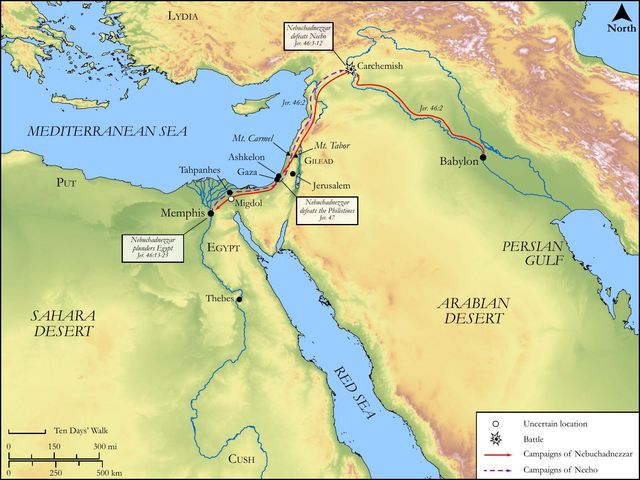
The accomplishment of the prediction in the former part of the chapter disabled the Egyptians from making any attempts upon other nations; for what could they do when their army was routed? But still they remained strong at home, and none of their neighbours durst make any attempts upon them. Though the kings of Egypt came no more out of their land (Kg2 24:7), yet they kept safe and easy in their land; and what would they desire more than peaceably to enjoy their own? One would think all men should be content to do this, and not covet to invade their neighbours. But the measure of Egypt's iniquity is full, and now they shall not long enjoy their own; those that encroached on others shall not be themselves encroached on. The scope of the prophecy here is to show how the king of Babylon should shortly come and smite the land of Egypt, and bring the war into their own bosoms which they had formerly carried into his borders, Jer 46:13. This was fulfilled by the same hand with the former, even Nebuchadnezzar's, but many years after, twenty at least, and probably the prediction of it was long after the former prediction, and perhaps much about the same time with that other prediction of the same event which we had Jer 43:10.
1.Here is the alarm of war sounded in Egypt, to their great amazement (Jer 46:14), notice given to the country that the enemy is approaching, the sword is devouring round about in the neighbouring countries, and therefore it is time for the Egyptians to put themselves in a posture of defence, to prepare for war, that they may give the enemy a warm reception. This must be proclaimed in all parts of Egypt, particularly in Migdol, Noph, and Tahpanhes, because in these places especially the Jewish refugees, or fugitives rather, had planted themselves, in contempt of God's command (Jer 44:1), and let them hear what a sorry shelter Egypt is likely to be to them.
2.The retreat hereupon of the forces of other nations which the Egyptians had in their pay is here foretold. Some considerable number of those troops, it is probable, were posted upon the frontiers to guard them, where they were beaten off by the invaders and put to flights. Then were the valiant men swept away (Jer 46:15) as with a sweeping rain (it is the word that is used Pro 28:3); they can none of them stand their ground, because the Lord drives them from their respective posts; he drives them by his terrors; he drives them by enabling the Chaldeans to drive them. It is not possible that those should fix whom the wrath of God chases. He it was (Jer 46:16) that made many to fall, yea, when their day shall come to fall, the enemy needs not throw them down, they shall fall one upon another, every man shall be a stumbling-block to his fellow, to his follower; nay, if God please, they shall be made to fall upon one another, they shall be made to fall upon one another, every man's sword shall be against his fellow. Her hired men, the troops Egypt has in he service, are indeed in the midst of her like fatted bullocks, lusty men, able bodied and high spirited, who were likely for action and promised to make their part good against the enemy; but they are turned back; their hearts failed them, and, instead of fighting, they have fled away together. How could they withstand their fate when the day of their calamity had come, the day in which God will visit them in wrath? Some think they are compared to fatted bullocks for their luxury; they had wantoned in pleasures, so that they were very unfit for hardships, and therefore turned back and could not stand. In this consternation,
(1.)They all made homeward towards their own country (Jer 46:16): They said, "Arise, and let us go again to our own people, where we may be safe from the oppressing sword of the Chaldeans, that bears down all before it." In times of exigence little confidence is to be put in mercenary troops, that fight purely for pay, and have no interest in theirs whom they fight for.
(2.)They exclaimed vehemently against Pharaoh, to whose cowardice or bad management, it is probably, their defeat was owing. When he posted them there upon the borders of his country it is probably that he told them he would within such a time come himself with a gallant army of his own subjects to support them; but he failed them, and, when the enemy advanced, they found they had none to back them, so that they were perfectly abandoned to the fury of the invaders. No marvel then that they quitted their post and deserted the service, crying out, Pharaoh king of Egypt is but a noise (Jer 46:17); he can hector, and talk big of the mighty things he would do, but that is all; he brings nothing to pass. All his promises to those in alliance with him, or that are employed for him, vanish into smoke. He brings not the succours he engaged to bring, or not till it is too late: He has passed the time appointed; he did not keep his word, nor keep his day, and therefore they bid him farewell, they will never serve under him any more. Note, Those that make most noise in any business are frequently but a noise. Great talkers are little doers.
3.The formidable power of the Chaldean army is here described as bearing down all before it. The King of kings, whose name is the Lord of hosts, and before whom the mightiest kings on earth, though gods to us, are but as grasshoppers, he hath said it, he hath sworn it, As I live, saith this king, as Tabor overtops the mountains and Carmel overlooks the sea, so shall the king of Babylon overpower all the force of Egypt, such a command shall he have, such a sway shall he bear, Jer 46:18. He and his army shall come against Egypt with axes, as hewers of wood (Jer 46:22), and the Egyptians shall be no more able to resist them than the tree is to resist the man that comes with an axe to cut it down; so that Egypt shall be felled as a forest is by the hewers of wood, which (if there by many of them, and those well provided with instruments for the purpose) will be done in a little time. Egypt is very populous, full of towns and cities, like a forest, the trees of which cannot be searched or numbered, and very rich, full of hidden treasures, many of which will escape the searching eye of the Chaldean soldiers; but they shall make a great spoil in the country, for they are more than the locusts, that come in vast swarms and overrun a country, devouring every green thing (Joe 1:6, Joe 1:7), so shall the Chaldeans do, for they are innumerable. Note, The Lord of hosts hath numberless hosts at his command.
4.The desolation of Egypt hereby is foretold, and the waste that should be made of that rich country. Egypt is now like a very fair heifer, or calf (Jer 46:20), fat and shining, and not accustomed to the yoke of subjection, wanton as a heifer that is well fed, and very sportful. Some think here is an allusion to Apis, the bull or calf which the Egyptians worshipped, from whom the children of Israel learned to worship the golden calf. Egypt is as fair as a goddess, and adores herself, but destruction comes; cutting up comes (so some read it); it comes out of the north; thence the Chaldean soldiers shall come, as so many butchers or sacrificers, to kill and cut up this fair heifer.
(1.)The Egyptians shall be brought down, shall be tamed, and their tune changed: The daughters of Egypt shall be confounded (Jer 46:24), shall be filled with astonishment. Their voice shall go like a serpent, that is, it shall be very low and submissive; they shall not low like a fair heifer, that makes a great noise, but hiss out of their holes like serpents. They shall not dare to make loud complaints of the cruelty of the conquerors, but vent their griefs in silent murmurs. They shall not now, as they used to do, answer roughly, but, with the poor, use entreaties and beg for their lives.
(2.)They shall be carried away prisoners into their enemy's land (Jer 46:19): "O thou daughter! dwelling securely and delicately in Egypt, that fruitful pleasant country, do not think this will last always, but furnish thyself to go into captivity; instead of rich clothes, which will but tempt the enemy to strip thee, get plain and warm clothes; instead of fine shoes, provide strong ones; and inure thyself to hardship, that thou mayest bear it the better." Note, It concerns us, among all our preparations, to prepare for trouble. We provide for the entertainment of our friends, let us not neglect to provide for the entertainment of our enemies, nor among all our furniture omit furniture for captivity. The Egyptians must prepare to flee; for their cities shall be evacuated. Noph particularly shall be desolate, without an inhabitant, so general shall the slaughter and the captivity be. There are some penalties which, we say, the king and the multitude are exempted from, but here even these are obnoxious: The multitude of No shall be punished: it is called populous No, Nah 3:8. Though hand join in hand, yet they shall not escape; nor can any think to go off in the crowd. Be they ever so many, they shall find God will be too many for them. Their kings and all their petty princes shall fall; and their gods too (Jer 43:12, Jer 43:13), their idols and their great men. Those which they call their tutelar deities shall be no protection to them. Pharaoh shall be brought down, and all those that trust in him (Jer 46:25), particularly the Jews that came to sojourn in his country, trusting in him rather than in God. All these shall be delivered into the hands of the northern nations (Jer 46:24), into the hand not only of Nebuchadnezzar that mighty potentate, but into the hands of his servants, according to the curse on Ham's posterity, of which the Egyptians were, that they should be the servants of servants. These seek their lives, and into their hands they shall be delivered.
5.An intimation is given that in process of time Egypt shall recover itself again (Jer 46:26): Afterwards it shall be inhabited, shall be peopled again, whereas by this destruction it was almost dispeopled. Ezekiel foretels that this should be at the end of forty years, Eze 29:13. See what changes the nations of the earth are subject to, how they are emptied and increased again; and let not nations that prosper be secure, nor those that for the present are in thraldom despair.
II.Comfort and peace are here spoken to the Israel of God, Jer 46:27, Jer 46:28.
Some understand it of those whom the king of Egypt had carried into captivity with Jehoahaz, but we read not of any that were carried away captives with him; it may therefore rather refer to the captives in Babylon, whom God had mercy in store for, or, more generally, to all the people of God, designed for their encouragement in the most difficult times, when the judgments of God are abroad among the nations. We had these words of comfort before, Jer 30:10, Jer 30:11.
1.Let the wicked of the earth tremble, they have cause for it; but fear not thou, O my servant Jacob! and be not dismayed, O Israel! and again, Fear thou not, O Jacob! God would not have his people to be a timorous people.
2.The wicked of the earth shall be put away like dross, not be looked after any more; but God's people, in order to their being saved, shall be found out and gathered though they be far off, shall be redeemed though they be held fast in captivity, and shall return.
3.The wicked is like the troubled sea when it cannot rest; they flee when none pursues. But Jacob, being at home in God, shall be at rest and at ease, and none shall make him afraid; for what time he is afraid he has a God to trust to.
4.The wicked God beholds afar off; but, wherever thou art, O Jacob! I am with thee, a very present help.
5.A full end shall be made of the nations that oppressed God's Israel, as Egypt and Babylon; but mercy shall be kept in store for the Israel of God: they shall be corrected, but not cast off; the correction shall be in measure, in respect of degree and continuance. Nations have their periods; the Jewish nation itself has come to an end as a nation; but the gospel church, God's spiritual Israel, still continues, and will to the end of time; in that this promise is to have its full accomplishment, that, though God correct it, he will never make a full end of it.
Historical interpretation
Historical reception
1 surviving comment on this verse from the historical church.
The Egyptians call Zeus Ammon. For this reason it is also called the Ammonian land. They have furnished the largest sacred precinct for this deity. He calls Ammon “Egypt’s son” on the grounds that Ammon was a god created by it, since a statue is something made by human hands. Thus, he threatens to give Ammon and their other gods to the Babylonians, for he says this: “And on Pharaoh and on Egypt and on its gods and those who trust in them, he says that the enemy will overcome them all alike—the king, rulers, idols and bodyguards.” Once Egypt has been given over to the king of the Babylonians, he will recover his earlier dominion.
Continue studying Jeremiah 46:25 across the web’s major study libraries — every link below opens this exact verse, chapter, or book on the destination site.
Read & Compare
 BibleGatewayThis verse in more than 200 translations and 70 languages.
 Bible.comThe YouVersion reader — hundreds of translations, reading plans, and highlights.
 ESV.orgCrossway's official English Standard Version reader.
 NET BibleThe NET translation with 60,000+ translators' notes on every rendering decision.
 STEP BibleTyndale House's free study tool — original text, vocabulary, and scholarly resources.
 BibliaLogos Bible Software's free web reader.
 USCCBThe New American Bible (Revised Edition) with the U.S. bishops' study notes.
Commentaries
 BibleHub CommentariesDozens of classic commentaries on this verse, gathered on one page.
 StudyLightMore than 100 commentary sets — the largest collection on the web.
 BibleRefPlain-English commentary on what this verse means, verse by verse.
 Enduring WordDavid Guzik's free commentary on this chapter, widely used by Bible teachers.
 Bible Study ToolsVerse commentary alongside Greek and Hebrew study aids.
Original Language & Research
- BibleHub InterlinearThe verse word by word — original language, transliteration, and English.
- BibleHub LexiconEvery word's original-language definition and Strong's entry.
 Blue Letter BibleDeep-study tools — Strong's numbers, concordance, and word studies.
 SefariaThe Hebrew text with Rashi and centuries of Jewish commentary.
Sermons, Hymns & Audio


TrulyRandomVerse is not affiliated with these sites and doesn’t control their content. They’re linked because they’re genuinely useful.
Summary
Jeremiah 46:25 powerfully asserts the absolute sovereignty of "The LORD of hosts, the God of Israel," declaring a comprehensive divine judgment against Egypt. This pronouncement targets not only its formidable capital, No (Thebes), and its reigning Pharaoh, but also extends to the very foundations of its national identity: its false gods, its kings, and all who place their confidence in human power and idolatrous systems rather than in the one true God. The verse unequivocally demonstrates that no earthly authority or spiritual deception can withstand the righteous wrath and sovereign will of Yahweh.
Context
ShowHideLiterary Context
Jeremiah 46:25 is strategically placed within the "Oracles Against the Nations" (Jeremiah 46-51), a significant section of Jeremiah's prophecy that follows extensive pronouncements of judgment upon Judah and Jerusalem. This specific chapter is dedicated entirely to the prophecy concerning Egypt, serving as a powerful demonstration that Yahweh's authority transcends the borders of Israel, extending His dominion over all nations and their rulers. The oracle against Egypt commences with a historical anchor, referencing the decisive Battle of Carchemish (605 BC), where Babylon dealt a crushing blow to Egypt, fundamentally altering the geopolitical landscape for Egypt, Babylon and Judah. Verse 25, therefore, is not a mere general statement but a precise and detailed declaration of judgment aimed at the very heart of Egyptian power, reinforcing the preceding warnings and establishing God's ultimate control over the unfolding events of world history.
Historical & Cultural Context
During the era of Jeremiah's prophetic ministry, Egypt was a formidable regional power, frequently serving as a tempting, though ultimately unreliable, ally for Judah in its desperate attempts to resist the burgeoning Babylonian Empire. Pharaoh Neco II, implicitly referenced, had recently suffered a devastating defeat at Carchemish, which significantly diminished Egypt's perceived invincibility. The city of "No" (Hebrew: Nôʼ, known to the Greeks as Thebes) was the ancient capital of Upper Egypt and a preeminent center of both religious and political authority. It was renowned for its immense wealth, its magnificent temples, and its deep devotion to the deity Amon-Ra. By explicitly naming "No," Pharaoh, and Egypt's pantheon of gods and its line of kings, the prophecy directly confronts the very sources of Egyptian pride, security, and spiritual identity. Culturally, ancient Egypt was profoundly polytheistic, with an elaborate system of deities believed to govern every aspect of life and the natural world. The divine judgment against "their gods" serves as a direct challenge to the efficacy and power of these idols, unequivocally asserting the singular supremacy of the God of Israel.
Key Themes
ShowHideThis verse profoundly contributes to several overarching theological themes prevalent in the book of Jeremiah and the broader prophetic tradition. Firstly, it emphatically underscores God's Sovereign Judgment over all nations. The declaration, "The LORD of hosts, the God of Israel, saith; Behold, I will punish," serves as an emphatic assertion of Yahweh's absolute authority, demonstrating that no empire, no king, and no deity can successfully oppose His divine decree. This theme resonates deeply with the biblical truth that the Most High rules in the kingdom of mankind and gives it to whom he will. Secondly, the verse highlights the Futility of Idolatry and Trust in Human Power. The explicit targeting of Egypt's "gods" and "all them that trust in him" (referring to Pharaoh) exposes the profound spiritual danger inherent in placing confidence in anything other than the Lord. It reveals the utter impotence of false deities and the ultimate weakness of human strength when confronted by divine power. This serves as a stark warning against reliance on political alliances or material might, echoing the timeless wisdom found in Psalm 146:3-5. Finally, this comprehensive judgment serves to Vindicate God's Name and Covenant Faithfulness. By executing such a decisive judgment on a formidable world power, the Lord of hosts demonstrates His unique power and vindicates His name as the true "God of Israel," thereby proving His unwavering covenant loyalty to His people by showcasing His absolute control over their enemies and the entire world.
Exposition and Analysis
ShowHideKey Word Analysis
ShowHideThis majestic composite divine title combines H3068 (Jehovah, signifying the self-Existent or Eternal God) with H6635 (hosts, referring to an organized mass of persons, particularly an army, or figuratively, a campaign or worship). Together, this title emphasizes God's absolute power and authority as the supreme commander of all creation, including celestial armies and earthly powers. It underscores His irresistible might and His ability to execute His will over nations like Egypt, demonstrating His universal dominion.
Derived from H6485, this primitive root means "to visit." While it can denote a friendly visitation, in this prophetic context, it carries the strong connotation of a hostile visitation, implying divine accountability, judgment, and the meting out of consequences. It signifies God's active intervention to oversee, inspect, and ultimately bring retribution upon those who defy His authority, highlighting His role as a righteous and sovereign judge who will not overlook unrighteousness.
This root means "to hide for refuge," and figuratively, "to be confident or sure." In Jeremiah 46:25, it points directly to the misplaced confidence and reliance of the Egyptians (and by extension, Judah) in human power (embodied by Pharaoh) and the impotent false gods. The divine judgment is specifically directed at those whose security, hope, and faith are rooted in created things rather than in the Creator Himself, emphasizing the profound spiritual danger and ultimate futility of such misplaced faith.
Verse Breakdown
ShowHide"The LORD of hosts, the God of Israel, saith;"
This opening clause unequivocally establishes the divine authority and ultimate source of the prophecy. The double title, "The LORD of hosts" (Yahweh Sabaoth), emphasizes God's omnipotence, His control over all creation, and His command over all armies, both heavenly and earthly. Simultaneously, "the God of Israel" highlights His unique and steadfast covenant relationship with His chosen people. The declaration "saith" (Hebrew, ʼâmar'), a standard prophetic formula, underscores that this is a direct, authoritative, and infallible word from God Himself, not merely a human observation or political prediction.
"Behold, I will punish the multitude of No, and Pharaoh, and Egypt, with their gods, and their kings;"
This is the core declaration of divine judgment, meticulously detailing its comprehensive and all-encompassing scope. "Behold" serves as an immediate attention-grabber, signaling the gravity and certainty of the pronouncement. "I will punish" asserts God's personal, active, and decisive involvement in executing this judgment. "The multitude of No" refers to Thebes, Egypt's powerful, populous, and religiously significant capital, symbolizing its vast wealth, military strength, and spiritual heart. The judgment extends to "Pharaoh" (the reigning monarch), "Egypt" (the entire nation), "their gods" (the complete pantheon of Egyptian deities, challenging their very existence and power), and "their kings" (encompassing all past, present, and future rulers). This exhaustive list signifies that no aspect of Egyptian power—whether political, military, economic, or religious—is beyond God's reach or immune to His righteous judgment.
"even Pharaoh, and [all] them that trust in him:"
This concluding phrase serves to reiterate and intensify the judgment, specifically re-emphasizing "Pharaoh" to underscore his central role as the embodiment of Egyptian power and a primary object of this specific divine reckoning. Crucially, it expands the scope to include "all them that trust in him." This highlights the profound spiritual dimension of the judgment: it is not merely against a nation or its leaders, but fundamentally against the misplaced confidence and idolatrous reliance on human power and false deities. It underscores the profound theological truth that those who place their ultimate faith and security in anything other than the true God will inevitably share in the devastating consequences of that misplaced trust.
Literary Devices
ShowHideJeremiah 46:25 masterfully employs several potent literary devices to convey its message of divine judgment with maximum impact. The most prominent is Divine Oracle, explicitly established by the authoritative declaration, "The LORD of hosts, the God of Israel, saith." This phrase immediately grounds the prophecy in absolute divine authority, signaling that this is not a human conjecture but a direct, infallible pronouncement from the Almighty God, the sovereign ruler over all things. The verse also utilizes Merism (or Totality), a rhetorical device that lists various parts to represent the whole. By enumerating "the multitude of No, and Pharaoh, and Egypt, with their gods, and their kings," the prophecy indicates a complete, exhaustive, and utterly comprehensive judgment. This detailed listing ensures that no element of Egypt's strength, identity, or spiritual foundation is omitted from God's wrath. Furthermore, there is a subtle yet effective use of Repetition by mentioning "Pharaoh" twice within the verse. This strategic reiteration serves to emphasize his central role as the personification of Egyptian power and the primary target of this specific divine reckoning, reinforcing the comprehensive and inescapable nature of the judgment against him and his entire sphere of influence.
Theological and Thematic Connections
ShowHideJeremiah 46:25 profoundly illustrates God's absolute sovereignty over all nations and their rulers, demonstrating with stark clarity that no earthly power, however formidable or self-assured, can ultimately stand against His divine will. It powerfully reveals the inherent futility of idolatry and the grave spiritual danger of placing trust in human strength, political alliances, or any false gods. The explicit judgment against Egypt's gods specifically underscores that the God of Israel is the only true and living God, before whom all other deities are utterly powerless, vain, and ultimately destined for destruction. This passage serves as a timeless and urgent reminder that ultimate security, true peace, and eternal salvation are found exclusively in Yahweh, not in worldly systems, human achievements, or any form of idolatrous worship. It challenges believers across all generations to critically examine the objects of their trust and to recognize that God alone holds the reins of history, destiny, and the ultimate fate of all nations.
Reflection and Application
ShowHideJeremiah 46:25 stands as a profound and enduring reminder for believers today: all human power, military might, economic prowess, technological advancements, and even deeply cherished ideologies are ultimately subject to the sovereign will of the Almighty God. In a world that frequently places its confidence in political leaders, financial security, scientific progress, or personal achievements, this verse calls us to a radical and honest re-evaluation of where our ultimate trust truly lies. It challenges us to identify any "Pharaohs" or "gods" in our own lives – anything we elevate above God, whether it be career success, material possessions, significant relationships, self-reliance, or even our own intellect – and to recognize their ultimate powerlessness and inability to provide lasting security when confronted by divine authority. True security, profound peace, and eternal salvation are found only in placing our unwavering faith in the living God, who alone is worthy of our complete trust, worship, and allegiance. This passage encourages humility, spiritual discernment, and a renewed commitment to seeking God's kingdom first, knowing with certainty that He is the ultimate ruler over all things, and His purposes will prevail.
Questions for Reflection
ShowHideFAQ
ShowHideWhat is "No" mentioned in this verse?
ShowHide"No" (Hebrew: Nôʼ, H4996) refers to the ancient Egyptian city of Thebes. During the time of Jeremiah's prophecy, Thebes was the capital of Upper Egypt and a preeminent religious and political center. It was renowned for its immense wealth, its grand temples dedicated primarily to the god Amon-Ra, and its significant population. By specifically naming "No," the prophecy targets the very heart of Egyptian power, pride, and religious devotion, signifying the comprehensive and inescapable nature of God's judgment against the entire nation and its perceived sources of strength.
Why is God punishing Egypt in this prophecy?
ShowHideGod punishes Egypt for several reasons, as revealed throughout the book of Jeremiah and other prophetic texts. Primarily, it is an act of divine judgment against Egypt's pervasive idolatry, its national pride, and its consistent role as a deceptive and ultimately unreliable ally for Judah, often leading God's people astray from trusting Him alone. Egypt's misplaced trust in its own military might and its elaborate pantheon of false gods directly defied the singular sovereignty of the LORD. Furthermore, God uses the judgment of powerful nations like Egypt to unequivocally demonstrate His universal dominion over all of creation and to vindicate His holy name as the one true God, proving that He alone controls the destinies of empires and peoples. This judgment also served as a stark warning to Judah against placing their trust in human alliances rather than in their covenant-keeping God, a critical theme seen throughout Jeremiah chapter 46.
What does "the LORD of hosts" mean in this context?
ShowHide"The LORD of hosts" (Hebrew: Yahweh Sabaoth) is a powerful and majestic title for God, emphasizing His supreme authority and omnipotence. "LORD" (Yahweh, H3068) refers to God's covenant name, signifying His self-existence, eternal nature, and faithfulness to His promises. "Hosts" (Sabaoth, H6635) refers to armies, whether human or angelic, or even the celestial bodies. In this context, it profoundly underscores God's role as the supreme commander of all creation, including all earthly powers and spiritual forces. It highlights His irresistible might and His absolute ability to muster and command all things to accomplish His divine purposes, even to bring devastating judgment upon a mighty nation like Egypt. This title reinforces that the judgment declared in Jeremiah 46:25 is not merely a political event but a divine act executed by the sovereign ruler of the universe, before whom no power can stand.
Christ-Centered Fulfillment
ShowHideJeremiah 46:25, with its stark declaration of divine judgment against the earthly powers and false gods of Egypt, finds its ultimate fulfillment and deeper redemptive meaning in the person and redemptive work of Jesus Christ. While this Old Testament passage speaks of God's temporal judgment on a specific nation, it powerfully foreshadows Christ's ultimate and decisive victory over all spiritual and earthly powers that set themselves in opposition to God. Just as Yahweh demonstrated His absolute sovereignty over Pharaoh and the impotent gods of Egypt, so Christ, through His sacrificial death on the cross and His glorious resurrection, triumphed definitively over the spiritual "Pharaohs" of sin, death, and the devil. The New Testament boldly declares that He disarmed the rulers and authorities and put them to open shame, by triumphing over them in Him. Furthermore, the futility of trusting in human strength and false gods, so vividly depicted in Jeremiah, is fully and eternally revealed in Christ. He is the ultimate and only worthy object of trust, the sole one who can truly deliver, redeem, and save. Unlike fleeting earthly kings and their transient kingdoms, Jesus' kingdom is not of this world, guaranteeing its eternal nature, supreme authority, and unshakeable foundation. The judgment pronounced on Egypt's gods points forward to the final and complete overthrow of all idolatry and false worship through Christ, who alone is worthy of all praise, adoration, and worship. His glorious return will see Him judge the nations with righteousness and equity, perfectly fulfilling the prophetic declarations of God's universal dominion. Thus, Jeremiah 46:25 ultimately directs our gaze to Christ, the true and eternal King, whose reign is everlasting and whose victory over all opposing powers is absolute, offering true refuge, salvation, and eternal life to all who trust in Him.