


Jeremiah 43:13
Bible text: King James Version (1769 Blayney text) · Public domain
Bible text: Berean Standard Bible · Public domain
Bible text: American Standard Version (1901) · Public domain
Bible text: World English Bible, Messianic edition · Public domain
Bible text: Geneva Bible (1599) · Public domain
Bible text: Young's Literal Translation · Public domain
- וְשִׁבַּרve·shi·Barand he will breakH7665Conj-w ¦ V-Piel-ConsecPerf-3msVerb Piel Consecutive Perfect 3rd Singular Masculineוְandשִׁבַּרhe will break
- אֶת'et<obj.>H853DirObjMParticle Object Indicator
- מַצְּבוֹתma·tze·Vot[the] sacred pillars ofH4676N-fpcNoun Plural Feminine Construct
- בֵּיתbeitBethH1053N-cscNoun Singular common gender Construct
- שֶׁמֶשׁShe·meshShemeshH1053N-csNoun Singular common gender Absolute
- אֲשֶׁר'a·SherwhichH834RelParticle Relative
- בְּאֶרֶץbe·'E·retz[is] in [the] land ofH776Prep-b ¦ N-fscNoun Singular Feminine Constructבְּ[is] inאֶרֶץ[the] land of
- מִצְרָיִםmitz·Ra·yimEgyptH4714N-properNoun Proper Location
- וְאֶתve·'Etand <obj.>H853Conj-w ¦ DirObjMParticle Object Indicatorוְandאֶת<obj.>
- בָּתֵּיba·Tei[the] houses ofH1004N-mpcNoun Plural Masculine Construct
- אֱלֹהֵי'e·lo·hei[the] gods ofH430N-mpcNoun Plural Masculine Construct
- מִצְרַיִםmitz·Ra·yimEgyptH4714N-properNoun Proper Location
- יִשְׂרֹףyis·Rofhe will burnH8313V-Qal-Imperf-3msVerb Qal Imperfect 3rd Singular Masculine
- בָּאֵשׁba·'Eshwith <the> fireH784Prep-b ¦ N-csNoun Singular common gender Absoluteבָּwith <the>אֵשׁfire
English is a literal word-by-word gloss of the Hebrew, not the KJV's wording. Why?
This is the original text the KJV's translators worked from — each Hebrew word with its own literal English meaning in this verse, prepared by scholars at Tyndale House, Cambridge. The KJV translates whole sentences, not word by word, so its wording differs: one Hebrew word can become several English words, and the KJV may choose “the LORD” where the gloss reads “Yahweh”. Both are faithful — they answer different questions. For the KJV's own rendering, switch to the KJV text.
Details
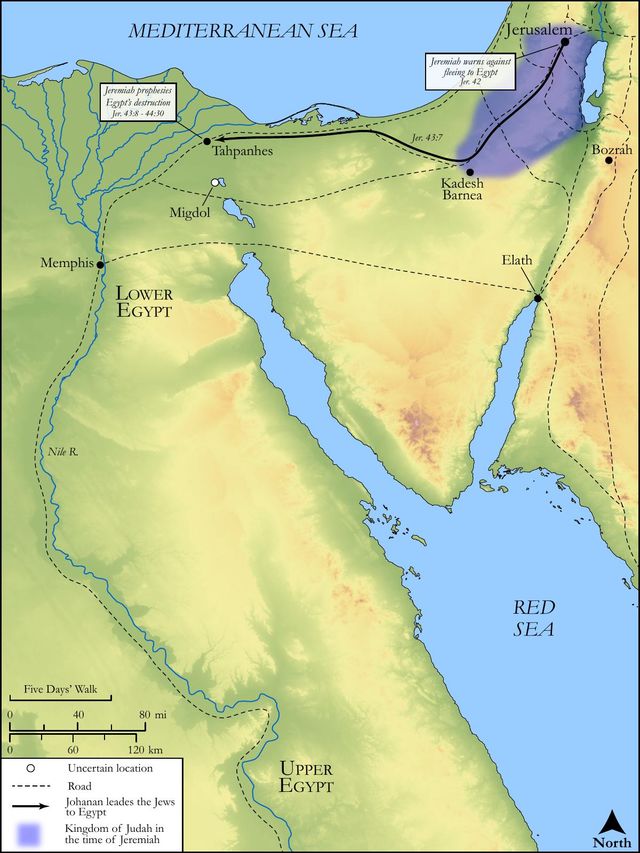
See on the biblical-era map
Study this verse
Public-domain commentary
Matthew Henry
From his Commentary on the Whole Bible. Henry comments on passages, not single verses — this entry covers Jeremiah 43:8–13. His two-level outline is real structure in the source text, so it is rendered as structure.
We have here, as also in the next chapter, Jeremiah prophesying in Egypt. Jeremiah was now in Tahpanhes, for there his lords and masters were; he was there among idolatrous Egyptians and treacherous Israelites; but there, 1. He received the word of the Lord; it came to him. God can find his people, with the visits of his grace, wherever they are; and, when his ministers are bound, yet the word of the Lord is not bound. The spirit of prophecy was not confined to the land of Israel. When Jeremiah went into Egypt, not out of choice, but by constraint, God withdrew not his wonted favour from him. 2. What he received of the Lord he delivered to the people. Wherever we are we must endeavour to do good, for that is our business in this world. Now we find two messages which Jeremiah was appointed and entrusted to deliver when he was in Egypt. We may suppose that he rendered what services he could to his countrymen in Egypt, at least as far as they would be acceptable, in performing the ordinary duties of a prophet, praying for them and instructing and comforting them; but only two messages of his, which he had received immediately from God, are recorded, one in this chapter, relating to Egypt itself and foretelling its destruction, the other in the next chapter, relating to the Jews in Egypt. God had told them before that if they went into Egypt the sword they feared should follow them; here he tells them further that the sword of Nebuchadnezzar, which they were in a particular manner afraid of, should follow them.
I.This is foretold by a sign.
Jeremiah must take great stones, such as are used for foundations, and lay them in the clay of the furnace, or brick-kiln, which is in the open way, or beside the way that leads to Pharaoh's house (Jer 43:9), some remarkable place in view of the royal palace. Egypt was famous for brick-kilns, witness the slavery of the Israelites there, whom they forced to make bricks (Exo 5:7), which perhaps was now remembered against them. The foundation of Egypt's desolation was laid in those brick-kilns, in that clay. This he must do, not in the sight of the Egyptians (they knew not Jeremiah's character), but in the sight of the men of Judah to whom he was sent, that, since he could not prevent their going into Egypt, he might bring them to repent of their going.
II.It is foretold in express words, as express as can be,
1.That the king, the present king of Babylon, Nebuchadnezzar, the very same that had been employed in the destruction of Jerusalem, should come in person against the land of Egypt, should make himself master even of this royal city, by the same token that he should set his throne in that very place where these stones were laid, Jer 43:10. This minute circumstance is particularly foretold, that, when it was accomplished, they might be put in mind of the prophecy and confirmed in their belief of the extent and certainly of the divine prescience, to which the smallest and most contingent events are evident. God calls Nebuchadnezzar his servant, because herein he executed God's will, accomplished his purposes, and was instrumental to carry on his designs. Note, The world's princes are God's servants and he makes what use he pleases of them, and even those that know him not, nor aim at his honour, are the tools which his providence makes use of.
2.That he should destroy many of the Egyptians, and have them all at his mercy (Jer 43:11): He shall smite the land of Egypt; and, though it has been always a warlike nation, yet none shall be able to make head against him, but whom he will he shall slay, and by what sort of death he will, whether pestilence (for that is here meant by death, as Jer 15:2) by shutting them up in places infected, or by the sword of war or justice, in cold blood or hot. And whom he will he shall save alive and carry into captivity. The Jews, by going into Egypt, brought the Chaldeans thither, and so did but ill repay those that entertained them. Those who promised to protect Israel from the king of Babylon exposed themselves to him.
3.That he shall destroy the idols of Egypt, both the temples and the images of their gods (Jer 43:12): He shall burn, the houses of the gods of Egypt, but it shall be with a fire of God's kindling; the fire of God's wrath fastens upon them, and then he burns some of them and carries others captive, Isa 46:1. Beth-shemesh, or the house of the sun, was so called from a temple there built to the sun, where at certain times there was a general meeting of the worshippers of the sun. The statues or standing images there he shall break in pieces (Jer 43:13) and carry away the rich materials of them. It intimates that he should lay all waste when even the temple and the images should not escape the fury of the victorious army. The king of Babylon was himself a great idolater and a patron of idolatry; he had his temples and images in honour of the sun as well as the Egyptians; and yet he is employed to destroy the idols of Egypt. Thus God sometimes makes one wicked man, or wicked nation, a scourge and plague to another.
4.That he shall make himself master of the land of Egypt, and none shall be able to plead its cause or avenge its quarrel (Jer 43:12): He shall array himself with the rich spoils of the land of Egypt, both beautify and fortify himself with them. He shall array himself with them as ornaments and as armour; and this, though it shall be a rich and heavy booty, being expert in war, and expeditious, he shall slip on with as much ease and in as little time, in comparison, as a shepherd slips on his garment, when he goes to turn out his sheep in a morning. And being loaded with the wealth of many other nations, the fruits of his conquests, he shall make no more of the spoils of the land of Egypt than of a shepherd's coat. And when he has taken what he pleases (as Benhadad threatened to do, Kg1 20:6) he shall go forth in peace, without any molestation given him, or any precipitation for fear of it, so effectually reduced shall the land of Egypt be. This destruction of Egypt by the king of Babylon is foretold, Eze 29:19 and Eze 30:10. Babylon lay at a great distance from Egypt, and yet thence the destruction of Egypt comes; for God can make those judgments strike home which are far-fetched.
Historical interpretation
Historical reception
2 surviving comments on this verse. Each one is dated, so this reads as a timeline rather than a list.
Select a marker to jump to its quote. Markers stagger vertically where authors wrote within a few decades of each other.
“He shall break the obelisks of the city of the sun, which is in Egypt, and the temples of the gods of the Egyptians he shall burn with fire.” The city of the sun is Egyptian Heliopolis, which was known for excessive demonic veneration and worship of futile idols. It had tall obelisks of amazing size. The height of each was up to sixty cubits, the capitals on the top of the obelisks were from shining brass that weighed up to a thousand or more pounds. On these obelisks were standing images and likenesses of people and animals that the Gentiles were worshiping. Also, those obelisks were inscribed with sacred writings of pagan mysteries. It was written about these obelisks that the Lord would break them. It does not speak so much about divine destruction and demolition of these obelisks as such, as about the destruction of the worship of demons and idols, images of those who were engraved on those obelisks. It was demolished, destroyed and stopped when the Lord Christ was incarnated and came to this world. This is exactly what Isaiah proclaimed when he said, “The Lord is seated on the light cloud and comes to Egypt, and handmade Egyptian idols will tremble in front of his face.” The cloud on which the Lord is riding symbolizes for us the virgin Mary, who gave birth to God; it also symbolizes the living and clear message of the Lord’s gospel and the holy name of Christ that was proclaimed by the apostles (these divine preachers). On them, as on the light cloud, the Lord was seated and was proclaimed to the ends of the earth. Also, these clouds mystically symbolize holy prophets. Just as Isaiah writes that God, in a figurative image of the vineyard, was talking about the people of Israel and that he would break their fence and “order the clouds that they rain no rain on it,” so likewise in this passage clouds mean prophets who rain a heavenly rain on us.
The city had two names. It was called both On and Heliopolis. Exodus also taught this, for it says that the children of Israel built cities for Pharaoh: Pithom, Raamses and On, which is Heliopolis. God calls Nebuchadnezzar his servant, not because he is a servant in appearance or disposition but because he is a servant by nature: creation is the servant of the Creator. At the same time he teaches that Nebuchadnezzar does these things because God permits him to.
Continue studying Jeremiah 43:13 across the web’s major study libraries — every link below opens this exact verse, chapter, or book on the destination site.
Read & Compare
 BibleGatewayThis verse in more than 200 translations and 70 languages.
 Bible.comThe YouVersion reader — hundreds of translations, reading plans, and highlights.
 ESV.orgCrossway's official English Standard Version reader.
 NET BibleThe NET translation with 60,000+ translators' notes on every rendering decision.
 STEP BibleTyndale House's free study tool — original text, vocabulary, and scholarly resources.
 BibliaLogos Bible Software's free web reader.
 USCCBThe New American Bible (Revised Edition) with the U.S. bishops' study notes.
Commentaries
 BibleHub CommentariesDozens of classic commentaries on this verse, gathered on one page.
 StudyLightMore than 100 commentary sets — the largest collection on the web.
 BibleRefPlain-English commentary on what this verse means, verse by verse.
 Enduring WordDavid Guzik's free commentary on this chapter, widely used by Bible teachers.
 Bible Study ToolsVerse commentary alongside Greek and Hebrew study aids.
Original Language & Research
- BibleHub InterlinearThe verse word by word — original language, transliteration, and English.
- BibleHub LexiconEvery word's original-language definition and Strong's entry.
 Blue Letter BibleDeep-study tools — Strong's numbers, concordance, and word studies.
 SefariaThe Hebrew text with Rashi and centuries of Jewish commentary.
Sermons, Hymns & Audio


TrulyRandomVerse is not affiliated with these sites and doesn’t control their content. They’re linked because they’re genuinely useful.
Summary
Jeremiah 43:13 delivers a stark prophecy of divine judgment against Egypt, specifically targeting its prominent idolatrous centers. Through Nebuchadnezzar, identified as God's instrument, the Lord declares that the images and temples dedicated to Egyptian deities, particularly those at Bethshemesh (Heliopolis), will be shattered and consumed by fire. This declaration underscores God's absolute sovereignty over all nations and His unwavering opposition to false worship, serving as a powerful warning to the disobedient Jewish remnant who had sought refuge in Egypt against His command.
Context
ShowHideLiterary Context
This verse is situated within a critical turning point in the book of Jeremiah, following the devastating fall of Jerusalem to Babylon in Jeremiah 39. Chapters Jeremiah 40-44 detail the tumultuous aftermath, focusing on the remnant left in Judah and their subsequent flight to Egypt. Despite the prophet Jeremiah's clear and fervent warnings from the Lord not to go to Egypt, as recorded in Jeremiah 42, the people defiantly chose to seek safety there, fearing Babylonian reprisal. Jeremiah 43 describes Jeremiah being forcibly taken by the remnant to Tahpanhes in Egypt, as detailed in Jeremiah 43:7. It is in this context, on Egyptian soil, that God delivers this prophecy through Jeremiah, demonstrating that even in their chosen refuge, they would not escape the reach of His judgment, which would now extend to Egypt itself.
Historical & Cultural Context
The historical backdrop is the immediate post-exilic period for Judah, around 586 BCE. After Jerusalem's destruction, a significant portion of the Jewish population was exiled to Babylon. A remnant, however, remained in Judah under Gedaliah, who was later assassinated. Fearing Babylonian reprisal, this remnant, against divine counsel, fled to Egypt. Egypt, at this time, was a powerful regional player, but its influence was waning, and it was increasingly vulnerable to the rising Babylonian empire under Nebuchadnezzar. Culturally, Egypt was deeply polytheistic, with a vast pantheon of gods worshipped across various cities. Bethshemesh, known to the Greeks as Heliopolis ("City of the Sun"), was a particularly significant religious center dedicated to the worship of Ra, the sun god, and other deities. Its "images" would have included obelisks, statues, and sacred pillars, central to their idolatrous practices. The prophecy's specificity about Bethshemesh highlights the direct assault on the heart of Egyptian paganism.
Key Themes
ShowHideJeremiah 43:13 powerfully contributes to several overarching themes in Jeremiah and the broader biblical narrative. Firstly, it emphasizes God's absolute sovereignty over all nations, demonstrating that He uses even pagan kings like Nebuchadnezzar as His "servant" (Jeremiah 25:9) to execute His will, not just over Israel but over global powers like Egypt. Secondly, the verse highlights the theme of judgment on idolatry. The destruction of Egyptian images and temples underscores God's uncompromising opposition to false worship and the utter futility of relying on man-made gods. This aligns with the consistent biblical condemnation of idolatry found from the Ten Commandments (Exodus 20:3-5) to prophetic denunciations. Finally, for the Jewish remnant, the prophecy reinforces the severe consequences of disobedience. By fleeing to Egypt, they sought human refuge over divine instruction, only to find themselves directly in the path of the very judgment God had warned them about, illustrating the danger of trusting in worldly security rather than the Lord's protective hand, as articulated in Psalm 20:7.
Exposition and Analysis
ShowHideKey Word Analysis
ShowHideThis term (H4676) refers to "something stationed, i.e. a column or (memorial stone)." By analogy, it denotes "an idol" or "standing image." In the context of Bethshemesh, these were the idolatrous monuments and statues central to Egyptian worship, whose destruction symbolizes the overthrow of the false gods they represented.
This proper noun (H1053) translates to "house of (the) sun." While the Strong's data notes it as "a place in Palestine," in the context of Jeremiah 43:13, it specifically refers to the Egyptian city known to the Greeks as Heliopolis, a major center for the worship of the sun god Ra. Its explicit mention signifies God's direct judgment upon one of the most significant sites of Egyptian idolatry.
This word (H1004) fundamentally means "a house (in the greatest variation of applications)." In this prophetic context, it specifically refers to the temples, shrines, or sacred dwellings dedicated to the Egyptian gods. The burning of these "houses" signifies the complete and irreversible desolation of their religious infrastructure.
Verse Breakdown
ShowHide"He shall break also the images of Bethshemesh, that [is] in the land of Egypt;"
This clause declares the initial act of judgment: the breaking of the idolatrous symbols. "He" refers to Nebuchadnezzar, the Babylonian king, whom God uses as His instrument. "Images" (matstsêbâh) points to the sacred pillars, obelisks, and statues prominent in Egyptian sun worship. Bethshemesh (Heliopolis) is singled out as a prime target, being a major center for the worship of the sun god Ra, highlighting the direct assault on the heart of Egyptian paganism within their own land.
"and the houses of the gods of the Egyptians shall he burn with fire."
This second clause specifies the further extent of the judgment: the destruction of the temples themselves. Not only will the images be broken, but the very "houses" (temples) where the Egyptian "gods" (idols) were worshipped will be consumed by "fire." This act signifies a complete and definitive desecration and obliteration of their religious infrastructure, demonstrating the absolute futility and powerlessness of these false deities against the sovereign power of the Lord.
Literary Devices
ShowHideJeremiah 43:13 employs several potent literary devices to convey its message of divine judgment. Prophecy is the overarching device, as Jeremiah delivers a future event as a direct word from God, asserting divine foreknowledge and control over historical outcomes. The specific mention of "Bethshemesh" and "images" serves as Synecdoche, where a part (a specific city and its idols) represents the whole (all of Egypt's idolatry and pagan worship). The act of "breaking" and "burning with fire" functions as powerful Symbolism for complete destruction, desecration, and divine wrath. Fire, in particular, is a recurring biblical symbol of judgment and purification. The entire verse is an example of Hyperbole in its definitive and totalizing language, emphasizing the comprehensive nature of the coming judgment, leaving no doubt about the fate of Egypt's false gods.
Theological and Thematic Connections
ShowHideJeremiah 43:13 profoundly underscores the biblical truth of God's uncompromising opposition to idolatry and His absolute sovereignty over all earthly powers. The destruction of the images and temples of Bethshemesh is not merely a political conquest but a theological statement: the gods of the nations are nothing before the one true God. This judgment serves as a stark reminder that any trust placed in created things, whether physical idols, national power, or human wisdom, is ultimately futile and will be exposed as such by the Lord of Hosts. For the Jewish remnant, it was a painful lesson that fleeing to a land steeped in idolatry for security, rather than trusting in God's explicit command, would only lead them into the path of His universal judgment.
Reflection and Application
ShowHideJeremiah 43:13 remains profoundly relevant today, challenging us to examine the "images" and "houses of gods" that might subtly or overtly occupy the place of God in our lives. While we may not bow to physical statues, modern idolatry manifests in placing ultimate trust, devotion, and security in wealth, career, relationships, reputation, political ideologies, or even self-reliance. This verse serves as a powerful reminder that anything we elevate to the status of ultimate concern apart from the Creator is a false god, destined for destruction and exposed as powerless in the face of God's sovereignty. True security and flourishing are found only in unwavering obedience and trust in the Lord, recognizing that He alone holds the destiny of individuals and nations. We are called to dismantle our own "Bethshemesh" – those areas where we seek light, life, or security apart from the true Son.
Questions for Reflection
ShowHideFAQ
ShowHideWho is the "He" who will break the images and burn the houses of the gods?
ShowHideThe "He" refers to Nebuchadnezzar, the king of Babylon. Throughout the book of Jeremiah, God frequently refers to Nebuchadnezzar as His "servant" (Jeremiah 25:9) and instrument of judgment, not only against Judah but also against surrounding nations, including Egypt. This highlights God's absolute sovereignty, demonstrating His ability to use even pagan rulers to accomplish His divine will and execute His judgment on idolatry.
What was Bethshemesh, and why was it specifically mentioned?
ShowHideBethshemesh (meaning "House of the Sun") was a major city in Egypt, known to the Greeks as Heliopolis, or the "City of the Sun." It was a prominent center for the worship of Ra, the Egyptian sun god, and other deities. It was known for its temples, obelisks, and sacred pillars dedicated to these gods. Its specific mention in the prophecy signifies that God's judgment would directly target one of the most significant and revered centers of Egyptian idolatry, thereby demonstrating the impotence of their most powerful gods against the one true God.
Why is Egypt singled out for this judgment?
ShowHideEgypt is singled out for judgment for several reasons. Firstly, it was a powerful nation steeped in polytheism and idolatry, which God consistently condemns. Secondly, it had historically been a source of temptation and false security for Israel, leading them away from trusting in God (e.g., Isaiah 30:1-3). Most immediately, the Jewish remnant had defied God's explicit command through Jeremiah and fled to Egypt for safety (Jeremiah 42:1-22). By bringing judgment upon Egypt, God demonstrated that there was no safe haven outside of His will, and that His judgment would reach even the place where His disobedient people had sought refuge.
Christ-Centered Fulfillment
ShowHideJeremiah 43:13, with its vivid depiction of the destruction of idols and the overthrow of false gods, finds its ultimate fulfillment and spiritual resonance in the person and work of Jesus Christ. While Nebuchadnezzar was God's instrument for physical judgment on Egyptian idolatry, Christ's coming ushered in a far more profound and spiritual dismantling of false worship. He declared that true worship would no longer be confined to physical temples or specific locations but would be "in spirit and truth" (John 4:23-24). Jesus, through His death and resurrection, utterly defeated the spiritual powers of darkness that lie behind all forms of idolatry and false worship (Colossians 2:15). He is the true "Sun of Righteousness" (Malachi 4:2) whose light exposes the futility of all other gods and false saviors. In Him, believers are called to turn from "idols to serve the living and true God" (1 Thessalonians 1:9-10), finding their ultimate security, identity, and worship in Him alone, rather than seeking refuge in the "Egypts" of this world. His kingdom, unlike earthly empires, will never be broken, and His reign ensures the final triumph over every false god and every human construct that opposes the glory of God (Revelation 19:11-16).