


Jeremiah 43:12
Bible text: King James Version (1769 Blayney text) · Public domain
Bible text: King James Version with Strong's numbers · Public domain
Bible text: Berean Standard Bible · Public domain
Bible text: American Standard Version (1901) · Public domain
Bible text: World English Bible, Messianic edition · Public domain
Bible text: Geneva Bible (1599) · Public domain
Bible text: Young's Literal Translation · Public domain
- וְהִצַּתִּיve·hi·Tza·tiand I will kindleH3341Conj-w ¦ V-Hiphil-ConsecPerf-1csVerb Hiphil Consecutive Perfect 1st Singular common genderוְandהִצַּתִּיI will kindle
- אֵשׁ'EshfireH784N-csNoun Singular common gender Absolute
- בְּבָתֵּיbe·va·Teiin [the] houses ofH1004Prep-b ¦ N-mpcNoun Plural Masculine Constructבְּinבָתֵּי[the] houses of
- אֱלֹהֵי'e·lo·Hei[the] gods ofH430N-mpcNoun Plural Masculine Construct
- מִצְרַיִםmitz·Ra·yimEgyptH4714N-properNoun Proper Location
- וּשְׂרָפָםu·se·ra·Famand he will burn themH8313Conj-w ¦ V-Qal-ConsecPerf-3ms ¦ 3mpVerb Qal Consecutive Perfect 3rd Singular Masculineוּandשְׂרָפָhe will burnםthem
- וְשָׁבָםve·sha·Vamand he will take captive themH7617Conj-w ¦ V-Qal-ConsecPerf-3ms ¦ 3mpVerb Qal Consecutive Perfect 3rd Singular Masculineוְandשָׁבָhe will take captiveםthem
- וְעָטָהve·'a·Tahand he will delouseH5844Conj-w ¦ V-Qal-ConsecPerf-3msVerb Qal Consecutive Perfect 3rd Singular Masculineוְandעָטָהhe will delouse
- אֶת'et<obj.>H853DirObjMParticle Object Indicator
- אֶרֶץ'E·retz[the] land ofH776N-fscNoun Singular Feminine Construct
- מִצְרַיִםmitz·Ra·yimEgyptH4714N-properNoun Proper Location
- כַּאֲשֶׁרka·'a·Sherjust asH834Prep-k ¦ RelParticle Relativeכַּjustאֲשֶׁרas
- יַעְטֶהya'·Tehhe delousesH5844V-Qal-Imperf-3msVerb Qal Imperfect 3rd Singular Masculine
- הָרֹעֶהha·ro·'Ehthe shepherdH7462Art ¦ V-Qal-Prtcpl-msVerb Qal Participle Singular Masculine Absoluteהָtheרֹעֶהshepherd
- אֶת'et<obj.>H853DirObjMParticle Object Indicator
- בִּגְדוֹbig·Dohis garmentH899N-msc ¦ 3msNoun Singular Masculine Constructבִּגְדgarmentוֹhis
- וְיָצָאve·ya·Tza'and he will go outH3318Conj-w ¦ V-Qal-ConsecPerf-3msVerb Qal Consecutive Perfect 3rd Singular Masculineוְandיָצָאhe will go out
- מִשָּׁםmi·Shamfrom thereH8033Prep-m ¦ AdvAdverbמִfromשָּׁםthere
- בְּשָׁלוֹםbe·sha·Lomin peaceH7965Prep-b ¦ N-msNoun Singular Masculine Absoluteבְּinשָׁלוֹםpeace
English is a literal word-by-word gloss of the Hebrew, not the KJV's wording. Why?
This is the original text the KJV's translators worked from — each Hebrew word with its own literal English meaning in this verse, prepared by scholars at Tyndale House, Cambridge. The KJV translates whole sentences, not word by word, so its wording differs: one Hebrew word can become several English words, and the KJV may choose “the LORD” where the gloss reads “Yahweh”. Both are faithful — they answer different questions. For the KJV's own rendering, switch to the KJV text.
Details
See on the biblical-era map
Study this verse
Public-domain commentary
Matthew Henry
From his Commentary on the Whole Bible. Henry comments on passages, not single verses — this entry covers Jeremiah 43:8–13. His two-level outline is real structure in the source text, so it is rendered as structure.
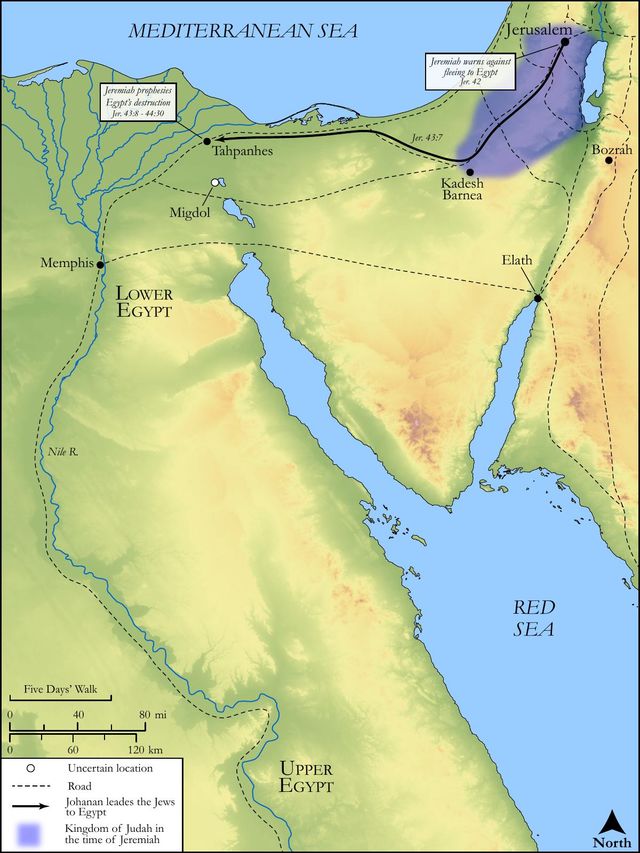
We have here, as also in the next chapter, Jeremiah prophesying in Egypt. Jeremiah was now in Tahpanhes, for there his lords and masters were; he was there among idolatrous Egyptians and treacherous Israelites; but there, 1. He received the word of the Lord; it came to him. God can find his people, with the visits of his grace, wherever they are; and, when his ministers are bound, yet the word of the Lord is not bound. The spirit of prophecy was not confined to the land of Israel. When Jeremiah went into Egypt, not out of choice, but by constraint, God withdrew not his wonted favour from him. 2. What he received of the Lord he delivered to the people. Wherever we are we must endeavour to do good, for that is our business in this world. Now we find two messages which Jeremiah was appointed and entrusted to deliver when he was in Egypt. We may suppose that he rendered what services he could to his countrymen in Egypt, at least as far as they would be acceptable, in performing the ordinary duties of a prophet, praying for them and instructing and comforting them; but only two messages of his, which he had received immediately from God, are recorded, one in this chapter, relating to Egypt itself and foretelling its destruction, the other in the next chapter, relating to the Jews in Egypt. God had told them before that if they went into Egypt the sword they feared should follow them; here he tells them further that the sword of Nebuchadnezzar, which they were in a particular manner afraid of, should follow them.
I.This is foretold by a sign.
Jeremiah must take great stones, such as are used for foundations, and lay them in the clay of the furnace, or brick-kiln, which is in the open way, or beside the way that leads to Pharaoh's house (Jer 43:9), some remarkable place in view of the royal palace. Egypt was famous for brick-kilns, witness the slavery of the Israelites there, whom they forced to make bricks (Exo 5:7), which perhaps was now remembered against them. The foundation of Egypt's desolation was laid in those brick-kilns, in that clay. This he must do, not in the sight of the Egyptians (they knew not Jeremiah's character), but in the sight of the men of Judah to whom he was sent, that, since he could not prevent their going into Egypt, he might bring them to repent of their going.
II.It is foretold in express words, as express as can be,
1.That the king, the present king of Babylon, Nebuchadnezzar, the very same that had been employed in the destruction of Jerusalem, should come in person against the land of Egypt, should make himself master even of this royal city, by the same token that he should set his throne in that very place where these stones were laid, Jer 43:10. This minute circumstance is particularly foretold, that, when it was accomplished, they might be put in mind of the prophecy and confirmed in their belief of the extent and certainly of the divine prescience, to which the smallest and most contingent events are evident. God calls Nebuchadnezzar his servant, because herein he executed God's will, accomplished his purposes, and was instrumental to carry on his designs. Note, The world's princes are God's servants and he makes what use he pleases of them, and even those that know him not, nor aim at his honour, are the tools which his providence makes use of.
2.That he should destroy many of the Egyptians, and have them all at his mercy (Jer 43:11): He shall smite the land of Egypt; and, though it has been always a warlike nation, yet none shall be able to make head against him, but whom he will he shall slay, and by what sort of death he will, whether pestilence (for that is here meant by death, as Jer 15:2) by shutting them up in places infected, or by the sword of war or justice, in cold blood or hot. And whom he will he shall save alive and carry into captivity. The Jews, by going into Egypt, brought the Chaldeans thither, and so did but ill repay those that entertained them. Those who promised to protect Israel from the king of Babylon exposed themselves to him.
3.That he shall destroy the idols of Egypt, both the temples and the images of their gods (Jer 43:12): He shall burn, the houses of the gods of Egypt, but it shall be with a fire of God's kindling; the fire of God's wrath fastens upon them, and then he burns some of them and carries others captive, Isa 46:1. Beth-shemesh, or the house of the sun, was so called from a temple there built to the sun, where at certain times there was a general meeting of the worshippers of the sun. The statues or standing images there he shall break in pieces (Jer 43:13) and carry away the rich materials of them. It intimates that he should lay all waste when even the temple and the images should not escape the fury of the victorious army. The king of Babylon was himself a great idolater and a patron of idolatry; he had his temples and images in honour of the sun as well as the Egyptians; and yet he is employed to destroy the idols of Egypt. Thus God sometimes makes one wicked man, or wicked nation, a scourge and plague to another.
4.That he shall make himself master of the land of Egypt, and none shall be able to plead its cause or avenge its quarrel (Jer 43:12): He shall array himself with the rich spoils of the land of Egypt, both beautify and fortify himself with them. He shall array himself with them as ornaments and as armour; and this, though it shall be a rich and heavy booty, being expert in war, and expeditious, he shall slip on with as much ease and in as little time, in comparison, as a shepherd slips on his garment, when he goes to turn out his sheep in a morning. And being loaded with the wealth of many other nations, the fruits of his conquests, he shall make no more of the spoils of the land of Egypt than of a shepherd's coat. And when he has taken what he pleases (as Benhadad threatened to do, Kg1 20:6) he shall go forth in peace, without any molestation given him, or any precipitation for fear of it, so effectually reduced shall the land of Egypt be. This destruction of Egypt by the king of Babylon is foretold, Eze 29:19 and Eze 30:10. Babylon lay at a great distance from Egypt, and yet thence the destruction of Egypt comes; for God can make those judgments strike home which are far-fetched.
Continue studying Jeremiah 43:12 across the web’s major study libraries — every link below opens this exact verse, chapter, or book on the destination site.
Read & Compare
 BibleGatewayThis verse in more than 200 translations and 70 languages.
 Bible.comThe YouVersion reader — hundreds of translations, reading plans, and highlights.
 ESV.orgCrossway's official English Standard Version reader.
 NET BibleThe NET translation with 60,000+ translators' notes on every rendering decision.
 STEP BibleTyndale House's free study tool — original text, vocabulary, and scholarly resources.
 BibliaLogos Bible Software's free web reader.
 USCCBThe New American Bible (Revised Edition) with the U.S. bishops' study notes.
Commentaries
 BibleHub CommentariesDozens of classic commentaries on this verse, gathered on one page.
 StudyLightMore than 100 commentary sets — the largest collection on the web.
 BibleRefPlain-English commentary on what this verse means, verse by verse.
 Enduring WordDavid Guzik's free commentary on this chapter, widely used by Bible teachers.
 Bible Study ToolsVerse commentary alongside Greek and Hebrew study aids.
Original Language & Research
- BibleHub InterlinearThe verse word by word — original language, transliteration, and English.
- BibleHub LexiconEvery word's original-language definition and Strong's entry.
 Blue Letter BibleDeep-study tools — Strong's numbers, concordance, and word studies.
 SefariaThe Hebrew text with Rashi and centuries of Jewish commentary.
Sermons, Hymns & Audio


TrulyRandomVerse is not affiliated with these sites and doesn’t control their content. They’re linked because they’re genuinely useful.
Summary
Jeremiah 43:12 powerfully declares the Lord's impending judgment upon Egypt, to be executed by King Nebuchadnezzar of Babylon. This divine decree details the destruction of Egyptian idolatry, the effortless conquest and plundering of the land by the Babylonian king, and his peaceful departure, thereby underscoring God's absolute sovereignty over all nations and the utter futility of trusting in human alliances or false gods. The prophecy serves as a stark reminder that divine will prevails, even through the actions of pagan rulers, against those who defy God's explicit commands and seek refuge outside His protective care.
Context
ShowHideLiterary Context
Jeremiah 43:12 is situated within a crucial and climactic section of the book of Jeremiah (chapters 42-44) that addresses the remnant of Judah following the devastating fall of Jerusalem in 586 BC. After the assassination of Gedaliah, the Babylonian-appointed governor, the remaining Jewish population, gripped by fear and uncertainty, sought divine guidance from Jeremiah regarding their future. Despite God's clear and explicit instruction through Jeremiah to remain in Judah and trust in His protection and provision (Jeremiah 42:10-12), the people, led by Johanan, defiantly decided to flee to Egypt, compelling Jeremiah and Baruch to accompany them (Jeremiah 43:5-7). This specific verse is part of a direct prophetic oracle delivered by Jeremiah in Tahpanhes, Egypt, immediately after he performed a symbolic act: burying large stones at the entrance of Pharaoh's palace to signify that Nebuchadnezzar would establish his throne upon these very stones (Jeremiah 43:8-10). Thus, Jeremiah 43:12 functions as a divine indictment against both Egyptian idolatry and, implicitly, the Jewish remnant's profound disobedience, demonstrating that God's judgment would relentlessly pursue them even into their chosen refuge.
Historical & Cultural Context
The historical backdrop for Jeremiah 43:12 is the tumultuous period following the destruction of Jerusalem and the definitive end of the Kingdom of Judah. Babylon, under the formidable Nebuchadnezzar II, had ascended to become the dominant superpower of its day, having decisively defeated Egypt at the Battle of Carchemish in 605 BC and subsequently conquering Assyria. Although weakened, Egypt still represented a significant regional power and a traditional, albeit unreliable, refuge for those fleeing turmoil in Canaan. For the Jewish remnant, Egypt symbolized a return to a place of perceived security, reminiscent of their ancestors' sojourn, yet it was also the land of their enslavement and a profound source of spiritual corruption and idolatry. Culturally, Egypt was renowned for its deeply entrenched polytheistic religion, featuring a vast and complex pantheon of gods and goddesses (e.g., Ra, Osiris, Isis, Amun, Seth) often represented by animal forms or human-animal hybrids, and worshipped in elaborate temples throughout the land. The prophecy of "fire in the houses of the gods of Egypt" directly targets the very core of their religious and national identity, signifying the complete humiliation, impotence, and ultimate destruction of these deities before the one true God, Yahweh. Nebuchadnezzar's subsequent invasion of Egypt, though debated in its exact timing and full extent, is widely supported by historical and archaeological evidence, reinforcing the accuracy and divine origin of Jeremiah's prophecy.
Key Themes
ShowHideThis verse powerfully contributes to several overarching themes prominently featured within the book of Jeremiah and the broader Old Testament narrative. Firstly, it highlights Divine Sovereignty, demonstrating God's absolute and unquestionable control over all nations and their rulers. Nebuchadnezzar, despite being a pagan king, is explicitly identified as God's "servant" (Jeremiah 25:9) and an unwitting instrument of divine judgment, fulfilling God's predetermined purposes even without acknowledging Him. Secondly, the passage underscores the Futility of Idolatry and the illusion of false security. The prophesied destruction of Egypt's gods signifies that idols are utterly powerless to protect their worshippers or their land, reinforcing the foundational biblical truth that "the Lord is the true God; he is the living God and the eternal King" (Jeremiah 10:10). Thirdly, the prophecy emphasizes the severe Consequences of Disobedience. The Jewish remnant's defiant flight to Egypt, directly contradicting God's explicit command, tragically leads them directly into the path of the very judgment they sought to escape, illustrating that true safety and peace are found solely in unwavering obedience to God's word, not in human strategies or worldly alliances (Proverbs 3:5-6). Finally, it speaks to the Certainty of Prophetic Fulfillment, affirming that God's declared word through His chosen prophet inevitably comes to pass, thereby affirming His faithfulness to His covenant promises and His solemn warnings.
Exposition and Analysis
ShowHideKey Word Analysis
ShowHideThis primitive root (H3341) means "to burn or set on fire," and figuratively, "to desolate." The divine declaration, "I will kindle," emphasizes the active, intentional, and destructive nature of God's judgment. It signifies that the fire is not accidental or merely a consequence of war, but a divinely initiated act of consuming wrath, meticulously targeting the very centers of Egyptian worship and national identity.
This plural form (H430), while often referring to the supreme God (especially with the definite article), here specifically denotes "gods in the ordinary sense," referring to the numerous deities of Egypt. The destruction of their "houses" (temples) signifies the utter humiliation, impotence, and powerlessness of these false gods before the one true God, Yahweh. It is a direct and definitive assault on the spiritual foundations and idolatrous practices of Egypt.
This primitive root (H5844) means "to wrap, i.e., cover, veil, cloth, or roll." In the metaphorical phrase "he shall array himself with the land of Egypt," the verb implies that Nebuchadnezzar will cover or take possession of the land as easily and completely as one puts on a garment. This conveys a powerful sense of effortless, casual, and total appropriation, suggesting a conquest achieved not through strenuous effort but with natural ease and absolute dominion.
Verse Breakdown
ShowHide"And I will kindle a fire in the houses of the gods of Egypt;"
This opening clause unequivocally declares Yahweh's direct agency and initiative in the coming judgment. The "fire" serves as a potent symbol of destructive judgment, and its specific target—"the houses of the gods of Egypt"—signifies a deliberate, theological assault on the religious and spiritual strongholds of the nation. This is not merely a military conquest but a profound theological statement: the myriad gods of Egypt are utterly powerless before the omnipotent God of Israel.
"and he shall burn them, and carry them away captives:"
This clause shifts the immediate agent of action to Nebuchadnezzar ("he"), who will serve as God's instrument to execute the divine decree. To "burn them" refers to the idols themselves and their associated temples, completing the destruction initiated by God's "kindling." To "carry them away captives" refers to the people of Egypt and likely their temple treasures and other valuable spoils, indicating the complete subjugation and plundering of the nation, much as Jerusalem was plundered by Babylon.
"and he shall array himself with the land of Egypt, as a shepherd putteth on his garment;"
This is a vivid and powerful simile that emphasizes the ease, naturalness, and completeness of Nebuchadnezzar's conquest. Just as a shepherd effortlessly puts on his cloak, taking full possession of it, Nebuchadnezzar would take possession of Egypt without significant struggle or opposition. The land would become his "garment," a potent symbol of his dominion, ownership, and casual mastery, worn completely and without contention.
"and he shall go forth from thence in peace."
This final clause indicates that Nebuchadnezzar's divinely ordained mission in Egypt would be accomplished without hindrance, challenge, or significant loss to himself or his forces. He would depart "in peace," signifying a successful, unmolested, and unthreatened withdrawal, having fully executed God's judgment and secured his spoils. This tranquil departure contrasts sharply with the turmoil and lack of peace experienced by those who disobeyed God's commands.
Literary Devices
ShowHideJeremiah 43:12 masterfully employs several potent literary devices to convey its message of divine judgment and sovereign control. The most striking is the Simile found in "as a shepherd putteth on his garment." This comparison vividly illustrates the effortless and complete nature of Nebuchadnezzar's conquest of Egypt, emphasizing that it would be as simple and natural as donning a piece of clothing, rather than a hard-fought and costly battle. This also implies a sense of casual mastery and absolute dominion over the conquered land. Furthermore, the phrase "I will kindle a fire" utilizes Anthropomorphism, attributing a human action (kindling a fire) to God, thereby highlighting His active involvement, direct initiation, and personal agency in the impending judgment. The destruction of the "houses of the gods" also employs rich Symbolism, where "fire" represents divine judgment, purification, and consuming wrath, and the "houses of the gods" symbolize the very spiritual and national identity of Egypt, which is utterly defeated and humiliated. The overall tone of the prophecy, particularly the emphasis on the ease of conquest, can be interpreted as a form of Hyperbole, exaggerating the effortlessness to underscore the inevitability, totality, and divine certainty of God's sovereign plan.
Theological and Thematic Connections
ShowHideJeremiah 43:12 profoundly illustrates the unwavering sovereignty of God over all earthly powers and His uncompromising judgment against idolatry and disobedience. It serves as a powerful testament that no nation, however mighty, can withstand the divine will, nor can any false god offer true protection or deliverance. The prophecy reveals that God uses even pagan rulers as instruments to accomplish His purposes, demonstrating His ultimate control over human history and geopolitical events. For the Jewish remnant, who deliberately sought refuge in Egypt against God's explicit command, this verse underscores the profound futility of trusting in worldly security over divine instruction, revealing that true peace and safety are found solely in unwavering obedience to the Lord. The destruction of Egyptian idols is a universal declaration of the impotence and ultimate demise of anything that usurps God's rightful place in human hearts and societies.
Reflection and Application
ShowHideJeremiah 43:12 offers profound and enduring lessons for believers today. In a world that often seeks security, comfort, and identity in wealth, power, political alliances, technological advancements, or fleeting pleasures, this passage serves as a stark reminder that true safety and lasting peace are found solely in unwavering obedience to God and absolute trust in His sovereign control. Just as the Jewish remnant foolishly fled to Egypt, seeking refuge in a place God forbade, we too can be tempted to seek solace and security in worldly solutions rather than relying on God's unfailing provision and divine guidance. The prophesied destruction of Egypt's gods serves as a timeless warning against any form of idolatry, whether it be the worship of material possessions, career success, personal comfort, social status, or even our own abilities and self-reliance. Anything that takes precedence over God in our lives effectively becomes an idol, and this verse powerfully declares that all such false gods will ultimately be exposed as powerless and brought to ruin. Therefore, our primary application must be to cultivate a deep, unwavering, and active trust in God's sovereignty, recognizing that He meticulously works all things according to His perfect will, even through seemingly chaotic or hostile circumstances. We are called to obey His Word with conviction, even when it seems counter-intuitive, difficult, or unpopular, knowing that His path alone leads to genuine peace, security, and eternal flourishing.
Questions for Reflection
ShowHideFAQ
ShowHideWho is the "he" who shall burn and carry away captives?
ShowHideThe "he" in Jeremiah 43:12 refers specifically to King Nebuchadnezzar of Babylon. God explicitly states in the preceding verses that He would bring His "servant Nebuchadnezzar" against Egypt (Jeremiah 43:10). Nebuchadnezzar was God's chosen instrument to execute divine judgment not only upon Judah but also upon other nations, including Egypt, as prophesied throughout Jeremiah and Ezekiel (Ezekiel 29:18-20).
Did Nebuchadnezzar actually invade Egypt as prophesied?
ShowHideYes, historical and archaeological evidence strongly suggests that Nebuchadnezzar did indeed invade Egypt, fulfilling Jeremiah's prophecy. While the precise details and full extent of his invasion are debated among historians, Babylonian chronicles, such as the "Nebuchadnezzar Chronicle" (BM 21946), record a significant campaign in the 37th year of Nebuchadnezzar's reign (568/567 BC) against Egypt. This historical evidence aligns remarkably well with the prophecies in Jeremiah and Ezekiel, confirming the accurate fulfillment of God's word regarding Egypt's subjugation by Babylon.
What does "he shall go forth from thence in peace" mean in the context of a devastating conquest?
ShowHideThe phrase "he shall go forth from thence in peace" does not imply that Egypt itself would experience peace or be left undisturbed. Rather, it signifies that Nebuchadnezzar would complete his divinely appointed mission in Egypt without significant opposition, loss, or hindrance to himself or his army. He would successfully achieve his objectives—destroying idols, plundering the land, and taking captives—and then depart unmolested and unthreatened. This highlights the ease and completeness of his divinely ordained victory, underscoring that his conquest was not a strenuous struggle but a casual act of possession, as vividly depicted by the "shepherd putteth on his garment" simile. It ultimately signifies the successful and unchallenged fulfillment of God's decree against Egypt.
Christ-Centered Fulfillment
ShowHideJeremiah 43:12, while a prophecy of temporal judgment against Egypt executed through Nebuchadnezzar, finds its ultimate and profound spiritual fulfillment in the person and redemptive work of Jesus Christ. The "kindling of fire in the houses of the gods of Egypt" foreshadows Christ's decisive and eternal victory over all spiritual idolatry, false gods, and the powers of darkness that hold humanity captive. Where Nebuchadnezzar physically destroyed temples and idols, Christ, through His sacrificial death and glorious resurrection, utterly disarmed the spiritual principalities and powers, triumphing over them by the cross (Colossians 2:15). He is the true and ultimate "Good Shepherd" (John 10:11) who does not merely "array himself with the land" through physical conquest, but takes possession of hearts and lives through redemptive love and the transforming power of the Holy Spirit, establishing a spiritual kingdom that is not of this world (John 18:36). The "peace" with which Nebuchadnezzar departed from Egypt, having accomplished his destructive mission, pales in comparison to the profound and lasting peace that Christ offers to those who trust in Him—a peace that surpasses all human understanding and is the glorious fruit of reconciliation with God (Philippians 4:7; Romans 5:1). Through Christ, the ultimate judgment against all forms of spiritual rebellion and false worship has been rendered, and His peaceful reign is established in the hearts of believers, leading them out of the captivity of sin into true freedom and eternal life (John 8:36).