


Jeremiah 43:11
Bible text: King James Version (1769 Blayney text) · Public domain
Bible text: King James Version with Strong's numbers · Public domain
Bible text: Berean Standard Bible · Public domain
Bible text: American Standard Version (1901) · Public domain
Bible text: World English Bible, Messianic edition · Public domain
Bible text: Geneva Bible (1599) · Public domain
Bible text: Young's Literal Translation · Public domain
- וּבָאu·va·'ah'and he will comeH935Conj-w ¦ V-Qal-ConsecPerf-3msVerb Qal Consecutive Perfect 3rd Singular Masculineוּandבָאhe will come
- וְהִכָּהve·hi·Kahand he will attackH5221Conj-w ¦ V-Hiphil-ConsecPerf-3msVerb Hiphil Consecutive Perfect 3rd Singular Masculineוְandהִכָּהhe will attack
- אֶת'et<obj.>H853DirObjMParticle Object Indicator
- אֶרֶץ'E·retz[the] land ofH776N-fscNoun Singular Feminine Construct
- מִצְרָיִםmitz·Ra·yimEgyptH4714N-properNoun Proper Location
- אֲשֶׁר'a·Sher[those] whoH834RelParticle Relative
- לַמָּוֶתla·Ma·vet[are] for <the> deathH4194Prep-l ¦ N-msNoun Singular Masculine Absoluteלַ[are] for <the>מָּוֶתdeath
- לַמָּוֶתla·Ma·vetto <the> deathH4194Prep-l ¦ N-msNoun Singular Masculine Absoluteלַto <the>מָּוֶתdeath
- וַאֲשֶׁרva·'a·Sherand [those] whoH834Conj-w ¦ RelParticle Relativeוַandאֲשֶׁר[those] who
- לַשְּׁבִיla·she·Vi[are] for <the> captivityH7628Prep-l ¦ N-msNoun Singular Masculine Absoluteלַ[are] for <the>שְּׁבִיcaptivity
- לַשֶּׁבִיla·She·vito <the> captivityH7628Prep-l ¦ N-msNoun Singular Masculine Absoluteלַto <the>שֶּׁבִיcaptivity
- וַאֲשֶׁרva·'a·Sherand [those] whoH834Conj-w ¦ RelParticle Relativeוַandאֲשֶׁר[those] who
- לַחֶרֶבla·Che·rev[are] for the swordH2719Prep-l ¦ N-fsNoun Singular Feminine Absoluteלַ[are] for theחֶרֶבsword
- לֶחָרֶבle·Cha·revto the swordH2719Prep-l ¦ N-fsNoun Singular Feminine Absoluteלֶto theחָרֶבsword
English is a literal word-by-word gloss of the Hebrew, not the KJV's wording. Why?
This is the original text the KJV's translators worked from — each Hebrew word with its own literal English meaning in this verse, prepared by scholars at Tyndale House, Cambridge. The KJV translates whole sentences, not word by word, so its wording differs: one Hebrew word can become several English words, and the KJV may choose “the LORD” where the gloss reads “Yahweh”. Both are faithful — they answer different questions. For the KJV's own rendering, switch to the KJV text.
Details
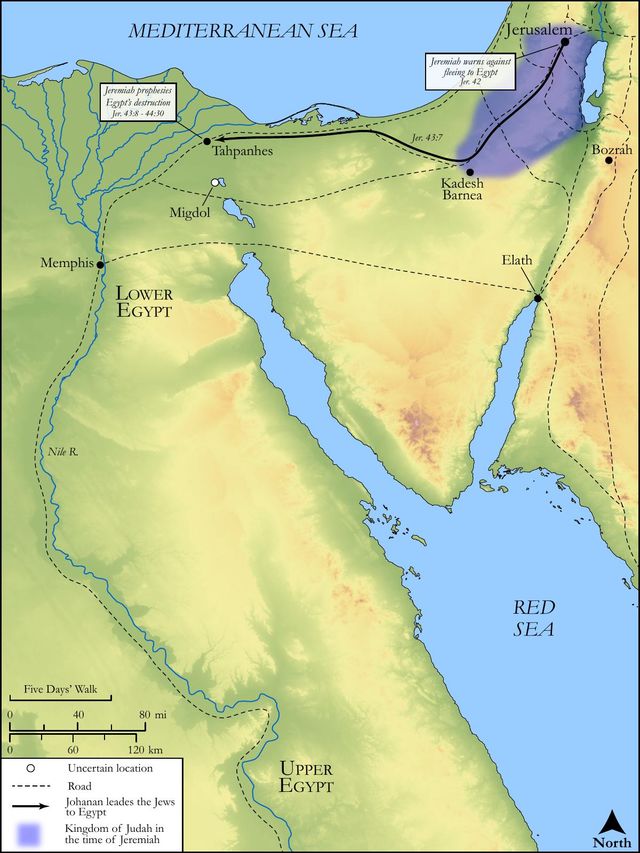
See on the biblical-era map
Study this verse
Public-domain commentary
Matthew Henry
From his Commentary on the Whole Bible. Henry comments on passages, not single verses — this entry covers Jeremiah 43:8–13. His two-level outline is real structure in the source text, so it is rendered as structure.
We have here, as also in the next chapter, Jeremiah prophesying in Egypt. Jeremiah was now in Tahpanhes, for there his lords and masters were; he was there among idolatrous Egyptians and treacherous Israelites; but there, 1. He received the word of the Lord; it came to him. God can find his people, with the visits of his grace, wherever they are; and, when his ministers are bound, yet the word of the Lord is not bound. The spirit of prophecy was not confined to the land of Israel. When Jeremiah went into Egypt, not out of choice, but by constraint, God withdrew not his wonted favour from him. 2. What he received of the Lord he delivered to the people. Wherever we are we must endeavour to do good, for that is our business in this world. Now we find two messages which Jeremiah was appointed and entrusted to deliver when he was in Egypt. We may suppose that he rendered what services he could to his countrymen in Egypt, at least as far as they would be acceptable, in performing the ordinary duties of a prophet, praying for them and instructing and comforting them; but only two messages of his, which he had received immediately from God, are recorded, one in this chapter, relating to Egypt itself and foretelling its destruction, the other in the next chapter, relating to the Jews in Egypt. God had told them before that if they went into Egypt the sword they feared should follow them; here he tells them further that the sword of Nebuchadnezzar, which they were in a particular manner afraid of, should follow them.
I.This is foretold by a sign.
Jeremiah must take great stones, such as are used for foundations, and lay them in the clay of the furnace, or brick-kiln, which is in the open way, or beside the way that leads to Pharaoh's house (Jer 43:9), some remarkable place in view of the royal palace. Egypt was famous for brick-kilns, witness the slavery of the Israelites there, whom they forced to make bricks (Exo 5:7), which perhaps was now remembered against them. The foundation of Egypt's desolation was laid in those brick-kilns, in that clay. This he must do, not in the sight of the Egyptians (they knew not Jeremiah's character), but in the sight of the men of Judah to whom he was sent, that, since he could not prevent their going into Egypt, he might bring them to repent of their going.
II.It is foretold in express words, as express as can be,
1.That the king, the present king of Babylon, Nebuchadnezzar, the very same that had been employed in the destruction of Jerusalem, should come in person against the land of Egypt, should make himself master even of this royal city, by the same token that he should set his throne in that very place where these stones were laid, Jer 43:10. This minute circumstance is particularly foretold, that, when it was accomplished, they might be put in mind of the prophecy and confirmed in their belief of the extent and certainly of the divine prescience, to which the smallest and most contingent events are evident. God calls Nebuchadnezzar his servant, because herein he executed God's will, accomplished his purposes, and was instrumental to carry on his designs. Note, The world's princes are God's servants and he makes what use he pleases of them, and even those that know him not, nor aim at his honour, are the tools which his providence makes use of.
2.That he should destroy many of the Egyptians, and have them all at his mercy (Jer 43:11): He shall smite the land of Egypt; and, though it has been always a warlike nation, yet none shall be able to make head against him, but whom he will he shall slay, and by what sort of death he will, whether pestilence (for that is here meant by death, as Jer 15:2) by shutting them up in places infected, or by the sword of war or justice, in cold blood or hot. And whom he will he shall save alive and carry into captivity. The Jews, by going into Egypt, brought the Chaldeans thither, and so did but ill repay those that entertained them. Those who promised to protect Israel from the king of Babylon exposed themselves to him.
3.That he shall destroy the idols of Egypt, both the temples and the images of their gods (Jer 43:12): He shall burn, the houses of the gods of Egypt, but it shall be with a fire of God's kindling; the fire of God's wrath fastens upon them, and then he burns some of them and carries others captive, Isa 46:1. Beth-shemesh, or the house of the sun, was so called from a temple there built to the sun, where at certain times there was a general meeting of the worshippers of the sun. The statues or standing images there he shall break in pieces (Jer 43:13) and carry away the rich materials of them. It intimates that he should lay all waste when even the temple and the images should not escape the fury of the victorious army. The king of Babylon was himself a great idolater and a patron of idolatry; he had his temples and images in honour of the sun as well as the Egyptians; and yet he is employed to destroy the idols of Egypt. Thus God sometimes makes one wicked man, or wicked nation, a scourge and plague to another.
4.That he shall make himself master of the land of Egypt, and none shall be able to plead its cause or avenge its quarrel (Jer 43:12): He shall array himself with the rich spoils of the land of Egypt, both beautify and fortify himself with them. He shall array himself with them as ornaments and as armour; and this, though it shall be a rich and heavy booty, being expert in war, and expeditious, he shall slip on with as much ease and in as little time, in comparison, as a shepherd slips on his garment, when he goes to turn out his sheep in a morning. And being loaded with the wealth of many other nations, the fruits of his conquests, he shall make no more of the spoils of the land of Egypt than of a shepherd's coat. And when he has taken what he pleases (as Benhadad threatened to do, Kg1 20:6) he shall go forth in peace, without any molestation given him, or any precipitation for fear of it, so effectually reduced shall the land of Egypt be. This destruction of Egypt by the king of Babylon is foretold, Eze 29:19 and Eze 30:10. Babylon lay at a great distance from Egypt, and yet thence the destruction of Egypt comes; for God can make those judgments strike home which are far-fetched.
Continue studying Jeremiah 43:11 across the web’s major study libraries — every link below opens this exact verse, chapter, or book on the destination site.
Read & Compare
 BibleGatewayThis verse in more than 200 translations and 70 languages.
 Bible.comThe YouVersion reader — hundreds of translations, reading plans, and highlights.
 ESV.orgCrossway's official English Standard Version reader.
 NET BibleThe NET translation with 60,000+ translators' notes on every rendering decision.
 STEP BibleTyndale House's free study tool — original text, vocabulary, and scholarly resources.
 BibliaLogos Bible Software's free web reader.
 USCCBThe New American Bible (Revised Edition) with the U.S. bishops' study notes.
Commentaries
 BibleHub CommentariesDozens of classic commentaries on this verse, gathered on one page.
 StudyLightMore than 100 commentary sets — the largest collection on the web.
 BibleRefPlain-English commentary on what this verse means, verse by verse.
 Enduring WordDavid Guzik's free commentary on this chapter, widely used by Bible teachers.
 Bible Study ToolsVerse commentary alongside Greek and Hebrew study aids.
Original Language & Research
- BibleHub InterlinearThe verse word by word — original language, transliteration, and English.
- BibleHub LexiconEvery word's original-language definition and Strong's entry.
 Blue Letter BibleDeep-study tools — Strong's numbers, concordance, and word studies.
 SefariaThe Hebrew text with Rashi and centuries of Jewish commentary.
Sermons, Hymns & Audio


TrulyRandomVerse is not affiliated with these sites and doesn’t control their content. They’re linked because they’re genuinely useful.
Summary
Jeremiah 43:11 is a stark prophetic declaration foretelling the comprehensive and inescapable judgment God would unleash upon the land of Egypt through Nebuchadnezzar, King of Babylon. It details the precise fates awaiting those within Egypt, including the disobedient Jewish remnant who had sought refuge there: some would face death, others captivity, and still others the sword. This verse powerfully underscores the absolute certainty of divine decree, the futility of attempting to evade God's sovereign will, and His ultimate control over the destinies of nations and individuals alike.
Context
ShowHideLiterary Context
This verse is strategically placed within a pivotal section of Jeremiah, immediately following the catastrophic fall of Jerusalem in 586 BC. After the assassination of Gedaliah, the Babylonian-appointed governor, a fearful remnant of Judah, including prominent military leaders and the prophet Jeremiah, found themselves at a crossroads. Jeremiah 42 records Jeremiah's fervent pleas and God's explicit command for the remnant to remain in Judah, promising divine protection and blessing if they obeyed, but warning of certain destruction by sword, famine, and pestilence if they fled to Egypt. Despite these clear divine instructions, the people, led by Johanan, defiantly rejected Jeremiah's prophecy as false and proceeded to Egypt, forcibly taking Jeremiah and Baruch with them (Jeremiah 43:4-7). Jeremiah 43:11, therefore, serves as the direct prophetic consequence of their profound disobedience, identifying Nebuchadnezzar as God's chosen instrument of judgment against Egypt, the very place they sought refuge. This highlights the inescapable nature of God's word and the tragic irony of seeking safety outside His divine will.
Historical & Cultural Context
At the time of this prophecy, Egypt, though no longer the dominant empire of its past, remained a significant regional power and a traditional sanctuary for those fleeing turmoil in Canaan. Judah had a long, often problematic, history of seeking alliances with Egypt against the rising powers of Assyria and Babylon, a practice consistently condemned by prophets like Isaiah and Jeremiah for demonstrating a lack of trust in Yahweh. The Babylonian Empire, under Nebuchadnezzar II, was the undisputed superpower, having recently devastated Jerusalem and exiled its population. For the Jewish remnant, fleeing to Egypt represented a return to a familiar, yet forbidden, source of perceived security, echoing their ancestors' bondage in Egypt. Culturally, Egypt was a polytheistic society, worshipping a vast pantheon of gods, which made it a place of spiritual defilement in the eyes of the Israelites. The prophecy of Nebuchadnezzar's invasion of Egypt, therefore, signifies not only political subjugation but also a profound divine judgment against Egypt's false gods and, by extension, against the misplaced trust of Judah's remnant in a foreign power rather than in the one true God, Yahweh.
Key Themes
ShowHideJeremiah 43:11 powerfully articulates several core themes prevalent throughout the book of Jeremiah. Foremost is the theme of Divine Sovereignty and Judgment, demonstrating God's absolute control over all nations, even powerful empires like Babylon and Egypt. Nebuchadnezzar is explicitly identified in Jeremiah 43:10 as God's "servant," an instrument for executing divine judgment, underscoring that no earthly power can thwart God's plans. Another crucial theme is the Inevitability of Prophecy's Fulfillment. The precise categorization of fates—death, captivity, sword—emphasizes that God's word, once spoken, will be fulfilled with exactitude, proving the truthfulness of Jeremiah's warnings. This ties into the theme of Consequences of Disobedience, as the remnant's flight to Egypt, a direct rejection of God's command, leads them directly into the path of the very judgment they sought to escape, illustrating the dire outcomes of trusting in human wisdom over divine instruction. The futility of seeking refuge outside of God's will is a stark lesson, mirroring earlier warnings in Jeremiah 2:36-37.
Exposition and Analysis
ShowHideKey Word Analysis
ShowHideFrom a primitive root (H5221), this verb signifies "to strike (lightly or severely, literally or figuratively)." In this prophetic context, it denotes a forceful, decisive, and destructive act of conquest and punishment. When applied to Nebuchadnezzar's invasion of Egypt, it conveys the comprehensive and devastating nature of the impending judgment, implying not merely a military victory but a thorough subjugation, infliction of suffering, and widespread devastation.
This noun (H4194) refers to "death (natural or violent)," and concretely, "the dead, their place or state (hades)." Figuratively, it can also mean "pestilence" or "ruin." In Jeremiah 43:11, its repetition emphasizes the finality and inescapability of this fate for a segment of the population. It speaks to literal mortality, likely through direct combat, famine, or disease accompanying the invasion, underscoring the severity and terminal nature of God's judgment.
Derived from a root meaning "exiled" or "captured," this noun (H7628) refers to "exile (abstractly or concretely and collectively)" or "booty." It describes the state of being taken as prisoners of war and forcibly deported from one's homeland. The repetition of "captivity to captivity" highlights the certainty and widespread nature of forced relocation, a common and devastating consequence of conquest in that day, signifying the loss of freedom, land, and identity for those who would endure it.
Verse Breakdown
ShowHide"And when he cometh, he shall smite the land of Egypt,"
This opening clause establishes the agent and the target of the impending judgment. "He" refers specifically to Nebuchadnezzar, King of Babylon, as identified in the preceding verse (Jeremiah 43:10). The verb "cometh" (H935, bôwʼ) indicates an arrival with hostile and conquering intent, while "smite" (H5221, nâkâh') signifies a decisive, destructive military action. The "land of Egypt" (H776, ʼerets and H4714, Mitsrayim) is the specific geographical and political entity destined for this divine punishment, demonstrating God's sovereign reach over even the most powerful nations.
"[and deliver] such [as are] for death to death;"
This phrase begins a tripartite declaration of specific, inescapable fates. The implied "deliver" or "appoint" indicates that Nebuchadnezzar, acting as God's instrument, would execute a preordained destiny. "Such as are for death" refers to those divinely appointed or destined for this fate, and the repetition "to death" confirms the absolute and inescapable outcome of literal mortality. This highlights the precise and certain nature of the judgment for this group, likely through direct killing in warfare or subsequent famine and pestilence.
"and such [as are] for captivity to captivity;"
Continuing the pattern, this clause specifies the second category of judgment. "Such as are for captivity" denotes those whose divine destiny is to be taken as prisoners of war and deported from their homeland. The repetition "to captivity" (H7628, shᵉbîy) underscores the certainty and comprehensive nature of this fate, emphasizing that this group would indeed be led into exile, losing their freedom, property, and national identity.
"and such [as are] for the sword to the sword."
The final clause in this series outlines the third distinct fate. "Such as are for the sword" refers to those appointed to perish by military violence. The phrase "to the sword" (H2719, chereb) confirms that their end would be violent death by weapon, likely in battle or through execution. This tripartite declaration covers the full spectrum of destructive outcomes in ancient warfare: direct killing, forced relocation, and death by battle, leaving no room for escape from God's decreed judgment.
Literary Devices
ShowHideJeremiah 43:11 masterfully employs several powerful literary devices to convey the certainty, comprehensiveness, and severity of God's impending judgment. The most prominent is Anaphora and Parallelism, evident in the striking repetition of the phrase structure: "such as are for X to X." This rhythmic and emphatic repetition of "death to death," "captivity to captivity," and "sword to the sword" creates a powerful sense of inescapable destiny and absolute finality. It underscores that each appointed fate will be fulfilled precisely, with no deviation or escape for those designated. This also functions as a form of Fair dealing, where each category of people receives their specific, preordained consequence based on divine decree. The language throughout the verse is highly Emphatic, leaving no doubt about the severity and certainty of the impending judgment. Furthermore, the entire declaration functions as a Divine Oracle, a direct and authoritative pronouncement from God through His prophet, carrying the weight of absolute truth and ensuring its inevitable fulfillment.
Theological and Thematic Connections
ShowHideJeremiah 43:11 profoundly illustrates God's absolute sovereignty over human affairs and His unyielding commitment to justice. It reveals that no nation, however powerful, is beyond His reach, and He orchestrates world events, even utilizing pagan kings like Nebuchadnezzar, as instruments of His divine will. The verse underscores the futility of human attempts to escape God's judgment through disobedience, demonstrating that seeking refuge outside of His revealed will ultimately leads to the very peril one seeks to avoid. This serves as a stark reminder that true security is found only in obedience and trust in the Lord, not in human strategies, political alliances, or self-devised solutions.
Reflection and Application
ShowHideJeremiah 43:11 stands as a timeless testament to the unwavering nature of God's word and the serious consequences of deliberate disobedience. For believers today, it serves as a powerful call to radical trust and obedience, even when God's path seems difficult, counter-intuitive, or fraught with perceived danger. In a world characterized by uncertainty, fear, and a constant search for security, we are often tempted to seek refuge in human institutions, financial stability, political systems, or worldly alliances, much like the remnant sought security in Egypt. This verse challenges us to critically examine where our ultimate trust truly lies. Do we genuinely believe that God is sovereign over all circumstances, or do we subtly rely on our own plans, wisdom, and resources? It reminds us that God's judgments, while sometimes severe, are always just and ultimately serve His redemptive purposes. Our greatest safety and most profound peace are found not in fleeing from perceived dangers into self-devised solutions, but in faithfully walking in the light of His commands, knowing that His protective hand is truly the only secure refuge and that His will is always for our ultimate good.
Questions for Reflection
ShowHideFAQ
ShowHideWho is the "he" referred to in Jeremiah 43:11 who "cometh" to smite Egypt?
ShowHideThe "he" referred to in Jeremiah 43:11 is Nebuchadnezzar, the formidable King of Babylon. This identification is explicitly made in the preceding verse, Jeremiah 43:10, where God declares, "Behold, I will send and bring Nebuchadnezzar the king of Babylon, my servant." This designation highlights a crucial theological point: God uses even pagan rulers as His instruments to execute His divine will and judgment, demonstrating His absolute sovereignty over all nations and their leaders. Nebuchadnezzar was not acting independently but as a tool in God's overarching plan for judgment and restoration.
Why did the Jewish remnant flee to Egypt despite Jeremiah's warnings?
ShowHideAfter the assassination of Gedaliah, the Babylonian-appointed governor in Judah, a fearful and traumatized remnant of the Jewish people, including prominent military leaders, decided to flee to Egypt. Their primary motivations were a deep-seated fear of further Babylonian retribution for Gedaliah's murder and a desire to escape the ongoing turmoil, famine, and perceived insecurity in Judah. They sought what they believed would be safety, provision, and stability in Egypt, a traditional place of refuge for those fleeing conflict in Canaan. However, they did so in direct and willful disobedience to God's clear command, delivered through the prophet Jeremiah. Jeremiah had warned them unequivocally that going to Egypt would lead to their destruction by the very sword, famine, and pestilence they sought to avoid, while remaining in Judah would bring God's protection (Jeremiah 42:15-17). They ultimately chose to trust in their own human wisdom, perceived security, and historical patterns rather than in God's divine guidance and promised protection.
Christ-Centered Fulfillment
ShowHideWhile Jeremiah 43:11 speaks of a temporal, earthly judgment executed by an earthly king, it profoundly foreshadows a deeper, spiritual reality found in Jesus Christ. The "he who cometh" in this passage, Nebuchadnezzar, serves as an instrument of divine judgment, bringing literal death, captivity, and the sword. However, the New Testament reveals the ultimate "He who cometh" as Jesus Christ, who comes not only as a merciful Savior but also as the righteous Judge of all the earth (John 5:22). Humanity, apart from Christ, is spiritually "for death" due to the wages of sin (Romans 6:23), "for captivity" to the power of sin and Satan (Romans 7:23), and under the "sword" of divine wrath and eternal separation from God (Hebrews 4:12). Yet, Christ, through His perfect life, atoning sacrifice on the cross, and glorious resurrection, delivers us from this spiritual death, captivity, and the sword of eternal judgment. He endured the ultimate "sword" of God's wrath, becoming a curse for us to redeem us (Galatians 3:13). He has triumphed over the powers of darkness, leading captivity captive (Ephesians 4:8), and has definitively conquered death itself, swallowing it up in victory (1 Corinthians 15:54-57). Thus, while Jeremiah 43:11 warns of inescapable earthly judgment for disobedience, Christ offers an escape from eternal judgment through faith and obedience to Him, providing the ultimate refuge and true, lasting security that no earthly power, place, or human strategy can ever offer.