


1 Samuel 5:10
Bible text: King James Version (1769 Blayney text) · Public domain
Bible text: King James Version with Strong's numbers · Public domain
Bible text: Berean Standard Bible · Public domain
Bible text: American Standard Version (1901) · Public domain
Bible text: World English Bible, Messianic edition · Public domain
Bible text: Geneva Bible (1599) · Public domain
Bible text: Young's Literal Translation · Public domain
- וַיְשַׁלְּחוּvay·sha·le·Chuand they sentH7971Conj-w ¦ V-Piel-ConsecImperf-3mpVerb Piel Consecutive Imperfect 3rd Plural Masculineוַandיְשַׁלְּחוּthey sent
- אֶת'et<obj.>H853DirObjMParticle Object Indicator
- אֲרוֹן'a·Ron[the] ark ofH727N-mscNoun Singular Masculine Construct
- הָאֱלֹהִיםha·'E·lo·Him<the> GodH430Art ¦ N-mpNoun Plural Masculine Absoluteהָ<the>אֱלֹהִיםGod
- עֶקְרוֹןek·RonEkronH6138N-properNoun Proper Location
- וַיְהִיvay·Hiand it wasH1961Conj-w ¦ V-Qal-ConsecImperf-3msVerb Qal Consecutive Imperfect 3rd Singular Masculineוַandיְהִיit was
- כְּבוֹאke·Vo'when wentH935Prep-k ¦ V-Qal-InfVerb Qal Infinitive Constructכְּwhenבוֹאwent
- אֲרוֹן'a·Ron[the] ark ofH727N-mscNoun Singular Masculine Construct
- הָאֱלֹהִיםha·'E·lo·Him<the> GodH430Art ¦ N-mpNoun Plural Masculine Absoluteהָ<the>אֱלֹהִיםGod
- עֶקְרוֹןek·RonEkronH6138N-properNoun Proper Location
- וַיִּזְעֲקוּvai·yiz·'a·Kuand they cried outH2199Conj-w ¦ V-Qal-ConsecImperf-3mpVerb Qal Consecutive Imperfect 3rd Plural Masculineוַandיִּזְעֲקוּthey cried out
- הָעֶקְרֹנִיםha·'ek·ro·Nimthe EkronitesH6139Art ¦ N-mpNoun Gentilic Plural Masculine AbsoluteהָtheעֶקְרֹנִיםEkronites
- לֵאמֹרle·Mor<to> sayingH559Prep-l ¦ V-Qal-InfVerb Qal Infinitive Constructלֵ<to>אמֹרsaying
- הֵסַבּוּhe·Sa·buthey have brought roundH5437V-Hiphil-Perf-3cpVerb Hiphil Perfect 3rd Plural common gender
- אֵלַי'e·Laito meH413Prep ¦ 1csPreposition Definiteאֵלַtoיme
- אֶת'et<obj.>H853DirObjMParticle Object Indicator
- אֲרוֹן'a·rOn[the] ark ofH727N-mscNoun Singular Masculine Construct
- אֱלֹהֵי'e·lo·Hei[the] God ofH430N-mpcNoun Plural Masculine Construct
- יִשְׂרָאֵלYis·ra·'ElIsraelH3478N-properNoun Proper Location
- לַהֲמִיתֵנִיla·ha·mi·Te·nito kill meH4191Prep-l ¦ V-Hiphil-Inf ¦ 1csVerb Hiphil Infinitive Constructלַtoהֲמִיתֵkillנִיme
- וְאֶתve·'Etand <obj.>H853Conj-w ¦ DirObjMParticle Object Indicatorוְandאֶת<obj.>
- עַמִּי'a·Mimy peopleH5971N-msc ¦ 1csNoun Singular Masculine Constructעַמִּpeopleיmy
English is a literal word-by-word gloss of the Hebrew, not the KJV's wording. Why?
This is the original text the KJV's translators worked from — each Hebrew word with its own literal English meaning in this verse, prepared by scholars at Tyndale House, Cambridge. The KJV translates whole sentences, not word by word, so its wording differs: one Hebrew word can become several English words, and the KJV may choose “the LORD” where the gloss reads “Yahweh”. Both are faithful — they answer different questions. For the KJV's own rendering, switch to the KJV text.
Details
See on the biblical-era map
Study this verse
Public-domain commentary
Matthew Henry
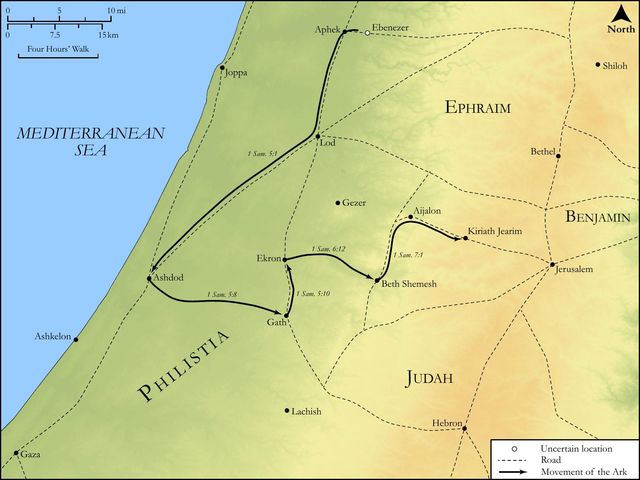
From his Commentary on the Whole Bible. Henry comments on passages, not single verses — this entry covers 1 Samuel 5:6–12.
The downfall of Dagon (if the people had made a good use of it, and had been brought by it to repent of their idolatries and to humble themselves before the God of Israel and seek his face) might have prevented the vengeance which God here proceeds to take upon them for the indignities done to his ark, and their obstinate adherence to their idol, in defiance of the plainest conviction. Lord, when thy hand is lifted up they will not see, but they shall see, Isa 26:11. And, if they will not see the glory, they shall feel the weight, of God's hand, for so the Philistines did. The hand of the Lord was heavy upon them (Sa1 5:6), and he not only convinced them of their folly, but severely chastised their insolence. 1. He destroyed them, that is, cut many of them off by sudden death, those, we may suppose, that had most triumphed in the captivity of the ark. This is distinguished from the disease with which others were smitten. At Gath it is called a great destruction (Sa1 5:9), a deadly destruction, Sa1 5:11. And it is expressly said (Sa1 5:12) that those who were smitten with the emerods were the men that died not by the other destruction, which probably was the pestilence. They boasted of the great slaughter which their sword had made among the Israelites, Sa1 4:10. But God lets them know that though he does not see fit to draw Israel's sword against them (they were unworthy to be employed), yet God had a sword of his own, with which he could make a no less dreadful execution among them, which if he whet, and his hand take hold on judgment, he will render vengeance to his enemies, Deu 32:41, Deu 32:42. Note, Those that contend with God, his ark, and his Israel, will infallibly be ruined at last. If conviction conquer not, destruction shall. 2. Those that were not destroyed he smote with emerods (Sa1 5:6), in their secret parts (Sa1 5:9), so grievous that (Sa1 5:12) the cry went up to heaven, that is, it might be heard a great way off, and perhaps, in the extremity of their pain and misery, they cried, not to Dagon, but to the God of heaven. The Psalmist, speaking of this sore judgment upon the Philistines, describes it thus: God smote his enemies in the hinder parts, and put them to a perpetual reproach, Psa 78:66. The emerods (which we call the piles, and perhaps it was then a more grievous disease than it is now) is threatened among the judgments that would be the fruit of the curse, Deu 28:27. It was both a painful and shameful disease; a vile disease for vile deserts. By it God would humble their pride, and put contempt upon them, as they had done upon his ark. The disease was epidemical, and perhaps, among them, a new disease. Ashdod was smitten, and the coasts thereof, the country round. For contempt of God's ordinances, many are weak and sick, and many sleep, Co1 11:30. 3. The men of Ashdod were soon aware that it was the hand of God, the God of Israel, Sa1 5:7. Thus they were constrained to acknowledge his power and dominion, and confess themselves within his jurisdiction, and yet they would not renounce Dagon and submit to Jehovah; but rather, now that he touched their bone and their flesh, and in a tender part, they were ready to curse him to his face, and instead of making their peace with him, and courting the stay of his ark upon better terms, they desired to get clear of it, as the Gadarenes, who, when they had lost their swine, desired Christ to depart out of their coasts. Carnal hearts, when they smart under the judgments of God, would rather, if it were possible, put him far from them than enter into covenant and communion with him, and make him their friend. Thus the men of Ashdod resolve, The ark of the God of Israel shall not abide with us. 4. It is resolved to change the place of its imprisonment. A great council was called, and the question proposed to all the lords was, "What shall be we with the ark?" And at last it was agreed that it should be carried to Gath, Sa1 5:8. Some superstitious conceit they had that the fault was in the place, and that the ark would be better pleased with another lodging, further off from Dagon's temple; and therefore, instead of returning it, as they should have done, to its own place, they contrive to send it to another place. Gath is pitched upon, a place famed for a race of giants, but their strength and stature are no fence against the pestilence and the emerods: the men of that city were smitten, both great and small (Sa1 5:9), both dwarfs and giants, all alike to God's judgments; none so great as to over-top them, none so small as to be over-looked by them. 5. They were all at last weary of the ark, and very willing to get rid of it. It was sent from Gath to Ekron, and, coming by order of council, the Ekronites could not refuse it, but were much exasperated against their great men for sending them such a fatal present (Sa1 5:10): They have sent it to us to slay us and our people. The ark had the tables of the law in it; and nothing more welcome to faithful Israelites than the word of God (to them it is a savour of life unto life), but to uncircumcised Philistines, that persist in enmity to God, nothing more dreadful nor unwelcome: to them it is a savour of death unto death. A general assembly is instantly called, to advise about sending the ark again to its place, Sa1 5:11. While they are consulting about it, the hand of God is doing execution; and their contrivances to evade the judgment do but spread it. Many drop down dead among them. Many more are raging ill of the emerods, Sa1 5:12. What shall they do? Their triumphs in the captivity of the ark are soon turned into lamentations, and they are as eager to quit it as ever they had been to seize it. Note, God can easily make Jerusalem a burdensome stone to all that heave at it, Zac 12:3. Those that fight against God will soon have enough of it, and, first or last, will be made to know that none ever hardened their hearts against him and prospered. The wealth that is got by fraud and injustice, especially that which is got by sacrilege and robbing God, though swallowed greedily, and rolled under the tongue as a sweet morsel, must be vomited up again; for, till it be, the sinner shall not feel quietness in his belly, Job 20:15-20.
Continue studying 1 Samuel 5:10 across the web’s major study libraries — every link below opens this exact verse, chapter, or book on the destination site.
Read & Compare
 BibleGatewayThis verse in more than 200 translations and 70 languages.
 Bible.comThe YouVersion reader — hundreds of translations, reading plans, and highlights.
 ESV.orgCrossway's official English Standard Version reader.
 NET BibleThe NET translation with 60,000+ translators' notes on every rendering decision.
 STEP BibleTyndale House's free study tool — original text, vocabulary, and scholarly resources.
 BibliaLogos Bible Software's free web reader.
 USCCBThe New American Bible (Revised Edition) with the U.S. bishops' study notes.
Commentaries
 BibleHub CommentariesDozens of classic commentaries on this verse, gathered on one page.
 StudyLightMore than 100 commentary sets — the largest collection on the web.
 BibleRefPlain-English commentary on what this verse means, verse by verse.
 Enduring WordDavid Guzik's free commentary on this chapter, widely used by Bible teachers.
 Bible Study ToolsVerse commentary alongside Greek and Hebrew study aids.
Original Language & Research
- BibleHub InterlinearThe verse word by word — original language, transliteration, and English.
- BibleHub LexiconEvery word's original-language definition and Strong's entry.
 Blue Letter BibleDeep-study tools — Strong's numbers, concordance, and word studies.
 SefariaThe Hebrew text with Rashi and centuries of Jewish commentary.
Sermons, Hymns & Audio


TrulyRandomVerse is not affiliated with these sites and doesn’t control their content. They’re linked because they’re genuinely useful.
Summary
1 Samuel 5:10 captures a climactic moment in the Philistines' calamitous possession of the Ark of God, as it is reluctantly transported to Ekron, the third city to endure its devastating presence. Having witnessed the divine judgments—manifested as plagues and the humiliation of their god Dagon—in Ashdod and Gath, the Ekronites immediately recognize the Ark not as a mere war trophy, but as a direct instrument of the God of Israel's wrath. Their terrified outcry upon its arrival underscores their profound fear for their lives and the very existence of their community, dramatically highlighting the Philistines' dawning, albeit fearful, realization of Yahweh's uncontainable power and severe holiness.
Context
ShowHideLiterary Context
This verse is a crucial turning point within the broader narrative of the Ark's capture and its subsequent journey through Philistine territory, a story arc that spans 1 Samuel 4 through 1 Samuel 7. Following Israel's defeat and the Ark's capture in 1 Samuel 4:11, the Philistines brought it to Ashdod, where it caused the repeated collapse of Dagon's idol and inflicted a severe plague of tumors upon the inhabitants (1 Samuel 5:1-6). Consequently, the Ark was moved to Gath, where similar plagues and "very great destruction" ensued (1 Samuel 5:7-9). By the time the Ark reaches Ekron in 1 Samuel 5:10, its reputation for divine judgment precedes it, leading to the Ekronites' desperate plea for its removal in 1 Samuel 5:11-12. This sequential movement and escalating fear build narrative tension, emphasizing the inescapable nature of God's judgment.
Historical & Cultural Context
The Philistines were a formidable "Sea Peoples" group who settled in the fertile southwestern coastal plain of Canaan, establishing a powerful pentapolis of city-states: Ashdod, Gaza, Ashkelon, Gath, and Ekron. They posed a significant military and cultural threat to the nascent Israelite nation during the period of the Judges and early monarchy. Their polytheistic religion centered on deities such as Dagon, often depicted as a fish-god or grain-god, and Baal-zebub, associated with Ekron. For the Philistines, capturing an enemy's sacred object or deity was a common practice, symbolizing the defeat of that god and the supremacy of their own. The Ark of the Covenant, for Israel, was the holiest object, representing God's throne, His active presence, and the tangible sign of His covenant with His people. The Philistines' initial placement of the Ark in Dagon's temple was an act of triumphal subjugation, a declaration of Dagon's superiority. However, the subsequent events dramatically subverted their understanding of divine power and territorial gods, demonstrating the unique, uncontainable sovereignty of the God of Israel, who could not be confined or manipulated like their pagan idols.
Key Themes
ShowHideThis passage powerfully illustrates several profound theological themes. Firstly, it highlights the uncontainable holiness and sovereignty of God, demonstrating that the God of Israel cannot be confined, manipulated, or dishonored, even by pagan nations. His presence, symbolized by the Ark, brings judgment upon those who oppose Him or treat His sacred things with contempt, regardless of their belief system or geographical location (Psalm 99:1). Secondly, it underscores the theme of divine judgment on idolatry and rebellion. The plagues inflicted upon the Philistine cities serve as undeniable proof of the supremacy of Yahweh over their false gods, specifically Dagon, who is repeatedly humiliated before the Ark (1 Samuel 5:3-4). Finally, the Ekronites' outcry reveals a profound, albeit reluctant, acknowledgment of God's power, driven by terror rather than genuine reverence. Their recognition of "the God of Israel" as the source of their affliction signifies a forced confession of His unique and potent identity, emphasizing His transcendent power over all other gods, even to those who are His enemies (Exodus 12:12).
Exposition and Analysis
ShowHideKey Word Analysis
ShowHideThis term refers to the Ark of the Covenant, the most sacred object in Israelite worship. According to the provided Strong's data, it denotes "a box; ark, chest, coffin." In this context, it is the gold-covered wooden chest containing the tablets of the Law, Aaron's rod, and a pot of manna, surmounted by the mercy seat and cherubim. It symbolized the very presence of God among His people, His throne, and the place where He met with them. Its capture by the Philistines was a profound theological crisis for Israel, but its subsequent journey among the Philistines powerfully demonstrated that God's presence and power were not bound by the Ark's physical location or human control.
This specific designation is crucial. The term ʼĕlôhîym (H430) refers to "God (gods) (-dess, -ly)" and can denote the supreme God. Yisrâʼêl (H3478) means "he will rule as God; Jisrael, a symbolical name of Jacob; also (typically) of his posterity; Israel." Combined, "God of Israel" emphasizes Yahweh's unique identity and His covenant relationship with Israel, distinguishing Him sharply from the Philistine deities like Dagon. Even in their distress, the Philistines acknowledge Him by His specific national designation, recognizing His unique and potent identity as the source of their affliction, rather than attributing the plagues to a generic "god" or a random misfortune. This forced acknowledgment highlights God's self-revelation even to His enemies.
Derived from the primitive root mûwth (H4191), meaning "to die (literally or figuratively); causatively, to kill." The Ekronites' use of this word reveals the extreme terror and direct threat they perceived. It's not just sickness or discomfort; they believe the Ark's presence is a direct, intentional act of God designed to bring about their literal death and the destruction of their entire community. This hyperbole underscores the severity of the plagues and their desperate fear, indicating a perceived existential threat to their very existence.
Verse Breakdown
ShowHide"Therefore they sent the ark of God to Ekron."
This phrase indicates the culmination of the Philistines' desperate attempts to rid themselves of the Ark's devastating presence. After its disastrous effects in Ashdod and Gath, the Philistine lords, in their desperation, decided to transfer the Ark to Ekron, hoping to escape the divine judgment that had afflicted the previous cities. This decision implies a collective, strategic move, yet one born of fear and a lack of understanding regarding the true nature of the God whose presence they were trying to evade.
"And it came to pass, as the ark of God came to Ekron, that the Ekronites cried out, saying,"
This describes the immediate and visceral reaction of the Ekronite populace upon the Ark's arrival. The phrase "cried out" (Hebrew, wayyizʿăqû from H2199 zâʻaq - "to shriek (from anguish or danger)") signifies a loud, desperate cry, indicative of panic, alarm, and profound distress. Unlike the initial curiosity or triumphalism in Ashdod, the Ekronites were already acutely aware of the Ark's destructive reputation, leading to an immediate and overwhelming sense of dread that erupted into a public lament.
"They have brought about the ark of the God of Israel to us, to slay us and our people."
This is the core of the Ekronites' terrified outcry, expressed through the verb "brought about" (Hebrew, hēsabbû from H5437 çâbab - "to revolve, surround, or border; used in various applications, literally and figuratively; bring"). Their words reveal several key insights: (1) They correctly identify the object as "the ark of the God of Israel," demonstrating their awareness of its origin and the specific deity it represents. (2) They explicitly link the Ark's arrival to a direct, intentional threat: "to slay us and our people." This illustrates their understanding that the plagues were not random but a targeted act of divine judgment, and they feared the same fate that had befallen Ashdod and Gath, anticipating widespread death. Their fear is not merely for individuals but for the entire community (Hebrew, ʻam H5971 - "a people (as a congregated unit)"), highlighting the collective nature of the perceived existential threat.
Literary Devices
ShowHideThe passage employs several potent literary devices to convey its message. Irony is profoundly prominent, as the Philistines, who captured the Ark as a trophy of war and a symbol of their victory over Israel, are now desperately trying to get rid of it, finding it to be a source of divine judgment and torment rather than a testament to their triumph. The very object meant to signify their subjugation of Israel's God becomes the instrument of their own suffering and humiliation. The Ekronites' outcry also contains hyperbole, "to slay us and our people," expressing their extreme fear and the perceived existential threat to their entire population, even if not every individual would literally die. This exaggerated language effectively conveys the profound terror and despair gripping the city. Furthermore, the narrative uses foreshadowing, as the Ekronites' immediate and accurate assessment of the Ark's destructive power foreshadows the continued plagues and the ultimate decision by the Philistine lords to return the Ark to Israel, highlighting the inevitable triumph of God's sovereignty over all human and pagan opposition.
Theological and Thematic Connections
ShowHideThe events surrounding the Ark in Philistia, culminating in the Ekronites' terrified outcry, profoundly underscore the uncontainable nature of God's holiness and His absolute sovereignty over all creation, including pagan nations and their deities. The Philistines' experience demonstrates that God's power is not limited by geographical boundaries or human understanding; He is not merely a tribal deity but the supreme God whose presence demands reverence and whose judgment falls upon those who defy Him or desecrate what is holy. This narrative serves as a powerful reminder that God defends His own honor and name, even when His own people are unfaithful, and that true power belongs to Him alone, far surpassing any false god or human might.
Reflection and Application
ShowHideThe Ekronites' desperate cry in 1 Samuel 5:10 serves as a stark reminder that even those who do not know or worship God can be confronted with the undeniable reality of His power and holiness. Their fear, born of self-preservation rather than genuine reverence, highlights a fundamental truth: God's character demands respect, and there are severe consequences for treating Him or His sacred things lightly. While we no longer have a physical Ark, the spiritual principle remains: God's presence, His Word, and His Church are not to be trifled with. For believers, this passage calls us to a deeper understanding of God's awesome majesty, prompting us to cultivate genuine reverence and worship, not out of a servile fear of punishment, but out of a profound awe for His character and a desire to honor Him in all things. For those who do not yet know Him, it stands as a testament to His inescapable reality and the ultimate futility of resisting His sovereign will, inviting them to turn from fear to saving faith.
Questions for Reflection
ShowHideFAQ
ShowHideWhy did the Philistines keep moving the Ark instead of just getting rid of it immediately?
ShowHideThe narrative suggests a complex interplay of factors. Initially, after capturing the Ark, the Philistines likely viewed it as a powerful war trophy, signifying the defeat of Israel's God and the supremacy of their own deity, Dagon. Placing it in Dagon's temple in Ashdod was an act of triumphal subjugation. When plagues struck Ashdod, they didn't immediately discard it, perhaps hoping to contain its power or transfer the problem to another city within their pentapolis, believing that moving it might alleviate the curse. There might also have been a cultural belief that simply destroying or abandoning a powerful divine object could incur even greater wrath or that it might still possess some beneficial power if properly managed. They were attempting to manage a supernatural problem they did not understand, leading to a series of desperate transfers rather than an immediate, definitive solution, until the cumulative effect of the plagues forced a more radical decision as seen in 1 Samuel 5:11-12.
Christ-Centered Fulfillment
ShowHideThe terrifying journey of the Ark of God through Philistine territory, culminating in the Ekronites' cry of dread, powerfully foreshadows the ultimate confrontation between God's unblemished holiness and human sin, a confrontation uniquely resolved in the person and work of Jesus Christ. The Ark, representing God's awesome presence and His throne, brought judgment and death to those who treated it irreverently; similarly, the unblemished holiness of God, when encountered by sinful humanity, justly brings condemnation and spiritual death (Romans 6:23). However, unlike the Ark, which could only bring judgment to the Philistines, Jesus Christ, the true embodiment of God's presence—"God with us," Immanuel (Matthew 1:23)—came into the world not to condemn it, but to save it (John 3:17). He became the ultimate "Ark" of God's presence, bearing the full weight of God's righteous wrath against sin on the cross, so that those who believe in Him might escape the judgment that sin justly deserves (2 Corinthians 5:21). The Philistines desperately sought to remove the Ark to save themselves; humanity, in its sin, needed God Himself to provide the means of salvation, found only in the Lamb of God who takes away the sin of the world (John 1:29). Thus, the fear of death brought by the Ark finds its redemptive answer in Christ, who conquered death and offers eternal life to all who turn to Him in faith (Hebrews 2:14-15).