


Joshua 15:45
Bible text: King James Version (1769 Blayney text) · Public domain
Bible text: Berean Standard Bible · Public domain
Bible text: American Standard Version (1901) · Public domain
Bible text: World English Bible, Messianic edition · Public domain
Bible text: Geneva Bible (1599) · Public domain
Bible text: Young's Literal Translation · Public domain
- עֶקְרוֹןek·RonEkronH6138N-properNoun Proper Location
- וּבְנֹתֶיהָu·ve·no·Tei·haand its daughtersH1323Conj-w ¦ N-fpc ¦ 3fsNoun Plural Feminine Constructוּandבְנֹתֶיdaughtersהָits
- וַחֲצֵרֶיהָva·cha·tze·Rei·haand its villagesH2691Conj-w ¦ N-mpc ¦ 3fsNoun Plural Masculine Constructוַandחֲצֵרֶיvillagesהָits
English is a literal word-by-word gloss of the Hebrew, not the KJV's wording. Why?
This is the original text the KJV's translators worked from — each Hebrew word with its own literal English meaning in this verse, prepared by scholars at Tyndale House, Cambridge. The KJV translates whole sentences, not word by word, so its wording differs: one Hebrew word can become several English words, and the KJV may choose “the LORD” where the gloss reads “Yahweh”. Both are faithful — they answer different questions. For the KJV's own rendering, switch to the KJV text.
Details
See on the biblical-era maps
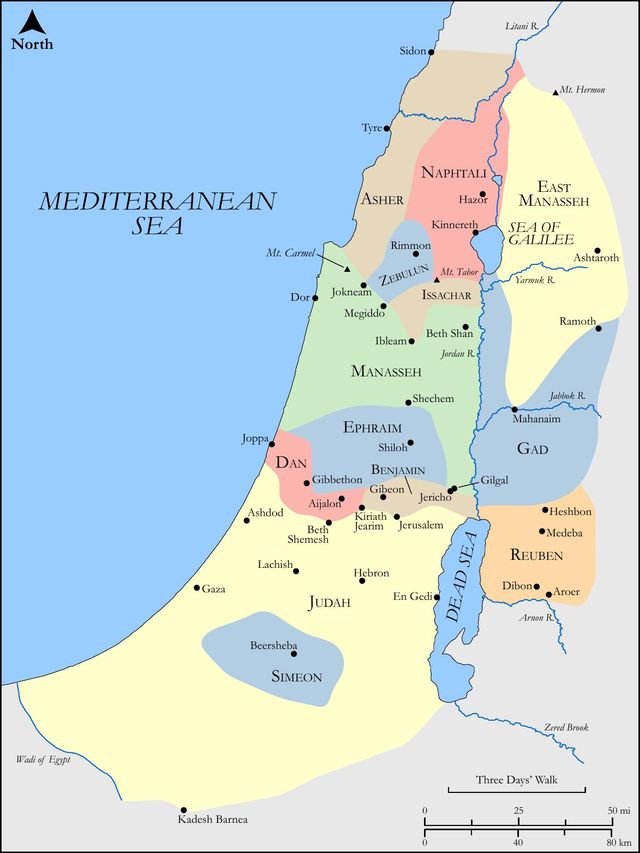
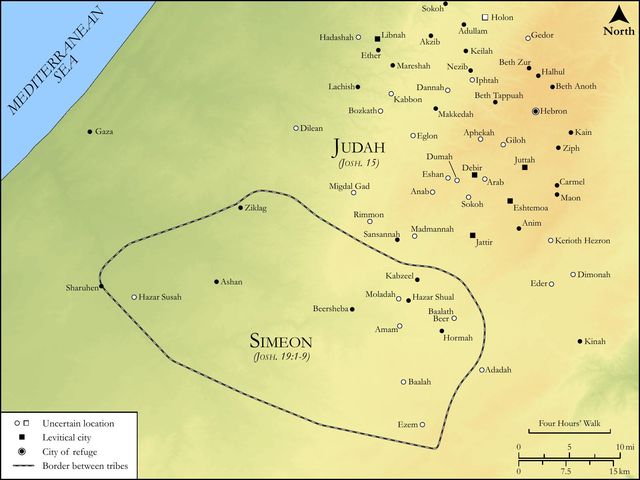
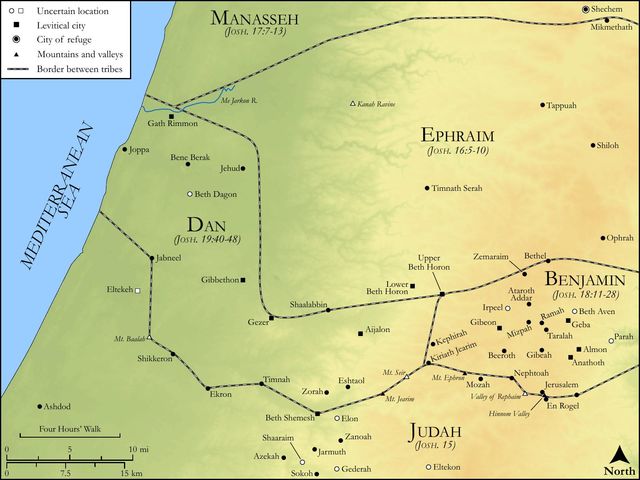
Study this verse
Public-domain commentary
Matthew Henry
From his Commentary on the Whole Bible. Henry comments on passages, not single verses — this entry covers Joshua 15:20–63. His two-level outline is real structure in the source text, so it is rendered as structure.
We have here a list of the several cities that fell within the lot of the tribe of Judah, which are mentioned by name, that they might know their own, and both keep it and keep to it, and might neither through cowardice nor sloth lose the possession of what was their own.
I.The cities are here named, and numbered in several classes, which they then could account for the reason of better than we can now. Here are,
1.Some that are said to be the uttermost cities towards the coast of Edom, Jos 15:21-32. Here are thirty-eight named, and yet said to be twenty-nine (Jos 15:32), because nine of these were afterwards transferred to the lot of Simeon, and are reckoned as belonging to that, as appears by comparing Jos 19:2, etc.; therefore those only are counted (though the rest are named) which remained to Judah.
2.Others that are said to be in the valley (Jos 15:33) are counted to be fourteen, yet fifteen are named; but it is probable that Gederah and Gederathaim were either two names or two parts of one and the same city.
3.Then sixteen are named without any head of distinction, Jos 15:37-41, and nine more, Jos 15:42-44.
4.Then the three Philistine-cities, Ekron, Ashdod, and Gaza, Jos 15:45-47.
5.Cities in the mountains, eleven in all (Jos 15:48-51), nine more (Jos 15:52-54), ten more (Jos 15:55-57), six more (Jos 15:58, Jos 15:59), then two (Jos 15:60), and six in the wilderness, a part of the country not so thick of inhabitants as some others were.
II.Now here,
1.We do not find Bethlehem, which was afterwards the city of David, and was ennobled by the birth of our Lord Jesus in it. But that city, which at the best was but little among the thousands of Judah (Mic 5:2), except that it was thus dignified, was now so little as not to be accounted one of the cities, but perhaps was one of the villages not named. Christ came to give honour to the places he was related to, not to receive honour from them.
2.Jerusalem is said to continue in the hands of the Jebusites (Jos 15:63), for the children of Judah could not drive them out, through their sluggishness, stupidity, and unbelief. Had they attempted it with vigour and resolution, we have reason to think God would not have been wanting to them to give them success; but they could not do it, because they would not. Jerusalem was afterwards to be the holy city, the royal city, the city of the great King, the brightest ornament of all the land of Israel. God has designed it should be so. It may therefore be justly looked upon as a punishment of their neglect to conquer other cities which God had given them that they were so long kept out of this.
3.Among the cities of Judah (in all 114) we meet with Libnah, which in Joram's days revolted, and probably set up for a free independent state (Kg2 8:22), and Lachish, where king Amaziah was slain (Kg1 14:19); it led the dance in idolatry (Mic 1:13); it was the beginning of sin to the daughter of Zion. Giloh, Ahithophel's town, is here mentioned, and Tekoa, of which the prophet Amos was, and near which Jehoshaphat obtained that glorious victory, Ch2 20:20, etc., and Maresha, where Asa was a conqueror. Many of the cities of this tribe occur in the history of David's troubles. Adullam, Ziph, Keilah, Maon, Engedi, Ziklag, here reckoned in this tribe, were places near which David had most of his haunts; for, though sometimes Saul drove him out from the inheritance of the Lord, yet he kept as close to it as he could. The wilderness of Judah he frequented much, and in it John Baptist preached, and there the kingdom of heaven commenced, Mat 3:1. The riches of this country no doubt answered Jacob's blessing of this tribe, that he should wash his garments in wine, Gen 49:11. And, in general, Judah, thou art he whom thy brethren shall praise, not envy.
Continue studying Joshua 15:45 across the web’s major study libraries — every link below opens this exact verse, chapter, or book on the destination site.
Read & Compare
 BibleGatewayThis verse in more than 200 translations and 70 languages.
 Bible.comThe YouVersion reader — hundreds of translations, reading plans, and highlights.
 ESV.orgCrossway's official English Standard Version reader.
 NET BibleThe NET translation with 60,000+ translators' notes on every rendering decision.
 STEP BibleTyndale House's free study tool — original text, vocabulary, and scholarly resources.
 BibliaLogos Bible Software's free web reader.
 USCCBThe New American Bible (Revised Edition) with the U.S. bishops' study notes.
Commentaries
 BibleHub CommentariesDozens of classic commentaries on this verse, gathered on one page.
 StudyLightMore than 100 commentary sets — the largest collection on the web.
 BibleRefPlain-English commentary on what this verse means, verse by verse.
 Enduring WordDavid Guzik's free commentary on this chapter, widely used by Bible teachers.
 Bible Study ToolsVerse commentary alongside Greek and Hebrew study aids.
Original Language & Research
- BibleHub InterlinearThe verse word by word — original language, transliteration, and English.
- BibleHub LexiconEvery word's original-language definition and Strong's entry.
 Blue Letter BibleDeep-study tools — Strong's numbers, concordance, and word studies.
 SefariaThe Hebrew text with Rashi and centuries of Jewish commentary.
Sermons, Hymns & Audio


TrulyRandomVerse is not affiliated with these sites and doesn’t control their content. They’re linked because they’re genuinely useful.
Summary
Joshua 15:45 precisely delineates Ekron, along with its dependent towns and villages, as an integral part of the tribal inheritance granted to Judah. This seemingly straightforward geographical listing carries profound theological weight, underscoring God's unwavering faithfulness in fulfilling His ancient covenant promises of land to Israel. Simultaneously, it subtly introduces the enduring challenge Judah would face in fully possessing their divinely appointed territory, particularly concerning the formidable Philistine strongholds.
Context
ShowHideLiterary Context
Joshua chapter 15 meticulously details the vast and significant territory allocated to the tribe of Judah, the largest and most prominent of the Israelite tribes. Following the general land distribution outlined in Joshua 13-14, this chapter provides precise boundary descriptions and an exhaustive catalog of cities, organized by geographical region (south, Shephelah/lowlands, hill country, wilderness, and Negev). Joshua 15:45 is situated within the section describing the cities of the Shephelah, a fertile western lowland region bordering the Philistine plain. The highly detailed nature of this list functions as a crucial legal and theological document, affirming the divine precision and faithfulness in the fulfillment of God's promise to provide a land for His people. The inclusion of cities like Ekron, which were well-known Philistine strongholds, within Judah's inheritance establishes a significant tension between the divine grant and the practical reality of the ongoing conquest, setting the stage for future conflicts.
Historical & Cultural Context
During the period of the Israelite conquest, the Philistines were a powerful and technologically advanced people group who inhabited the fertile coastal plain of Canaan. They were organized into a formidable "pentapolis" of five major city-states: Gaza, Ashkelon, Ashdod, Gath, and Ekron. These cities were not only strategically vital but also heavily fortified, presenting a substantial military challenge to the nascent Israelite nation. While God had unequivocally promised the entire land of Canaan to Israel, the Philistines, along with other indigenous groups, were not immediately dispossessed. This meant that the Israelites, and specifically the tribe of Judah, would be compelled to contend with these powerful neighbors for centuries to come. The designation of Ekron as part of Judah's inheritance therefore represents a divine claim over territory that, in practice, remained largely under Philistine control for a considerable period, leading to numerous and often bloody conflicts throughout the periods of the Judges and the Monarchy.
Key Themes
ShowHideThis verse, embedded within its broader chapter, contributes significantly to several foundational biblical themes. Firstly, it powerfully illustrates the theme of Divine Provision and Inheritance, showcasing God's meticulous and faithful fulfillment of His ancient covenant promises to Abraham regarding the land of Canaan, as initially articulated in passages like Genesis 12:7. Secondly, it introduces the critical theme of The Challenge of Unconquered Territory. While God had sovereignly granted the land, the Israelites were simultaneously responsible for actively dispossessing its current inhabitants. The inclusion of Ekron, a formidable Philistine stronghold, within Judah's assigned territory starkly highlights the persistent gap between divine promise and human possession. This incomplete conquest of key areas like Ekron would become a recurring source of trouble, a test of Israel's obedience, and a demonstration of their spiritual shortcomings, as vividly depicted in the narratives of the Book of Judges, particularly in Judges 1:19, and later historical accounts, such as the journey of the Ark of the Covenant through Philistine cities, including Ekron in 1 Samuel 5:10.
Exposition and Analysis
ShowHideKey Word Analysis
ShowHideThis prominent Philistine city's name (H6138) is derived from a root meaning "eradication" or "uprooting." While in Joshua 15:45 its primary significance is geographical, this etymological root foreshadows later prophetic pronouncements against Ekron, such as those found in Amos 1:8 and Zephaniah 2:4, which foretell its eventual desolation or complete uprooting. This linguistic detail subtly hints at the city's ultimate fate, even as it is initially listed as a divinely granted inheritance.
The word bath (H1323), literally meaning "daughter," is used idiomatically here to refer to the satellite communities or dependent settlements associated with a major city. These "daughters" were typically the larger, more significant communities that relied on the central city for defense, administration, and commerce. Their inclusion signifies that Judah's inheritance extended beyond the immediate walls of Ekron to its wider sphere of influence.
The term châtsêr (H2691) refers to a "yard" or "enclosed space," and by extension, a "hamlet" or "village." These were generally smaller, often unfortified agricultural outposts or encampments that surrounded and supported the main city. Their mention alongside "towns" emphasizes the comprehensive nature of the land grant, encompassing not just the urban center but its entire agricultural and economic hinterland, ensuring a fully functional and self-sustaining region for the tribe of Judah.
Verse Breakdown
ShowHide"Ekron"
This clause precisely identifies Ekron, one of the five major Philistine city-states, as a specific component of the territory assigned to the tribe of Judah. Its inclusion here is a declaration of God's sovereign claim over this strategically vital region, despite its current occupation by a powerful and hostile foreign entity.
"with her towns and her villages"
This phrase expands the scope of the inheritance beyond the fortified city of Ekron itself to encompass its entire surrounding territory. It signifies that the divine allocation included all the satellite communities, agricultural lands, and natural resources associated with the city. This detail underscores the comprehensive and generous nature of God's provision, granting Judah not merely a city, but a complete and viable region, even if the full possession of it would require sustained effort and faith.
Literary Devices
ShowHideJoshua 15:45, situated within the broader context of the chapter, employs several significant literary devices. The most overarching device is Catalog or Enumeration, as the entire chapter is a meticulous listing of cities and geographical boundaries. This detailed enumeration serves to underscore the legal and theological precision of God's land distribution, thereby affirming His unwavering faithfulness to His covenant promises. Furthermore, the mention of "Ekron" can be understood as a form of Synecdoche or Metonymy, where the name of the central city represents its entire sphere of influence, including all its dependent settlements and surrounding territory. More profoundly, the inclusion of Ekron, a known Philistine stronghold that notoriously remained unconquered by Israel for centuries, creates a subtle yet potent Irony and Foreshadowing. It is ironic that a city explicitly listed as an inheritance would remain outside Israelite control for such an extended period, and this situation powerfully foreshadows the recurring conflicts, the theme of incomplete obedience, and the consequences of Israel's spiritual compromises that would plague the nation throughout the period of the Judges and beyond.
Theological and Thematic Connections
ShowHideThe listing of Ekron as part of Judah's inheritance, despite its continued Philistine occupation, profoundly illustrates the inherent tension between divine promise and human responsibility. God's declaration of ownership is absolute and sovereign, yet its full realization in the earthly realm often depends on human faith, obedience, and active engagement. This dynamic reveals that while God provides the victory and the inheritance, His people are simultaneously called to "possess" it through diligent effort and unwavering reliance on His strength. The "Ekron" in Judah's allotted territory serves as a powerful metaphor for those areas of life or spiritual battles where God has already granted definitive victory and dominion, but where the full experience of that victory requires ongoing spiritual warfare and persistent perseverance. It is a vital reminder that God's gifts are not passive endowments but active callings to engagement, demanding our participation in His redemptive purposes.
Reflection and Application
ShowHideFor the believer today, Joshua 15:45 offers a profound and practical metaphor for our spiritual inheritance in Christ and the ongoing journey of sanctification. Just as God meticulously allocated specific territory to Judah, He has, in Christ, blessed us with "every spiritual blessing in the heavenly places," granting us decisive victory over sin, death, and the powers of darkness. However, much like Judah with Ekron, we often find that certain "territories" in our lives—areas of persistent struggle, unyielded habits, unaddressed sins, or unredeemed aspects of our character—remain under the lingering influence of the "Philistines" of our fallen nature, the world's allure, or spiritual opposition. This verse serves as a compelling call to actively "possess" what God has already given us by divine right. It challenges us to identify those "Ekrons" in our personal lives, to refuse to tolerate their continued dominion, and to courageously engage in the spiritual battle through fervent prayer, sincere repentance, steadfast obedience to God's Word, and unwavering reliance on the empowering presence of the Holy Spirit. Our spiritual inheritance is not merely a legal declaration of our standing in Christ but an active calling to live out the reality of Christ's victory in every facet of our being, demonstrating the transformative power of God's grace to a watching world.
Questions for Reflection
ShowHideFAQ
ShowHideWhy was Ekron listed as Judah's inheritance if they didn't fully conquer it?
ShowHideThe listing of Ekron as part of Judah's inheritance signifies God's divine decree and sovereign claim over the entire land of Canaan, including regions occupied by powerful enemies like the Philistines. It was a clear declaration of what belonged to Judah by divine right, regardless of the immediate military reality on the ground. While God promised the land, He also explicitly commanded Israel to drive out its inhabitants (e.g., Numbers 33:52). The fact that Ekron remained a Philistine stronghold for centuries highlights the persistent gap between God's perfect provision and Israel's incomplete obedience, lack of faith, or strategic failures. It served as a constant reminder of their failure to fully possess what God had given them and became a recurring source of conflict and spiritual compromise, as seen throughout the Book of Judges and 1 Samuel.
What was the significance of Ekron later in Israelite history?
ShowHideEkron remained one of the five major Philistine city-states and a frequent antagonist to Israel for centuries. It played a significant role in several key biblical narratives. Most notably, after the Philistines captured the Ark of the Covenant, it was transported through their cities, eventually arriving in Ekron in 1 Samuel 5:10. The people of Ekron suffered greatly from divine judgment in the form of tumors and widespread panic due to the Ark's presence, ultimately leading them to return it to Israel. Later, Ekron is mentioned as the city where King Ahaziah of Israel sent messengers to inquire of Baal-Zebub, the god of Ekron, about his recovery from an injury, drawing the severe condemnation of the prophet Elijah (see 2 Kings 1:2-16). Prophets like Amos and Zephaniah also pronounced divine judgment against Ekron, foretelling its eventual destruction and desolation (e.g., Amos 1:8; Zephaniah 2:4), which eventually came to pass in later historical periods.
Christ-Centered Fulfillment
ShowHideJoshua 15:45, with its depiction of a promised inheritance yet to be fully possessed, finds its profound Christ-centered fulfillment in the New Covenant. In Christ, believers receive a far greater and more perfect inheritance—not merely a physical land, but "every spiritual blessing in the heavenly places" (Ephesians 1:3). Jesus, the true and greater Joshua, has already secured definitive victory over sin, death, and the spiritual powers that once held humanity captive, triumphing over them decisively on the cross (Colossians 2:15). While our salvation and spiritual inheritance are fully accomplished in Him, the "Ekrons" of our lives represent the ongoing, progressive process of sanctification. We are called not to earn our salvation, but to actively "put off your old self, which belongs to your former manner of life... and to put on the new self, created after the likeness of God in true righteousness and holiness" (Ephesians 4:22-24). This is about actively walking in the victory Christ has already won, bringing every thought, habit, and area of our lives under His loving dominion. Through the indwelling power of the Holy Spirit, we are empowered to be "more than conquerors through him who loved us" (Romans 8:37), enabled to live out the reality of our spiritual inheritance, transforming the "unconquered territories" of our hearts into places where Christ reigns supreme.