


Joshua 15:46
Bible text: King James Version (1769 Blayney text) · Public domain
Bible text: Berean Standard Bible · Public domain
Bible text: American Standard Version (1901) · Public domain
Bible text: World English Bible, Messianic edition · Public domain
Bible text: Geneva Bible (1599) · Public domain
Bible text: Young's Literal Translation · Public domain
- מֵעֶקְרוֹןme·'ek·Ronfrom EkronH6138Prep-m ¦ N-properNoun Proper LocationמֵfromעֶקְרוֹןEkron
- וָיָמָּהva·Ya·mahand west -wardH3220Conj-w ¦ N-ms ¦ SfxNoun Singular Masculine Absoluteוָandיָמָּwestה-ward
- כֹּלkolallH3605N-msNoun Singular Masculine Absolute
- אֲשֶׁר'a·SherthatH834RelParticle Relative
- עַל'al[is] onH5921PrepPreposition
- יַדyad[the] hand ofH3027N-cscNoun Singular common gender Construct
- אַשְׁדּוֹד'ash·DodAshdodH795N-properNoun Proper Location
- וְחַצְרֵיהֶןve·chatz·rei·Henand their villagesH2691Conj-w ¦ N-mpc ¦ 3fpNoun Plural Masculine Constructוְandחַצְרֵיvillagesהֶןtheir
English is a literal word-by-word gloss of the Hebrew, not the KJV's wording. Why?
This is the original text the KJV's translators worked from — each Hebrew word with its own literal English meaning in this verse, prepared by scholars at Tyndale House, Cambridge. The KJV translates whole sentences, not word by word, so its wording differs: one Hebrew word can become several English words, and the KJV may choose “the LORD” where the gloss reads “Yahweh”. Both are faithful — they answer different questions. For the KJV's own rendering, switch to the KJV text.
Details
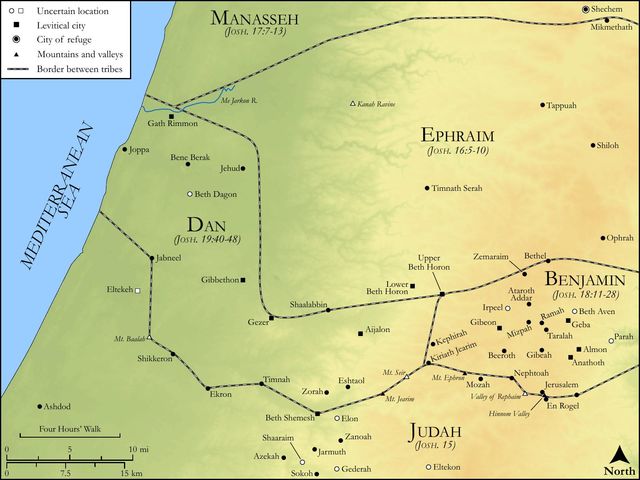
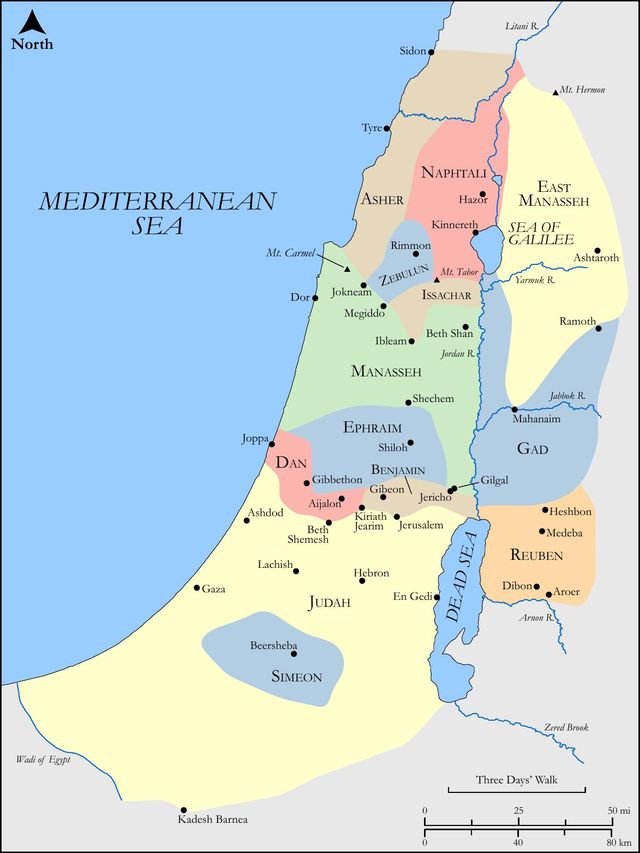
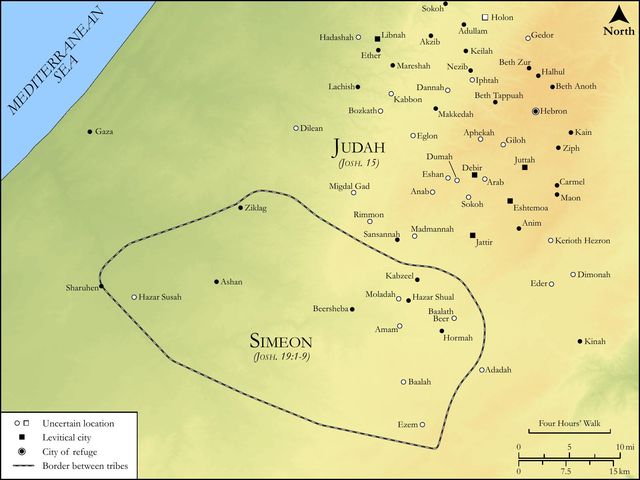
See on the biblical-era maps
Study this verse
Public-domain commentary
Matthew Henry
From his Commentary on the Whole Bible. Henry comments on passages, not single verses — this entry covers Joshua 15:20–63. His two-level outline is real structure in the source text, so it is rendered as structure.
We have here a list of the several cities that fell within the lot of the tribe of Judah, which are mentioned by name, that they might know their own, and both keep it and keep to it, and might neither through cowardice nor sloth lose the possession of what was their own.
I.The cities are here named, and numbered in several classes, which they then could account for the reason of better than we can now. Here are,
1.Some that are said to be the uttermost cities towards the coast of Edom, Jos 15:21-32. Here are thirty-eight named, and yet said to be twenty-nine (Jos 15:32), because nine of these were afterwards transferred to the lot of Simeon, and are reckoned as belonging to that, as appears by comparing Jos 19:2, etc.; therefore those only are counted (though the rest are named) which remained to Judah.
2.Others that are said to be in the valley (Jos 15:33) are counted to be fourteen, yet fifteen are named; but it is probable that Gederah and Gederathaim were either two names or two parts of one and the same city.
3.Then sixteen are named without any head of distinction, Jos 15:37-41, and nine more, Jos 15:42-44.
4.Then the three Philistine-cities, Ekron, Ashdod, and Gaza, Jos 15:45-47.
5.Cities in the mountains, eleven in all (Jos 15:48-51), nine more (Jos 15:52-54), ten more (Jos 15:55-57), six more (Jos 15:58, Jos 15:59), then two (Jos 15:60), and six in the wilderness, a part of the country not so thick of inhabitants as some others were.
II.Now here,
1.We do not find Bethlehem, which was afterwards the city of David, and was ennobled by the birth of our Lord Jesus in it. But that city, which at the best was but little among the thousands of Judah (Mic 5:2), except that it was thus dignified, was now so little as not to be accounted one of the cities, but perhaps was one of the villages not named. Christ came to give honour to the places he was related to, not to receive honour from them.
2.Jerusalem is said to continue in the hands of the Jebusites (Jos 15:63), for the children of Judah could not drive them out, through their sluggishness, stupidity, and unbelief. Had they attempted it with vigour and resolution, we have reason to think God would not have been wanting to them to give them success; but they could not do it, because they would not. Jerusalem was afterwards to be the holy city, the royal city, the city of the great King, the brightest ornament of all the land of Israel. God has designed it should be so. It may therefore be justly looked upon as a punishment of their neglect to conquer other cities which God had given them that they were so long kept out of this.
3.Among the cities of Judah (in all 114) we meet with Libnah, which in Joram's days revolted, and probably set up for a free independent state (Kg2 8:22), and Lachish, where king Amaziah was slain (Kg1 14:19); it led the dance in idolatry (Mic 1:13); it was the beginning of sin to the daughter of Zion. Giloh, Ahithophel's town, is here mentioned, and Tekoa, of which the prophet Amos was, and near which Jehoshaphat obtained that glorious victory, Ch2 20:20, etc., and Maresha, where Asa was a conqueror. Many of the cities of this tribe occur in the history of David's troubles. Adullam, Ziph, Keilah, Maon, Engedi, Ziklag, here reckoned in this tribe, were places near which David had most of his haunts; for, though sometimes Saul drove him out from the inheritance of the Lord, yet he kept as close to it as he could. The wilderness of Judah he frequented much, and in it John Baptist preached, and there the kingdom of heaven commenced, Mat 3:1. The riches of this country no doubt answered Jacob's blessing of this tribe, that he should wash his garments in wine, Gen 49:11. And, in general, Judah, thou art he whom thy brethren shall praise, not envy.
Continue studying Joshua 15:46 across the web’s major study libraries — every link below opens this exact verse, chapter, or book on the destination site.
Read & Compare
 BibleGatewayThis verse in more than 200 translations and 70 languages.
 Bible.comThe YouVersion reader — hundreds of translations, reading plans, and highlights.
 ESV.orgCrossway's official English Standard Version reader.
 NET BibleThe NET translation with 60,000+ translators' notes on every rendering decision.
 STEP BibleTyndale House's free study tool — original text, vocabulary, and scholarly resources.
 BibliaLogos Bible Software's free web reader.
 USCCBThe New American Bible (Revised Edition) with the U.S. bishops' study notes.
Commentaries
 BibleHub CommentariesDozens of classic commentaries on this verse, gathered on one page.
 StudyLightMore than 100 commentary sets — the largest collection on the web.
 BibleRefPlain-English commentary on what this verse means, verse by verse.
 Enduring WordDavid Guzik's free commentary on this chapter, widely used by Bible teachers.
 Bible Study ToolsVerse commentary alongside Greek and Hebrew study aids.
Original Language & Research
- BibleHub InterlinearThe verse word by word — original language, transliteration, and English.
- BibleHub LexiconEvery word's original-language definition and Strong's entry.
 Blue Letter BibleDeep-study tools — Strong's numbers, concordance, and word studies.
 SefariaThe Hebrew text with Rashi and centuries of Jewish commentary.
Sermons, Hymns & Audio


TrulyRandomVerse is not affiliated with these sites and doesn’t control their content. They’re linked because they’re genuinely useful.
Summary
Joshua 15:46 precisely delineates a crucial western segment of the territory divinely allotted to the tribe of Judah within the Promised Land. This verse specifies the region stretching from the Philistine city of Ekron westward to the Mediterranean Sea, encompassing the area under the influence of Ashdod and all its surrounding villages. It underscores the comprehensive nature of Judah's inheritance, extending to the very edge of the land promised by God, even including areas held by formidable adversaries, thereby highlighting God's meticulous fulfillment of His covenantal promises.
CONTEXT
ShowHideLiterary Context: Joshua 15:46 is embedded within the extensive and meticulous land allocation accounts found in Joshua chapters 13-19. Specifically, Joshua chapter 15 details the boundaries and cities assigned to the tribe of Judah, the largest and most prominent tribe, which received the southern portion of Canaan. The chapter begins with a general description of Judah's borders (verses 1-12) and then proceeds to list its cities by region (verses 21-62).
Verse 46 falls within the list of cities located in the "lowland" or Shephelah (verses 33-47), specifically those extending towards the western coastal plain. This detailed enumeration underscores the divine precision and fulfillment of God's covenant promises regarding the land. The meticulous geographical description serves not only as a record of divine apportionment but also as a legal document, establishing the legitimate claims of each tribe within the Promised Land.
The placement of this verse, following the general boundary descriptions and preceding the listing of cities in other regions, emphasizes the importance of Judah's western frontier and its interaction with the powerful Philistine presence. It highlights the practical challenges of possessing the land that God had already granted, setting the stage for future narratives of conquest and conflict.
Historical & Cultural Context: The cities mentioned, Ekron and Ashdod, were two of the five principal cities of the Philistine Pentapolis, a powerful confederation of city-states that dominated the southwestern coastal plain of Canaan. At the time of Joshua, these cities were formidable strongholds, and their inhabitants, the Philistines, were a significant military and cultural force, known for their advanced iron technology and martial prowess.
The inclusion of these areas in Judah's inheritance (even if not fully conquered immediately) signifies God's intention for Israel to possess the entire land, including regions held by their most potent enemies. This divine mandate for possession was a direct fulfillment of God's ancient covenant with Abraham, which promised his descendants the land from the river of Egypt to the Euphrates (Genesis 15:18). The presence of these unconquered cities within Judah's designated territory foreshadows the ongoing struggle that would characterize Israel's history for centuries.
The complete expulsion of the Philistines from these areas proved to be a persistent challenge for the Israelites, leading to centuries of conflict, as vividly illustrated in later historical narratives in books like Judges and 1 Samuel. The phrase "unto the sea" clearly designates the Mediterranean Sea as the ultimate western boundary, a natural geographical limit for the promised territory, emphasizing the full extent of God's intended gift.
Key Themes: This verse, like the broader context of Joshua 15, highlights several key themes central to the book of Joshua and the Deuteronomistic history. Foremost is the theme of Divine Faithfulness and Fulfillment, demonstrating God's meticulous adherence to His covenant promises to Abraham regarding the land (Genesis 15:18). The precise delineation of boundaries underscores God's reliable and detailed provision for His people.
It also underscores the theme of Inheritance and Possession, as the land is not merely given but must be actively taken and settled by the tribes through faith and obedience. This tension between divine grant and human responsibility is a recurring motif. Furthermore, it subtly introduces the theme of Unfinished Conquest, as the presence of unconquered Philistine cities within the allotted territory foreshadows the ongoing struggle and Israel's partial failure to fully dispossess the inhabitants, a reality explicitly noted in Judges 1:19.
The detailed geographical descriptions emphasize the Order and Precision of God's plan for His people, reflecting His sovereignty over the land and its distribution. This meticulousness serves to validate Israel's claim to the land as a divine gift, distinguishing it from mere military conquest.
Exposition and Analysis
ShowHideKey Word Analysis
ShowHideFrom a root meaning "eradication," Ekron was one of the five major Philistine city-states, located in the northern part of the Philistine plain. Its mention here marks a significant strategic point on Judah's western border, indicating the northernmost extent of this coastal strip. The etymological root is poignant, as God intended for Israel to "eradicate" the inhabitants of the land, though Ekron itself remained a Philistine stronghold for centuries, famously associated with the cult of Baal-zebub (2 Kings 1:2).
This primitive word literally means "hand" and is used in a wide variety of applications, including indicating proximity or influence. In the phrase "all that [lay] near Ashdod," yâd signifies the territory that was "at the hand of" or under the dominion/influence of Ashdod. This implies that the area immediately surrounding Ashdod, and likely subject to its administrative or military control, was also part of Judah's divinely appointed inheritance, extending Judah's claim beyond the city itself to its sphere of influence.
This term refers to unwalled settlements, hamlets, or encampments, often associated with agricultural or pastoral communities surrounding a main city. Its inclusion emphasizes the comprehensive nature of the land distribution, indicating that not just the fortified cities but also all the smaller, dependent settlements were part of the designated inheritance. This detail highlights the thoroughness of God's provision, ensuring that Judah's claim extended to every inhabited part of the region, including the vital agricultural lands necessary for sustenance.
Verse Breakdown
ShowHide"From Ekron"
This phrase establishes the northernmost point of this specific segment of Judah's western boundary. Ekron, despite being a strong Philistine city, was intended to be the northern anchor of Judah's coastal reach, signifying the extent of their divinely granted territory.
"even unto the sea"
This defines the westernmost limit of the territory as the Mediterranean Sea, providing a clear and natural geographical boundary for Judah's inheritance. It signifies the full extent of the land promised by God, reaching from the interior to the very edge of the continent, a natural and undeniable frontier.
"all that [lay] near Ashdod"
This clause indicates the inclusion of the territory influenced by or immediately adjacent to the major Philistine city of Ashdod. The KJV's "[lay]" clarifies the spatial relationship, emphasizing that the land under Ashdod's "hand" or sphere of influence was also part of Judah's domain, extending their claim further south along the coast within this western strip.
"with their villages"
This final detail emphasizes the completeness and thoroughness of the inheritance. It means that not only the major cities and their immediate environs but also all the smaller, dependent, and often unwalled settlements associated with them were part of Judah's divinely apportioned land, ensuring full control over the designated region and its resources.
Literary Devices
ShowHideJoshua 15:46 primarily employs Geographic Detail and Enumeration to precisely delineate the boundaries of Judah's inheritance. The verse meticulously lists specific locations—Ekron, the sea, and Ashdod—to create a clear mental map of the territory, reflecting the administrative and legalistic nature of the land distribution. This precise listing is characteristic of the entire chapter, underscoring the divine order and the fulfillment of God's promises. Furthermore, the phrase "with their villages" serves as a device of Universal Reach, ensuring that the reader understands the comprehensive nature of the inheritance, extending beyond just major urban centers to encompass all surrounding settlements, thereby leaving no ambiguity about the full extent of Judah's divinely granted claim.
Theological and Thematic Connections
ShowHideJoshua 15:46, within the broader context of the land distribution, powerfully illustrates God's unwavering faithfulness to His covenant promises. The meticulous detail in describing Judah's boundaries, including areas still occupied by formidable enemies like the Philistines, underscores that the land was a divine gift, precisely measured and granted according to God's word. This fulfillment is a tangible demonstration of God's reliability, a theme beautifully summarized in Joshua 21:45, which declares, "There failed not ought of any good thing which the LORD had spoken unto the house of Israel; all came to pass." Yet, the historical reality that Judah did not immediately dispossess the Philistines from Ekron and Ashdod (Judges 1:19) highlights the tension between divine promise and human responsibility. God faithfully gives the inheritance, but His people must, through faith and obedience, fully possess it. This serves as a theological reminder that while God's promises are sure, their full realization often requires human cooperation and perseverance in the face of spiritual opposition, demonstrating that divine sovereignty and human agency are not mutually exclusive but work in tandem.
Reflection and Application
ShowHideJoshua 15:46, though a seemingly dry geographical description, offers profound spiritual lessons for believers today. It reminds us that God is a God of precision, order, and absolute faithfulness. Just as He meticulously detailed the boundaries of Judah's inheritance, He has a specific and detailed plan for our lives, for our spiritual inheritance, and for the "territory" He calls us to possess in Christ. We are called to trust in His detailed provision and to step into the full measure of what He has granted us. The fact that Ekron and Ashdod were included in Judah's inheritance, despite being strongholds of the enemy, teaches us that God's promises often extend into areas where we face significant spiritual opposition. Our "promised land" may include areas of our lives, ministries, or communities that are currently dominated by "Philistines"—strongholds of sin, unbelief, or spiritual darkness. We are called not to shrink back but to press forward in faith, knowing that God has already given us the victory and the right to possess these areas through Christ. This verse encourages perseverance, reminding us that while the initial grant is divine, the ongoing possession requires our active faith and obedience, trusting that God's boundaries for our lives are sure and His provision is complete, enabling us to walk in the fullness of His intended blessing.
Questions for Reflection
ShowHideFAQ
ShowHideWhy are Philistine cities like Ekron and Ashdod mentioned as part of Judah's inheritance if they weren't immediately conquered?
ShowHideThe inclusion of Ekron and Ashdod in Judah's allotted territory highlights the divine intention and scope of God's promise to Israel. God's grant of the land was comprehensive, extending to all the regions He had promised to Abraham (Genesis 15:18). Even though these cities were powerful Philistine strongholds at the time of the allotment, their inclusion in the boundaries signified that they were divinely designated for Israelite possession. The fact that they were not immediately or fully conquered (as noted in Judges 1:19) speaks more to Israel's failure in complete obedience and faith than to any deficiency in God's promise or power. It underscores the tension between God's perfect will and humanity's imperfect execution, reminding us that divine promises often require human action to be fully realized.
What is the significance of the phrase "unto the sea" in defining Judah's boundary?
ShowHideThe phrase "unto the sea" explicitly designates the Mediterranean Sea as the ultimate western boundary of Judah's inheritance. This is significant because it marks a clear, natural, and undeniable limit to the territory. It emphasizes the completeness of the land grant, indicating that Judah's portion extended from the interior all the way to the very edge of the continent. It visually confirms the vastness and comprehensiveness of the land God had given to His people, fulfilling the ancient promise of a land from the river to the sea (Genesis 15:18), and establishing a clear, divinely ordained frontier.
What does the inclusion of "with their villages" imply about the inheritance?
ShowHideThe detail "with their villages" (Hebrew: châtsêr) signifies the comprehensive nature of the land distribution. It means that the inheritance was not limited to just the fortified major cities, but also included all the smaller, unwalled settlements, hamlets, and agricultural communities that were dependent on or associated with those cities. This ensured that Judah had full and complete control over the entire designated region, including its agricultural lands, pastures, and all inhabited areas, leaving no ambiguity about the extent of their divinely appointed domain. It speaks to the meticulousness of God's provision, ensuring that every aspect of the promised land was accounted for and granted to His people.
Christ-Centered Fulfillment
ShowHideJoshua 15:46, detailing the earthly inheritance of Judah, finds its ultimate and spiritual fulfillment in Jesus Christ. The land of Canaan, with its precise boundaries and the challenge of possessing it, serves as a powerful type of the spiritual inheritance and "rest" that believers receive in Christ. Just as Judah was granted a vast territory, including areas still contested by enemies, believers in Christ are granted a spiritual inheritance that is "in Christ" (Ephesians 1:11)—an inheritance of eternal life, righteousness, peace, and every spiritual blessing (Ephesians 1:3). The "sea" as a boundary points to the ultimate scope of Christ's dominion, which is universal and without limit (Psalm 72:8). While Israel struggled to fully dispossess the Philistines from Ekron and Ashdod, Christ has already triumphed over all spiritual enemies, disarming principalities and powers on the cross (Colossians 2:15). He is the true Joshua, leading His people into a spiritual rest that the earthly land could only foreshadow (Hebrews 4:8-10). Our "villages" and every aspect of our lives are brought under His gracious rule, and through Him, we are empowered to walk in the fullness of the spiritual inheritance and victory He has secured for us, anticipating the new heavens and new earth where righteousness dwells (Revelation 21:1-4).