


1 Samuel 6:17
Bible text: King James Version (1769 Blayney text) · Public domain
Bible text: King James Version with Strong's numbers · Public domain
Bible text: Berean Standard Bible · Public domain
Bible text: American Standard Version (1901) · Public domain
Bible text: World English Bible, Messianic edition · Public domain
Bible text: Geneva Bible (1599) · Public domain
Bible text: Young's Literal Translation · Public domain
- וְאֵלֶּהve·'E·lehand theseH428Conj-w ¦ PrtParticle Demonstrativeוְandאֵלֶּהthese
- טְחֹרֵיte·cho·Rei[are] [the] tumors ofH2914N-mpcNoun Plural Masculine Construct
- הַזָּהָבha·za·Hav<the> goldH2091Art ¦ N-msNoun Singular Masculine Absoluteהַ<the>זָּהָבgold
- אֲשֶׁר'a·SherwhichH834RelParticle Relative
- הֵשִׁיבוּhe·Shi·vuthey sent backH7725V-Hiphil-Perf-3cpVerb Hiphil Perfect 3rd Plural common gender
- פְלִשְׁתִּיםfe·lish·Tim[the] PhilistinesH6430N-mpNoun Gentilic Plural Masculine Absolute
- אָשָׁם'a·Shama guilt offeringH817N-msNoun Singular Masculine Absolute
- לַיהוָהla·Yah·wehto YahwehH3068Prep-l ¦ N-properNoun Proper TitleלַtoיהוָהYahweh
- לְאַשְׁדּוֹדle·'ash·Dodfor AshdodH795Prep-l ¦ N-properNoun Proper LocationלְforאַשְׁדּוֹדAshdod
- אֶחָד'e·ChadoneH259N-fsNoun Singular Feminine Absolute
- לְעַזָּהle·'a·Zahfor GazaH5804Prep-l ¦ N-properNoun Proper LocationלְforעַזָּהGaza
- אֶחָד'e·ChadoneH259N-fsNoun Singular Feminine Absolute
- לְאַשְׁקְלוֹןle·'ash·ke·Lonfor AshkelonH831Prep-l ¦ N-properNoun Proper LocationלְforאַשְׁקְלוֹןAshkelon
- אֶחָד'e·ChadoneH259N-fsNoun Singular Feminine Absolute
- לְגַתle·Gatfor GathH1661Prep-l ¦ N-properNoun Proper LocationלְforגַתGath
- אֶחָד'e·ChadoneH259N-fsNoun Singular Feminine Absolute
- לְעֶקְרוֹןle·'ek·Ronfor EkronH6138Prep-l ¦ N-properNoun Proper LocationלְforעֶקְרוֹןEkron
- אֶחָד'e·ChadoneH259N-fsNoun Singular Feminine Absolute
English is a literal word-by-word gloss of the Hebrew, not the KJV's wording. Why?
This is the original text the KJV's translators worked from — each Hebrew word with its own literal English meaning in this verse, prepared by scholars at Tyndale House, Cambridge. The KJV translates whole sentences, not word by word, so its wording differs: one Hebrew word can become several English words, and the KJV may choose “the LORD” where the gloss reads “Yahweh”. Both are faithful — they answer different questions. For the KJV's own rendering, switch to the KJV text.
Details
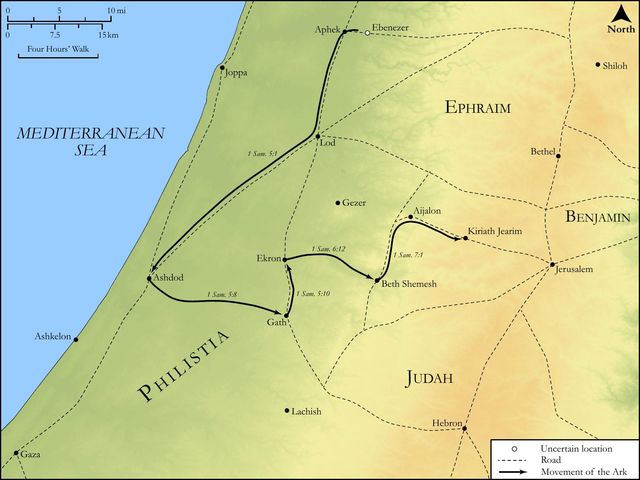
See on the biblical-era map
Study this verse
Public-domain commentary
Matthew Henry
From his Commentary on the Whole Bible. Henry comments on passages, not single verses — this entry covers 1 Samuel 6:10–18. His two-level outline is real structure in the source text, so it is rendered as structure.
We are here told,
I.How the Philistines dismissed the ark, Sa1 6:10, Sa1 6:11.
They were made as glad to part with it as ever they had been to take it. As God had fetched Israel out of the house of bondage, so now he fetched the ark out of its captivity, in such a manner as that Egypt was glad when they departed, Psa 105:38.
1.They received no money or price for the ransom of it, as they hoped to do, even beyond a king's ransom. Thus it is prophesied of Cyrus (Isa 45:13), He shall let go my captives, not for price nor reward. Nay,
2.They gave jewels of gold, as the Egyptians did to the Israelites, to be rid of it. Thus the ark that was carried into the land of the Philistines, a trophy of their victory, carried back with it trophies of its own, and lasting monuments of the disgrace of the Philistines. Note, God will be no loser in his glory, at last, by the successes of the church's enemies against his ark, but will get himself honour from those that seek to do dishonour to him.
II.How the kine brought it to the land of Israel, Sa1 6:12.
They took the straight way to Beth-shemesh, the next city of the land of Israel, and a priests' city, and turned not aside. This was a wonderful instance of the power of God over the brute-creatures, and, all things considered, no less than a miracle, that cattle unaccustomed to the yoke should draw so even, so orderly, and still go forward, - that, without any driver, they should go from home, to which all tame creatures have a natural inclination, and from their own calves, to which they had a natural affection, - that, without any director, they should go the straight road to Beth-shemesh, a city eight or ten miles off, never miss the way, never turn aside into the fields to feed themselves, nor turn back home to feed their calves. They went on lowing for their young ones, by which it appeared that they had not forgotten them, but that nature was sensible of the grievance of going from them; the power of the God of nature therefore appeared so much the greater, in overruling one of the strongest instincts of nature. These two kine, says Dr. Lightfoot, knew their owner, their great owner (Isa 1:3), whom Hophni and Phinehas knew not, to which I may add they brought home the ark to shame the stupidity of Israel, that made no attempt to fetch it home. God's providence is conversant about the motions even of brute-creatures, and serves its own purposes by them. The lords of the Philistines, with a suitable retinue no doubt, went after them, wondering at the power of the God of Israel; and thus those who thought to triumph over the ark were made to go like menial servants after it.
III.How it was welcomed to the land of Israel:
The men of Beth-shemesh were reaping their wheat-harvest, Sa1 6:13. They were going on with their worldly business, and were in no care about the ark, made no enquiries what had become of it; if they had, it is likely they might have had private intelligence beforehand of its coming, and might have gone to meet it, and conduct it into their own border. But they were as careless as the people that ceiled their own houses and let God's house lie waste. Note, God will in his own time effect the deliverance of his church, not only though it be fought against by its enemies, but though it be neglected by its friends. Some observe that the returning ark found the men of Beth-shemesh, not idling or sporting in the streets of the city, but busy, reaping their corn in their fields, and well employed. Thus the tidings of the birth of Christ were brought to the shepherds when they were keeping their flock by night. The devil visits idle men with his temptations. God visits industrious men with his favours. The same invisible hand that directed the kine to the land of Israel brought them into the field of Joshua, and in that field they stood, some think for the owner's sake, on whom, being a very good man, they suppose God designed to put this honour. I rather think it was for the sake of the great stone in that field, which was convenient to put the ark upon, and which is spoken of, v. 14, 15, 18. Now, 1. When the reapers saw the ark, they rejoiced (v. 13); their joy for that was greater than the joy of harvest, and therefore they left their work to bid it welcome. When the Lord turned again the captivity of his ark they were like men that dream; then was their mouth filled with laughter, Psa 126:1, Psa 126:2. Though they had not zeal and courage enough to attempt the rescue or ransom of it, yet, when it did come, they bade it heartily welcome. Note, The return of the ark, and the revival of holy ordinances, after days of restraint and trouble, cannot but be matter of great joy to every faithful Israelite. 3. They offered up the kine for a burnt-offering, to the honour of God, and made use of the wood of the cart for fuel, Sa1 6:14. Probably the Philistines intended these, when they sent them, to be a part of their trespass-offering, to make atonement, Sa1 6:3, Sa1 6:7. However, the men of Beth-shemesh looked upon it as proper to make this use of them, because it was by no means fit that ever they should be put to any other use; never shall that cart carry any common thing that has once carried that sacred symbol of the divine presence: and the kine had been under such an immediate guidance of heaven that God had, as it were, already laid claim to them; they were servants to him, and therefore must be sacrifices to him, and no doubt were accepted, though females, whereas, in strictness, every burnt-offering was to be a male. 3. They deposited the ark, with a chest of jewels that the Philistines presented, upon the great stone in the open field, a cold lodging for the ark of the Lord and a very mean one; yet better so than in Dagon's temple, or in the hands of the Philistines. It is desirable to see the ark in its habitation in all the circumstances of solemnity and splendour; but better have it upon a great stone, and in the fields of the wood, than be without it. The intrinsic grandeur of instituted ordinances ought not to be diminished in our eyes by the meanness and poverty of the place where they are administered. As the burning of the cart and cows that brought home the ark might be construed to signify their hopes that it should never be carried away again out of the land of Israel, so the setting of it upon a great stone might signify their hopes that it should be established again upon a firm foundation. The church is built upon a rock. 4. They offered the sacrifices of thanksgiving to God, some think upon the great stone, more probably upon an altar of earth made for the purpose, Sa1 6:15. And, the case being extraordinary, the law for offering at the altar in the court of the tabernacle was dispensed with, and the more easily because Shiloh was now dismantled; God himself had forsaken it, and the ark, which was its chief glory, they had with them here. Beth-shemesh, though it lay within the lot of the tribe of Dan, yet belonged to Judah, so that this accidental bringing of the ark hither was an indication of its designed settlement there, in process of time; for, when God refused the tabernacle of Joseph, he chose the tribe of Judah, Psa 78:67, Psa 78:68. It was one of those cities which were assigned out of the lot of Judah to the sons of Aaron, Jos 21:16. Whither should the ark go but to a priests' city? And it was well they had those of that sacred order ready (for though they are here called Levites, Sa1 6:15, yet it should seem they were priests) both to take down the ark and to offer the sacrifices. 5. The lords of the Philistines returned to Ekron, much affected, we may suppose, with what they had seen of the glory of God and the zeal of the Israelites, and yet not reclaimed from the worship of Dagon; for how seldom has a nation changed its gods, though they were no gods! Jer 2:11. Though they cannot but think the God of Israel glorious in holiness and fearful in praises, yet they are resolved they will think Baal-zebub, the god of Ekron, at least as good as he, and to him they will cleave because he is theirs. 6. Notice is taken of the continuance of the great stone in the same place; there it is unto this day (Sa1 6:18), because it remained a lasting memorial of this great event, and served to support the traditional history by which it was transmitted to posterity. The fathers would say to the children, "This is the stone upon which the ark of God was set when it came out of the Philistines' hands, a thing never to be forgotten."
Continue studying 1 Samuel 6:17 across the web’s major study libraries — every link below opens this exact verse, chapter, or book on the destination site.
Read & Compare
 BibleGatewayThis verse in more than 200 translations and 70 languages.
 Bible.comThe YouVersion reader — hundreds of translations, reading plans, and highlights.
 ESV.orgCrossway's official English Standard Version reader.
 NET BibleThe NET translation with 60,000+ translators' notes on every rendering decision.
 STEP BibleTyndale House's free study tool — original text, vocabulary, and scholarly resources.
 BibliaLogos Bible Software's free web reader.
 USCCBThe New American Bible (Revised Edition) with the U.S. bishops' study notes.
Commentaries
 BibleHub CommentariesDozens of classic commentaries on this verse, gathered on one page.
 StudyLightMore than 100 commentary sets — the largest collection on the web.
 BibleRefPlain-English commentary on what this verse means, verse by verse.
 Enduring WordDavid Guzik's free commentary on this chapter, widely used by Bible teachers.
 Bible Study ToolsVerse commentary alongside Greek and Hebrew study aids.
Original Language & Research
- BibleHub InterlinearThe verse word by word — original language, transliteration, and English.
- BibleHub LexiconEvery word's original-language definition and Strong's entry.
 Blue Letter BibleDeep-study tools — Strong's numbers, concordance, and word studies.
 SefariaThe Hebrew text with Rashi and centuries of Jewish commentary.
Sermons, Hymns & Audio


TrulyRandomVerse is not affiliated with these sites and doesn’t control their content. They’re linked because they’re genuinely useful.
Summary
First Samuel 6:17 precisely enumerates the golden votive offerings presented by the Philistine lords, serving as a "trespass offering" to the God of Israel. These symbolic gifts—golden models of the tumors and mice that had afflicted them—were a desperate, albeit pagan, attempt to appease the Lord and halt the devastating plagues that had ravaged their five major cities after their ill-advised capture and desecration of the Ark of the Covenant. The verse underscores the Philistines' clear recognition of Yahweh's overwhelming power as the source of their suffering and their perceived need for immediate restitution.
Context
ShowHideLiterary Context
This verse is deeply embedded within the dramatic narrative of the Ark of the Covenant's journey among the Philistines, following its capture from Israel during a battle detailed in 1 Samuel 4. After the Ark was brought into their territory, God's judgment manifested powerfully and unmistakably. The Philistine idol Dagon repeatedly toppled and was shattered before the Ark in Ashdod, as recorded in 1 Samuel 5:4. Subsequently, the inhabitants of Ashdod, Gath, and Ekron were afflicted with painful tumors (KJV "emerods") and a devastating plague of mice, as vividly described in 1 Samuel 5:6, 1 Samuel 5:9, and 1 Samuel 5:12. Recognizing the divine hand behind their suffering, the Philistine lords, advised by their own priests and diviners, decided to return the Ark, accompanied by a guilt offering, as outlined in 1 Samuel 6:3-4. This specific verse, 1 Samuel 6:17, meticulously lists the golden emerods, corresponding to each of the five major Philistine cities, as a tangible part of that required restitution.
Historical & Cultural Context
The Philistines were a formidable confederation of "Sea Peoples," organized into a powerful pentapolis (five major city-states: Ashdod, Gaza, Askelon, Gath, and Ekron), which exerted significant influence over the southwestern coastal plain of Canaan during this period. Their religious practices, like those of the nations round about, frequently involved votive offerings—gifts presented to deities in fulfillment of a vow, in supplication for healing, or as an act of appeasement. The concept of creating offerings that physically represented the affliction (e.g., golden models of tumors or mice) was a common practice in pagan cultures of the time. Such offerings were intended to appease the offended deity, remove the plague, or demonstrate a public acknowledgment of the deity's power. While the Philistines were not bound by the Mosaic Covenant given to Israel, their priests and diviners recognized a universal principle of culpability and the perceived need for restitution when divine wrath was evident. Their actions, though rooted in paganism, remarkably echo the Israelite concept of a "trespass offering" ('asham), demonstrating a pragmatic and fear-driven response to overwhelming supernatural power, even from a foreign deity.
Key Themes
ShowHideThis passage powerfully illustrates several profound theological themes. Firstly, Divine Sovereignty and Judgment is paramount; God's absolute control is unequivocally demonstrated, extending even over pagan nations and their deities, as His inescapable judgment falls upon those who dishonor His holy presence and sacred objects. Secondly, the theme of Repentance and Restitution emerges, as the Philistines, though outside the covenant, recognized the necessity of a "trespass offering" to atone for their profound offense against the God of Israel. This highlights a universal, albeit often distorted, understanding of culpability and the need for restitution when divine wrath is perceived. Thirdly, the Symbolic Nature of the Offering is evident; the golden emerods and mice were not merely valuable items but potent, symbolic representations of the very afflictions they had suffered. These served as a public, tangible acknowledgment that their suffering was directly caused by the God of Israel and a desperate plea for its cessation. Finally, the Holiness of the Ark is underscored; representing God's very presence, the Ark was not a mere war trophy but a sacred object demanding utmost reverence, and its capture brought severe, devastating consequences upon those who treated it with disrespect, affirming God's unyielding demand for holiness and the dire repercussions of its violation.
Exposition and Analysis
ShowHideKey Word Analysis
ShowHideFrom an unused root meaning "to shimmer," this term refers to gold, or figuratively, something gold-colored. The specification that these offerings were "golden" is highly significant. Gold was the most precious metal, universally signifying value, importance, royalty, and honor. By making the models of their afflictions out of gold, the Philistines underscored the gravity of their situation, the high esteem (even if born of fear) in which they now held the God of Israel, and their earnest, costly desire for the plague to cease. It was a conspicuous and valuable act of appeasement, demonstrating their willingness to offer something of great worth to avert further divine wrath.
Derived from an unused root meaning "to burn," this term refers to a boil or ulcer, specifically a tumor in the anus or pudenda (the piles). Scholarly consensus suggests these were painful hemorrhoids or buboes, likely associated with a severe plague, possibly bubonic plague, which would account for the rapid, widespread affliction and high mortality rates described in the preceding chapters. The Philistines' offering of golden models of these specific tumors was a direct, symbolic acknowledgment of the precise divine judgment they had endured, a physical representation of their suffering offered back to the perceived source of their pain.
This term, meaning "guilt" or "a fault," by implication also refers to a sin-offering. Within the Mosaic Law, an ʼâshâm was a specific type of offering made for unintentional sins or violations against holy things, often requiring restitution or compensation in addition to the sacrifice (e.g., Leviticus 5:14-19). While the Philistines were not under Israelite law, their use of this concept demonstrates their recognition of a spiritual debt owed to the God of Israel for their offense against His sacred Ark. It acknowledges a profound violation that required appeasement and restitution, indicating a universal understanding of culpability for transgressions against the divine.
Verse Breakdown
ShowHide"And these [are] the golden emerods which the Philistines returned [for] a trespass offering unto the LORD;"
This initial clause introduces the specific nature of the restitution made by the Philistines. The "golden emerods" (tumors) are explicitly identified as the physical representation of the plague they suffered. By returning them "for a trespass offering," the Philistines acknowledge their culpability and the need for atonement to Yahweh, the God of Israel, for their offense in capturing and dishonoring His Ark. This demonstrates their understanding that their suffering was a direct and punitive consequence of their actions against the divine, necessitating a formal act of appeasement.
"for Ashdod one, for Gaza one, for Askelon one, for Gath one, for Ekron one;"
This enumeration meticulously details the distribution and origin of the offerings, specifying that each of the five principal Philistine cities (the Pentapolis) contributed one golden emerod. This highlights the widespread nature of the affliction across their entire confederacy and signifies a collective act of appeasement from all major Philistine lordships. It emphasizes the unified recognition of God's hand upon them and their joint effort to seek relief, demonstrating the comprehensive impact of God's judgment and their synchronized response.
Literary Devices
ShowHideThe verse employs several effective literary devices to convey its profound meaning and emphasize the Philistines' plight and response. Enumeration is prominently featured, with the explicit listing of each of the five Philistine cities, which serves to emphasize the comprehensive nature of the plague and the unified, widespread response from the entire pentapolis. This repetition of "for [city] one" further underscores the pervasive impact of God's judgment across their land. Symbolism is central, as the "golden emerods" are not merely valuable objects but potent symbols representing the very affliction that God brought upon them. This act of creating symbolic representations of their suffering and offering them back to God can be seen as a form of votive offering, a common practice among the pagan nations, here adapted by the Philistines in a desperate response to a foreign deity. There is also a subtle but powerful irony in a pagan nation adopting a concept akin to Israel's "trespass offering" to appease the God of Israel, highlighting God's universal sovereignty and the inescapable nature of His judgment, even upon those who do not explicitly worship or acknowledge Him.
Theological and Thematic Connections
ShowHideThis passage powerfully illustrates God's absolute sovereignty and His active involvement in the affairs of all nations, not just Israel. The Philistines, a pagan people, are compelled to acknowledge the overwhelming power and holiness of Yahweh through direct, punitive judgment. Their "trespass offering," though rooted in their own cultural practices, signifies a universal understanding that sin against a holy God, even if committed in ignorance or defiance, carries severe consequences and requires restitution. This echoes the broader biblical theme that God's justice extends beyond covenant boundaries, demonstrating His inherent righteousness and His demand for reverence from all creation. The very nature of the offering—golden models of their afflictions—serves as a tangible confession of their guilt and a desperate plea for mercy, underscoring that true acknowledgment of sin often involves a costly and humbling act of repentance.
Reflection and Application
ShowHideThe narrative of the Ark among the Philistines, culminating in their desperate offering, serves as a profound reminder of God's unyielding holiness and His power to bring judgment upon those who dishonor Him or His sacred things. It teaches us that God's authority transcends human boundaries, cultural norms, or even our acknowledgment of Him. The Philistines, despite their paganism, were compelled to recognize and respond to the divine hand. For believers today, this passage underscores the critical importance of reverence for God's name, His Word, and His presence in our lives. It challenges us to consider if there are areas where we might be treating God's holiness lightly, either through neglect, disobedience, or a lack of awe. Furthermore, the Philistines' act of restitution, costly and symbolic, prompts us to reflect on the nature of our own repentance. Is our confession of sin merely verbal, or does it lead to tangible actions of restitution where possible, demonstrating a genuine desire to make things right with God and others? God's justice is absolute, but His mercy is also available to those who humbly acknowledge their transgression and seek His grace.
Questions for Reflection
ShowHideFAQ
ShowHideWhy did the Philistines offer golden models of tumors and mice?
ShowHideThe Philistines offered golden models of tumors (emerods) and mice as a symbolic and superstitious act of appeasement to the God of Israel. Among the pagan nations, it was common to make votive offerings that represented the affliction from which one sought deliverance. By offering golden images of the very plagues they suffered (painful tumors and a devastating mouse infestation, as described in 1 Samuel 5:6 and 1 Samuel 6:5), they were publicly acknowledging that Yahweh was the source of their suffering. The gold signified the value and seriousness of their offering, hoping to appease His wrath and persuade Him to remove the plague from their land. It was a form of "sympathetic magic" combined with a recognition of divine judgment, aimed at diverting further divine punishment.
Did the Philistines truly repent or convert to the worship of Yahweh?
ShowHideWhile the Philistines acknowledged the overwhelming power of the God of Israel and sought to appease Him, there is no indication in the text that they truly repented in the biblical sense or converted to the worship of Yahweh. Their actions were primarily driven by fear and a pragmatic desire to end the devastating plagues. They consulted their own priests and diviners (1 Samuel 6:2), and their offering, though echoing the Israelite "trespass offering," was rooted in their own cultural practices of votive gifts. Their primary goal was self-preservation and the cessation of divine judgment, not a genuine turning from their idols (like Dagon, mentioned in 1 Samuel 5:2-4) to serve the one true God. Their subsequent conflicts with Israel (e.g., 1 Samuel 7:7) further confirm that their fear-induced appeasement was not a lasting spiritual conversion.
Christ-Centered Fulfillment
ShowHideThe Philistines' desperate act of returning the Ark with a "trespass offering" of golden emerods and mice, while rooted in pagan superstition, powerfully foreshadows the ultimate solution to humanity's greatest trespass: sin. Their affliction was a direct consequence of dishonoring God's holy presence, much like humanity's spiritual "plague" is a direct result of our sin against a holy God (Romans 3:23). The Philistines sought to appease God through costly, symbolic representations of their suffering, but these could only temporarily alleviate physical judgment. In stark contrast, Jesus Christ is the true and perfect "trespass offering" for humanity's sin, not merely a symbolic representation but the very Lamb of God who takes away the sin of the world (John 1:29). He bore the full weight of our spiritual "emerods" and "plagues"—the consequences of our rebellion against God—on the cross (Isaiah 53:5). Through His one, perfect sacrifice, He provided the ultimate restitution and atonement, satisfying God's justice and opening the way for true peace and reconciliation, a peace that goes far beyond the temporary cessation of physical plagues, offering eternal life and freedom from the dominion of sin and death (Romans 5:1-2; Hebrews 9:11-14).