


1 Samuel 6:10
- וַיַּעֲשׂוּvai·ya·'a·Suand they didH6213Conj-w ¦ V-Qal-ConsecImperf-3mpVerb Qal Consecutive Imperfect 3rd Plural Masculineוַandיַּעֲשׂוּthey did
- הָאֲנָשִׁיםha·'a·na·Shimthe menH582Art ¦ N-mpNoun Plural Masculine Absoluteהָtheאֲנָשִׁיםmen
- כֵּןKenthusH3651AdvAdverb
- וַיִּקְחוּvai·yik·Chuand they tookH3947Conj-w ¦ V-Qal-ConsecImperf-3mpVerb Qal Consecutive Imperfect 3rd Plural Masculineוַandיִּקְחוּthey took
- שְׁתֵּיshe·TeitwoH8147N-fdcNoun Dual Feminine Construct
- פָרוֹתfa·rOtcowsH6510N-fpNoun Plural Feminine Absolute
- עָלוֹתa·LotnursingH5763V-Qal-Prtcpl-fpVerb Qal Participle Plural Feminine Absolute
- וַיַּאַסְרוּםvai·ya·'as·Rumand they harnessed themH631Conj-w ¦ V-Qal-ConsecImperf-3mp ¦ 3mpVerb Qal Consecutive Imperfect 3rd Plural Masculineוַandיַּאַסְרוּthey harnessedםthem
- בָּעֲגָלָהba·'a·ga·Lahon the cartH5699Prep-b ¦ N-fsNoun Singular Feminine Absoluteבָּon theעֲגָלָהcart
- וְאֶתve·'Etand <obj.>H853Conj-w ¦ DirObjMParticle Object Indicatorוְandאֶת<obj.>
- בְּנֵיהֶםbe·nei·Hemtheir young onesH1121N-mpc ¦ 3mpNoun Plural Masculine Constructבְּנֵיyoung onesהֶםtheir
- כָּלוּka·Luthey shut upH3607V-Qal-Perf-3cpVerb Qal Perfect 3rd Plural common gender
- בַבָּיִתva·Ba·yitin the houseH1004Prep-b ¦ N-msNoun Singular Masculine Absoluteבַin theבָּיִתhouse
English is a literal word-by-word gloss of the Hebrew, not the KJV's wording. Why?
This is the original text the KJV's translators worked from — each Hebrew word with its own literal English meaning in this verse, prepared by scholars at Tyndale House, Cambridge. The KJV translates whole sentences, not word by word, so its wording differs: one Hebrew word can become several English words, and the KJV may choose “the LORD” where the gloss reads “Yahweh”. Both are faithful — they answer different questions. For the KJV's own rendering, switch to the KJV text.
Details
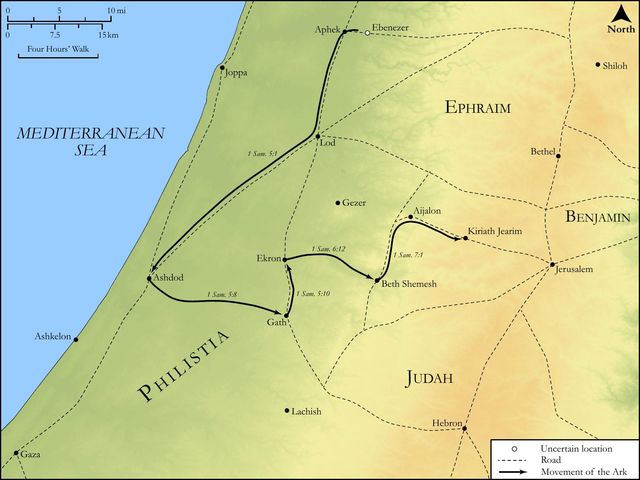
See on the biblical-era map
Study this verse
Public-domain commentary
Matthew Henry
From his Commentary on the Whole Bible. Henry comments on passages, not single verses — this entry covers 1 Samuel 6:10–18. His two-level outline is real structure in the source text, so it is rendered as structure.
We are here told,
I.How the Philistines dismissed the ark, Sa1 6:10, Sa1 6:11.
They were made as glad to part with it as ever they had been to take it. As God had fetched Israel out of the house of bondage, so now he fetched the ark out of its captivity, in such a manner as that Egypt was glad when they departed, Psa 105:38.
1.They received no money or price for the ransom of it, as they hoped to do, even beyond a king's ransom. Thus it is prophesied of Cyrus (Isa 45:13), He shall let go my captives, not for price nor reward. Nay,
2.They gave jewels of gold, as the Egyptians did to the Israelites, to be rid of it. Thus the ark that was carried into the land of the Philistines, a trophy of their victory, carried back with it trophies of its own, and lasting monuments of the disgrace of the Philistines. Note, God will be no loser in his glory, at last, by the successes of the church's enemies against his ark, but will get himself honour from those that seek to do dishonour to him.
II.How the kine brought it to the land of Israel, Sa1 6:12.
They took the straight way to Beth-shemesh, the next city of the land of Israel, and a priests' city, and turned not aside. This was a wonderful instance of the power of God over the brute-creatures, and, all things considered, no less than a miracle, that cattle unaccustomed to the yoke should draw so even, so orderly, and still go forward, - that, without any driver, they should go from home, to which all tame creatures have a natural inclination, and from their own calves, to which they had a natural affection, - that, without any director, they should go the straight road to Beth-shemesh, a city eight or ten miles off, never miss the way, never turn aside into the fields to feed themselves, nor turn back home to feed their calves. They went on lowing for their young ones, by which it appeared that they had not forgotten them, but that nature was sensible of the grievance of going from them; the power of the God of nature therefore appeared so much the greater, in overruling one of the strongest instincts of nature. These two kine, says Dr. Lightfoot, knew their owner, their great owner (Isa 1:3), whom Hophni and Phinehas knew not, to which I may add they brought home the ark to shame the stupidity of Israel, that made no attempt to fetch it home. God's providence is conversant about the motions even of brute-creatures, and serves its own purposes by them. The lords of the Philistines, with a suitable retinue no doubt, went after them, wondering at the power of the God of Israel; and thus those who thought to triumph over the ark were made to go like menial servants after it.
III.How it was welcomed to the land of Israel:
The men of Beth-shemesh were reaping their wheat-harvest, Sa1 6:13. They were going on with their worldly business, and were in no care about the ark, made no enquiries what had become of it; if they had, it is likely they might have had private intelligence beforehand of its coming, and might have gone to meet it, and conduct it into their own border. But they were as careless as the people that ceiled their own houses and let God's house lie waste. Note, God will in his own time effect the deliverance of his church, not only though it be fought against by its enemies, but though it be neglected by its friends. Some observe that the returning ark found the men of Beth-shemesh, not idling or sporting in the streets of the city, but busy, reaping their corn in their fields, and well employed. Thus the tidings of the birth of Christ were brought to the shepherds when they were keeping their flock by night. The devil visits idle men with his temptations. God visits industrious men with his favours. The same invisible hand that directed the kine to the land of Israel brought them into the field of Joshua, and in that field they stood, some think for the owner's sake, on whom, being a very good man, they suppose God designed to put this honour. I rather think it was for the sake of the great stone in that field, which was convenient to put the ark upon, and which is spoken of, v. 14, 15, 18. Now, 1. When the reapers saw the ark, they rejoiced (v. 13); their joy for that was greater than the joy of harvest, and therefore they left their work to bid it welcome. When the Lord turned again the captivity of his ark they were like men that dream; then was their mouth filled with laughter, Psa 126:1, Psa 126:2. Though they had not zeal and courage enough to attempt the rescue or ransom of it, yet, when it did come, they bade it heartily welcome. Note, The return of the ark, and the revival of holy ordinances, after days of restraint and trouble, cannot but be matter of great joy to every faithful Israelite. 3. They offered up the kine for a burnt-offering, to the honour of God, and made use of the wood of the cart for fuel, Sa1 6:14. Probably the Philistines intended these, when they sent them, to be a part of their trespass-offering, to make atonement, Sa1 6:3, Sa1 6:7. However, the men of Beth-shemesh looked upon it as proper to make this use of them, because it was by no means fit that ever they should be put to any other use; never shall that cart carry any common thing that has once carried that sacred symbol of the divine presence: and the kine had been under such an immediate guidance of heaven that God had, as it were, already laid claim to them; they were servants to him, and therefore must be sacrifices to him, and no doubt were accepted, though females, whereas, in strictness, every burnt-offering was to be a male. 3. They deposited the ark, with a chest of jewels that the Philistines presented, upon the great stone in the open field, a cold lodging for the ark of the Lord and a very mean one; yet better so than in Dagon's temple, or in the hands of the Philistines. It is desirable to see the ark in its habitation in all the circumstances of solemnity and splendour; but better have it upon a great stone, and in the fields of the wood, than be without it. The intrinsic grandeur of instituted ordinances ought not to be diminished in our eyes by the meanness and poverty of the place where they are administered. As the burning of the cart and cows that brought home the ark might be construed to signify their hopes that it should never be carried away again out of the land of Israel, so the setting of it upon a great stone might signify their hopes that it should be established again upon a firm foundation. The church is built upon a rock. 4. They offered the sacrifices of thanksgiving to God, some think upon the great stone, more probably upon an altar of earth made for the purpose, Sa1 6:15. And, the case being extraordinary, the law for offering at the altar in the court of the tabernacle was dispensed with, and the more easily because Shiloh was now dismantled; God himself had forsaken it, and the ark, which was its chief glory, they had with them here. Beth-shemesh, though it lay within the lot of the tribe of Dan, yet belonged to Judah, so that this accidental bringing of the ark hither was an indication of its designed settlement there, in process of time; for, when God refused the tabernacle of Joseph, he chose the tribe of Judah, Psa 78:67, Psa 78:68. It was one of those cities which were assigned out of the lot of Judah to the sons of Aaron, Jos 21:16. Whither should the ark go but to a priests' city? And it was well they had those of that sacred order ready (for though they are here called Levites, Sa1 6:15, yet it should seem they were priests) both to take down the ark and to offer the sacrifices. 5. The lords of the Philistines returned to Ekron, much affected, we may suppose, with what they had seen of the glory of God and the zeal of the Israelites, and yet not reclaimed from the worship of Dagon; for how seldom has a nation changed its gods, though they were no gods! Jer 2:11. Though they cannot but think the God of Israel glorious in holiness and fearful in praises, yet they are resolved they will think Baal-zebub, the god of Ekron, at least as good as he, and to him they will cleave because he is theirs. 6. Notice is taken of the continuance of the great stone in the same place; there it is unto this day (Sa1 6:18), because it remained a lasting memorial of this great event, and served to support the traditional history by which it was transmitted to posterity. The fathers would say to the children, "This is the stone upon which the ark of God was set when it came out of the Philistines' hands, a thing never to be forgotten."
Historical interpretation
Six Centuries of Reception
4 surviving comments on this verse. Each one is dated, so this reads as a timeline rather than a list.
Select a marker to jump to its quote. Markers stagger vertically where authors wrote within a few decades of each other.
You are aware, then, that when the ark of the testimony was seized by the enemies of Ashdod, and a terrible and incurable malady had broken out among them, they resolved to place it on a cart to which they yoked cows that had recently calved, for the purpose of ascertaining by trial whether or not they had been plagued by God's power on account of the ark, and if God wished it to be taken back to the place from which it had been carried away. And when they had done this, the cows, led by no man, went not to the place whence the ark had been taken, but to the fields of a certain man whose name was Oshea, the same as his whose name was altered to Jesus (Joshua), as has been previously mentioned, who also led the people into the land and meted it out to them: and when the cows had come into these fields they remained there, showing to you thereby that they were guided by the name of power; just as formerly the people who survived of those that came out of Egypt, were guided into the land by him who had received the name Jesus (Joshua), who before was called Oshea.
For it is not that holy people do not love their fleshly kin, to give them all things necessary, but they subdue this very fondness within themselves from love of spiritual things, in order so to temper it by the control of discretion, that they may be never led by it, even in a small measure and in the very least degree, to deviate from the straight path. And these are well conveyed to us by the representation of the cows, which going along towards the hilly lands under the ark of the Lord, proceed at one and the same time with fondness and with hardened feeling; as it is written, “And the men did so: and took two milk cows and tied them to the cart and shut up their calves at home; and they laid the ark of the Lord upon the cart.” And soon after: “And the cows took the straight way to the way of Beth-shemesh, and they went along by one way, lowing as they went, and did not turn aside to the right hand or to the left.” For observe, when the calves were shut up at home, the cows, which are fastened to the wagon bearing the ark of the Lord, moan and go their way, they give forth lowings from deep within, and yet [they] never alter their steps from following the path. They feel love indeed shown by compassion but never bend their necks behind. Thus, they must go on their way, who, being placed under the yoke of the sacred law, henceforth carry the Lord’s ark in interior knowledge, so as never to deviate from the course of righteousness which they have entered upon, in order to take compassion on the necessities of relatives. For Beth-shemesh is rendered “the house of the sun.” Thus to go to Beth-shemesh with the ark of the Lord placed on them is in company with heavenly knowledge to draw near to the seat of light eternal. But we are then really going on toward Beth-shemesh when, in walking the path of righteousness, we never turn aside onto the adjoining side-paths of error, not even for the sake of the affection we bear for our offspring.
We know that when the ark of the Lord was returned from the land of the Philistines to the land of the Israelites, it was placed on a cart. They yoked cows that had recently borne young to the cart, and shut up their calves at home. “And the cows went straight on over the way that leads to Beth-shemesh, keeping to the one road, lowing as they went; they turned neither to the right nor to the left.” What do these cows represent but the faithful of the church? When they ponder the sacred precepts, it is as if they are carrying the ark of the Lord placed upon them. We should also notice that they are described as having recently borne young. Many who are inwardly set on the way toward God are externally bound by their unspiritual feelings, but they do not turn aside from the right road because they are carrying the ark of God in their hearts.The cows were going to Beth-shemesh, a name meaning “house of the sun.” The prophet says, “For you who fear the Lord, the sun of righteousness shall rise.” If we are moving on toward the dwelling place of the everlasting sun, we do right not to turn aside from the route toward God on account of our unspiritual feelings. We must consider with all our energy that the cows yoked to God’s cart moan as they go, lowing from their depths, but do not turn aside from their road. So surely must God’s preachers, so must all believers within holy church do. They must be compassionate toward their neighbors through their love, while not deviating from God’s way through their compassion.
They therefore did this in this way, and took two cows, etc. The Philistines made the ark according to the advice of their priests and diviners. And the faithful stewards of it will also act in accordance with the predictions or future instructions of previous priests and prophets; let us also make corrections either of our own, or of a neighbor, namely the members of the Church according to the command of spiritual teachers. No one should think it absurd that we say the deeds of unbelieving diviners and priests overflow to the interpreting prophets and teachers of the Church with spiritual mystery; but rather, recognizing the use of allegorical speech, let the one who reads see that even those things that not only unbelievers but also those openly hostile to God have done are typologically related by distinguished expositors for the observance of most wholesome piety. No less sacred or full of mystical piety is it that the impious persecutor of the Lord in His passion clothed Him in a purple or white robe, crowned Him with thorns, gave Him vinegar to drink, hung Him on the cross, wrote "King" in Latin, Greek, and Hebrew, than that His devout and inviolate mother wrapped Him in swaddling clothes at His birth, laid Him in a manger, shepherds praised Him, magi worshipped Him; that when He was killed, His chosen disciples anointed Him with spices, wrapped Him in linen clothes, laid Him in a stone tomb, closed it with a large stone, and do not doubt to learn useful things from people of any kind, your fellow human beings. Hear what Solomon says: "Go to the ant, O sluggard, consider her ways, and be wise" (Prov. VI).
Continue studying 1 Samuel 6:10 across the web’s major study libraries — every link below opens this exact verse, chapter, or book on the destination site.
Read & Compare
 BibleGatewayThis verse in more than 200 translations and 70 languages.
 Bible.comThe YouVersion reader — hundreds of translations, reading plans, and highlights.
 ESV.orgCrossway's official English Standard Version reader.
 NET BibleThe NET translation with 60,000+ translators' notes on every rendering decision.
 STEP BibleTyndale House's free study tool — original text, vocabulary, and scholarly resources.
 BibliaLogos Bible Software's free web reader.
 USCCBThe New American Bible (Revised Edition) with the U.S. bishops' study notes.
Commentaries
 BibleHub CommentariesDozens of classic commentaries on this verse, gathered on one page.
 StudyLightMore than 100 commentary sets — the largest collection on the web.
 BibleRefPlain-English commentary on what this verse means, verse by verse.
 Enduring WordDavid Guzik's free commentary on this chapter, widely used by Bible teachers.
 Bible Study ToolsVerse commentary alongside Greek and Hebrew study aids.
Original Language & Research
- BibleHub InterlinearThe verse word by word — original language, transliteration, and English.
- BibleHub LexiconEvery word's original-language definition and Strong's entry.
 Blue Letter BibleDeep-study tools — Strong's numbers, concordance, and word studies.
 SefariaThe Hebrew text with Rashi and centuries of Jewish commentary.
Sermons, Hymns & Audio


TrulyRandomVerse is not affiliated with these sites and doesn’t control their content. They’re linked because they’re genuinely useful.
Summary
1 Samuel 6:10 meticulously details the Philistines' precise and immediate execution of the instructions provided by their priests and diviners for returning the Ark of the Covenant to Israel. This pivotal moment initiates a unique, divinely orchestrated test designed to unequivocally determine whether the devastating plagues afflicting Philistia were indeed direct judgments from the God of Israel or merely a coincidence. The Philistines' actions, including the selection of nursing cows that had never been yoked and their deliberate separation from their calves, underscore their profound desperation and their meticulous adherence to a ritual intended to discern undeniable supernatural intervention, setting the stage for a profound demonstration of divine sovereignty.
Context
ShowHideLiterary Context
This verse is situated at a critical juncture in the dramatic narrative of the Ark of the Covenant's journey. Following its capture by the Philistines in battle, the Ark brought not victory but a series of devastating plagues—tumors and a rodent infestation—to every Philistine city where it resided, as vividly recounted in passages like 1 Samuel 5:6 and 1 Samuel 5:9. After seven months of relentless affliction, the Philistine lords, priests, and diviners convened to determine how to appease the God of Israel and facilitate the Ark's return, as described in 1 Samuel 6:2. The specific and seemingly irrational instructions, detailed in 1 Samuel 6:7-9, involved an elaborate test designed to eliminate any natural explanation for the Ark's return. Verse 10 marks the immediate and careful implementation of this plan, setting the stage for the miraculous and unprecedented journey described in 1 Samuel 6:12.
Historical & Cultural Context
The Philistines were a formidable, technologically advanced people inhabiting the southwestern coast of Canaan, frequently clashing with Israel. Their religious practices, typical of the ancient Near East, involved consulting priests and diviners to interpret omens and discern divine will. The concept of a "guilt offering" (Hebrew: 'asham) was known in various forms across the region, though the specific form here—golden tumors and mice—was uniquely tailored to the afflictions they suffered. The use of "milch kine" (nursing cows) that had never been yoked, and critically, their separation from their calves, was an extreme measure. Cows, especially those with young, possess an exceptionally strong maternal instinct to remain with their offspring. To harness such animals to a cart and expect them to move away from their calves and towards a specific, distant destination without human guidance defied all natural behavior. This desperate act underscores their profound fear and grudging recognition of the God of Israel as a powerful, active deity responsible for their suffering.
Key Themes
ShowHideThis verse powerfully contributes to several overarching themes within the broader narrative of 1 Samuel. Firstly, it emphatically underscores Divine Sovereignty and Orchestration. Even the actions of God's enemies are ultimately under His meticulous control, serving His greater redemptive and revelatory purposes. The Philistines' elaborate test, intended to rule out mere chance, paradoxically became the very means by which God's undeniable power was demonstrated, confirming His active hand in their affliction. Secondly, the theme of Unnatural Obedience is central. The deliberate choice of "milch kine" and the act of "shut up their calves at home" creates a profound test of natural instinct versus divine compulsion. The cows' subsequent journey, against all natural inclination, would confirm the miraculous nature of the events, highlighting God's ability to override creation for His sovereign will, as further evidenced in 1 Samuel 6:12. Finally, the verse emphasizes The Ark's Profound Significance. The Philistines' costly, meticulous, and fear-driven method of returning the Ark, rather than simply discarding it, highlights their recognition of its potent connection to the God of Israel and His fearsome power, a power they had experienced firsthand through the devastating plagues mentioned in 1 Samuel 5.
Exposition and Analysis
ShowHideKey Word Analysis
ShowHideThis word, derived from H5763, means "to suckle" or "to give milk," specifically referring to a female animal that is currently nursing young. The detail that these were "milch kine" (nursing cows) is absolutely crucial to the Philistines' test. It intensifies the miraculous nature of their subsequent journey because it would be entirely against their strong maternal instinct to leave their calves. This choice was deliberate, designed to eliminate any natural explanation for their movement, thereby making any direct journey to Israel a clear and undeniable sign of divine compulsion.
The Hebrew verb H3607 means "to restrict," "to hold back," "to restrain," or "to shut up." In this context, it signifies the deliberate and forceful act of confining the calves, preventing them from following their mothers. This action was a vital component of the Philistines' test, ensuring that the cows' movement was not influenced by the natural pull of their offspring. It highlights the Philistines' meticulous adherence to the diviners' instructions, demonstrating their earnest desire to discern divine intervention by removing all natural variables and leaving no room for doubt.
Verse Breakdown
ShowHide"And the men did so;"
This opening clause immediately establishes the Philistines' prompt, obedient, and thorough response to the precise instructions given by their priests and diviners in 1 Samuel 6:7-9. It signifies their full compliance and the initiation of the elaborate, seemingly irrational test. This phrase underscores their desperation to end the devastating plagues and their willingness to follow even the most unusual directives to appease the God of Israel, whom they now recognized as a formidable power.
"and took two milch kine, and tied them to the cart,"
This describes the specific animals chosen and their preparation for the test. The selection of "milch kine" (nursing cows) was not arbitrary but a critical component of the test, designed to challenge and overcome natural maternal instinct. These specific cows were then yoked to the new cart, which was carrying the Ark of the Covenant and the golden guilt offering. This detail highlights the meticulousness and precision of the Philistines' actions, ensuring every part of the diviners' instructions was followed to the letter, leaving no stone unturned in their quest for certainty.
"and shut up their calves at home:"
This final clause emphasizes the most unnatural and crucial element of the entire test. By forcibly separating the nursing mothers from their young calves and confining the calves to their homes, the Philistines created a scenario where the cows' powerful natural maternal instinct would compel them to return to their offspring. If the cows were, against all natural inclination, to proceed directly towards Israel instead, it would be an undeniable and irrefutable sign of supernatural guidance, proving beyond doubt that the plagues were indeed divine judgment and not mere chance. This act elevates the subsequent journey of the cows from a simple return to a profound and undeniable miracle.
Literary Devices
ShowHideThe narrative in 1 Samuel 6:10 employs several potent literary devices to heighten its impact and theological significance. Irony is profoundly prominent, as the Philistines, intending to rule out divine intervention through a rigorously controlled test, inadvertently set up the perfect conditions for God to demonstrate His power undeniably. Their meticulous adherence to a pagan ritual ultimately serves to confirm the absolute sovereignty of Yahweh over all creation. There is also a strong element of Foreshadowing, as the unnatural obedience of the cows, defying their deepest instincts, foreshadows God's ultimate control over all creation and His ability to bend natural laws to His will for His purposes. This event also contains rich Symbolism: the Ark itself symbolizes the tangible presence and fearsome power of God, and its return via such an extraordinary means underscores its sacredness and the divine authority it represents. The cows, acting against their deepest biological imperatives, become powerful symbols of submission to a higher, unseen power, illustrating that even the most resistant elements of creation can be compelled and directed by the divine for His sovereign plan.
Theological and Thematic Connections
ShowHideThe actions described in 1 Samuel 6:10 serve as a powerful testament to God's absolute sovereignty, not only over His chosen people but over all creation and even the affairs of His enemies. The Philistines, in their attempt to discern divine will through a meticulously crafted test, inadvertently provided the perfect stage for God to display His omnipotence and undeniable control. Their careful removal of all natural explanations for the cows' journey ensured that when the cows did indeed proceed directly to Beth-shemesh, it would be an irrefutable miracle, demonstrating that the plagues were not random misfortune but direct, deliberate judgment from the God of Israel. This narrative powerfully reinforces the biblical truth that God's purposes cannot be thwarted, and He can use any means—even the pagan rituals and desperate measures of His adversaries—to accomplish His will and reveal His glory. It speaks to a God who is actively engaged in the world, meticulously directing events and even the deepest instincts of animals to achieve His divine plan and manifest His power.
Reflection and Application
ShowHideThis verse, and the broader narrative it initiates, offers profound and enduring lessons for believers today. It serves as a powerful reminder that God is actively and meticulously involved in the world, orchestrating events even among those who do not acknowledge Him or actively oppose His will. His purposes will ultimately prevail, often in ways that defy human logic, natural explanation, or our limited comprehension. The Philistines' elaborate test, designed to eliminate the supernatural, ultimately served to confirm it, teaching us that God's truth and power will always be revealed in His time and His way. We can take immense comfort and find deep peace in knowing that God is sovereign over all circumstances, able to guide and direct even against natural instincts, to accomplish His divine will. This calls us to cultivate a deeper trust in His plan, even when it seems unconventional, difficult, or beyond our immediate understanding. Just as the Philistines' unusual test ultimately revealed God's undeniable power, so too can our seemingly inexplicable circumstances or challenges be part of God's greater design to display His glory, faithfulness, and providential care in our lives. We are called to observe His hand at work, even in the smallest details, and to rest securely in His ultimate and unwavering control.
Questions for Reflection
ShowHideFAQ
ShowHideWhy was it so important that the cows were "milch kine" and separated from their calves?
ShowHideThe specific requirement that the cows be "milch kine" (nursing mothers) and forcibly separated from their calves was absolutely critical to the Philistines' test. This was a deliberate and ingenious design to eliminate any possible natural explanation for the Ark's return. Cows, particularly those with young calves, possess an incredibly strong maternal instinct that compels them to remain with or return to their offspring. Their natural inclination would be to turn back towards their calves, not to walk away from them. By forcing this unnatural separation and then observing if the cows would proceed directly towards Israelite territory without any human guidance or coaxing, the Philistines were creating a scenario where any successful journey would be an undeniable and irrefutable sign of supernatural intervention. If the cows had simply been any two cows, or if their calves had been allowed to follow, their movement could have been attributed to chance, habit, or even the subtle influence of human expectation. This meticulous detail ensured that the subsequent journey of the Ark was perceived as a clear and profound miracle, confirming beyond doubt that the plagues were indeed divine judgment from the God of Israel, as outlined in 1 Samuel 6:9.
Christ-Centered Fulfillment
ShowHideThe narrative of the Ark's return, initiated by the Philistines' actions in 1 Samuel 6:10, profoundly foreshadows the ultimate sovereignty of God revealed in the person and work of Jesus Christ. Just as God demonstrated His power over creation and the wills of men through the unnatural obedience of the "milch kine" and the compelling presence of the Ark, so too does Christ embody God's complete dominion over all things. The Ark, serving as a tangible symbol of God's presence among His people, finds its ultimate and perfect fulfillment in Christ, who is God incarnate, the very presence of God dwelling among us, as powerfully declared in John 1:14. The Philistines' desperate attempt to appease an unknown God through a precise ritual and a guilt offering points to humanity's inherent need for reconciliation and atonement, a need fully and perfectly met in Christ's singular, sacrificial atonement on the cross, for "without the shedding of blood there is no forgiveness of sins" (Hebrews 9:22). The miraculous guidance of the cows, defying natural instinct and maternal bond, prefigures the Holy Spirit's transformative work in the New Covenant, guiding believers into all truth and empowering them to live lives that often defy worldly logic, driven by a divine impulse rather than natural inclination, as those who are "led by the Spirit of God" (Romans 8:14). Ultimately, the God who compelled animals to carry His presence back to His people is the same God who, in Christ, came to dwell among us and, by His Spirit, continues to guide and empower His church, ensuring His redemptive purposes prevail over all natural and human opposition, even to the very end of the age (Matthew 28:20).