


1 Samuel 6:14
- וְהָעֲגָלָהve·ha·'a·ga·Lahand the cartH5699Conj-w ¦ Art ¦ N-fsNoun Singular Feminine Absoluteוְandהָtheעֲגָלָהcart
- בָּאָהBa·'ahit cameH935V-Qal-Perf-3fsVerb Qal Perfect 3rd Singular Feminine
- אֶל'eltoH413PrepPreposition
- שְׂדֵהse·Deh[the] field ofH7704N-mscNoun Singular Masculine Construct
- יְהוֹשֻׁעַye·ho·Shu·a'JoshuaH3091N-proper-mNoun Proper Masculine
- בֵּיתbeit[the] BethH1030N-mscNoun Singular Masculine Construct
- הַשִּׁמְשִׁיha·shim·Shi<the> ShemeshiteH1030Art ¦ N-msNoun Gentilic Singular Masculine Absoluteהַ<the>שִּׁמְשִׁיShemeshite
- וַתַּעֲמֹדva·ta·'a·Modand it stoppedH5975Conj-w ¦ V-Qal-ConsecImperf-3fsVerb Qal Consecutive Imperfect 3rd Singular Feminineוַandתַּעֲמֹדit stopped
- שָׁםShamthereH8033AdvAdverb
- וְשָׁםve·Shamand [was] thereH8033Conj-w ¦ AdvAdverbוְandשָׁם[was] there
- אֶבֶן'E·vena stoneH68N-fsNoun Singular Feminine Absolute
- גְּדוֹלָהge·do·LahlargeH1419Adj-fsAdjective Singular Feminine Absolute
- וַיְבַקְּעוּvay·va·ke·'Uand they splitH1234Conj-w ¦ V-Piel-ConsecImperf-3mpVerb Piel Consecutive Imperfect 3rd Plural Masculineוַandיְבַקְּעוּthey split
- אֶת'et<obj.>H853DirObjMParticle Object Indicator
- עֲצֵי'a·Tzei[the] wood<s> ofH6086N-mpcNoun Plural Masculine Construct
- הָעֲגָלָהha·'a·ga·Lahthe cartH5699Art ¦ N-fsNoun Singular Feminine Absoluteהָtheעֲגָלָהcart
- וְאֶתve·'Etand <obj.>H853Conj-w ¦ DirObjMParticle Object Indicatorוְandאֶת<obj.>
- הַפָּרוֹתha·pa·Rotthe cowsH6510Art ¦ N-fpNoun Plural Feminine Absoluteהַtheפָּרוֹתcows
- הֶעֱלוּhe·'e·Luthey offered upH5927V-Hiphil-Perf-3cpVerb Hiphil Perfect 3rd Plural common gender
- עֹלָה'o·Laha burnt offeringH5930N-fsNoun Singular Feminine Absolute
- לַיהוָהla·Yah·wehto YahwehH3068Prep-l ¦ N-properNoun Proper TitleלַtoיהוָהYahweh
English is a literal word-by-word gloss of the Hebrew, not the KJV's wording. Why?
This is the original text the KJV's translators worked from — each Hebrew word with its own literal English meaning in this verse, prepared by scholars at Tyndale House, Cambridge. The KJV translates whole sentences, not word by word, so its wording differs: one Hebrew word can become several English words, and the KJV may choose “the LORD” where the gloss reads “Yahweh”. Both are faithful — they answer different questions. For the KJV's own rendering, switch to the KJV text.
Details
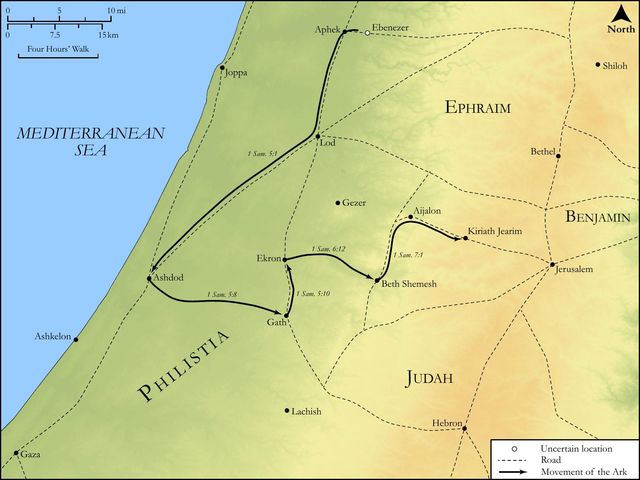
See on the biblical-era map
Study this verse
Public-domain commentary
Matthew Henry
From his Commentary on the Whole Bible. Henry comments on passages, not single verses — this entry covers 1 Samuel 6:10–18. His two-level outline is real structure in the source text, so it is rendered as structure.
We are here told,
I.How the Philistines dismissed the ark, Sa1 6:10, Sa1 6:11.
They were made as glad to part with it as ever they had been to take it. As God had fetched Israel out of the house of bondage, so now he fetched the ark out of its captivity, in such a manner as that Egypt was glad when they departed, Psa 105:38.
1.They received no money or price for the ransom of it, as they hoped to do, even beyond a king's ransom. Thus it is prophesied of Cyrus (Isa 45:13), He shall let go my captives, not for price nor reward. Nay,
2.They gave jewels of gold, as the Egyptians did to the Israelites, to be rid of it. Thus the ark that was carried into the land of the Philistines, a trophy of their victory, carried back with it trophies of its own, and lasting monuments of the disgrace of the Philistines. Note, God will be no loser in his glory, at last, by the successes of the church's enemies against his ark, but will get himself honour from those that seek to do dishonour to him.
II.How the kine brought it to the land of Israel, Sa1 6:12.
They took the straight way to Beth-shemesh, the next city of the land of Israel, and a priests' city, and turned not aside. This was a wonderful instance of the power of God over the brute-creatures, and, all things considered, no less than a miracle, that cattle unaccustomed to the yoke should draw so even, so orderly, and still go forward, - that, without any driver, they should go from home, to which all tame creatures have a natural inclination, and from their own calves, to which they had a natural affection, - that, without any director, they should go the straight road to Beth-shemesh, a city eight or ten miles off, never miss the way, never turn aside into the fields to feed themselves, nor turn back home to feed their calves. They went on lowing for their young ones, by which it appeared that they had not forgotten them, but that nature was sensible of the grievance of going from them; the power of the God of nature therefore appeared so much the greater, in overruling one of the strongest instincts of nature. These two kine, says Dr. Lightfoot, knew their owner, their great owner (Isa 1:3), whom Hophni and Phinehas knew not, to which I may add they brought home the ark to shame the stupidity of Israel, that made no attempt to fetch it home. God's providence is conversant about the motions even of brute-creatures, and serves its own purposes by them. The lords of the Philistines, with a suitable retinue no doubt, went after them, wondering at the power of the God of Israel; and thus those who thought to triumph over the ark were made to go like menial servants after it.
III.How it was welcomed to the land of Israel:
The men of Beth-shemesh were reaping their wheat-harvest, Sa1 6:13. They were going on with their worldly business, and were in no care about the ark, made no enquiries what had become of it; if they had, it is likely they might have had private intelligence beforehand of its coming, and might have gone to meet it, and conduct it into their own border. But they were as careless as the people that ceiled their own houses and let God's house lie waste. Note, God will in his own time effect the deliverance of his church, not only though it be fought against by its enemies, but though it be neglected by its friends. Some observe that the returning ark found the men of Beth-shemesh, not idling or sporting in the streets of the city, but busy, reaping their corn in their fields, and well employed. Thus the tidings of the birth of Christ were brought to the shepherds when they were keeping their flock by night. The devil visits idle men with his temptations. God visits industrious men with his favours. The same invisible hand that directed the kine to the land of Israel brought them into the field of Joshua, and in that field they stood, some think for the owner's sake, on whom, being a very good man, they suppose God designed to put this honour. I rather think it was for the sake of the great stone in that field, which was convenient to put the ark upon, and which is spoken of, v. 14, 15, 18. Now, 1. When the reapers saw the ark, they rejoiced (v. 13); their joy for that was greater than the joy of harvest, and therefore they left their work to bid it welcome. When the Lord turned again the captivity of his ark they were like men that dream; then was their mouth filled with laughter, Psa 126:1, Psa 126:2. Though they had not zeal and courage enough to attempt the rescue or ransom of it, yet, when it did come, they bade it heartily welcome. Note, The return of the ark, and the revival of holy ordinances, after days of restraint and trouble, cannot but be matter of great joy to every faithful Israelite. 3. They offered up the kine for a burnt-offering, to the honour of God, and made use of the wood of the cart for fuel, Sa1 6:14. Probably the Philistines intended these, when they sent them, to be a part of their trespass-offering, to make atonement, Sa1 6:3, Sa1 6:7. However, the men of Beth-shemesh looked upon it as proper to make this use of them, because it was by no means fit that ever they should be put to any other use; never shall that cart carry any common thing that has once carried that sacred symbol of the divine presence: and the kine had been under such an immediate guidance of heaven that God had, as it were, already laid claim to them; they were servants to him, and therefore must be sacrifices to him, and no doubt were accepted, though females, whereas, in strictness, every burnt-offering was to be a male. 3. They deposited the ark, with a chest of jewels that the Philistines presented, upon the great stone in the open field, a cold lodging for the ark of the Lord and a very mean one; yet better so than in Dagon's temple, or in the hands of the Philistines. It is desirable to see the ark in its habitation in all the circumstances of solemnity and splendour; but better have it upon a great stone, and in the fields of the wood, than be without it. The intrinsic grandeur of instituted ordinances ought not to be diminished in our eyes by the meanness and poverty of the place where they are administered. As the burning of the cart and cows that brought home the ark might be construed to signify their hopes that it should never be carried away again out of the land of Israel, so the setting of it upon a great stone might signify their hopes that it should be established again upon a firm foundation. The church is built upon a rock. 4. They offered the sacrifices of thanksgiving to God, some think upon the great stone, more probably upon an altar of earth made for the purpose, Sa1 6:15. And, the case being extraordinary, the law for offering at the altar in the court of the tabernacle was dispensed with, and the more easily because Shiloh was now dismantled; God himself had forsaken it, and the ark, which was its chief glory, they had with them here. Beth-shemesh, though it lay within the lot of the tribe of Dan, yet belonged to Judah, so that this accidental bringing of the ark hither was an indication of its designed settlement there, in process of time; for, when God refused the tabernacle of Joseph, he chose the tribe of Judah, Psa 78:67, Psa 78:68. It was one of those cities which were assigned out of the lot of Judah to the sons of Aaron, Jos 21:16. Whither should the ark go but to a priests' city? And it was well they had those of that sacred order ready (for though they are here called Levites, Sa1 6:15, yet it should seem they were priests) both to take down the ark and to offer the sacrifices. 5. The lords of the Philistines returned to Ekron, much affected, we may suppose, with what they had seen of the glory of God and the zeal of the Israelites, and yet not reclaimed from the worship of Dagon; for how seldom has a nation changed its gods, though they were no gods! Jer 2:11. Though they cannot but think the God of Israel glorious in holiness and fearful in praises, yet they are resolved they will think Baal-zebub, the god of Ekron, at least as good as he, and to him they will cleave because he is theirs. 6. Notice is taken of the continuance of the great stone in the same place; there it is unto this day (Sa1 6:18), because it remained a lasting memorial of this great event, and served to support the traditional history by which it was transmitted to posterity. The fathers would say to the children, "This is the stone upon which the ark of God was set when it came out of the Philistines' hands, a thing never to be forgotten."
Historical interpretation
Six Centuries of Reception
5 surviving comments on this verse. Each one is dated, so this reads as a timeline rather than a list.
Select a marker to jump to its quote. Markers stagger vertically where authors wrote within a few decades of each other.
You are aware, then, that when the ark of the testimony was seized by the enemies of Ashdod, and a terrible and incurable malady had broken out among them, they resolved to place it on a cart to which they yoked cows that had recently calved, for the purpose of ascertaining by trial whether or not they had been plagued by God's power on account of the ark, and if God wished it to be taken back to the place from which it had been carried away. And when they had done this, the cows, led by no man, went not to the place whence the ark had been taken, but to the fields of a certain man whose name was Oshea, the same as his whose name was altered to Jesus (Joshua), as has been previously mentioned, who also led the people into the land and meted it out to them: and when the cows had come into these fields they remained there, showing to you thereby that they were guided by the name of power; just as formerly the people who survived of those that came out of Egypt, were guided into the land by him who had received the name Jesus (Joshua), who before was called Oshea.
For it is not that holy people do not love their fleshly kin, to give them all things necessary, but they subdue this very fondness within themselves from love of spiritual things, in order so to temper it by the control of discretion, that they may be never led by it, even in a small measure and in the very least degree, to deviate from the straight path. And these are well conveyed to us by the representation of the cows, which going along towards the hilly lands under the ark of the Lord, proceed at one and the same time with fondness and with hardened feeling; as it is written, “And the men did so: and took two milk cows and tied them to the cart and shut up their calves at home; and they laid the ark of the Lord upon the cart.” And soon after: “And the cows took the straight way to the way of Beth-shemesh, and they went along by one way, lowing as they went, and did not turn aside to the right hand or to the left.” For observe, when the calves were shut up at home, the cows, which are fastened to the wagon bearing the ark of the Lord, moan and go their way, they give forth lowings from deep within, and yet [they] never alter their steps from following the path. They feel love indeed shown by compassion but never bend their necks behind. Thus, they must go on their way, who, being placed under the yoke of the sacred law, henceforth carry the Lord’s ark in interior knowledge, so as never to deviate from the course of righteousness which they have entered upon, in order to take compassion on the necessities of relatives. For Beth-shemesh is rendered “the house of the sun.” Thus to go to Beth-shemesh with the ark of the Lord placed on them is in company with heavenly knowledge to draw near to the seat of light eternal. But we are then really going on toward Beth-shemesh when, in walking the path of righteousness, we never turn aside onto the adjoining side-paths of error, not even for the sake of the affection we bear for our offspring.
We know that when the ark of the Lord was returned from the land of the Philistines to the land of the Israelites, it was placed on a cart. They yoked cows that had recently borne young to the cart, and shut up their calves at home. “And the cows went straight on over the way that leads to Beth-shemesh, keeping to the one road, lowing as they went; they turned neither to the right nor to the left.” What do these cows represent but the faithful of the church? When they ponder the sacred precepts, it is as if they are carrying the ark of the Lord placed upon them. We should also notice that they are described as having recently borne young. Many who are inwardly set on the way toward God are externally bound by their unspiritual feelings, but they do not turn aside from the right road because they are carrying the ark of God in their hearts.The cows were going to Beth-shemesh, a name meaning “house of the sun.” The prophet says, “For you who fear the Lord, the sun of righteousness shall rise.” If we are moving on toward the dwelling place of the everlasting sun, we do right not to turn aside from the route toward God on account of our unspiritual feelings. We must consider with all our energy that the cows yoked to God’s cart moan as they go, lowing from their depths, but do not turn aside from their road. So surely must God’s preachers, so must all believers within holy church do. They must be compassionate toward their neighbors through their love, while not deviating from God’s way through their compassion.
Now there was a great stone there, etc. There was in the field of the Church that exceptionally great stone, which was cut out of the mountain without hands and grew into a great mountain and filled the whole earth. And concerning which the Psalmist says: "The stone which the builders rejected has become the chief cornerstone" (Psalm 118); that is to say, to make both one. And the persecutors of the Church cut down the structure, which, erected in the likeness of the Lord's cross, rejoiced in the firm state of new grace. Moreover, they slaughtered as a most pleasing victim to the Lord, even though unknowingly, the teachers and those who were able to bear the burdens of the weak, consumed in the flame of martyrdom. For the wood of the new cart, which had carried the ark of the Lord, was cut down when, persecution arising in the Church of Jerusalem, all were scattered through the regions of Samaria and Judea, except the apostles. The cows were made a burnt offering to the Lord upon it when all were pricked by the ardor of intimate love and dissolved into mourning and tears. Stephen was stoned, and James, the brother of John, was killed by the sword; and reading the church history, you will find innumerable such events, and infinite acts of martyrs. Among all these, the greater cutting down of this cart, that is the perturbation of the Church in the times of Antichrist, is not doubted to come. Nor is there anything preventing these two cows, which bearing the ark of the Lord were given as a burnt offering to the Israelites, from being interpreted as Enoch and Elijah, who will then reveal the grace of faith to the Jews and are believed to receive death from Antichrist without delay. Nor should you marvel that the good deeds of the Beth Shemites are interpreted by us in the opposite manner, because it is the custom of Holy Scripture to sometimes delineate evil through good and good through evil. Indeed, how many kinds of sacrificial victims in the law, which by command of the Lord were offered with devoted minds, typologically foretell the death of the Savior, which He received at the hands of the wicked.
And the cart came into the field of Joshua of Beth Shemesh, etc. And wherever the Church sees hearts bringing forth fruit for Jesus Christ, the Lord of eternal clarity and the inventor of perpetual light, it prepares to make a dwelling there, as if finding rest after the labor of seeking. Such was always the progress of the Church; such was its coming into the nations; such will be its return to Israel.
Continue studying 1 Samuel 6:14 across the web’s major study libraries — every link below opens this exact verse, chapter, or book on the destination site.
Read & Compare
 BibleGatewayThis verse in more than 200 translations and 70 languages.
 Bible.comThe YouVersion reader — hundreds of translations, reading plans, and highlights.
 ESV.orgCrossway's official English Standard Version reader.
 NET BibleThe NET translation with 60,000+ translators' notes on every rendering decision.
 STEP BibleTyndale House's free study tool — original text, vocabulary, and scholarly resources.
 BibliaLogos Bible Software's free web reader.
 USCCBThe New American Bible (Revised Edition) with the U.S. bishops' study notes.
Commentaries
 BibleHub CommentariesDozens of classic commentaries on this verse, gathered on one page.
 StudyLightMore than 100 commentary sets — the largest collection on the web.
 BibleRefPlain-English commentary on what this verse means, verse by verse.
 Enduring WordDavid Guzik's free commentary on this chapter, widely used by Bible teachers.
 Bible Study ToolsVerse commentary alongside Greek and Hebrew study aids.
Original Language & Research
- BibleHub InterlinearThe verse word by word — original language, transliteration, and English.
- BibleHub LexiconEvery word's original-language definition and Strong's entry.
 Blue Letter BibleDeep-study tools — Strong's numbers, concordance, and word studies.
 SefariaThe Hebrew text with Rashi and centuries of Jewish commentary.
Sermons, Hymns & Audio


TrulyRandomVerse is not affiliated with these sites and doesn’t control their content. They’re linked because they’re genuinely useful.
Summary
1 Samuel 6:14 chronicles the climactic moment of the Ark of the Covenant's return to Israelite territory after its capture by the Philistines. The verse vividly describes the Ark's miraculous, divinely guided journey, pulled by unyoked cows, culminating in its arrival and halt in the field of Joshua, a Bethshemite. Upon witnessing this undeniable act of God's sovereignty, the Bethshemites immediately responded with profound worship, dismantling the cart that carried the sacred Ark and offering the very cows that had transported it as a complete burnt offering to the LORD, demonstrating their reverence, gratitude, and recognition of His manifest power.
Context
ShowHideLiterary Context
This verse stands as a pivotal moment within the larger narrative arc that begins with the capture of the Ark in 1 Samuel 4 and extends through its journey and eventual placement in 1 Samuel 7. Following the devastating defeat of Israel and the death of Eli's sons, the Ark, representing God's very presence, was taken by the Philistines. Its presence, however, brought divine judgment upon their cities—Ashdod, Gath, and Ekron—in the form of plagues and tumors, compelling them to acknowledge the supremacy of the God of Israel. In 1 Samuel 6, the Philistine lords, advised by their priests and diviners, devised a test to ascertain if their afflictions were indeed from Yahweh. They placed the Ark on a new cart, drawn by two milk cows that had never been yoked, and sent them off without a human driver. The miraculous, direct, and unswerving journey of these cows from Ekron to Bethshemesh, a Levitical city in Judah, without turning aside, served as irrefutable proof to both Philistines and Israelites of God's sovereign hand. Verse 14 captures the immediate, awe-filled, and reverent response of the Bethshemites upon witnessing this profound divine intervention.
Historical & Cultural Context
Bethshemesh was a city designated for the Levites, a priestly tribe responsible for the meticulous care and handling of sacred objects, including the Ark of the Covenant. This made it a fitting and divinely appointed first destination for the Ark's return, as its inhabitants were expected to understand the protocols and reverence due to such a holy item. The act of offering a "burnt offering" ('olah) was a foundational practice in Israelite worship, symbolizing complete dedication, thanksgiving, and often serving as an act of atonement or purification. The use of the cart's wood as fuel for the fire and the very cows that pulled the Ark as the sacrifice underscores the spontaneity, immediacy, and profound resourcefulness of the Bethshemites. In their overwhelming awe and gratitude, they offered what was at hand, demonstrating a deep recognition of the sacredness of the moment. The "great stone" likely served as a natural, unhewn altar or a significant landmark, providentially available to facilitate this impromptu act of worship, further emphasizing the urgency and solemnity of the occasion.
Key Themes
ShowHideThe narrative surrounding the Ark's return, culminating in this verse, powerfully articulates several core theological themes. Firstly, Divine Sovereignty is unequivocally demonstrated; God exercises absolute control over all creation, even compelling pagan animals to fulfill His divine purpose, as evidenced by the unyoked cows' direct and unwavering path to Bethshemesh, thereby confirming to the Philistines that their afflictions originated from Him (Psalm 24:1). Secondly, the Holiness of God is vividly portrayed; the plagues inflicted upon the Philistines and the subsequent judgment upon the Bethshemites for irreverently looking into the Ark (later in 1 Samuel 6:19-20) underscore that God's presence demands utmost reverence, adherence to His commands, and a proper understanding of His sacred nature. Thirdly, Worship and Atonement are central; the Bethshemites' immediate burnt offering symbolizes their profound gratitude, their recognition of God's power, and perhaps an act of purification for the land and themselves after the Ark's return from pagan captivity. This spontaneous, costly act of worship foreshadows the ongoing necessity of proper worship and reverent approach in the presence of a holy God.
Exposition and Analysis
ShowHideKey Word Analysis
ShowHideThis term, specifically feminine, refers to a heifer or cow. In this context, it denotes the two milk cows that miraculously pulled the Ark. The significance lies in the fact that they were "milk cows" (implying they had calves, which they would naturally desire to return to) and had "never been yoked" (making them ritually unblemished and unsuitable for ordinary labor, thus highlighting the miraculous nature of their journey). Their unyoked status also meant they were untrained, making their direct, unswerving path to Bethshemesh a clear sign of divine guidance, not human direction or instinct.
A primitive root meaning "to split," "break open," "rend," or "cleave." This word precisely describes the action of the Bethshemites in breaking apart the wooden cart. This act was not merely pragmatic for obtaining fuel but also deeply symbolic. The Philistine cart, which had carried the holy Ark, was now repurposed for sacred use, its wood consumed in an offering to the LORD. It signifies the immediate, resourceful, and complete dedication of whatever was at hand to God's service, transforming an object of pagan association into an instrument of Israelite worship.
This is a specific type of sacrifice in Israelite worship, literally meaning "that which goes up" or "ascending offering." It was characterized by the complete consumption of the animal by fire on the altar, symbolizing total dedication to God and often serving as an act of atonement for general sin, thanksgiving, or profound devotion. The offering of the kine as a burnt offering signifies the Bethshemites' profound gratitude for the Ark's return and their immediate acknowledgment of God's holiness, sovereignty, and merciful intervention.
Verse Breakdown
ShowHide"And the cart came into the field of Joshua, a Bethshemite, and stood there, where [there was] a great stone:"
This clause precisely identifies the location of the Ark's miraculous arrival and halt. The "field of Joshua, a Bethshemite" indicates a specific, identifiable place within Bethshemesh, a Levitical city. The detail that the cart "stood there" implies a divinely orchestrated halt, not a random stop, marking the precise end of its miraculous journey. The "great stone" serves as a natural, providentially available altar or a significant landmark, immediately suitable for the spontaneous act of worship that followed. It underscores the divine precision and provision in the Ark's return to its proper place among God's people.
"and they clave the wood of the cart,"
This describes the immediate and decisive action taken by the Bethshemites. They did not delay for formal preparations or a pre-built altar. In their awe and reverence, they dismantled the very vehicle that had brought the Ark. This act was both pragmatic, providing essential fuel for the sacrifice, and deeply symbolic, repurposing an object that had been in Philistine hands for a sacred Israelite ritual, thereby purifying it through fire and dedicating it to the LORD. It demonstrates their immediate and complete commitment to worship.
"and offered the kine a burnt offering unto the LORD."
This is the culmination of the Bethshemites' reverent response. The "kine" (the two milk cows that had miraculously brought the Ark) were offered as a "burnt offering," signifying complete dedication, thanksgiving, and perhaps an act of communal purification. This spontaneous sacrifice was an immediate, heartfelt act of worship, acknowledging God's power, His holiness, and His mercy in returning His tangible presence to Israel. It was a profound expression of their faith and obedience in the face of an undeniable divine miracle, giving back to God what He had used for His purposes.
Literary Devices
ShowHideThe passage employs several potent literary devices to convey its theological message. Divine Intervention is the overarching theme, powerfully manifested through the miraculous, unguided journey of the cows, which serves as irrefutable proof of Yahweh's supreme power over both nature and pagan deities. Symbolism is richly woven throughout: the Ark itself symbolizes God's tangible and holy presence among His people; the "great stone" functions as an impromptu altar, symbolizing the immediate and natural response of worship that God's presence evokes; and the "burnt offering" of the kine symbolizes complete dedication, thanksgiving, and atonement. There is also a strong element of Irony, as the Philistines' superstitious test, designed to determine if their afflictions were truly from the God of Israel, inadvertently becomes a powerful public demonstration of Yahweh's undeniable sovereignty and power over their gods and their land. Furthermore, the Bethshemites' immediate and reverent response in this verse Foreshadows the critical importance of proper reverence for God's holiness, a theme that will tragically be underscored later in the same chapter when many Bethshemites are struck down for irreverently looking into the Ark.
Theological and Thematic Connections
ShowHide1 Samuel 6:14 stands as a profound testament to God's active sovereignty and the appropriate human response to His manifest presence. The miraculous return of the Ark, orchestrated by God through seemingly ordinary animals, underscores that His purposes cannot be thwarted by human or pagan opposition, and His inherent holiness demands recognition and reverence from all. The Bethshemites' immediate and costly act of worship—offering the very means of the Ark's return as a burnt offering—demonstrates a spontaneous, heartfelt dedication that acknowledges God's supreme authority and mercy. This event serves as a powerful reminder that true worship is not merely ritualistic adherence but flows from a deep recognition of God's hand in our lives and a willingness to dedicate our best, even our most unexpected blessings, back to Him. It also highlights the enduring tension between God's desire to dwell among His people and the absolute necessity of approaching His holiness with proper awe, obedience, and a humble spirit, a theme consistently woven throughout the tapestry of Scripture.
Reflection and Application
ShowHideThe scene in 1 Samuel 6:14 profoundly invites us to consider our own responses to God's undeniable presence and work in our lives. Just as the Bethshemites immediately recognized the divine hand in the Ark's return and responded with costly worship, we are called to cultivate a spirit of prompt gratitude, sacrificial dedication, and profound reverence when we perceive God's providence, power, or presence. This verse challenges us to move beyond passive observation to active, wholehearted, and sometimes costly worship. It serves as a potent reminder that God's holiness is not to be trifled with, and His manifest presence, whether in His written Word, in the gathered community of believers, or through the indwelling Holy Spirit, demands our utmost awe, respect, and obedience. Our lives, like the cart and kine, are to be wholly consecrated to Him, transformed from instruments of the world into offerings of praise and service. This involves not just grand, public gestures, but a daily posture of acknowledging His sovereignty and dedicating our resources, time, talents, and very selves to His glory.
Questions for Reflection
ShowHideFAQ
ShowHideWhy were the cows offered as a burnt offering, especially since they were used for the Ark's return?
ShowHideThe offering of the cows as a burnt offering served multiple, deeply significant purposes, reflecting the Bethshemites' immediate and profound response to God's miraculous intervention. Firstly, it was a spontaneous act of thanksgiving for the safe return of the Ark, recognizing God's power and mercy in delivering His sacred presence back to Israel. Secondly, as a "burnt offering" ('olah), it symbolized complete dedication to the LORD, signifying that everything, even the very instruments God used for His miraculous work, belonged wholly to Him. This symbolized a total consecration. Thirdly, the cows had never been yoked (1 Samuel 6:7), making them ritually unblemished and therefore suitable for sacrifice, even though they were not typically sacrificial animals in other contexts. This spontaneous act was not a prescribed sin offering but a general act of worship, an act of purification for the land, and a profound acknowledgment of God's holiness after the Ark's time in pagan hands. It underscored the immediate, heartfelt, and total devotion of the Bethshemites.
What is the significance of the "great stone" mentioned in this verse?
ShowHideThe "great stone" served as a crucial element in the narrative, primarily functioning as a natural altar or a sacred marker for the spontaneous act of worship. Its presence at the precise spot where the cart stopped suggests divine providence, providing an immediate and fitting location for the burnt offering. In ancient Israelite culture, significant stones or pillars were often used to commemorate divine encounters or important events, serving as memorials or places of worship (e.g., Genesis 28:18 or Joshua 24:26-27). Here, it provided a stable, prominent surface for the sacrifice, underscoring the gravity and public nature of the event. It highlights the Bethshemites' immediate and unhesitating response to God's manifest presence, utilizing what was readily available to honor Him in a profound act of worship.
Christ-Centered Fulfillment
ShowHideThe events of 1 Samuel 6:14, particularly the spontaneous burnt offering of the kine and the cart, find profound Christ-centered fulfillment. The Ark, symbolizing God's tangible presence dwelling among His people and representing His covenant faithfulness, ultimately points to Jesus Christ, who is Emmanuel, "God with us" (Matthew 1:23). Just as the Ark's miraculous return was divinely orchestrated, so too was Christ's journey to earth, not by human will or effort but by divine purpose, culminating in His ultimate, self-sacrificial offering. The burnt offering of the cows, wholly consumed and signifying complete dedication and atonement, powerfully foreshadows the perfect and ultimate sacrifice of Jesus on the cross. His body was "broken" (like the cart's wood was "clave") and His life "poured out" as a single, all-sufficient offering that truly takes away the sin of the world (John 1:29). Unlike the repeated and imperfect sacrifices of the Old Testament, Christ's sacrifice was a "once for all" act, perfectly fulfilling the Law and bringing eternal redemption and access to God (Hebrews 10:10). Our response to Christ's finished work is akin to the Bethshemites' immediate worship: we are called to offer ourselves as "living sacrifices, holy and pleasing to God—this is your true and proper worship" (Romans 12:1), dedicating our entire lives to Him in gratitude for His ultimate act of love and atonement.