


1 Samuel 5:12
- וְהָאֲנָשִׁיםve·ha·'a·na·Shimand the menH582Conj-w ¦ Art ¦ N-mpNoun Plural Masculine Absoluteוְandהָtheאֲנָשִׁיםmen
- אֲשֶׁר'a·SherwhoH834RelParticle Relative
- לֹאlo'notH3808NegParticle Negative
- מֵתוּMe·tuthey diedH4191V-Qal-Perf-3cpVerb Qal Perfect 3rd Plural common gender
- הֻכּוּhu·Kuthey were struckH5221V-Hophal-Perf-3cpVerb Hophal Perfect 3rd Plural common gender
- בַּטְּחֹרִיםbat·cho·Rimwith the tumorsH2914Prep-b ¦ N-mpNoun Plural Masculine Absoluteבַּwith theטְּחֹרִיםtumors
- וַתַּעַלva·Ta·'aland it went upH5927Conj-w ¦ V-Qal-ConsecImperf-3fsVerb Qal Consecutive Imperfect 3rd Singular Feminineוַandתַּעַלit went up
- שַׁוְעַתshav·'At[the] cry for help ofH7775N-fscNoun Singular Feminine Construct
- הָעִירha·'Irthe cityH5892Art ¦ N-fsNoun Singular Feminine Absoluteהָtheעִירcity
- הַשָּׁמָיִםha·sha·Ma·yimthe heavensH8064Art ¦ N-mpNoun Plural Masculine Absoluteהַtheשָּׁמָיִםheavens
English is a literal word-by-word gloss of the Hebrew, not the KJV's wording. Why?
This is the original text the KJV's translators worked from — each Hebrew word with its own literal English meaning in this verse, prepared by scholars at Tyndale House, Cambridge. The KJV translates whole sentences, not word by word, so its wording differs: one Hebrew word can become several English words, and the KJV may choose “the LORD” where the gloss reads “Yahweh”. Both are faithful — they answer different questions. For the KJV's own rendering, switch to the KJV text.
Details
See on the biblical-era map
Study this verse
Public-domain commentary
Matthew Henry
From his Commentary on the Whole Bible. Henry comments on passages, not single verses — this entry covers 1 Samuel 5:6–12.
The downfall of Dagon (if the people had made a good use of it, and had been brought by it to repent of their idolatries and to humble themselves before the God of Israel and seek his face) might have prevented the vengeance which God here proceeds to take upon them for the indignities done to his ark, and their obstinate adherence to their idol, in defiance of the plainest conviction. Lord, when thy hand is lifted up they will not see, but they shall see, Isa 26:11. And, if they will not see the glory, they shall feel the weight, of God's hand, for so the Philistines did. The hand of the Lord was heavy upon them (Sa1 5:6), and he not only convinced them of their folly, but severely chastised their insolence. 1. He destroyed them, that is, cut many of them off by sudden death, those, we may suppose, that had most triumphed in the captivity of the ark. This is distinguished from the disease with which others were smitten. At Gath it is called a great destruction (Sa1 5:9), a deadly destruction, Sa1 5:11. And it is expressly said (Sa1 5:12) that those who were smitten with the emerods were the men that died not by the other destruction, which probably was the pestilence. They boasted of the great slaughter which their sword had made among the Israelites, Sa1 4:10. But God lets them know that though he does not see fit to draw Israel's sword against them (they were unworthy to be employed), yet God had a sword of his own, with which he could make a no less dreadful execution among them, which if he whet, and his hand take hold on judgment, he will render vengeance to his enemies, Deu 32:41, Deu 32:42. Note, Those that contend with God, his ark, and his Israel, will infallibly be ruined at last. If conviction conquer not, destruction shall. 2. Those that were not destroyed he smote with emerods (Sa1 5:6), in their secret parts (Sa1 5:9), so grievous that (Sa1 5:12) the cry went up to heaven, that is, it might be heard a great way off, and perhaps, in the extremity of their pain and misery, they cried, not to Dagon, but to the God of heaven. The Psalmist, speaking of this sore judgment upon the Philistines, describes it thus: God smote his enemies in the hinder parts, and put them to a perpetual reproach, Psa 78:66. The emerods (which we call the piles, and perhaps it was then a more grievous disease than it is now) is threatened among the judgments that would be the fruit of the curse, Deu 28:27. It was both a painful and shameful disease; a vile disease for vile deserts. By it God would humble their pride, and put contempt upon them, as they had done upon his ark. The disease was epidemical, and perhaps, among them, a new disease. Ashdod was smitten, and the coasts thereof, the country round. For contempt of God's ordinances, many are weak and sick, and many sleep, Co1 11:30. 3. The men of Ashdod were soon aware that it was the hand of God, the God of Israel, Sa1 5:7. Thus they were constrained to acknowledge his power and dominion, and confess themselves within his jurisdiction, and yet they would not renounce Dagon and submit to Jehovah; but rather, now that he touched their bone and their flesh, and in a tender part, they were ready to curse him to his face, and instead of making their peace with him, and courting the stay of his ark upon better terms, they desired to get clear of it, as the Gadarenes, who, when they had lost their swine, desired Christ to depart out of their coasts. Carnal hearts, when they smart under the judgments of God, would rather, if it were possible, put him far from them than enter into covenant and communion with him, and make him their friend. Thus the men of Ashdod resolve, The ark of the God of Israel shall not abide with us. 4. It is resolved to change the place of its imprisonment. A great council was called, and the question proposed to all the lords was, "What shall be we with the ark?" And at last it was agreed that it should be carried to Gath, Sa1 5:8. Some superstitious conceit they had that the fault was in the place, and that the ark would be better pleased with another lodging, further off from Dagon's temple; and therefore, instead of returning it, as they should have done, to its own place, they contrive to send it to another place. Gath is pitched upon, a place famed for a race of giants, but their strength and stature are no fence against the pestilence and the emerods: the men of that city were smitten, both great and small (Sa1 5:9), both dwarfs and giants, all alike to God's judgments; none so great as to over-top them, none so small as to be over-looked by them. 5. They were all at last weary of the ark, and very willing to get rid of it. It was sent from Gath to Ekron, and, coming by order of council, the Ekronites could not refuse it, but were much exasperated against their great men for sending them such a fatal present (Sa1 5:10): They have sent it to us to slay us and our people. The ark had the tables of the law in it; and nothing more welcome to faithful Israelites than the word of God (to them it is a savour of life unto life), but to uncircumcised Philistines, that persist in enmity to God, nothing more dreadful nor unwelcome: to them it is a savour of death unto death. A general assembly is instantly called, to advise about sending the ark again to its place, Sa1 5:11. While they are consulting about it, the hand of God is doing execution; and their contrivances to evade the judgment do but spread it. Many drop down dead among them. Many more are raging ill of the emerods, Sa1 5:12. What shall they do? Their triumphs in the captivity of the ark are soon turned into lamentations, and they are as eager to quit it as ever they had been to seize it. Note, God can easily make Jerusalem a burdensome stone to all that heave at it, Zac 12:3. Those that fight against God will soon have enough of it, and, first or last, will be made to know that none ever hardened their hearts against him and prospered. The wealth that is got by fraud and injustice, especially that which is got by sacrilege and robbing God, though swallowed greedily, and rolled under the tongue as a sweet morsel, must be vomited up again; for, till it be, the sinner shall not feel quietness in his belly, Job 20:15-20.
Historical interpretation
Historical reception
1 surviving comment on this verse from the historical church.
And the wailing of each city went up to heaven. And the murmur and impatience and the clamor of Sodom, falsely significant among the faithful, in whichever places, or persons, or certainly senses of the body, which are five for the cities of the Philistines, can never escape the strict judge, who foretelling such times with a dreadful sentence says: Nevertheless, when the Son of Man comes, will he find faith on earth? (Luke XVIII.)
Continue studying 1 Samuel 5:12 across the web’s major study libraries — every link below opens this exact verse, chapter, or book on the destination site.
Read & Compare
 BibleGatewayThis verse in more than 200 translations and 70 languages.
 Bible.comThe YouVersion reader — hundreds of translations, reading plans, and highlights.
 ESV.orgCrossway's official English Standard Version reader.
 NET BibleThe NET translation with 60,000+ translators' notes on every rendering decision.
 STEP BibleTyndale House's free study tool — original text, vocabulary, and scholarly resources.
 BibliaLogos Bible Software's free web reader.
 USCCBThe New American Bible (Revised Edition) with the U.S. bishops' study notes.
Commentaries
 BibleHub CommentariesDozens of classic commentaries on this verse, gathered on one page.
 StudyLightMore than 100 commentary sets — the largest collection on the web.
 BibleRefPlain-English commentary on what this verse means, verse by verse.
 Enduring WordDavid Guzik's free commentary on this chapter, widely used by Bible teachers.
 Bible Study ToolsVerse commentary alongside Greek and Hebrew study aids.
Original Language & Research
- BibleHub InterlinearThe verse word by word — original language, transliteration, and English.
- BibleHub LexiconEvery word's original-language definition and Strong's entry.
 Blue Letter BibleDeep-study tools — Strong's numbers, concordance, and word studies.
 SefariaThe Hebrew text with Rashi and centuries of Jewish commentary.
Sermons, Hymns & Audio


TrulyRandomVerse is not affiliated with these sites and doesn’t control their content. They’re linked because they’re genuinely useful.
Summary
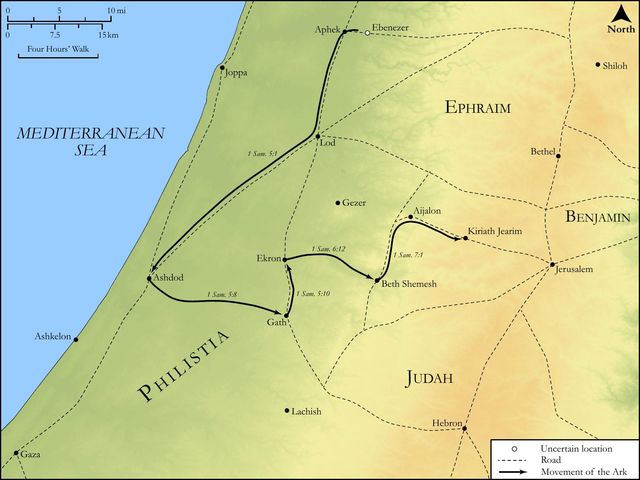
1 Samuel 5:12 vividly depicts the devastating climax of divine judgment upon the Philistine city of Ekron. Following the Ark of the Covenant's capture and its subsequent movement through Ashdod and Gath, Ekron became the final recipient of a severe plague of tumors and widespread death. This verse powerfully conveys the profound anguish and desperation of the surviving inhabitants, whose collective cries of distress ascended to the heavens, underscoring the undeniable and overwhelming impact of the Lord's holy presence among them, forcing even a pagan city to acknowledge a higher power.
Context
ShowHideLiterary Context
This verse serves as the grim conclusion to the narrative arc detailing the Ark of the Covenant's journey through Philistine territory, which began with its capture in 1 Samuel 4. After the Philistines seized the Ark, believing it a trophy of war, 1 Samuel 5 meticulously chronicles the escalating divine judgments. The Ark first brought affliction to Ashdod, where the idol Dagon repeatedly fell before it and the people were struck with a plague, as narrated in 1 Samuel 5:1-6. It was then moved to Gath, where a similar devastating plague afflicted its inhabitants, as recorded in 1 Samuel 5:9. Verse 12 describes the final and most intense stage of this divine retribution in Ekron, setting the stage for the Philistines' urgent decision to return the Ark to Israel, a decision detailed in 1 Samuel 6. The escalating severity of the judgment emphasizes the Ark's inherent holiness and the unassailable power of the God of Israel.
Historical & Cultural Context
The Philistines, a powerful non-Semitic people, had established themselves along the southwestern coast of Canaan and were frequent adversaries of the Israelites. Their polytheistic religion included Dagon, a prominent deity often depicted as a fish-god. In ancient Near Eastern warfare, capturing the cultic objects or deities of a defeated nation was a common practice, signifying the superiority of the victors' gods. The Philistines likely viewed the Ark of the Covenant as a war trophy, representing Yahweh, the God of Israel, whom they believed they had vanquished. However, the narrative of 1 Samuel 5 dramatically subverts this expectation, demonstrating Yahweh's absolute sovereignty over all other gods and nations. The plagues, particularly the "emerods" (tumors or boils), were a recognized form of divine judgment in the ancient world, often associated with curses or specific deities. This context highlights the Philistines' utter inability to escape the power of the God of Israel, despite their military prowess and pagan beliefs.
Key Themes
ShowHideThe central theme permeating this passage is the unassailable sovereignty and holiness of Yahweh. Even when His people, Israel, are defeated and His sacred Ark is captured, God demonstrates His power independently, proving that His authority is not confined or diminished by human actions or the strength of pagan deities. The narrative powerfully illustrates divine judgment against those who disrespect His presence and holiness. The Philistines, by treating the Ark as a mere trophy or a defeated idol, incurred severe and undeniable consequences. Furthermore, the "cry of the city went up to heaven" highlights the universal human response to overwhelming suffering, revealing a desperate plea for relief, even from those unfamiliar with Yahweh. This collective anguish underscores the undeniable reality of a supernatural force at work, compelling even a pagan people to acknowledge a power beyond their control, as evidenced by their later decision to return the Ark with guilt offerings in 1 Samuel 6:3-5. This passage also implicitly touches on the theme of God's vindication of His own name, as His power is displayed not for Israel's sake directly, but for the sake of His own glory among the nations.
Exposition and Analysis
ShowHideKey Word Analysis
ShowHideThis term, derived from an unused root meaning "to burn," refers to a boil or ulcer, specifically a tumor in the anus or pudenda, commonly understood as hemorrhoids or painful tumors. The King James Version's "emerods" is an archaic term for hemorrhoids, aligning with ancient medical understanding of such afflictions. This was a particularly humiliating and debilitating plague, causing immense suffering and likely rendering its victims incapacitated. The subsequent mention of golden mice in 1 Samuel 6:5 suggests a possible connection to a rodent-borne disease, further emphasizing the widespread and unpleasant nature of the affliction, impacting both the human population and their land.
This feminine noun denotes a loud, desperate outcry or a hallooing, often signifying deep distress, anguish, or an urgent plea for help. It is not merely an audible sound but an expression of profound suffering and desperation that emanates from the very core of a community's anguish. In biblical contexts, such a "cry" often reaches the ears of God, whether from His people in oppression (Exodus 3:7) or from the victims of injustice (Genesis 18:20).
This primitive root verb means "to ascend," "to be high," or "to mount." Used here, it signifies the rising or ascending of the cry, indicating its intensity and pervasiveness. The cry was not merely heard within the city walls; it rose above them, symbolizing its overwhelming nature and perhaps its reaching towards a higher, unseen power. This verb emphasizes the sheer volume and desperation of the lament, portraying it as an almost physical emanation from the suffering population.
Verse Breakdown
ShowHide"And the men that died not were smitten with the emerods"
This clause starkly highlights the dual nature of the divine judgment: while some succumbed to death, those who survived were not spared from suffering. The phrase "that died not" underscores that survival did not equate to escape from divine wrath; instead, survivors were afflicted with a painful, debilitating, and humiliating disease. This ensured that the divine judgment was inescapable and visibly manifest to all, leaving no one untouched by the Ark's holy and powerful presence. The affliction served as a constant, agonizing reminder of the consequences of profaning God's sacred object.
"and the cry of the city went up to heaven"
This vivid and powerful imagery portrays the collective and overwhelming anguish that engulfed the entire city of Ekron. It signifies a profound, widespread lament, not merely from isolated individuals but from the community as a whole, indicating a catastrophic scale of suffering. The "cry... to heaven" is a hyperbolic expression emphasizing the extremity of their distress, implying that their suffering was so great it could not be contained within human bounds. It also suggests an unconscious, desperate appeal to a higher, unseen power for relief from the unbearable affliction, acknowledging a force beyond their control.
Literary Devices
ShowHideThe verse effectively employs several literary devices to convey the gravity and widespread nature of the divine judgment. Hyperbole is powerfully evident in the phrase "the cry of the city went up to heaven," which dramatically emphasizes the overwhelming and pervasive nature of the suffering, suggesting that the lament was so intense it reached the divine realm itself. This vivid imagery also contributes significantly to pathos, evoking a deep sense of pity and dread for the afflicted Philistines, despite their being adversaries of Israel. There is a profound irony woven into the narrative: the Philistines captured the Ark as a symbol of their military victory and the supposed superiority of their gods, only for it to become an instrument of their own torment and humiliation, demonstrating the utter futility of opposing God's power. Furthermore, the "emerods" themselves serve as a potent symbol of divine judgment, the defilement that results from disrespecting God's holiness, and the physical manifestation of spiritual rebellion.
Theological and Thematic Connections
ShowHide1 Samuel 5:12 powerfully articulates the theological truth of God's active sovereignty and the inviolable nature of His holiness. The Ark, though a physical object, represented the very presence of Yahweh, and its mistreatment by the Philistines triggered an immediate and undeniable divine response. This narrative demonstrates that God does not need human armies or interventions to defend His honor; His inherent power is sufficient to vindicate His name and demonstrate His supremacy over all false gods and nations. The severe plague and the city's desperate cry underscore the seriousness of treating God's sacred things lightly and the dire consequences of defiance against divine order, even from those outside the covenant. It is a stark reminder that God's holiness demands reverence and that His presence can be a source of judgment for those who profane it. This passage also serves as a testament to God's universal reach, as His judgment extends even to those who do not explicitly acknowledge Him, revealing His ultimate control over all creation.
Reflection and Application
ShowHideThe account of the Ark among the Philistines, culminating in the widespread suffering described in 1 Samuel 5:12, offers profound lessons for believers today. It serves as a powerful reminder of God's absolute holiness and His demand for reverence. We are called to approach God and His truth with awe and respect, recognizing that His presence is not to be trifled with or taken for granted. This narrative also underscores God's unstoppable power and sovereignty; He remains in control even when circumstances seem chaotic or His people are in disarray. He can defend His own honor and purposes without human intervention, reminding us to trust in His ultimate authority and not rely solely on human strength or strategy. Furthermore, the "cry of the city" highlights humanity's innate response to overwhelming suffering—a desperate turning to a higher power, even if vaguely understood. This can prompt us to consider how we respond to crises and whether our cries are directed to the one true God, who truly hears and has the power to deliver. It challenges us to examine our own hearts: do we truly revere God's holiness, or do we, like the Philistines, inadvertently treat His sacred truths with a casualness that invites His displeasure?
Questions for Reflection
ShowHideFAQ
ShowHideWhat were "emerods" and why were they significant in this narrative?
ShowHideThe "emerods" (Hebrew: ṭᵉchôr') refer to painful tumors, boils, or hemorrhoids. They were profoundly significant because they represented a specific, humiliating, and debilitating divine plague. Unlike a swift death, these afflictions caused prolonged suffering, visible disfigurement, and immense discomfort, serving as an undeniable and constant reminder of God's judgment. The subsequent mention of golden images of mice in 1 Samuel 6:5 suggests a possible connection to a rodent-borne disease, which would have made the plague even more widespread and terrifying, impacting both the people and their land. This specific affliction underscored God's power to humble the Philistines and their false gods, demonstrating His sovereignty over their bodies, their health, and their environment, forcing them to acknowledge a power far greater than their own.
Why did the "cry of the city go up to heaven"?
ShowHideThe phrase "the cry of the city went up to heaven" is a powerful idiomatic expression used in the Bible to convey extreme, widespread distress and lament. It signifies that the suffering in Ekron was so profound and pervasive that it could not be contained, reaching a level of overwhelming anguish that was universally felt and heard throughout the city. This hyperbole emphasizes the extremity of their distress, implying that their lament was so intense it reached the divine realm. While the Philistines were not Yahweh-worshippers, this collective cry suggests a desperate, perhaps unconscious, appeal to a higher power for relief from an undeniable supernatural force. It underscores the undeniable presence of God's judgment and the Philistines' recognition that something far beyond human control was at work, compelling them to seek an end to their torment. Such a cry, even from a pagan city, highlights the universal human inclination to appeal to the transcendent in times of ultimate despair.
Christ-Centered Fulfillment
ShowHideThe narrative of the Ark of the Covenant among the Philistines, culminating in the desperate cries of Ekron, finds its profound Christ-centered fulfillment in the person and redemptive work of Jesus Christ. The Ark symbolized God's holy presence, a presence that brought judgment and affliction to those who disrespected it, as seen in the plague upon Ekron. This foreshadows the ultimate reality that God's perfect holiness, fully embodied in Christ, demands absolute reverence from all humanity. Humanity, in its inherent sinfulness, has continually dishonored and rebelled against God's holiness, incurring a judgment far more severe than physical "emerods"—the judgment of eternal separation from God and spiritual death. However, Christ, the true Ark of the Covenant, did not come to bring judgment to those who believe but bore the full weight of God's righteous wrath against sin on the cross (2 Corinthians 5:21). He became the propitiation for our sins, satisfying the demands of divine holiness and justice, thereby averting the judgment we deserved. The "cry of the city" for relief from an unbearable plague prefigures humanity's desperate need for salvation from the spiritual plague of sin and death. It is in Christ alone that this cry is answered, for He is the one who "takes away the sin of the world" (John 1:29). Through His sacrificial death and glorious resurrection, Jesus offers not judgment, but life and peace to all who turn to Him in faith, demonstrating God's ultimate power to save and transform, rather than merely to punish (John 3:17). He is the true dwelling place of God, "in whom the whole fullness of deity dwells bodily" (Colossians 2:9), a presence that brings life, healing, and reconciliation, not death, to those who approach Him in humility and faith. He is the ultimate answer to humanity's cry for deliverance.