


Judges 1:18
- וַיִּלְכֹּדvai·yil·Kodand he capturedH3920Conj-w ¦ V-Qal-ConsecImperf-3msVerb Qal Consecutive Imperfect 3rd Singular Masculineוַandיִּלְכֹּדhe captured
- יְהוּדָהye·hu·DahJudahH3063N-properNoun Proper Location
- אֶת'et<obj.>H853DirObjMParticle Object Indicator
- עַזָּה'a·ZahGazaH5804N-properNoun Proper Location
- וְאֶתve·'Etand <obj.>H853Conj-w ¦ DirObjMParticle Object Indicatorוְandאֶת<obj.>
- גְּבוּלָהּge·vu·Lahits territoryH1366N-msc ¦ 3fsNoun Singular Masculine Constructגְּבוּלָterritoryהּits
- וְאֶתve·'Etand <obj.>H853Conj-w ¦ DirObjMParticle Object Indicatorוְandאֶת<obj.>
- אַשְׁקְלוֹן'ash·ke·LonAshkelonH831N-properNoun Proper Location
- וְאֶתve·'Etand <obj.>H853Conj-w ¦ DirObjMParticle Object Indicatorוְandאֶת<obj.>
- גְּבוּלָהּge·vu·Lahits territoryH1366N-msc ¦ 3fsNoun Singular Masculine Constructגְּבוּלָterritoryהּits
- וְאֶתve·'Etand <obj.>H853Conj-w ¦ DirObjMParticle Object Indicatorוְandאֶת<obj.>
- עֶקְרוֹןek·RonEkronH6138N-properNoun Proper Location
- וְאֶתve·'Etand <obj.>H853Conj-w ¦ DirObjMParticle Object Indicatorוְandאֶת<obj.>
- גְּבוּלָהּge·vu·Lahits territoryH1366N-msc ¦ 3fsNoun Singular Masculine Constructגְּבוּלָterritoryהּits
English is a literal word-by-word gloss of the Hebrew, not the KJV's wording. Why?
This is the original text the KJV's translators worked from — each Hebrew word with its own literal English meaning in this verse, prepared by scholars at Tyndale House, Cambridge. The KJV translates whole sentences, not word by word, so its wording differs: one Hebrew word can become several English words, and the KJV may choose “the LORD” where the gloss reads “Yahweh”. Both are faithful — they answer different questions. For the KJV's own rendering, switch to the KJV text.
Details
See on the biblical-era maps
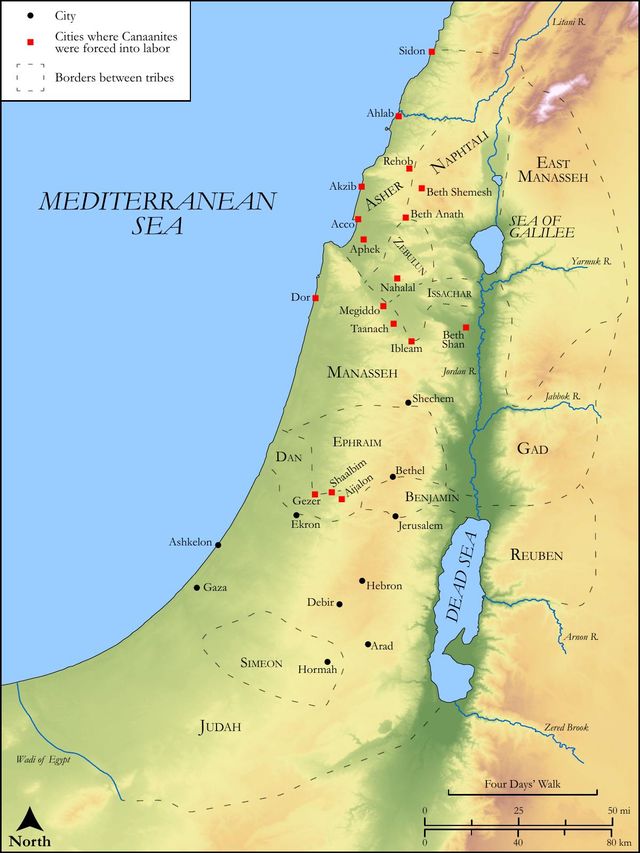
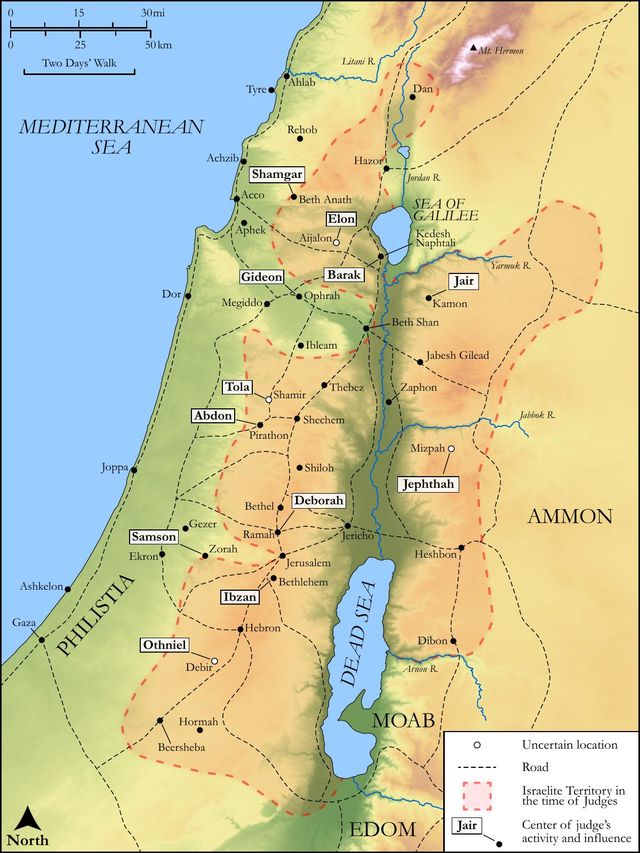
Study this verse
Public-domain commentary
Matthew Henry
From his Commentary on the Whole Bible. Henry comments on passages, not single verses — this entry covers Judges 1:9–20.
We have here a further account of that glorious and successful campaign which Judah and Simeon made. 1. The lot of Judah was pretty well cleared of the Canaanites, yet not thoroughly. Those that dwelt in the mountain (the mountains that were round about Jerusalem) were driven out (Jdg 1:9, Jdg 1:19), but those in the valley kept their ground against them, having chariots of iron, such as we read of, Jos 17:16. Here the men of Judah failed, and thereby spoiled the influence which otherwise their example hitherto might have had on the rest of the tribes, who followed them in this instance of their cowardice, rather than in all the other instances of their courage. They had iron chariots, and therefore it was thought not safe to attack them: but had not Israel God on their side, whose chariots are thousands of angels (Psa 68:17), before whom these iron chariots would be but as stubble to the fire? Had not God expressly promised by the oracle (Jdg 1:2) to give them success against the Canaanites in this very expedition, without excepting those that had iron chariots? Yet they suffered their fears to prevail against their faith, they could not trust God under any disadvantages, and therefore durst not face the iron chariots, but meanly withdrew their forces, when with one bold stroke they might have completed their victories; and it proved of pernicious consequence. They did run well, what hindered them? Gal 5:7. 2. Caleb was put in possession of Hebron, which, though given him by Joshua ten or twelve years before (as Dr. Lightfoot computes), yet being employed in public service, for the settling of the tribes, which he preferred before his own private interests, it seems he did not till now make himself master of; so well content was that good man to serve others, while he left himself to be served last; few are like-minded, for all seek their own, Phi 2:20, Phi 2:21. Yet now the men of Judah all came in to his assistance for the reducing of Hebron (Jdg 1:10), slew the sons of Anak, and put him in possession of it, Jdg 1:20. They gave Hebron unto Caleb. And now Caleb, that he might return the kindness of his countrymen, is impatient to see Debir reduced and put into the hands of the men of Judah, to expedite which he proffers his daughter to the person that will undertake to command in the siege of that important place, Jdg 1:11, Jdg 1:12. Othniel bravely undertakes it, and wins the town and the lady (Jdg 1:13), and by his wife's interest and management with her father gains a very good inheritance for himself and his family, Jdg 1:14, Jdg 1:15. We had this passage before, Jos 15:16-19, where it was largely explained and improved. 3. Simeon got ground of the Canaanites in his border, Jdg 1:17, Jdg 1:18. In the eastern part of Simeon's lot, they destroyed the Canaanites in Zephath, and called it Hormah - destruction, adding this to some other devoted cities not far off, which they had some time ago, with good reason, called by that name, Num 21:2, Num 21:3. And this perhaps was the complete performance of the vow they them made that they would utterly destroy these cities of the Canaanites in the south. In the western part they took Gaza, Askelon, and Ekron, cities of the Philistines; they gained present possession of the cities, but, not destroying the inhabitants, the Philistines in process of time recovered the cities, and proved inveterate enemies to the Israel of God, and no better could come of doing their work by the halves. 4. The Kenites gained a settlement in the tribe of Judah, choosing it there rather than in any other tribe, because it was the strongest, and there they hoped to be safe and quiet, Jdg 1:16. These were the posterity of Jethro, who either went with Israel when Moses invited them (Num 10:29) or met them about the same place when they came up from their wanderings in the wilderness thirty-eight years after, and went with them then to Canaan, Moses having promised them that they should fare as Israel fared, Num 10:32. They had at first seated themselves in the city of palm-trees, that is, Jericho, a city which never was to be rebuilt, and therefore the fitter for those who dwelt in tents, and did not mind building. But afterwards they removed into the wilderness of Judah, either out of their affection to that place, because solitary and retired, or out of their affection to that tribe, which perhaps had been in a particular manner kind to them. Yet we find the tent of Jael, who was of that family, far north, in the lot of Naphtali, when Sisera took shelter there, Jdg 4:17. This respect Israel showed them, to let them fix where they pleased, being a quiet people, who, wherever they were, were content with a little. Those that molested none were molested by none. Blessed are the meek, for thus they shall inherit the earth.
Historical interpretation
Historical reception
1 surviving comment on this verse from the historical church.
Gaza: These were three of the principal cities of the Philistines, famous both in sacred and profane history. They were taken at this time by the Israelites: but as they took no care to put garrisons in them, the Philistines soon recovered them.
Continue studying Judges 1:18 across the web’s major study libraries — every link below opens this exact verse, chapter, or book on the destination site.
Read & Compare
 BibleGatewayThis verse in more than 200 translations and 70 languages.
 Bible.comThe YouVersion reader — hundreds of translations, reading plans, and highlights.
 ESV.orgCrossway's official English Standard Version reader.
 NET BibleThe NET translation with 60,000+ translators' notes on every rendering decision.
 STEP BibleTyndale House's free study tool — original text, vocabulary, and scholarly resources.
 BibliaLogos Bible Software's free web reader.
 USCCBThe New American Bible (Revised Edition) with the U.S. bishops' study notes.
Commentaries
 BibleHub CommentariesDozens of classic commentaries on this verse, gathered on one page.
 StudyLightMore than 100 commentary sets — the largest collection on the web.
 BibleRefPlain-English commentary on what this verse means, verse by verse.
 Enduring WordDavid Guzik's free commentary on this chapter, widely used by Bible teachers.
 Bible Study ToolsVerse commentary alongside Greek and Hebrew study aids.
Original Language & Research
- BibleHub InterlinearThe verse word by word — original language, transliteration, and English.
- BibleHub LexiconEvery word's original-language definition and Strong's entry.
 Blue Letter BibleDeep-study tools — Strong's numbers, concordance, and word studies.
 SefariaThe Hebrew text with Rashi and centuries of Jewish commentary.
Sermons, Hymns & Audio


TrulyRandomVerse is not affiliated with these sites and doesn’t control their content. They’re linked because they’re genuinely useful.
Summary
Judges 1:18 records a pivotal early triumph for the tribe of Judah in the period immediately following Joshua's leadership, detailing their successful military capture of the strategically vital Philistine cities of Gaza, Askelon, and Ekron, along with their extensive surrounding territories. This verse powerfully illustrates Judah's initial obedience and formidable military prowess in dispossessing the Canaanite inhabitants, marking a crucial and comprehensive step in the tribal inheritance of the Promised Land, even as it subtly hints at the enduring challenges these unconquered regions would later pose.
Context
ShowHideLiterary Context
Judges 1 commences immediately after the death of Joshua, signaling a critical transition from a unified, divinely-directed conquest to a decentralized era of tribal efforts. The chapter meticulously establishes the recurring pattern of incomplete obedience that will define the entire book of Judges. Judah, divinely appointed as the leading tribe, takes the initiative, seeking and receiving divine guidance before embarking on the essential task of completing the territorial inheritance. Judges 1:1-20 meticulously chronicles Judah's initial successes, including the capture of Bezek, Jerusalem, Hebron, and Debir, culminating in the significant coastal victories detailed in verse 18. This verse stands as a high point of achievement for Judah, providing a stark contrast to the subsequent failures of other tribes, and even Judah's own later struggles, as meticulously outlined in the remainder of the chapter.
Historical & Cultural Context
The cities explicitly named—Gaza, Askelon, and Ekron—were preeminent Philistine strongholds strategically situated on the fertile coastal plain of Canaan. This region constituted a vital corridor for ancient trade routes connecting the powerful empires of Egypt, Mesopotamia, and Anatolia. The Philistines, identified as one of the "Sea Peoples" who had settled in the region, were formidable adversaries, renowned for their advanced iron technology and robust military presence. The recurring phrase "with the coast thereof" (Hebrew: gᵉbûwl) is profoundly significant, indicating that Judah's conquest extended beyond the walled cities themselves to encompass their entire surrounding territories, including vital villages, agricultural lands, and strategic access points to the Mediterranean Sea. This comprehensive capture was absolutely essential for achieving full control and integrating these areas into Judah's tribal inheritance, representing a monumental military and strategic achievement against a powerful enemy in the nascent post-conquest period.
Key Themes
ShowHideJudges 1:18 contributes significantly to several overarching themes woven throughout the book of Judges and the broader Old Testament narrative. It emphatically underscores Judah's Initiative and Strength, portraying them as the foremost and most successful tribe in this initial phase of conquest, demonstrating remarkable courage and undeniable divine favor. The verse also highlights the Strategic Importance of Coastal Cities, as the successful taking of these Philistine strongholds was paramount for securing crucial trade routes and fertile agricultural land, which were indispensable for Israel's long-term economic and political stability. Furthermore, while representing a significant victory, this verse subtly contributes to the pervasive theme of Partial Obedience and Lingering Threats. Despite this initial success, the Philistines would regrettably remain a persistent and formidable enemy throughout Israel's history, indicating that the driving out of all inhabitants was neither permanent nor comprehensively achieved (cf. the immediate follow-up in Judges 1:19 and the earlier description of unconquered territories in Joshua 13:2-3). This foreshadows the broader, tragic pattern of compromise and incomplete obedience that plagues Israel throughout the book of Judges, where many tribes, as vividly depicted in Judges 1:21-36, failed to completely dispossess the indigenous inhabitants.
Exposition and Analysis
ShowHideKey Word Analysis
ShowHideAs the primary subject of this action, "Judah" (H3063) derives from a root meaning "celebrated" or "praised." This tribe's prominent role in taking the initiative in the post-Joshua conquest underscores their divinely appointed leadership and inherent strength. This early success for Judah foreshadows their future significance as the royal tribe from which Israel's kings, and ultimately the Messiah, would descend.
The verb "took" (H3920, lâkad) signifies a decisive and forceful military act of "capturing or occupying" territory, akin to catching something in a net or trap. It denotes a successful and complete acquisition of territory through conquest, emphasizing Judah's effective and definitive seizure of these strategic Philistine cities and their surrounding areas. This term highlights the comprehensive nature of their victory.
This crucial phrase (H1366, gᵉbûwl), meaning "boundary" or "territory inclosed," is vital for understanding the full extent of Judah's conquest. It indicates that Judah did not merely capture the urban centers of Gaza, Askelon, and Ekron, but also their entire surrounding regions, including agricultural lands, villages, and strategic access points. This comprehensive taking of the "border" or "coast" was essential for securing true control and integrating the land into their tribal inheritance.
Verse Breakdown
ShowHide"Also Judah took Gaza with the coast thereof"
This opening clause immediately establishes Judah's preeminent and active role in the initial phase of the post-Joshua conquest. The capture of Gaza, a major Philistine city and a strategic port, represents a significant military achievement. The inclusion of "with the coast thereof" profoundly emphasizes the comprehensive nature of this conquest, signifying that Judah extended its control beyond the city walls to encompass its entire surrounding territory, including vital trade routes and fertile plains.
"and Askelon with the coast thereof"
The repetition of the grammatical structure here underscores and reinforces the continued success of Judah's campaign. Askelon, another key Philistine city situated on the vital coastal plain, was equally strategic in its importance. Its capture, along with its entire surrounding territory, further solidifies the extent of Judah's early victories and their demonstrable ability to dislodge powerful enemies from their fortified strongholds.
"and Ekron with the coast thereof"
The final city mentioned in this trio, Ekron, was the northernmost of the five major Philistine city-states. Its capture, once again explicitly stated as "with the coast thereof," completes a remarkable series of decisive victories for Judah. This succession of conquests demonstrates a sustained, effective, and comprehensive military campaign, securing a substantial and strategically important portion of the Philistine plain for Judah's tribal inheritance.
Literary Devices
ShowHideThe primary literary device prominently employed in Judges 1:18 is Repetition, specifically the recurring phrase "with the coast thereof." This repetitive structure serves to emphatically underscore the comprehensive nature of Judah's conquests, stressing that they secured not just the urban centers but also their vital and extensive surrounding territories. This highlights the thoroughness and completeness of their initial military success. Additionally, the verse effectively utilizes Listing/Cataloging by naming the three prominent Philistine cities (Gaza, Askelon, Ekron). This cataloging technique efficiently conveys the broad scope of Judah's achievement and highlights the strategic importance of these specific locations, presenting a concise yet impactful record of their early and significant victories.
Theological and Thematic Connections
ShowHideJudges 1:18, while primarily a historical record of military triumph, carries profound and enduring theological implications. It powerfully demonstrates the principle of divine enablement intrinsically coupled with human responsibility. God had faithfully promised the land to Israel, but their inheritance required active, obedient participation in dispossessing the inhabitants. Judah's initial success here is a compelling testament to God's unwavering faithfulness to His covenant promises and His willingness to empower and bless His people when they act in faith and obedience to His commands. However, the broader, unfolding narrative of Judges tragically reveals that this initial success was not sustained; the Philistines, despite these early and significant defeats, would regrettably continue to be a persistent and formidable thorn in Israel's side, vividly illustrating the long-term, detrimental consequences of incomplete obedience and compromise. This verse, therefore, stands as a poignant snapshot of what could have been if Israel had fully obeyed God's command to utterly drive out all the inhabitants, highlighting the tragic and cyclical pattern of partial obedience that would inevitably lead to repeated cycles of oppression and divine deliverance throughout the book.
Reflection and Application
ShowHideJudah's decisive and comprehensive action in Judges 1:18 serves as a powerful and enduring reminder for believers today regarding the paramount importance of active faith and complete obedience in our spiritual lives. Just as Judah was divinely called to "take" and fully possess the land God had promised, we too are called to actively engage in the spiritual battles before us, diligently dispossessing the "inhabitants" of sin, compromise, and worldly influences from the "territory" of our hearts and lives. This verse celebrates a moment of bold initiative and comprehensive victory, urging us not to settle for partial obedience or to tolerate any "pockets of resistance" within our spiritual walk. The subsequent and prolonged struggles of Israel with the Philistines serve as a solemn cautionary tale: incomplete obedience almost invariably leads to ongoing conflict, spiritual stagnation, and painful compromise. We are therefore profoundly encouraged to pursue the full victory that Christ has already decisively secured for us, diligently applying His truth to every single area of our lives, rather than leaving any "coast thereof" unconquered by His transformative power.
Questions for Reflection
ShowHideFAQ
ShowHideWhy were these cities (Gaza, Askelon, Ekron) so important, and why did Judah's conquest of them not lead to the complete eradication of the Philistines?
ShowHideGaza, Askelon, and Ekron were three of the five major Philistine city-states (the others being Gath and Ashdod), all strategically situated on the vital coastal plain of Canaan. Their immense importance stemmed from their prime location along major international trade routes connecting Egypt to the north, their exceptionally fertile agricultural lands, and their crucial access to maritime trade. Conquering them, "with the coast thereof," was absolutely crucial for controlling the region's economy, defense, and overall strategic dominance. Judah's success here was undoubtedly a significant military achievement, demonstrating both divine enablement and their own valor. However, this conquest did not lead to the complete eradication of the Philistines for several complex reasons. Firstly, while Judges 1:18 records a victory, Judges 1:19 immediately notes that Judah "could not drive out the inhabitants of the valley, because they had chariots of iron." This indicates a significant technological disadvantage and a limitation to Judah's conquest, leaving formidable pockets of Philistine strength intact. Secondly, the broader narrative of Judges and later books like Samuel consistently reveals a pervasive pattern of incomplete obedience among the tribes of Israel. God had explicitly commanded the complete dispossessing of the inhabitants (e.g., Deuteronomy 7:2), but Israel often failed to fully comply, choosing instead to live alongside or even intermarry with the remaining Canaanites and Philistines. This partial obedience allowed the Philistines to regroup, rebuild, and remain a persistent and formidable enemy throughout Israel's history, leading to recurring cycles of oppression that would necessitate the rise of figures like Samson and David to confront.
Christ-Centered Fulfillment
ShowHideThe partial and often incomplete conquest achieved by Judah in Judges 1:18, while representing a significant early victory, ultimately serves as a profound pointer to the complete and decisive spiritual conquest accomplished by Jesus Christ. Judah's valiant but ultimately limited struggle to fully dispossess the inhabitants of the land, particularly the formidable Philistines, powerfully foreshadows humanity's inherent inability to fully conquer sin and death on its own strength. Christ, the true and ultimate Son of David (Himself from the tribe of Judah), accomplished with perfect obedience what Israel could not. He did not merely "take" a few cities; He triumphed over all the spiritual strongholds of darkness, disarming principalities and powers and openly shaming them through His cross (as declared in Colossians 2:15). Where Judah faced limitations due to the Philistines' iron chariots, Christ, through His sacrificial death and glorious resurrection, utterly defeated the one who holds the power of death, that is, the devil (as revealed in Hebrews 2:14-15). His "conquest" is not merely territorial but cosmic in scope, establishing His absolute dominion over all creation (as authoritatively declared in Matthew 28:18). Thus, Judges 1:18, a testament to a fleeting human victory, ultimately directs our gaze to the Lamb of God, who truly takes away the sin of the world and fully establishes His eternal kingdom, securing a complete and everlasting inheritance for all who believe in Him (as promised in Revelation 11:15).