


Psalms 60:8
Bible text: King James Version (1769 Blayney text) · Public domain
Bible text: Berean Standard Bible · Public domain
Bible text: American Standard Version (1901) · Public domain
Bible text: World English Bible, Messianic edition · Public domain
Bible text: Geneva Bible (1599) · Public domain
Bible text: Young's Literal Translation · Public domain
- מוֹאָבmo·'AvMoabH4124N-properNoun Proper Location
- סִירsir[is] [the] pot ofH5518N-fscNoun Singular Feminine Construct
- רַחְצִיrach·Tzimy washingH7366N-msc ¦ 1csNoun Singular Masculine Constructרַחְצִwashingיmy
- עַל'aloverH5921PrepPreposition
- אֱדוֹם'E·domEdomH123N-proper-mNoun Proper Masculine
- אַשְׁלִיךְ'ash·LikhI throwH7993V-Hiphil-Imperf-1csVerb Hiphil Imperfect 1st Singular common gender
- נַעֲלִיna·'a·Limy sandalH5275N-fsc ¦ 1csNoun Singular Feminine Constructנַעֲלִsandalיmy
- עָלַי'a·Laion meH5921Prep ¦ 1csPrepositionעָלַonיme
- פְּלֶשֶׁתpe·Le·shetO PhilistiaH6429N-properNoun Proper Location
- הִתְרֹעָעִיhit·ro·'A·'IshoutH7321V-Hithpael-Imp-2fsVerb Hithpael Imperative 2nd Singular Feminine
English is a literal word-by-word gloss of the Hebrew, not the KJV's wording. Why?
This is the original text the KJV's translators worked from — each Hebrew word with its own literal English meaning in this verse, prepared by scholars at Tyndale House, Cambridge. The KJV translates whole sentences, not word by word, so its wording differs: one Hebrew word can become several English words, and the KJV may choose “the LORD” where the gloss reads “Yahweh”. Both are faithful — they answer different questions. For the KJV's own rendering, switch to the KJV text.
Details
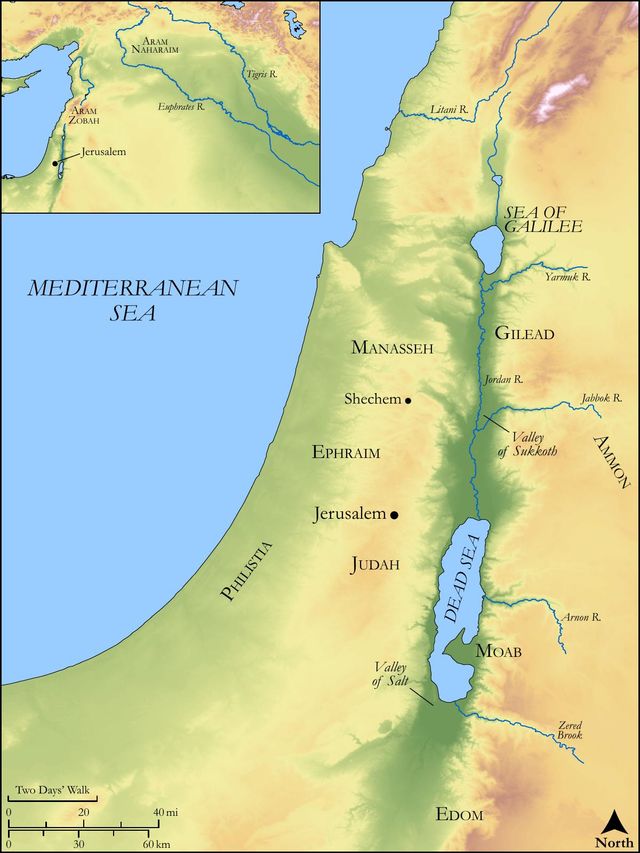
See on the biblical-era map
Study this verse
Public-domain commentary
Matthew Henry
From his Commentary on the Whole Bible. Henry comments on passages, not single verses — this entry covers Psalms 60:6–12. His three-level outline is real structure in the source text, so it is rendered as structure.
David is here rejoicing in hope and praying in hope; such are the triumphs of the saints, not so much upon the account of what they have in possession as of what they have in prospect (Psa 60:6): "God has spoken in his holiness (that is, he has given me his word of promise, has sworn by his holiness, and he will not lie unto David, Psa 89:35), therefore I will rejoice, and please myself with the hopes of the performance of the promise, which was intended for more than a pleasing promise," Note, God's word of promise, being a firm foundation of hope, is a full fountain of joy to all believers.
I.David here rejoices; and it is in prospect of two things: -
1.The perfecting of this revolution in his own kingdom. God having spoken in his holiness that David shall be king, he doubts not but the kingdom is all his own, as sure as if it were already in his hand: I will divide Shechem (a pleasant city in Mount Ephraim) and mete out the valley of Succoth, as my own. Gilead is mine, and Manasseh is mine, and both are entirely reduced, Psa 60:7. Ephraim would furnish him with soldiers for his life-guards and his standing forces; Judah would furnish him with able judges for his courts of justice; and thus Ephraim would be the strength of his head and Judah his lawgiver. Thus may an active believer triumph in the promises, and take the comfort of all the good contained in them; for they are all yea and amen in Christ. "God has spoken in his holiness, and then pardon is mine, peace mine, grace mine, Christ mine, heaven mine, God himself mine." All is yours, for you are Christ's, Co1 3:22, Co1 3:23.
2.The conquering of the neighbouring nations, which had been vexatious to Israel, were still dangerous, and opposed the throne of David, Psa 60:8. Moab shall be enslaved, and put to the meanest drudgery. The Moabites became David's servants, Sa2 8:2. Edom shall be made a dunghill to throw old shoes upon; at least David shall take possession of it as his own, which was signified by drawing off his shoe over it, Rut 4:7. As for the Philistines, let them, if they dare, triumph over him as they had done; he will soon force them to change their note. Rather let those that know their own interest triumph because of him; for it would be the greatest kindness imaginable to them to be brought into subjection to David and communion with Israel. But the war is not yet brought to an end; there is a strong city, Rabbah (perhaps) of the children of Ammon, which yet holds out; Edom is not yet subdued. Now,
(1.)David is here enquiring for help to carry on the ark: "Who will bring me into the strong city? What allies, what auxiliaries, can I depend upon, to make me master of the enemies' country and their strongholds?" Those that have begun a good work cannot but desire to make a thorough work of it, and to bring it to perfection.
(2.)He is expecting it from God only: "Wilt not thou, O God? For thou hast spoken in thy holiness; and wilt not thou be as good as thy word?" He takes notice of the frowns of Providence they had been under: Thou hadst, in appearance, cast us off; thou didst not go forth with our armies. When they were defeated and met with disappointments, they owned it was because they wanted (that is, because they had forfeited) the gracious presence of God with them; yet they do not therefore fly off from him, but rather take so much the faster hold of him; and the less he has done for them of late the more they hoped he would do. At the same time that they own God's justice in what was past they hope in his mercy for what was to come: "Though thou hadst cast us off, yet thou wilt not contend for ever, thou wilt not always chide; though thou hadst cast us off, yet thou hast begun to show mercy; and wilt thou not perfect what thou hast begun?" The Son of David, in his sufferings, seemed to be cast off by his Father when he cried out, Why hast thou forsaken me? and yet even then he obtained a glorious victory over the powers of darkness and their strong city, a victory which will undoubtedly be completed at last; for he has gone forth conquering and to conquer. The Israel of God, his spiritual Israel, are likewise, through him, more than conquerors. Though sometimes they may be tempted to think that God has cast them off, and may be foiled in particular conflicts, yet God will bring them into the strong city at last. Vincimur in praelio, sed non in bello - We are foiled in a battle, but not in the whole war. A lively faith in the promise will assure us, not only that the God of peace shall tread Satan under our feet shortly, but that it is our Father's good pleasure to give us the kingdom.
II.He prays in hope.
His prayer is, Give us help from trouble, Psa 60:11. Even in the day of their triumph they see themselves in trouble, because still in war, which is troublesome even to the prevailing side. None therefore can delight in war but those that love to fish in troubled waters. The help from trouble they pray for is preservation from those they were at war with. Though now they were conquerors, yet (so uncertain are the issues of war), unless God gave them help in the next engagement, they might be defeated; therefore, Lord, send us help from the sanctuary. Help from trouble is rest from war, which they prayed for, as those that contended for equity, not for victory. Sic quaerimus pacem - Thus we seek for peace. The hope with which they support themselves in this prayer has two things in it: - 1. A diffidence of themselves and all their creature-confidences: Vain is the help of man. Then only we are qualified to receive help from God when we are brought to own the insufficiency of all creatures to do that for us which we expect him to do. 2. A confidence in God, and in his power and promise (Psa 60:12): "Through God we shall do valiantly, and so we shall do victoriously; for he it is, and he only, that shall tread down our enemies, and shall have the praise of doing it." Note, (1.) Our confidence in God must be so far from superseding that it must encourage and quicken our endeavours in the way of our duty. Though it is God that performs all things for us, yet there is something to be done by us. (2.) Hope in God is the best principle of true courage. Those that do their duty under his conduct may afford to do it valiantly; for what need those fear who have God on their side? (3.) It is only through God, and by the influence of his grace, that we do valiantly; it is he that puts strength into us, and inspires us, who of ourselves are weak and timorous, with courage and resolution. (4.) Though we do ever so valiantly, the success must be attributed entirely to him; for he it is that shall tread down our enemies, and not we ourselves. All our victories, as well as our valour, are from him, and therefore at his feet all our crown must be cast.
Historical interpretation
Two Centuries of Reception
6 surviving comments on this verse. Each one is dated, so this reads as a timeline rather than a list.
Select a marker to jump to its quote. Markers stagger vertically where authors wrote within a few decades of each other.
“Gilead is mine, and Manasseh is mine.” Gilead is a grandson of Manasseh; this is said in order that he may show that the succession of the patriarchs, from whom is descended Christ according to the flesh, comes down from God. “And Ephraim is the support of my head. Judah is my king.” He will join together by agreement the parts that are severed. “Moab is the washbasin of my hope.” Or “a pot for washing,” another of the interpreters says; or “a pot of security”; that is to say, the excommunicated person, who has been forbidden with threats to enter the church of the Lord. For the Moabite and the Ammonite will not enter until the third and until the tenth generation and until everlasting time. Nevertheless, since baptism possesses remission for sins and produces security for the debtors, he, showing the deliverance through baptism and the affection for God, says, “Moab is a pot for washing” or “a pot of security.” Therefore, all “foreigners are made subject,” bowing down under the yoke of Christ; for this reason he will set his shoe in Edom. The shoe of the divinity is the God-bearing flesh, through which he approaches humans. In this hope, pronouncing blessed the time of the coming of the Lord, the prophet says, “Who will bring me into the fortified city.” Perhaps he means the church, a city, indeed, because it is a community governed conformably to laws; and fortified, because of the faith encompassing it. Whence one of the interpreters produced a very clear translation: “Into a city fortified all around.” Who, then, will permit me to see this great spectacle, God living among people? These are the words of the Lord: “Many prophets and just people have longed to see what you see, and they have not seen it.”
Therefore, “O God, you have cast us off.” You have cast off those who in proportion to their sins removed themselves a distance from you. You have destroyed the accumulations of our wickedness, doing good to us because of our weakness. You were angry, since “we were by nature children of wrath,” having no hope and being without God in the world. You had mercy on us when “you sent forth your only-begotten Son as a propitiation for our sins,” in order that in his blood we might find redemption. We would not know that we were having these kindnesses done to us, unless “you have made us drink the wine of sorrow.” By wine he means the words that lead the hardened heart to conscious perception.
"Into Idumæa I will stretch out my shoe" [Psalm 60:8]. The Church speaks, "I will come through even unto Idumæa." Let tribulations rage, let the world boil with offenses, even unto those very persons that lead an earthly life (for Idumæa is interpreted earthly), even unto those same, "even unto Idumæa, I will stretch out my shoe." Of what thing the shoe except of the Gospel? "How beautiful the feet of them that tell of peace, that tell of good things," [Romans 10:15] and "the feet shod unto the preparation of the Gospel of peace." [Ephesians 6:15] ...In these times we see, brethren, how many earthly men do perpetrate frauds for the sake of gain, for frauds perjuries; on account of their fears they consult fortune-tellers, astrologers: all these men are Edomites, earthly; and nevertheless all these men adore Christ, under His own shoe they are; now even unto Idumæa is stretched out His shoe. "To Me Allophyli have been made subject." Who are "Allophyli"? Men of other race, not belonging to My race. They "have been made subject," because many men adore Christ, and are not to reign with Christ.
All strangers have stooped and been put under the yoke of Christ, wherefore also “over Edom” does he “cast out” his “shoe.” Now the shoe of the Godhead is the flesh that bore God whereby he came among humankind.
When a person lays aside his past sinfulness, he is suddenly endowed with new dignity, with that cup of divine love of which it is said, “And your cup which inebriated me, how it overflows!” Inebriated with that cup, I repeat, hearts taste the sweetness of heavenly things through the strength of spiritual wisdom. Then they may merit to hear, “Taste and see how good the Lord is.” Now he said “taste,” because love of God can refresh the soul but cannot satisfy the desire, regardless of the amount of faith or longing with which it is sought. More and more, it arouses thirst when it is, as it were, tasted beforehand with the edge of the lips, and for this reason he says of himself, “He who eats of me will hunger still, he who drinks of me will thirst for more.” Because of its sweetness, it arouses an appetite for itself, but it does not cause disgust from satiety. Just as people who are experienced in drinking wine are likely to thirst all the more when they have become drunk, so it is with the devout and chaste soul that is prudent and contrite and that can, therefore, say with the psalmist, “You have given us stupefying wine,” when it has begun to think about hope in a future life and to imbibe a thirst for heavenly goods. It knows how to be filled but not how to be satisfied, so that the more it consumes according to its capacity, the more it lacks in its eagerness, and it can join with the prophet in that word of longing: “My soul pines for your salvation”;4 and again: “My flesh and my heart waste away, O God of my heart”; moreover, “My soul yearns and pines for the courts of the Lord.”
For who does not know that sandals are made from dead animals? But the Lord coming incarnate appeared as if shod, because in his divinity he assumed the dead flesh of our corruption. Hence also through the Prophet he says: "Over Edom I will extend my sandal." For by Edom the Gentile world is signified, and by the sandal the assumed mortality is designated. Therefore the Lord asserts that he extends his sandal over Edom, because when he became known to the Gentiles through flesh, divinity came to us as if shod.
Continue studying Psalms 60:8 across the web’s major study libraries — every link below opens this exact verse, chapter, or book on the destination site.
Read & Compare
 BibleGatewayThis verse in more than 200 translations and 70 languages.
 Bible.comThe YouVersion reader — hundreds of translations, reading plans, and highlights.
 ESV.orgCrossway's official English Standard Version reader.
 NET BibleThe NET translation with 60,000+ translators' notes on every rendering decision.
 STEP BibleTyndale House's free study tool — original text, vocabulary, and scholarly resources.
 BibliaLogos Bible Software's free web reader.
 USCCBThe New American Bible (Revised Edition) with the U.S. bishops' study notes.
Commentaries
 BibleHub CommentariesDozens of classic commentaries on this verse, gathered on one page.
 StudyLightMore than 100 commentary sets — the largest collection on the web.
 BibleRefPlain-English commentary on what this verse means, verse by verse.
 Enduring WordDavid Guzik's free commentary on this chapter, widely used by Bible teachers.
 Bible Study ToolsVerse commentary alongside Greek and Hebrew study aids.
Original Language & Research
- BibleHub InterlinearThe verse word by word — original language, transliteration, and English.
- BibleHub LexiconEvery word's original-language definition and Strong's entry.
 Blue Letter BibleDeep-study tools — Strong's numbers, concordance, and word studies.
 SefariaThe Hebrew text with Rashi and centuries of Jewish commentary.
Sermons, Hymns & Audio


TrulyRandomVerse is not affiliated with these sites and doesn’t control their content. They’re linked because they’re genuinely useful.
Summary
Psalms 60:8 stands as a potent declaration of divine sovereignty and assured victory, spoken from the perspective of God or His anointed king, David, over the traditional adversaries of Israel. This verse encapsulates a profound sense of God's absolute control and the promise of triumph for His people, employing vivid, culturally resonant imagery to depict the utter subjugation and humiliation of nations that dared to oppose God's chosen nation. It is a testament to the reversal of fortunes, where former oppressors are brought low under divine judgment.
Context
ShowHideLiterary Context
Psalm 60 is a communal lament and a prayer for restoration, uniquely framed by a superscription that anchors it to a specific historical moment in David's reign. The psalm opens with a poignant cry of distress, acknowledging a perceived divine rejection and military defeat (verses 1-3), followed by an earnest plea for God's merciful intervention (verses 4-5). A pivotal shift occurs in verse 6, where God speaks a prophetic oracle, promising victory and affirming His dominion over key Israelite territories like Shechem, Succoth, Gilead, and Manasseh, with Ephraim and Judah serving as His strength and scepter. Verse 8, therefore, seamlessly continues this divine oracle, specifically targeting the prominent foreign enemies—Moab, Edom, and Philistia—thereby solidifying the comprehensive nature of God's promised triumph. The psalm concludes with a renewed, faith-filled plea for God's help to actualize the promised victory, demonstrating the psalmist's unwavering trust in God's word despite ongoing challenges.
Historical & Cultural Context
The superscription of Psalm 60 explicitly links its composition to a significant period of military conflict during King David's reign: "When he strove with Aram-naharaim and with Aram-zobah, when Joab returned, and smote of Edom in the valley of salt twelve thousand." This places the psalm within the broader narrative of David's expansion of the Israelite kingdom, specifically following a setback against the Arameans but preceding or during a decisive victory over Edom. Moab, situated east of the Dead Sea, was a frequent antagonist of Israel, and David indeed brought them under his dominion, as recorded in 2 Samuel 8:2. Edom, located south of Moab and descended from Esau, also shared a long history of antagonism with Israel, and David similarly subjected them to his rule (2 Samuel 8:14). The Philistines, dwelling along the Mediterranean coast, represented Israel's most formidable and persistent enemies during the early monarchy, often posing an existential threat, famously exemplified by David's encounter with Goliath in 1 Samuel 17:50. The imagery employed in the verse—the washpot, casting a shoe, and a forced shout—are powerful symbols of humiliation, subjugation, and the assertion of ownership in that day.
Key Themes
ShowHidePsalms 60:8 profoundly contributes to several foundational themes prevalent throughout the Psalter and the broader Old Testament narrative. Foremost among these is the theme of Divine Sovereignty, which asserts God's absolute control and authority over all nations, even those that appear powerful or have historically opposed His people. Their ultimate fate rests entirely in His hands, a truth echoed in Psalm 2:8. This verse also powerfully highlights the Assurance of Victory for God's chosen king and nation. Despite initial defeats or present struggles, the psalm transitions to a confident declaration of God's promise to grant dominion, offering profound comfort and hope in times of adversity. Furthermore, the vivid imagery underscores the Humiliation of Enemies, showcasing the complete subjugation and abasement of opposing nations before God's overwhelming might. Finally, the verse implicitly reinforces God's Faithfulness to His covenant promises to Israel, ensuring their ultimate triumph over adversaries and the establishment of His righteous kingdom on earth.
Exposition and Analysis
ShowHideKey Word Analysis
ShowHideFrom a prolonged form of the prepositional prefix m- and אָב; meaning "from (her (the mother's)) father." Moab was an incestuous son of Lot, and the term refers to both his descendants and their territory east of the Dead Sea. In this context, Moab represents a historical and persistent enemy of Israel, whose subjugation signifies God's comprehensive triumph over His people's foes.
The Hebrew word çîyr (H5518) refers to a "pot" or "caldron," while rachats (H7366) means "to wash" or "a bath." Combined, "washpot" denotes a humble, utilitarian vessel used for washing feet or clothes, often associated with menial tasks performed by servants or slaves. To declare Moab as a "washpot" is an extreme expression of contempt and utter debasement, reducing a proud nation to a subservient, ignoble status, fit only for the most demeaning service. It symbolizes complete subjugation and the loss of all dignity and independence.
A primitive root meaning "to throw out, down or away" (literally or figuratively); to adventure, cast (away, down, forth, off, out), hurl, pluck, throw. In the phrase "over Edom will I cast out my shoe," this verb signifies a decisive and forceful act of asserting dominion. It implies a casual yet authoritative gesture of ownership and disdain, treating Edom as a conquered possession over which one exercises absolute and unquestioned control.
A primitive root meaning "to mar (especially by breaking); figuratively, to split the ears (with sound), i.e. shout (for alarm or joy)." While it can denote a shout of triumph or joy, in the context of Philistia, it is almost universally interpreted ironically. The command implies that Philistia will be forced to shout not in victory, but in acknowledgment of God's superior power, perhaps a cry of distress, submission, or even a forced acclamation of Israel's God-given dominion. It signifies the reversal of fortunes, where the former boastful enemy is compelled to acknowledge the true victor.
Verse Breakdown
ShowHide"Moab [is] my washpot"
This clause emphatically declares Moab's complete subjugation. The possessive "my" underscores divine ownership or the king's dominion granted by God. Moab, a long-standing and often arrogant enemy, is here reduced to the status of a lowly, common washbasin, signifying profound contempt, utter humiliation, and forced servitude. It implies that Moab will be utilized by Israel for the most menial and demeaning purposes, stripped of its former pride, independence, and national identity.
"over Edom will I cast out my shoe"
This phrase further emphasizes divine or royal authority and absolute ownership over Edom. The act of "casting out my shoe" over Edom is a powerful symbolic gesture. In that day, throwing a shoe could signify taking possession of land or property, or more commonly, it was a gesture of contempt, disdain, or utter subjugation, much like a master might casually discard his shoe over a slave or conquered territory. Over Edom, it powerfully conveys absolute proprietorship and abject humiliation, indicating that Edom is now under the complete control and dominion of God's chosen king.
"Philistia, triumph thou because of me"
This is a striking and profoundly ironic declaration concerning Philistia. Instead of Philistia triumphing over Israel, as they often had in the past, the command is for them to "triumph" (or shout) because of God's action. This implies that their "triumph" will not be one of victory or celebration, but rather a forced shout of submission, a cry of lament, or a reluctant, perhaps even bitter, acknowledgment of Israel's God-given supremacy. It signifies a complete reversal of fortunes, where the former oppressors are now compelled to acknowledge the overwhelming power of the God of Israel and His victorious people.
Literary Devices
ShowHidePsalms 60:8 is exceptionally rich in Imagery and Metaphor, painting vivid and unforgettable pictures of divine judgment and conquest. The comparison of Moab to a "washpot" is a potent Metaphor for utter debasement and servitude, reducing a once-proud nation to a common, ignoble household item used for the most menial tasks. Similarly, the act of "casting out my shoe" over Edom employs a powerful Metaphor and Symbolism for claiming possession and expressing profound contempt, evoking a master's casual dominion over a slave or a conquered territory. The phrase "Philistia, triumph thou because of me" utilizes profound Irony. What would typically be a shout of victory for Philistia is twisted into a forced acknowledgment of Israel's triumph, or even a cry of despair and submission, at the hand of God. The nations themselves are treated almost as persons, capable of being humiliated and forced to react, which is a subtle form of Personification. These literary devices collectively amplify the message of God's absolute sovereignty and the inevitable subjugation of all who oppose His divine will.
Theological and Thematic Connections
ShowHideThis verse powerfully articulates God's absolute sovereignty over all nations and His unwavering commitment to His covenant promises to Israel. It underscores the profound theological truth that no earthly power, however formidable or historically antagonistic, can ultimately stand against the divine will. The humiliation of Moab, Edom, and Philistia serves as a stark testament to God's justice and His ability to bring low the proud and elevate His chosen people. This declaration of dominion is not merely about political conquest but about the establishment of God's righteous rule, foreshadowing a time when all nations will acknowledge His supreme authority. It reinforces the theme that God uses His anointed king (David, and ultimately Christ) as the instrument of His universal dominion, ensuring that His purposes prevail over all opposition, demonstrating that the Lord alone is God over all the earth.
Reflection and Application
ShowHideFor the modern believer, Psalms 60:8 offers profound encouragement and a vital perspective on God's enduring sovereignty amidst life's inevitable battles. We often face "enemies" in the form of spiritual opposition, overwhelming circumstances, personal struggles, or societal injustices that seem insurmountable. This verse powerfully reminds us that just as God brought powerful, historical nations to their knees before His anointed king, He remains absolutely sovereign over every challenge and adversary we encounter. We are called to cultivate a deep, unwavering trust in God's ultimate control, knowing that He holds the power to subdue what seems impossible in our lives. This confidence in divine victory is not a call to passivity but an active invitation to stand firm in faith, knowing that God is actively working on behalf of His people. It encourages us to pray boldly for deliverance, to persevere through trials, and to align our lives with His righteous purposes, understanding that all who oppose God's will, whether they be spiritual forces, personal strongholds, or pervasive evils, will ultimately be brought low before His supreme authority. Our battles may be intense, but our God is eternally victorious.
Questions for Reflection
ShowHideFAQ
ShowHideDoes "Moab is my washpot" imply literal servitude for Moabites today?
ShowHideNo, the phrase "Moab is my washpot" is a highly symbolic and metaphorical declaration of complete subjugation and humiliation within the setting of David's wars. It refers to the historical defeat and dominion of the nation of Moab by King David, acting as God's instrument, as recorded in 2 Samuel 8:2. The language is not a literal prophecy for the perpetual, physical servitude of the descendants of Moab in the modern era. Instead, it serves as a powerful illustration of God's absolute sovereignty over nations and His ability to bring down those who oppose His purposes, demonstrating that even the proudest adversaries will be brought low before His divine authority. The primary application for believers today is understanding God's power over all opposition and His faithfulness to His people, rather than a literal interpretation of the ongoing fate of a specific ancient nation.
Christ-Centered Fulfillment
ShowHidePsalms 60:8, with its vivid imagery of divine triumph over national enemies, finds its ultimate and most profound fulfillment in the person and work of Jesus Christ. While David's historical victories over Moab, Edom, and Philistia were significant shadows of God's dominion, Christ's victory is spiritual and eternal, over all things. He is the true King, the greater David, who has definitively triumphed over the ultimate enemies of humanity: sin, death, and the spiritual principalities and powers of darkness. Just as God declared His dominion over earthly nations through His anointed king, so in Christ, God has made a public spectacle of the principalities and powers, triumphing over them by the cross (Colossians 2:15). The "washpot" and "cast shoe" imagery powerfully foreshadow the complete subjugation of all spiritual opposition under Christ's feet, a theme echoed profoundly in the New Testament, where Christ "must reign until he has put all his enemies under his feet" (1 Corinthians 15:25). His resurrection from the dead is the ultimate declaration of victory, rendering death itself a defeated foe (1 Corinthians 15:54-57). Thus, the psalmist's confident declaration becomes a prophetic glimpse of the Lamb of God, who not only takes away the sin of the world (John 1:29) but also reigns as King of Kings and Lord of Lords, before whom every knee will ultimately bow and every tongue confess His supreme authority (Revelation 19:16 and Philippians 2:10-11).