


Revelation 13:6
Bible text: King James Version (1769 Blayney text) · Public domain
Bible text: King James Version with Strong's numbers · Public domain
Bible text: Berean Standard Bible · Public domain
Bible text: American Standard Version (1901) · Public domain
Bible text: World English Bible, Messianic edition · Public domain
Bible text: Geneva Bible (1599) · Public domain
Bible text: Young's Literal Translation · Public domain
- καὶkaiAndG2532CONJConjunction
- ἤνοιξενēnoixenit openedG455V-2AAI-3SVerb 2nd Aorist Active Indicative 3rd Singular
- τὸtotheG3588T-ASNDefinite article Accusative Singular Neuter
- στόμαstomamouthG4750N-ASNNoun Accusative Singular Neuter
- αὐτοῦautouof itG846P-GSNPersonal pronoun Genitive Singular Neuter
- εἰςeisuntoG1519PREPPreposition
- βλασφημίαςblasphēmiasblasphemiesG988N-APFNoun Accusative Plural Feminine
- πρὸςprosagainstG4314PREPPreposition
- τὸνton<the>G3588T-ASMDefinite article Accusative Singular Masculine
- θεὸνtheonGodG2316N-ASM-TNoun Accusative Singular Masculine Title
- βλασφημῆσαιblasphēmēsaito blasphemeG987V-AANVerb Aorist Active Infinitive
- τὸtotheG3588T-ASNDefinite article Accusative Singular Neuter
- ὄνομαonomanameG3686N-ASNNoun Accusative Singular Neuter
- αὐτοῦautouof HimG846P-GSMPersonal pronoun Genitive Singular Masculine
- καὶkaiandG2532CONJConjunction
- τὴνtēntheG3588T-ASFDefinite article Accusative Singular Feminine
- σκηνὴνskēnēntabernacleG4633N-ASFNoun Accusative Singular Feminine
- αὐτοῦautouof HimG846P-GSMPersonal pronoun Genitive Singular Masculine
- καὶkaiandG2532CONJConjunction
- τοὺςtousthoseG3588T-APMDefinite article Accusative Plural Masculine
- ἐνeninG1722PREPPreposition
- τῷtō<the>G3588T-DSMDefinite article Dative Singular Masculine
- οὐρανῷouranōheavenG3772N-DSMNoun Dative Singular Masculine
- σκηνοῦνταςskēnountasdwellingG4637V-PAP-APMVerb Present Active Participle Accusative Plural Masculine
English is a literal word-by-word gloss of the Greek, not the KJV's wording. Why?
This is the original text the KJV's translators worked from — each Greek word with its own literal English meaning in this verse, prepared by scholars at Tyndale House, Cambridge. The KJV translates whole sentences, not word by word, so its wording differs: one Greek word can become several English words, and the KJV may choose “charity” where the gloss reads “love”. Both are faithful — they answer different questions. For the KJV's own rendering, switch to the KJV text.
Details
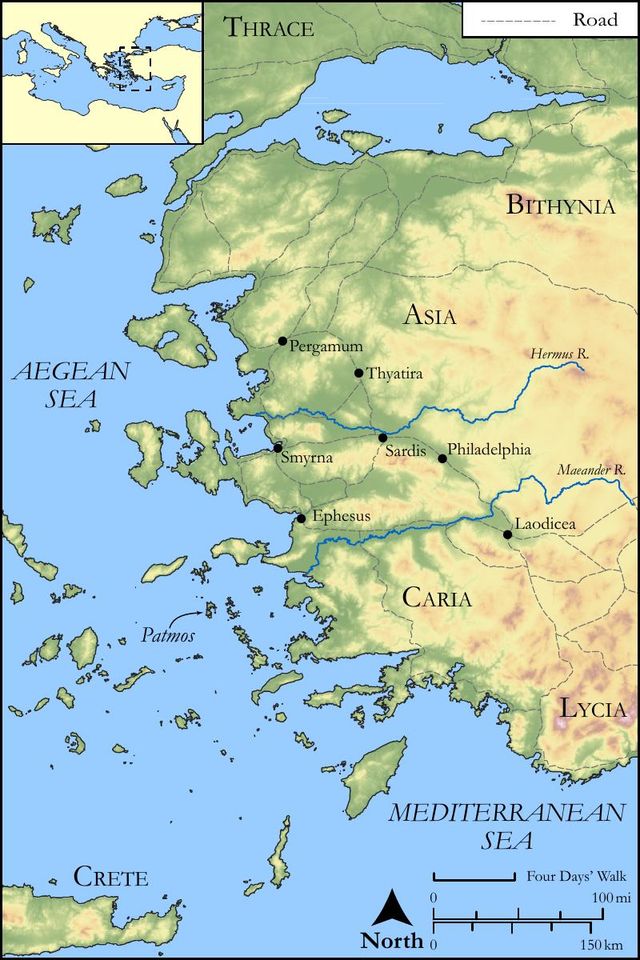
See on the biblical-era maps

Study this verse
Public-domain commentary
Matthew Henry
From his Commentary on the Whole Bible. Henry comments on passages, not single verses — this entry covers Revelation 13:1–10.
We have here an account of the rise, figure, and progress of the first beast; and observe, 1. From what situation the apostle saw this monster. He seemed to himself to stand upon the sea-shore, though it is probable he was still in a rapture; but he took himself to be in the island Patmos, but whether in the body or out of the body he could not tell. 2. Whence this beast came - out of the sea; and yet, by the description of it, it would seem more likely to be a land-monster; but the more monstrous every thing about it was the more proper an emblem it would be to set forth the mystery of iniquity and tyranny. 3. What was the form and shape of this beast. It was for the most part like a leopard, but its feet were like the feet of a bear and its mouth as the mouth of a lion; it had seven heads, and ten horns, and upon its heads the name of blasphemy: the most horrid and hideous monster! In some part of this description here seems to be an allusion to Daniel's vision of the four beasts, which represented the four monarchies, Dan 7:1-3, etc. One of these beasts was like a lion, another like a bear, and another like a leopard; this beast was a sort of composition of those three, with the fierceness, strength, and swiftness, of them all; the seven heads and the ten horns seem to design its several powers; the ten crowns, its tributary princes; the word blasphemy on its forehead proclaims its direct enmity and opposition to the glory of God, by promoting idolatry. 4. The source and spring of his authority - the dragon; he gave him his power, and seat, and great authority. He was set up by the devil, and supported by him to do his work and promote his interest; and the devil lent him all the assistance he could. 5. A dangerous wound given him, and yet unexpectedly healed, Rev 13:3. Some think that by this wounded head we are to understand the abolishing of pagan idolatry; and by the healing of the wound the introducing of the popish idolatry, the same in substance with the former, only in a new dress, and which as effectually answers the devil's design as that did. 6. The honour and worship paid to this infernal monster: All the world wondered after the beast; they all admired his power, and policy, and success, and they worshipped the dragon that gave power to the beast, and they worshipped the beast; they paid honour and subjection to the devil and his instruments, and thought there was no power able to withstand them: so great were the darkness, degeneracy, and madness of the world! 7. How he exercised his infernal power and policy: He had a mouth, speaking great things, and blasphemies; he blasphemed God, the name of God, the tabernacle of God, and all those that dwell in heaven; and he made war with the saints, and overcame them, and gained a sort of universal empire in the world. His malice was principally levelled at the God of heaven, and his heavenly attendants - at God, in making images of him that is invisible, and in worshipping them; - at the tabernacle of God, that is, say some, at the human nature of the Lord Jesus Christ, in which God dwells as in a tabernacle; this is dishonoured by their doctrine of transubstantiation, which will not suffer his body to be a true body, and will put it into the power of every priest to prepare a body for Christ; - and against those that dwell in heaven, the glorified saints, by putting them into the place of the pagan demons, and praying to them, which they are so far from being pleased with that they truly judge themselves wronged and dishonoured by it. Thus the malice of the devil shows itself against heaven and the blessed inhabitants of heaven. These are above the reach of his power. All he can do is to blaspheme them; but the saints on earth are more exposed to his cruelty, and he sometimes is permitted to triumph over them and trample upon them. 8. The limitation of the devil's power and success, and that both as to time and persons. He is limited in point of time; his reign is to continue forty-and-two months (Rev 13:5), suitable to the other prophetical characters of the reign of antichrist. He is also limited as to the persons and people that he shall entirely subject his will and power; it will be only those whose names are not written in the Lamb's book of life. Christ had a chosen remnant, redeemed by his blood, recorded in his book, sealed by his Spirit; and though the devil and antichrist might overcome their bodily strength, and take away their natural life, they could never conquer their souls, nor prevail with them to forsake their Saviour and revolt to his enemies. 9. Here is a demand of attention to what is here discovered of the great sufferings and troubles of the church, and an assurance given that when God has accomplished his work on mount Zion, his refining work, then he will turn his hand against the enemies of his people, and those who have killed with the sword shall themselves fall by the sword (Rev 13:10), and those who led the people of God into captivity shall themselves be made captives. Here now is that which will be proper exercise for the patience and faith of the saints - patience under the prospect of such great sufferings, and faith in the prospect of so glorious a deliverance.
Historical interpretation
Four Centuries of Reception
5 surviving comments on this verse. Each one is dated, so this reads as a timeline rather than a list.
Select a marker to jump to its quote. Markers stagger vertically where authors wrote within a few decades of each other.
The forty-two months are to be interpreted as the time of the last persecution. “It opened its mouth to blaspheme against God.” It is clear that this refers to those who have left the catholic church, for while earlier they seemed to be within the church as though they held the right faith, in time of persecution they openly blaspheme God with the mouth. [The dwelling of God] is the saints who are contained within the church, which is called “heaven,” for they are the habitation of God.
With these months there is completed the three years and six months, which above were understood to refer to the quality of the present age. However, here the severity of the final persecution is especially foretold. For were one to consider the four familiar directions of the earth and multiply four times the ten sayings of the law, which is the symbol of perfection, one would have forty. Were the performance of the two commandments of love added to this, the number forty-two would be completed. That which is commanded in words achieves no favor if it is not perfected by works. And the church is said to be protected by these [commandments] as though by the wings of an eagle, and she flees from the treachery of the dragon into the wilderness to be nourished there for 1, days, which is equal to the forty-two months, so that the calculation of the same number may not render a useless meaning.… [The beast blasphemed] against God and the church, which dwells in heaven, because “our citizenship is in heaven,” and “now you are not in the flesh.” I think that here the temple might also signify the glorified trophy of the body of Christ against whom the antichrist is said then to blaspheme, when he has dared assign to himself that honor which is especially due to [Christ]. Concerning this the Lord said in the Gospel, “That they might lead astray, if possible, even the elect,” and just earlier, “But for the elect those days will be shortened.”
With the allowance of God, it says, he will have authority for three and a half years to blaspheme against God and to harm the saints. The “dwelling of God” is the dwelling of the Word in the flesh, that is, his incarnation, as well as his repose among the saints, against whom, as also against the holy angels, he will fully direct his blasphemy.
To blaspheme His name and His tabernacle. The wicked one, usurping for himself the dignity of God's name, will also presume to call his own church by that name.
He says, and he opened his mouth in blasphemy against God, to blaspheme his name and his tabernacle, and them that dwell in heaven. It is said that the blasphemies against God are of the apostate. By the tabernacle of God he means the holy angels because God dwells in them. For if it has been said concerning men, "I will dwell in them and walk among them," (2 Cor 6:16; see Lev. 26:11) what would one say about the heavenly powers, that God has them as a dwelling?
Continue studying Revelation 13:6 across the web’s major study libraries — every link below opens this exact verse, chapter, or book on the destination site.
Read & Compare
 BibleGatewayThis verse in more than 200 translations and 70 languages.
 Bible.comThe YouVersion reader — hundreds of translations, reading plans, and highlights.
 ESV.orgCrossway's official English Standard Version reader.
 NET BibleThe NET translation with 60,000+ translators' notes on every rendering decision.
 STEP BibleTyndale House's free study tool — original text, vocabulary, and scholarly resources.
 BibliaLogos Bible Software's free web reader.
 USCCBThe New American Bible (Revised Edition) with the U.S. bishops' study notes.
Commentaries
 BibleHub CommentariesDozens of classic commentaries on this verse, gathered on one page.
 StudyLightMore than 100 commentary sets — the largest collection on the web.
 BibleRefPlain-English commentary on what this verse means, verse by verse.
 Enduring WordDavid Guzik's free commentary on this chapter, widely used by Bible teachers.
 Bible Study ToolsVerse commentary alongside Greek and Hebrew study aids.
Original Language & Research
- BibleHub InterlinearThe verse word by word — original language, transliteration, and English.
- BibleHub LexiconEvery word's original-language definition and Strong's entry.
 Blue Letter BibleDeep-study tools — Strong's numbers, concordance, and word studies.
 CNTR CollationThe earliest Greek manuscripts of this verse, collated letter by letter.
Sermons, Hymns & Audio


TrulyRandomVerse is not affiliated with these sites and doesn’t control their content. They’re linked because they’re genuinely useful.
Summary
Revelation 13:6 vividly portrays the malevolent character of the "beast" from the sea, a central figure in end-times prophecy, by describing its open and deliberate blasphemy against God. This act is not merely an incidental offense but a direct, vocal, and comprehensive assault on God's divine nature, His sacred presence, and all who are intimately connected with Him in heaven, revealing the beast's ultimate rebellion and defiance against the Creator's authority and glory.
Context
ShowHideLiterary Context
Revelation 13 introduces two formidable beasts, both empowered by the dragon (Satan, as identified in Revelation 12:9). The first beast, emerging from the sea, is depicted with seven heads and ten horns, a composite of the beasts from Daniel's vision (Daniel 7), symbolizing a powerful, oppressive empire. Prior to this verse, the beast is granted authority to rule for forty-two months (Revelation 13:5), and its rise is met with worship from the unbelieving world (Revelation 13:4). The opening of its mouth in blasphemy in Revelation 13:6 is a direct consequence and manifestation of the power and authority it has received, indicating its primary agenda is to oppose and insult the divine.
Historical & Cultural Context
The imagery of beasts in Revelation draws heavily from Old Testament prophetic traditions, particularly the book of Daniel, where powerful empires are symbolized by monstrous creatures. For John's original audience, likely facing Roman persecution, the "beast" would have resonated as a symbol of oppressive imperial power that demanded worship and persecuted Christians. Blasphemy, in both Jewish and Roman contexts, was a severe offense: for Jews, it was a direct insult to God punishable by death; for Romans, it could involve disrespecting the emperor, who was often deified. The beast's blasphemy would therefore be understood as a direct challenge to the true God, mirroring the imperial cult's demands for worship and its persecution of those who refused to acknowledge Caesar as divine.
Key Themes
ShowHideThis verse contributes significantly to several overarching themes within Revelation and broader biblical prophecy. It underscores the theme of Spiritual Conflict, portraying the ultimate spiritual battle between God and the forces of evil, with the beast acting as Satan's primary earthly agent. The beast's actions exemplify Rebellion and Usurpation of Divine Authority, as it not only claims power but actively speaks against the One true God, attempting to seize His glory and worship. This theme is echoed in passages like 2 Thessalonians 2:4 which describes the "man of lawlessness" who "exalts himself above every so-called god or object of worship." Furthermore, the blasphemy against God's "tabernacle" and "them that dwell in heaven" highlights the theme of Comprehensive Opposition to God's Presence and People, indicating that the beast's animosity extends to all aspects of God's being, dwelling, and heavenly court, setting the stage for the persecution of God's earthly saints (Revelation 13:7).
Exposition and Analysis
ShowHideKey Word Analysis
ShowHideMeaning "to open up (literally or figuratively, in various applications)." In this context, it emphasizes a deliberate, intentional, and public act. The beast does not merely harbor blasphemous thoughts but actively gives them vocal expression, making its defiance known.
Meaning "vilification (especially against God)." This term denotes abusive, slanderous, or impious speech. It is a strong and severe word, indicating not just error or misunderstanding, but a direct, contemptuous assault on the character, reputation, and authority of God.
Meaning "a tent or cloth hut (literally or figuratively); habitation." In Revelation, this often refers to God's heavenly dwelling place or temple, symbolizing His immediate presence and the place of true worship (Revelation 15:5). Blaspheming the tabernacle is an attack on God's sacred presence and the very locus of His divine activity and worship.
Verse Breakdown
ShowHide"And he opened his mouth"
This phrase signifies a deliberate and public declaration. It is not a casual or accidental utterance but a purposeful act of vocalizing the beast's inner antagonism. The mouth is the instrument of speech, and its opening here denotes the initiation of a sustained verbal assault.
"in blasphemy against God"
This specifies the nature and target of the beast's speech. It is "blasphemy," meaning slander, reviling, or impious speech, and it is directed explicitly "against God." This highlights the beast's fundamental opposition to the divine, demonstrating its spiritual allegiance to the dragon.
"to blaspheme his name"
The purpose clause indicates the specific objects of the beast's blasphemy. Blaspheming God's "name" is an attack on His very character, reputation, authority, and essence. In biblical thought, a name represents the person's identity and nature, so defiling God's name is to defile all that He is.
"and his tabernacle"
This extends the blasphemy to God's dwelling place. As noted in the key word analysis, the "tabernacle" here refers to God's heavenly sanctuary, the place of His immediate presence and worship. To blaspheme it is to desecrate the holy space where God dwells and receives adoration, challenging His sovereignty and purity.
"and them that dwell in heaven"
This final clause broadens the scope of the beast's blasphemy to include all who reside in God's presence. This would encompass angels and glorified saints (the "heavenly host" or "church of the firstborn," cf. Hebrews 12:22-23). By attacking those in heaven, the beast demonstrates its comprehensive hatred for all that is associated with God and His divine order, foreshadowing its persecution of God's people on earth.
Literary Devices
ShowHideRevelation 13:6 employs several powerful literary devices. Personification is evident as the abstract concept of "blasphemy" is given a voice through the beast, which "opens its mouth" to utter it. This makes the evil tangible and active. Symbolism is pervasive, with the "beast" itself symbolizing oppressive, anti-God political and spiritual power, and "heaven" symbolizing God's dwelling place and the realm of His faithful. The act of "blaspheming" is a form of Antithesis, setting the beast's defiant and impious speech in direct opposition to the worship and praise due to God. The progression from blaspheming God Himself to His "name," "tabernacle," and "them that dwell in heaven" utilizes Climax or Expansion, showing an escalating and comprehensive assault, moving from the divine essence to His presence and finally to His heavenly retinue, emphasizing the totality of the beast's rebellion.
Theological and Thematic Connections
ShowHideRevelation 13:6 serves as a stark theological declaration about the nature of ultimate evil and its direct opposition to God. It reveals that the pinnacle of rebellion is not merely human sinfulness but an active, conscious, and vocal defiance against the Creator's very being, His character (name), His sacred presence (tabernacle), and His heavenly community. This blasphemy underscores the spiritual warfare at play, where the enemy's primary objective is to usurp God's glory and dismantle His order. It highlights the profound contrast between the worship due to God alone and the false worship demanded by the beast, setting the stage for the final judgment where all blasphemers will be silenced.
Reflection and Application
ShowHideRevelation 13:6, while depicting a future, terrifying reality, offers profound insights for believers today. It calls us to a heightened sense of spiritual discernment, enabling us to recognize and resist ideologies, movements, or even subtle cultural shifts that subtly or overtly blaspheme God's name, challenge His authority, or disrespect His divine presence. In a world increasingly prone to relativism and open hostility towards biblical truth, this verse reminds us of the absolute necessity of upholding God's character and defending His honor. It encourages us to stand firm in our faith, knowing that the spiritual battle is real and that the enemy's ultimate target is God Himself. Our response should be one of unwavering loyalty to Christ, speaking truth in love, and living lives that glorify the Father, thereby counteracting the spirit of blasphemy with lives of worship and adoration.
Questions for Reflection
ShowHideFAQ
ShowHideWhat does it mean for the beast to "blaspheme his tabernacle" and "them that dwell in heaven"?
ShowHideTo "blaspheme his tabernacle" refers to the beast's attack on God's dwelling place, which in Revelation often symbolizes the heavenly temple or God's immediate, sacred presence. This is an act of desecration, a direct assault on the holiness and sanctity of God's abode and the place where true worship is offered. By blaspheming "them that dwell in heaven," the beast extends its animosity to all who are intimately connected with God in the heavenly realm. This includes the angels who serve Him and the glorified saints who have been redeemed and now reside in His presence (Hebrews 12:22-23). It signifies a comprehensive hatred for everything associated with God and His divine order, foreshadowing the beast's earthly persecution of God's people.
Christ-Centered Fulfillment
ShowHideWhile Revelation 13:6 describes the ultimate expression of rebellion against God, its profound darkness serves to highlight the glorious light of Christ's perfect obedience and ultimate triumph. The beast's blasphemy against God's name, tabernacle, and heavenly dwellers stands in stark contrast to Jesus Christ, who perfectly glorified the Father's name (John 17:4), is Himself the true "tabernacle" or dwelling place of God among humanity (John 1:14), and is the One through whom all who dwell in heaven and on earth will ultimately worship the Father (Philippians 2:9-11). The beast seeks to usurp divine authority, but Christ, being God, humbled Himself to become a servant, and was therefore highly exalted by God (Philippians 2:6-8). The beast blasphemes, but Jesus always spoke the truth of God, even to His own suffering and death (John 18:37). Ultimately, the beast's reign is temporary and will be utterly destroyed by the Lamb (Revelation 19:20), demonstrating that Christ, the faithful and true witness, is the sovereign Lord over all, whose name alone is worthy of all honor and praise.