


Revelation 13:4
“Who is like the beast?
Who can fight against it?”
- καὶkaiAndG2532CONJConjunction
- προσεκύνησανprosekunēsanthey worshipedG4352V-AAI-3PVerb Aorist Active Indicative 3rd Plural
- τῷtōtheG3588T-DSMDefinite article Dative Singular Masculine
- δράκοντιdrakontidragonG1404N-DSMNoun Dative Singular Masculine
- ὅτιhotithatG3754CONJConjunction
- ἔδωκενedōkengaveG1325V-AAI-3SVerb Aorist Active Indicative 3rd Singular
- τὴνtēn<the>G3588T-ASFDefinite article Accusative Singular Feminine
- ἐξουσίανexousianauthorityG1849N-ASFNoun Accusative Singular Feminine
- τῷtōto theG3588T-DSNDefinite article Dative Singular Neuter
- θηρίῳthēriōbeastG2342N-DSNNoun Dative Singular Neuter
- καὶkaiandG2532CONJConjunction
- προσεκύνησανprosekunēsanthey worshipedG4352V-AAI-3PVerb Aorist Active Indicative 3rd Plural
- τῷtōtheG3588T-DSNDefinite article Dative Singular Neuter
- θηρίῳthēriōbeastG2342N-DSNNoun Dative Singular Neuter
- λέγοντες·legontessayingG3004V-PAP-NPMVerb Present Active Participle Nominative Plural Masculine
- τίςtisWhoG5101I-NSMInterrogative pronoun Nominative Singular Masculine
- ὅμοιοςhomoios[is] likeG3664A-NSMAdjective Nominative Singular Masculine
- τῷtōas theG3588T-DSNDefinite article Dative Singular Neuter
- θηρίῳthēriōbeastG2342N-DSNNoun Dative Singular Neuter
- τίςtiswhoG5101I-NSMInterrogative pronoun Nominative Singular Masculine
- δύναταιdunataiis ableG1410V-PNI-3SVerb Present Middle Or Passive Deponent Indicative 3rd Singular
- πολεμῆσαιpolemēsaito make warG4170V-AANVerb Aorist Active Infinitive
- μετ᾽met᾽againstG3326PREPPreposition
- αὐτοῦ;autouit?G846P-GSNPersonal pronoun Genitive Singular Neuter
English is a literal word-by-word gloss of the Greek, not the KJV's wording. Why?
This is the original text the KJV's translators worked from — each Greek word with its own literal English meaning in this verse, prepared by scholars at Tyndale House, Cambridge. The KJV translates whole sentences, not word by word, so its wording differs: one Greek word can become several English words, and the KJV may choose “charity” where the gloss reads “love”. Both are faithful — they answer different questions. For the KJV's own rendering, switch to the KJV text.
Details
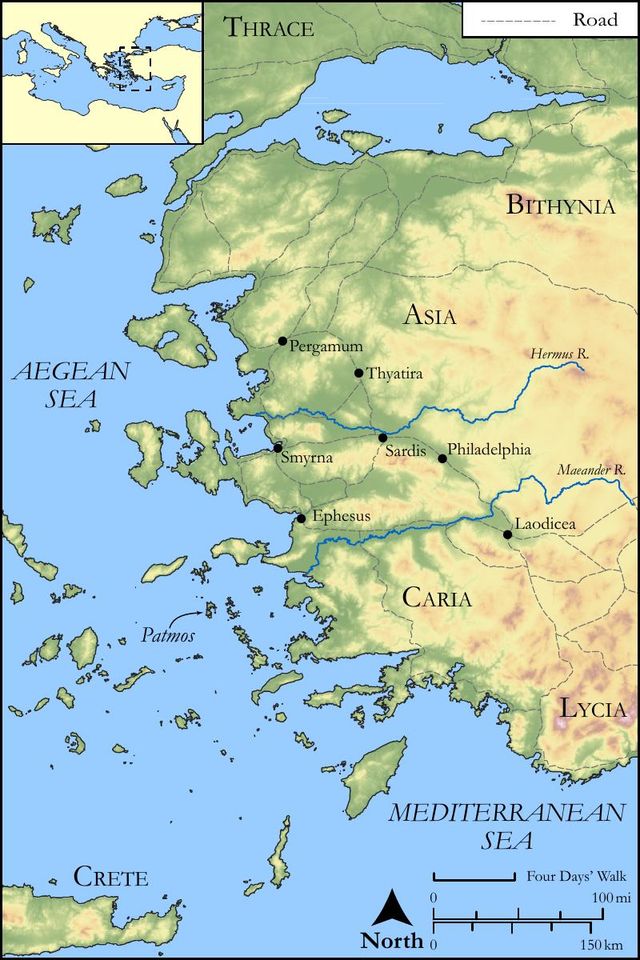
See on the biblical-era map

Study this verse
Public-domain commentary
Matthew Henry
From his Commentary on the Whole Bible. Henry comments on passages, not single verses — this entry covers Revelation 13:1–10.
We have here an account of the rise, figure, and progress of the first beast; and observe, 1. From what situation the apostle saw this monster. He seemed to himself to stand upon the sea-shore, though it is probable he was still in a rapture; but he took himself to be in the island Patmos, but whether in the body or out of the body he could not tell. 2. Whence this beast came - out of the sea; and yet, by the description of it, it would seem more likely to be a land-monster; but the more monstrous every thing about it was the more proper an emblem it would be to set forth the mystery of iniquity and tyranny. 3. What was the form and shape of this beast. It was for the most part like a leopard, but its feet were like the feet of a bear and its mouth as the mouth of a lion; it had seven heads, and ten horns, and upon its heads the name of blasphemy: the most horrid and hideous monster! In some part of this description here seems to be an allusion to Daniel's vision of the four beasts, which represented the four monarchies, Dan 7:1-3, etc. One of these beasts was like a lion, another like a bear, and another like a leopard; this beast was a sort of composition of those three, with the fierceness, strength, and swiftness, of them all; the seven heads and the ten horns seem to design its several powers; the ten crowns, its tributary princes; the word blasphemy on its forehead proclaims its direct enmity and opposition to the glory of God, by promoting idolatry. 4. The source and spring of his authority - the dragon; he gave him his power, and seat, and great authority. He was set up by the devil, and supported by him to do his work and promote his interest; and the devil lent him all the assistance he could. 5. A dangerous wound given him, and yet unexpectedly healed, Rev 13:3. Some think that by this wounded head we are to understand the abolishing of pagan idolatry; and by the healing of the wound the introducing of the popish idolatry, the same in substance with the former, only in a new dress, and which as effectually answers the devil's design as that did. 6. The honour and worship paid to this infernal monster: All the world wondered after the beast; they all admired his power, and policy, and success, and they worshipped the dragon that gave power to the beast, and they worshipped the beast; they paid honour and subjection to the devil and his instruments, and thought there was no power able to withstand them: so great were the darkness, degeneracy, and madness of the world! 7. How he exercised his infernal power and policy: He had a mouth, speaking great things, and blasphemies; he blasphemed God, the name of God, the tabernacle of God, and all those that dwell in heaven; and he made war with the saints, and overcame them, and gained a sort of universal empire in the world. His malice was principally levelled at the God of heaven, and his heavenly attendants - at God, in making images of him that is invisible, and in worshipping them; - at the tabernacle of God, that is, say some, at the human nature of the Lord Jesus Christ, in which God dwells as in a tabernacle; this is dishonoured by their doctrine of transubstantiation, which will not suffer his body to be a true body, and will put it into the power of every priest to prepare a body for Christ; - and against those that dwell in heaven, the glorified saints, by putting them into the place of the pagan demons, and praying to them, which they are so far from being pleased with that they truly judge themselves wronged and dishonoured by it. Thus the malice of the devil shows itself against heaven and the blessed inhabitants of heaven. These are above the reach of his power. All he can do is to blaspheme them; but the saints on earth are more exposed to his cruelty, and he sometimes is permitted to triumph over them and trample upon them. 8. The limitation of the devil's power and success, and that both as to time and persons. He is limited in point of time; his reign is to continue forty-and-two months (Rev 13:5), suitable to the other prophetical characters of the reign of antichrist. He is also limited as to the persons and people that he shall entirely subject his will and power; it will be only those whose names are not written in the Lamb's book of life. Christ had a chosen remnant, redeemed by his blood, recorded in his book, sealed by his Spirit; and though the devil and antichrist might overcome their bodily strength, and take away their natural life, they could never conquer their souls, nor prevail with them to forsake their Saviour and revolt to his enemies. 9. Here is a demand of attention to what is here discovered of the great sufferings and troubles of the church, and an assurance given that when God has accomplished his work on mount Zion, his refining work, then he will turn his hand against the enemies of his people, and those who have killed with the sword shall themselves fall by the sword (Rev 13:10), and those who led the people of God into captivity shall themselves be made captives. Here now is that which will be proper exercise for the patience and faith of the saints - patience under the prospect of such great sufferings, and faith in the prospect of so glorious a deliverance.
Historical interpretation
Six Centuries of Reception
6 surviving comments on this verse. Each one is dated, so this reads as a timeline rather than a list.
Select a marker to jump to its quote. Markers stagger vertically where authors wrote within a few decades of each other.
One of its heads refers to the antichrist, because there are seven heads not in regard to number but as a sign of the universality of that earthly kingdom that is hostile to the Lamb. It is evident that the dragon, that is, the devil, will give his authority and his throne to [the antichrist]. As in a good sense the soul of a righteous person is the seat of wisdom, so in an evil sense the enemy is said to give his throne to those whom he especially possesses and whom he uses for the seduction of others. Moreover, with God’s permission he frequently does amazing things through them, and he proceeds to so great a rashness that in imitation of the true Head and in order to delude the souls of [God’s] children, he claims that one of the seven heads resurrected as if it had died before and that he should be accepted instead of Christ, who actually accomplished this deed. “And the nations which inhabit the earth wondered at the beast.” … By “earth” he refers to those who are earthly and who desire to follow and to worship him, that is, those who in the antichrist are said to worship the dragon as in an image.
That which “seemed wounded” are the heretics who hypocritically seem to confess Christ and blaspheme since they do not believe as the catholic faith has it. They prophesy that he who was wounded is also raised again, for even Satan himself transfigures himself into an angel of light. Another interpretation might be that heresies are wounded by the catholics, for they are suppressed by the testimonies of the Scriptures. Yet, as though a wound of Satan they are revived and accomplish the works of Satan and do not cease from blaspheming and attracting whomever they can to his teachings.… [The dragon gave his power to the beast], for indeed the heretics possess power, especially the Arians. … “And they adored the beast, saying, ‘Who is like the beast, and who can fight against it?’ ” To be sure, the heretics flatter themselves that no one believes better than they and that no one can conquer their people who are marked by the name of the beast. And it will be given to him by the devil himself, although with God’s permission, that he should speak haughty things and blasphemies, as the apostle says, “There must be heresies in order that those who are genuine among you may be manifested.”
That he had a head that was wounded indicates that one of his lieutenants, having been put to death, deceptively seems to be raised again by him through his sorcery, in a way similar to Simon the magician, who, in light of his magic tricks, was unmasked by the chief of the apostles. Or the phrase could indicate that the Roman Empire, having suffered a kind of wound through division, seems to be healed by a unified rule, as occurred at the time of Augustus Caesar.… The wonder directed at the antichrist will be transferred to the devil, who is working through him. For through him the devil will be worshiped, and through him he will seem, to those blinded in the eyes of the mind, to raise the dead and perform signs.
And they worshiped the dragon who gave authority to the beast. They claim to worship God, who gave authority to Christ.
And they worshiped the beast, saying: Who is like the beast? They say: Who is like Christ? Or who can defeat him?
And the whole earth, he says, was astonished at the beast. For how could not even the God-fearing nation of Israel have bowed down to it? And this is what was spoken by Isaiah before God concerning Israel: "for your sake my name is continually blasphemed among the nations," (Isa. 52:5) yet they also worshipped together with the prime evil one the Dragon, the cause of so great deceit and treacherous devices, in homage to the beast.
From whom Israel's fame was routed; those who were seized by him weave praises to him, saying, "Who is like the beast, and who can make war against him?"
Continue studying Revelation 13:4 across the web’s major study libraries — every link below opens this exact verse, chapter, or book on the destination site.
Read & Compare
 BibleGatewayThis verse in more than 200 translations and 70 languages.
 Bible.comThe YouVersion reader — hundreds of translations, reading plans, and highlights.
 ESV.orgCrossway's official English Standard Version reader.
 NET BibleThe NET translation with 60,000+ translators' notes on every rendering decision.
 STEP BibleTyndale House's free study tool — original text, vocabulary, and scholarly resources.
 BibliaLogos Bible Software's free web reader.
 USCCBThe New American Bible (Revised Edition) with the U.S. bishops' study notes.
Commentaries
 BibleHub CommentariesDozens of classic commentaries on this verse, gathered on one page.
 StudyLightMore than 100 commentary sets — the largest collection on the web.
 BibleRefPlain-English commentary on what this verse means, verse by verse.
 Enduring WordDavid Guzik's free commentary on this chapter, widely used by Bible teachers.
 Bible Study ToolsVerse commentary alongside Greek and Hebrew study aids.
Original Language & Research
- BibleHub InterlinearThe verse word by word — original language, transliteration, and English.
- BibleHub LexiconEvery word's original-language definition and Strong's entry.
 Blue Letter BibleDeep-study tools — Strong's numbers, concordance, and word studies.
 CNTR CollationThe earliest Greek manuscripts of this verse, collated letter by letter.
Sermons, Hymns & Audio


TrulyRandomVerse is not affiliated with these sites and doesn’t control their content. They’re linked because they’re genuinely useful.
Summary
Revelation 13:4 vividly portrays a scene of widespread spiritual rebellion where humanity, awestruck by the first beast's power and apparent invincibility, offers worship not to God but to the dragon—identified as Satan—who empowers the beast, and subsequently to the beast itself. This act of idolatry is underscored by a blasphemous challenge, questioning who can rival or contend with this formidable, satanically-backed entity.
Context
ShowHideLiterary Context
Revelation 13:4 is nestled within a crucial section of John's apocalyptic vision, immediately following the description of the first beast's emergence from the sea and its miraculous recovery from a seemingly fatal wound (Revelation 13:1-3). This "healing" event serves as a catalyst for the world's astonishment and subsequent worship. The verse also directly follows the revelation of the dragon's identity as "that old serpent, called the Devil, and Satan" in Revelation 12:9. The worship described here sets the stage for the beast's further actions, including its blasphemies and persecution of the saints, as detailed in Revelation 13:5-7.
Historical & Cultural Context
John's audience, Christians in the late first century, would have been acutely aware of the Roman Empire's burgeoning cult of emperor worship. Emperors like Domitian increasingly demanded divine honors, and refusal often led to persecution. The imagery of a powerful beast rising from the sea (often symbolizing nations or chaos) and demanding worship would resonate strongly with the political and religious pressures faced by believers. The questions "Who is like unto the beast? who is able to make war with him?" echo the rhetoric of imperial propaganda, which often touted the emperor's unparalleled might and invincibility, contrasting sharply with the Christian confession of God's sole sovereignty.
Key Themes
ShowHideThis verse powerfully contributes to several overarching themes in Revelation. It highlights misplaced worship and idolatry, demonstrating humanity's susceptibility to deceptive power and its tendency to worship the created rather than the Creator. The explicit statement that the dragon "gave power unto the beast" underscores the theme of satanic empowerment behind earthly systems of evil, revealing the spiritual warfare at play (as seen in Ephesians 6:12). The rhetorical questions are a direct blasphemous challenge to God's uniqueness and sovereignty, echoing praises typically reserved for God alone, such as found in Exodus 15:11. Finally, the widespread nature of this worship points to the theme of global deception that will characterize the end times, drawing the entire world into allegiance with the forces of evil (further elaborated in Revelation 13:8).
Exposition and Analysis
ShowHideKey Word Analysis
ShowHideThis term, derived from G4352, signifies an act of prostration, bowing down in homage, reverence, or adoration. It implies deep submission and allegiance, typically reserved for deity. Its application here to the dragon and the beast emphasizes the profound spiritual allegiance and devotion given to these satanic entities, highlighting the gravity of this misdirected worship and the ultimate spiritual rebellion it represents.
From G1404, this word literally refers to a fabulous kind of serpent, often associated with fascination or a powerful, dangerous animal. In Revelation, as explicitly stated in Revelation 12:9, the dragon is the symbolic representation of Satan, the Devil, the ancient serpent. Its appearance here underscores the direct demonic source of the beast's power and the ultimate spiritual enemy behind the worldly system.
Derived from G1849, this term denotes privilege, force, capacity, competency, freedom, mastery, or delegated influence. It can refer to authority, jurisdiction, or strength. When the dragon gives "power" to the beast, it signifies a transfer of legitimate-seeming authority and influence, allowing the beast to operate with a delegated, yet formidable, capacity for control and deception on a global scale. This power is not inherent to the beast but is granted by its demonic patron.
Verse Breakdown
ShowHide"And they worshipped the dragon which gave power unto the beast:"
This clause reveals the ultimate object of worship and the source of the beast's authority. The "dragon," explicitly identified as Satan, is worshipped because he is the one who empowers the beast. This highlights a profound spiritual perversion: humanity bows down to the very source of evil, acknowledging its dominion and the power it bestows. It indicates a willing submission to satanic influence.
"and they worshipped the beast,"
This signifies a secondary, yet equally significant, act of idolatry. The beast, as the visible manifestation of the dragon's power on earth, becomes the direct recipient of human adoration. This worship is a testament to the beast's deceptive allure and the effectiveness of its satanically-derived authority, drawing the allegiance of the world.
"saying, Who [is] like unto the beast?"
This rhetorical question is a blasphemous parody of praises typically reserved for God. It implies the beast's unparalleled might and uniqueness, challenging any other power or authority. This question directly mirrors ancient hymns and declarations of God's incomparable nature (e.g., Psalm 89:8).
"who is able to make war with him?"
This second rhetorical question further emphasizes the perceived invincibility of the beast. It suggests that no one, no nation, no force, can successfully oppose or defeat this entity. This declaration of the beast's unchallenged supremacy reinforces the world's awe and fear, solidifying their worship through intimidation and a false sense of security derived from aligning with what appears to be the most powerful force.
Literary Devices
ShowHideRevelation 13:4 is rich in literary devices that amplify its theological message. Symbolism is paramount, with the "dragon" representing Satan and the "beast" symbolizing a powerful, oppressive, satanically-empowered political and religious system. This allows John to convey complex spiritual realities through vivid, memorable imagery. The rhetorical questions, "Who is like unto the beast? who is able to make war with him?", exemplify Irony and Parody. They are ironic because the beast, despite its perceived might, is ultimately finite and destined for destruction, unlike the truly incomparable God. They are a parody because they mimic the language of praise and worship due only to God, thus highlighting the blasphemous nature of the world's allegiance. Furthermore, the global scope implied by "they worshipped" suggests Hyperbole, emphasizing the widespread nature of this deception and the profound spiritual rebellion it entails. Finally, the verse presents a clear Antithesis between the worship of God and the worship of the dragon and beast, setting up a stark choice that humanity will face.
Theological and Thematic Connections
ShowHideThis verse serves as a stark warning against idolatry and the seductive power of worldly authority detached from divine truth. It reveals the spiritual dimension behind earthly powers, demonstrating that ultimate evil is not merely human depravity but is empowered and directed by Satan. The world's worship of the beast and the dragon is the ultimate act of rebellion against God's sovereignty, a direct challenge to His unique and incomparable nature. This misplaced allegiance underscores humanity's profound spiritual blindness when confronted with deceptive displays of power and miraculous signs, leading them to embrace a system that ultimately opposes God and His people.
Reflection and Application
ShowHideRevelation 13:4 challenges believers to critically examine the objects of their allegiance and the sources of perceived power in the world. In an age where charismatic leaders, powerful ideologies, or seemingly invincible systems demand unquestioning loyalty, this verse calls for profound discernment. It reminds us that true power and authority belong to God alone, and any system or individual that demands ultimate worship apart from Him is a counterfeit, empowered by the adversary. Our ultimate allegiance must always be reserved for the Creator, not for the created or for instruments of evil, no matter how appealing or formidable they may appear. This verse calls us to stand firm in our faith, resisting the pressure to conform to worldly worship, and to recognize that the spiritual battle is real, requiring us to be rooted in Christ and His truth.
Questions for Reflection
ShowHideFAQ
ShowHideWho is the "dragon" mentioned in Revelation 13:4?
ShowHideThe "dragon" in Revelation 13:4 is explicitly identified in Revelation 12:9 as "that old serpent, called the Devil, and Satan, which deceiveth the whole world." He is the ultimate spiritual adversary of God and humanity, the source of all evil and deception. In this verse, he is portrayed as the one who bestows power and authority upon the beast, orchestrating the global rebellion against God.
What does "the beast" represent in this verse?
ShowHide"The beast" (Greek: thēríon, meaning 'wild animal' or 'dangerous animal') represents a powerful, oppressive, and satanically-empowered political and religious entity that arises in the end times. It is a tool of Satan, given authority to persecute the saints and deceive the world. While interpretations vary, it is generally understood to symbolize a global system or a specific leader who embodies ultimate human rebellion against God, demanding worship and enforcing a false religion. Its characteristics and actions are further detailed throughout Revelation 13.
Why do people worship the dragon and the beast?
ShowHidePeople worship the dragon and the beast primarily due to deception and awe inspired by their perceived power and miraculous signs. The beast's recovery from a "deadly wound" (mentioned in Revelation 13:3) astonishes the world, leading them to believe in its invincibility and unique authority. This is coupled with the dragon's (Satan's) underlying influence, which blinds people to the truth and seduces them into idolatry. The rhetorical questions, "Who is like unto the beast? who is able to make war with him?", reflect the world's conviction that the beast is an unstoppable force, making allegiance to it seem like the only logical or safe choice.
Christ-Centered Fulfillment
ShowHideRevelation 13:4, with its depiction of widespread worship of the dragon and the beast, stands in stark contrast to the true worship due to Christ alone. While the world bows to a counterfeit king empowered by Satan, the New Testament consistently proclaims Jesus Christ as the true and rightful King, to whom all authority in heaven and on earth has been given (as seen in Matthew 28:18). The beast's false claim to invincibility and unparalleled power is ultimately shattered by the Lamb, who is "King of kings, and Lord of lords" (Revelation 19:16). Unlike the beast, whose power is delegated and temporary, Christ's dominion is eternal and inherent, for He is the one through whom all things were created and in whom all things hold together (Colossians 1:15-17). The worship demanded by the beast is a blasphemous imitation of the adoration truly deserved by Christ, who humbled Himself to death on a cross, and was therefore highly exalted by God, so that "at the name of Jesus every knee should bow, of things in heaven, and things in earth, and things under the earth" (Philippians 2:9-11). The ultimate victory of the Lamb over the beast and the dragon, as prophesied in Revelation 19 and Revelation 20, ensures that all false worship will cease, and all glory will finally be given to the One who is truly worthy (Revelation 5:11-14).