


Revelation 13:2
- καὶkaiAndG2532CONJConjunction
- τὸtotheG3588T-NSNDefinite article Nominative Singular Neuter
- θηρίονthērionbeastG2342N-NSNNoun Nominative Singular Neuter
- ὃhothatG3739R-ASNRelative pronoun Accusative Singular Neuter
- εἶδονeidonI sawG1492V-2AAI-1SVerb 2nd Aorist Active Indicative 1st Singular
- ἦνēnwasG1510V-IAI-3SVerb Imperfect Active Indicative 3rd Singular
- ὅμοιονhomoionlikeG3664A-NSNAdjective Nominative Singular Neuter
- παρδάλειpardaleias a leopardG3917N-DSFNoun Dative Singular Feminine
- καὶkaiandG2532CONJConjunction
- οἱhoitheG3588T-NPMDefinite article Nominative Plural Masculine
- πόδεςpodesfeetG4228N-NPMNoun Nominative Plural Masculine
- αὐτοῦautouof itG846P-GSNPersonal pronoun Genitive Singular Neuter
- ὡςhōslikeG5613PRTParticle or Disjunctive
- ἄρκουarkoua bear’sG715N-GSFNoun Genitive Singular Feminine
- καὶkaiandG2532CONJConjunction
- τὸtotheG3588T-NSNDefinite article Nominative Singular Neuter
- στόμαstomamouthG4750N-NSNNoun Nominative Singular Neuter
- αὐτοῦautouof itG846P-GSNPersonal pronoun Genitive Singular Neuter
- ὡςhōslikeG5613PRTParticle or Disjunctive
- στόμαstoma[the] mouthG4750N-NSNNoun Nominative Singular Neuter
- λέοντοςleontosof a lionG3023N-GSMNoun Genitive Singular Masculine
- καὶkaiAndG2532CONJConjunction
- ἔδωκενedōkengaveG1325V-AAI-3SVerb Aorist Active Indicative 3rd Singular
- αὐτῷautōto itG846P-DSNPersonal pronoun Dative Singular Neuter
- ὁhotheG3588T-NSMDefinite article Nominative Singular Masculine
- δράκωνdrakōndragonG1404N-NSMNoun Nominative Singular Masculine
- τὴνtēntheG3588T-ASFDefinite article Accusative Singular Feminine
- δύναμινdunaminpowerG1411N-ASFNoun Accusative Singular Feminine
- αὐτοῦautouof himG846P-GSNPersonal pronoun Genitive Singular Neuter
- καὶkaiandG2532CONJConjunction
- τὸνtontheG3588T-ASMDefinite article Accusative Singular Masculine
- θρόνονthrononthroneG2362N-ASMNoun Accusative Singular Masculine
- αὐτοῦautouof himG846P-GSNPersonal pronoun Genitive Singular Neuter
- καὶkaiandG2532CONJConjunction
- ἐξουσίανexousianauthorityG1849N-ASFNoun Accusative Singular Feminine
- μεγάληνmegalēngreatG3173A-ASFAdjective Accusative Singular Feminine
English is a literal word-by-word gloss of the Greek, not the KJV's wording. Why?
This is the original text the KJV's translators worked from — each Greek word with its own literal English meaning in this verse, prepared by scholars at Tyndale House, Cambridge. The KJV translates whole sentences, not word by word, so its wording differs: one Greek word can become several English words, and the KJV may choose “charity” where the gloss reads “love”. Both are faithful — they answer different questions. For the KJV's own rendering, switch to the KJV text.
Details
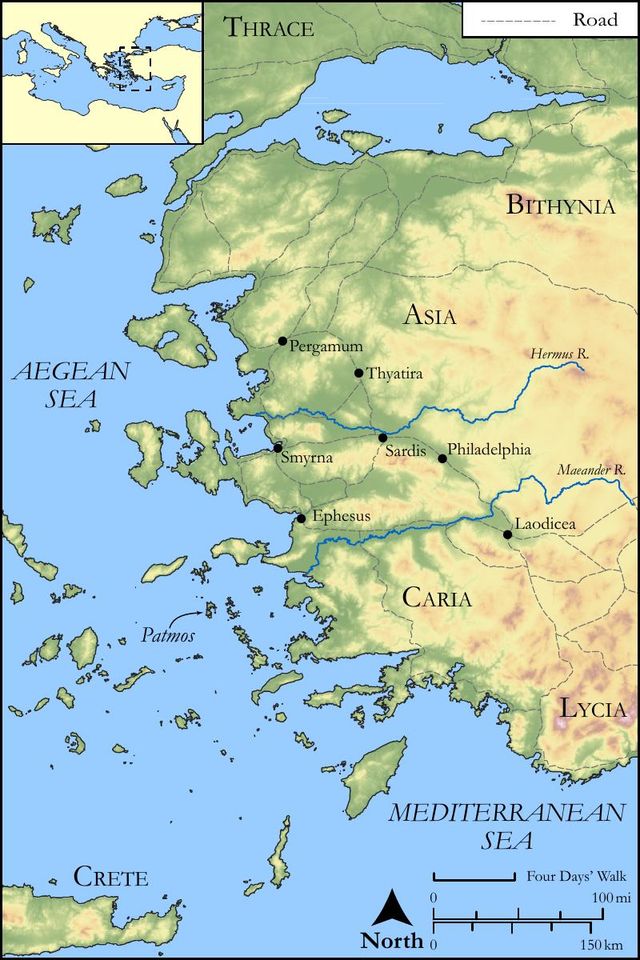
See on the biblical-era map

Study this verse
Public-domain commentary
Matthew Henry
From his Commentary on the Whole Bible. Henry comments on passages, not single verses — this entry covers Revelation 13:1–10.
We have here an account of the rise, figure, and progress of the first beast; and observe, 1. From what situation the apostle saw this monster. He seemed to himself to stand upon the sea-shore, though it is probable he was still in a rapture; but he took himself to be in the island Patmos, but whether in the body or out of the body he could not tell. 2. Whence this beast came - out of the sea; and yet, by the description of it, it would seem more likely to be a land-monster; but the more monstrous every thing about it was the more proper an emblem it would be to set forth the mystery of iniquity and tyranny. 3. What was the form and shape of this beast. It was for the most part like a leopard, but its feet were like the feet of a bear and its mouth as the mouth of a lion; it had seven heads, and ten horns, and upon its heads the name of blasphemy: the most horrid and hideous monster! In some part of this description here seems to be an allusion to Daniel's vision of the four beasts, which represented the four monarchies, Dan 7:1-3, etc. One of these beasts was like a lion, another like a bear, and another like a leopard; this beast was a sort of composition of those three, with the fierceness, strength, and swiftness, of them all; the seven heads and the ten horns seem to design its several powers; the ten crowns, its tributary princes; the word blasphemy on its forehead proclaims its direct enmity and opposition to the glory of God, by promoting idolatry. 4. The source and spring of his authority - the dragon; he gave him his power, and seat, and great authority. He was set up by the devil, and supported by him to do his work and promote his interest; and the devil lent him all the assistance he could. 5. A dangerous wound given him, and yet unexpectedly healed, Rev 13:3. Some think that by this wounded head we are to understand the abolishing of pagan idolatry; and by the healing of the wound the introducing of the popish idolatry, the same in substance with the former, only in a new dress, and which as effectually answers the devil's design as that did. 6. The honour and worship paid to this infernal monster: All the world wondered after the beast; they all admired his power, and policy, and success, and they worshipped the dragon that gave power to the beast, and they worshipped the beast; they paid honour and subjection to the devil and his instruments, and thought there was no power able to withstand them: so great were the darkness, degeneracy, and madness of the world! 7. How he exercised his infernal power and policy: He had a mouth, speaking great things, and blasphemies; he blasphemed God, the name of God, the tabernacle of God, and all those that dwell in heaven; and he made war with the saints, and overcame them, and gained a sort of universal empire in the world. His malice was principally levelled at the God of heaven, and his heavenly attendants - at God, in making images of him that is invisible, and in worshipping them; - at the tabernacle of God, that is, say some, at the human nature of the Lord Jesus Christ, in which God dwells as in a tabernacle; this is dishonoured by their doctrine of transubstantiation, which will not suffer his body to be a true body, and will put it into the power of every priest to prepare a body for Christ; - and against those that dwell in heaven, the glorified saints, by putting them into the place of the pagan demons, and praying to them, which they are so far from being pleased with that they truly judge themselves wronged and dishonoured by it. Thus the malice of the devil shows itself against heaven and the blessed inhabitants of heaven. These are above the reach of his power. All he can do is to blaspheme them; but the saints on earth are more exposed to his cruelty, and he sometimes is permitted to triumph over them and trample upon them. 8. The limitation of the devil's power and success, and that both as to time and persons. He is limited in point of time; his reign is to continue forty-and-two months (Rev 13:5), suitable to the other prophetical characters of the reign of antichrist. He is also limited as to the persons and people that he shall entirely subject his will and power; it will be only those whose names are not written in the Lamb's book of life. Christ had a chosen remnant, redeemed by his blood, recorded in his book, sealed by his Spirit; and though the devil and antichrist might overcome their bodily strength, and take away their natural life, they could never conquer their souls, nor prevail with them to forsake their Saviour and revolt to his enemies. 9. Here is a demand of attention to what is here discovered of the great sufferings and troubles of the church, and an assurance given that when God has accomplished his work on mount Zion, his refining work, then he will turn his hand against the enemies of his people, and those who have killed with the sword shall themselves fall by the sword (Rev 13:10), and those who led the people of God into captivity shall themselves be made captives. Here now is that which will be proper exercise for the patience and faith of the saints - patience under the prospect of such great sufferings, and faith in the prospect of so glorious a deliverance.
Historical interpretation
Eight Centuries of Reception
7 surviving comments on this verse. Each one is dated, so this reads as a timeline rather than a list.
Select a marker to jump to its quote. Markers stagger vertically where authors wrote within a few decades of each other.
If any shall slay with the sword, he must be slain with the sword. Here is the endurance and the faith of the saints."
"His feet were as the feet of a bear." A strong and most unclean beast, the feet are to be understood as his leaders.
"And his mouth as the mouth of a lion." That is, his mouth armed for blood is his bidding, and a tongue which will proceed to nothing else than to the shedding of blood.
The beast is like a leopard because of the variety of nations; he is like a bear because of his maliciousness and madness; he is like a lion because of the strength of his body and the haughtiness of his mouth. At the time of the antichrist his kingdom will be [as a leopard], for it will contain a commixture of various nations and people; it will have feet as a bear in its leaders, and its commanding authority will be as the mouth [of a lion]. “And the dragon gave him his power,” for we see how the heretics, who have the power of the devil, are powerful in this world. For just as formerly it was the pagans who devastated the church, so now it is the heretics.
The kingdom of the Greeks is signified by the leopard; the Persians are signified by the bear; the Babylonians are signified by the lion. The antichrist, who will come as a king of the Romans, will rule over them and destroy their empires, when he beholds the clay toes of their feet, by which is indicated the destruction of a weak and brittle kingdom. Satan, that spiritual dragon, will give all of his authority to the antichrist, who through false signs and wonders will work for the ruination of those who are weak and unstable.
And the dragon gave him his power. Thus the Apostle, speaking of the body of the devil, says: His coming is according to the working of Satan with all power, signs, and lying wonders, and with all deceivableness of unrighteousness in them that perish (2 Thessalonians II).
And the beast I saw was like a leopard, etc. It is compared to a leopard because of the diversity of nations; to a bear, because of its malice and ferocity; to a lion, because of its physical strength and the arrogance of its tongue. In Daniel, we read that the kingdom of the Chaldeans is compared to a lioness, that of the Persians to a bear, and that of the Macedonians to a leopard.
And the beast, he says, which I saw was like a leopard, and because of its swift-moving feet, I think, and quick for deceits.
And his feet, he says, are like those of a bear, somewhat weak and patient so as even to walk under heaven to plot against men.
And his mouth, he says, is like the mouth of a lion; "Your adversary the Devil prowls around like a roaring lion, seeking someone to devour," according to what is written. (1 Peter 5:8)
And the Dragon is said to have given him his power. Now the power of that apostate Dragon lies in these deceits and guiles, and he himself became their author and teacher.
Continue studying Revelation 13:2 across the web’s major study libraries — every link below opens this exact verse, chapter, or book on the destination site.
Read & Compare
 BibleGatewayThis verse in more than 200 translations and 70 languages.
 Bible.comThe YouVersion reader — hundreds of translations, reading plans, and highlights.
 ESV.orgCrossway's official English Standard Version reader.
 NET BibleThe NET translation with 60,000+ translators' notes on every rendering decision.
 STEP BibleTyndale House's free study tool — original text, vocabulary, and scholarly resources.
 BibliaLogos Bible Software's free web reader.
 USCCBThe New American Bible (Revised Edition) with the U.S. bishops' study notes.
Commentaries
 BibleHub CommentariesDozens of classic commentaries on this verse, gathered on one page.
 StudyLightMore than 100 commentary sets — the largest collection on the web.
 BibleRefPlain-English commentary on what this verse means, verse by verse.
 Enduring WordDavid Guzik's free commentary on this chapter, widely used by Bible teachers.
 Bible Study ToolsVerse commentary alongside Greek and Hebrew study aids.
Original Language & Research
- BibleHub InterlinearThe verse word by word — original language, transliteration, and English.
- BibleHub LexiconEvery word's original-language definition and Strong's entry.
 Blue Letter BibleDeep-study tools — Strong's numbers, concordance, and word studies.
 CNTR CollationThe earliest Greek manuscripts of this verse, collated letter by letter.
Sermons, Hymns & Audio


TrulyRandomVerse is not affiliated with these sites and doesn’t control their content. They’re linked because they’re genuinely useful.
Summary
Revelation 13:2 presents the terrifying appearance of the first beast, a formidable entity rising from the sea, whose composite nature reflects the cumulative power of oppressive empires throughout history. Crucially, this verse reveals the true source of its immense dominion: the dragon, identified as Satan, who bestows upon the beast his own power, throne, and great authority, thereby establishing it as his chief agent in the final days to deceive and persecute humanity.
Context
ShowHideLiterary Context
This verse immediately follows the cosmic conflict described in Revelation 12, where the great red dragon, Satan, is cast down to earth, knowing his time is short. Having been defeated in the heavenly realm by Michael and his angels, the dragon now turns his fury toward God's people on earth. Revelation 13 thus marks a shift from the heavenly war to the earthly manifestation of Satan's malice, introducing his primary agents: the beast from the sea (Revelation 13:1-10) and the beast from the earth (Revelation 13:11-18). Verse 2 specifically details the first beast's appearance and the satanic origin of its power, setting the stage for its global dominance and persecution of the saints.
Historical & Cultural Context
John's vision, written during a time of intense Roman imperial cult worship and persecution of Christians, draws heavily on Old Testament prophetic imagery, particularly from the book of Daniel. The composite beast echoes the succession of empires depicted in Daniel 7, which represented Babylon, Media-Persia, Greece, and Rome. For John's original audience, the imagery would have resonated with the oppressive power of the Roman Empire, which demanded worship of its emperors and persecuted those who refused, especially Christians. The beast's description would have immediately signaled a powerful, tyrannical earthly authority, reminiscent of past and present empires, but now imbued with an unprecedented, overtly satanic backing.
Key Themes
ShowHideRevelation 13:2 significantly contributes to several overarching themes in the book of Revelation and biblical prophecy. It underscores the Satanic Origin of Evil Authority, revealing that worldly powers that oppose God are ultimately empowered by the devil, not by divine ordination. This contrasts sharply with the biblical understanding of legitimate human authority as ordained by God for good (e.g., Romans 13:1). The verse also highlights the Composite Nature of Anti-God Power, suggesting that this final, climactic manifestation of evil incorporates the worst characteristics of all previous oppressive empires, making it uniquely formidable. Furthermore, it introduces the theme of Global Deception and Persecution, as the beast's authority, given by the dragon, will lead to widespread worship and the persecution of those who refuse to conform, a theme further developed in Revelation 13:7-8.
Exposition and Analysis
ShowHideKey Word Analysis
ShowHideThis diminutive form from a root meaning "to hunt" or "wild animal" denotes a dangerous, venomous, or wild creature. In Revelation, it consistently refers to the two monstrous figures empowered by the dragon, symbolizing a brutal, savage, and anti-God power that acts outside the bounds of civilized, God-ordained authority. It conveys a sense of raw, untamed, destructive force.
This term refers to a fabulous kind of serpent, often associated with fascination or a powerful, mythical creature. In Revelation, as explicitly stated in Revelation 12:9, the dragon is unequivocally identified as "that old serpent, called the Devil, and Satan, which deceiveth the whole world." Thus, its appearance here immediately identifies the ultimate source of the beast's power as the arch-enemy of God and humanity.
Derived from a word meaning "to be permitted" or "ability," exousía signifies privilege, force, capacity, competency, freedom, or, objectively, mastery, delegated influence, and the right to act. In this context, it emphasizes that the beast's dominion is not inherent but is a conferred, legitimate-seeming right to rule, granted by the dragon. This delegated power allows the beast to exercise control and demand allegiance.
Verse Breakdown
ShowHide"And the beast which I saw was like unto a leopard"
John describes the beast's primary resemblance to a leopard, known for its swiftness, cunning, and spotted appearance (symbolizing diverse origins or characteristics). This imagery immediately evokes the third beast in Daniel 7:6, representing the Greek Empire under Alexander the Great, renowned for its rapid conquest and strategic prowess.
"and his feet were as the feet of a bear"
The beast's feet are likened to those of a bear, a creature known for its immense strength, crushing power, and slow, ponderous movements. This alludes to the second beast in Daniel 7:5, representing the Medo-Persian Empire, characterized by its formidable military might and ability to crush opposition.
"and his mouth as the mouth of a lion"
The beast's mouth is described as that of a lion, symbolizing ferocity, devouring power, and regal, terrifying authority. This directly references the first beast in Daniel 7:4, representing the Babylonian Empire, known for its destructive conquests and absolute rule. The combination of these features signifies that this final beast embodies the most terrifying and oppressive characteristics of all previous world empires.
"and the dragon gave him his power, and his seat, and great authority"
This crucial clause reveals the ultimate source of the beast's dominion. The "dragon" (Satan) directly bestows upon the beast his (Satan's) own inherent "power" (Greek: dýnamis, inherent strength), his "seat" (Greek: thrónos, a throne, signifying a place of rule and sovereignty), and "great authority" (Greek: exousía, delegated right to rule). This makes the beast Satan's earthly proxy, operating with the full backing and empowerment of the devil himself.
Literary Devices
ShowHideRevelation 13:2 is rich in Symbolism and Allusion. The description of the beast as a composite creature—part leopard, bear, and lion—is a direct Allusion to the four beasts in Daniel 7, which symbolized successive world empires. This Symbolism communicates that the beast of Revelation embodies the cumulative evil, cunning, strength, and ferocity of all past anti-God powers. The "dragon" is a potent Symbol for Satan, as explicitly stated elsewhere in Revelation, and his act of "giving" power, seat, and authority is Symbolic of the spiritual reality behind the beast's earthly dominion. The entire passage uses Apocalyptic Imagery to convey profound spiritual truths about the nature of evil and its ultimate source, rather than a literal description of a physical creature.
Theological and Thematic Connections
ShowHideRevelation 13:2 profoundly impacts our understanding of the nature of evil and authority in the world. It reveals that beyond human political and economic structures, there is a malevolent spiritual force—Satan—actively empowering systems and leaders to oppose God's kingdom. The beast's composite nature underscores that the final manifestation of evil will synthesize the worst aspects of historical oppression, demonstrating evil's persistent and evolving nature. This verse serves as a stark reminder that not all power is divinely sanctioned; some authority is directly derived from the adversary, demanding spiritual discernment from believers. It sets the stage for the cosmic conflict between God's sovereign rule and Satan's delegated, temporary dominion, ultimately highlighting the need for steadfast faith in the face of overwhelming worldly opposition.
Reflection and Application
ShowHideRevelation 13:2 serves as a crucial spiritual compass for believers navigating a complex world. It compels us to look beyond the surface of worldly power and discern its true source. Not every impressive or dominant force in society, politics, or even religion is aligned with God's will; some are directly empowered by the adversary. This understanding calls for a profound level of spiritual discernment, urging us to test spirits and ideologies against the unchanging truth of God's Word. It reinforces the reality of spiritual warfare, reminding us that our struggle is not merely against flesh and blood, but against principalities and powers (as described in Ephesians 6:12). Knowing that the beast's power is delegated and temporary, rather than ultimate and eternal, strengthens our resolve to resist its allure and stand firm in our allegiance to Christ, even when facing immense pressure or persecution. This verse encourages us to remain vigilant, to pray for wisdom, and to refuse to compromise our faith for worldly acceptance or security.
Questions for Reflection
ShowHideFAQ
ShowHideDoes the beast represent a specific person, empire, or system?
ShowHideWhile Revelation 13:2 describes the beast with characteristics reminiscent of historical empires (alluding to Daniel's visions), the composite nature and global authority suggest it represents more than just a single historical figure or nation. The beast is often interpreted as a future world leader, a global political-economic system, or a combination thereof, that embodies the culmination of all anti-God human government and power throughout history. Its power is derived from Satan, making it the ultimate earthly agent of the dragon's rebellion against God. The description allows for both literal and symbolic interpretations, pointing to a formidable, globally influential entity that will demand worship and persecute God's people in the end times.
How can we identify the "dragon" mentioned in this verse?
ShowHideThe "dragon" is explicitly identified in Revelation 12:9 as "that old serpent, called the Devil, and Satan, which deceiveth the whole world." This clear identification leaves no doubt that the dragon is the ultimate spiritual adversary, the archenemy of God and humanity. In Revelation 13:2, the dragon's act of bestowing power, his "seat," and great authority upon the beast underscores his role as the orchestrator of earthly evil and the true force behind the beast's dominion.
Christ-Centered Fulfillment
ShowHideWhile Revelation 13:2 vividly portrays the formidable power of the beast, empowered by the dragon, it simultaneously highlights the ultimate triumph of Christ. The dragon's ability to grant power, a throne, and authority to the beast is a perverse imitation of God's divine sovereignty and Christ's rightful dominion. Yet, the New Testament consistently affirms that all true authority in heaven and on earth has been given to Jesus Christ (as declared in Matthew 28:18). The beast's power is delegated and temporary, a mere shadow compared to the eternal and inherent power of the Lamb of God. Christ has already triumphed over the dragon through His death and resurrection, disarming the powers and authorities (as seen in Colossians 2:15). Furthermore, the "seat" (throne) given to the beast by the dragon stands in stark contrast to the throne of God and the Lamb, from which Christ reigns supreme (as described in Revelation 22:1). Ultimately, the beast and the dragon will be cast into the lake of fire, demonstrating that Christ's authority is final and absolute, securing victory for His faithful followers (foretold in Revelation 20:10).