


Joshua 5:13
Bible text: King James Version (1769 Blayney text) · Public domain
Bible text: King James Version with Strong's numbers · Public domain
Bible text: Berean Standard Bible · Public domain
Bible text: American Standard Version (1901) · Public domain
Bible text: World English Bible, Messianic edition · Public domain
Bible text: Geneva Bible (1599) · Public domain
Bible text: Young's Literal Translation · Public domain
- וַיְהִיvay·Hiand it wasH1961Conj-w ¦ V-Qal-ConsecImperf-3msVerb Qal Consecutive Imperfect 3rd Singular Masculineוַandיְהִיit was
- בִּהְיוֹתbih·Yotwhen wasH1961Prep-b ¦ V-Qal-InfVerb Qal Infinitive Constructבִּwhenהְיוֹתwas
- יְהוֹשֻׁעַye·ho·shu·a'JoshuaH3091N-proper-mNoun Proper Masculine
- בִּירִיחוֹbi·ri·Choat JerichoH3405Prep-b ¦ N-properNoun Proper LocationבִּatירִיחוֹJericho
- וַיִּשָּׂאvai·yi·Sa'and he lifted upH5375Conj-w ¦ V-Qal-ConsecImperf-3msVerb Qal Consecutive Imperfect 3rd Singular Masculineוַandיִּשָּׂאhe lifted up
- עֵינָיו'ei·Navhis eyesH5869N-fdc ¦ 3msNoun Dual Feminine Constructעֵינָיeyesוhis
- וַיַּרְאvai·Yar'and he sawH7200Conj-w ¦ V-Qal-ConsecImperf-3msVerb Qal Consecutive Imperfect 3rd Singular Masculineוַandיַּרְאhe saw
- וְהִנֵּהve·hi·nehand there!H2009Conj-w ¦ PrtParticle Interjectionוְandהִנֵּהthere!
- אִישׁ'isha manH376N-msNoun Singular Masculine Absolute
- עֹמֵד'o·Med[was] standingH5975V-Qal-Prtcpl-msVerb Qal Participle Singular Masculine Absolute
- לְנֶגְדּוֹle·neg·Doto before himH5048Prep-l ¦ Adj-msc ¦ 3msAdjective Numerical Singular Masculine Constructלְtoנֶגְדּbeforeוֹhim
- וְחַרְבּוֹve·char·Boand his swordH2719Conj-w ¦ N-fsc ¦ 3msNoun Singular Feminine Constructוְandחַרְבּswordוֹhis
- שְׁלוּפָהshe·lu·Fah[was] drawnH8025V-Qal-PassPrtcpl-fsVerb Qal Participle Passive Singular Feminine Absolute
- בְּיָדוֹbe·ya·Doin his handH3027Prep-b ¦ N-csc ¦ 3msNoun Singular common gender Constructבְּinיָדhandוֹhis
- וַיֵּלֶךְvai·Ye·lekhand he wentH1980Conj-w ¦ V-Qal-ConsecImperf-3msVerb Qal Consecutive Imperfect 3rd Singular Masculineוַandיֵּלֶךְhe went
- יְהוֹשֻׁעַye·ho·Shu·a'JoshuaH3091N-proper-mNoun Proper Masculine
- אֵלָיו'e·Lavto himH413Prep ¦ 3msPreposition Definiteאֵלָיtoוhim
- וַיֹּאמֶרvai·Yo·merand he saidH559Conj-w ¦ V-Qal-ConsecImperf-3msVerb Qal Consecutive Imperfect 3rd Singular Masculineוַandיֹּאמֶרhe said
- לוֹloto <the> himPrep-l ¦ 3msSuffix Personal 3rd Singular Masculineלto <the>וֹhim
- הֲלָנוּha·La·nu¿ for <the> usInterrog ¦ Prep-l ¦ 1cpSuffix Personal 1st Plural common genderהֲ¿לָfor <the>נוּus
- אַתָּה'a·Tah[are] youH859Pro-2msPronoun Personal 2nd Singular Masculine
- אִם'imor?H518PrtParticle Conditional
- לְצָרֵינוּle·tza·Rei·nufor our foesH6862Prep-l ¦ N-mpc ¦ 1cpNoun Plural Masculine Constructלְforצָרֵיfoesנוּour
English is a literal word-by-word gloss of the Hebrew, not the KJV's wording. Why?
This is the original text the KJV's translators worked from — each Hebrew word with its own literal English meaning in this verse, prepared by scholars at Tyndale House, Cambridge. The KJV translates whole sentences, not word by word, so its wording differs: one Hebrew word can become several English words, and the KJV may choose “the LORD” where the gloss reads “Yahweh”. Both are faithful — they answer different questions. For the KJV's own rendering, switch to the KJV text.
Details
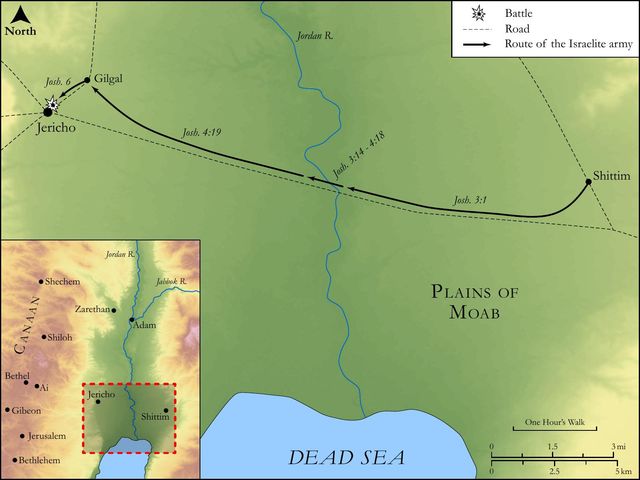
See on the biblical-era map
Study this verse
Public-domain commentary
Matthew Henry
From his Commentary on the Whole Bible. Henry comments on passages, not single verses — this entry covers Joshua 5:13–15. His three-level outline is real structure in the source text, so it is rendered as structure.
We have hitherto found God often speaking to Joshua, but we read not till now of any appearance of God's glory to him; now that his difficulties increased his encouragements were increased in proportion. Observe,
I.The time when he was favoured with this vision.
It was immediately after he had performed the great solemnities of circumcision and the passover; then God made himself known to him. Note, We may then expect the discoveries of the divine grace when we are found in the way of our duty and are diligent and sincere in our attendance on holy ordinances.
II.The place where he had this vision.
It was by Jericho; in Jericho, so the word is; in it by faith and hope, though as yet he had not begun to lay siege to it; in it in thought and expectation; or in the fields of Jericho, hard by the city. There, it should seem, he was all alone, fearless of danger, because sure of the divine protection. There he was (some think) meditating and praying; and to those who are so employed God often graciously manifests himself. Or perhaps there he was to take a view of the city, to observe its fortifications, and contrive how to attack it; and perhaps he was at a loss within himself how to make his approaches, when God came and directed him. Note, God will help those that help themselves. Vigilantibus non dormientibus succurrit lex - The law succours those who watch, not those who sleep. Joshua was in his post as a general, when God came and made himself known as Generalissimo.
III.The appearance itself.
Joshua, as is usual with those that are full of thought and care, was looking downwards, his eyes fixed on the ground, when of a sudden he was surprised with the appearance of a man who stood before him at some little distance, which obliged him to lift up his eyes, and gave a diversion to his musings, v. 13. He appeared to him as a man, but a considerable man, and one fit to be taken notice of. Now, 1. We have reason to think that this man was the Son of God, the eternal Word, who, before he assumed the human nature for a perpetuity, frequently appeared in a human shape. So bishop Patrick thinks, consonant to the judgment of the fathers. Joshua gave him divine honours, and he received them, which a created angel would not have done, and he is called Jehovah, Jos 6:2. 2. He here appeared as a soldier, with his sword drawn in his hand. To Abraham in his tent he appeared as a traveller; to Joshua in the field as a man of war. Christ will be to his people what their faith expects and desires. Christ had his sword drawn, which served, (1.) To justify the war Joshua was engaging in, and to show him that it was of God, who gave him commission to kill and slay. If the sovereign draw the sword, this proclaims war, and authorizes the subject to do so too. The sword is then well drawn when Christ draws it, and gives the banner to those that fear him, to be displayed because of the truth, Psa 60:4. (2.) To encourage him to carry it on with vigour; for Christ's sword drawn in his hand denotes how ready he is for the defence and salvation of his people, who through him shall do valiantly. His sword turns every way.
IV.The bold question with which Joshua accosted him; he did not send a servant, but stepped up to him himself, and asked, Art thou for us or for our adversaries? which intimates his readiness to entertain him if he were for them, and to fight him if he were against them. This shows,
1.His great courage and resolution. He was not ruffled by the suddenness of the appearance, nor daunted with the majesty and bravery which no doubt appeared in the countenance of the person he saw; but, with a presence of mind that became so great a general, put this fair question to him. God had bidden Joshua be courageous, and by this it appears that he was so; for what God by his word requires of his people he does by his grace work in them.
2.His great concern for the people and their cause; so heartily has he embarked in the interests of Israel that none shall stand by him with the face of a man but he will know whether he be a friend or a foe. It should seem, he suspected him for an enemy, a Goliath that had come to defy the armies of the living God, and to give him a challenge. Thus apt are we to look upon that as against us which is most for us. The question plainly implies that the cause between the Israelites and the Canaanites, between Christ and Beelzebub, will not admit of a neutrality. He that is not with us is against us.
V.The account he gave of himself, Jos 5:14.
"Nay, not for your adversaries, you may be sure, but as captain of the host of the Lord have I now come, not only for you as a friend, but over you as commander in chief." Here were now, as of old (Gen 32:2), Mahanaim, two hosts, a host of Israelites ready to engage the Canaanites and a host of angels to protect them therein, and he, as captain of both, conducts the host of Israel and commands the host of angels to their assistance. Perhaps in allusion to this Christ is called the captain of our salvation (Heb 2:10), and a leader and commander to the people, Isa 55:4. Those cannot but be victorious that have such a captain. He now came as captain to review the troops, to animate them, and to give the necessary orders for the besieging of Jericho.
VI.The great respect Joshua paid him when he understood who he was; it is probable that he perceived, not only by what he said but by some other sensible indications, that he was a divine person, and not a man.
1.Joshua paid homage to him: He fell on his face to the earth and did worship. Joshua was himself general of the forces of Israel, and yet he was far from looking with jealousy upon this stranger, who produced a commission as captain of the Lord's host above him; he did not offer to dispute his claims, but cheerfully submitted to him as his commander. It will become the greatest of men to be humble and reverent in their addresses to God.
2.He begged to receive commands and directions from him: What saith my Lord unto his servant? His former question was not more bold and soldier-like than this was pious and saint-like; nor was it any disparagement to the greatness of Joshua's spirit thus to humble himself when he had to do with God: even crowned heads cannot bow to low before the throne of the Lord Jesus, who is King of kings, Psa 2:10, Psa 2:11; Psa 72:10, Psa 72:11; Rev 19:16. Observe,
(1.)The relation he owns between himself and Christ, that Christ was his Lord and himself his servant and under his command, Christ his Captain and himself a soldier under him, to do as he is bidden, Mat 8:9. Note, The foundation of all acceptable obedience is laid in a sincere dedication of ourselves, as servants to Jesus Christ as our Lord, Psa 16:2.
(2.)The enquiry he makes pursuant to this relation: What saith my Lord? which implies an earnest desire to know the will of Christ, and a cheerful readiness and resolution to do it. Joshua owns himself an inferior officer, and stands to receive orders. This temper of mind shows him fit for the post he was in; for those know best how to command that know how to obey.
VII.The further expressions of reverence which this divine captain required from Joshua (Jos 5:15):
Loose thy shoe from off thy foot, in token of reverence and respect (which with us are signified by uncovering the head), and as an acknowledgment of a divine presence, which, while it continued there, did in a manner sanctify the place and dignify it. We are accustomed to say of a person for whom we have a great affection that we love the very ground he treads upon; thus Joshua must show his reverence for this divine person, he must not tread the ground he stood on with his dirty shoes, Ecc 5:1. Outward expressions of inward reverence, and a religious awe of God, well become us, and are required of us, whenever we approach to him in solemn ordinances. Bishop Patrick well observes here that the very same orders that God gave to Moses at the bush, when he was sending him to bring Israel out of Egypt (Exo 3:5), her here gives to Joshua, for the confirming of his faith in the promise he had lately given him, that as he had been with Moses so he would be with him, Jos 1:5. Had Moses such a presence of God with him as, when it became sensible, sanctified the ground? So had Joshua.
And (lastly) Hereby he prepares him to receive the instructions he was about to give him concerning the siege of Jericho, which this captain of the Lord's host had now come to give Israel possession of.
Historical interpretation
Five Centuries of Reception
6 surviving comments on this verse. Each one is dated, so this reads as a timeline rather than a list.
Select a marker to jump to its quote. Markers stagger vertically where authors wrote within a few decades of each other.
And so you must beware and exercise great care in order to discern with knowledge the kinds of visions, just as Joshua the son of Nun, when he saw a vision and knew there was temptation in it, immediately asked the one who appeared to him and said, "Are you for us, or for our adversaries?" So, then, the soul progresses when it comes to the place where it begins to distinguish between visions; and it is proved to be spiritual if it knows how to discern them all. That is why, as well, one of the spiritual gifts, given by the Holy Spirit, is mentioned as "the ability to distinguish between spirits."
Joshua, the successor of Moses, calls the leader of the heavenly angels and archangels and of the supernal powers and as if he were the power and wisdom of the Father, entrusted with the second rank of sovereignty and rule over all, “prince of the host of the Lord,” although he saw him only in the form and shape of a man. At any rate, it is written: “And it came to pass, when Joshua was in the field of the city of Jericho, he lifted up his eyes, and saw a man standing over against him, holding a drawn sword, and he went to him and said: ‘Are you one of ours, or of our adversaries?’ And he said to him, ‘I am prince of the host of the Lord and I have now come.’ And Joshua fell on his face to the ground and said to him, ‘What does my Lord command to his servant?’ And the prince of the Lord said to Joshua, ‘Loose your shoe from off your feet, for the place on which you stand is a holy place.’ ” Here, too, you will perceive from the identity of words that this is no other than he who also spoke to Moses.
A brother asked a hermit, ‘Is it good to be always repenting?’ He answered, ‘We have seen Joshua the son of Nun; it was when he was lying prostrate on his face that God appeared to him’ (cf. Josh. 5:14).
Divine providence surrounds all persons at all times, but it is not visible except to those who have purified their souls of sin and think about God at all times. To these it is luminously revealed at that time; because when they have undergone great temptations for the sake of truth, then they receive the faculty to perceive sensibly as if with eyes of flesh also when necessary, even palpably, according to the kind and cause of the temptation, as if for greater encouragement.So it was with Jacob and Joshua son of Nun, Hananiah and his companions, Peter and others to whom the form of a man appeared to encourage them and to console their faith.
Joshua, the son of Nun, and Daniel bowed in veneration before an angel of God, but they did not adore him. For adoration is one thing, and that which is offered in order to honor something of great excellence is another.
Joshua the son of Nun did not see the angel as he is by nature, but an image, for an angel by nature is not visible to bodily eyes, yet he fell down and worshiped, and Daniel did likewise. Yet an angel is a creature, a servant and minister of God, but not God. And they fell down in worship before the angels, not as God, but as God’s ministering spirits. Shall I not make images of friends? Shall I not honor them, not as gods but as the images of God’s friends? Neither Joshua nor Daniel worshiped the angels they saw as gods. Neither do I worship an image as god, but through the images of Christ and of the holy Theotokos and of the saints, I bring worship and honor to God, because of the reverence with which I honor his friends. God did not unite himself with angelic nature but with human nature. God did not become an angel; he became a man by nature and in truth.
Continue studying Joshua 5:13 across the web’s major study libraries — every link below opens this exact verse, chapter, or book on the destination site.
Read & Compare
 BibleGatewayThis verse in more than 200 translations and 70 languages.
 Bible.comThe YouVersion reader — hundreds of translations, reading plans, and highlights.
 ESV.orgCrossway's official English Standard Version reader.
 NET BibleThe NET translation with 60,000+ translators' notes on every rendering decision.
 STEP BibleTyndale House's free study tool — original text, vocabulary, and scholarly resources.
 BibliaLogos Bible Software's free web reader.
 USCCBThe New American Bible (Revised Edition) with the U.S. bishops' study notes.
Commentaries
 BibleHub CommentariesDozens of classic commentaries on this verse, gathered on one page.
 StudyLightMore than 100 commentary sets — the largest collection on the web.
 BibleRefPlain-English commentary on what this verse means, verse by verse.
 Enduring WordDavid Guzik's free commentary on this chapter, widely used by Bible teachers.
 Bible Study ToolsVerse commentary alongside Greek and Hebrew study aids.
Original Language & Research
- BibleHub InterlinearThe verse word by word — original language, transliteration, and English.
- BibleHub LexiconEvery word's original-language definition and Strong's entry.
 Blue Letter BibleDeep-study tools — Strong's numbers, concordance, and word studies.
 SefariaThe Hebrew text with Rashi and centuries of Jewish commentary.
Sermons, Hymns & Audio


TrulyRandomVerse is not affiliated with these sites and doesn’t control their content. They’re linked because they’re genuinely useful.
Summary
Joshua 5:13 recounts a pivotal and mysterious encounter between Joshua, Israel's newly appointed leader, and a formidable, armed figure identified in subsequent verses as the Captain of the Lord's Host. This dramatic revelation occurs just as the Israelites stand poised on the brink of their first major conquest in Canaan, the heavily fortified city of Jericho. The encounter serves as a profound theological turning point, shifting Joshua's strategic focus from human military planning to a divine mandate, underscoring God's supreme command and active involvement in the impending conquest, thereby setting the stage for Israel's miraculous victory.
Context
ShowHideLiterary Context
This encounter is strategically positioned at a critical juncture in the book of Joshua, immediately following a series of events that underscore Israel's renewed covenant relationship with Yahweh and their readiness for the conquest. Prior to this, Israel miraculously crossed the Jordan River on dry ground, echoing the Red Sea deliverance and reaffirming God's powerful presence. This was followed by a mass circumcision at Gilgal, which consecrated the new generation and symbolically "rolled away the reproach of Egypt" (Joshua 5:9). The nation then observed the Passover (Joshua 5:10), reinforcing their identity as God's redeemed people. Finally, the manna, which had sustained them for forty years in the wilderness, ceased (Joshua 5:12), signaling a transition from divine provision in the wilderness to reliance on the produce of the promised land. Thus, Joshua's encounter occurs precisely when Israel is spiritually renewed, physically prepared, and divinely positioned, yet still facing the daunting military challenge of Jericho. It shifts the narrative from Israel's preparation to God's direct, active leadership in the conquest.
Historical & Cultural Context
Jericho was an ancient and formidable city, strategically located at the gateway to the central highlands of Canaan. Its reputation for strong fortifications (later confirmed by archaeology, though the exact nature of the walls at the time of the conquest is debated) presented a significant military challenge to the Israelites, who were not a professional, standing army in the conventional sense. In Israel, war was understood as the LORD's own contest, as Moses and the children of Israel sang, "The LORD is a man of war: the LORD is his name." The appearance of the captain of the LORD's host signified divine endorsement, active participation, and guaranteed victory for the people of God. For Israel, this encounter would have profoundly reinforced their understanding that Yahweh was not merely their tribal deity but the supreme commander of all creation, actively fighting on their behalf to fulfill His covenant promises regarding the land of Canaan. This concept of "holy war" or "Yahweh War," where God is the primary actor and strategist, is central to the conquest narrative.
Key Themes
ShowHideThe encounter in Joshua 5:13 introduces and reinforces several foundational themes central to the book of Joshua and the broader biblical narrative. Firstly, it powerfully highlights Divine Presence and Leadership, demonstrating unequivocally that God Himself is the true commander of Israel's forces, not Joshua alone. This appearance, widely interpreted as a Christophany or theophany, assures Joshua of God's direct involvement and supreme authority over the military campaign. Secondly, it emphasizes the nature of Spiritual Warfare; before any physical battle commences, Joshua faces a spiritual confrontation, underscoring that Israel's conflicts are not merely earthly but possess a profound unseen dimension where God's power is paramount, a truth echoed in later biblical texts like Ephesians 6:12. Finally, it powerfully reaffirms the Sovereignty of God over all events, demonstrating His unwavering commitment to fulfilling His covenant promises to Abraham and his descendants regarding the land of Canaan, ensuring that the conquest is not a human endeavor but a divinely orchestrated fulfillment of His will and purpose.
Exposition and Analysis
ShowHideKey Word Analysis
ShowHideThe initial description of the figure as "a man" (אִישׁ) creates an immediate sense of mystery and ambiguity. While the term typically refers to a human male, the context and subsequent verses (Joshua 5:14-15) quickly elevate this figure beyond ordinary humanity. This deliberate choice of word highlights Joshua's initial perception, setting up the dramatic reveal of the figure's true identity as the "Captain of the Lord's Host," suggesting a divine or highly exalted angelic being, most commonly interpreted as a pre-incarnate appearance of Christ (a Christophany).
The phrase "with his sword drawn in his hand" (חֶרֶב שְׁלוּפָה בְּיָדוֹ) is highly symbolic and immediately conveys the figure's martial nature and purpose. A "sword" (חֶרֶב) is a cutting instrument used for battle and judgment, while "drawn" (שָׁלַף) signifies that it has been pulled out of its sheath, indicating readiness for immediate action, authority, and the execution of judgment. In a divine context, this visual represents God's active engagement in warfare, His power to judge and execute His will, and His readiness to fight for His people or against their enemies. It is a potent manifestation of divine power, intent, and impending action.
Verse Breakdown
ShowHide"And it came to pass, when Joshua was by Jericho"
This opening clause precisely establishes the geographical and chronological setting for this momentous encounter. Joshua is positioned in the immediate vicinity of Jericho, the first formidable obstacle in the conquest of Canaan, signifying a moment of intense strategic contemplation and anticipation for the impending conflict. The phrase "it came to pass" often serves as a literary marker in biblical narrative, introducing significant divine interventions or pivotal events.
"that he lifted up his eyes and looked, and, behold, there stood a man over against him"
This vivid description portrays the sudden, unexpected, and perhaps startling nature of the encounter. Joshua is not actively seeking this figure; rather, the figure appears to him. The action of "lifted up his eyes and looked" implies a deliberate observation, while the interjection "behold" (הִנֵּה, hinnēh) draws immediate attention to the surprising appearance of this individual. The phrase "over against him" suggests a direct, face-to-face encounter, possibly even a confrontational or opposing stance, which prompts Joshua's subsequent question.
"with his sword drawn in his hand:"
This crucial detail immediately conveys the figure's martial bearing and unmistakable purpose. The drawn sword is a clear and universally recognized indicator of readiness for conflict, authority, and the potential for decisive action. It creates an initial sense of potential threat or, conversely, powerful assistance, setting the tone for a momentous encounter and hinting at the figure's significant and active role in the upcoming events.
"and Joshua went unto him, and said unto him, [Art] thou for us, or for our adversaries?"
Joshua's response is remarkably bold, direct, and pragmatic. He does not cower or flee but, demonstrating his leadership and courage, approaches the mysterious, armed figure. His immediate question seeks to ascertain the figure's allegiance, revealing Joshua's primary concern: the success of Israel's mission and the identity of those who would either aid or oppose them. This question reflects a leader intensely focused on the immediate task and the critical need for divine alignment and support.
Literary Devices
ShowHideThe passage employs several potent literary devices that enrich its theological and narrative impact. Foreshadowing is powerfully evident as this pre-battle encounter strongly hints at the divine, supernatural nature of the upcoming conquest of Jericho, indicating that Israel's victory will not be achieved by human strength or strategy alone. Symbolism is profoundly used through the "sword drawn in his hand," which immediately conveys authority, readiness for battle, and divine judgment, setting a tone of serious, divinely ordained conflict. The appearance of the "man" who is later revealed as the "Captain of the Lord's Host" functions as a Theophany or Christophany, a visible manifestation of God or a pre-incarnate appearance of Christ, imbuing the narrative with profound theological weight and divine presence. Furthermore, there is a subtle Dramatic Irony in Joshua's initial question, "Art thou for us, or for our adversaries?", as the reader (and soon Joshua himself) realizes that the figure is not merely "for" a side in a human conflict but is the very embodiment of the divine authority that commands all sides, including Israel, and demands absolute submission.
Theological and Thematic Connections
ShowHideThis encounter profoundly shapes the theological understanding of the conquest narrative, decisively shifting the focus from human military strategy to divine command and participation. It underscores that the battles of Israel are ultimately the Lord's battles, fought under His direct leadership and supreme authority. Joshua's bold question, "Are you for us, or for our adversaries?", is met not with a partisan answer, but with a declaration of supreme authority: the Captain is not "for" a side in a human sense, but is the commander of God's own celestial army, demanding allegiance, reverence, and holiness. This encounter serves as a foundational moment, teaching Joshua and all of Israel that true victory comes not from human strength or strategic alliances, but from absolute surrender to God's will and unwavering reliance on His power. It establishes the enduring principle that God's people must align themselves with God's purposes, recognizing His ultimate sovereignty over all earthly conflicts and His active engagement in their behalf.
Reflection and Application
ShowHideJoshua's encounter with the Captain of the Lord's Host provides a timeless and profound lesson for believers navigating their own "Jerichos" – those seemingly insurmountable obstacles, daunting challenges, or spiritual battles in life. Just as Joshua was initially focused on military strategy and human resources, we often find ourselves consumed by our own plans, capabilities, and anxieties. This passage calls us to pause, to "lift up our eyes," and to discern the divine presence actively at work in our circumstances. Joshua's direct question, "Are you for us, or for our adversaries?", though initially focused on allegiance, ultimately leads to a revelation of supreme authority that transcends human partisanship. It challenges us to move beyond merely asking if God is "on our side" to ensuring that we are truly "on His side," fully surrendered to His will and leadership. Recognizing that our battles, both personal and corporate, are ultimately spiritual and belong to the Lord, frees us from the crushing burden of self-reliance and invites us into a posture of humble obedience and radical trust. When we truly encounter God's presence, the ground we stand on becomes holy, demanding reverence, a willingness to obey His unexpected commands, and a readiness to remove our "sandals" of self-sufficiency.
Questions for Reflection
ShowHideFAQ
ShowHideWho was the "man" Joshua encountered, and why is this significant?
ShowHideThe "man" Joshua encountered is identified in the very next verse as the "Captain of the Lord's Host" (Joshua 5:14). The significance of this figure is profound and widely debated among scholars, with the most prominent interpretations being a high-ranking angel or, more commonly, a Christophany—a pre-incarnate appearance of Jesus Christ. The latter view is strongly supported by the fact that Joshua immediately bows down and worships this figure, and the figure accepts the worship, even instructing Joshua to remove his sandals because the place is holy ground (Joshua 5:15). In the Bible, only God accepts worship. This encounter is supremely significant because it demonstrates that God Himself, in a visible manifestation, is directly leading Israel's conquest, assuring Joshua that the battle belongs to the Lord and not to human might. It fundamentally shifts the focus from Joshua's leadership to God's supreme command and active participation.
Why did this encounter happen precisely when Joshua was "by Jericho"?
ShowHideThe timing of this encounter is crucial and highly strategic. It occurs just as Israel is poised to face their first major, formidable military challenge in Canaan—the heavily fortified city of Jericho. This precise timing serves several critical purposes. Firstly, it provides divine assurance and a powerful demonstration of God's active presence and leadership to Joshua, who has recently taken over from Moses and is facing immense pressure and responsibility. It reminds him that he is not alone and that the ultimate victory is secured by divine intervention, not human strength or military prowess. Secondly, it sets the spiritual tone for the entire conquest, emphasizing that the battles are not merely physical conflicts but profound spiritual ones, fought under God's explicit command and strategy. This encounter serves as a foundational moment, preparing Joshua and the entire nation for the unique and miraculous way God intends to fight their battles, beginning with the astonishing fall of Jericho. It underscores God's absolute sovereignty and His direct, personal involvement in fulfilling His covenant promises to Israel.
Christ-Centered Fulfillment
ShowHideThe encounter between Joshua and the Captain of the Lord's Host in Joshua 5:13 finds its ultimate Christ-centered fulfillment in Jesus Christ, the true and eternal Captain of God's people. If the Captain of the Lord's Host was indeed a Christophany, it reveals the pre-incarnate Son of God actively leading His people in the Old Testament, demonstrating His eternal commitment to His covenant people. As the resurrected Lord, Jesus is the supreme commander of all spiritual forces, the one who has definitively disarmed the powers and authorities and put them to open shame through His victory on the cross (Colossians 2:15). He is the ultimate General who leads His church in spiritual warfare, having triumphed over sin, death, and the devil—the ultimate "Jericho" that held humanity captive (Hebrews 2:14). Unlike Joshua, who was a temporary leader, Christ is the eternal head of the church (Ephesians 1:22), interceding for His people and guiding them through every battle with divine wisdom and power. The "sword drawn" in the Captain's hand foreshadows Jesus, whose mouth is depicted with a sharp, two-edged sword, symbolizing the living and active power of His Word and His righteous judgment (Revelation 1:16; Hebrews 4:12). Ultimately, the scene in Joshua points forward to the glorious return of Christ as the conquering King, leading the armies of heaven, coming to establish His eternal kingdom and bring final, decisive victory over all His adversaries (Revelation 19:11-16).