


Daniel 10:5
- וָאֶשָּׂאva·'e·Sa'and I lifted upH5375Conj-w ¦ V-Qal-ConsecImperf-1csVerb Qal Consecutive Imperfect 1st Singular common genderוָandאֶשָּׂאI lifted up
- אֶת'et<obj.>H853DirObjMParticle Object Indicator
- עֵינַי'ei·Naimy eyesH5869N-fdc ¦ 1csNoun Dual Feminine Constructעֵינַeyesיmy
- וָאֵרֶאva·'E·re'and I sawH7200Conj-w ¦ V-Qal-ConsecImperf-1csVerb Qal Consecutive Imperfect 1st Singular common genderוָandאֵרֶאI saw
- וְהִנֵּהve·hi·Nehand there!H2009Conj-w ¦ PrtParticle Interjectionוְandהִנֵּהthere!
- אִישׁ'isha manH376N-msNoun Singular Masculine Absolute
- אֶחָד'e·ChadoneH259Adj-fsAdjective Numerical Singular Feminine Absolute
- לָבוּשׁla·VushclothedH3847Adj-msAdjective Singular Masculine Absolute
- בַּדִּיםba·Dimlinen<s>H906N-mpNoun Plural Masculine Absolute
- וּמָתְנָיוu·ma·te·Navand his loinsH4975Conj-w ¦ N-mdc ¦ 3msNoun Dual Masculine Constructוּandמָתְנָיloinsוhis
- חֲגֻרִיםcha·gu·Rim[were] girdedH2296V-Qal-PassPrtcpl-mpVerb Qal Participle Passive Plural Masculine Absolute
- בְּכֶתֶםbe·Khe·temwith [the] gold ofH3800Prep-b ¦ N-mscNoun Singular Masculine Constructבְּwithכֶתֶם[the] gold of
- אוּפָז'u·FazUphazH210N-properNoun Proper Location
English is a literal word-by-word gloss of the Hebrew, not the KJV's wording. Why?
This is the original text the KJV's translators worked from — each Hebrew word with its own literal English meaning in this verse, prepared by scholars at Tyndale House, Cambridge. The KJV translates whole sentences, not word by word, so its wording differs: one Hebrew word can become several English words, and the KJV may choose “the LORD” where the gloss reads “Yahweh”. Both are faithful — they answer different questions. For the KJV's own rendering, switch to the KJV text.
Details
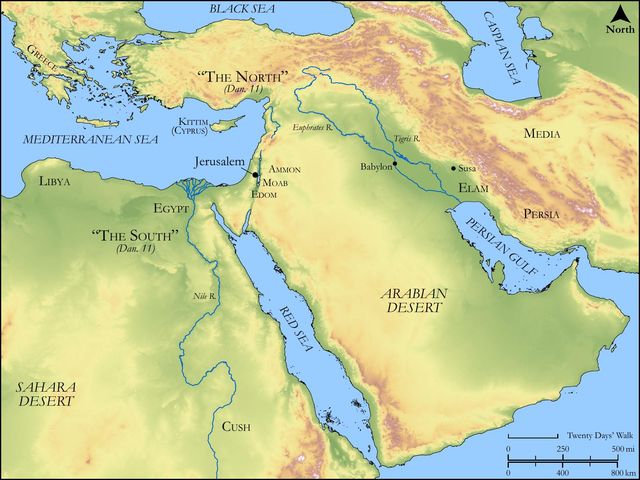
See on the biblical-era map
Study this verse
Public-domain commentary
Matthew Henry
From his Commentary on the Whole Bible. Henry comments on passages, not single verses — this entry covers Daniel 10:1–9. His two-level outline is real structure in the source text, so it is rendered as structure.
This vision is dated in the third year of Cyrus, that is, of his reign after the conquest of Babylon, his third year since Daniel became acquainted with him and a subject to him. Here is,
I.A general idea of this prophecy (Dan 10:1):
The thing was true; every word of God is so; it was true that Daniel had such a vision, and that such and such things were said. This he solemnly attests upon the word of a prophet. Et hoc paratus est verificare - He was prepared to verify it; and, if it was a word spoken from heaven, no doubt it is stedfast and may be depended upon. But the time appointed was long, as long as to the end of the reign of Antiochus, which was 300 years, a long time indeed when it is looked upon as to come. Nay, and because it is usual with the prophets to glance at things spiritual and eternal, there is that in this prophecy which looks in type as far forward as to the end of the world and the resurrection of the dead; and then he might well say, The time appointed was long. It was, however, made as plain to him as if it had been a history rather than a prophecy; he understood the thing; so distinctly was it delivered to him, and received by him, that he could say he had understanding of the vision. It did not so much operate upon his fancy as upon his understanding.
II.An account of Daniel's mortification of himself before he had this vision, not in expectation of it, nor, when he prayed that solemn prayer ch. 9, does it appear that he had any expectation of the vision in answer to it, but purely from a principle of devotion and pious sympathy with the afflicted people of God. He was mourning full three weeks (Dan 10:2), for his own sins and the sins of his people, and their sorrows. Some think that the particular occasion of his mourning was slothfulness and indifference of many of the Jews, who, though they had liberty to return to their own land, continued still in the land of their captivity, not knowing how to value the privileges offered them; and perhaps it troubled him the more because those that did so justified themselves by the example of Daniel, though they had not that reason to stay behind which he had. Others think that it was because he heard of the obstruction given to the building of the temple by the enemies of the Jews, who hired counsellors against them, to frustrate their purpose (Ezr 4:4, Ezr 4:5), all the days of Cyrus, and gained their point from his son Cambyses, or Artaxerxes, who governed while Cyrus was absent in the Scythian war. Note, Good men cannot but mourn to see how slowly the work of God goes on in the world and what opposition it meets with, how weak its friends are and how active its enemies. During the days of Daniel's mourning he ate no pleasant bread; he could not live without meat, but he ate little, and very sparingly, and mortified himself in the quality as well as the quantity of what he ate, which may truly be reckoned fasting, and a token of humiliation and sorrow. He did not eat the pleasant bread he used to eat, but that which was course and unpalatable, which he would not be tempted to eat any more of than was just necessary to support nature. As ornaments, so delicacies, are very disagreeable to a day of humiliation. Daniel ate no flesh, drank no wine, nor anointed himself, for those three week's time, Dan 10:3. Though he was now a very old man, and might plead that the decay of his nature required what was nourishing, though he was a very great man, and might plead that, being used to dainty meats, he could not do without them, it would prejudice his health if he were, yet, when it was both to testify and to assist his devotion, he could thus deny himself; let this be noted to the shame of many young people in the common ranks of life who cannot persuade themselves thus to deny themselves.
III.A description of that glorious person whom Daniel saw in vision, which, it is generally agreed, could be no other that Christ himself, the eternal Word. He was by the side of the river Hiddekel (Dan 10:4), probably walking there, not for diversion, but devotion and contemplation, as Isaac walked in the field, to meditate; and, being a person of distinction, he had his servants attending him at some distance. There he looked up, and saw one man Christ Jesus. It must be he, for he appears in the same resemblance wherein he appeared to St. John in the isle of Patmos, Rev 1:13-15. His dress was priestly, for he is the high priest of our profession, clothed in linen, as the high priest himself was on the day of atonement, that great day; his loins were girded (in St. John's vision his paps were girded) with a golden girdle of the finest gold, that of Uphaz, for every thing about Christ is the best in its kind. The girding of the loins denotes his ready and diligent application to his work, as his Father's servant, in the business of our redemption. His shape was amiable, his body like the beryl, a precious stone of a sky-colour. His countenance was awful, and enough to strike a terror on the beholders, for his face was as the appearance of lightning, which dazzles the eyes, both brightens and threatens. His eyes were bright and sparkling, as lamps of fire. His arms and feet shone like polished brass, Dan 10:6. His voice was loud, and strong, and very piercing, like the voice of a multitude. The vox Dei - voice of God can overpower the vox populi - voice of the people. Thus glorious did Christ appear, and it should engage us,
1.To think highly and honourably of him. Now consider how great this man is, and in all things let him have the pre-eminence.
2.To admire his condescension for us and our salvation. Over all this splendour he drew a veil when he took upon him the form of a servant, and emptied himself.
IV.The wonderful influence that this appearance had upon Daniel and his attendants, and the terror that it struck upon him and them.
1.His attendants saw not the vision; it was not fit that they should be honoured with the sight of it. There is a divine revelation vouchsafed to all, from converse with which none are excluded who do not exclude themselves; but such a vision must be peculiar to Daniel, who was a favourite. Paul's companions were aware of the light, but saw no man, Act 9:7; Act 22:9. Note, It is the honour of those who are beloved of God that, what is hidden from others, is known to them. Christ manifests himself to them, but not to the world, Joh 14:22. But, though they saw not the vision, they were seized with an unaccountable trembling; either from the voice they heard, or from some strange concussion or vibration of the air they felt, so it was that a great quaking fell upon them, so that they fled to hide themselves, probably among the willows that grew by the river's side. Note, Many have a spirit of bondage to fear who never receive a spirit of adoption, to whom Christ has been, and will be, never otherwise than a terror. Now the fright that Daniel's attendants were in is a confirmation of the truth of the vision; it could not be Daniel's fancy, or the product of a heated imagination of his own, or it had a real, powerful, and strange effect upon those about him.
2.He himself saw it, and saw it alone, but he was not able to bear the sight of it. It not only dazzled his eyes, but overwhelmed his spirit, so that there remained no strength in him, Dan 10:8. He said, as Moses himself, I exceedingly fear and quake. His spirits were all so employed, either in an intense speculation of the glory of this vision or in the fortifying of his heart against the terror of it, that his body was left in a manner lifeless and spiritless. He had no vigour in him, and was but one remove from a dead carcase; he looked as pale as death, his colour was gone, his comeliness in him was turned into corruption, and he retained no strength. Note, the greatest and best of men cannot bear the immediate discoveries of the divine glory; no man can see it and live; it is next to death to see a glimpse of it, as Daniel here; but glorified saints see Christ as he is and can bear the sight. But, though Daniel was thus dispirited with the vision of Christ, yet he heard the voice of his words and knew what he said. Note, We must take heed lest our reverence of God's glory, by which we should be awakened to hear his voice both in his word and in his providence, should degenerate into such a dread of him as will disable or indispose us to hear it. It should seem that when the vision of Christ terrified Daniel the voice of his words soon pacified and composed him, silenced his fear, and laid him to sleep in a holy security and serenity of mind: When I heard the voice of his words I fell into a slumber, a sweet slumber, on my face, and my face towards the ground. When he saw the vision he threw himself prostrate, into a posture of the most humble adoration, and dropped asleep, not as careless of what he heard and saw, but charmed with it. Note, How dreadful soever Christ may appear to those who are under convictions of sin, and in terror by reason of it, there is enough in his word to quiet their spirits and make them easy, if they will but attend to it and apply it.
Historical interpretation
Two Centuries of Reception
4 surviving comments on this verse. Each one is dated, so this reads as a timeline rather than a list.
Select a marker to jump to its quote. Markers stagger vertically where authors wrote within a few decades of each other.
Now the word Uphaz, which is a word transferred from Hebrew to Greek, denotes pure gold.
In the first vision he says, “Behold, the angel Gabriel [was] sent.” Here, however, it is not so; he sees the Lord, not yet indeed as perfect man but with the appearance and form of man, as he says: “And, behold, a man clothed in linen.” For in being clothed in a various-colored coat, he indicated mystically the variety of the graces of our calling. For the priestly coat was made up of different colors, as various nations waited for Christ’s coming, in order that we might be made up (as one body) of many colors.
[The Hebrew word] baddim means an intricately woven cloak, just as believers, whom Christ wears as a robe, are eminent in the weave of virtues. God puts on the faithful and girds them with the precious and pure gospel so that they might believe in the resurrection. For Orphaz means “pure.”
Verse 5. "And I lifted my eyes and saw." We must lift up our eyes if we are to be able to discern a mystical vision.
"And behold, a person clothed in linen." Instead of "linen," as Aquila rendered it, Theodotion simply puts baddim, whereas the Septuagint renders it as byssus, and Symmachus as exaireta (choice vestments), that is, "distinguished clothing" (praecipua). And instead of what we have rendered as, "Behold, a man," on the basis of the Hebrew text, Symmachus puts, "One like unto a man," inasmuch as he was not actually a man but only had the appearance of one.
"And his loins were girt about with pure gold." The Hebrew term for this is 'wpz or ophaz, a word which Aquila has rendered in this fashion: "And his loins were girt about with the color of ophax".
Continue studying Daniel 10:5 across the web’s major study libraries — every link below opens this exact verse, chapter, or book on the destination site.
Read & Compare
 BibleGatewayThis verse in more than 200 translations and 70 languages.
 Bible.comThe YouVersion reader — hundreds of translations, reading plans, and highlights.
 ESV.orgCrossway's official English Standard Version reader.
 NET BibleThe NET translation with 60,000+ translators' notes on every rendering decision.
 STEP BibleTyndale House's free study tool — original text, vocabulary, and scholarly resources.
 BibliaLogos Bible Software's free web reader.
 USCCBThe New American Bible (Revised Edition) with the U.S. bishops' study notes.
Commentaries
 BibleHub CommentariesDozens of classic commentaries on this verse, gathered on one page.
 StudyLightMore than 100 commentary sets — the largest collection on the web.
 BibleRefPlain-English commentary on what this verse means, verse by verse.
 Enduring WordDavid Guzik's free commentary on this chapter, widely used by Bible teachers.
 Bible Study ToolsVerse commentary alongside Greek and Hebrew study aids.
Original Language & Research
- BibleHub InterlinearThe verse word by word — original language, transliteration, and English.
- BibleHub LexiconEvery word's original-language definition and Strong's entry.
 Blue Letter BibleDeep-study tools — Strong's numbers, concordance, and word studies.
 SefariaThe Hebrew text with Rashi and centuries of Jewish commentary.
Sermons, Hymns & Audio


TrulyRandomVerse is not affiliated with these sites and doesn’t control their content. They’re linked because they’re genuinely useful.
Summary
After three weeks of intense mourning and fasting, the prophet Daniel is granted a profound vision by the river Hiddekel, experiencing a divine manifestation of immense glory and power. This verse introduces a majestic, human-like figure whose radiant appearance and distinctive attire—linen garments and a golden girdle—immediately signify a being of extraordinary holiness, authority, and divine origin, setting the stage for the detailed prophecies that follow.
Context
ShowHideLiterary Context
Daniel 10 serves as the introduction to Daniel's final and most extensive prophetic vision, which spans through Daniel 11 and Daniel 12. The chapter opens with Daniel's deep spiritual distress and a three-week period of fasting and mourning, indicating his profound burden for his people and the future. This period of intense spiritual preparation precedes the vision, emphasizing the solemnity and significance of the revelation. The appearance of this glorious figure in Daniel 10:5 is so overwhelming that Daniel's companions flee, and Daniel himself is left prostrate and without strength, underscoring the immense power and holiness of the divine messenger. This encounter prepares Daniel to receive the complex and challenging prophecies that will unfold concerning the conflicts between earthly kingdoms and the ultimate triumph of God's kingdom.
Historical & Cultural Context
Daniel's vision takes place in the third year of Cyrus, king of Persia (c. 536 BC), placing it roughly two years after the decree allowing the Jews to return to Jerusalem and begin rebuilding the temple. Despite the decree, the process was fraught with opposition, and the Jewish people faced significant challenges and discouragement, as recorded in Ezra 4. Daniel, though an old man, remained in Babylon, likely serving in the Persian court, and continued to intercede for his people. The cultural context of ancient Near Eastern visions often involved encounters with divine beings, but Daniel's visions consistently emphasize the sovereignty of the one true God over all earthly powers. The imagery of a "girded" figure was common for readiness and authority, whether for labor, battle, or official duties, and the use of precious metals like "fine gold of Uphaz" would immediately convey immense wealth, status, and divine majesty to an ancient audience.
Key Themes
ShowHideThe appearance of this glorious man in Daniel 10:5 introduces several crucial themes. Firstly, it highlights Divine Manifestation and Glory, showcasing God's willingness to reveal Himself and His heavenly messengers in awe-inspiring ways to His faithful servants. The radiant description points to a being of immense divine authority, often interpreted as a Christophany (a pre-incarnate appearance of Christ) or a highly exalted angel. Secondly, the attire emphasizes Purity, Righteousness, and Holiness. Being "clothed in linen" is a recurring biblical symbol for purity and righteousness, notably worn by priests in the Old Testament (Exodus 28:42) and associated with heavenly beings and the redeemed in the New Testament (Revelation 15:6; Revelation 19:8). Finally, the "girded loins" with "fine gold" signifies Authority, Readiness, and Divine Value. Girding the loins prepared one for action, while gold universally denotes royalty, wealth, and divine majesty. This imagery underscores the figure's readiness to execute divine decrees and his supreme, invaluable nature, echoing similar descriptions of divine beings in scripture, such as the Son of Man in Revelation 1:13.
Exposition and Analysis
ShowHideKey Word Analysis
ShowHideThis term (H376) typically refers to an individual male person. However, in contexts of divine or angelic appearances, it can denote a figure with a human-like form but possessing extraordinary, non-human attributes. Here, combined with the subsequent glorious description, it signals a being distinct from ordinary men, yet appearing in a relatable, albeit overwhelming, form to Daniel.
The root (H3847) means "to wrap around" or "to put on a garment." In this verse, it describes the act of the figure being adorned with linen, which carries significant symbolic weight. The verb emphasizes the deliberate act of wearing specific attire that communicates the figure's nature and role.
This primitive root (H2296) means "to gird on," typically referring to fastening a belt or armor around the loins. It signifies preparedness, strength, and readiness for action, whether for work, battle, or a journey. The act of girding suggests a state of active engagement and purposeful intent.
This proper noun (H210) refers to a famous gold region, possibly a corruption or alternative name for Ophir. Its inclusion emphasizes the exceptional quality and purity of the gold, underscoring the immense value, majesty, and divine nature of the figure's adornment. The gold from Uphaz would have been recognized as the finest available, highlighting the supreme excellence of this being.
Verse Breakdown
ShowHide"Then I lifted up mine eyes, and looked,"
Daniel, having been in a state of deep mourning and spiritual preparation, actively engages his senses. This phrase indicates a deliberate act of perception, signaling that what follows is a direct, visual encounter with a divine manifestation, not merely an internal impression or dream. It sets the scene for the profound revelation.
"and behold a certain man"
The interjection "behold" (Hebrew: hinneh) draws immediate attention to the astonishing nature of the sight. The phrase "a certain man" introduces a figure who appears human-like but whose subsequent description quickly transcends ordinary humanity, hinting at a unique and singular individual of immense significance.
"clothed in linen,"
This detail is highly symbolic. Linen, particularly fine linen, in biblical contexts, represents purity, holiness, and righteousness. It was the prescribed attire for priests ministering before God and is associated with heavenly beings. This clothing immediately communicates the sacred, undefiled nature of the figure.
"whose loins [were] girded with fine gold of Uphaz:"
The loins, the seat of strength, being girded signifies readiness, power, and authority. The material, "fine gold of Uphaz," further elevates the figure's status. "Gold" denotes royalty, divinity, and immense value, while "Uphaz" specifies gold of the highest purity and quality, emphasizing the extraordinary, unblemished, and supremely precious nature of this divine being.
Literary Devices
ShowHideDaniel 10:5 is rich in Imagery and Symbolism. The description of the "man clothed in linen, whose loins were girded with fine gold of Uphaz" paints a vivid picture designed to convey profound theological truths. The linen symbolizes purity, holiness, and righteousness, connecting the figure to the sacred priestly attire and the unblemished nature of divine beings. The gold of Uphaz is a powerful symbol of divine majesty, royalty, and immense value, suggesting an unparalleled glory. The act of being girded symbolizes readiness, strength, and authority, indicating that this figure is prepared for action and possesses immense power. The overall effect is one of Awe-inspiring Description, intended to evoke a sense of overwhelming reverence and humility in Daniel, and by extension, in the reader. The figure's appearance also serves as Foreshadowing, hinting at the divine authority and purity that will be central to the messages he delivers in the subsequent chapters.
Theological and Thematic Connections
ShowHideDaniel 10:5 presents a profound theological encounter, revealing the active involvement of heavenly beings in human affairs and the spiritual battles that underlie earthly events. The glorious figure, often interpreted as a Christophany or a high-ranking angel, embodies divine purity, authority, and readiness. This vision underscores the reality of the spiritual realm and God's sovereign control over history, even amidst periods of human struggle and political upheaval. The description of the figure's attire—linen and fine gold—connects to broader biblical themes of holiness, righteousness, and divine majesty, emphasizing the sacred nature of God's messengers and His ultimate glory. This encounter prepares Daniel, and us, for the revelation of God's intricate plan for the ages, demonstrating that God's purposes are being worked out by powerful, holy agents.
Reflection and Application
ShowHideDaniel's encounter in Daniel 10:5 reminds us that our spiritual journey is not confined to the visible world. There is a profound, active spiritual reality, often unseen but deeply impactful, in which God's messengers operate and divine purposes unfold. Daniel's three weeks of fasting and mourning prior to this vision highlight the importance of spiritual preparation, persistent prayer, and a heart burdened for God's will. When we earnestly seek God, even in times of distress or confusion, He is faithful to reveal Himself and His truth, sometimes in ways that are overwhelming yet ultimately strengthening. This vision encourages us to cultivate a posture of humility and reverence before God's majesty, recognizing that His power and authority transcend all earthly limitations. It calls us to look beyond immediate circumstances to the ultimate, glorious reality of God's sovereign rule, trusting that He sends His holy agents to accomplish His will and bring clarity to His people.
Questions for Reflection
ShowHideFAQ
ShowHideWho is the "certain man" Daniel sees in this vision?
ShowHideThe identity of the "certain man" in Daniel 10:5 is a subject of theological discussion. Many scholars interpret this figure as a Christophany, a pre-incarnate appearance of Jesus Christ. This interpretation is strongly supported by the highly majestic and divine description, which bears striking similarities to the vision of the glorified Christ in Revelation 1:13-16, particularly the "garment down to the foot" and the "golden girdle." Other scholars suggest it is a very high-ranking angel, such as Michael or Gabriel, given their prominent roles elsewhere in Daniel (e.g., Daniel 8:16; Daniel 12:1). However, the overwhelming glory and the profound effect on Daniel (and his companions) seem to point to a being of even greater stature than typical angelic appearances, making the Christophany view compelling. Regardless of the precise identity, the figure is clearly a divine messenger of immense authority and holiness.
Christ-Centered Fulfillment
ShowHideWhile Daniel 10:5 describes a magnificent, human-like figure in the Old Testament, its imagery profoundly foreshadows and finds its ultimate fulfillment in the person of Jesus Christ. The "man clothed in linen" resonates with Christ's perfect purity and righteousness, qualities essential for His role as our High Priest, who offered Himself as a spotless sacrifice (e.g., Hebrews 7:26). The "loins girded with fine gold of Uphaz" speaks to divine authority, readiness, and immeasurable value. This imagery is strikingly echoed in John's vision of the glorified Christ in Revelation 1:13, where the "Son of Man" is described as "clothed with a garment down to the foot, and girt about the paps with a golden girdle." This connection strongly suggests that the figure Daniel saw was indeed a pre-incarnate manifestation of the Lord Jesus, revealing His eternal glory and sovereign power even before His earthly advent. Christ, as the ultimate divine messenger, is the one who reveals God's deepest truths (John 1:18), and through His sacrifice and resurrection, He has secured the ultimate victory over the spiritual forces of evil that Daniel's vision hints at (Colossians 2:15). Thus, the glorious figure of Daniel 10:5 points forward to the supreme majesty and redemptive work of the incarnate Christ.