


Old Testament · History · Book 15 of 66
Ezra
Exiles return from Babylon under Cyrus’ decree and rebuild the house of God at Jerusalem; Ezra the scribe follows with the law and leads the people in confession.
- 10 chapters
- 280 verses
- About 34 minutes to read
- The Return from Exile, c. 538–400 BC
Ezra opens with the words that close 2 Chronicles. In the first year of Cyrus, “that the word of the LORD by the mouth of Jeremiah might be fulfilled, the LORD stirred up the spirit of Cyrus king of Persia” (Ezra 1:1). The seventy years of Babylon were over, and the LORD brought his people home by a Persian king’s decree.
The book has two halves, nearly sixty years apart. In chapters 1–6 the first company returns with Zerubbabel and Jeshua, builds the altar, lays the foundation and is stopped by its adversaries; Haggai and Zechariah stir it to build again, and the house is finished in the sixth year of Darius. In chapters 7–10 Ezra the scribe brings the law of Moses and finds that “the holy seed have mingled themselves with the people of those lands” (9:2). The first half rebuilds the house, the second the people who worship in it.
The kings’ letters and decrees are copied as the court wrote them, in “the Syrian tongue” (4:7), and each decree for the house is credited to the LORD. Ezra’s account returns to “the good hand of his God upon him” (7:9).
For Ezra had prepared his heart to seek the law of the LORD, and to do it, and to teach in Israel statutes and judgments.
Ezra 7:10 KJV
How Ezra is laid out
8 movements · 39 passages · 280 verses
Chapters 1–2 · 81 verses
Cyrus sends the captivity home
In his first year Cyrus proclaims that the LORD God of heaven has charged him to build a house at Jerusalem. All whose spirit God has raised go up, and Cyrus brings out the vessels Nebuchadnezzar took, numbered to Sheshbazzar, the prince of Judah. A register lists the company by families, with priests, Levites, singers and porters: 42,360 in all, besides 7,337 servants and maids.
9 passages
- 1:1–4 Cyrus' Proclamation to Rebuild the Temple
- 1:5–6 The Exiles Prepare to Return
- 1:7–11 The Restoration of the Temple Vessels
- 2:1–2 The Returnees and Their Leaders
- 2:3–35 Register of the Lay Israelites
- 2:36–58 The Priests, Levites, and Temple Staff
- 2:59–63 Those Whose Status Was Uncertain
- 2:64–67 The Grand Total of the Congregation
- 2:68–70 Initial Offerings and Settlement
Chapter 3 · 13 verses
Altar first, then the foundation
In the seventh month the people gather at Jerusalem. Jeshua and Zerubbabel build the altar “as it is written in the law of Moses”, offer burnt offerings morning and evening, and keep the feast of tabernacles. In the second year the foundation of the house is laid. The priests and Levites praise the LORD “because he is good”; the old men who had seen the first house weep.
Chapter 4 · 24 verses
Adversaries stop the work
The adversaries of Judah ask to build with them, and Zerubbabel and Jeshua refuse. The people of the land then weaken the builders and hire counsellors against them all the days of Cyrus. Letters to Ahasuerus and Artaxerxes accuse Jerusalem as “the rebellious and the bad city”, and Artaxerxes orders the building stopped. The work of the house ceases until the second year of Darius.
Chapters 5–6 · 39 verses
The house finished and dedicated
Haggai and Zechariah prophesy, and Zerubbabel and Jeshua begin to build again. Tatnai the governor asks who commanded it and writes to Darius. Cyrus’ decree is found in the palace at Achmetha; Darius confirms it and pays the costs from the tribute beyond the river. The house is finished in his sixth year and dedicated with joy, and the children of the captivity keep the passover.
Chapter 7 · 28 verses
Ezra, a ready scribe
After these things, in the reign of Artaxerxes, Ezra goes up from Babylon, a priest descended from Aaron and a scribe in the law of Moses who has set his heart to seek it, do it and teach it. The king’s letter sends him with silver and gold for the house and authority to appoint judges. Ezra blesses God, who put this in the king’s heart.
Chapter 8 · 36 verses
From Ahava to Jerusalem
Ezra gathers the heads of families at the river Ahava, finds no Levites, and sends for them; they come “by the good hand of our God upon us”. Ashamed to ask the king for soldiers, he proclaims a fast. The treasure is weighed to twelve chief priests, carried safely to Jerusalem and weighed again in the house of God, and the returned exiles offer burnt offerings.
Chapter 9 · 15 verses
Confession at the evening sacrifice
The princes report that the people, the priests and the Levites have taken wives from the peoples of the lands, and that the rulers led the way. Ezra rends his garment and sits astonied until the evening sacrifice. Then he falls on his knees and confesses the people’s trespass as his own: God has left them a remnant, and they cannot stand before him.
Chapter 10 · 44 verses
A covenant to put away
A great congregation gathers weeping. Shechaniah confesses the trespass and proposes a covenant to put away the strange wives and their children according to the law, and Ezra makes all Israel swear to it. Judah and Benjamin assemble in the rain of the ninth month, and the cases are heard city by city over three months. The book closes with the names of those who had taken strange wives.
The words Ezra turns on
Build and decree fill the Aramaic letters of chapters 4–7. The rest trace the captivity brought home by God’s hand, kept by his law and called to separate.
What Ezra teaches
ʻûwr · stir up
The LORD stirred up the spirit
The book’s first act is God’s: “the LORD stirred up the spirit of Cyrus king of Persia” (1:1), to close the seventy years Jeremiah had set for Babylon (Jeremiah 29:10). Isaiah had named the king, “He is my shepherd” (Isaiah 44:28), and said that “he shall build my city, and he shall let go my captives” (Isaiah 45:13). The same word is used of the people who went: “all them whose spirit God had raised” (1:5). The later kings are moved in the same way. At the Passover the LORD had “turned the heart of the king of Assyria unto them” (6:22), and Ezra blesses God, “which hath put such a thing as this in the king’s heart” (7:27). The decrees that send them home and build the house are Persian, and the book credits each of them to the LORD.
yâd · hand
The good hand of our God
Ezra’s account returns to one phrase. The king granted his request “according to the hand of the LORD his God upon him” (7:6). He reached Jerusalem “according to the good hand of his God upon him” (7:9), and the Levites he lacked were found “by the good hand of our God upon us” (8:18). At the river Ahava Ezra’s words to the king were put to the test. Ezra had told the king that “the hand of our God is upon all them for good that seek him”, and so he was “ashamed to require of the king a band of soldiers” (8:22). He proclaimed a fast instead, “and he was intreated of us” (8:23). The journey ends on the same words: “the hand of our God was upon us, and he delivered us from the hand of the enemy” (8:31).
tôwrâh · law
As it is written
The returned community orders its worship by the written law. The altar is built “as it is written in the law of Moses the man of God” (3:2), the feast of tabernacles is kept “as it is written” (3:4), and the priests and Levites are set in their courses “as it is written in the book of Moses” (6:18). Ezra comes up as “a ready scribe in the law of Moses” (7:6), and his task is given in its order: he “had prepared his heart to seek the law of the LORD, and to do it, and to teach in Israel statutes and judgments” (7:10). Seeking comes first, then doing, then teaching. The covenant of chapter 10 is held to the same rule: “let it be done according to the law” (10:3).
bâdal · separate
A holy seed
The princes report that “the holy seed have mingled themselves with the people of those lands” (9:2). The law had forbidden these marriages and given the reason: “they will turn away thy son from following me, that they may serve other gods” (Deuteronomy 7:4). The line drawn is worship, not descent. The Passover was already shared with “all such as had separated themselves unto them from the filthiness of the heathen of the land, to seek the LORD God of Israel” (6:21). Ezra calls them to “separate yourselves from the people of the land, and from the strange wives” (10:11), and each case is heard before the elders and judges of its city (10:14). Tertullian heard the same rule in the apostle’s “only in the Lord” (1 Corinthians 7:39): he maintains a law of the Creator, who everywhere prohibits marriage with strangers
.
Christ in Ezra
Zerubbabel the son of Shealtiel, who brought the first company home and began the house, stood in the line of David. Matthew counts the generations of Jesus Christ through him: “after they were brought to Babylon, Jechonias begat Salathiel; and Salathiel begat Zorobabel” (Matthew 1:12). The return kept that line in the land, with no king on its throne, until the Son of David was born. Bede saw the two builders of chapter 3, Jeshua and Zerubbabel, as one figure of Christ: Joshua conspicuously for the priesthood, Zerubbabel for the kingdom
.
The house finished in the sixth year of Darius (Ezra 6:15) fell short of Solomon’s, and the old men wept to see its foundation (3:12). Yet Haggai promised that “the glory of this latter house shall be greater than of the former” (Haggai 2:9), and Malachi that “the Lord, whom ye seek, shall suddenly come to his temple” (Malachi 3:1). The child Jesus was brought into that house (Luke 2:27), and there he spoke of a greater one: “he spake of the temple of his body” (John 2:21).
- David the king
- … Matthew 1:6–11
- Jehoiachin Jechonias, carried to Babylon
- Shealtiel Zerubbabel’s father
- Zerubbabel led the first return
- … Matthew 1:13–16
- Jesus, who is called Christ
People
By how many verses name them
- EzraSon of Seraiah13
- Cyrus12
- Darius10
- ZerubbabelSon of Shealtiel, or of Pedaiah (1 Chronicles 3:19)10
- Artaxerxes7
- JeshuaA son of Jehozadak; father of Joiakim5
- NebuchadnezzarFather of Belshazzar5
- Rehum4
316 more are named.
Places
36 named
- JerusalemThe city and house the returning exiles came to rebuild44
- PersiaThe empire whose kings decree the return and the rebuilding11
- BabylonWhere the exiles were carried, and where both returns began6
- Babylonia6
- AhavaThe river where Ezra gathered the company and proclaimed a fast3
- Assyria2
- Nebo2
- SamariaHome of the officers who wrote to Artaxerxes against Jerusalem2
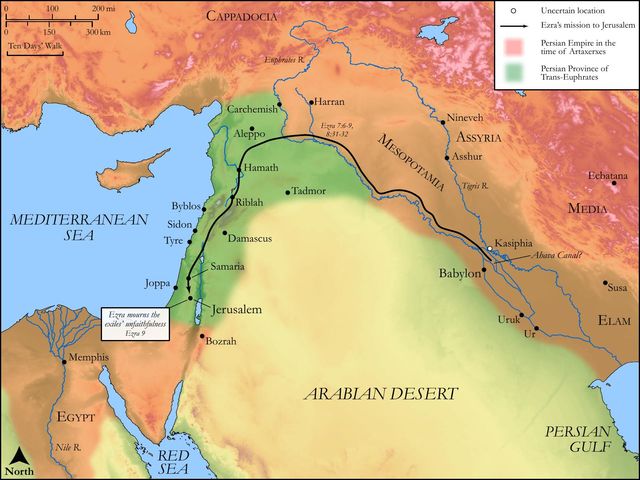
Where Ezra reaches
The passages it leans on, and the ones that lean on it
2 Chronicles 36:22 Ezra 1:1 Jeremiah 29:10
Chronicles ends where Ezra begins: Cyrus’ proclamation, which closes the seventy years Jeremiah set for Babylon.
The old men who had seen the first house weep; Haggai asks who is left that saw it in its first glory.
Zechariah’s word to Zerubbabel as the building began again: “Not by might, nor by power, but by my spirit”.
In Nehemiah’s day the same trespass returns: Jews married to wives of Ashdod, of Ammon, and of Moab.
Ezra is ashamed to lift his face to God; the publican would not lift up so much as his eyes unto heaven.
Books Ezra links to most
The Church Fathers on Ezra
125 quotations from 10 writers before AD 800
- Irenaeus202
- Tertullian220
- Eusebius339
- Athanasius373
- Basil379
- Jerome420
- Augustine430
- Quodvultdeus450
- Cassiodorus585
- Bede735
Bede, on the faith Cyrus confessed in his proclamation.
Great is the faith of the king in these words, great shines his piety. Faith indeed, that he understood the people of Israel to be the people of God above all other nations. Piety, that he allowed all who wished without exception to return to their country as free men.
Jerome read the return as a type, completed in Christ and his apostles.
A type of these events previously occurred in Zerubbabel and Ezra, when the people returned and the city was begun to be built on its heights and religion observed in the temple, all of which are contained in Ezra’s own book. But this was more fully and more perfectly completed in the Lord and Savior and his apostles … so that whatever was done carnally by the people in the past would be completed spiritually in the church.
Athanasius noted that worship began at the altar before the house was built.
And yet the Scripture says expressly that when these things were done, the temple of God was not yet built; but rather while they thus prayed, the building of the house was advancing.
Bede, on why Ezra waited three days at Ahava for Levites.
And we stayed there three days, etc. Ezra acted prudently, so that before beginning such a journey, he carefully ensured he had a supply of ministers of the house of God, through whom, upon arriving in Jerusalem, he could complete what was necessary for the temple's use.
Keep studying
Articles