


Ezra 3:4
Bible text: King James Version (1769 Blayney text) · Public domain
Bible text: King James Version with Strong's numbers · Public domain
Bible text: Berean Standard Bible · Public domain
Bible text: American Standard Version (1901) · Public domain
Bible text: World English Bible, Messianic edition · Public domain
Bible text: Geneva Bible (1599) · Public domain
Bible text: Young's Literal Translation · Public domain
- וַיַּעֲשׂוּvai·ya·'a·Suand they celebratedH6213Conj-w ¦ V-Qal-ConsecImperf-3mpVerb Qal Consecutive Imperfect 3rd Plural Masculineוַandיַּעֲשׂוּthey celebrated
- אֶת'et<obj.>H853DirObjMParticle Object Indicator
- חַגchag[the] festival ofH2282N-mscNoun Singular Masculine Construct
- הַסֻּכּוֹתha·su·Kot<the> boothsH5521Art ¦ N-fpNoun Plural Feminine Absoluteהַ<the>סֻּכּוֹתbooths
- כַּכָּתוּבka·ka·Tuvaccording to <the> [what] is writtenH3789Prep-k ¦ V-Qal-PassPrtcpl-msVerb Qal Participle Passive Singular Masculine Absoluteכַּaccording to <the>כָּתוּב[what] is written
- וְעֹלַתve·'o·Latand a burnt offering ofH5930Conj-w ¦ N-fscNoun Singular Feminine Constructוְandעֹלַתa burnt offering of
- יוֹםYoma dayH3117N-msNoun Singular Masculine Absolute
- בְּיוֹםbe·yOmin a dayH3117Prep-b ¦ N-msNoun Singular Masculine Absoluteבְּinיוֹםa day
- בְּמִסְפָּרbe·mis·Parby numberH4557Prep-b ¦ N-msNoun Singular Masculine Absoluteבְּbyמִסְפָּרnumber
- כְּמִשְׁפַּטke·mish·Pataccording to [the] ordinance ofH4941Prep-k ¦ N-mscNoun Singular Masculine Constructכְּaccording toמִשְׁפַּט[the] ordinance of
- דְּבַרde·var[the] matter ofH1697N-mscNoun Singular Masculine Construct
- יוֹםYoma dayH3117N-msNoun Singular Masculine Absolute
- בְּיוֹמוֹbe·yo·Moin its dayH3117Prep-b ¦ N-msc ¦ 3msNoun Singular Masculine Constructבְּinיוֹמdayוֹits
English is a literal word-by-word gloss of the Hebrew, not the KJV's wording. Why?
This is the original text the KJV's translators worked from — each Hebrew word with its own literal English meaning in this verse, prepared by scholars at Tyndale House, Cambridge. The KJV translates whole sentences, not word by word, so its wording differs: one Hebrew word can become several English words, and the KJV may choose “the LORD” where the gloss reads “Yahweh”. Both are faithful — they answer different questions. For the KJV's own rendering, switch to the KJV text.
Details
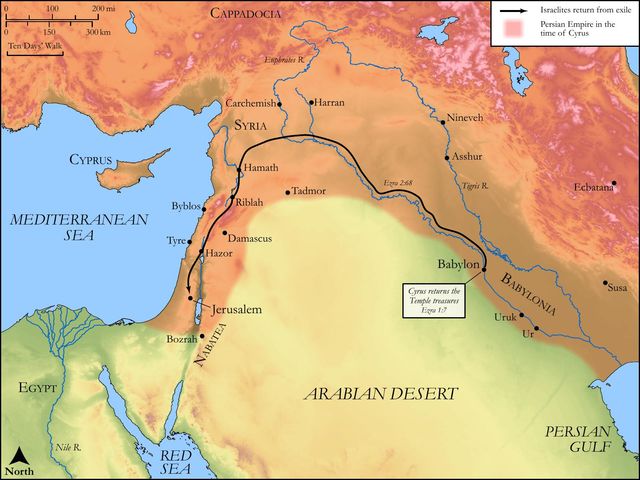
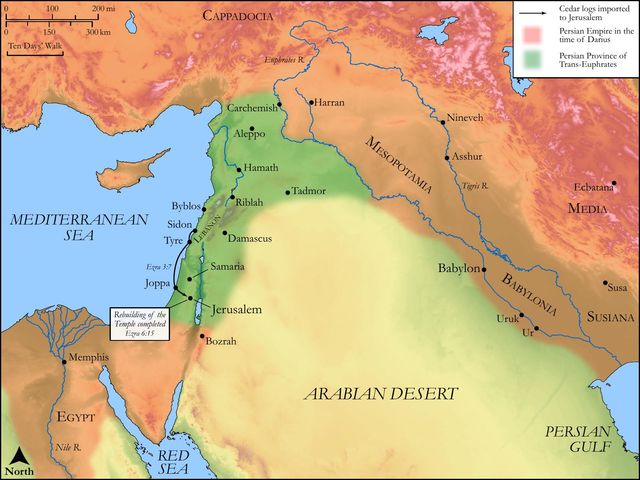
See on the biblical-era maps
Study this verse
Public-domain commentary
Matthew Henry
From his Commentary on the Whole Bible. Henry comments on passages, not single verses — this entry covers Ezra 3:1–7. His three-level outline is real structure in the source text, so it is rendered as structure.
Here is, I. A general assembly of the returned Israelites at Jerusalem, in the seventh month, Ezr 3:1. We may suppose that they came from Babylon in the spring, and must allow at least four months for the journey, for so long Ezra and his company were in coming, Ezr 7:9. The seventh month therefore soon came, in which many of the feasts of the Lord were to be solemnized; and then they gathered themselves together by agreement among themselves, rather than by the command of authority, to Jerusalem. Though they had newly come to their cities, and had their hands full of business there, to provide necessaries for themselves and their families, which might have excused them from attending on God's altar till the hurry was a little over, as many foolishly put off their coming to the communion till they are settled in the world, yet such was their zeal for religion, now that they had newly come from under correction for their irreligion, that they left all their business in the country, to attend God's altar; and (which is strange) in this pious zeal they were all of a mind, they came as one man. Let worldly business be postponed to the business of religion and it will prosper the better.
II.The care which their leading men took to have an altar ready for them to attend upon.
1.Joshua and his brethren the priests, Zerubbabel and his brethren the princes, built the altar of the God of Israel (Ezr 3:2), in the same place (it is likely) where it had stood, upon the same bases, Ezr 3:3. Bishop Patrick, observing that before the temple was built there seems to have been a tabernacle pitched for the divine service, as was in David's time, not on Mount Moriah, but Mount Sion (Ch1 9:23), supposes that this altar was erected there, to be sued while the temple was in building. Let us learn hence,
(1.)To begin with God. The more difficult and necessitous our case is the more concerned we are to take him along with us in all our ways. If we expect to be directed by his oracles, let him be honoured by our offerings.
(2.)To do what we can in the worship of God when we cannot do what we would. They could not immediately have a temple, but they would not be without an altar. Abraham, wherever he came, built an altar; and wherever we come, though we may perhaps want the benefit of the candlestick of preaching, and the showbread of the eucharist, yet, if we bring not the sacrifices of prayer and praise, we are wanting in our duty, for we have an altar that sanctifies the gift ever ready.
2.Observe the reason here given why they hastened to set up the altar: Fear was upon them, because of the people of the land. They were in the midst of enemies that bore ill will to them and their religion, for whom they were an unequal match. And,
(1.)Though they were so, yet they built the altar (so some read it); they would not be frightened from their religion by the opposition they were likely to meet with in it. Never let the fear of man bring us into this snare.
(2.)Because they were so, therefore they set up the altar. Apprehension of danger should stir us up to our duty. Have we many enemies? Then it is good to have God our friend and to keep up our correspondence with him. This good use we should make of our fears, we should be driven by them to our knees. Even Saul would think himself undone if the enemy should come upon him before he had made his supplication to God, Sa1 13:12.
III.The sacrifices they offered upon the altar.
The altar was reared to be used, and they used it accordingly. Let not those that have an altar starve it.
1.They began on the first day of the seventh month, Ezr 3:6. It does not appear that they had any fire from heaven to begin with, as Moses and Solomon had, but common fire served them, as it did the patriarchs.
2.Having begun, they kept up the continual burnt-offering (Ezr 3:5), morning and evening, Ezr 3:3. They had known by sad experience what it was to want the comfort of the daily sacrifice to plead in their daily prayers, and now that it was revived they resolved not to let it fall again. The daily lamb typified the Lamb of God, whose righteousness must be our confidence in all our prayers.
3.They observed all the set feasts of the Lord, and offered the sacrifices appointed for each, and particularly the feast of tabernacles, Ezr 3:4, Ezr 3:5. Now that they had received such great mercy from God that joyful feast was in a special manner seasonable. And now that they were beginning to settle in their cities it might serve well to remind them of their fathers dwelling in tents in the wilderness. That feast also which had a peculiar reference to gospel times (as appears, Zac 14:18) was brought, in a special manner, into reputation, now that those times drew on. Of the services of this feast, which continued seven days and had peculiar sacrifices appointed, it is said that they did as the duty of every day required (see Num 29:13, Num 29:17, etc.), Verbum die in die suo - the word, or matter, of the day in its day (so it is in the original) - a phrase that has become proverbial with those that have used themselves to scripture-language. If the feast of tabernacles was a figure of a gospel conversation, in respect of continual weanedness from the world and joy in God, we may infer that it concerns us all to do the work of the day in its day, according as the duty of the day requires, that is,
(1.)We must improve time, by finding some business to do every day that will turn to a good account.
(2.)We must improve opportunity, by accommodating ourselves to that which is the proper business of the present day. Every thing is beautiful in its season. The tenth day of this month was the day of atonement, a solemn day, and very seasonable now: it is very probable that they observed it, yet it is not mentioned, nor indeed in all the Old Testament do I remember the least mention of the observance of that day; as if it were enough that we have the law of it in Lev. 16, and the gospel of it, which was the chief intention of it, in the New Testament.
4.They offered every man's free-will offering, Ezr 3:5. The law required much, but they brought more; for, though they had little wealth to support the expense of their sacrifices, they had much zeal, and, we may suppose, spared at their own tables that they might plentifully supply God's altar. Happy are those that bring with them out of the furnace of affliction such a holy heat as this.
IV.The preparation they made for the building of the temple, Ezr 3:7.
This they applied themselves immediately to; for, while we do what we can, we must still be aiming to do more and better. Tyre and Sidon must now, as of old, furnish them with workmen, and Lebanon with timber, orders for both which they had from Cyrus. What God calls us to we may depend upon his providence to furnish us for.
Historical interpretation
Four Centuries of Reception
2 surviving comments on this verse. Each one is dated, so this reads as a timeline rather than a list.
Select a marker to jump to its quote. Markers stagger vertically where authors wrote within a few decades of each other.
Or rather let them learn of you, who are so well instructed in such histories, how that Jeshua the son of Josedek the priest, and his brother, and Zerubbabel the wise, the son of Salathiel, and Ezra the priest and scribe of the law, as the temple was being built after the captivity, the feast of tabernacles being at hand (which was a great feast and time of assembly and prayer in Israel), gathered the people together with one accord in the great court within the first gate, which is toward the east, and prepared the altar to God, and there offered their gifts and kept the feast. And so afterwards they brought hither their sacrifices, on the sabbaths and the new moons, and the people offered up their prayers. And yet the Scripture says expressly that when these things were done, the temple of God was not yet built; but rather while they thus prayed, the building of the house was advancing. So neither were their prayers deferred in expectation of the dedication, nor was the dedication prevented by the assemblies held for the sake of prayer. But the people thus continued to pray; and when the house was entirely finished, they celebrated the dedication, and brought their gifts for that purpose and all kept the feast for the completion of the work.
And they kept the feast of booths, etc. The Feast of Booths, which in the Gospel is called in Greek Skenopegia, that is, the pitching of booths, was a festival of seven days, beginning on the fifteenth day of the seventh month, during which the Lord commanded all the people to make booths for themselves from leaves and branches of the most beautiful trees, and to leave their houses and stay in these booths for seven days, daily studying the decrees of the divine law, and offering burnt sacrifices to the Lord in fire. They were ordered to do all this in memory of the time when they had once come out of Egypt and dwelt in booths in the wilderness, with Moses preaching the law and the divine presence frequently appearing to them, looking forward for a long time to when they could enter the promised land, so that the grace of this great benefit would never fade from their minds. Therefore, those who had come up from Babylon to Jerusalem, with great devotion to carry out all the commands of the Lord, took care to celebrate this feast on the fifteenth day of the seventh month, performing every day of that week the things commanded by the law. All of which we ought to do spiritually with equal devotion. For we too have come out of Egyptian slavery through the blood of the Lamb, so that we might come to the promised land, having been baptized into the sacraments of the Lord’s passion, casting off the heavy yoke of trespasses, so that, having been adopted into the liberty of the glory of the children of God, we might be heirs of the heavenly kingdom. For we were dwelling in booths and tents, journeying for a long time through the desert, until we might come to our homeland, when in baptism renouncing not only Satan as the king of Egypt, that is, of darkness, but also all the pomps and works of this age, we promised to be like foreigners and pilgrims in this world, citizens of another life which we hoped for from the Lord. In memory of this hope and promise, we must dwell in booths in the seventh month, that is, being illuminated by the grace of the Holy Spirit, which is described as sevenfold, leaving this world with our whole mind as if it were alien and pressing on us, and fixing our intention on hastening to the unwithering joys of paradise; and we must do this for seven days, that is, during the whole time of the present life, which is circled by as many days, without ceasing, and every day of this week we must make a burnt offering and the work of the day in its day; a burnt offering, that is, a whole burnt sacrifice in things that properly pertain to divine service, such as prayers and fasts. And the work of the day in its day, in those things that pertain to the service of fraternal love; such as giving bread to the hungry, drink to the thirsty, clothing to the cold, hospitality to the traveler, visitation to the sick, burial to the dead, teaching to the wandering, and comfort to the grieving. And it is well that he said they should make a burnt offering on each day according to the command of the law, and the work of the day in its day, he interposed, In order; because whatever is done in the service of divine or fraternal love out of order, loses the merit of its perfection. For "the honor of the king loves judgment" (Psalm 99); for whatever we do devoutly in honor of the highest king, it is necessary to distinguish with the discretion of judgment when or how much it should be done; lest if we do our proper work disorderly, we spoil the rule of its correctness. Paul implied these mystical feasts of booths, that is Skenopegia, when he was preaching and occupied in the work of tentmaking (Acts 28). For he was making tents, that is, booths, both to teach himself to be an inhabitant of the world and a pilgrim, and to teach those he instructed to be pilgrims in this life and hope for a future homeland. For we are accustomed to use booths and tents when traveling or making a journey; which the same Apostle testifies that the saints do in this life, when he says: "While we are in this body, we are pilgrims away from the Lord" (2 Corinthians 5). And to the Hebrews: "For we do not have here a lasting city, but we seek the future one" (Hebrews 13). Since he wanted those who perfectly alienate their minds from the world and faithfully confess themselves as citizens of the homeland which is above, to immediately open the entry to all virtues, it is rightly added:
Continue studying Ezra 3:4 across the web’s major study libraries — every link below opens this exact verse, chapter, or book on the destination site.
Read & Compare
 BibleGatewayThis verse in more than 200 translations and 70 languages.
 Bible.comThe YouVersion reader — hundreds of translations, reading plans, and highlights.
 ESV.orgCrossway's official English Standard Version reader.
 NET BibleThe NET translation with 60,000+ translators' notes on every rendering decision.
 STEP BibleTyndale House's free study tool — original text, vocabulary, and scholarly resources.
 BibliaLogos Bible Software's free web reader.
 USCCBThe New American Bible (Revised Edition) with the U.S. bishops' study notes.
Commentaries
 BibleHub CommentariesDozens of classic commentaries on this verse, gathered on one page.
 StudyLightMore than 100 commentary sets — the largest collection on the web.
 BibleRefPlain-English commentary on what this verse means, verse by verse.
 Enduring WordDavid Guzik's free commentary on this chapter, widely used by Bible teachers.
 Bible Study ToolsVerse commentary alongside Greek and Hebrew study aids.
Original Language & Research
- BibleHub InterlinearThe verse word by word — original language, transliteration, and English.
- BibleHub LexiconEvery word's original-language definition and Strong's entry.
 Blue Letter BibleDeep-study tools — Strong's numbers, concordance, and word studies.
 SefariaThe Hebrew text with Rashi and centuries of Jewish commentary.
Sermons, Hymns & Audio


TrulyRandomVerse is not affiliated with these sites and doesn’t control their content. They’re linked because they’re genuinely useful.
Summary
Ezra 3:4 meticulously records the immediate and faithful actions of the returned Jewish exiles in Jerusalem, under the leadership of Zerubbabel and Jeshua. Following the re-establishment of the altar, their foundational commitment to God's covenant was powerfully demonstrated by their precise observance of the Feast of Tabernacles and the diligent reinstatement of the daily burnt offerings. This verse profoundly underscores their determination to restore proper worship and spiritual discipline in strict accordance with divine command, laying a vital spiritual groundwork even before the full reconstruction of the Temple.
Context
ShowHideLiterary Context
Ezra 3:4 is situated within the pivotal narrative of the post-exilic community's initial steps to re-establish their spiritual life in Jerusalem. It directly follows the crucial act of rebuilding and dedicating the altar for burnt offerings in Ezra 3:2, an act undertaken despite the palpable fear of surrounding peoples (Ezra 3:3). The verse details the first major festival observed, the Feast of Tabernacles, emphasizing their immediate return to prescribed worship rituals. This foundational act of obedience precedes the laying of the Temple's actual foundation (Ezra 3:6-13), highlighting that spiritual restoration and adherence to God's commands were paramount and foundational to any physical rebuilding efforts. The sequence of events in Ezra 3 thus emphasizes a divine priority: right worship before physical structure.
Historical & Cultural Context
The events of Ezra 3:4 unfold shortly after the momentous return of the Jewish exiles from seventy years of Babylonian captivity, a return made possible by the decree of Cyrus the Great (Ezra 1:1-4). Led by Zerubbabel, the civil governor, and Jeshua, the high priest, the community faced the monumental challenge of rebuilding a desolate city and re-establishing their national and spiritual identity. The observance of the Feast of Tabernacles (Sukkot) was deeply significant. It was one of the three major annual pilgrimage festivals, a harvest festival celebrating God's bountiful provision and, more profoundly, commemorating the Israelites' forty years of wandering in the wilderness, living in temporary shelters, and experiencing God's faithful presence. Reinstating this festival, along with the daily burnt offerings, served as a powerful public declaration of their renewed covenant with Yahweh, a tangible step towards restoring the religious life that had been severely disrupted by the exile. It signaled a profound commitment to the Mosaic Law as the guiding principle for their reconstituted community.
Key Themes
ShowHideThis verse powerfully encapsulates several foundational themes that resonate throughout the book of Ezra and the post-exilic narrative. Foremost is the theme of Obedience to God's Law. The meticulous adherence implied by "as it is written" and "according to the custom, as the duty of every day required" underscores a deliberate commitment to the Mosaic Law, a stark and conscious contrast to the generations whose disobedience led to the exile. This commitment to God's precise commands is presented as the bedrock for their spiritual restoration. Secondly, the verse highlights the Restoration of Worship. By re-establishing the prescribed feasts and sacrifices, the community was actively rebuilding the channels of communion and atonement with God, symbolizing a renewed covenant relationship. This act of worship was a tangible sign of their return to God's ways and a critical step in their national revival. Finally, the emphasis on "daily burnt offerings" points to Spiritual Discipline and Perseverance. It signifies a commitment to consistent, disciplined worship beyond just major festivals, demonstrating a deep desire to honor God continually, even amidst the formidable challenges of rebuilding and potential opposition (Ezra 4:1-5).
Exposition and Analysis
ShowHideKey Word Analysis
ShowHideFrom a root meaning "to move in a circle," hence "to keep a festival." This term refers to a solemn religious festival, often involving pilgrimage and sacrifices. Its usage here emphasizes the communal, prescribed nature of the celebration, marking a significant return to Israel's divinely ordained calendar of worship. The Feast of Tabernacles was one of the most joyous and climactic annual festivals, signifying God's provision and presence.
A primitive root meaning "to grave," by implication "to write" (describe, inscribe, prescribe, subscribe). The phrase "as it is written" (כַּכָּתוּב, ka-katuv) is crucial, indicating that their actions were not arbitrary or based on human tradition, but were a direct, precise, and intentional fulfillment of the divine instructions found in the Torah. This highlights the authority of Scripture as the guiding principle for their worship and communal life.
From a root meaning "to ascend." This specific type of offering was entirely consumed by fire on the altar, with the smoke ascending to God. It symbolized complete dedication, devotion, and atonement for sin. The reinstatement of the daily burnt offering (the tamid offering) was a foundational element of Israelite worship, signifying the continuous need for atonement and the constant dedication of the people to God.
Verse Breakdown
ShowHide"They kept also the feast of tabernacles, as [it is] written,"
This initial clause highlights the immediate and foundational act of worship undertaken by the returned exiles. "They kept" (H6213, ʻâsâh, "to do or make") signifies their active and deliberate observance, while "as it is written" underscores their unwavering commitment to biblical fidelity. This was not a casual or optional observance but a precise adherence to the specific instructions for the Feast of Tabernacles found in the Mosaic Law, signaling a profound return to covenant obedience and a rejection of the past generations' neglect.
"and [offered] the daily burnt offerings by number, according to the custom,"
This specifies the nature and regularity of their sacrifices. Beyond the annual festival, the re-establishment of the "daily burnt offerings" (the tamid offerings) demonstrates a commitment to consistent, ongoing worship. "By number" (H4557, miçpâr, "a number") and "according to the custom" (H4941, mishpâṭ, "a verdict, sentence, formal decree, custom") indicate a precise, ordered, and traditional practice, ensuring that the sacrifices were performed exactly as prescribed by the Law for each day, leaving no room for improvisation or deviation.
"as the duty of every day required;"
This final phrase reinforces the meticulousness and unwavering commitment of the community. It emphasizes that their actions were not arbitrary but were in fulfillment of a divinely mandated obligation. This speaks to their dedication to spiritual discipline and their understanding that daily worship was an essential "duty" (H1697, dâbâr, "a word, matter, thing, duty") or requirement for maintaining their covenant relationship with God. The repetition of "daily" (H3117, yôwm, "a day") underscores the continuous and unwavering nature of this commitment.
Literary Devices
ShowHideEzra 3:4 employs several Literary Devices to powerfully convey its central message of faithful restoration and meticulous obedience. Repetition is a prominent feature, with the triple emphasis on adherence to divine command through phrases like "as it is written," "according to the custom," and "as the duty of every day required." This cumulative repetition highlights the intentionality, precision, and unwavering commitment of the exiles, setting their obedience in stark contrast to the past disobedience that led to their exile. The verse also utilizes potent Symbolism: the Feast of Tabernacles itself is a rich symbol of God's dwelling presence, His faithful provision, and the pilgrimage of His people through the wilderness, while the burnt offerings symbolize complete dedication, atonement, and the continuous need for reconciliation with God. Their immediate re-establishment of these rituals, even before the Temple's physical completion, functions as a powerful Metonymy for the broader spiritual revival of the entire nation, where specific acts of worship stand in for the comprehensive restoration of Israel's relationship with God.
Theological and Thematic Connections
ShowHideEzra 3:4 is a profound testament to the theological principle that true restoration, whether personal or communal, begins with a humble return to God's authoritative Word and a steadfast commitment to obedient worship. The exiles' prioritization of the Feast of Tabernacles and daily offerings, even amidst fear and the daunting task of rebuilding a devastated city, demonstrates that spiritual foundations are paramount. Their meticulous adherence to "what is written" reflects a deep understanding that God's covenant blessings and renewed favor are contingent upon faithfulness to His commands. This passage serves as a powerful reminder that structured, disciplined worship is not merely ritualistic formality but a vital expression of profound devotion, a means of acknowledging God's sovereignty, and a pathway to renewed communion with Him. It underscores the enduring importance of God's Law as the divine blueprint for a flourishing life, both individually and corporately, emphasizing that genuine revival flows from a re-centered focus on God's revealed will.
Reflection and Application
ShowHideEzra 3:4 offers a compelling and timeless blueprint for spiritual renewal in any age. In a world often characterized by spiritual apathy, a pick-and-choose approach to faith, or a focus on outward appearances, the unwavering commitment of the returned exiles to God's prescribed worship is a powerful and challenging example. It reminds us that true spiritual restoration begins not with our fleeting feelings or personal preferences, but with a deliberate, disciplined return to the authoritative Word of God and the practices He has ordained. Just as they prioritized rebuilding the altar and re-establishing worship before anything else, we are called to place God and His commands at the absolute center of our lives, especially after periods of spiritual neglect, adversity, or distraction. This involves a consistent commitment to spiritual disciplines—daily engagement with Scripture, fervent prayer, and faithful corporate worship—not as burdensome duties, but as acts of profound devotion and obedience that shape our hearts, transform our minds, and align us more perfectly with God's will. Their perseverance in offering daily sacrifices, even in the absence of a complete Temple, teaches us that our worship should be consistent, faithful, and heartfelt, regardless of our present circumstances or the grandeur of our physical surroundings.
Questions for Reflection
ShowHideFAQ
ShowHideWhat was the significance of observing the Feast of Tabernacles first?
ShowHideThe Feast of Tabernacles (Sukkot) was one of the most joyous and significant annual festivals in ancient Israel. Its immediate observance by the returned exiles, even before the Temple's foundation was fully laid, held profound significance. Spiritually, it commemorated God's faithful provision and protective presence during the Israelites' forty years of wilderness wanderings, offering a powerful message of hope and reassurance that God would again dwell among them and provide for them as they embarked on the arduous task of rebuilding. Culturally, it was a major harvest festival, a time of thanksgiving and communal celebration, which would have helped unite the diverse group of returned exiles and instill a vital sense of shared identity and purpose. Its observance, meticulously "as it is written" in the Law, also demonstrated their immediate commitment to covenant obedience, signaling a fresh start rooted deeply in God's revealed will. This act served as a spiritual cornerstone for their entire rebuilding endeavor, prioritizing God's presence and commands.
What does "as it is written" imply about their approach to worship?
ShowHideThe phrase "as it is written" (Hebrew, ka-katuv) is a crucial and recurring indicator of the returned exiles' deep commitment to biblical authority and precise obedience. It implies that their worship was not based on human tradition, personal convenience, or innovative ideas, but was meticulously guided by the specific, detailed instructions found in the Mosaic Law. This stands in stark contrast to the generations prior to the exile, whose disregard for God's written commands ultimately led to their judgment and dispersion. For the post-exilic community, this phrase underscored their profound determination to avoid past mistakes and to ensure that every aspect of their worship was pleasing to God by conforming strictly to His revealed will. It highlights the supreme and unchallengeable authority of Scripture as the foundational blueprint for all true worship and spiritual life, emphasizing a return to divine prescription over human preference.
Christ-Centered Fulfillment
ShowHideEzra 3:4, with its profound emphasis on the Feast of Tabernacles and the meticulous reinstatement of daily burnt offerings, powerfully foreshadows the ultimate fulfillment found in the person and work of Jesus Christ. The Feast of Tabernacles, commemorating God's dwelling among His people in temporary shelters (sukkot), finds its ultimate reality in Christ, who is God incarnate, the true "tabernacle" who "dwelt among us" (John 1:14). Jesus Himself attended and spoke profoundly at this very feast, proclaiming Himself the source of living water (John 7:37-38) and the "light of the world" (John 8:12), thereby fulfilling the festival's symbolic rituals and pointing to His divine identity. Furthermore, the daily burnt offerings, which symbolized complete dedication and atonement for sin, point directly to Christ's singular, perfect, and once-for-all sacrifice on the cross. His offering was not "by number" or "according to the custom" of repeated animal sacrifices, but a unique, sufficient act that perfectly fulfilled "the duty" required for the reconciliation of humanity with God (Hebrews 10:10-14). Through Him, the need for daily animal sacrifices ceased, and believers are now called to offer spiritual sacrifices of praise and lives wholly devoted to God (Hebrews 13:15, Romans 12:1). Thus, the meticulous obedience of the exiles in Ezra 3:4 ultimately points to the perfect obedience of Christ, who fully accomplished what the Law and its rituals could only anticipate, ushering in a new covenant of grace.