


Ezra 3:5
Bible text: King James Version (1769 Blayney text) · Public domain
Bible text: King James Version with Strong's numbers · Public domain
Bible text: Berean Standard Bible · Public domain
Bible text: American Standard Version (1901) · Public domain
Bible text: World English Bible, Messianic edition · Public domain
Bible text: Geneva Bible (1599) · Public domain
Bible text: Young's Literal Translation · Public domain
- וְאַחֲרֵיכֵןve·'a·cha·rei·Khenand after thisH310Conj-w ¦ Adj-mpc ¦ AdvAdjective Numerical Plural Masculine Constructוְandאַחֲרֵיafterכֵןthis
- עֹלַת'o·Lata burnt offering ofH5930N-fscNoun Singular Feminine Construct
- תָּמִידta·MidcontinuityH8548N-msNoun Singular Masculine Absolute
- וְלֶחֳדָשִׁיםve·Le·cho·da·Shimand for the new moonsH2320Conj-w ¦ Prep-l ¦ N-mpNoun Plural Masculine Absoluteוְandלֶfor theחֳדָשִׁיםnew moons
- וּלְכָלu·le·kholand for allH3605Conj-w ¦ Prep-l ¦ N-mscNoun Singular Masculine Constructוּandלְforכָלall
- מוֹעֲדֵיmo·'a·Dei[the] appointed times ofH4150N-mpcNoun Plural Masculine Construct
- יְהוָהYah·wehYahwehH3068N-properNoun Proper Title
- הַמְקֻדָּשִׁיםham·ku·da·Shim<the> consecratedH6942Art ¦ V-Pual-PassPrtcpl-mpVerb Pual Participle Passive Plural Masculine Absoluteהַ<the>מְקֻדָּשִׁיםconsecrated
- וּלְכֹלu·le·Kholand for everyH3605Conj-w ¦ Prep-l ¦ N-mscNoun Singular Masculine Constructוּandלְforכֹלevery
- מִתְנַדֵּבmit·na·Dev[one who] offeredH5068V-Hithpael-Prtcpl-msVerb Hithpael Participle Singular Masculine Absolute
- נְדָבָהne·da·Vaha freewill offeringH5071N-fsNoun Singular Feminine Absolute
- לַיהוָהla·Yah·wehto YahwehH3068Prep-l ¦ N-properNoun Proper TitleלַtoיהוָהYahweh
English is a literal word-by-word gloss of the Hebrew, not the KJV's wording. Why?
This is the original text the KJV's translators worked from — each Hebrew word with its own literal English meaning in this verse, prepared by scholars at Tyndale House, Cambridge. The KJV translates whole sentences, not word by word, so its wording differs: one Hebrew word can become several English words, and the KJV may choose “the LORD” where the gloss reads “Yahweh”. Both are faithful — they answer different questions. For the KJV's own rendering, switch to the KJV text.
Details
See on the biblical-era maps
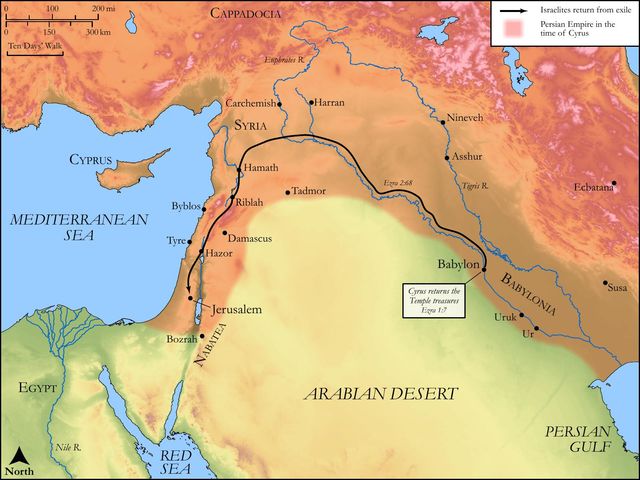
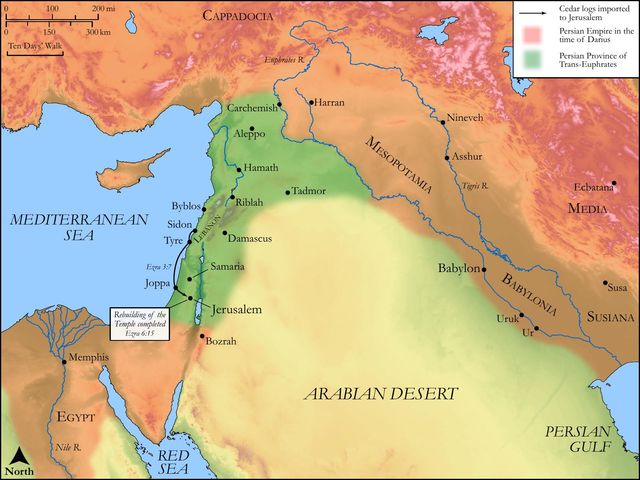
Study this verse
Public-domain commentary
Matthew Henry
From his Commentary on the Whole Bible. Henry comments on passages, not single verses — this entry covers Ezra 3:1–7. His three-level outline is real structure in the source text, so it is rendered as structure.
Here is, I. A general assembly of the returned Israelites at Jerusalem, in the seventh month, Ezr 3:1. We may suppose that they came from Babylon in the spring, and must allow at least four months for the journey, for so long Ezra and his company were in coming, Ezr 7:9. The seventh month therefore soon came, in which many of the feasts of the Lord were to be solemnized; and then they gathered themselves together by agreement among themselves, rather than by the command of authority, to Jerusalem. Though they had newly come to their cities, and had their hands full of business there, to provide necessaries for themselves and their families, which might have excused them from attending on God's altar till the hurry was a little over, as many foolishly put off their coming to the communion till they are settled in the world, yet such was their zeal for religion, now that they had newly come from under correction for their irreligion, that they left all their business in the country, to attend God's altar; and (which is strange) in this pious zeal they were all of a mind, they came as one man. Let worldly business be postponed to the business of religion and it will prosper the better.
II.The care which their leading men took to have an altar ready for them to attend upon.
1.Joshua and his brethren the priests, Zerubbabel and his brethren the princes, built the altar of the God of Israel (Ezr 3:2), in the same place (it is likely) where it had stood, upon the same bases, Ezr 3:3. Bishop Patrick, observing that before the temple was built there seems to have been a tabernacle pitched for the divine service, as was in David's time, not on Mount Moriah, but Mount Sion (Ch1 9:23), supposes that this altar was erected there, to be sued while the temple was in building. Let us learn hence,
(1.)To begin with God. The more difficult and necessitous our case is the more concerned we are to take him along with us in all our ways. If we expect to be directed by his oracles, let him be honoured by our offerings.
(2.)To do what we can in the worship of God when we cannot do what we would. They could not immediately have a temple, but they would not be without an altar. Abraham, wherever he came, built an altar; and wherever we come, though we may perhaps want the benefit of the candlestick of preaching, and the showbread of the eucharist, yet, if we bring not the sacrifices of prayer and praise, we are wanting in our duty, for we have an altar that sanctifies the gift ever ready.
2.Observe the reason here given why they hastened to set up the altar: Fear was upon them, because of the people of the land. They were in the midst of enemies that bore ill will to them and their religion, for whom they were an unequal match. And,
(1.)Though they were so, yet they built the altar (so some read it); they would not be frightened from their religion by the opposition they were likely to meet with in it. Never let the fear of man bring us into this snare.
(2.)Because they were so, therefore they set up the altar. Apprehension of danger should stir us up to our duty. Have we many enemies? Then it is good to have God our friend and to keep up our correspondence with him. This good use we should make of our fears, we should be driven by them to our knees. Even Saul would think himself undone if the enemy should come upon him before he had made his supplication to God, Sa1 13:12.
III.The sacrifices they offered upon the altar.
The altar was reared to be used, and they used it accordingly. Let not those that have an altar starve it.
1.They began on the first day of the seventh month, Ezr 3:6. It does not appear that they had any fire from heaven to begin with, as Moses and Solomon had, but common fire served them, as it did the patriarchs.
2.Having begun, they kept up the continual burnt-offering (Ezr 3:5), morning and evening, Ezr 3:3. They had known by sad experience what it was to want the comfort of the daily sacrifice to plead in their daily prayers, and now that it was revived they resolved not to let it fall again. The daily lamb typified the Lamb of God, whose righteousness must be our confidence in all our prayers.
3.They observed all the set feasts of the Lord, and offered the sacrifices appointed for each, and particularly the feast of tabernacles, Ezr 3:4, Ezr 3:5. Now that they had received such great mercy from God that joyful feast was in a special manner seasonable. And now that they were beginning to settle in their cities it might serve well to remind them of their fathers dwelling in tents in the wilderness. That feast also which had a peculiar reference to gospel times (as appears, Zac 14:18) was brought, in a special manner, into reputation, now that those times drew on. Of the services of this feast, which continued seven days and had peculiar sacrifices appointed, it is said that they did as the duty of every day required (see Num 29:13, Num 29:17, etc.), Verbum die in die suo - the word, or matter, of the day in its day (so it is in the original) - a phrase that has become proverbial with those that have used themselves to scripture-language. If the feast of tabernacles was a figure of a gospel conversation, in respect of continual weanedness from the world and joy in God, we may infer that it concerns us all to do the work of the day in its day, according as the duty of the day requires, that is,
(1.)We must improve time, by finding some business to do every day that will turn to a good account.
(2.)We must improve opportunity, by accommodating ourselves to that which is the proper business of the present day. Every thing is beautiful in its season. The tenth day of this month was the day of atonement, a solemn day, and very seasonable now: it is very probable that they observed it, yet it is not mentioned, nor indeed in all the Old Testament do I remember the least mention of the observance of that day; as if it were enough that we have the law of it in Lev. 16, and the gospel of it, which was the chief intention of it, in the New Testament.
4.They offered every man's free-will offering, Ezr 3:5. The law required much, but they brought more; for, though they had little wealth to support the expense of their sacrifices, they had much zeal, and, we may suppose, spared at their own tables that they might plentifully supply God's altar. Happy are those that bring with them out of the furnace of affliction such a holy heat as this.
IV.The preparation they made for the building of the temple, Ezr 3:7.
This they applied themselves immediately to; for, while we do what we can, we must still be aiming to do more and better. Tyre and Sidon must now, as of old, furnish them with workmen, and Lebanon with timber, orders for both which they had from Cyrus. What God calls us to we may depend upon his providence to furnish us for.
Historical interpretation
Four Centuries of Reception
2 surviving comments on this verse. Each one is dated, so this reads as a timeline rather than a list.
Select a marker to jump to its quote. Markers stagger vertically where authors wrote within a few decades of each other.
Or rather let them learn of you, who are so well instructed in such histories, how that Jeshua the son of Josedek the priest, and his brother, and Zerubbabel the wise, the son of Salathiel, and Ezra the priest and scribe of the law, as the temple was being built after the captivity, the feast of tabernacles being at hand (which was a great feast and time of assembly and prayer in Israel), gathered the people together with one accord in the great court within the first gate, which is toward the east, and prepared the altar to God, and there offered their gifts and kept the feast. And so afterwards they brought hither their sacrifices, on the sabbaths and the new moons, and the people offered up their prayers. And yet the Scripture says expressly that when these things were done, the temple of God was not yet built; but rather while they thus prayed, the building of the house was advancing. So neither were their prayers deferred in expectation of the dedication, nor was the dedication prevented by the assemblies held for the sake of prayer. But the people thus continued to pray; and when the house was entirely finished, they celebrated the dedication, and brought their gifts for that purpose and all kept the feast for the completion of the work.
And after these things, the daily burnt offering, etc. He calls it the daily burnt offering, which was offered in the morning and evening. Moreover, he calls the Kalends the beginnings of the months, that is, the rising of the new moon; from which the Hebrews always began their months, as they had no months except the lunar ones. Hence the Greeks, instead of Kalends, better call them "neomenias," which means "new moons." Now, if by the month, because of the thirty days by which they are completed, they designate the fullness of the works of light, when in faith in the Holy Trinity we fulfill the commandments of the Decalogue; what are the beginnings of the months, in which the moon, to shine again for us, is said to be newly lighted by the sun, except that they designate the beginnings of each good work, which through the grace of our Creator, we perceive as if by the presence of the Sun of Righteousness? Because of this symbolism of divine illumination, without which we can neither begin nor complete anything good, the Lord commanded all Kalends, that is, the beginnings of the months, to be celebrated and the ceremonies of sacrifices to be observed. This is why the Psalmist says: Blow the trumpet at the new moon, on our solemn feast day (Psalm 81). Which is openly to say: Rejoice, ye righteous, in the Lord, and in the word of doctrine sounding to your neighbors; as soon as you consider yourselves to be regarded by Him in order to do good deeds in the notable light of internal inspiration; by which you are called away from the desire of this world, and are more deeply dedicated to divine matters. Well then, it is said that after the feast of tabernacles was completed, the children of the exiles made the daily burnt offering, both on the Kalends and on all the Lord's consecrated solemnities, and in all where a gift was voluntarily offered to God. Because after the mind has once perfectly renounced this world, it must constantly devote itself entirely to the service of the divine will, which we have said the burnt offering was to designate; and this it should do both in the initiation of each good work and in the devout execution of those virtues which the Lord has commanded, as well as in those in which a pious mind, apart from general commands, delights to spontaneously serve the Lord. About which the Lord Himself, giving counsel rather than commanding, says: If you want to be perfect, go, sell what you have (Matt. 19). And when He was disputing about taking a wife, He said not by commanding but by advising: He who can accept this, let him accept it (Matt. 19). But Paul too, boasting about these things which he offered to the Lord as a spontaneous gift, says: Do we not have the right to eat and drink? Do we not have the right to take along a believing wife (1 Cor. 9)? and so forth, in the same place.
Continue studying Ezra 3:5 across the web’s major study libraries — every link below opens this exact verse, chapter, or book on the destination site.
Read & Compare
 BibleGatewayThis verse in more than 200 translations and 70 languages.
 Bible.comThe YouVersion reader — hundreds of translations, reading plans, and highlights.
 ESV.orgCrossway's official English Standard Version reader.
 NET BibleThe NET translation with 60,000+ translators' notes on every rendering decision.
 STEP BibleTyndale House's free study tool — original text, vocabulary, and scholarly resources.
 BibliaLogos Bible Software's free web reader.
 USCCBThe New American Bible (Revised Edition) with the U.S. bishops' study notes.
Commentaries
 BibleHub CommentariesDozens of classic commentaries on this verse, gathered on one page.
 StudyLightMore than 100 commentary sets — the largest collection on the web.
 BibleRefPlain-English commentary on what this verse means, verse by verse.
 Enduring WordDavid Guzik's free commentary on this chapter, widely used by Bible teachers.
 Bible Study ToolsVerse commentary alongside Greek and Hebrew study aids.
Original Language & Research
- BibleHub InterlinearThe verse word by word — original language, transliteration, and English.
- BibleHub LexiconEvery word's original-language definition and Strong's entry.
 Blue Letter BibleDeep-study tools — Strong's numbers, concordance, and word studies.
 SefariaThe Hebrew text with Rashi and centuries of Jewish commentary.
Sermons, Hymns & Audio


TrulyRandomVerse is not affiliated with these sites and doesn’t control their content. They’re linked because they’re genuinely useful.
Summary
Upon their return from Babylonian exile, the Jewish community in Jerusalem, led by Zerubbabel and Jeshua, immediately prioritized the re-establishment of divine worship. Ezra 3:5 details their comprehensive restoration of the Mosaic sacrificial system, including the daily burnt offerings, the monthly sacrifices for new moons, all the annual set feasts ordained by the Lord, and the voluntary contributions of freewill offerings. This meticulous adherence to God's commands underscored their profound covenant commitment, their renewed identity as a consecrated people, and their foundational act of rebuilding communal life centered entirely on Yahweh's prescribed worship.
Context
ShowHideLiterary Context
Ezra 3:5 is situated within the crucial narrative of the returned exiles' initial efforts to re-establish their spiritual and communal life in Jerusalem. Following Cyrus's decree, the first wave of returnees, under the leadership of Zerubbabel and Jeshua, gathered in Jerusalem. The preceding verses, specifically Ezra 3:1-2, describe the people assembling "as one man" and their courageous act of rebuilding the altar of God, despite the fear of surrounding peoples. This foundational step enabled them to immediately resume the daily burnt offerings. Verse 5 then expands upon this initial act, detailing the full scope of offerings reinstated, indicating a comprehensive and systematic return to the prescribed worship. This meticulous re-establishment of the sacrificial system sets the stage for the subsequent laying of the temple foundation in Ezra 3:8-9, highlighting that spiritual restoration preceded physical reconstruction. The detailed enumeration of offerings emphasizes the exiles' dedication to divine law as the bedrock of their restored community.
Historical & Cultural Context
The events described in Ezra 3:5 transpired shortly after the Jewish people's return from seventy years of Babylonian exile (c. 538 BC), a period during which the Temple in Jerusalem lay in ruins and formal temple worship had entirely ceased. For ancient Israel, the sacrificial system was the divinely ordained heart of their covenant relationship with Yahweh, meticulously detailed in the Torah (e.g., Leviticus 1-7). Upon returning to a desolate Jerusalem, the immediate priority was not the grand temple structure itself, but the re-establishment of the altar and the sacrificial system. This was a profound act of cultural and religious reorientation, signaling a decisive break from the pagan influences of Babylon and a return to their ancestral faith and covenant obligations. The "new moons" and "set feasts" were not merely religious holidays; they were crucial calendrical markers and communal gatherings that reinforced national identity, theological understanding, and the rhythm of life centered on God's appointed times. Resuming these practices demonstrated a deep commitment to their heritage and a re-anchoring in their unique identity as God's chosen people.
Key Themes
ShowHideEzra 3:5 powerfully articulates several key themes central to the book of Ezra and the post-exilic period. Foremost is the Restoration of Worship, emphasizing that the re-establishment of the sacrificial system was not merely a ritualistic act but a spiritual and communal imperative, marking a return to God's prescribed order after decades of disruption. This restoration underscores the theme of Obedience to God's Law, as the exiles meticulously followed the divine ordinances concerning the "continual burnt offering," "new moons," and "set feasts," demonstrating their unwavering commitment to the Mosaic covenant (e.g., the detailed instructions in Numbers 28-29). Furthermore, the inclusion of "freewill offerings" introduces the profound theme of Heartfelt Devotion and Willingness. This highlights that beyond mere obligation, the people offered out of genuine love and gratitude, reflecting a spiritual revival and a desire to give generously to the Lord, a sentiment deeply rooted in Israel's history of giving for sacred purposes (e.g., Exodus 35:29). These themes collectively portray a community rebuilding its identity and future upon a renewed foundation of faith, obedience, and sincere devotion.
Exposition and Analysis
ShowHideKey Word Analysis
ShowHideFrom an unused root meaning "to stretch," this word signifies continuance, constancy, or perpetuity. In the context of the "continual burnt offering" (‘ôlâh tâmîyd), it emphasizes the unbroken, perpetual nature of the daily morning and evening sacrifices (e.g., Numbers 28:3). Its immediate re-establishment by the exiles underscores their commitment to the foundational, uninterrupted rhythm of worship as a constant expression of Israel's covenant relationship with God and their ongoing need for atonement and communion.
This term, derived from the root ya‘ad (to appoint, to meet), properly refers to an "appointed time" or "season," specifically a festival or solemn assembly. These were not merely celebrations but divinely ordained convocations, sacred assemblies at specific times of the year (e.g., Passover, Pentecost, Tabernacles, as detailed in Leviticus 23). The term highlights God's initiative in setting these times and Israel's obligation to meet with Him in worship according to His calendar. Their restoration signified a return to God's established order for communal life and worship, reinforcing national identity and covenant fidelity.
From the root nâdab (to impel, to volunteer), this word denotes spontaneity or a spontaneous/abundant gift. It refers to a voluntary offering, given out of spontaneous generosity and devotion, not as a mandatory requirement (e.g., Leviticus 7:16). Unlike the prescribed daily or feast offerings, the nədâbâh came from the heart of the individual, reflecting a personal, uncompelled desire to honor God. Its inclusion in Ezra 3:5 demonstrates that the exiles' worship was not merely rote obedience but also flowed from genuine spiritual revival and personal commitment, indicating a vibrant faith beyond mere ritual.
Verse Breakdown
ShowHide"And afterward [offered] the continual burnt offering,"
This clause signifies the immediate and foundational re-establishment of the daily sacrifices. The "continual burnt offering" (Hebrew: ‘ôlâh tāmîd) was offered every morning and evening, symbolizing perpetual atonement, communion, and dedication. Its prompt resumption by the returned exiles marked the restoration of the most basic and constant act of worship, signifying their commitment to an ongoing relationship with God after decades of disruption.
"both of the new moons,"
Following the daily offerings, the exiles also reinstated the monthly sacrifices prescribed for the beginning of each new lunar month (e.g., Numbers 28:11-15). These offerings marked the sacred calendar and involved specific burnt offerings and sin offerings, emphasizing the monthly renewal of the community's dedication and need for purification before the Lord, aligning their time with His divine rhythms.
"and of all the set feasts of the LORD that were consecrated,"
This comprehensive clause indicates the full restoration of the annual pilgrimage festivals and other appointed times (Hebrew: mô‘ădîm) that God had consecrated, meaning set apart as holy. These included major celebrations like Passover, Pentecost, and the Feast of Tabernacles (as detailed in Leviticus 23), which were vital for national identity, communal worship, and remembering God's redemptive acts throughout their history. Their re-establishment underscored a complete return to God's divinely ordered calendar and covenant life.
"and of every one that willingly offered a freewill offering unto the LORD."
This final phrase highlights the personal and voluntary dimension of the restored worship. Beyond the mandatory communal offerings, individuals were moved by their own devotion to bring nədâbâh (freewill offerings). This demonstrates that the spiritual revival extended beyond mere ritual adherence to include heartfelt, spontaneous generosity and commitment, signifying a deep personal engagement with God's covenant and a desire to give out of love and gratitude, not compulsion.
Literary Devices
ShowHideEzra 3:5 employs several literary devices to underscore the thoroughness and spiritual significance of the exiles' actions. The most prominent is Enumeration, as the verse meticulously lists the various categories of offerings: the "continual burnt offering," "new moons," "set feasts," and "freewill offerings." This detailed listing serves to emphasize the comprehensive nature of the restoration of worship, demonstrating that no aspect of the divinely prescribed sacrificial system was overlooked. Furthermore, there is a clear sense of Emphasis through cumulative detail, moving from the daily, foundational offering to the monthly, then the annual, and finally to the individual, voluntary contributions. This progression builds a rich picture of a community fully engaged in worship at all levels—daily, calendrical, and personal. The phrase "every one that willingly offered" also subtly uses Universal Reach, highlighting that this was not merely an act of the leaders but a widespread spiritual movement involving the entire community, indicating a collective and heartfelt commitment to God.
Theological and Thematic Connections
ShowHideEzra 3:5 is a profound theological statement on the centrality of worship and obedience in the life of God's covenant people. The immediate re-establishment of the sacrificial system upon return from exile signifies that right relationship with God, expressed through prescribed worship, was paramount to their identity and future. It underscores the enduring nature of God's covenant and the people's renewed commitment to its stipulations, even after severe discipline. This act of worship was not merely ritualistic but a declaration of faith, a re-anchoring of their communal life in God's divine order, and an acknowledgment of their dependence on His provision and atonement. The inclusion of freewill offerings further reveals a spiritual revival where obedience was coupled with heartfelt devotion, demonstrating that true worship encompasses both prescribed duties and spontaneous expressions of love and gratitude.
Reflection and Application
ShowHideEzra 3:5 presents a powerful model for believers today, emphasizing the foundational importance of prioritizing corporate and personal worship in the journey of faith. Just as the exiles, facing daunting challenges and fear, first rebuilt the altar and re-established the sacrificial system before embarking on the grand temple structure, we are called to prioritize our spiritual disciplines and our relationship with God above all else. This verse reminds us that consistent, intentional worship—whether through daily devotion, participation in corporate gatherings, or observance of spiritual rhythms—is essential for nurturing our covenant relationship with God and for building a life that truly honors Him. Furthermore, the inclusion of "freewill offerings" challenges us to move beyond mere obligation, encouraging a spirit of generosity, willing service, and heartfelt devotion that flows from love and gratitude, not just duty. Our worship should be both ordered and spontaneous, reflecting both obedience to God's commands and the overflow of a grateful heart.
Questions for Reflection
ShowHideFAQ
ShowHideWhy was it so important for the exiles to re-establish the sacrificial system immediately?
ShowHideThe re-establishment of the sacrificial system was critically important for several reasons. First, it was the divinely ordained means of atonement and communion with God under the Mosaic Covenant. Without it, the people could not properly address their sin or draw near to God. Second, it was a tangible act of obedience to God's commands, signaling their renewed commitment to the covenant after decades of exile, which was a direct consequence of their disobedience. Third, it served as a powerful symbol of their restored identity as God's chosen people and a foundational step in rebuilding their communal and spiritual life in Jerusalem. It was a declaration that despite their past failures and current challenges, their future would be centered on Yahweh and His prescribed worship, as seen in their immediate actions described in Ezra 3:2-3.
What is the difference between "set feasts" and "freewill offerings"?
ShowHideThe "set feasts" (Hebrew: mô‘ădîm) were mandatory, divinely appointed annual festivals that all Israel was commanded to observe, such as Passover, Pentecost, and the Feast of Tabernacles (e.g., Leviticus 23). They were part of the communal covenant obligations and marked specific times in God's redemptive calendar. "Freewill offerings" (Hebrew: nədâbâh), on the other hand, were voluntary gifts given by individuals out of spontaneous generosity, devotion, or gratitude (e.g., Leviticus 7:16). They were not required by law but were an expression of personal love and commitment to the Lord, demonstrating a heart that desired to give beyond what was strictly commanded. Both were vital components of a holistic worship life, showcasing both obedience and heartfelt devotion.
Christ-Centered Fulfillment
ShowHideEzra 3:5, with its meticulous detailing of the re-established sacrificial system, powerfully foreshadows the ultimate and perfect sacrifice of Jesus Christ. The "continual burnt offering" pointed to the ongoing need for atonement, a need fully met by Christ's singular, once-for-all sacrifice on the cross, which perfected for all time those who are being sanctified (see Hebrews 10:10-14). The "new moons" and "set feasts" were shadows of things to come, with the substance and reality found in Christ (see Colossians 2:16-17). For instance, Passover finds its glorious fulfillment in Christ, our true Passover Lamb, who was sacrificed for us (see 1 Corinthians 5:7), and Pentecost in the outpouring of the Holy Spirit, ushering in the new covenant. Jesus is the true and living Temple (see John 2:19-21), making physical altars and animal sacrifices obsolete. Furthermore, the "freewill offering" of the exiles, given out of willing hearts, beautifully prefigures Christ's own willing offering of Himself—not as a compelled duty, but out of infinite love for the Father and for humanity (see John 10:17-18). In Christ, the entire sacrificial system finds its perfect and eternal fulfillment, providing not just temporary covering for sin but complete redemption and eternal access to God through His shed blood (see Hebrews 9:11-14).