


Zechariah 14:19
Bible text: King James Version (1769 Blayney text) · Public domain
Bible text: King James Version with Strong's numbers · Public domain
Bible text: Berean Standard Bible · Public domain
Bible text: American Standard Version (1901) · Public domain
Bible text: World English Bible, Messianic edition · Public domain
Bible text: Geneva Bible (1599) · Public domain
Bible text: Young's Literal Translation · Public domain
- זֹאתzotthisH2063PrtParticle Demonstrative
- תִּהְיֶהtih·Yehit will beH1961V-Qal-Imperf-3fsVerb Qal Imperfect 3rd Singular Feminine
- חַטַּאתcha·Tat[the] punishment for sin ofH2403N-fscNoun Singular Feminine Construct
- מִצְרָיִםmitz·Ra·yimEgyptH4714N-properNoun Proper Location
- וְחַטַּאתve·cha·taTand [the] punishment for sin ofH2403Conj-w ¦ N-fscNoun Singular Feminine Constructוְandחַטַּאת[the] punishment for sin of
- כָּלkolallH3605N-mscNoun Singular Masculine Construct
- הַגּוֹיִםha·go·Yimthe nationsH1471Art ¦ N-mpNoun Plural Masculine Absoluteהַtheגּוֹיִםnations
- אֲשֶׁר'a·SherwhichH834RelParticle Relative
- לֹאlo'notH3808NegParticle Negative
- יַעֲלוּya·'a·Luthey will go upH5927V-Qal-Imperf-3mpVerb Qal Imperfect 3rd Plural Masculine
- לָחֹגla·Chogto celebrate a festivalH2287Prep-l ¦ V-Qal-InfVerb Qal Infinitive Constructלָtoחֹגcelebrate a festival
- אֶת'et<obj.>H853DirObjMParticle Object Indicator
- חַגchag[the] festival ofH2282N-mscNoun Singular Masculine Construct
- הַסֻּכּוֹתha·su·Kot<the> TabernaclesH5521Art ¦ N-fpNoun Plural Feminine Absoluteהַ<the>סֻּכּוֹתTabernacles
English is a literal word-by-word gloss of the Hebrew, not the KJV's wording. Why?
This is the original text the KJV's translators worked from — each Hebrew word with its own literal English meaning in this verse, prepared by scholars at Tyndale House, Cambridge. The KJV translates whole sentences, not word by word, so its wording differs: one Hebrew word can become several English words, and the KJV may choose “the LORD” where the gloss reads “Yahweh”. Both are faithful — they answer different questions. For the KJV's own rendering, switch to the KJV text.
Details
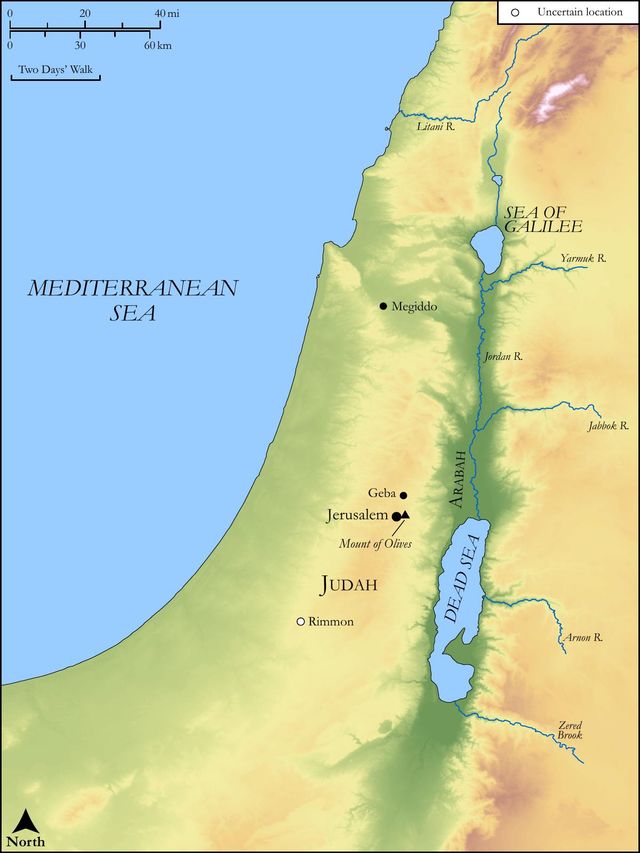
See on the biblical-era map
Study this verse
Public-domain commentary
Matthew Henry
From his Commentary on the Whole Bible. Henry comments on passages, not single verses — this entry covers Zechariah 14:16–21. His four-level outline is real structure in the source text, so it is rendered as structure.
Three things are here foretold: -
I.That a gospel-way of worship being set up in the church there shall be a great resort to it and a general attendance upon it.
Those that were left of the enemies of religion shall be so sensible of the mercy of God to them in their narrow escape that they shall apply themselves to the worship of the God of Israel, and pay their homage to him, Zac 14:16. Those that were not consumed shall be converted, and this makes their deliverance a mercy indeed, a double mercy. It is a great change that the grace of God makes upon them; those that had come against Jerusalem, finding their attempts vain and fruitless, shall become as much her admirers as ever they had been her adversaries, and shall come to Jerusalem to worship there, and go in concurrence with those whom they had gone contrary to. Note, As some of Christ's foes shall be made his footstool, so others of them shall be made his friends; and, when the principle of enmity is slain in them, their former acts of hostility are pardoned to them, and their services are admitted and accepted, as though they had never fought against Jerusalem. They shall go up to worship at Jerusalem, because that was the place which God had chosen, and there the temple was, which was a type of Christ and his mediation. Converting grace sets us right,
1.In the object of our worship. They shall no longer worship the Molochs and Baals, the kings and lords, that the Gentiles worship, the creatures of their own imagination, but the King, the Lord of hosts, the everlasting King, the King of kings, the sovereign Lord of all.
2.In the ordinances of worship, those which God himself has appointed. Gospel-worship is here represented by the keeping of the feast of tabernacles, for the sake of those two great graces which were in a special manner acted and signified in that feast - contempt of the world, and joy in God, Neh 8:17. The life of a good Christian is a constant feast of tabernacles, and, in all acts of devotion, we must retire from the world and rejoice in the Lord, must worship as in that feast.
3.In the Mediator of our worship; we must go to Christ our temple with all our offerings, for in him only our spiritual sacrifices are acceptable to God, Pe1 2:5. If we rest in ourselves, we come short of pleasing God; we must go up to him, and mention his righteousness only.
4.In the time of it; we must be constant. They shall go up from year to year, at the times appointed for this solemn feast. Every day of a Christian's life is a day of the feast of tabernacles, and every Lord's day especially (that is the great day of the feast); and therefore every day we must worship the Lord of hosts and every Lord's day with a peculiar solemnity.
II.That those who neglect the duties of gospel-worship shall be reckoned with for their neglect.
God will compel them to come and worship before him, by suspending his favours from those that keep not his ordinances: Upon them there shall be no rain, Zac 14:17. Some understand it figuratively; the rain of heavenly doctrine shall be withheld, and of the heavenly grace, which should accompany that doctrine. God will command the clouds that they rain no rain upon them. Note, It is a righteous thing with God to withhold the blessings of grace from those that do not attend the means of grace, to deny the green pastures to those that attend not the shepherd's tents. Or we may take it literally: On them there shall be no rain, to make their ground fruitful. Note, The gifts of common providence are justly denied to those that neglect and despise instituted ordinances. Those that neglected to build the temple were punished with the want of rain (Hag 2:17), and so were those that neglected to attend there when it was built. If we be barren and unfruitful towards God, justly is the earth made so to us. Many are crossed, and go backward, in their affairs, and this is at the bottom of it - they do not keep close to the worship of God as they should; they go off from God, and then he walks contrary to them. If we omit or postpone the duties he expects from us, it is just with him to deny the favours we expect from him. But what shall be done to the defaulters of the land of Egypt, to whom the threatening of the want of rain is no threatening, for they have no rain at any time; they need none; they desire none; the river Nilus is to them instead of the clouds of heaven, waters their land, and makes it fruitful, so that what is a punishment to others is none to them? Zac 14:18, Zac 14:19. It is threatened that if the family of Egypt go not up, that have no rain, yet God will find out a way to meet with them, for there shall be, in effect, the same plague wherewith other nations are smitten for their neglect. God can, and often did, restrain the overflowing of the river, which was equivalent to the shutting up of the clouds; or if the river did its part, and rose as high as it used to do, God had other ways of bringing famine upon them, and destroying the fruits of their ground, as he did by several of the ten plagues of Egypt, so that this (that is, the same) shall be the punishment of Egypt that is the punishment of other nations who come not up to keep the feast of tabernacles. Note, Those who think themselves least indebted to, and depending on, the mercy of heaven, cannot therefore think themselves guarded against the justice of Heaven. It does not follow that those who can live without rain can therefore live without God; for not the heavens only, but all other creatures, are that to us that God makes them to be, and no more; nor can any man's way of living enable him to set light by the judgments of God. This shall be the punishment - margin, This shall be the sin of Egypt, and the sin of all nations, that come not up to keep the feast of tabernacles. The same word signifies both sin and the punishment of sin, so close and inseparable is the connexion between them (as Gen 4:7), and sin is often its own punishment. Note, Omissions are sins, and we must come into judgment for them; those contract guilt that go not up to worship at the times appointed, as they have opportunity; and it is a sin that is its own punishment, for those who forsake the duty forfeit the privilege of communion with God.
III.That those who perform the duties of gospel-worship shall have grace to adorn their profession by the duties of a gospel-conversation too.
This is promised (Zac 14:20, Zac 14:21), and it is necessary to the completing of the beauty and happiness of the church. In general, all shall be holiness to the Lord.
1.The name and character of holiness shall not be so confined as formerly. Holiness to the Lord had been written only upon the high priest's forehead, but now it shall not be so appropriated. All Christians shall be living temples, and spiritual priests, dedicated to the honour of God and employed in his service.
2.Real holiness shall be more diffused than it had been, because there shall be more powerful means of sanctification, more excellent rules, more cogent arguments, and brighter patterns of holiness, and because there shall be a more plentiful effusion of the Spirit of holiness and sanctification, after Christ's ascension than ever before.
(1.)There shall be holiness introduced into common things; and those things shall be devoted to God that seemed very foreign.
[1.]The furniture of their horses shall be consecrated to God. "Upon the bells of the horses shall be engraven Holiness to the Lord, or upon the bridles of the horses (so the margin) or the trappings. The horses used in war shall no longer be used against God and his people, as they have been, but for him and them. Even their wars shall be holy wars, their troopers serving under God's banner. Their great men, who ride in state with a pompous retinue, shall reckon it their greatest ornament to honour God with their honours. Holiness to the Lord shall be written on the harness of their chariot-horses, as great men have sometimes their coat of arms with their motto painted on their coaches; every gentleman shall take the high priest's motto for his, and glory in it, and make it a memento to himself not to do any thing unworthy of it. Travellers shall have it upon their bridles, with which they guide their horses, as those who desire always to be put in mind of it, by having it continually before them, and to guide themselves in all their motions by this rule. The bells of the horses, which are designed to quicken them in their journey and to give notice of their approach, shall have Holiness to the Lord upon them," to signify that this is that which we ought to be influenced by ourselves, and make profession of to others, wherever we go.
[2.]The furniture of their houses too shall be consecrated to God, to be employed in his service. First, The furniture of the priests' houses, or apartments adjoining to the house of the Lord. The common drinking cups they used shall be like the bowls before the altar, that were used either to receive the blood of the sacrifices or to present the wine and oil in, which were for the drink-offerings. The vessels which they used for their own tables shall be used in such a religious manner, with such sobriety and temperance, such devotedness to the glory of God, and such a mixture of pious thoughts and expressions, that their meals shall look like sacrifices; they shall eat and drink, not to themselves, but to him that spreads their tables and fills their cups. And thus, in ministers' families especially, should common actions be done after a godly sort, however they are done in other families. Secondly, The furniture of other houses, those of the common people: "Every pot in Jerusalem and in Judah shall be holiness to the Lord. The pots in which they boil their meat, the cups out of which they drink their wine (Jer 35:5), in these God's good creatures shall never be abused to excess, nor that made the food and fuel of lust which should be oil to the wheels of obedience," as had formerly been, when all tables were full of vomit and filthiness, Isa 28:8. "What they eat and drink out of these shall nourish their bodies for the service of God; and out of these they shall give liberally for the relief of the poor;" then are they Holiness to the Lord, as the merchandise and the hire of the converted Tyrians are said to be (Isa 23:18); for both in our gettings and in our spendings we must have an eye to the will of God as our rule and the glory of God as our end. Thirdly, When there shall be such an abundance of real holiness people shall not be nice and curious about ceremonial holiness: "Those that sacrifice shall come and take of these common vessels, and seethe their sacrifices therein, making no distinction between them and the bowls before the altar." In gospel-times the true worshippers shall worship God in spirit and in truth, and neither in this mountain nor yet at Jerusalem, Joh 4:21. One place shall be as acceptable to God as another (I will that men pray every where); and one vessel shall be as acceptable as another. Little regard shall be had to the circumstance, provided there be nothing indecent or disorderly, while the substance is religiously preserved and adhered to. Some think it intimates that there should be greater numbers of sacrifices offered than the vessels of the sanctuary would serve for; but, rather than any should be turned back or deferred. they shall make no difficulty at all of using common vessels, as the Levites in a case of necessity helped the priests to kill the sacrifices, Ch2 29:34.
(2.)There shall be no unholiness introduced into their sacred things, to corrupt them: In that day there shall be no more the Canaanite in the house of the Lord of hosts. Some read it, There shall be no more the merchant, for so a Canaanite sometimes signifies; and they think it was fulfilled when Christ once and again drove the buyers and sellers out of the temple. Or though those that were Canaanites, strangers and foreigners, shall be brought into the house of the Lord, yet they shall cease to be Canaanites; they shall have nothing of the spirit or disposition of Canaanites in them. Or it intimates that though in gospel-times people should grow indifferent as to holy vessels, yet they should be very strict in church-discipline, and careful not to admit the profane to special ordinances, but to separate between the precious and the vile, between Israelites and Canaanites. Yet this will not have its full accomplishment short of the heavenly Jerusalem, that house of the Lord of hosts, into which no unclean thing shall enter; for at the end of time, and not before, Christ shall gather out of his kingdom every thing that offends, and the tares and wheat shall be perfectly and eternally separated.
Historical interpretation
Historical reception
1 surviving comment on this verse from the historical church.
(Vers. 18, 19.) And if the family of Egypt does not ascend and does not come, there will be no plague on them, but there will be a punishment by which the Lord will strike all the nations that do not ascend to celebrate the feast of Tabernacles. This will be the sin of Egypt, and this will be the sin of all the nations that do not ascend to celebrate the feast of Tabernacles. LXX: But if the tribe of Egypt does not ascend and does not come there, there will be a punishment on them by which the Lord will strike all the nations that did not ascend to observe the feast of Booths. This will be the sin of Egypt, and the sin of all the nations that do not go up to celebrate the feast of the tabernacles. Whoever is an Egyptian, and of other nations, as long as he remains an Egyptian and a foreigner, will not go up to Jerusalem; and because he cannot go up, nor raise himself to higher things, therefore the rain of the Lord's blessing will not be upon him. And this sin will be the greatest for the Egyptians, Assyrians, Chaldeans, Syrians, Moabites, and Ammonites, if they do not desire to leave their lands and go up to Jerusalem, to pass through the tabernacles in Jerusalem, and find an eternal home, and if the people of other nations cease, and if they become Israelites in whom there is no deceit (John 7:24). All these things which we quickly discuss, O Jews, and our Judaizers, or rather not ours, because they are Judaizers, hope for future things bodily, certainly circumcision for themselves, and marriages promising in the reign of a thousand years, so that the curse which is written may not be fulfilled in them: Cursed is the barren one who does not bear seed in Israel; and: Blessed is he who has seed in Zion and household members in Jerusalem (Isa. XXXI, 9, sec. LXX). But if it is true, all the virgins that the thousand-year reign shall find shall be subject to eternal curses and sterility: or certainly they shall marry, to escape the curse.
Continue studying Zechariah 14:19 across the web’s major study libraries — every link below opens this exact verse, chapter, or book on the destination site.
Read & Compare
 BibleGatewayThis verse in more than 200 translations and 70 languages.
 Bible.comThe YouVersion reader — hundreds of translations, reading plans, and highlights.
 ESV.orgCrossway's official English Standard Version reader.
 NET BibleThe NET translation with 60,000+ translators' notes on every rendering decision.
 STEP BibleTyndale House's free study tool — original text, vocabulary, and scholarly resources.
 BibliaLogos Bible Software's free web reader.
 USCCBThe New American Bible (Revised Edition) with the U.S. bishops' study notes.
Commentaries
 BibleHub CommentariesDozens of classic commentaries on this verse, gathered on one page.
 StudyLightMore than 100 commentary sets — the largest collection on the web.
 BibleRefPlain-English commentary on what this verse means, verse by verse.
 Enduring WordDavid Guzik's free commentary on this chapter, widely used by Bible teachers.
 Bible Study ToolsVerse commentary alongside Greek and Hebrew study aids.
Original Language & Research
- BibleHub InterlinearThe verse word by word — original language, transliteration, and English.
- BibleHub LexiconEvery word's original-language definition and Strong's entry.
 Blue Letter BibleDeep-study tools — Strong's numbers, concordance, and word studies.
 SefariaThe Hebrew text with Rashi and centuries of Jewish commentary.
Sermons, Hymns & Audio


TrulyRandomVerse is not affiliated with these sites and doesn’t control their content. They’re linked because they’re genuinely useful.
Summary
Zechariah 14:19 pronounces a specific judgment upon Egypt and all other nations that refuse to ascend to Jerusalem annually to observe the Feast of Tabernacles in the eschatological kingdom of God. This verse underscores the universal requirement for obedience and worship to the King, the LORD of hosts, in the future Messianic era, with the withholding of rain serving as the divinely appointed consequence for non-compliance, signifying God's absolute sovereignty over all creation and nations.
Context
ShowHideLiterary Context
Zechariah 14 is the climactic conclusion of the book, detailing the "Day of the Lord" and the establishment of God's universal kingdom on earth. The chapter begins with a dramatic depiction of Jerusalem's siege and ultimate divine deliverance (Zechariah 14:1-5). It then transitions to a description of the transformed earth and Jerusalem as the global capital (Zechariah 14:6-11). Following the defeat of God's enemies (Zechariah 14:12-15), the passage in Zechariah 14:16-19 outlines the universal worship required of all surviving nations, specifically their annual pilgrimage to Jerusalem to keep the Feast of Tabernacles. Verse 19 directly follows verses 17 and 18, which detail the general punishment (no rain) for nations that fail to make this pilgrimage, explicitly singling out Egypt as a prominent example.
Historical & Cultural Context
The Feast of Tabernacles (Sukkot in Hebrew) was one of the three annual pilgrimage festivals (along with Passover and Pentecost) where all Israelite males were commanded to appear before the Lord in Jerusalem (Deuteronomy 16:16). It commemorated God's provision and dwelling with Israel during their forty years in the wilderness, living in temporary shelters or booths (tabernacles) (Leviticus 23:42-43). Agriculturally, it marked the end of the harvest season, a time of great rejoicing and thanksgiving for God's bounty. The specific mention of Egypt is significant. Historically, Egypt often represented a powerful nation hostile to God's people, a symbol of the world system in opposition to divine will. Its agricultural economy was uniquely dependent on the annual flooding of the Nile, not direct rainfall. Thus, the withholding of rain, while devastating to other nations, would manifest in Egypt as the failure of the Nile to rise sufficiently, leading to famine, a tailored judgment that echoes the plagues of the Exodus (Exodus 7-12).
Key Themes
ShowHideThis verse powerfully contributes to several major themes in Zechariah and broader biblical prophecy. Firstly, it highlights God's Universal Sovereignty and Kingdom Rule. The "Day of the Lord" culminates in God's undisputed reign over all nations, demanding their submission and worship (Zechariah 14:9). Secondly, it underscores Divine Judgment and Retribution for disobedience. Even in a restored world, refusal to acknowledge God's authority carries severe consequences, demonstrating that God's justice is absolute (Deuteronomy 28:15-24). Thirdly, it emphasizes the Perpetual Significance of Worship and the Feast of Tabernacles. This ancient festival, once specific to Israel, becomes a universal act of homage to the King, symbolizing God's dwelling among humanity and His bountiful provision in the new age (Zechariah 14:16). Finally, the mention of Egypt and "all nations" reinforces the theme of God's Authority Over All Peoples, indicating that no nation, regardless of its past or power, will be exempt from God's righteous rule.
Exposition and Analysis
ShowHideKey Word Analysis
ShowHideThis word, often translated as "sin" or "sin offering," here refers to the penalty or consequence of sin. In this context, it signifies the divinely ordained retribution for the nations' offense of refusing to worship the King. It emphasizes that the suffering they experience is a direct and just consequence of their disobedience.
While often referring to "Gentiles" or non-Israelite peoples, here it broadly encompasses all "foreign nations" or "peoples" of the world. Its use highlights the universal scope of God's future reign and the global requirement for worship, extending beyond Israel to all humanity.
This verb signifies "to ascend" or "to go up," specifically referring to the pilgrimage to Jerusalem, which is geographically elevated. It implies a deliberate act of submission and worship, a physical journey to the holy city to present oneself before the Lord.
Derived from a root meaning "to move in a circle" or "to observe a festival," this term denotes a solemn, joyous festival or pilgrimage. It emphasizes the communal and celebratory nature of the required worship, a time of gathering and rejoicing before God.
This refers to temporary shelters or booths. The "Feast of Tabernacles" (Sukkot) commemorates God's dwelling with Israel in the wilderness. In the future kingdom, its observance by all nations will symbolize God's universal presence and provision among all peoples, not just Israel.
Verse Breakdown
ShowHide"This shall be the punishment of Egypt,"
This clause specifically names Egypt, a nation historically representative of worldly power and opposition to God. Its explicit mention highlights that even the most formidable and historically resistant nations will be subject to God's judgment and rule in the eschatological age. The "punishment" (Hebrew: chaṭṭâʼâh) refers to the consequence of their sin of non-compliance.
"and the punishment of all nations"
This expands the scope of judgment from Egypt to include every other nation that fails to comply. It underscores the universal nature of God's sovereignty and the mandatory worship required of all peoples in His established kingdom. No nation will be exempt from this divine decree or its consequences.
"that come not up to keep the feast of tabernacles."
This specifies the precise act of disobedience that incurs the divine punishment. The phrase "come not up" refers to the refusal to make the annual pilgrimage to Jerusalem, the elevated city, to observe the Feast of Tabernacles. This refusal signifies a deliberate rejection of the King's authority and a failure to participate in the mandated worship, thereby incurring the described judgment.
Literary Devices
ShowHideZechariah 14:19 employs several potent literary devices. Synecdoche is evident in the specific mention of "Egypt" to represent a larger category, "all nations." Egypt, being a prominent historical adversary of Israel and a symbol of worldly power, stands in for all Gentile nations that might resist God's future reign. This emphasizes that even the most formidable powers will be subject to divine authority. The passage also utilizes Symbolism, where the "Feast of Tabernacles" transcends its historical Israelite context to become a symbol of universal submission, worship, and recognition of God's dwelling among humanity in the Messianic age. The "punishment" itself, the withholding of rain, functions as a powerful Metonymy for divine judgment and control over creation, directly linking disobedience to a tangible, life-sustaining consequence. This specific form of judgment also exhibits Irony, as Egypt, a land dependent on the Nile's annual inundation rather than direct rainfall, would still suffer from a lack of "rain" in the broader sense of life-giving water, demonstrating God's ability to tailor His judgments to specific contexts.
Theological and Thematic Connections
ShowHideZechariah 14:19 powerfully articulates the future reality of God's absolute sovereignty over all creation and nations. In the eschatological kingdom, the worship of the King, the LORD of hosts, will not be optional but a universal mandate, enforced by divine judgment. This highlights God's ultimate authority and the necessary submission of all peoples to His righteous rule. The Feast of Tabernacles, once a covenantal observance for Israel, is transformed into a global act of homage, symbolizing God's dwelling among humanity and His bountiful provision for all who acknowledge Him. The specific punishment of withholding rain underscores God's control over the natural world and His power to enforce His will, demonstrating that true peace and prosperity in the kingdom are contingent upon obedient worship.
Reflection and Application
ShowHideZechariah 14:19, while describing a future eschatological reality, offers profound spiritual principles for believers today. It serves as a stark reminder of God's ultimate authority and the inevitability of His universal reign. We are called to worship God not out of compulsion, but out of a voluntary and joyful heart, recognizing His sovereignty now, before the time when all knees will bow. This passage challenges us to consider the depth of our own worship and obedience. Are we truly submitting to the King of kings in every area of our lives, or are we, like the nations in this prophecy, withholding the homage due to Him? Furthermore, it broadens our perspective to God's global plan, reminding us that His desire is for all nations to ultimately acknowledge and worship Him. This should fuel our passion for missions and evangelism, participating in God's redemptive work to draw people from every tribe and tongue into His kingdom, so that one day they too might willingly "come up" and worship the Lord.
Questions for Reflection
ShowHideFAQ
ShowHideWhy is Egypt specifically mentioned in this verse?
ShowHideEgypt is specifically mentioned because it historically represented a powerful, often hostile, nation that resisted God's will and oppressed His people. By singling out Egypt, Zechariah emphasizes that even the most formidable and historically defiant nations will be subject to God's authority and judgment in the future kingdom. It serves as a prominent example of "all nations" and highlights God's absolute sovereignty over every earthly power, demonstrating that no one will be exempt from His rule or the consequences of disobedience, echoing the divine judgments seen in the Exodus narrative.
What is the significance of the Feast of Tabernacles in this future context?
ShowHideThe Feast of Tabernacles (Sukkot) was one of Israel's three major pilgrimage festivals, commemorating God's provision and dwelling with them in the wilderness (Leviticus 23:42-43). In the future kingdom, its universal observance by all nations signifies several key things: it marks the establishment of God's universal reign and the King's presence among all peoples; it symbolizes God's ongoing provision and blessing for the earth; and it represents the joyous, communal worship of the King by all humanity. It transforms from an Israelite historical commemoration into a global celebration of God's dwelling and sovereignty over the entire world, as prophesied in Zechariah 14:16.
Christ-Centered Fulfillment
ShowHideWhile Zechariah 14:19 describes a future literal event in the Messianic kingdom, its underlying principles find their ultimate fulfillment and spiritual resonance in Christ. The "Day of the Lord" culminates in the reign of Jesus Christ, the true King, who will indeed establish a kingdom where all nations are called to worship Him. The punishment for those who "come not up" to worship foreshadows the eternal consequences for those who reject the call to repent and believe in Jesus now. Jesus Himself is the ultimate "Tabernacle" or dwelling place of God among humanity, as John 1:14 declares, "the Word became flesh and dwelt among us." Through His atoning work on the cross, Jesus makes it possible for all peoples, regardless of their national origin, to enter into a relationship with God and worship Him in spirit and truth (John 4:23-24). The future universal worship described in Zechariah is a glorious anticipation of the reality that every knee will one day bow and every tongue confess that Jesus Christ is Lord (Philippians 2:10-11), whether in willing adoration or compelled submission. Thus, the Feast of Tabernacles, symbolizing God's presence and provision, finds its deepest meaning in Christ, through whom God dwells with His people and provides eternal life for all who believe (Revelation 21:3-4).