


Ezra 5:2
Bible text: King James Version (1769 Blayney text) · Public domain
Bible text: King James Version with Strong's numbers · Public domain
Bible text: Berean Standard Bible · Public domain
Bible text: American Standard Version (1901) · Public domain
Bible text: World English Bible, Messianic edition · Public domain
Bible text: Geneva Bible (1599) · Public domain
Bible text: Young's Literal Translation · Public domain
- בֵּאדַיִןbe·Da·yin<in> thenH116Prep-b ¦ AdvAdverbבֵּ<in>אדַיִןthen
- קָמוּKa·muthey aroseH6966V-Peal-Perf-3mpVerb Peal Perfect 3rd Plural Masculine
- זְרֻבָּבֶלze·ru·ba·VelZerubbabelH2217N-proper-mNoun Proper Masculine
- בַּרbar[the] son ofH1247N-cscNoun Singular common gender Construct
- שְׁאַלְתִּיאֵלshe·'al·ti·'ElShealtielH7598N-proper-mNoun Proper Masculine
- וְיֵשׁוּעַve·ye·Shu·a'and JeshuaH3443Conj-w ¦ N-proper-mNoun Proper MasculineוְandיֵשׁוּעַJeshua
- בַּרbar[the] son ofH1247N-cscNoun Singular common gender Construct
- יוֹצָדָקyo·tza·DakJozadakH3136N-proper-mNoun Proper Masculine
- וְשָׁרִיוve·sha·Rivand they beganH8271Conj-w ¦ V-Pael-Perf-3mpVerb Pael Perfect 3rd Plural Masculineוְandשָׁרִיוthey began
- לְמִבְנֵאle·miv·Ne'to buildH1124Prep-l ¦ V-Qal-InfVerb Qal Infinitive Constructלְtoמִבְנֵאbuild
- בֵּיתbeit[the] house ofH1005N-cscNoun Singular common gender Construct
- אֱלָהָא'e·la·Ha'<the> GodH426N-cs ¦ ArtNoun Singular common gender Definiteאֱלָהָ<the>אGod
- דִּיdiwhichH1768ConjConjunction
- בִירוּשְׁלֶםvi·ru·she·Lem[is] in JerusalemH3390Prep-b ¦ N-properNoun Proper Locationבִ[is] inירוּשְׁלֶםJerusalem
- וְעִמְּהוֹןve·'i·me·Honand [were] with themH5974Conj-w ¦ Prep ¦ 3mpPrepositionוְandעִמְּ[were] withהוֹןthem
- נְבִיַּיָּאne·vi·'ai·ya'prophets theH5029N-mp ¦ ArtNoun Plural Masculine Definiteנְבִיַּיָּprophetsאthe
- דִיdiofH1768ConjConjunction
- אֱלָהָא'e·la·Ha'<the> GodH426N-cs ¦ ArtNoun Singular common gender Definiteאֱלָהָ<the>אGod
- מְסָעֲדִיןme·sa·'a·DinsupportingH5583V-Pael-Prtcpl-mpVerb Pael Participle Plural Masculine Absolute
- לְהוֹןle·Hon<obj.> themPrep-l ¦ 3mpSuffix Personal 3rd Plural Masculineלְ<obj.>הוֹןthem
English is a literal word-by-word gloss of the Hebrew, not the KJV's wording. Why?
This is the original text the KJV's translators worked from — each Hebrew word with its own literal English meaning in this verse, prepared by scholars at Tyndale House, Cambridge. The KJV translates whole sentences, not word by word, so its wording differs: one Hebrew word can become several English words, and the KJV may choose “the LORD” where the gloss reads “Yahweh”. Both are faithful — they answer different questions. For the KJV's own rendering, switch to the KJV text.
Details
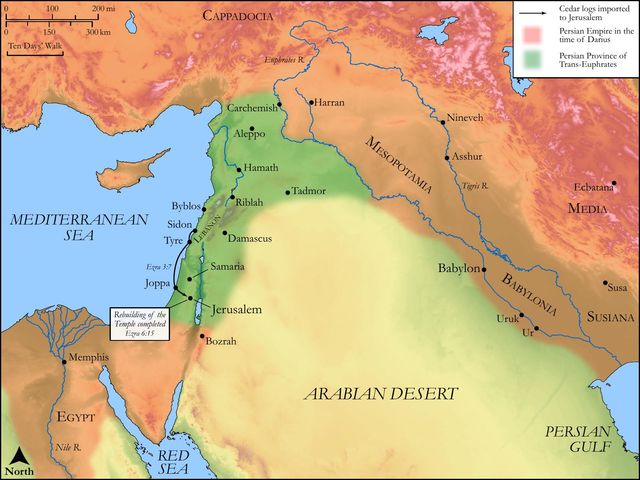
See on the biblical-era map
Study this verse
Public-domain commentary
Matthew Henry
From his Commentary on the Whole Bible. Henry comments on passages, not single verses — this entry covers Ezra 5:1–2. His three-level outline is real structure in the source text, so it is rendered as structure.
Some reckon that the building of the temple was suspended for only nine years; I am willing to believe that fifteen years were the utmost. During this time they had an altar and a tabernacle, which no doubt they made use of. When we cannot do what we would we must do what we can in the service of God, and be sorry we can do no better. But the counsellors that were hired to hinder the work (Ezr 4:5) told them, and perhaps with a pretence to inspiration, that the time had not come for the building of the temple (Hag 1:2), urging that it was long ere the time came for the building of Solomon's temple; and thus the people were made easy in their own ceiled houses, while God's house lay waste. Now here we are told how life was put into that good cause which seemed to lie dead.
I.They had two good ministers, who, in God's name, earnestly persuaded them to put the wheel of business in motion again. Observe,
1.Who these ministers were, namely, the prophets Haggai and Zechariah, who both began to prophesy in the second year of Darius, as appears, Hag 1:1; Zac 1:1. Note,
(1.)The temple of God among men is to be built by prophecy, not by secular force (that often hinders it, but seldom furthers it), but by the word of God. As the weapons of our warfare, so the instruments of our building, are not carnal, but spiritual, and they are the ministers of the gospel that are the master-builders.
(2.)It is the business of God's prophets to stir up God's people to that which is good, and to help them in it, to strengthen their hands, and, by suitable considerations fetched from the word of God, to quicken them to their duty and encourage them in it.
(3.)It is a sign that God has mercy in store for a people when he raises up prophets among them to be their helpers in the way and work of God, their guides, overseers, and rulers.
2.To whom they were sent. They prophesied unto the Jews (for, as to them pertained the giving of the law, so also the gift of prophecy, and therefore they are called the children of the prophets, Act 3:25, because they were educated under their tuition and instruction), even unto them, upon them, even upon them (so it is in the original), as Ezekiel prophesied upon the dry bones, that they might live, Eze 37:4. They prophesied against them (so bishop Patrick), for they reproved them because they did not build the temple. The word of God, if it be not received now as a testimony to us, will be received now as a testimony to us, will be received another day as a testimony against us, and will judge us.
3.Who sent them. They prophesied in the name, or (as some read it) in the cause, or for the sake, of the God of Israel; they spoke by commission from him, and argued from his authority over them, his interest in them, and the concern of his glory among them.
II.They had two good magistrates, who were forward and active in this work.
Zerubbabel their chief prince, and Jeshua their chief priest, Ezr 5:2. Those that are in places of dignity and power ought with their dignity to put honour upon and with their power to put life into every good work: thus it becomes those that preceded, and those that preside, with an exemplary care and zeal to fulfil all righteousness and to go before in a good work. These great men thought it no disparagement to them, but a happiness, to be taught and prescribed to by the prophets of the Lord, and were glad of their help in reviving this good work. Read the first chapter of the prophecy of Haggai here (for that is the best comment on these two verses) and see what great things God does by his word, which he magnifies above all his name, and by his Spirit working with it.
Continue studying Ezra 5:2 across the web’s major study libraries — every link below opens this exact verse, chapter, or book on the destination site.
Read & Compare
 BibleGatewayThis verse in more than 200 translations and 70 languages.
 Bible.comThe YouVersion reader — hundreds of translations, reading plans, and highlights.
 ESV.orgCrossway's official English Standard Version reader.
 NET BibleThe NET translation with 60,000+ translators' notes on every rendering decision.
 STEP BibleTyndale House's free study tool — original text, vocabulary, and scholarly resources.
 BibliaLogos Bible Software's free web reader.
 USCCBThe New American Bible (Revised Edition) with the U.S. bishops' study notes.
Commentaries
 BibleHub CommentariesDozens of classic commentaries on this verse, gathered on one page.
 StudyLightMore than 100 commentary sets — the largest collection on the web.
 BibleRefPlain-English commentary on what this verse means, verse by verse.
 Enduring WordDavid Guzik's free commentary on this chapter, widely used by Bible teachers.
 Bible Study ToolsVerse commentary alongside Greek and Hebrew study aids.
Original Language & Research
- BibleHub InterlinearThe verse word by word — original language, transliteration, and English.
- BibleHub LexiconEvery word's original-language definition and Strong's entry.
 Blue Letter BibleDeep-study tools — Strong's numbers, concordance, and word studies.
 SefariaThe Hebrew text with Rashi and centuries of Jewish commentary.
Sermons, Hymns & Audio


TrulyRandomVerse is not affiliated with these sites and doesn’t control their content. They’re linked because they’re genuinely useful.
Summary
Ezra 5:2 marks a pivotal moment in the post-exilic history of Israel, detailing the decisive resumption of the Second Temple's construction in Jerusalem after a significant sixteen-year halt. This verse highlights the unified leadership of Zerubbabel, the civil governor, and Jeshua, the high priest, who, inspired and actively supported by the prophets of God, courageously initiated the rebuilding effort despite persistent opposition. It underscores the divine impetus behind the work and the essential role of both spiritual and civil authority in fulfilling God's purposes for His people, demonstrating God's faithfulness in stirring His people to action.
Context
ShowHideLiterary Context
Ezra 5:2 immediately follows a sixteen-year period of inactivity in the Temple's reconstruction, a time of discouragement and opposition detailed in Ezra 4. Chapter 4 recounts how the adversaries of Judah and Benjamin successfully petitioned King Artaxerxes to issue a decree that halted the work, specifically noted in Ezra 4:24. Prior to this cessation, the foundation of the Temple had been laid with great joy and sorrow, as described in Ezra 3:8-13, but the subsequent opposition stifled the initial enthusiasm. This verse, therefore, represents a dramatic and divinely orchestrated shift, marking the renewed commitment to God's work. It is directly prompted by the prophetic ministries of Haggai and Zechariah, whose messages are explicitly referenced in Ezra 5:1 and recorded in their respective books, thereby moving the narrative flow from stagnation and despair to dynamic action and renewed hope, setting the stage for the successful completion of the Temple.
Historical & Cultural Context
The events of Ezra 5:2 unfold during the second year of the reign of Darius I Hystaspes (520 BC), a period of relative stability within the vast Persian Empire following a time of political unrest. The Jewish exiles had returned to Judah under Cyrus's decree in 538 BC, but their initial zeal for rebuilding Jerusalem and its Temple was met with significant local hostility from surrounding peoples, particularly the Samaritans. These adversaries actively sought to undermine their efforts, even sending false and misleading reports to the Persian court, which led to the royal decree halting the work. Culturally, the Temple was far more than just a religious building; it was the spiritual, cultural, and national center for the Jewish people, symbolizing God's presence among them and their identity as His covenant people. Its reconstruction was essential for the restoration of their religious life, the resumption of sacrificial worship, and the reaffirmation of their distinctiveness after the devastation of the Babylonian exile. The cultural expectation was that a people's God resided in their central sanctuary, and a desolate temple implied a defeated or absent deity, making its rebuilding a matter of profound theological and national significance.
Key Themes
ShowHideThis verse powerfully contributes to several overarching themes prominent in the book of Ezra and the broader post-exilic literature. Firstly, it highlights the theme of Divine Sovereignty and Providence, demonstrating that even amidst human opposition, political decrees, and prolonged delay, God's purposes for His people and His house will ultimately prevail. The resumption of work is not merely human initiative but a divinely inspired response to prophetic encouragement, showing God's active hand in history. Secondly, the verse underscores the importance of Unified and God-Empowered Leadership. The collaboration between Zerubbabel (the civil governor, a descendant of David and thus representing the Davidic covenant) and Jeshua (the high priest, a descendant of Aaron and representing the Aaronic priesthood) symbolizes the essential partnership between spiritual and governmental authority in leading God's people. Their joint action, empowered by God's Spirit, was crucial for overcoming inertia and opposition, as seen in Zechariah 4:6. Finally, the verse emphasizes the vital role of Prophetic Guidance and Obedience. The prophets Haggai and Zechariah were instrumental in stirring the people and leaders to action, reminding them of God's commands and promises, and rebuking their complacency (e.g., Haggai 1:4-8). This demonstrates God's consistent method of using His messengers to call His people to repentance and renewed commitment to His will, ensuring His work continues despite human failings.
Exposition and Analysis
ShowHideKey Word Analysis
ShowHideThis verb signifies more than merely standing; it conveys a sense of decisive, resolute action, an active rising to the occasion after a period of dormancy. It implies a firm resolve to overcome past inertia and opposition, indicating a divinely inspired surge of determination and courage to recommence a challenging task. The root meaning suggests establishing or setting up, reinforcing the idea of a new, firm beginning.
This term indicates the initiation of a process, specifically the commencement of the building work. It implies unraveling or loosening a previous state of inactivity, moving from a standstill to active construction. The word conveys the idea of setting free from a previous constraint, highlighting the breakthrough from the sixteen-year halt.
This term, used to describe the prophets' role, suggests active support, strengthening, and providing assistance. It's not merely passive observation or verbal encouragement but implies a vital, hands-on role in motivating, assisting, and perhaps even providing resources or spiritual fortification to the builders. It highlights the practical and empowering nature of prophetic ministry, underscoring their active participation in the work.
Verse Breakdown
ShowHide"Then rose up Zerubbabel the son of Shealtiel, and Jeshua the son of Jozadak"
This clause identifies the two divinely appointed leaders who spearheaded the renewed effort. Zerubbabel, the civil governor and a descendant of David, represented the royal line, while Jeshua, the high priest, represented the priestly line. Their "rising up" signifies a courageous and decisive initiative, an act of faith and obedience to God's prophetic word after a long period of inactivity and discouragement. It underscores their divinely appointed roles and their readiness to lead God's people.
"and began to build the house of God which [is] at Jerusalem"
This phrase states the central action: the resumption of the Temple's construction. The designation "the house of God" emphasizes its sacred purpose, its divine ownership, and its centrality to Israel's covenant relationship with Yahweh. The specific location, "at Jerusalem," highlights the enduring significance of the holy city as the place of God's dwelling and the symbolic heart of the Jewish nation, signifying the restoration of their religious and national identity.
"and with them [were] the prophets of God helping them"
This final clause reveals the crucial role of divine encouragement and support that empowered the leaders and the people. The "prophets of God" (primarily Haggai and Zechariah, as mentioned in Ezra 5:1) were not just observers but active participants. Their ministry provided spiritual impetus, divine validation, guidance, and practical assistance, stirring the leaders and the people to action, confirming God's will, and empowering them to persevere through continued challenges.
Literary Devices
ShowHideEzra 5:2 effectively employs several literary devices to convey its powerful message of renewed divine activity and human obedience. Synergy is prominently evident in the joint action of Zerubbabel and Jeshua, symbolizing the essential partnership between civil and spiritual authority, both working in concert for a divine purpose. This collaboration highlights the unified front necessary for overcoming significant obstacles and demonstrates the comprehensive nature of God's leadership. The phrase "began to build the house of God" functions as a Divine Mandate, emphasizing that the construction is not merely a human project but a sacred task commanded and empowered by God, underscoring its ultimate significance. The Temple itself serves as a profound Symbolism, representing God's enduring presence among His people, the restored covenant relationship, and the hope for Judah's future. The active "helping" of the prophets underscores the theme of Divine Enablement, illustrating how God provides the necessary encouragement, guidance, and support through His messengers to accomplish His sovereign will, transforming human inertia into obedient zeal.
Theological and Thematic Connections
ShowHideEzra 5:2 stands as a powerful testament to God's faithfulness and His unwavering commitment to His covenant people, even when their own zeal wanes or external opposition mounts. It highlights the profound theological principle that divine purposes, though sometimes delayed by human sin or external adversity, are never ultimately thwarted. The verse underscores the necessity of courageous, unified leadership in the face of adversity, demonstrating that when spiritual and civil authorities align under God's inspiration and obey His prophetic word, significant breakthroughs can occur. It also emphasizes the indispensable role of prophetic ministry in stirring God's people to action, reminding them of His presence, promises, and commands, thereby transforming inertia into obedient zeal. This narrative serves as a powerful reminder that God often uses human agents, empowered by His Spirit and Word, to accomplish His redemptive plans, always bringing His will to fruition in His perfect timing.
Reflection and Application
ShowHideEzra 5:2 offers profound encouragement and practical guidance for believers today, particularly when facing spiritual apathy, prolonged delays, or overwhelming opposition in God's work. It reminds us that even when God's purposes seem to stall, or we face discouragement, His plans are not abandoned. The sixteen-year delay in Temple construction teaches us that perseverance, renewed commitment, and faith in God's perfect timing are often prerequisites for seeing His will accomplished. We are called to "rise up" with decisive action, just as Zerubbabel and Jeshua did, trusting that God will provide the necessary leadership and prophetic guidance. This verse challenges us to consider our own "temples"—our lives, our families, our churches, our communities—and ask where we might have allowed discouragement or opposition to halt God's work. It calls us to listen attentively to God's voice, whether through His written Word, the counsel of godly leaders, or the promptings of the Holy Spirit, and to respond with courageous obedience, knowing that our strength and success come from Him alone.
Questions for Reflection
ShowHideFAQ
ShowHideWhat was the significance of the 16-year delay in the Temple's construction mentioned in the context of Ezra 5:2?
ShowHideThe 16-year delay (from the laying of the foundation in 536 BC to the resumption in 520 BC) was highly significant, serving as a stark illustration of the severe impact of human opposition and spiritual discouragement on God's work, as detailed in Ezra 4. During this period, the people prioritized their own comfortable homes over God's house, leading to spiritual apathy, economic hardship, and a lack of divine blessing, as rebuked by the prophet Haggai in Haggai 1:2-11. The delay highlighted the critical need for divine intervention and prophetic stirring to re-ignite the people's zeal and reorient their priorities. Its end, marked by the decisive action in Ezra 5:2, signifies God's faithfulness in prompting His people to resume the work, demonstrating that His purposes will ultimately prevail despite human failings, external obstacles, or prolonged periods of inactivity.
Christ-Centered Fulfillment
ShowHideEzra 5:2, while describing the rebuilding of a physical temple, powerfully foreshadows the ultimate Temple, Jesus Christ, and His spiritual body, the Church. Just as Zerubbabel and Jeshua "rose up" with divine impetus to build the dwelling place of God in Jerusalem, so too did Christ "rise up" from the grave, inaugurating a new spiritual temple not made with human hands. Jesus Himself declared, "Destroy this temple, and in three days I will raise it up," speaking of His own body (John 2:21). The unified leadership of Zerubbabel and Jeshua, representing both kingly and priestly authority, points to Christ as the ultimate King and High Priest, who perfectly embodies both roles, building His Church upon the confession of His identity (Matthew 16:18). The prophets who "helped" the builders prefigure the Holy Spirit and the apostles and prophets of the New Covenant, who continue to equip and build up the spiritual house of God, which is the Church (Ephesians 2:19-22). Believers are now living stones, being built into a spiritual house, a holy priesthood, to offer spiritual sacrifices acceptable to God through Jesus Christ (1 Peter 2:5). Thus, the physical restoration in Ezra serves as a tangible illustration of God's greater redemptive plan to dwell among His people, fully realized in Christ and His ongoing work through the Church, which is His glorious dwelling place on earth.