


Ezra 5:3
Bible text: King James Version (1769 Blayney text) · Public domain
Bible text: King James Version with Strong's numbers · Public domain
Bible text: Berean Standard Bible · Public domain
Bible text: American Standard Version (1901) · Public domain
Bible text: World English Bible, Messianic edition · Public domain
Bible text: Geneva Bible (1599) · Public domain
Bible text: Young's Literal Translation · Public domain
- בֵּהּbehat itPrep-b ¦ 3fsSuffix Personal 3rd Singular Feminineבֵּatהּit
- זִמְנָאzim·Na'time theH2166N-cs ¦ ArtNoun Singular common gender Definiteזִמְנָtimeאthe
- אֲתָא'a·Ta'he cameH858V-Peal-Perf-3msVerb Peal Perfect 3rd Singular Masculine
- עֲלֵיהוֹןa·lei·Honto themH5922Prep ¦ 3mpPrepositionעֲלֵיtoהוֹןthem
- תַּתְּנַיTa·te·naiTattenaiH8674N-proper-mNoun Proper Masculine
- פַּחַתpa·Chat[the] governor ofH6347N-fscNoun Singular Feminine Construct
- עֲבַר'a·var[the] region beyondH5675N-cscNoun Singular common gender Construct
- נַהֲרָהna·ha·Rah'river theH5103N-cs ¦ ArtNoun Singular common gender Definiteנַהֲרָriverהthe
- וּשְׁתַרu·she·Tarand Shethar-H8370Conj-w ¦ N-proper-mNoun Proper MasculineוּandשְׁתַרShethar-
- בּוֹזְנַיboz·NaiBozenaiH8370N-proper-mNoun Proper Masculine
- וּכְנָוָתְהוֹןu·khe·na·va·te·Honand their associatesH3675Conj-w ¦ N-fpc ¦ 3mpNoun Plural Feminine Constructוּandכְנָוָתְassociatesהוֹןtheir
- וְכֵןve·Khenand as followsH3652Conj-w ¦ AdvAdverbוְandכֵןas follows
- אָמְרִין'a·me·Rin[they were] sayingH560V-Peal-Prtcpl-mpVerb Peal Participle Plural Masculine Absolute
- לְהֹםle·Homto themPrep-l ¦ 3mpSuffix Personal 3rd Plural Masculineלְtoהֹםthem
- מַןmanwho?H4479InterrogPronoun Interrogative
- שָׂםsamdid he makeH7761V-Peal-Perf-3msVerb Peal Perfect 3rd Singular Masculine
- לְכֹםle·Khomfor youPrep-l ¦ 2mpSuffix Personal 2nd Plural Masculineלְforכֹםyou
- טְעֵםte·'Ema decreeH2942N-csNoun Singular common gender Absolute
- בַּיְתָאbay·Ta'house theH1005N-cs ¦ ArtNoun Singular common gender Definiteבַּיְתָhouseאthe
- דְנָהde·NahthisH1836PrtParticle Demonstrative
- לִבְּנֵאli·be·Ne'to buildH1124Prep-l ¦ V-Qal-InfVerb Qal Infinitive Constructלִtoבְּנֵאbuild
- וְאֻשַּׁרְנָאve·'u·shar·Na'and structure theH846Conj-w ¦ N-cs ¦ ArtNoun Singular common gender Definiteוְandאֻשַּׁרְנָstructureאthe
- דְנָהde·NahthisH1836PrtParticle Demonstrative
- לְשַׁכְלָלָהle·shakh·la·Lahto finishH3635Prep-l ¦ V-Shaphel-InfVerb Shaphel Infinitive Constructלְtoשַׁכְלָלָהfinish
English is a literal word-by-word gloss of the Hebrew, not the KJV's wording. Why?
This is the original text the KJV's translators worked from — each Hebrew word with its own literal English meaning in this verse, prepared by scholars at Tyndale House, Cambridge. The KJV translates whole sentences, not word by word, so its wording differs: one Hebrew word can become several English words, and the KJV may choose “the LORD” where the gloss reads “Yahweh”. Both are faithful — they answer different questions. For the KJV's own rendering, switch to the KJV text.
Details
See on the biblical-era map
Study this verse
Public-domain commentary
Matthew Henry
From his Commentary on the Whole Bible. Henry comments on passages, not single verses — this entry covers Ezra 5:3–17. His two-level outline is real structure in the source text, so it is rendered as structure.
We have here, I. The cognizance which their neighbours soon took of the reviving of this good work. A jealous eye, it seems, they had upon them, and no sooner did the Spirit of God stir up the friends of the temple to appear for it than the evil spirit stirred up its enemies to appear against it. While the people built and ceiled their own houses their enemies gave them no molestation (Hag 1:4), though the king's order was to put a stop to the building of the city (Ezr 4:21); but when they fell to work again at the temple then the alarm was taken, and all heads were at work to hinder them, Ezr 5:3, Ezr 5:4. The adversaries are here named: Tatnai and Shethar-boznai. The governors we read of (ch. 4) were, it is probable, displaced at the beginning of this reign, as is usual. It is the policy of princes often to change their deputies, proconsuls, and rulers of provinces. These, though real enemies to the building of the temple, were men of better temper than the other, and made some conscience of telling truth. If all men have not faith (Th2 3:2), it is well some have, and a sense of honour. The church's enemies are not all equally wicked and unreasonable. The historian begins to relate what passed between the builders and those inquisitors (Ezr 5:3, Ezr 5:4), but breaks off his account, and refers to the ensuing copy of the letter they sent to the king, where the same appears more fully and at large, which he began to abridge (Ezr 5:4), or make an extract out of, though, upon second thoughts, he inserted the whole.
II.The care which the divine Providence took of this good work (Ezr 5:5):
The eye of their God was upon the elders of the Jews, who were active in the work, so that their enemies could not cause them to cease, as they would have done, till the matter came to Darius. They desired they would only cease till they had instructions from the king about it. But they would not so much as yield them that, for the eye of God was upon them, even their God. And,
1.That baffled their enemies, infatuated and enfeebled them, and protected the builders from their malicious designs. While we are employed in God's work we are taken under his special protection; his eye is upon us for good, seven eyes upon one stone in his temple; see Zac 3:9; Zac 4:10.
2.That quickened them. The elders of the Jews saw the eye of God upon them, to observe what they did and own them in what they did well, and then they had courage enough to face their enemies and to go on vigorously with their work, notwithstanding all the opposition they met with. our eye upon God, observing his eye upon us, will keep us to our duty and encourage us in it when the difficulties are ever so discouraging.
III.The account they sent to the king of this matter, in which we may observe,
1.How fully the elders of the Jews gave the Samaritans an account of their proceedings. They, finding them both busy and prosperous, that all hands were at work to run up this building and that it went on rapidly, put these questions to them: - "By what authority do you do these things, and who gave you that authority? Who set you to work? Have you that which will bear you out?" To this they answered that they had sufficient warrant to do what they did; for, (1.) "We are the servants of the God of heaven and earth. The God we worship is not a local deity, and therefore we cannot be charged with making a faction, or setting up a sect, in building this temple to his honour: but we pay our homage to a God on whom the whole creation depends, and therefore ought to be protected and assisted by all and hindered by none." It is the wisdom as well as duty of kings to countenance the servants of the God of heaven. (2.) "We have a prescription to this house; it was built for the honour of our God by Solomon many ages ago. It is no novel invention of our own; we are but raising the foundations of many generations," Isa 58:12. (3.) "It was to punish us for our sins that we were, for a time, put out of the possession of this house; not because the gods of the nations had prevailed against our God, but because we had provoked him (Ezr 5:12), for which he delivered us and our temple into the hands of the king of Babylon, but never intended thereby to put a final period to our religion. We were only suspended for a time, not deprived for ever." (4.) "We have the royal decree of Cyrus to justify us and bear us out in what we do. He not only permitted and allowed us, but charged and commanded us to build this house (Ezr 5:13), and to build it in its place (Ezr 5:15), the same place where it had stood before." He ordered this, not only in compassion to the Jews, but in veneration of their God, saying, He is the God. He also delivered the vessels of the temple to one whom he entrusted to see them restored to their ancient place and use, Ezr 5:14. And they had these to show in confirmation of what they alleged. (5.) "The building was begun according to this order as soon as ever we had returned, so that we have not forfeited the benefit of the order for want of pursuing it in time; still it has been in building, but, because we have met with opposition, it is not finished." But, observe, they mention not the falsehood and malice of the former governors, nor make any complaint of them, though they had cause enough, to teach us not to render bitterness for bitterness, nor the most just reproach for that which is most unjust, but to think it enough if we can obtain fair treatment for the future, without an invidious reference to former injuries, Ezr 5:16. This is the account they give of their proceedings, not asking what authority they had to examine them, nor upbraiding them with their idolatry, and superstitions, and medley religion. Let us learn hence with meekness and fear to give a reason of the hope that is in us (Pe1 3:15), rightly to understand, and then readily to declare, what we do in God's service and why we do it.
2.How fairly the Samaritans represented this to the king. (1.) They called the temple at Jerusalem the house of the great God (Ezr 5:8); for though the Samaritans, as it should seem, had yet gods many and lords many, they owned the God of Israel to be the great God, who is above all gods. "It is the house of the great God, and therefore we dare not oppose the building of it without orders from thee." (2.) They told him truly what was done, not stating, as their predecessors did, that they were fortifying the city as if they intended war, but only that they were rearing the temple as those that intended worship, Ezr 5:8. (3.) They fully represented their plea, told him what they had to say for themselves, and were willing that the cause should be set in a true light. (4.) They left it to the king to consult the records whether Cyrus had indeed made such a decree, and then to give directions as he should think fit, Ezr 5:17. We have reason to think that if Artaxerxes, in the foregoing chapter, had had the Jews' cause as fairly represented to him as it was here to Darius, he would not have ordered the work to be hindered. God's people could not be persecuted if they were not belied, could not be baited if they were not dressed up in bears' skins. Let but the cause of God and truth be fairly stated, and fairly heard, and it will keep its ground.
Historical interpretation
Historical reception
1 surviving comment on this verse from the historical church.
At that time, Thathannai came to them, etc. The sense of the letter is clear, because the leaders of the Jews, strengthened by the words of the prophets, were not able to be hindered by the persecution of the enemies from the holy work, which they had ceased from for fear of the enemies while the prophets still rested. What is now carried out in the holy Church in the same manner, while those who had become more lukewarm towards good work due to the snares of evil men or spirits remained for a while, suddenly corrected by the words of either faithful teachers or divine Scriptures, begin to boil over with good endeavors to such an extent that they cannot be overcome by any machinations of temptations, nor can they be recalled from their intended purpose. However, it is rightly asked how it was said, "To which we responded to them," as if he who wrote was present at that time, since Ezra is said to have written this book, who is found not to have been in Jerusalem at this time but came much later during the reign of Artaxerxes. Either he was truly there at that time when the temple was being built and returned to Babylon after the temple was made to lead more of the children of Israel back to Jerusalem; or certainly, even if he was not there while the temple was being built, he nonetheless joined with those who were building, because he considered everything that was done concerning his brothers or that they did as his own. Similarly, the Apostle also, for the sake of fraternal concord, in a way associates himself with the saints who will be at the end of the age: "We," he says, "who are alive, who remain, will not precede those who have fallen asleep at the coming of our Lord" (I Thess. IV).
Continue studying Ezra 5:3 across the web’s major study libraries — every link below opens this exact verse, chapter, or book on the destination site.
Read & Compare
 BibleGatewayThis verse in more than 200 translations and 70 languages.
 Bible.comThe YouVersion reader — hundreds of translations, reading plans, and highlights.
 ESV.orgCrossway's official English Standard Version reader.
 NET BibleThe NET translation with 60,000+ translators' notes on every rendering decision.
 STEP BibleTyndale House's free study tool — original text, vocabulary, and scholarly resources.
 BibliaLogos Bible Software's free web reader.
 USCCBThe New American Bible (Revised Edition) with the U.S. bishops' study notes.
Commentaries
 BibleHub CommentariesDozens of classic commentaries on this verse, gathered on one page.
 StudyLightMore than 100 commentary sets — the largest collection on the web.
 BibleRefPlain-English commentary on what this verse means, verse by verse.
 Enduring WordDavid Guzik's free commentary on this chapter, widely used by Bible teachers.
 Bible Study ToolsVerse commentary alongside Greek and Hebrew study aids.
Original Language & Research
- BibleHub InterlinearThe verse word by word — original language, transliteration, and English.
- BibleHub LexiconEvery word's original-language definition and Strong's entry.
 Blue Letter BibleDeep-study tools — Strong's numbers, concordance, and word studies.
 SefariaThe Hebrew text with Rashi and centuries of Jewish commentary.
Sermons, Hymns & Audio


TrulyRandomVerse is not affiliated with these sites and doesn’t control their content. They’re linked because they’re genuinely useful.
Summary
Ezra 5:3 marks a pivotal moment in the post-exilic rebuilding of the Temple in Jerusalem, introducing the direct confrontation between the newly re-energized Jewish builders and the Persian imperial authorities. Following a period of stagnation and discouragement, the people, spurred by prophetic encouragement, resumed construction. This verse immediately presents the consequence: the arrival of Tatnai, the governor of the province "Beyond the River," and his associates, who challenge the legitimacy of the building project, demanding to know by whose authority they are proceeding. This official inquiry, though seemingly an obstacle, ultimately serves as a catalyst for the rediscovery of King Cyrus's original decree, leading to renewed imperial support for the Temple's completion.
Context
ShowHideLiterary Context
Ezra 5:3 immediately follows a powerful narrative shift in the book of Ezra. Chapters 1-3 detail the initial return from exile and the laying of the Temple foundation. However, Ezra 4 describes significant opposition from surrounding peoples, leading to a cessation of the work that lasted for approximately sixteen years, as explicitly stated in Ezra 4:24. The narrative picks up in Ezra 5:1-2 with the intervention of the prophets Haggai and Zechariah, who divinely stirred up Zerubbabel and Jeshua, along with the people, to resume the building. Verse 3 then presents the immediate, almost inevitable, consequence of this renewed activity: the arrival of Persian officials, initiating a formal inquiry into the project's authority. This sets the stage for the subsequent legal proceedings and the search for the original decree, which culminates in Ezra 6.
Historical & Cultural Context
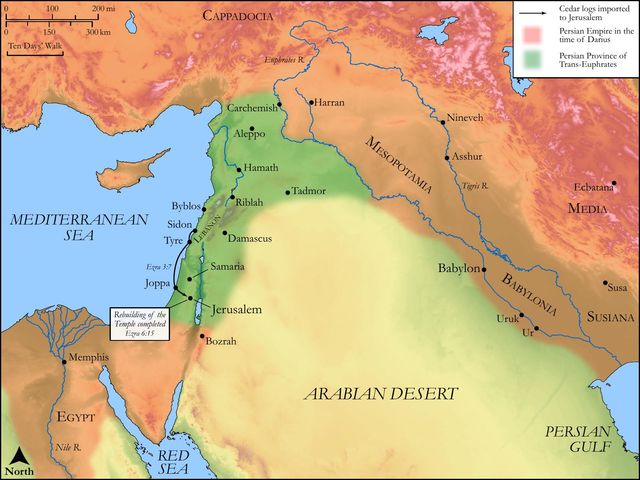
The events of Ezra 5 take place during the reign of Darius I (522-486 BC), a period when the Persian Empire had consolidated its vast territories. The province of "Beyond the River" (Abar-Nahara in Aramaic, or Trans-Euphrates) was a significant satrapy encompassing Syria, Phoenicia, and Judah. Tatnai, as its governor (peḥat), held considerable administrative and military authority, responsible for maintaining order, collecting taxes, and ensuring compliance with imperial decrees. His arrival was not merely a casual visit but a formal inspection, prompted by reports (likely from the adversaries mentioned in Ezra 4) of unauthorized building activity. The Persian administrative system was highly organized, requiring official sanction for large-scale public works, especially those that might involve significant resources or have political implications. The question "Who hath commanded you?" reflects this bureaucratic necessity for proper authorization within the imperial structure.
Key Themes
ShowHideEzra 5:3 contributes significantly to several overarching themes within the book of Ezra and the broader post-exilic narrative. Firstly, it highlights the theme of Divine Providence Amidst Human Opposition. While the inquiry appears as an obstacle, it ultimately serves God's purpose by forcing the Jewish leaders to articulate their divine and royal mandate, leading to a more robust and officially sanctioned rebuilding effort. Secondly, it underscores the Legitimacy of God's Work and the need for His people to be prepared to defend it, even before secular authorities. The question of "Who hath commanded you?" is not just administrative but also a challenge to the very foundation of their enterprise. Thirdly, the verse exemplifies the recurring theme of Perseverance in Faith. Despite past setbacks and renewed scrutiny, the people, empowered by the prophets, continue the work, demonstrating their unwavering commitment to God's command. This perseverance is ultimately vindicated by the subsequent events in Ezra 6:6-12, where Darius issues a decree supporting their efforts.
Exposition and Analysis
ShowHideKey Word Analysis
ShowHideThis term (H6347) refers to a Persian provincial governor or viceroy, indicating a position of significant power and responsibility within the imperial administration. A pechâh was responsible for maintaining order, collecting taxes, and enforcing imperial decrees within his jurisdiction. Tatnai's title emphasizes that this was an official, legitimate investigation, not merely a personal curiosity, and that the Jewish leaders were dealing with the full weight of Persian authority.
This Aramaic word (H2942), used in conjunction with the verb "put" (H7761, sûwm), refers to a formal decree, judgment, or command. Tatnai's use of this term signifies his demand for official authorization or a verifiable royal edict. He is not asking for a mere suggestion or an internal decision, but a legitimate imperial order that would grant the Jews permission to undertake such a significant public works project. This highlights the bureaucratic necessity for proper authorization within the Persian system.
This Aramaic verb (H1124) means "to build" or "to make." It directly refers to the construction activity of the Temple ("this house") and potentially the surrounding fortifications ("this wall"). The very act of building, especially a structure of such significance, was what drew the attention of the Persian authorities. Tatnai's question about who commanded them to "build this house" goes to the heart of the legitimacy of their physical labor and their perceived challenge to imperial control.
Verse Breakdown
ShowHide"¶ At the same time came to them Tatnai, governor on this side the river, and Shetharboznai, and their companions"
This clause sets the scene, indicating the immediate consequence of the resumed building work. "At the same time" links directly to the renewed activity spurred by the prophets in the preceding verses. The arrival of Tatnai, the chief governor of the entire Trans-Euphrates province, along with his subordinate Shetharboznai and other officials, underscores the official and high-level nature of this intervention. Their presence signals a formal inquiry into the legality of the construction project.
"and said thus unto them"
This simple phrase introduces the direct confrontation, emphasizing that the officials did not merely observe but engaged in a verbal challenge. It highlights the shift from passive observation to active interrogation, signaling the beginning of a formal investigation.
"Who hath commanded you to build this house, and to make up this wall?"
This is the central question, a direct challenge to the authority of the builders. "This house" refers unequivocally to the Temple. The phrase "and to make up this wall" could refer to the walls of the Temple precincts, or more broadly, to any defensive structures being erected concurrently, which would be of particular concern to imperial authorities as it might imply rebellion or unauthorized fortification. The core of the question is about legitimacy: by what decree or order, and from whom, are they undertaking such a significant and potentially sensitive project? This question forces the Jewish leaders to articulate their divine mandate and recall the royal decree from Cyrus.
Literary Devices
ShowHideThe verse effectively employs Interrogation as its primary literary device, with Tatnai's direct question serving as the central dramatic element. This question is not merely informational but functions as a challenge, creating immediate tension and driving the narrative forward towards the search for the original decree. There is also a strong sense of Juxtaposition, as the renewed zeal and spiritual encouragement of Ezra 5:1-2 are immediately met with the bureaucratic and potentially hostile inquiry in Ezra 5:3. This contrast highlights the reality that even divinely inspired work often faces external opposition. Furthermore, the inquiry itself acts as a form of Foreshadowing, hinting at the legal and administrative hurdles that the builders must overcome. It sets the stage for the subsequent search for Cyrus's decree and Darius's eventual supportive edict, demonstrating how apparent obstacles can ultimately lead to greater clarity and stronger divine vindication.
Theological and Thematic Connections
ShowHideEzra 5:3 powerfully illustrates the principle of God's sovereignty over human authorities and the necessity for His people to be prepared to articulate their divine mandate. Even when God's work is undertaken with spiritual zeal, it often intersects with human governance, requiring a clear and legitimate basis for action. Tatnai's inquiry, though seemingly a hindrance, ultimately serves God's purpose by forcing the Jewish leaders to rediscover and present the original decree of Cyrus, thereby securing the Temple's completion under official imperial protection. This demonstrates that God can use even the scrutiny of secular powers to further His redemptive plans, turning potential opposition into an opportunity for His will to be publicly affirmed. It reminds believers that faithfulness often involves navigating complex earthly systems while relying on heavenly authority.
Reflection and Application
ShowHideEzra 5:3 resonates deeply with believers today, offering crucial insights into the nature of God's work and the challenges we may face. Just as the Jewish community experienced renewed opposition after resuming the Temple work, we too should anticipate that significant spiritual endeavors often attract scrutiny, skepticism, or even direct challenge, sometimes from unexpected or official sources. This verse calls us to be prepared, not only spiritually but also practically, to articulate the "who" and "why" behind our faith and actions. Our ultimate command comes from God, revealed in His Word and through the leading of His Spirit. When questioned, our response should be rooted in truth, humility, and a clear understanding of our divine mandate. Furthermore, this passage encourages us to trust in God's sovereign hand, even when faced with seemingly insurmountable obstacles. What appears to be an interrogation can, in God's providence, become the very means by which His purposes are clarified, affirmed, and ultimately brought to a more glorious completion. Our trials can become testimonies to His faithfulness.
Questions for Reflection
ShowHideFAQ
ShowHideWho were Tatnai and Shetharboznai, and why were they involved?
ShowHideTatnai was the Persian governor (peḥat) of the satrapy of Abar-Nahara, or "Beyond the River," which encompassed the region west of the Euphrates, including Judah. Shetharboznai was likely a subordinate official or commissioner. They were involved because the rebuilding of the Temple was a significant public works project that required imperial sanction. Reports (likely from the adversaries mentioned in Ezra 4) of the resumed construction reached them, prompting a formal, administrative inquiry into the legitimacy and authorization of the project. As high-ranking officials, they were responsible for ensuring order, collecting taxes, and enforcing the king's decrees, making their investigation a standard procedure within the Persian administrative system.
Christ-Centered Fulfillment
ShowHideEzra 5:3, with its focus on authority and the building of God's house under scrutiny, finds profound Christ-centered fulfillment in the person and work of Jesus Christ and the establishment of His church. Just as Tatnai questioned the authority of the Jewish builders, Jesus's authority was repeatedly challenged by the religious leaders of His day, who demanded, "By what authority are you doing these things, and who gave you this authority?" (Matthew 21:23). Jesus's ultimate authority, however, came directly from God the Father, a divine mandate that superseded any earthly decree. Furthermore, the "house" being built in Ezra is a physical temple, a shadow of the spiritual house that Jesus came to establish—His church. As the "chief cornerstone" (Ephesians 2:20), Jesus is the one upon whom the entire spiritual edifice is built, a "spiritual house" composed of believers (1 Peter 2:5). The "wall" that the builders were making up can also be seen as a foreshadowing of the dividing wall of hostility that Christ broke down through His sacrifice, uniting Jew and Gentile into one new humanity (Ephesians 2:14). Thus, the challenges faced by the builders in Ezra 5:3 ultimately point to the greater work of Christ, who, by His divine authority, builds His church against which "the gates of hell shall not prevail" (Matthew 16:18).