


Ezra 6:6
Bible text: King James Version (1769 Blayney text) · Public domain
Bible text: King James Version with Strong's numbers · Public domain
Bible text: Berean Standard Bible · Public domain
Bible text: American Standard Version (1901) · Public domain
Bible text: World English Bible, Messianic edition · Public domain
Bible text: Geneva Bible (1599) · Public domain
Bible text: Young's Literal Translation · Public domain
- כְּעַןke·'AnnowH3705AdvAdverb
- תַּתְּנַיTa·te·naiO TattenaiH8674N-proper-mNoun Proper Masculine
- פַּחַתpa·Chat[the] governor ofH6347N-fscNoun Singular Feminine Construct
- עֲבַר'a·var[the] region beyondH5675N-cscNoun Singular common gender Construct
- נַהֲרָהna·ha·Rah'river theH5103N-cs ¦ ArtNoun Singular common gender Definiteנַהֲרָriverהthe
- שְׁתַרshe·TarShethar-H8370N-proper-mNoun Proper Masculine
- בּוֹזְנַיboz·NaiBozenaiH8370N-proper-mNoun Proper Masculine
- וּכְנָוָתְהוֹןu·khe·na·Va·te·Honand their associatesH3675Conj-w ¦ N-fpc ¦ 3mpNoun Plural Feminine Constructוּandכְנָוָתְassociatesהוֹןtheir
- אֲפַרְסְכָיֵא'a·far·se·kha·Ye'officials theH671N-mp ¦ ArtNoun Plural Masculine Definiteאֲפַרְסְכָיֵofficialsאthe
- דִּיdiwhoH1768ConjConjunction
- בַּעֲבַרba·'a·Var[are] in [the] region beyondH5675Prep-b ¦ N-cscNoun Singular common gender Constructבַּ[are] inעֲבַר[the] region beyond
- נַהֲרָהna·ha·Rah'river theH5103N-cs ¦ ArtNoun Singular common gender Definiteנַהֲרָriverהthe
- רַחִיקִיןra·chi·KinfarH7352Adj-mpAdjective Plural Masculine Absolute
- הֲווֹha·Vobe!H1934V-Peal-Imp-2mpVerb Peal Imperative 2nd Plural Masculine
- מִןminfromH4481PrepPreposition
- תַּמָּהta·MahthereH8536AdvAdverb
English is a literal word-by-word gloss of the Hebrew, not the KJV's wording. Why?
This is the original text the KJV's translators worked from — each Hebrew word with its own literal English meaning in this verse, prepared by scholars at Tyndale House, Cambridge. The KJV translates whole sentences, not word by word, so its wording differs: one Hebrew word can become several English words, and the KJV may choose “the LORD” where the gloss reads “Yahweh”. Both are faithful — they answer different questions. For the KJV's own rendering, switch to the KJV text.
Details
See on the biblical-era map
Study this verse
Public-domain commentary
Matthew Henry
From his Commentary on the Whole Bible. Henry comments on passages, not single verses — this entry covers Ezra 6:1–12. His four-level outline is real structure in the source text, so it is rendered as structure.
We have here, I. The decree of Cyrus for the building of the temple repeated. To this the Samaritans referred because the Jews pleaded it, and perhaps hoped it would not be found, and then their plea would be over-ruled and a stop put to their work. Search was ordered to be made for it among the records; for, it seems, the tribes had not taken care to provide themselves with an authentic copy of it, which might have stood them in good stead, but they must appeal to the original. It was looked for in Babylon (Ezr 6:1), where Cyrus was when he signed it. But, when it was not found there, Darius did not make that a pretence to conclude that therefore there was no such decree, and thereupon to give judgment against the Jews; but it is probable, having himself heard that such a decree was certainly made, he ordered the rolls in other places to be searched, and at length it was found at Achmetha, in the province of the Medes, Ezr 6:2. Perhaps some that durst not destroy it, yet hid it there, out of ill will to the Jews, that they might lose the benefit of it. But Providence so ordered that it came to light; and it is here inserted, Ezr 6:3-5. 1. Here is a warrant for the building of the temple: Let the house of God at Jerusalem, yea, let that house be built (so it may be read), within such and such dimensions, and with such and such materials. 2. A warrant for the taking of the expenses of the building out of the king's revenue, Ezr 6:4. We do not find that they had received what was here ordered them, the face of things at court being soon changed. 3. A warrant for the restoring of the vessels and utensils of the temple, which Nebuchadnezzar had taken away (Ezr 6:5), with an order that the priests, the Lord's ministers, should return them all to their places in the house of God.
II.The confirmation of it by a decree of Darius, grounded upon it and in pursuance of it.
1.The decree of Darius is very explicit and satisfactory.
(1.)He forbids his officers to do any thing in opposition to the building of the temple. The manner of expression intimates that he knew they had a mind to hinder it: Be you far hence (Ezr 6:6); let the work of this house of God alone, Ezr 6:7. Thus was the wrath of the enemy made to praise God and the remainder thereof did he restrain.
(2.)He orders them out of his own revenue to assist the builders with money,
[1.]For carrying on the building, Ezr 6:8. Herein he pursues the example of Cyrus, Ezr 6:4.
[2.]For maintaining the sacrifices there when it was built, Ezr 6:9. He ordered that they should be supplied with every thing they wanted both for burnt-offerings and meat-offerings. He was content it should be a rent-charge upon his revenue, and ordered it to be paid every day, and this without fail, that they might offer sacrifices and prayers with them (for the patriarchs, when they offered sacrifice, called on the name of the Lord, so did Samuel, Elijah, and others) for the life (that is, the happiness and prosperity) of the king and his sons, Ezr 6:10. See here how he gives honour, First, To Israel's God, whom he calls once and again the God of heaven. Secondly, To his ministers, in ordering his commissioners to give out supplies for the temple service at the appointment of the priests. Those that thought to control them must now be, in this matter, at their command. It was a new thing for God's priests to have such an interest in the public money. Thirdly, To prayer: That they may pray for the life of the king. He knew they were a praying people, and had heard that God was nigh to them in all that which they called upon him for. He was sensible he needed their prayers and might receive benefit by them, and was kind to them in order that he might have an interest in their prayers. It is the duty of God's people to pray for those that are in authority over them, not only for the good and gentle, but also for the forward; but they are particularly bound in gratitude to pray for their protectors and benefactors; and it is the wisdom of princes to desire their prayers, and to engage them. Let not the greatest princes despise the prayers of the meanest saints; it is desirable to have them for us, and dreadful to have them against us.
(3.)He enforces his decree with a penalty (Ezr 6:11): "Let none either oppose the work and service of the temple or withhold the supports granted to it by the crown upon pain of death. If any alter this decree, let him be (hanged before his own door as we say), hanged upon a beam of his own house, and, as an execrable man, let his house be made a dunghill."
(4.)He entails a divine curse upon all those kings and people that should ever have any hand in the destruction of this house, Ezr 6:12. What he would not do himself for the protection of the temple he desired that God, to whom vengeance belongs, would do. This bespeaks him zealous in the cause; and though this temple was, at length, most justly destroyed by the righteous hand of God, yet perhaps the Romans, who were the instruments of that destruction, felt the effects of this curse, for that empire sensibly declined ever after.
2.From all this we learn,
(1.)That the heart of kings is in the hand of God, and he turns it which way soever he pleases; what they are he makes them to be, for he is King of kings.
(2.)That when God's time has come for the accomplishing of his gracious purposes concerning his church he will raise up instruments to promote them from whom such good service was not expected. The earth sometimes helps the woman (Rev 12:16), and those are made use of for the defence of religion who have little religion themselves.
(3.)That what is intended for the prejudice of the church has often, by the overruling providence of God, been made serviceable to it, Phi 1:12. The enemies of the Jews, in appealing to Darius, hoped to get an order to suppress them, but, instead of that, they got an order to supply them. Thus out of the eater comes forth meat. The apocryphal Esdras (or Ezra), Book 1 ch. 3 and 4, gives another account of this decree in favour of the Jews, that Darius had vowed that if ever he came to the kingdom he would build the temple at Jerusalem, and that Zerubbabel, who was one of his attendants (whereas it is plain here that he was now at Jerusalem), for making an ingenious discourse before him on that subject (Great is the truth and will prevail), was told to ask what recompence he would, and asked only for this order, in pursuance of the king's vow.
Historical interpretation
Historical reception
1 surviving comment on this verse from the historical church.
Now therefore, Thathannai, governor of the region, etc. Thus the sequence of the text is such, as if Darius himself had read the letters of Cyrus, and immediately confirmed them with his own authority upon reading them, thereby restraining all their adversaries, and ordering the temple of God to be built in its place, as it was read to them, and assisting its worshippers in all things with the most devoted mind to serve according to his will. Therefore, Artaxerxes, who forbade the building of the house or city of God above, signifies those lords who opposed the construction of the holy Church with persecutions leading to death; amidst these disturbances, the same Church flourished most especially by the victory of the martyrs. Darius signifies the pious devotion of those kings who, recognizing the will of the Christian faith, not only did not resist it but also took care to assist it with their own means. Many of these, after the prohibitions of the previous persecutions had been lifted, desired to consecrate themselves and their subjects with the sacraments of the same faith; the persons of whom fittingly correspond to what is subsequently added in the words of King Darius:
Continue studying Ezra 6:6 across the web’s major study libraries — every link below opens this exact verse, chapter, or book on the destination site.
Read & Compare
 BibleGatewayThis verse in more than 200 translations and 70 languages.
 Bible.comThe YouVersion reader — hundreds of translations, reading plans, and highlights.
 ESV.orgCrossway's official English Standard Version reader.
 NET BibleThe NET translation with 60,000+ translators' notes on every rendering decision.
 STEP BibleTyndale House's free study tool — original text, vocabulary, and scholarly resources.
 BibliaLogos Bible Software's free web reader.
 USCCBThe New American Bible (Revised Edition) with the U.S. bishops' study notes.
Commentaries
 BibleHub CommentariesDozens of classic commentaries on this verse, gathered on one page.
 StudyLightMore than 100 commentary sets — the largest collection on the web.
 BibleRefPlain-English commentary on what this verse means, verse by verse.
 Enduring WordDavid Guzik's free commentary on this chapter, widely used by Bible teachers.
 Bible Study ToolsVerse commentary alongside Greek and Hebrew study aids.
Original Language & Research
- BibleHub InterlinearThe verse word by word — original language, transliteration, and English.
- BibleHub LexiconEvery word's original-language definition and Strong's entry.
 Blue Letter BibleDeep-study tools — Strong's numbers, concordance, and word studies.
 SefariaThe Hebrew text with Rashi and centuries of Jewish commentary.
Sermons, Hymns & Audio


TrulyRandomVerse is not affiliated with these sites and doesn’t control their content. They’re linked because they’re genuinely useful.
Summary
Ezra 6:6 records King Darius I's decisive command to Tatnai, the governor of the Trans-Euphrates province, and his associates, Shetharboznai and the Apharsachites, instructing them to cease all interference with the rebuilding of the Jerusalem Temple. This royal decree marks a critical turning point, as the very officials who had sought to impede the work are now sternly ordered to distance themselves, signifying God's sovereign intervention to remove obstacles and ensure the unhindered progress of His people's sacred task.
Context
ShowHideLiterary Context
Ezra 6:6 is strategically placed within the narrative detailing the reconstruction of the Second Temple following the Babylonian exile, specifically as the direct outcome of King Darius's investigation into the matter. The preceding chapter, Ezra 5, describes the initial challenge posed by Tatnai and Shetharboznai to the Jewish leaders in Jerusalem, questioning their authority to rebuild the temple. This inquiry prompted a letter to King Darius, seeking clarification. Ezra 6:1-5 then recounts Darius's diligent search of the royal archives, leading to the discovery of King Cyrus's original decree, which explicitly authorized and even provided funding for the temple's reconstruction. Consequently, Ezra 6:6 serves as the immediate and powerful response to this discovery, initiating Darius's unequivocal affirmation of Cyrus's mandate and issuing a direct, prohibitive command to the very officials who had previously challenged the work. This command sets the stage for the temple's unhindered completion, as further detailed in Ezra 6:7-12.
Historical & Cultural Context
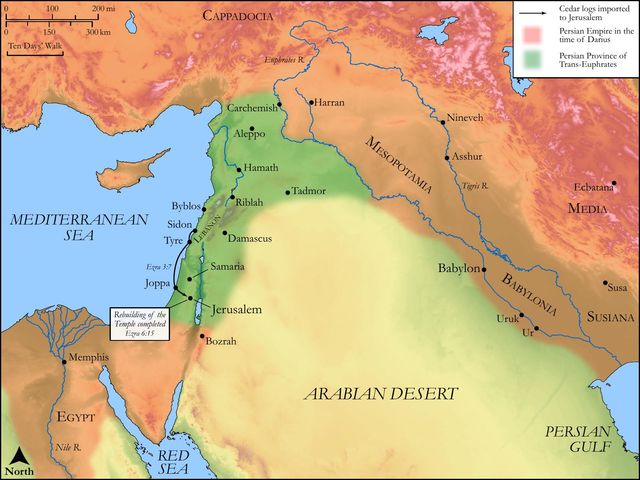
This verse is situated within the expansive Persian Empire during the reign of Darius I (522-486 BC), a period following the initial return of Jewish exiles to Judah. The phrase "beyond the river" (Aramaic: ʻabar nahara') designates the administrative region of Trans-Euphrates, a vast satrapy west of the Euphrates River that encompassed Judah, Samaria, and other territories. Tatnai held the significant position of Persian governor (satrap) over this region, responsible for its administration, taxation, and maintaining imperial order. Persian imperial policy, exemplified by Cyrus's earlier decree, often permitted conquered peoples to return to their homelands and rebuild their religious sites, provided they remained loyal subjects. However, local officials sometimes acted on their own initiative or were influenced by regional opposition, as demonstrated by Tatnai's initial inquiry. Royal decrees in Persia were legally binding and meticulously recorded in state archives, underscoring the immense legal weight and absolute authority behind Darius's pronouncement in Ezra 6:6. The Aramaic language, which constitutes a significant portion of Ezra, was the lingua franca of the Persian Empire's western provinces, reflecting the official and administrative nature of these communications and decrees.
Key Themes
ShowHideThis verse powerfully contributes to several overarching themes within the book of Ezra and the broader biblical narrative. Firstly, it profoundly illustrates Divine Providence and Sovereignty, showcasing how God orchestrates events and works through secular authorities, even pagan kings like Darius, to accomplish His divine purposes. Darius's heart is moved not only to confirm but actively support the temple's rebuilding, demonstrating God's ability to direct the hearts of kings to fulfill His will. Secondly, the verse highlights the theme of Overcoming Opposition. What began as an inquiry intended to halt the sacred work is dramatically transformed into a royal injunction to cease all interference, signifying God's power to turn adversaries into instruments, or at least non-impeders, of His plan. This offers profound encouragement that God can frustrate the plans of the enemy and turn opposition into support. Finally, it emphasizes Authority and Protection for God's people. Darius's decree grants the Jews the full legal and royal protection they needed, ensuring that their divinely appointed task could proceed unhindered and even with imperial resources, reinforcing God's commitment to protecting His people and their sacred endeavors, a theme echoed in passages like Psalm 121:7-8.
Exposition and Analysis
ShowHideKey Word Analysis
ShowHideThis term (H6347) refers to a prefect or governor of a city or small district. In this context, Tatnai held the significant office of governor over the vast Trans-Euphrates province, making him the highest Persian authority in the region where the temple was being rebuilt. The use of this title underscores the official and authoritative nature of the individual to whom Darius's decree is addressed, highlighting the king's direct intervention into the highest levels of provincial administration.
This Aramaic word (H3675) signifies a colleague or associate, someone sharing the same title or position. By including Tatnai's "companions" (including Shetharboznai and the Apharsachites), the decree ensures that the command to cease interference extends beyond just the named individuals to encompass their entire administrative retinue and any other officials who might have been involved in the opposition or could potentially cause future hindrance. This broad address ensures comprehensive compliance.
This Aramaic word (H7352) means remote, distant, or far, either literally in terms of place or figuratively. When combined with the imperative "be ye" (H1934) and the preposition "from" (H4481) and adverb "thence" (H8536), it forms a powerful and unequivocal command to "keep your distance," "stay away," or "do not interfere." It is an emphatic prohibition against any further involvement in hindering the temple's construction, signifying a decisive removal of obstacles and a clear path forward for the builders.
Verse Breakdown
ShowHide"Now [therefore], Tatnai, governor beyond the river, Shetharboznai, and your companions the Apharsachites, which [are] beyond the river"
This initial clause meticulously identifies the specific recipients of King Darius's authoritative decree. It names Tatnai, the chief Persian administrator of the Trans-Euphrates province, and Shetharboznai, another prominent official, along with their "companions the Apharsachites," referring to their associated officials or a specific ethnic/administrative group. The repetition of "which are beyond the river" serves to firmly establish their geographical and administrative jurisdiction, thereby underscoring the precise scope of the command that immediately follows. This detailed address ensures that the king's authority reaches directly and undeniably to those who had initiated the opposition, leaving no ambiguity as to whom the command applies.
"be ye far from thence"
This is the stark, imperative core of the verse, conveying a strong and absolute prohibition. It means "keep your distance," "stay away," or "do not interfere with the work at Jerusalem." This command is a direct and forceful countermand to their previous actions of inquiry and implied hindrance. It signifies a complete and dramatic reversal of their position: from potential obstructors, they are now mandated non-interferers. The implication is not merely to cease active opposition, but to actively remove themselves from any proximity that might suggest further interference or even observation with hostile intent, ensuring the builders can proceed without intimidation.
Literary Devices
ShowHideEzra 6:6 masterfully employs several literary devices to underscore the power and significance of Darius's decree. The most prominent is the Royal Decree itself, which functions as a powerful narrative device signifying absolute authority and irreversible command. The formal, direct address to the named officials ("Tatnai, governor beyond the river, Shetharboznai, and your companions the Apharsachites") emphasizes the weight and legal binding nature of the king's word, highlighting the hierarchical structure of the Persian Empire. There is a strong element of Irony at play: the very officials who initiated the inquiry with the intent to halt the temple's construction are now commanded by the highest earthly authority to "be ye far from thence," effectively removing themselves from the scene of their intended obstruction. This ironic reversal powerfully highlights God's sovereign control over human affairs, turning the tables on the adversaries. Furthermore, the verse demonstrates Divine Reversal, where a situation initiated by human opposition is dramatically turned around by divine providence, operating through a pagan king, to become an affirmation and protection of God's work. The abruptness and directness of "be ye far from thence" after the detailed identification of the officials create a sense of immediate, non-negotiable authority, underscoring the finality and decisive nature of the king's decision.
Theological and Thematic Connections
ShowHideEzra 6:6 stands as a powerful testament to God's unwavering faithfulness and His sovereign control over all earthly powers. It reveals that no human opposition, no matter how formidable or bureaucratically entrenched, can ultimately thwart the divine purposes. Just as God "turns the hearts of kings wherever he wills" (Proverbs 21:1), Darius's decree is not merely a political act but an instrument of divine providence, ensuring the completion of the temple. This demonstrates that God is actively involved in the affairs of nations, orchestrating events—even through those who do not acknowledge Him—to protect His people and advance His kingdom. The command "be ye far from thence" is a dramatic manifestation of God clearing the path for His work, turning potential adversaries into unwitting facilitators or, at the very least, non-interfering parties. This offers profound encouragement that God will always provide the necessary means and protection for His people to fulfill their God-given tasks, even when faced with seemingly insurmountable obstacles.
Reflection and Application
ShowHideEzra 6:6 offers timeless lessons for believers navigating opposition in their lives and ministries. When we embark on tasks we believe are God-ordained, whether it's personal spiritual growth, family discipleship, or broader ministry initiatives, we often encounter resistance—from skeptical colleagues, bureaucratic hurdles, financial constraints, or even direct antagonism. This verse serves as a powerful reminder that God is ultimately in control, and His purposes will prevail. Just as Darius's decree cleared the path for the temple's completion, we can trust that God has the power to remove obstacles in unexpected ways, even turning the hearts of those who oppose us or compelling them to stand aside. It encourages us to persist in faith and prayer, knowing that our Lord ultimately oversees all circumstances to ensure the fulfillment of His will. We are called to be faithful in our part, to build with diligence, and to trust that God will handle the opposition, often in ways far beyond our imagination, demonstrating His power and faithfulness.
Questions for Reflection
ShowHideFAQ
ShowHideWho were Tatnai and Shetharboznai, and what was their role?
ShowHideTatnai was the Persian governor (satrap) of the province "beyond the river" (Trans-Euphrates), a vast administrative region west of the Euphrates River that included Judah. Shetharboznai was another high-ranking official associated with Tatnai. Their role was to oversee the administration, taxation, and general order of their province. When they heard about the Jews rebuilding the temple in Jerusalem, they questioned the authority for such a project and sent a letter of inquiry to King Darius, effectively attempting to halt the work until royal authorization could be confirmed or denied, as seen in Ezra 5:3-5.
Why did King Darius issue such a strong decree, commanding them to "be ye far from thence"?
ShowHideKing Darius issued this strong decree after his royal archives were searched and the original decree of King Cyrus (from Ezra 1:1-4) was found in Ecbatana, explicitly authorizing and even funding the rebuilding of the Temple in Jerusalem (Ezra 6:1-5). As a ruler who valued legal precedent and imperial order, Darius was bound to uphold Cyrus's decree. His command to Tatnai and his companions to "be far from thence" was a stern, emphatic imperative to cease all interference and allow the work to proceed unhindered, demonstrating his commitment to justice and the established law of the empire.
What does "Apharsachites" mean, and why are they mentioned?
ShowHideThe "Apharsachites" (Aramaic: ʼĂpharçᵉkay, H671) likely refers to a specific ethnic group or, more commonly understood, a class of Persian officials or administrators who served under Tatnai's authority in the Trans-Euphrates province. They were part of the bureaucratic apparatus that had initially challenged the Jews' rebuilding efforts. Their mention alongside Tatnai and Shetharboznai indicates that the royal command to cease interference applied to all levels of the provincial administration involved in the opposition, ensuring a comprehensive removal of obstacles and preventing further harassment of the Jewish builders.
Christ-Centered Fulfillment
ShowHideEzra 6:6, with its dramatic reversal of opposition and the clearing of the path for the Temple's rebuilding, powerfully foreshadows the ultimate work of Christ. The earthly temple in Jerusalem, though significant for God's people, was but a shadow of the true Temple, which is Christ Himself (John 2:19-21). Just as Darius's decree ensured the physical construction, God's ultimate decree in Christ ensures the building of His spiritual Temple, the Church (Matthew 16:18). The "be ye far from thence" issued to Tatnai and his companions finds its ultimate echo in Christ's triumph over all spiritual opposition. Through His death and resurrection, Jesus disarmed the powers and authorities that sought to hinder God's redemptive plan, making a public spectacle of them (Colossians 2:15). He has given His followers authority to overcome the schemes of the enemy (Luke 10:19). The unhindered completion of the temple in Ezra points to the certain and glorious completion of God's redemptive work through Christ, where every spiritual adversary will ultimately be commanded to "be far from thence" from His eternal kingdom, and His people will dwell in the presence of the Lamb, who is the true Temple.