


Ezra 8:15
Bible text: King James Version (1769 Blayney text) · Public domain
Bible text: King James Version with Strong's numbers · Public domain
Bible text: Berean Standard Bible · Public domain
Bible text: American Standard Version (1901) · Public domain
Bible text: World English Bible, Messianic edition · Public domain
Bible text: Geneva Bible (1599) · Public domain
Bible text: Young's Literal Translation · Public domain
- וָאֶקְבְּצֵםva·'ek·be·Tzemand I assembled themH6908Conj-w ¦ V-Qal-ConsecImperf-1cs ¦ 3mpVerb Qal Consecutive Imperfect 1st Singular common genderוָandאֶקְבְּצֵI assembledםthem
- אֶל'eltoH413PrepPreposition
- הַנָּהָרha·na·Harthe riverH5104Art ¦ N-msNoun Singular Masculine Absoluteהַtheנָּהָרriver
- הַבָּאha·Ba'which goesH935Art ¦ V-Qal-Prtcpl-msVerb Qal Participle Singular Masculine Absoluteהַwhichבָּאgoes
- אֶל'eltoH413PrepPreposition
- אַהֲוָא'a·ha·Va'AhavaH163N-properNoun Proper Location
- וַנַּחֲנֶהva·na·cha·Nehand we encampedH2583Conj-w ¦ V-Qal-ConsecImperf-1cpVerb Qal Consecutive Imperfect 1st Plural common genderוַandנַּחֲנֶהwe encamped
- שָׁםshamthereH8033AdvAdverb
- יָמִיםya·MimdaysH3117N-mpNoun Plural Masculine Absolute
- שְׁלֹשָׁהshe·lo·ShahthreeH7969Adj-csAdjective Numerical Singular common gender Absolute
- וָאָבִינָהva·'a·Vi·nahand I considered !H995Conj-w ¦ V-Qal-ConsecImperf-1cs ¦ SfxVerb Qal Consecutive Imperfect 1st Singular common genderוָandאָבִינָI consideredה!
- בָעָםva·'Am<in> the peopleH5971Prep-b ¦ N-msNoun Singular Masculine Absoluteבָ<in> theעָםpeople
- וּבַכֹּהֲנִיםu·va·Ko·ha·Nimand <in> the priestsH3548Conj-w ¦ Prep-b ¦ N-mpNoun Plural Masculine Absoluteוּandבַ<in> theכֹּהֲנִיםpriests
- וּמִבְּנֵיu·mi·be·Neiand any of [the] descendants ofH1121Conj-w ¦ Prep-m ¦ N-mpcNoun Plural Masculine Constructוּandמִany ofבְּנֵי[the] descendants of
- לֵוִיle·ViLeviH3881N-proper-mNoun Proper Masculine
- לֹאlo'notH3808NegParticle Negative
- מָצָאתִיma·Tza·tiI foundH4672V-Qal-Perf-1csVerb Qal Perfect 1st Singular common gender
- שָׁםShamthereH8033AdvAdverb
English is a literal word-by-word gloss of the Hebrew, not the KJV's wording. Why?
This is the original text the KJV's translators worked from — each Hebrew word with its own literal English meaning in this verse, prepared by scholars at Tyndale House, Cambridge. The KJV translates whole sentences, not word by word, so its wording differs: one Hebrew word can become several English words, and the KJV may choose “the LORD” where the gloss reads “Yahweh”. Both are faithful — they answer different questions. For the KJV's own rendering, switch to the KJV text.
Details
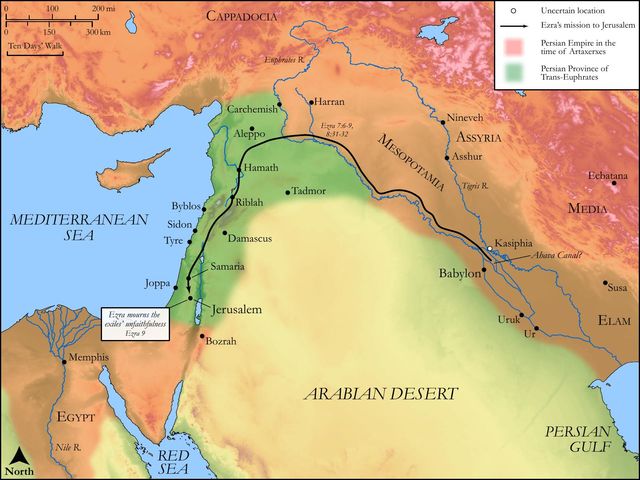
See on the biblical-era map
Study this verse
Public-domain commentary
Matthew Henry
From his Commentary on the Whole Bible. Henry comments on passages, not single verses — this entry covers Ezra 8:1–20. His two-level outline is real structure in the source text, so it is rendered as structure.
Ezra, having received his commission from the king, beats up for volunteers, as it were, sets up an ensign to assemble the outcasts of Israel and the dispersed of Judah, Isa 11:12. "Whoever of the sons of Sion, that swell with the daughters of Babylon, is disposed to go to Jerusalem, now that the temple there is finished and the temple-service set a-going, now is their time." Now one would think that under such a leader, with such encouragements, all the Jews should at length have shaken themselves from their dust, and loosed the bands of their neck, according to that call, Isa 52:1, Isa 52:2, etc. I wonder how any of them could read that chapter and yet stay behind. But multitudes did. They loved their ease better than their religion, thought themselves well off where they were, and either believed not that Jerusalem would better their condition or durst not go thither through any difficulties. But here we are told,
I.That some offered themselves willingly to go with Ezra.
The heads of the several families are here named, for their honour, and the numbers of the males that each brought in, amounting in all to 1496. Two priests are named (Ezr 8:2) and one of the sons of David; but, it should seem, they came without their families, probably intending to see how they liked Jerusalem and then either to send for their families or return to them as they saw cause. Several of their families, or clans, here named, we had before, ch. 2. Some went up from them at that time, more went up now, as God inclined their hearts; some were called into the vineyard at the third hour, others not till the eleventh, yet even those were not rejected. But here we read of the last sons of Adonikam (Ezr 8:13), which some understand to their dispraise, that they were the last that enlisted themselves under Ezra; I rather understand it to their honour, that now all the sons of that family returned and none staid behind.
II.That the Levites who went in this company were in a manner pressed into the service.
Ezra appointed a general rendezvous of all his company at a certain place upon new-year's day, the first day of the first month. Ezr 7:9. Then and there he took a view of them, and mustered them, and (which was strange) found there none of the sons of Levi, Ezr 8:15. Some priests there were, but no others that were Levites. Where was the spirit of that sacred tribe? Ezra, a priest, like Moses proclaims, Who is on the Lord's side? They, unlike to Levi, shrink, and desire to abide among the sheep-folds to hear the bleatings of the flock. Synagogues we suppose they had in Babylon, in which they prayed, and preached, and kept sabbaths (and, when they could not have better, they had reason to be thankful for them); but now that the temple at Jerusalem was opened, to the service of which they were ordained, they ought to have preferred the gates of Zion before all those synagogues. It is upon record here, to their reproach; but tell it not in Gath. Ezra, when he observed that he had no Levites in his retinue, was much at a loss. He had money enough for the service of the temple, but wanted men. The king and princes had more than done their part, but the sons of Levi had not half done theirs. Eleven men, chief men, and men of understanding, he chooses out of his company, to be employed for the filling up of this lamentable vacancy; and here we are informed,
1.Of their being sent. Ezra sent them to a proper place, where there as a college of Levites, the place Casiphia, probably a street or square in Babylon allowed for that purpose - Silver Street one may call it, for ceseph signifies silver. He sent them to a proper person, to Iddo, the chief president of the college, not to urge him to come himself (we will suppose him to be old and unfit for such a remove), but to send some of the juniors, ministers for the house of our God, Ezr 8:17. The furnishing of God's house with good ministers is a good work, which will redound to the comfort and credit of all that have a hand in it.
2.Of their success. They did not return without their errand, but, though the warning was short, they brought about forty Levites to attend Ezra, Sherebiah, noted as a very intelligent man, and eighteen with him (Ezr 8:18). Hashabiah, and Jeshaiah, and twenty with them, Ezr 8:19. By this it appears that they were not averse to go, but were slothful and inattentive, and only wanted to be called upon and excited to go. What a pity it is that good men should omit a good work, merely for want of being spoken to! What a pity that they should need it, but, if they do, what a pity that they should be left without it! Of the Nethinim, the servitors of the sacred college, the species infima - the lowest order of the temple ministers, more appeared forward to go than of the Levites themselves. Of them 220, upon this hasty summons, enlisted themselves, and had the honour to be expressed by name in Ezra's muster-roll, Ezr 8:20. "Thus," says Ezra, "were we furnished with Levites, by the good hand of our God upon us." If, where ministers have been wanting, the vacancies are well supplied, let God have the glory, and his good hand be acknowledged as qualifying them for the service, inclining them to it, and then opening a door of opportunity for them.
Historical interpretation
Historical reception
2 surviving comments on this verse. Each one is dated, so this reads as a timeline rather than a list.
But I gathered them at the river that flows to Ahava. I do not remember reading this name of the place anywhere else. However, when it is later written, And I proclaimed there a fast by the river Ahava; and after some further writing, We set out from the river Ahava on the twelfth day of the first month; it seems probable that Ahava is both a river and that another river flows into it, at the confluence of which Ezra gathered those who went up with him. Moreover, Josephus substitutes the Euphrates for this name. Whence Ahava can not incongruously be understood as some tributary of the river Euphrates.
And we stayed there three days, etc. Ezra acted prudently, so that before beginning such a journey, he carefully ensured he had a supply of ministers of the house of God, through whom, upon arriving in Jerusalem, he could complete what was necessary for the temple's use.
Continue studying Ezra 8:15 across the web’s major study libraries — every link below opens this exact verse, chapter, or book on the destination site.
Read & Compare
 BibleGatewayThis verse in more than 200 translations and 70 languages.
 Bible.comThe YouVersion reader — hundreds of translations, reading plans, and highlights.
 ESV.orgCrossway's official English Standard Version reader.
 NET BibleThe NET translation with 60,000+ translators' notes on every rendering decision.
 STEP BibleTyndale House's free study tool — original text, vocabulary, and scholarly resources.
 BibliaLogos Bible Software's free web reader.
 USCCBThe New American Bible (Revised Edition) with the U.S. bishops' study notes.
Commentaries
 BibleHub CommentariesDozens of classic commentaries on this verse, gathered on one page.
 StudyLightMore than 100 commentary sets — the largest collection on the web.
 BibleRefPlain-English commentary on what this verse means, verse by verse.
 Enduring WordDavid Guzik's free commentary on this chapter, widely used by Bible teachers.
 Bible Study ToolsVerse commentary alongside Greek and Hebrew study aids.
Original Language & Research
- BibleHub InterlinearThe verse word by word — original language, transliteration, and English.
- BibleHub LexiconEvery word's original-language definition and Strong's entry.
 Blue Letter BibleDeep-study tools — Strong's numbers, concordance, and word studies.
 SefariaThe Hebrew text with Rashi and centuries of Jewish commentary.
Sermons, Hymns & Audio


TrulyRandomVerse is not affiliated with these sites and doesn’t control their content. They’re linked because they’re genuinely useful.
Summary
Ezra 8:15 records a critical juncture during the second return of Jewish exiles from Babylon to Jerusalem, under the leadership of Ezra the scribe. Having gathered the returning community by the river Ahava, Ezra conducted a meticulous three-day review of the assembled people and priests, only to discover a profound and problematic absence: none of the sons of Levi were present. This significant oversight immediately highlighted a major challenge for the proper re-establishment of temple worship and service in Jerusalem, necessitating immediate and decisive action before the arduous and perilous journey could commence.
Context
ShowHideLiterary Context
This verse is strategically positioned within the narrative of Ezra's divinely sanctioned return to Jerusalem. It directly follows the detailed account of King Artaxerxes' empowering decree in Ezra 7 and Ezra's initial preparations, including the meticulous listing of families accompanying him in Ezra 8:1-14. The discovery of the missing Levites in this verse serves as a pivotal turning point, creating immediate narrative tension and directly leading to Ezra's proactive and prayerful measures to recruit them in the subsequent verses (Ezra 8:16-20). This meticulous detailing of the muster at Ahava underscores the profound importance of proper organization, divine provision, and the right personnel for the successful and divinely sanctioned restoration of the community, its worship, and its adherence to the Law. The narrative flow emphasizes Ezra's diligent leadership, his reliance on God, and the practical challenges inherent in re-establishing a covenant community after generations of exile.
Historical & Cultural Context
The return described in Ezra 8 represents the second major wave of Jewish exiles returning from Babylon, occurring approximately 80 years after the initial return led by Zerubbabel and Joshua, which focused on rebuilding the Temple (recorded in Ezra 1-6). During this period, under the relatively benevolent rule of the Persian Empire, the Jewish people were granted a degree of autonomy to rebuild their temple and re-establish their religious and civic life. The journey from Babylon to Jerusalem was not merely a physical trek but a dangerous undertaking, spanning hundreds of miles through potentially hostile territories, making a well-organized, adequately provisioned, and divinely protected caravan absolutely essential. Culturally, the Levites held a distinct and indispensable role in Israelite society, specifically concerning the Tabernacle and later the Temple and its services. As outlined extensively in the Mosaic Law (e.g., Numbers 3), they were consecrated to assist the priests, maintain the sacred space, provide music, serve as gatekeepers, and teach the Law. Their absence would severely cripple the proper functioning of the restored temple and the re-establishment of the sacrificial system and worship according to God's precise commands, rendering the community incomplete in its covenant responsibilities.
Key Themes
ShowHideEzra 8:15 contributes significantly to several overarching themes within the book of Ezra and the broader post-exilic narrative. Firstly, it highlights the theme of Meticulous Preparation and Diligent Leadership, demonstrating Ezra's responsible and thorough approach to a divinely ordained mission. His act of "viewing the people" underscores that spiritual endeavors, though divinely initiated, require careful human planning and assessment, not merely passive reliance on providence. Secondly, the verse powerfully underscores the Indispensable Role of Every Member in God's Service, particularly the Levites, whose absence reveals a critical gap in the community's ability to fulfill its sacred duties. This points to the theological truth that the body of believers, like the ancient Israelite community, functions optimally only when all its parts are present and contributing according to their God-given design, as later articulated in 1 Corinthians 12. Thirdly, it vividly illustrates the Challenges and Obstacles in Spiritual Restoration, showing that even with divine favor and royal decrees, the process of rebuilding a community of faith is not without significant practical and spiritual hurdles. Ezra's immediate response to the lack of Levites, detailed in Ezra 8:16-20, exemplifies the need for active problem-solving, prayer, and reliance on God's provision in the face of unforeseen difficulties.
Exposition and Analysis
ShowHideKey Word Analysis
ShowHideThis refers to a specific river or canal, and likely a surrounding district, near Babylon, which served as the designated gathering point for Ezra's caravan. While its exact geographical location remains debated among scholars, it was clearly a strategic staging area where the returning exiles could assemble, organize, and prepare for the arduous journey to Jerusalem. The name itself, "Ahava," is probably of foreign origin, and its significance here is primarily geographical, marking a crucial waypoint for the returning exiles.
Derived from a root meaning "to build," this word fundamentally refers to a "son" as a builder of the family name, but it extends in its meaning to include various relationships, including descendants, members of a group, or even those sharing a quality or condition. In the phrase "sons of Levi," it specifically denotes the male descendants of Levi, distinguishing them as members of the Levitical tribe who were not necessarily priests (descendants of Aaron). Their identity as "sons" emphasizes their lineage and their inherited, consecrated role within the Israelite community, underscoring the gravity of their collective absence.
Meaning "attached," Levi was one of Jacob's twelve sons, and his descendants, the Levites, were set apart by God for special service in the Tabernacle and Temple. This tribe, distinct from the other Israelite tribes, had no territorial inheritance in Canaan but were supported by tithes and offerings. Their duties were vast and varied, encompassing everything from carrying the Tabernacle components during the wilderness wanderings to assisting the priests, serving as musicians, gatekeepers, and teachers of the Law in the Temple. The mention of "Levi" here immediately evokes their indispensable, divinely appointed role in Israel's worship and national life.
Verse Breakdown
ShowHide"And I gathered them together to the river that runneth to Ahava;"
This opening clause immediately establishes Ezra's active and intentional leadership. He was not a passive observer but a diligent leader who took the initiative to assemble the willing exiles at a specific, pre-determined location. The "river that runneth to Ahava" was the chosen rendezvous point, indicating a strategic decision for a large group to converge, likely providing essential access to water and a suitable area for encampment before embarking on the long and dangerous journey. This highlights the practical foresight required for such a massive undertaking.
"and there abode we in tents three days:"
This phrase signifies a deliberate period of pause, organization, and assessment. The "three days" indicate a significant, but not excessively long, duration for the caravan to settle, organize their provisions, and for Ezra to conduct his crucial review. This encampment in "tents" underscores the temporary nature of their stay and their readiness to depart, while also emphasizing the practical aspects of managing a large group of travelers. It was a vital time for final preparations, inventory, and ensuring all necessary personnel were present and accounted for before the perilous journey.
"and I viewed the people, and the priests, and found there none of the sons of Levi."
This is the critical discovery and the central revelation of the verse. Ezra's act of "viewing" or meticulously inspecting the assembled group demonstrates his thorough leadership and foresight. He systematically checked for the presence of various groups, specifically noting the general "people" (the lay Israelites) and the "priests" (the descendants of Aaron who performed the sacrificial duties). The shocking and profound revelation was the complete absence of the "sons of Levi." This was not a minor oversight but a significant problem, as the Levites were indispensable for the proper functioning of the temple and its elaborate worship, distinct from the priests who were present. Their absence posed a major logistical, theological, and practical challenge for the full and proper restoration of worship in Jerusalem, indicating a critical gap in the community's ability to fulfill its covenantal obligations.
Literary Devices
ShowHideEzra 8:15 employs several literary devices to convey its meaning and emphasize the narrative's significance. The verse utilizes precise Narrative Detail, with specific mentions of "the river that runneth to Ahava" and "three days." These concrete details lend a strong sense of realism and historical accuracy to the account, immersing the reader in the meticulous preparations undertaken by Ezra and his company. Furthermore, the discovery of the missing Levites functions as a powerful element of Foreshadowing. This critical absence immediately creates narrative tension and sets the stage for the subsequent narrative, where Ezra must actively and prayerfully seek to rectify this significant deficiency. This foreshadows Ezra's resourceful and divinely guided efforts to recruit the necessary personnel, highlighting his proactive leadership in addressing unforeseen challenges. An implicit Contrast is also drawn between the presence of "the people, and the priests" and the striking, unexpected absence of "the sons of Levi." This contrast underscores the gravity of the missing component, emphasizing the unique and essential role the Levites played in the religious life of Israel and highlighting the significant gap that needed to be filled for the restoration to be complete and proper according to God's Law. Finally, there is an element of Emphasis placed on the word "none," highlighting the absolute and complete lack of Levites, which would have been a profoundly alarming discovery for Ezra, given their crucial role.
Theological and Thematic Connections
ShowHideEzra 8:15 profoundly illustrates the divine principle that every role within God's service is vital and interdependent, akin to the functioning of a body where each part contributes to the whole. The absence of the Levites, though seemingly a logistical issue, carried immense theological weight, as their duties were divinely ordained for the proper functioning of the temple and the maintenance of holiness and order in worship. This incident underscores God's meticulousness in requiring specific roles and order for His worship, and it highlights Ezra's unwavering commitment to adhering to these divine standards, even when faced with significant challenges and the need for extraordinary effort. It also speaks to the broader theme of restoration, not just of physical structures like the Temple, but of spiritual integrity, covenantal faithfulness, and adherence to the precise patterns God had established for His people. The critical need for the Levites emphasizes that a community is truly whole, effective, and pleasing to God in its mission only when all its parts are present, functioning, and contributing according to God's design and calling.
Reflection and Application
ShowHideEzra's experience at Ahava offers profound and enduring lessons for contemporary leadership and community life, particularly within the church and any collective endeavor for God's kingdom. It serves as a powerful reminder of the critical importance of thorough preparation, diligent assessment, and proactive problem-solving before embarking on significant undertakings, especially those with spiritual implications. Just as Ezra meticulously "viewed the people," leaders today must diligently assess available resources, identify potential gaps, and ensure that all necessary components, whether human or material, are in place for a task to be completed effectively and in alignment with God's will. Furthermore, this verse highlights the invaluable contribution of every member within a community or spiritual body. The absence of the Levites, though they were not the high priests, created a major crisis because their specific roles were indispensable for the holistic functioning of the temple system. This teaches us to deeply value and affirm every gift, calling, and function within the body of Christ, recognizing that even seemingly less prominent or "behind-the-scenes" roles are absolutely crucial for the holistic health, effective ministry, and ultimate success of the church's mission. When deficiencies or missing elements are identified, the example of Ezra calls for immediate, prayerful, and resourceful action to address them, rather than proceeding with known shortcomings or hoping they will resolve themselves.
Questions for Reflection
ShowHideFAQ
ShowHideWhy were the Levites so important, distinct from the priests?
ShowHideThe Levites were a specific tribe consecrated by God for service in the Tabernacle and later the Temple, distinct from the priests who were a specific lineage within the tribe of Levi (descendants of Aaron). While priests performed the sacrificial rituals, offered incense, and mediated between God and the people, the Levites had a broad range of essential, support duties that made the priests' work possible and ensured the proper functioning of the entire worship system. Their responsibilities included maintaining the temple structure, serving as musicians and singers (as seen in 1 Chronicles 25:1-8), acting as gatekeepers and treasurers (e.g., 1 Chronicles 26:1-19), and assisting the priests in various capacities. They also played a crucial role in teaching the Law to the people (as exemplified in Nehemiah 8:7-8). Their absence meant a severe lack of personnel to perform these vital functions, making the full, proper, and orderly restoration of temple worship impossible according to Mosaic Law.
What was "Ahava" and why was it chosen as a gathering point?
ShowHide"Ahava" refers to a specific river or canal, and likely the surrounding district, near Babylon. Its precise geographical location is not definitively known today, but it served as the designated rendezvous point for Ezra's large caravan of exiles returning to Jerusalem. It was most likely chosen for its strategic advantages: providing essential access to water for a large group of people and their animals, offering a suitable open area for encampment and organization, and serving as a secure and identifiable location for all the disparate families and individuals to converge. This staging area was critical for final preparations, assessment of personnel and provisions, and spiritual consecration (as seen in Ezra 8:21-23) before embarking on the perilous, months-long journey through potentially hostile territory to Jerusalem.
Christ-Centered Fulfillment
ShowHideThe meticulous assessment by Ezra at Ahava, revealing the critical absence of the Levites, powerfully foreshadows the New Covenant reality where all "missing pieces" for true and perfect worship are completely and eternally supplied in Christ. In the Old Testament, the Levites were essential for the proper functioning of the earthly temple and its intricate sacrificial system, pointing to the inherent need for mediation, service, and atonement to approach a holy God. However, in Christ, we find the ultimate and perfect fulfillment of all priestly and Levitical roles. Jesus is our Great High Priest, who, through His perfect, once-for-all sacrifice on the cross, rendered the continual temple sacrifices obsolete (Hebrews 7:27). Through His finished work, believers are no longer dependent on a specific tribe or lineage for access to God; instead, by His blood, we are all brought near and made a "royal priesthood" and a "holy nation" (1 Peter 2:9), able to draw near to God directly through Him with confidence (Hebrews 10:19-22). The church, as the spiritual temple of God, is built upon Christ as the cornerstone, with every single believer, empowered by the indwelling Holy Spirit, contributing their unique gifts and ministries to the body, ensuring that no "sons of Levi" are missing for the true worship, service, and mission of God in the world (Ephesians 2:20-22). In Him, the community of faith is complete, perfectly equipped, and fully empowered for its divine calling.