


Ezra 8:16
Bible text: King James Version (1769 Blayney text) · Public domain
Bible text: King James Version with Strong's numbers · Public domain
Bible text: Berean Standard Bible · Public domain
Bible text: American Standard Version (1901) · Public domain
Bible text: World English Bible, Messianic edition · Public domain
Bible text: Geneva Bible (1599) · Public domain
Bible text: Young's Literal Translation · Public domain
- וָאֶשְׁלְחָהva·'esh·le·Chahand I sent !H7971Conj-w ¦ V-Qal-ConsecImperf-1cs ¦ SfxVerb Qal Consecutive Imperfect 1st Singular common genderוָandאֶשְׁלְחָI sentה!
- לֶאֱלִיעֶזֶרle·'e·li·'E·zerfor EliezerH461Prep-l ¦ N-proper-mNoun Proper MasculineלֶforאֱלִיעֶזֶרEliezer
- לַאֲרִיאֵלla·'a·ri·'Elfor ArielH740Prep-l ¦ N-proper-mNoun Proper MasculineלַforאֲרִיאֵלAriel
- לִשְׁמַעְיָהLish·ma'·yahfor ShemaiahH8098Prep-l ¦ N-proper-mNoun Proper MasculineלִforשְׁמַעְיָהShemaiah
- וּלְאֶלְנָתָןu·le·'el·na·Tanand for ElnathanH494Conj-w ¦ Prep-l ¦ N-proper-mNoun Proper MasculineוּandלְforאֶלְנָתָןElnathan
- וּלְיָרִיבu·le·ya·Rivand for JaribH3402Conj-w ¦ Prep-l ¦ N-proper-mNoun Proper MasculineוּandלְforיָרִיבJarib
- וּלְאֶלְנָתָןu·le·'el·na·Tanand for ElnathanH494Conj-w ¦ Prep-l ¦ N-proper-mNoun Proper MasculineוּandלְforאֶלְנָתָןElnathan
- וּלְנָתָןu·le·na·Tanand for NathanH5416Conj-w ¦ Prep-l ¦ N-proper-mNoun Proper MasculineוּandלְforנָתָןNathan
- וְלִזְכַרְיָהve·liz·khar·Yahand for ZechariahH2148Conj-w ¦ Prep-l ¦ N-proper-mNoun Proper MasculineוְandלִforזְכַרְיָהZechariah
- וְלִמְשֻׁלָּםve·lim·shu·Lamand for MeshullamH4918Conj-w ¦ Prep-l ¦ N-proper-mNoun Proper MasculineוְandלִforמְשֻׁלָּםMeshullam
- רָאשִׁיםra·ShimchiefsH7218N-mpNoun Plural Masculine Absolute
- וּלְיוֹיָרִיבu·le·yo·ya·Rivand for JoiaribH3114Conj-w ¦ Prep-l ¦ N-proper-mNoun Proper MasculineוּandלְforיוֹיָרִיבJoiarib
- וּלְאֶלְנָתָןu·le·'el·na·Tanand for ElnathanH494Conj-w ¦ Prep-l ¦ N-proper-mNoun Proper MasculineוּandלְforאֶלְנָתָןElnathan
- מְבִינִיםme·vi·NimteachersH995V-Hiphil-Prtcpl-mpVerb Hiphil Participle Plural Masculine Absolute
English is a literal word-by-word gloss of the Hebrew, not the KJV's wording. Why?
This is the original text the KJV's translators worked from — each Hebrew word with its own literal English meaning in this verse, prepared by scholars at Tyndale House, Cambridge. The KJV translates whole sentences, not word by word, so its wording differs: one Hebrew word can become several English words, and the KJV may choose “the LORD” where the gloss reads “Yahweh”. Both are faithful — they answer different questions. For the KJV's own rendering, switch to the KJV text.
Details
See on the biblical-era map
Study this verse
Public-domain commentary
Matthew Henry
From his Commentary on the Whole Bible. Henry comments on passages, not single verses — this entry covers Ezra 8:1–20. His two-level outline is real structure in the source text, so it is rendered as structure.
Ezra, having received his commission from the king, beats up for volunteers, as it were, sets up an ensign to assemble the outcasts of Israel and the dispersed of Judah, Isa 11:12. "Whoever of the sons of Sion, that swell with the daughters of Babylon, is disposed to go to Jerusalem, now that the temple there is finished and the temple-service set a-going, now is their time." Now one would think that under such a leader, with such encouragements, all the Jews should at length have shaken themselves from their dust, and loosed the bands of their neck, according to that call, Isa 52:1, Isa 52:2, etc. I wonder how any of them could read that chapter and yet stay behind. But multitudes did. They loved their ease better than their religion, thought themselves well off where they were, and either believed not that Jerusalem would better their condition or durst not go thither through any difficulties. But here we are told,
I.That some offered themselves willingly to go with Ezra.
The heads of the several families are here named, for their honour, and the numbers of the males that each brought in, amounting in all to 1496. Two priests are named (Ezr 8:2) and one of the sons of David; but, it should seem, they came without their families, probably intending to see how they liked Jerusalem and then either to send for their families or return to them as they saw cause. Several of their families, or clans, here named, we had before, ch. 2. Some went up from them at that time, more went up now, as God inclined their hearts; some were called into the vineyard at the third hour, others not till the eleventh, yet even those were not rejected. But here we read of the last sons of Adonikam (Ezr 8:13), which some understand to their dispraise, that they were the last that enlisted themselves under Ezra; I rather understand it to their honour, that now all the sons of that family returned and none staid behind.
II.That the Levites who went in this company were in a manner pressed into the service.
Ezra appointed a general rendezvous of all his company at a certain place upon new-year's day, the first day of the first month. Ezr 7:9. Then and there he took a view of them, and mustered them, and (which was strange) found there none of the sons of Levi, Ezr 8:15. Some priests there were, but no others that were Levites. Where was the spirit of that sacred tribe? Ezra, a priest, like Moses proclaims, Who is on the Lord's side? They, unlike to Levi, shrink, and desire to abide among the sheep-folds to hear the bleatings of the flock. Synagogues we suppose they had in Babylon, in which they prayed, and preached, and kept sabbaths (and, when they could not have better, they had reason to be thankful for them); but now that the temple at Jerusalem was opened, to the service of which they were ordained, they ought to have preferred the gates of Zion before all those synagogues. It is upon record here, to their reproach; but tell it not in Gath. Ezra, when he observed that he had no Levites in his retinue, was much at a loss. He had money enough for the service of the temple, but wanted men. The king and princes had more than done their part, but the sons of Levi had not half done theirs. Eleven men, chief men, and men of understanding, he chooses out of his company, to be employed for the filling up of this lamentable vacancy; and here we are informed,
1.Of their being sent. Ezra sent them to a proper place, where there as a college of Levites, the place Casiphia, probably a street or square in Babylon allowed for that purpose - Silver Street one may call it, for ceseph signifies silver. He sent them to a proper person, to Iddo, the chief president of the college, not to urge him to come himself (we will suppose him to be old and unfit for such a remove), but to send some of the juniors, ministers for the house of our God, Ezr 8:17. The furnishing of God's house with good ministers is a good work, which will redound to the comfort and credit of all that have a hand in it.
2.Of their success. They did not return without their errand, but, though the warning was short, they brought about forty Levites to attend Ezra, Sherebiah, noted as a very intelligent man, and eighteen with him (Ezr 8:18). Hashabiah, and Jeshaiah, and twenty with them, Ezr 8:19. By this it appears that they were not averse to go, but were slothful and inattentive, and only wanted to be called upon and excited to go. What a pity it is that good men should omit a good work, merely for want of being spoken to! What a pity that they should need it, but, if they do, what a pity that they should be left without it! Of the Nethinim, the servitors of the sacred college, the species infima - the lowest order of the temple ministers, more appeared forward to go than of the Levites themselves. Of them 220, upon this hasty summons, enlisted themselves, and had the honour to be expressed by name in Ezra's muster-roll, Ezr 8:20. "Thus," says Ezra, "were we furnished with Levites, by the good hand of our God upon us." If, where ministers have been wanting, the vacancies are well supplied, let God have the glory, and his good hand be acknowledged as qualifying them for the service, inclining them to it, and then opening a door of opportunity for them.
Continue studying Ezra 8:16 across the web’s major study libraries — every link below opens this exact verse, chapter, or book on the destination site.
Read & Compare
 BibleGatewayThis verse in more than 200 translations and 70 languages.
 Bible.comThe YouVersion reader — hundreds of translations, reading plans, and highlights.
 ESV.orgCrossway's official English Standard Version reader.
 NET BibleThe NET translation with 60,000+ translators' notes on every rendering decision.
 STEP BibleTyndale House's free study tool — original text, vocabulary, and scholarly resources.
 BibliaLogos Bible Software's free web reader.
 USCCBThe New American Bible (Revised Edition) with the U.S. bishops' study notes.
Commentaries
 BibleHub CommentariesDozens of classic commentaries on this verse, gathered on one page.
 StudyLightMore than 100 commentary sets — the largest collection on the web.
 BibleRefPlain-English commentary on what this verse means, verse by verse.
 Enduring WordDavid Guzik's free commentary on this chapter, widely used by Bible teachers.
 Bible Study ToolsVerse commentary alongside Greek and Hebrew study aids.
Original Language & Research
- BibleHub InterlinearThe verse word by word — original language, transliteration, and English.
- BibleHub LexiconEvery word's original-language definition and Strong's entry.
 Blue Letter BibleDeep-study tools — Strong's numbers, concordance, and word studies.
 SefariaThe Hebrew text with Rashi and centuries of Jewish commentary.
Sermons, Hymns & Audio


TrulyRandomVerse is not affiliated with these sites and doesn’t control their content. They’re linked because they’re genuinely useful.
Summary
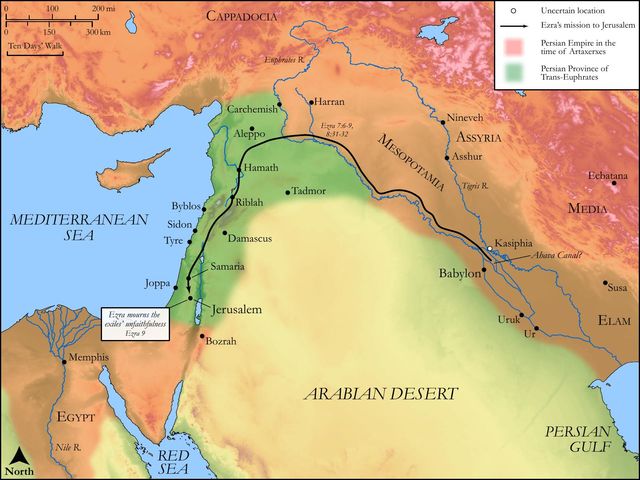
Ezra 8:16 recounts Ezra's decisive action to address a critical lack of Levites and temple servants among the returning exiles gathered at the Ahava canal. Recognizing the indispensable role these individuals played in the proper functioning of temple worship and the spiritual life of the community, Ezra strategically dispatched a select group of respected and wise leaders. These "chief men" and "men of understanding" were commissioned to recruit the necessary personnel, thereby demonstrating Ezra's meticulous foresight and his reliance on capable individuals to ensure the spiritual integrity and success of their perilous journey back to Jerusalem.
Context
ShowHideLiterary Context
Ezra 8:16 is strategically positioned within the broader narrative of Ezra's second return of Jewish exiles from Babylon to Jerusalem. It immediately follows the assembly of the people at the Ahava canal, as detailed in Ezra 8:15, where Ezra conducted a census and discovered the critical absence of Levites. This verse marks a pivotal turning point, transitioning from the initial gathering to Ezra's proactive and essential measures to ensure the spiritual viability of the returning community. The commissioning of these specific individuals directly precedes their successful recruitment efforts, which are subsequently described in Ezra 8:17-20, highlighting the immediate impact of Ezra's discerning leadership.
Historical & Cultural Context
The post-exilic period presented immense challenges for the Jewish people under Persian suzerainty, marked by the daunting task of spiritual and physical reconstruction in Jerusalem. The Temple, though rebuilt, was merely an empty structure without the full complement of priests and Levites required to administer the sacrificial system and maintain the Mosaic Law, which was central to Israelite identity and worship. Levites were not simply temple staff; they were vital custodians of the Law, teachers, musicians, and guardians of the sacred traditions. The journey itself from Babylon to Jerusalem was fraught with danger from bandits and hostile populations, necessitating not only divine protection but also meticulous human preparation. Ezra's mission, sanctioned by King Artaxerxes (as outlined in Ezra 7:11-26), was fundamentally a spiritual restoration, making the presence of qualified Levites absolutely indispensable for re-establishing proper worship and the administration of God's Law in the land.
Key Themes
ShowHideThis verse powerfully contributes to several overarching themes prominent in the book of Ezra. Firstly, it exemplifies Strategic Leadership, as Ezra identifies a critical deficiency (the lack of Levites) and immediately implements a well-conceived plan, demonstrating a leader's responsibility to equip the community for its divine purpose. Secondly, it underscores the Importance of Qualified Personnel, emphasizing that God's work necessitates not merely numbers but individuals possessing specific qualities such as "understanding" and proven leadership. The meticulous naming of individuals, both earlier in the list of returnees in Ezra 8:1-14 and here in Ezra 8:16, reflects the profound value placed on each person's unique contribution. Finally, the passage vividly illustrates the interplay between Divine Providence and Human Responsibility. While Ezra consistently attributes his success to "the good hand of his God upon him" (e.g., Ezra 7:6 and Ezra 8:31), this verse explicitly showcases his diligent human effort and reliance on capable individuals to fulfill God's sovereign will.
Exposition and Analysis
ShowHideKey Word Analysis
ShowHideThis primitive root signifies "to send away, for, or out," encompassing a wide variety of applications from dispatching a messenger to extending a hand. In Ezra 8:16, it highlights Ezra's active, intentional, and authoritative dispatch of his chosen emissaries. It implies a deliberate commission, indicating that these men were not merely asked but formally sent with a specific purpose and the backing of Ezra's leadership. This verb underscores Ezra's proactive leadership in mobilizing resources for the divine mission.
Derived from a root meaning "to shake," this term literally refers to the "head" and is used figuratively to denote prominence, authority, and leadership. In this context, it identifies individuals who held positions of high regard, influence, and perhaps even hereditary authority within their respective families or clans. Their status as "chief men" would have lent significant credibility and weight to Ezra's appeal, making them ideal representatives for a sensitive and crucial recruitment task.
This primitive root means "to separate mentally (or distinguish), i.e., (generally) understand." It denotes not merely intellectual knowledge but a deeper capacity for discernment, insight, and practical wisdom. It implies the ability to grasp complex situations, make sound judgments, and communicate effectively. For the delicate task of persuading Levites to leave their settled lives in Babylon for a perilous journey and demanding service in Jerusalem, such discernment and persuasive ability were absolutely crucial.
Verse Breakdown
ShowHide"Then sent I for Eliezer, for Ariel, for Shemaiah, and for Elnathan, and for Jarib, and for Elnathan, and for Nathan, and for Zechariah, and for Meshullam, chief men;"
This initial enumeration underscores Ezra's direct involvement and meticulous selection process. The listing of nine specific names, identified as "chief men," emphasizes their established leadership status and the inherent authority they carried. The repetition of "Elnathan" (appearing twice in this first group) may indicate either a common name or, potentially, the significant involvement of two distinct individuals bearing the same name, highlighting the breadth of Ezra's outreach to influential figures. These individuals were chosen for their standing and ability to command respect in the recruitment effort.
"also for Joiarib, and for Elnathan, men of understanding."
This second group, consisting of two individuals (one of whom is again named Elnathan, making it three occurrences in the verse), is specifically designated as "men of understanding." This distinction suggests that while the first group provided leadership and authority, this latter pair brought particular wisdom, discernment, and perhaps persuasive abilities. These qualities were vital for the delicate task of convincing Levites and temple servants, who might have been comfortable in Babylon, to undertake a perilous journey and commit to the challenging service in Jerusalem. The combination of "chief men" and "men of understanding" reveals Ezra's comprehensive approach to leadership and delegation.
Literary Devices
ShowHideThe primary literary device employed in Ezra 8:16 is Enumeration, where a detailed list of names is provided. This technique serves to underscore the meticulousness of Ezra's planning and the personal, intentional nature of his leadership. By naming each individual, the text lends a strong sense of historical accuracy and emphasizes the importance of each person's specific role in the larger divine mission. The repetition of the name "Elnathan" (appearing three times in total) could be an instance of Emphasis, drawing particular attention to this individual's significant involvement across different capacities, or it might simply reflect the commonality of the name within the community. Furthermore, the distinct categorization of the men as "chief men" and "men of understanding" employs Classification or Categorization, highlighting the specific qualities Ezra sought in his emissaries, thereby emphasizing the dual need for both authority and wisdom in effective leadership and delegation.
Theological and Thematic Connections
ShowHideEzra 8:16 powerfully illustrates the profound principle that divine work, while divinely initiated and sustained, invariably requires diligent human effort, strategic planning, and discerning leadership. Ezra, a man deeply reliant on God's "good hand" upon him, did not passively await a miraculous influx of Levites but actively sought out and commissioned capable individuals for a vital recruitment mission. This proactive approach underscores the biblical truth that faith is not antithetical to wisdom or practical action; rather, God often works through the thoughtful application of human gifts and resources, especially through discerning leadership that identifies needs and mobilizes appropriate personnel. The specific qualities of "chief men" and "men of understanding" point to the enduring theological emphasis on the necessity of integrity, authority, and spiritual discernment in those called to lead and serve God's people, ensuring that God's purposes are fulfilled through human instrumentality.
Reflection and Application
ShowHideEzra 8:16 offers profound insights into effective leadership and community building within a faith context, challenging believers to move beyond passive reliance on providence to active, prayerful engagement with the needs around them. Like Ezra, we are called to be discerning—to identify gaps in resources, personnel, or spiritual maturity within our churches, ministries, or communities. This requires keen observation, humble assessment, and a willingness to confront uncomfortable realities. Once identified, the next step is strategic action: actively seeking out and empowering individuals who possess the specific gifts, wisdom, and leadership qualities required for the task. It's not merely about filling a vacancy, but about finding the right person for the right role, recognizing that God has gifted His people diversely for the building up of the body of Christ. Ezra's delegation of this vital task to trusted leaders also teaches us the importance of empowering others, fostering shared responsibility, and building capacity within the community. Proactive planning, rather than reactive crisis management, is a hallmark of wise stewardship, ensuring that our endeavors are not only Spirit-led but also thoughtfully executed for maximum impact and God's glory.
Questions for Reflection
ShowHideFAQ
ShowHideWhy was it so important for Ezra to have Levites for the journey back to Jerusalem?
ShowHideThe presence of Levites was absolutely critical because they were divinely appointed for specific, indispensable roles in Israelite worship and community life, especially concerning the temple. They were responsible for the care and transport of sacred vessels, the administration of temple services, assisting the priests, teaching the Law, and leading the people in worship. Without them, the proper functioning of the rebuilt temple in Jerusalem would be impossible, and the spiritual mission of restoring true worship and adherence to God's Law, which was central to Ezra's purpose (as highlighted in Ezra 7:10), could not be fully realized. Their absence would have rendered the entire return incomplete and spiritually deficient, hindering the re-establishment of a covenant-faithful community.
What does the distinction between "chief men" and "men of understanding" tell us about Ezra's leadership?
ShowHideThis distinction reveals Ezra's remarkably astute and nuanced understanding of leadership and team building. "Chief men" (Hebrew: ro'shim) implies those with established authority, influence, and perhaps social standing—individuals whose very presence would lend weight and credibility to the mission. "Men of understanding" (Hebrew: anshei binah), on the other hand, points to those possessing practical wisdom, discernment, and the ability to persuade and negotiate effectively. Ezra understood that a successful mission required both: authoritative figures who could command respect and wise individuals who could skillfully articulate the vision and overcome resistance. This demonstrates Ezra's strategic thinking, his commitment to finding the right people for the right roles, and his recognition that diverse gifts are necessary for God's work, a principle beautifully echoed in the New Testament (e.g., 1 Corinthians 12:4-11).
Christ-Centered Fulfillment
ShowHideEzra 8:16, while detailing a specific moment in post-exilic Jewish history, foreshadows profound Christ-centered truths about the building of God's spiritual temple. Just as Ezra meticulously selected "chief men" and "men of understanding" to gather those essential for the physical temple's service, Christ, the ultimate builder of His church, strategically calls and equips His disciples for the work of the Kingdom. He did not merely wish for the spread of the Gospel but actively commissioned His apostles, empowering them with the Holy Spirit (as seen in Acts 1:8) and sending them out with specific instructions (e.g., Matthew 28:18-20). The Levites' indispensable role in facilitating worship and teaching the Law points to Christ, who is our ultimate High Priest (as described in Hebrews 4:14) and the embodiment of God's perfect Law. Moreover, the New Testament teaches that believers are now "living stones" built into a spiritual house, a "holy priesthood" (as in 1 Peter 2:5), called to offer spiritual sacrifices. Christ, our wise and authoritative leader, continues to raise up "chief men" and "men of understanding" within His church—pastors, teachers, and leaders—who, like Ezra's emissaries, are sent to gather, equip, and lead His people in worship and service, ensuring the ongoing building and spiritual health of His eternal temple.