


Ezra 8:14
Bible text: King James Version (1769 Blayney text) · Public domain
Bible text: Berean Standard Bible · Public domain
Bible text: American Standard Version (1901) · Public domain
Bible text: World English Bible, Messianic edition · Public domain
Bible text: Geneva Bible (1599) · Public domain
Bible text: Young's Literal Translation · Public domain
- וּמִבְּנֵיu·mi·be·Neiand of [the] descendants ofH1121Conj-w ¦ Prep-m ¦ N-mpcNoun Plural Masculine Constructוּandמִofבְּנֵי[the] descendants of
- בִגְוַיvig·VaiBigvaiH902N-proper-mNoun Proper Masculine
- עוּתַי'u·TaiUthaiH5793N-proper-mNoun Proper Masculine
- וְזַכּוּרve·zakh·vurand ZaccurH2139Conj-w ¦ N-proper-mNoun Proper MasculineוְandזַכּוּרZaccur
- וְעִמּוֹve·'i·Moand with himH5973Conj-w ¦ Prep ¦ 3msPreposition Definiteוְandעִמּwithוֹhim
- שִׁבְעִיםshiv·'Im[were] seventyH7657Adj-mpAdjective Numerical Plural Masculine Absolute
- הַזְּכָרִיםha·ze·kha·Rimthe malesH2145Art ¦ Adj-mpAdjective Plural Masculine Absoluteהַtheזְּכָרִיםmales
English is a literal word-by-word gloss of the Hebrew, not the KJV's wording. Why?
This is the original text the KJV's translators worked from — each Hebrew word with its own literal English meaning in this verse, prepared by scholars at Tyndale House, Cambridge. The KJV translates whole sentences, not word by word, so its wording differs: one Hebrew word can become several English words, and the KJV may choose “the LORD” where the gloss reads “Yahweh”. Both are faithful — they answer different questions. For the KJV's own rendering, switch to the KJV text.
Details
See on the biblical-era map
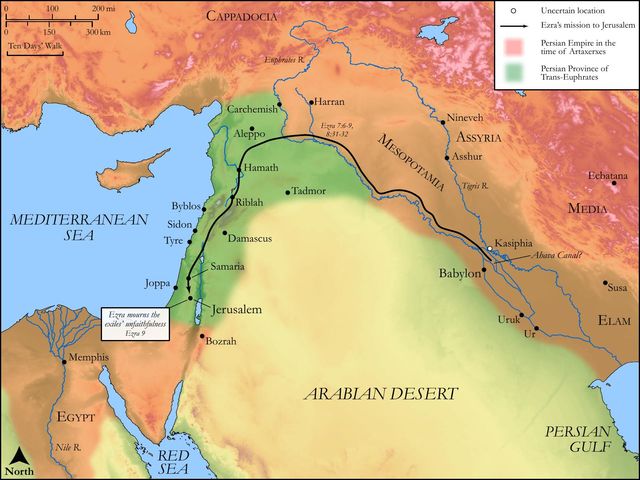
Study this verse
Public-domain commentary
Matthew Henry
From his Commentary on the Whole Bible. Henry comments on passages, not single verses — this entry covers Ezra 8:1–20. His two-level outline is real structure in the source text, so it is rendered as structure.
Ezra, having received his commission from the king, beats up for volunteers, as it were, sets up an ensign to assemble the outcasts of Israel and the dispersed of Judah, Isa 11:12. "Whoever of the sons of Sion, that swell with the daughters of Babylon, is disposed to go to Jerusalem, now that the temple there is finished and the temple-service set a-going, now is their time." Now one would think that under such a leader, with such encouragements, all the Jews should at length have shaken themselves from their dust, and loosed the bands of their neck, according to that call, Isa 52:1, Isa 52:2, etc. I wonder how any of them could read that chapter and yet stay behind. But multitudes did. They loved their ease better than their religion, thought themselves well off where they were, and either believed not that Jerusalem would better their condition or durst not go thither through any difficulties. But here we are told,
I.That some offered themselves willingly to go with Ezra.
The heads of the several families are here named, for their honour, and the numbers of the males that each brought in, amounting in all to 1496. Two priests are named (Ezr 8:2) and one of the sons of David; but, it should seem, they came without their families, probably intending to see how they liked Jerusalem and then either to send for their families or return to them as they saw cause. Several of their families, or clans, here named, we had before, ch. 2. Some went up from them at that time, more went up now, as God inclined their hearts; some were called into the vineyard at the third hour, others not till the eleventh, yet even those were not rejected. But here we read of the last sons of Adonikam (Ezr 8:13), which some understand to their dispraise, that they were the last that enlisted themselves under Ezra; I rather understand it to their honour, that now all the sons of that family returned and none staid behind.
II.That the Levites who went in this company were in a manner pressed into the service.
Ezra appointed a general rendezvous of all his company at a certain place upon new-year's day, the first day of the first month. Ezr 7:9. Then and there he took a view of them, and mustered them, and (which was strange) found there none of the sons of Levi, Ezr 8:15. Some priests there were, but no others that were Levites. Where was the spirit of that sacred tribe? Ezra, a priest, like Moses proclaims, Who is on the Lord's side? They, unlike to Levi, shrink, and desire to abide among the sheep-folds to hear the bleatings of the flock. Synagogues we suppose they had in Babylon, in which they prayed, and preached, and kept sabbaths (and, when they could not have better, they had reason to be thankful for them); but now that the temple at Jerusalem was opened, to the service of which they were ordained, they ought to have preferred the gates of Zion before all those synagogues. It is upon record here, to their reproach; but tell it not in Gath. Ezra, when he observed that he had no Levites in his retinue, was much at a loss. He had money enough for the service of the temple, but wanted men. The king and princes had more than done their part, but the sons of Levi had not half done theirs. Eleven men, chief men, and men of understanding, he chooses out of his company, to be employed for the filling up of this lamentable vacancy; and here we are informed,
1.Of their being sent. Ezra sent them to a proper place, where there as a college of Levites, the place Casiphia, probably a street or square in Babylon allowed for that purpose - Silver Street one may call it, for ceseph signifies silver. He sent them to a proper person, to Iddo, the chief president of the college, not to urge him to come himself (we will suppose him to be old and unfit for such a remove), but to send some of the juniors, ministers for the house of our God, Ezr 8:17. The furnishing of God's house with good ministers is a good work, which will redound to the comfort and credit of all that have a hand in it.
2.Of their success. They did not return without their errand, but, though the warning was short, they brought about forty Levites to attend Ezra, Sherebiah, noted as a very intelligent man, and eighteen with him (Ezr 8:18). Hashabiah, and Jeshaiah, and twenty with them, Ezr 8:19. By this it appears that they were not averse to go, but were slothful and inattentive, and only wanted to be called upon and excited to go. What a pity it is that good men should omit a good work, merely for want of being spoken to! What a pity that they should need it, but, if they do, what a pity that they should be left without it! Of the Nethinim, the servitors of the sacred college, the species infima - the lowest order of the temple ministers, more appeared forward to go than of the Levites themselves. Of them 220, upon this hasty summons, enlisted themselves, and had the honour to be expressed by name in Ezra's muster-roll, Ezr 8:20. "Thus," says Ezra, "were we furnished with Levites, by the good hand of our God upon us." If, where ministers have been wanting, the vacancies are well supplied, let God have the glory, and his good hand be acknowledged as qualifying them for the service, inclining them to it, and then opening a door of opportunity for them.
Continue studying Ezra 8:14 across the web’s major study libraries — every link below opens this exact verse, chapter, or book on the destination site.
Read & Compare
 BibleGatewayThis verse in more than 200 translations and 70 languages.
 Bible.comThe YouVersion reader — hundreds of translations, reading plans, and highlights.
 ESV.orgCrossway's official English Standard Version reader.
 NET BibleThe NET translation with 60,000+ translators' notes on every rendering decision.
 STEP BibleTyndale House's free study tool — original text, vocabulary, and scholarly resources.
 BibliaLogos Bible Software's free web reader.
 USCCBThe New American Bible (Revised Edition) with the U.S. bishops' study notes.
Commentaries
 BibleHub CommentariesDozens of classic commentaries on this verse, gathered on one page.
 StudyLightMore than 100 commentary sets — the largest collection on the web.
 BibleRefPlain-English commentary on what this verse means, verse by verse.
 Enduring WordDavid Guzik's free commentary on this chapter, widely used by Bible teachers.
 Bible Study ToolsVerse commentary alongside Greek and Hebrew study aids.
Original Language & Research
- BibleHub InterlinearThe verse word by word — original language, transliteration, and English.
- BibleHub LexiconEvery word's original-language definition and Strong's entry.
 Blue Letter BibleDeep-study tools — Strong's numbers, concordance, and word studies.
 SefariaThe Hebrew text with Rashi and centuries of Jewish commentary.
Sermons, Hymns & Audio


TrulyRandomVerse is not affiliated with these sites and doesn’t control their content. They’re linked because they’re genuinely useful.
Summary
Ezra 8:14 serves as a precise administrative and theological record within Ezra's account of the second major return from Babylonian exile. This verse meticulously identifies Uthai and Zabbud, two prominent individuals from the family of Bigvai, along with the seventy males who accompanied them, highlighting the organized and intentional nature of this post-exilic migration. It underscores the careful enumeration of God's people, essential for re-establishing communal identity, land claims, and the spiritual and social foundations of Judah under divine providence.
Context
ShowHideLiterary Context
Ezra 8:14 is embedded within a vital genealogical and numerical list that spans Ezra 8:1-14. This section meticulously records the heads of families and the number of males who journeyed with Ezra from Babylon to Jerusalem. The preceding verses systematically name various family lines (e.g., of Phinehas, of Ithamar, of David) and their respective numbers, with Ezra 8:14 concluding this detailed enumeration of the returning groups. This roster is far more than a mere administrative record; it authenticates the lineage of the returnees, establishing their legitimate right to participate in the rebuilding of the Temple and the community. Furthermore, it powerfully demonstrates the organized fulfillment of God's promise to restore His people, setting the stage for the arduous journey itself by identifying the faithful remnant committed to this divine undertaking.
Historical & Cultural Context
The return described in Ezra 8 transpired around 458 BC, approximately 80 years after the initial return led by Zerubbabel and Joshua (c. 538 BC) and nearly a century after the devastating destruction of Jerusalem and the Temple by Babylon in 586 BC. Many Jewish exiles had established lives in Babylon, making the decision to return to a desolate homeland a profound act of faith, sacrifice, and commitment to their ancestral heritage. King Artaxerxes I of Persia granted Ezra, a priest and skilled scribe in the Law of Moses, royal permission and substantial resources to lead this contingent. This act reflects the Persian Empire's strategic policy of supporting local religious practices to maintain stability across its vast territories. In Israel, meticulous genealogical records were paramount for establishing land ownership, tribal identity, and religious purity, especially for a people returning from exile to reclaim their heritage. The specific focus on "males" in censuses, such as the "seventy males" in this verse, was typical for determining military strength, communal labor capacity, or eligibility for religious and civic duties, underscoring the practical aspects of re-establishing a functional and secure society.
Key Themes
ShowHideThe meticulous listing in Ezra 8 contributes significantly to several overarching themes within the book of Ezra and the broader post-exilic narrative. Firstly, it powerfully illustrates Divine Order and Providence, showcasing God's meticulous care for His covenant people, orchestrating their return and preserving their lineage even amidst foreign rule. The fact that these specific families and individuals are named reflects God's attention to every detail of His restoration plan, echoing the careful enumerations found in Numbers 1. Secondly, the emphasis on family heads and their accompanying numbers highlights Community and Identity, underscoring the vital process of rebuilding the nation family by family, reinforcing who belonged to the covenant community and held legitimate claims in the land. This re-establishment of identity was crucial after generations in exile. Thirdly, the return itself embodies Commitment to Restoration, as these individuals demonstrated immense faith and sacrifice by leaving established lives in Babylon to rebuild Jerusalem and restore true worship, driven by a desire to live according to God's Law, as championed by Ezra himself (Ezra 7:10). Finally, the listing implicitly conveys the Importance of Every Individual, demonstrating that each name, each family, and each group, no matter how seemingly small (like "seventy males"), played a significant and valued role in God's grand plan of restoration.
Exposition and Analysis
ShowHideKey Word Analysis
ShowHideVerse Breakdown
ShowHide"Of the sons also of Bigvai;"
This phrase introduces another family group contributing to the returning exiles, following a clear pattern established in the preceding verses of Ezra 8. The "sons of Bigvai" refers to the descendants or members of the Bigvai family, indicating a cohesive familial unit rather than just disparate individuals. The inclusion of "also" links this entry to the continuous, comprehensive register of families, emphasizing its place within the larger, divinely orchestrated return.
"Uthai, and Zabbud,"
These are two specific individuals identified as leaders or prominent members within the Bigvai family contingent. Their names are singled out, suggesting they held positions of responsibility, perhaps as heads of sub-families or key representatives of their larger family unit among the returnees. Their mention personalizes the list, reminding the reader that these numbers represent real people who made a conscious and sacrificial decision to participate in the restoration of Judah.
"and with them seventy males."
This clause specifies the precise number of adult men who accompanied Uthai and Zabbud from the Bigvai family. The number "seventy" represents a significant contingent, demonstrating a substantial contribution from this particular family to the overall strength and manpower of the returning community. The emphasis on "males" highlights the practical and functional aspect of the census, focusing on those who could contribute to the physical rebuilding efforts, defense, and social re-establishment in Judah.
Literary Devices
ShowHideThe primary literary device employed in Ezra 8:14, and indeed throughout much of Ezra 8, is Enumeration or Cataloging. This technique involves the systematic listing of names, places, or numbers. In this context, it serves multiple purposes: it authenticates the lineage of the returnees, establishing their right to land and heritage; it provides a meticulous record of those who participated in God's redemptive plan, underscoring the divine order and precision in the restoration; and it emphasizes the collective effort and significant human resources committed to the rebuilding of Jerusalem and the Temple. The specific mention of "Uthai, and Zabbud" within the "sons of Bigvai" can also be seen as a form of Synecdoche, where specific individuals represent the larger family unit or contingent they lead. While seemingly dry, this detailed listing technique imbues the narrative with a profound sense of historical veracity and divine intentionality, highlighting that every individual and family was known and accounted for in God's grand design.
Theological and Thematic Connections
ShowHideEzra 8:14, though a simple entry in a list, profoundly illustrates God's meticulous care for His people and the significance of every individual in His redemptive plan. The careful enumeration of families and the specific count of "seventy males" reflect a divine order and providence that meticulously oversees the restoration of Israel. It underscores that God knows His own, not just as a collective, but as distinct individuals and families, each with a vital role to play in the unfolding of His purposes. This attention to detail highlights the covenant faithfulness of God, who ensured the preservation and return of a remnant to re-establish His dwelling place and worship in Jerusalem. It also challenges us to recognize the inherent value and indispensable contribution of every person within the community of faith, affirming that no contribution is too small or insignificant in God's eyes.
Reflection and Application
ShowHideThe seemingly mundane list in Ezra 8:14 offers profound and enduring lessons for contemporary believers. It serves as a powerful reminder that God is a God of order and detail, who cares intimately about every individual within His community. Just as He meticulously recorded each family and the number of males returning from exile, He knows and values every person in His church today. This truth should inspire us to value and affirm the unique gifts, callings, and contributions of every member, recognizing that each plays an indispensable role in the vibrant body of Christ. Furthermore, the commitment of these returnees, who willingly left established lives in Babylon to embark on a difficult and uncertain journey for God's purposes, serves as a powerful example of profound faith and sacrificial obedience. It challenges us to examine our own willingness to step out in faith, to commit our resources, time, and ourselves to God's kingdom work, even when it requires personal cost or inconvenience. The meticulous record-keeping also speaks to the importance of good stewardship, accountability, and divine order within our spiritual and organizational endeavors, reflecting the very character of the God we serve.
Questions for Reflection
ShowHideFAQ
ShowHideWhy are these lists of names so important in the Bible?
ShowHideLists of names, like the one in Ezra 8:14, are crucial for several profound reasons. Theologically, they demonstrate God's meticulous care and intimate knowledge of His covenant people, affirming His unwavering faithfulness to His promises. Historically and culturally, they served to authenticate lineage, which was vital for establishing land claims, tribal identity, and eligibility for priestly service or community leadership in ancient Israel. For a people returning from generations of exile, these lists were essential for re-establishing their identity, legal standing, and rightful inheritance in the land. They also highlight the human element of God's redemptive plan, showing that real people, often making great sacrifices, were actively involved in the unfolding of His divine purposes. Such lists provide a tangible and verifiable record of God's work through specific individuals and families, reinforcing the narrative of restoration and continuity across generations.
What was the significance of "seventy males" specifically?
ShowHideThe number "seventy" in Ezra 8:14, referring to "seventy males," primarily indicates a specific, organized contingent from the Bigvai family. While the number seventy can hold symbolic significance elsewhere in the Bible (e.g., the seventy nations in Genesis 10, the seventy elders of Israel in Exodus 24:1, or the seventy disciples sent out by Jesus in Luke 10:1), in this specific context within a census, it primarily denotes a precise, counted group. The emphasis on "males" (Hebrew: zâkâr) indicates that this count was for able-bodied men, crucial for the physical labor of rebuilding Jerusalem and the Temple, for defense, and for fulfilling various community duties. It signifies a substantial and organized contribution of manpower to the returning community, essential for their survival, security, and re-establishment in the land of Judah.
Christ-Centered Fulfillment
ShowHideThe meticulous record-keeping and the careful enumeration of individuals in Ezra 8:14, highlighting God's attention to every person in the returning community, find their ultimate and glorious fulfillment in Christ Jesus. The Old Testament restoration from Babylonian exile, driven by God's faithfulness to His covenant people, powerfully foreshadows the far greater spiritual restoration and new creation accomplished through the atoning work of Jesus. Just as the returnees were gathered to rebuild a physical temple and a covenant community in Jerusalem, Christ gathers His people, not from one nation but from every tribe, tongue, people, and nation, to build His eternal spiritual temple—the Church (Ephesians 2:19-22). The significance of every individual name in Ezra points to the New Covenant reality where every believer is a vital and cherished member of the body of Christ, known personally and intimately by the Good Shepherd (John 10:14). The names of Uthai and Zabbud, along with the seventy males, represent those who chose to participate in God's redemptive work. In the new covenant, those whose names are eternally written in the Lamb's Book of Life are the true spiritual Israel, redeemed by the precious blood of the Lamb, participating in an eternal restoration that infinitely surpasses the physical return to Jerusalem. Christ is the ultimate leader who gathers His people, enabling them to live in true spiritual freedom, purpose, and community, fulfilling the deepest longings for identity and belonging that the exiles sought.