


Old Testament · History · Book 16 of 66
Nehemiah
Nehemiah, cupbearer to the king of Persia, goes up to rebuild Jerusalem’s broken wall; then the people hear the law read and bind themselves by covenant to keep it.
- 13 chapters
- 406 verses
- About 48 minutes to read
- The Return from Exile, c. 538–400 BC
Nehemiah is cupbearer to King Artaxerxes at Shushan when word comes that Jerusalem’s wall “is broken down, and the gates thereof are burned with fire” (Nehemiah 1:3). He weeps and prays, asks the king for leave, and goes up to build. The wall is finished in fifty-two days against mockery, threats and plots, and the enemies themselves “perceived that this work was wrought of our God” (6:16). Then the book turns from stones to people. Ezra reads the law, the Levites give the sense, the feast of booths is kept, and the people seal a covenant to walk in God’s law. Its events are the last the Old Testament narrates.
Prayer runs through the book. Nehemiah prays between the king’s question and his answer (2:4), prays and sets a watch when the enemy plots (4:9), and breaks into his own account with short requests to God. Chapter 13 answers chapter 10: the promises the people sealed on marriage, the sabbath and the tithes are found broken when Nehemiah comes back from the king, and he sets each right again.
Then he said unto them, Go your way, eat the fat, and drink the sweet, and send portions unto them for whom nothing is prepared: for this day is holy unto our Lord: neither be ye sorry; for the joy of the LORD is your strength.
Nehemiah 8:10 KJV
How Nehemiah is laid out
8 movements · 61 passages · 406 verses
Chapters 1–2 · 31 verses
From Shushan to the ruins
Hanani brings word to Shushan that the remnant is in great affliction and reproach and the wall broken down. Nehemiah weeps, fasts and confesses Israel’s sins, pleading the word given to Moses. In Nisan the king sees his sad face and sends him with letters and timber. He views the walls by night, and the people answer, “Let us rise up and build.”
7 passages
- 1:1–3 Nehemiah Hears of Jerusalem's Distress
- 1:4 Nehemiah Laments and Begins Intercession
- 1:5–11 The Prayer of Confession and Petition
- 2:1–8 Nehemiah Requests Permission from the King
- 2:9–10 Arrival in Jerusalem and Initial Opposition
- 2:11–16 The Secret Inspection of the Walls
- 2:17–20 Nehemiah Motivates the People
Chapters 3–4 · 55 verses
Gate by gate, sword in hand
Eliashib the high priest and his brethren build the sheep gate, and families, guilds, rulers and towns repair a section each, many “over against his house,” round to the sheep gate again. Sanballat and Tobiah mock, then conspire to attack. The builders pray and set a watch; half of Nehemiah’s servants work while half hold spears, and every builder has his sword girded by his side.
8 passages
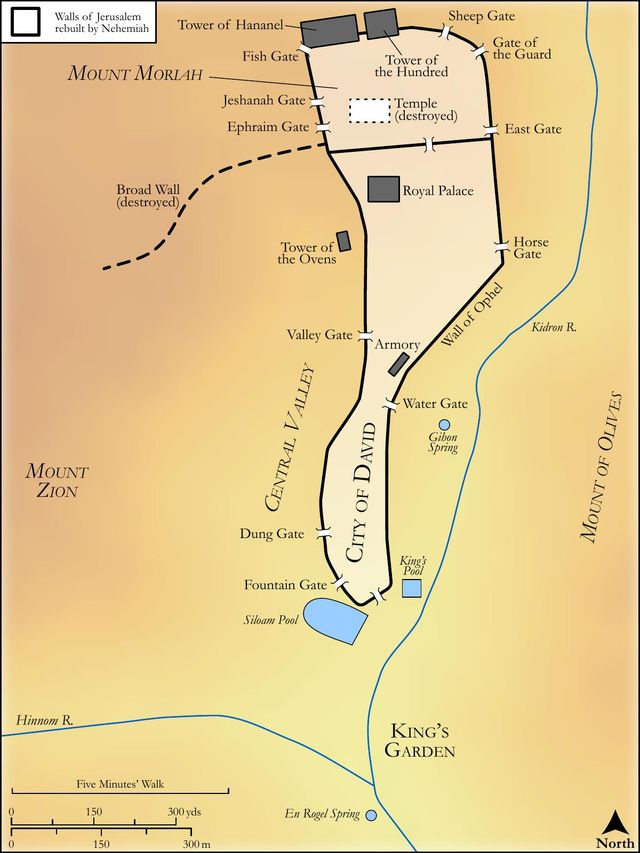
- 3:1–5 Rebuilding the Wall: Sheep Gate to Old Gate
- 3:6–12 The Northwest Wall: Old Gate to Valley Gate
- 3:13–14 The Southern Wall: Valley Gate to Fountain Gate
- 3:15–27 Repairs along the Eastern Wall
- 3:28–32 Completing the Circuit: Horse Gate to Sheep Gate
- 4:1–6 Sanballat Mocks the Builders
- 4:7–15 The Enemy Conspires to Attack
- 4:16–23 Armed Labor and Constant Vigilance
Chapter 5 · 19 verses
Brothers in debt
The people cry out against their brethren: they have mortgaged lands, vineyards and houses for corn and borrowed for the king’s tribute, and their children are going into bondage. Nehemiah rebukes the nobles, “Ye exact usury, every one of his brother,” and they swear to restore. As governor for twelve years he takes no governor’s bread, “because of the fear of God.”
Chapters 6–7 · 92 verses
The wall finished
Sanballat and Geshem call Nehemiah to the plain of Ono; he answers, “I am doing a great work, so that I cannot come down.” An open letter, a hired prophet and Tobiah’s letters do not stop him, and the wall is finished in fifty and two days. He sets the doors and the watches, and finds the register of those who came up at the first.
11 passages
- 6:1–9 Attempts to Lure Nehemiah Away
- 6:10–14 The Threat of False Prophecy
- 6:15–16 The Wall is Finished
- 6:17–19 Internal Treachery Persists
- 7:1–4 Administration and Security Established
- 7:5 Nehemiah Finds the First Returnees' Register
- 7:6–38 The Register of Returnees
- 7:39–60 Priests, Levites, and Temple Servants
- 7:61–65 Those with Disputed Heritage
- 7:66–72 Summary of the Population and Wealth
- 7:73 Settling in the Cities
Chapter 8 · 18 verses
The law read with the sense
In the seventh month the people gather at the water gate, and Ezra reads the book of the law from morning until midday while the Levites give the sense. The people weep; they are told to feast, for “the joy of the LORD is your strength.” Finding the feast of booths written, they keep it as Israel had not since Jeshua the son of Nun.
Chapters 9–10 · 77 verses
Confession and a sure covenant
On the twenty-fourth day the people fast in sackcloth, separate themselves from strangers and confess. The Levites recount God’s works from creation through Abraham, the exodus, the wilderness and the land, and Israel’s rebellions met by mercy. Princes, Levites and priests seal “a sure covenant”: no marriages with the people of the land, the sabbath kept, tithes brought, and the house of God not forsaken.
11 passages
- 9:1–4 The Day of Confession and Separation
- 9:5–8 Invocation and Praise to the Creator
- 9:9–15 God's Deliverance in the Exodus
- 9:16–21 Israel's Rebellion in the Wilderness
- 9:22–31 Conquest, Prosperity, and Disobedience
- 9:32–37 Acknowledging God's Justice and Present Servitude
- 9:38 Sealing the Covenant
- 10:1–27 Signatories of the Covenant
- 10:28–29 The Community Joins the Oath
- 10:30–31 Vows Regarding Social and Economic Life
- 10:32–39 Vows Regarding Temple Support and Offerings
Chapters 11–12 · 83 verses
The city peopled and dedicated
The rulers dwell at Jerusalem, and the rest cast lots to bring one in ten to live in the holy city; the others settle in the towns of Judah and Benjamin. Lists of priests and Levites follow, from Zerubbabel’s day on. At the dedication two great companies of thanksgiving go round upon the wall, and “the joy of Jerusalem was heard even afar off.”
12 passages
- 11:1–2 The Repopulation of Jerusalem
- 11:3–9 Residents of Jerusalem: Judah and Benjamin
- 11:10–14 The Priests in the Holy City
- 11:15–19 The Levites, Singers, and Gatekeepers
- 11:20–24 Distribution in the Cities of Judah
- 11:25–30 Judahite Settlements Outside Jerusalem
- 11:31–36 Benjaminite Settlements
- 12:1–9 Priests and Levites Who Returned with Zerubbabel
- 12:10–11 The Line of High Priests
- 12:12–26 Priestly Leaders in the Next Generation
- 12:27–43 The Dedication of the Wall of Jerusalem
- 12:44–47 Provision for Temple Maintenance
Chapter 13 · 31 verses
Reforms on his return
Hearing the law against the Ammonite and the Moabite, Israel separates the mixed multitude. While Nehemiah is away with the king, Eliashib the priest gives Tobiah a chamber in the courts of the house of God. Returning, Nehemiah casts out Tobiah’s stuff, restores the Levites’ portions, shuts the gates on the sabbath, and contends with Jews who married wives of Ashdod, Ammon and Moab.
The words Nehemiah turns on
Chapters 1–7 turn on wall, repair and work; chapters 8–13 on the law, a God who did not forsake, and Nehemiah’s “remember me.”
What Nehemiah teaches
châzaq · strengthen
Hands strengthened for the work
When Nehemiah told the people of “the hand of my God which was good upon me,” they “strengthened their hands for this good work” (2:18). The verb is châzaq, the same word as the “repaired” that runs through chapter 3, where each family takes up its section of the wall. The enemy’s aim was the reverse: “Their hands shall be weakened from the work.” Nehemiah answered with a prayer, “Now therefore, O God, strengthen my hands” (6:9). Prayer did not replace the labour, nor the labour the prayer: “we made our prayer unto our God, and set a watch against them day and night” (4:9).
tôwrâh · law
The law read, and the sense given
The people asked for the law themselves: they “spake unto Ezra the scribe to bring the book of the law of Moses” (8:1). Ezra read it to “all that could hear with understanding” (8:2), and the Levites “read in the book in the law of God distinctly, and gave the sense, and caused them to understand the reading” (8:8). Hearing it, “all the people wept” (8:9). They were told not to mourn, for “the joy of the LORD is your strength” (8:10), and they kept the feast “because they had understood the words that were declared unto them” (8:12). The next day’s reading sent them out to dwell in booths (8:14).
ʻâzab · forsake
Not forsaken, and forsaking
The Levites’ prayer in chapter 9 sets Israel’s record beside God’s. Israel “hardened their necks,” but God was “a God ready to pardon, gracious and merciful, slow to anger, and of great kindness, and forsookest them not” (9:17), echoing the name the LORD proclaimed to Moses (Exodus 34:6). In the wilderness “thou in thy manifold mercies forsookest them not” (9:19), and in the land “thou didst not utterly consume them, nor forsake them” (9:31). The people answered with a sealed promise: “we will not forsake the house of our God” (10:39). Coming back from the king, Nehemiah found the Levites’ portions unpaid and had to ask the rulers, “Why is the house of God forsaken?” (13:10–11).
zâkar · remember
Remember me, O my God
Nehemiah’s account is broken by short prayers spoken straight to God. He pleads God’s own word: “Remember, I beseech thee, the word that thou commandedst thy servant Moses” (1:8). He tells the people to “remember the Lord, which is great and terrible” (4:14). He asks God to remember his enemies (6:14) and those who “defiled the priesthood” (13:29). Four times he asks to be remembered himself, for what he has done for the people and for the house of God (5:19; 13:14). The third asks for mercy: “spare me according to the greatness of thy mercy” (13:22). The book ends on the fourth, “Remember me, O my God, for good” (13:31).
Christ in Nehemiah
The Levites thank God for “bread from heaven for their hunger” and “water for them out of the rock for their thirst” (Nehemiah 9:15). The crowd cited the same gift to Jesus, “He gave them bread from heaven to eat” (John 6:31), and he answered, “I am the bread of life: he that cometh to me shall never hunger; and he that believeth on me shall never thirst” (John 6:35). Paul says of the rock, “that Rock was Christ” (1 Corinthians 10:4). At the feast of tabernacles, the booths of chapter 8, Jesus stood and cried, “If any man thirst, let him come unto me, and drink” (John 7:37).
Daniel was told that the weeks “unto the Messiah the Prince” would run “from the going forth of the commandment to restore and to build Jerusalem,” and that the wall would be built “even in troublous times” (Daniel 9:25). Julius Africanus counted from Nehemiah’s commission: The specified interval began in the twentieth year of Artaxerxes, King of the Persians
. Tertullian counted from an earlier year: This calculation begins with the first year of Darius
. Both read the weeks as ending in Christ.
People
By how many verses name them
- NehemiahSon of Hacaliah; a brother of Hanani5
- TobiahHusband of daughter of Shecaniah; father of Jehohanan12
- Sanballat10
- EzraSon of Seraiah9
- DavidSon of Jesse7
- MosesSon of Amram and Jochebed; a brother of Aaron and Miriam; husband of Zipporah7
- JeshuaA son of Azaniah6
- KadmielFather of Jeshua6
447 more are named.
Places
73 named
- JerusalemThe city whose wall is rebuilt, then peopled by lot34
- Geba3
- MizpahIts rulers repair sections of the wall3
- OnoThe plain where Sanballat and Geshem tried to draw Nehemiah down3
- OphelWhere the Nethinims, the temple servants, dwelt3
- Anathoth2
- AshdodIts men join the plot; Jews marry its women2
- BabylonWhere the first exiles were carried; Artaxerxes is called its king2
Where Nehemiah reaches
The passages it leans on, and the ones that lean on it
Deuteronomy 7:9 Nehemiah 1:5 Daniel 9:4
Moses’ words for the God “which keepeth covenant and mercy,” opening the exiles’ prayers in Nehemiah and Daniel.
The register of the first return under Zerubbabel, which Nehemiah found; Ezra 2 records it as well.
Nehemiah 9:29 Leviticus 18:5 Romans 10:5
The law’s promise, “which if a man do, he shall live in them,” which Paul cites for the righteousness of the law.
Nehemiah 13:10–12 Malachi 3:8–10
Malachi too rebukes withheld tithes: “Bring ye all the tithes into the storehouse.”
Nehemiah’s warning from Solomon, whom “outlandish women” caused to sin.
Books Nehemiah links to most
The Church Fathers on Nehemiah
99 quotations from 4 writers before AD 800
Bede saw in Nehemiah’s name and work a figure of Christ the Comforter.
Nehemiah is interpreted in Latin as "the Lord comforts," … when he had renewed the walls of Jerusalem and freed the people of God from the insults of their enemies, elevated observance of the divine law; it is evident that in both name and deed and person he fittingly designates the Mediator of God and men, the man Christ Jesus …
Origen heard in the promise to gather the scattered the good shepherd who seeks the one lost sheep.
But again he says to them, "If your dispersion should be from one end of heaven to the other, from there I will gather you, says the Lord." Because, therefore, "the princes of this world" had first invaded "the Lord's portion," "the good shepherd" had, necessarily, the ninety and nine having been left on the heights, to descend to the lands and seek the one sheep that was lost …
Bede on the feast that followed the reading of the law.
For the day of the Lord is holy to us when we strive to hear and fulfill his words. On which day, although suffering external tribulations, we ought to be rejoicing in hope …
Keep studying
Articles