


Nehemiah 13:31
Bible text: King James Version (1769 Blayney text) · Public domain
Bible text: Berean Standard Bible · Public domain
Bible text: American Standard Version (1901) · Public domain
Bible text: World English Bible, Messianic edition · Public domain
Bible text: Geneva Bible (1599) · Public domain
Bible text: Young's Literal Translation · Public domain
- וּלְקֻרְבַּןu·le·kur·Banand for [the] offering ofH7133Conj-w ¦ Prep-l ¦ N-mscNoun Singular Masculine Constructוּandלְforקֻרְבַּן[the] offering of
- הָעֵצִיםha·'e·Tzimthe wood<s>H6086Art ¦ N-mpNoun Plural Masculine Absoluteהָtheעֵצִיםwood<s>
- בְּעִתִּיםbe·'i·Timat timesH6256Prep-b ¦ N-cpNoun Plural common gender Absoluteבְּatעִתִּיםtimes
- מְזֻמָּנוֹתme·zu·ma·NotappointedH2163V-Pual-PassPrtcpl-fpVerb Pual Participle Passive Plural Feminine Absolute
- וְלַבִּכּוּרִיםve·lab·bi·ku·Rimand for the first-fruitsH1061Conj-w ¦ Prep-l ¦ N-mpNoun Plural Masculine Absoluteוְandלַfor theבִּכּוּרִיםfirst-fruits
- זָכְרָהza·khe·rahremember !H2142V-Qal-Imp-2ms ¦ SfxVerb Qal Imperative 2nd Singular Masculineזָכְרָrememberה!
- לִּיlito mePrep-l ¦ 1csSuffix Personal 1st Singular common genderלִּtoיme
- אֱלֹהַי'e·lo·Haimy O GodH430N-mpc ¦ 1csNoun Plural Masculine ConstructאֱלֹהַO Godיmy
- לְטוֹבָהle·to·Vahfor goodH2896Prep-l ¦ N-fsNoun Singular Feminine Absoluteלְforטוֹבָהgood
English is a literal word-by-word gloss of the Hebrew, not the KJV's wording. Why?
This is the original text the KJV's translators worked from — each Hebrew word with its own literal English meaning in this verse, prepared by scholars at Tyndale House, Cambridge. The KJV translates whole sentences, not word by word, so its wording differs: one Hebrew word can become several English words, and the KJV may choose “the LORD” where the gloss reads “Yahweh”. Both are faithful — they answer different questions. For the KJV's own rendering, switch to the KJV text.
Details
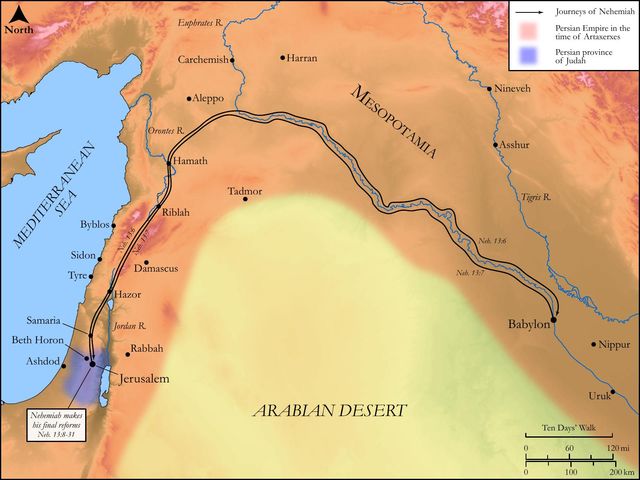
See on the biblical-era map
Study this verse
Public-domain commentary
Matthew Henry
From his Commentary on the Whole Bible. Henry comments on passages, not single verses — this entry covers Nehemiah 13:23–31. His three-level outline is real structure in the source text, so it is rendered as structure.
We have here one instance more of Nehemiah's pious zeal for the purifying of his countrymen as a peculiar people to God; that was the thing he aimed at in the use of his power, not the enriching of himself. See here,
I.How they had corrupted themselves by marrying strange wives.
This was complained of in Ezra's time, and much done towards a reformation, Ezr 9:1-15 and 10. But, when the unclean spirit is cast out, if a watchful eye be not kept upon him, he will re-enter; so he did here. Though in Ezra's time those that had married strange wives were forced to put them away, which could not but occasion trouble and confusion in families, yet others would not take warning. Nitimur in vetitum - we still lean towards what is forbidden. Nehemiah, like a good governor, enquired into the state of the families of those that were under his charge, that he might reform what was amiss in them, and so heal the streams by healing the springs.
1.He enquired whence they had their wives, and found that many of the Jews had married wives of Ashdod, of Ammon, and of Moab (Neh 13:23), either because they were fond of what was far-fetched or because they hoped by these alliances to strengthen and enrich themselves. See how God by the prophet reproves this, Mal 2:11. Judah has dealt treacherously, and broken covenant with God, the covenant made in Ezra's time with reference to this very thing; he has profaned the holiness of the Lord by marrying the daughter (that is, the worshipper) of a strange god.
2.He talked with the children, and found they were children of strangers, for their speech betrayed them. The children were bred up with their mothers, and learned of them and their nurses and servants to speak, so that they could not speak the Jews' language, could not speak it at all, or not readily, or not purely, but half in the speech of Ashdod, or Ammon, or Moab, according as the country was which the mother was a native of. Observe,
(1.)Children, in their childhood, learn much of their mothers. Partus sequitur ventrem - they are prone to imitate their mothers.
(2.)If either side be bad, the corrupt nature will incline the children to take after that, which is a good reason why Christians should not be unequally yoked.
(3.)In the education of children great care should be taken about the government of their tongues, that they learn not the language of Ashdod, any impious or impure talk, any corrupt communication.
II.What course Nehemiah took to purge out this corruption, when he discovered how much it had prevailed.
1.He showed them the evil of it, and the obligation he lay under to witness against it. He did not seek an occasion against them, but this was an iniquity to be punished by the judge, and which he must by no means connive at (Neh 13:27): "Shall we hearken to you, who endeavour to palliate and excuse it? No, it is an evil, a great evil, it is a transgression against our God, to marry strange wives, and we must do our utmost to put a stop to it. You beg that they may not be divorced from you, but we cannot hearken to you, for there is no other remedy to clear us from the guilt and prevent infection." (1.) He quotes a precept, to prove that it was in itself a great sin; and makes them swear to that precept: You shall not give your daughters unto their sons, etc., which is taken from Deu 7:3. When we would reclaim people from sin we must show them the sinfulness of it in the glass of the commandment. (2.) He quotes a precedent, to show the pernicious consequences of it, which made it necessary to be animadverted upon by the government (Neh 13:26): Did not Solomon king of Israel sin by these things? The falls of great and good men are recorded in order that we may take warning by them to shun the temptations which they were overcome by. Solomon was famous for wisdom; there was no king like him for it; yet, when he married strange wives, his wisdom could not secure him from their snares, nay, it departed from him, and he did very foolishly. He was beloved of God, but his marrying strange wives threw him out of God's favour, and went near to extinguish the holy fire of grace in his soul: he was king over all Israel; but his doing this occasioned the loss of ten of his twelve tribes. You plead that you can marry strange wives and yet retain the purity of Israelites; but Solomon himself could not; even him did outlandish women cause to sin. Therefore let him that thinks he stands take heed lest he fall when he runs upon such a precipice.
2.He showed himself highly displeased at it, that he might awaken them to a due sense of the evil of it: He contended with them, Neh 13:25. They offered to justify themselves in what they did, but he showed them how frivolous their excuses were, and argued it warmly with them. When he had silenced them he cursed them, that is, he denounced the judgments of God against them, and showed them what their sin deserved. He then picked out some of them that were more obstinate than the rest, and fit to be made examples, and smote them (that is, ordered them to be beaten by the proper officers according to the law, Deu 25:2, Deu 25:3), to which he added this further mark of infamy that he plucked off their hair, or cut or shaved it off; for it may so be understood. Perhaps they had prided themselves in their hair, and therefore he took it off to deform and humble them, and put them to shame; it was, in effect, to stigmatize them, at least for a time. Ezra, in this case, had plucked off his own hair, in holy sorrow for the sin; Nehemiah plucked off their hair, in a holy indignation at the sinners. See the different tempers of wise, and good, and useful men, and the divers graces, as well as divers gifts, of the same Spirit.
3.He obliged them not to take any more such wives, and separated those whom they had taken: He cleansed them from all strangers, both men and women (Neh 13:30), and made them promise with an oath that they would never do so again, Neh 13:25. Thus did he try all ways and means to put a stop to this mischief and to prevent another relapse into this disease.
4.He took particular care of the priests' families, that they might not lie under this stain, this guilt. He found, upon enquiry, that a branch of the high priest's own family, one of his grandsons, had married a daughter of Sanballat, that notorious enemy of the Jews (Neh 2:10; Neh 4:1), and so had, in effect, twisted interests with the Samaritans, Neh 13:28. How little love had that man either to God or his country who could make himself in duty and interest a friend to him that was a sworn enemy to both. It seems this young priest would not put away his wife, and therefore Nehemiah chased him from him, deprived him, degraded him, and made him for ever incapable of the priesthood. Josephus says that this expelled priest was Manasseh, and that when Nehemiah drove him away he went to his father-in-law Sanballat, who built him a temple upon Mount Gerazim, like that at Jerusalem, and promised him he should be high priest in it, and that then was laid the foundation of the Samaritans' pretensions, which continued warm to our Saviour's time. Joh 4:20, Our fathers worshipped in this mountain. When Nehemiah had thus expelled one that had forfeited the honour of the priesthood he again posted the priests and Levites every one in his business, Neh 13:30. It was no loss to them to part with one that was the scandal of their cloth; the work would be done better without him. When Judas had gone out Christ said, Now is the Son of Man glorified, Joh 13:30, Joh 13:31. Here are Nehemiah's prayers on this occasion. (1.) He prays, Remember them, O my God! Neh 13:29. "Lord, convince and convert them; put them in mind of what they should be and do, that they may come to themselves." Or, "Remember them to reckon with them for their sin; remember it against them." If we take it so, this prayer is a prophecy that God would remember it against them. Those that defile the priesthood despise God, and shall be lightly esteemed. Perhaps they were too many and too great for him to deal with. "Lord" (says he), "deal thou with them; take the work into thy own hands." (2.) He prays, Remember me, O my God! Neh 13:31. The best services done to the public have sometimes been forgotten by those for whom they were done (Ecc 9:15); therefore Nehemiah refers it to God to recompense him, takes him for his paymaster, and then doubts not but he shall be well paid. This may well be the summary of our petitions; we need no more to make us happy than this: Remember me, O my God! for good.
Continue studying Nehemiah 13:31 across the web’s major study libraries — every link below opens this exact verse, chapter, or book on the destination site.
Read & Compare
 BibleGatewayThis verse in more than 200 translations and 70 languages.
 Bible.comThe YouVersion reader — hundreds of translations, reading plans, and highlights.
 ESV.orgCrossway's official English Standard Version reader.
 NET BibleThe NET translation with 60,000+ translators' notes on every rendering decision.
 STEP BibleTyndale House's free study tool — original text, vocabulary, and scholarly resources.
 BibliaLogos Bible Software's free web reader.
 USCCBThe New American Bible (Revised Edition) with the U.S. bishops' study notes.
Commentaries
 BibleHub CommentariesDozens of classic commentaries on this verse, gathered on one page.
 StudyLightMore than 100 commentary sets — the largest collection on the web.
 BibleRefPlain-English commentary on what this verse means, verse by verse.
 Enduring WordDavid Guzik's free commentary on this chapter, widely used by Bible teachers.
 Bible Study ToolsVerse commentary alongside Greek and Hebrew study aids.
Original Language & Research
- BibleHub InterlinearThe verse word by word — original language, transliteration, and English.
- BibleHub LexiconEvery word's original-language definition and Strong's entry.
 Blue Letter BibleDeep-study tools — Strong's numbers, concordance, and word studies.
 SefariaThe Hebrew text with Rashi and centuries of Jewish commentary.
Sermons, Hymns & Audio


TrulyRandomVerse is not affiliated with these sites and doesn’t control their content. They’re linked because they’re genuinely useful.
Summary
Nehemiah 13:31 serves as the poignant and deeply personal conclusion to the book of Nehemiah, encapsulating the leader's unwavering commitment to the spiritual and administrative integrity of post-exilic Jerusalem. This final verse highlights his diligent efforts in ensuring the proper provision for temple worship, specifically the "wood offering" and "firstfruits," which were vital for sustaining the sacrificial system and supporting the Levites and priests. The verse culminates in Nehemiah's humble yet confident plea to God, "Remember me, O my God, for good," revealing his ultimate desire for divine approval and favorable remembrance for his arduous, faithful service in the Lord's work.
Context
ShowHideLiterary Context
Nehemiah 13:31 functions as the powerful and reflective capstone to the entire Book of Nehemiah, offering a personal summation from the protagonist. The preceding verses of chapter 13 meticulously detail Nehemiah's second return to Jerusalem after a period of absence, during which he discovers significant spiritual and administrative backsliding among the people, effectively undoing many of his earlier reforms. He confronts the defilement of the temple by Tobiah the Ammonite, the neglect of the Levites and singers due to withheld tithes, widespread Sabbath breaking, and the re-emergence of mixed marriages with foreign women. With characteristic zeal and decisive action, Nehemiah confronts these abuses, expelling Tobiah, restoring the tithes, enforcing Sabbath observance, and addressing the issue of mixed marriages. This final verse, therefore, encapsulates his ongoing dedication to maintaining the purity of worship and the communal order, underscoring his profound personal investment in these crucial reforms.
Historical & Cultural Context
The events described in Nehemiah 13 unfold during the Post-Exilic period, specifically in the mid-5th century BCE, under the overarching authority of the Persian Empire. Jerusalem, though its walls had been magnificently rebuilt, remained a relatively small provincial capital, and its inhabitants were grappling with the complex task of re-establishing their covenant identity and faithfulness in their ancestral land. The "wood offering" was an indispensable provision for the daily burnt offerings on the temple altar, as wood was not always readily available in Jerusalem and required systematic collection and delivery. Similarly, the "firstfruits" were a divinely mandated offering from the harvest, a portion of which was specifically designated to sustain the priests and Levites, thereby ensuring their livelihood and enabling them to fulfill their sacred duties within the temple. The neglect of these offerings, as documented earlier in the chapter, directly undermined the temple's operations and the spiritual vitality of the community. Nehemiah's zealous actions were thus aimed at rigorously restoring adherence to the Mosaic Law, which formed the very bedrock of the covenant relationship between God and Israel.
Key Themes
ShowHideThis poignant concluding verse powerfully reinforces several overarching themes woven throughout the Book of Nehemiah and the broader Old Testament narrative. Firstly, it highlights the enduring theme of faithful leadership and diligence, as Nehemiah consistently exemplifies unwavering commitment to God's law and the holistic welfare of His people, even in the face of pervasive apathy, internal corruption, and external opposition. His life serves as a compelling model of a servant leader who prioritizes divine commands and the integrity of worship over personal comfort or gain, a dedication visible from the book's opening prayer in Nehemiah 1:4-11. Secondly, the verse underscores the profound importance of supporting corporate worship and ministry. The practical mention of "wood offering" and "firstfruits" emphasizes the tangible resources required for the sustained maintenance of temple worship and the economic sustenance of those dedicated to spiritual service. This principle resonates deeply with broader biblical teachings on generosity and the support of ministry, as seen in passages like Proverbs 3:9-10. Finally, Nehemiah's repeated, earnest plea, "Remember me, O my God, for good," (also articulated in Nehemiah 13:14 and Nehemiah 13:22) reveals the profound theme of divine remembrance and approval. It speaks to the ultimate desire of a faithful servant: not fleeting human accolades, but God's favorable acknowledgment and eternal blessing for their arduous work, trusting implicitly in God's covenant faithfulness, a truth beautifully affirmed in Psalm 105:8.
Exposition and Analysis
ShowHideKey Word Analysis
ShowHideThis term refers to the timber or logs necessary for fueling the altar fire, which was absolutely essential for the daily burnt offerings and other sacrifices prescribed in the Mosaic Law. The provision of wood was a practical and ongoing logistical requirement, and its neglect, as seen earlier in Nehemiah's reforms, would directly impede the sacrificial system, which was central to Israelite worship and the process of atonement. Nehemiah's meticulous attention to this seemingly mundane detail underscores his comprehensive concern for the proper, uninterrupted functioning of the temple and its rituals.
These were the initial, earliest produce of the harvest, specifically mandated to be offered to God as a tangible expression of gratitude and an acknowledgment of His sovereign provision and ownership of all things. As commanded in the Mosaic Law (e.g., Deuteronomy 26:1-11), a designated portion of these offerings was allocated for the support and sustenance of the priests and Levites who served in the temple. Nehemiah's efforts to ensure their proper collection and distribution were therefore vital for the economic and spiritual well-being of the entire temple staff, enabling them to dedicate themselves fully to their sacred duties without distraction.
In biblical Hebrew, this verb carries a much deeper and more active connotation than mere mental recall. When God is implored to "remember," it signifies an active, purposeful engagement, intervention, or favorable consideration on behalf of someone or something, often in fulfillment of a covenant, promise, or righteous deed. Nehemiah is not simply asking God to recall his past actions, but to actively respond to his faithful service with blessing, reward, and divine favor, acknowledging his efforts with justice and benevolence.
This adjective, used adverbially here, encompasses a wide range of positive meanings, signifying that which is beautiful, excellent, beneficial, pleasant, or favorable. In this context, "for good" emphasizes the desired outcome of God's remembrance: Nehemiah desires a positive, beneficial, and divinely favorable response from God. It speaks to a longing for God's approval, a just recompense for his labors, and ultimately, a blessed and prosperous outcome that aligns with God's character as the ultimate benevolent Judge and Rewarder of those who diligently seek and serve Him.
Verse Breakdown
ShowHide"And for the wood offering, at times appointed, and for the firstfruits."
This opening clause vividly reflects Nehemiah's meticulous administrative concern for the practical, logistical, and financial aspects essential for the sustained operation of temple worship. He is actively ensuring that the necessary provisions—the wood for the altar fire and the firstfruits to support the Levites and priests—are systematically collected and delivered "at times appointed." This phrase indicates a commitment to establishing an organized, regular, and enduring system, designed to prevent the backsliding and neglect he had so vigorously confronted earlier in the chapter. It powerfully highlights his role not merely as a builder of physical walls but, more profoundly, as a restorer of proper worship, spiritual order, and covenant faithfulness within the community.
"Remember me, O my God, for good."
This is Nehemiah's deeply personal, poignant, and concluding prayer, a direct and intimate address to the Almighty. It is a humble supplication, yet simultaneously imbued with profound confidence in the justice, faithfulness, and benevolent character of God. Having dedicated his life to God's service, often enduring immense opposition, personal sacrifice, and thankless tasks, Nehemiah appeals directly to God's divine memory and righteous character. He asks not for human praise, earthly accolades, or temporal rewards, but for God's favorable remembrance and ultimate blessing, trusting implicitly that God sees his heart, his tireless efforts, and his unwavering commitment. This plea encapsulates his ultimate motivation: to please God above all else and to receive His divine approval and eternal recompense.
Literary Devices
ShowHideNehemiah 13:31 masterfully employs several potent literary devices to convey its profound and deeply personal message. The most prominent is Supplication, as the verse culminates in a direct, earnest, and deeply personal prayer from Nehemiah to God. This intimate appeal serves as a powerful and fitting concluding statement for the entire book, shifting the focus from the grand narrative of national restoration to the heartfelt plea of a single, dedicated servant. The use of Juxtaposition is also striking, as the practical, administrative details concerning the "wood offering" and "firstfruits" are immediately followed by a profoundly spiritual and personal request for divine remembrance. This stark contrast effectively highlights Nehemiah's holistic concern: both for the meticulous, tangible functioning of the temple and for his own eternal standing before God. Furthermore, the verse functions as an Inclusio or bookend, echoing Nehemiah's earlier, similar prayers for remembrance found in Nehemiah 13:14 and Nehemiah 13:22. This recurring motif powerfully emphasizes the consistency of Nehemiah's character, his unwavering focus on divine approval as the ultimate reward, and the persistent nature of his faithful appeals to God.
Theological and Thematic Connections
ShowHideNehemiah 13:31 powerfully articulates the profound theological principle that faithful service to God, undertaken with diligence, integrity, and a pure heart, is indeed seen, valued, and remembered by the Almighty. Nehemiah's concluding plea is not a presumptuous demand but a humble yet confident appeal to God's inherent justice and unwavering covenant faithfulness, trusting implicitly that God will acknowledge and ultimately reward those who labor tirelessly for His kingdom. It underscores the vital biblical truth that while human recognition may be fleeting, fickle, or entirely absent, God's remembrance is eternal, perfectly just, and always "for good." This verse also reinforces the enduring importance of practical and financial support for spiritual ministries, recognizing that the tangible provisions for worship (such as wood for the altar and firstfruits for the Levites) are not peripheral but integral to the spiritual health and vitality of the entire community. It serves as a timeless challenge to believers across generations to consider their own contributions to the work of God, understanding that such efforts, no matter how seemingly small or unnoticed, are never in vain but are treasured and recorded in God's sight.
Reflection and Application
ShowHideNehemiah 13:31 offers a profound and deeply personal lesson for every believer: our ultimate reward, validation, and true satisfaction come not from human praise, earthly accolades, or temporal success, but from God's favorable remembrance and divine approval. Nehemiah, a man who dedicated his entire life to arduous and often thankless service—rebuilding physical walls, reforming spiritual hearts, and restoring covenant faithfulness—concludes his extraordinary story not with a boast of his accomplishments, but with a humble, earnest prayer. This challenges us profoundly to examine our own motivations for service within God's kingdom. Are we primarily seeking recognition from others, or are we fundamentally focused on pleasing God and trusting in His divine justice and perfect timing? Like Nehemiah, we are often called to diligent, persistent, and sometimes unappreciated work in God's kingdom, whether in grand public roles or in quiet, unseen acts of faithfulness within our homes and communities. This verse serves as a powerful reminder that every act of obedience, every sacrifice made, and every effort expended for God's glory is meticulously seen, cherished, and recorded in heaven. We can confidently commit our lives, our labors, and our deepest desires to Him, knowing with absolute certainty that He is a God who remembers "for good" and will ultimately bring about a beneficial and eternal outcome for those who serve Him with integrity and devotion.
Questions for Reflection
ShowHideFAQ
ShowHideWhat is the significance of Nehemiah's repeated prayer, "Remember me, O my God, for good"?
ShowHideNehemiah's repeated prayer, "Remember me, O my God, for good," (found also in Nehemiah 13:14 and Nehemiah 13:22) is profoundly significant. It reveals his deep humility, his unwavering faith, and his ultimate desire for divine approval rather than fleeting human accolades. In biblical thought, for God to "remember" means far more than simply recalling facts or past events; it implies active, favorable intervention, a purposeful acknowledgment, and a commitment to act on behalf of the one remembered. Nehemiah is not merely asking God to recall his deeds, but to respond to them with blessing, reward, and divine favor. This recurring plea underscores his unwavering conviction that God is a righteous and just judge who sees, values, and rewards faithful service, and that His remembrance is truly "for good," bringing about beneficial and eternal outcomes for His devoted servants. This prayer serves as a powerful testament to Nehemiah's integrity, his profound trust in God's character, and his ultimate focus on an eternal recompense.
Christ-Centered Fulfillment
ShowHideWhile Nehemiah's earnest plea for divine remembrance highlights the heartfelt desire of a faithful servant under the Old Covenant, its ultimate fulfillment and deeper theological meaning are found definitively in Jesus Christ. Nehemiah, like all Old Testament figures, served God imperfectly, needing God's grace and favorable remembrance for his flawed yet sincere efforts. Jesus, however, stands as the perfectly obedient Servant, the only One who lived a life utterly without blemish or sin. He needed no "remembrance for good" for Himself, as His life was flawlessly righteous and His atoning sacrifice on the cross was complete and fully sufficient. Instead, through His perfect life, substitutionary death, and glorious resurrection, Jesus secured "good" for all who place their faith in Him. He is the ultimate "firstfruits" of resurrection, guaranteeing our future resurrection and eternal life in His presence (1 Corinthians 15:20-23). Our service, unlike Nehemiah's, is therefore not aimed at earning God's remembrance or favor, but flows from the secure and joyful knowledge that we are already remembered "for good" in Christ. God "remembers" us favorably not because of our imperfect works or merits, but solely because of the perfect work of His Son, Jesus, who bore our sins and secured our righteousness before a holy God (2 Corinthians 5:21). Thus, Nehemiah's prayer finds its most profound and glorious answer in the gospel: God remembers His covenant people for good, not based on their own fluctuating merit, but solely on the perfect and enduring merit of Christ, ensuring that our labor in the Lord is never in vain and will ultimately culminate in eternal glory (1 Corinthians 15:58).