


Old Testament · History · Book 17 of 66
Esther
A Jewish orphan made queen of Persia goes uncalled before the king to save her people from Haman’s decree, and their deliverance is kept as Purim.
- 10 chapters
- 167 verses
- About 26 minutes to read
- The Return from Exile, c. 538–400 BC
Esther is set at the Persian court in Shushan, among the Jews dispersed through the empire after the captivity. God is not named in it, and no prophet speaks. Nothing in it happens by chance. A queen is put away and an orphan crowned in her place. A plot against the king is overheard and written down. On the night before Haman comes to ask for Mordecai’s life, the king cannot sleep. Mordecai puts the turn into words when he sends to Esther: “who knoweth whether thou art come to the kingdom for such a time as this?” (Esther 4:14).
Haman cast the lot to fix the day of the Jews’ destruction (3:7). When the day came, “it was turned to the contrary” (9:1), and the feast of Purim, named after that lot, keeps “the month which was turned unto them from sorrow to joy” (9:22). Watch the book’s pairs: two banquets of Esther, two approaches to the king’s sceptre, two decrees, two days of fighting in Shushan, two letters of Purim.
For if thou altogether holdest thy peace at this time, then shall there enlargement and deliverance arise to the Jews from another place; but thou and thy father's house shall be destroyed: and who knoweth whether thou art come to the kingdom for such a time as this?
Esther 4:14 KJV
Before you read
- Who wrote it
- Not named in the book; traditionally Mordecai, who “wrote these things” and sent letters to the Jews of every province (Esther 9:20). It sends the reader to “the book of the chronicles of the kings of Media and Persia” for the rest (10:2).
- When it happens
- The reign of Ahasuerus, who ruled “from India even unto Ethiopia” (Esther 1:1), from his third year to his twelfth (1:3; 3:7). The book does not say which Persian king of that name he was, and Christians have answered differently.
Those who identify Ahasuerus with Xerxes, son of Darius Ezra names a king Ahasuerus after Darius and before Artaxerxes (Ezra 4:5–7), which is Xerxes’ place in the Persian line. The book then falls between the first return under Zerubbabel and Ezra’s journey to Jerusalem.
The Greek Septuagint, and those who followed it Ahasuerus is Artaxerxes, the name the Greek translators gave him. Jerome, who translated the book from the Hebrew, noted it twice, writing of
Ahasuerus, whom the Seventy call Artaxerxes
.Grounds Jerome 420 · Against the Pelagians 3.10Jerome 420 · St. Jerome, Commentary on Daniel, CHAPTER SEVEN
- Where
- Shushan the palace, the king’s seat (Esther 1:2), and the 127 provinces of his empire, where the Jews lived “scattered abroad and dispersed among the people” (3:8).
- About the text
- The KJV translates the Hebrew text, which ends at 10:3. The Greek Septuagint carries further passages, among them prayers of Mordecai and Esther. Protestant Bibles that print them set them among the Apocrypha.
Jerome, and the Reformation churches after him The book is the Hebrew text. Jerome translated it from the Hebrew word for word and said the common edition was
adding to it things which may have been said or heard at any time
.Grounds Jerome 420
Origen, and the Catholic and Orthodox churches The Greek passages belong to the book. Origen counted
the prayer and fasting of Mardochai and Esther
among his examples of answered prayer from the Scriptures, and it is the Greek text that records their prayers.Grounds Origen of Alexandria 253 · On Prayer 13.2
How Esther is laid out
8 movements · 34 passages · 167 verses
Vashti refuses the king
Chapter 1 · 22 verses
Ahasuerus, ruling 127 provinces from Shushan, shows his riches for 180 days and then feasts all the people of the palace for seven. On the seventh day, merry with wine, he sends for Queen Vashti to show her beauty, and she refuses to come. On Memucan’s counsel she is put away by an unalterable law, and letters go to every province.
Esther made queen
Chapter 2 · 23 verses
Fair young virgins are gathered to Shushan for the king. Among them is Hadassah, called Esther, the orphaned cousin whom Mordecai the Benjamite raised as his daughter; at his charge she keeps her people hidden. The king loves her above all the women and sets the royal crown on her head. Mordecai uncovers a plot against the king, and it is written in the chronicles.
Haman’s lot and decree
Chapter 3 · 15 verses
Ahasuerus sets Haman the Agagite above all the princes, and the king’s servants bow to him, except Mordecai. Learning that Mordecai is a Jew, Haman seeks to destroy all his people. The lot is cast for the day, and the king gives Haman his ring. Posts carry letters to kill every Jew on the thirteenth of Adar. The king and Haman sit down to drink; Shushan is perplexed.
For such a time as this
Chapter 4 · 17 verses
Mordecai mourns in sackcloth, and the Jews fast in every province. He sends Esther the decree and charges her to plead for her people. She answers that whoever goes uncalled to the king dies, unless he holds out the sceptre. Mordecai replies that deliverance will arise “from another place” if she keeps silent. Esther calls a three-day fast, resolved to go in: “if I perish, I perish.”
The sceptre and the gallows
Chapter 5 · 14 verses
On the third day Esther stands in the inner court, and the king holds out the golden sceptre. She asks only that he and Haman come to a banquet, and there invites them to a second. Haman leaves glad, but Mordecai will not stand or move for him. At the counsel of Zeresh his wife he has a gallows fifty cubits high made for Mordecai.
Haman falls before Mordecai
Chapters 6–7 · 24 verses
That night the king cannot sleep, and the chronicles read to him tell of Mordecai’s unrewarded service. Haman, come to ask for Mordecai’s death, is made to lead him through the city in royal honour. At the second banquet Esther pleads for her life and her people and names their enemy, “this wicked Haman.” He is hanged on the gallows he had made for Mordecai.
The second decree
8:1–9:19 · 36 verses
Esther receives Haman’s house, and Mordecai the king’s ring. A sealed decree cannot be reversed, so Mordecai writes a second in the king’s name: the Jews may gather and stand for their life. On the thirteenth of Adar they prevail over such as sought their hurt, in Shushan for a second day, and take no spoil. Then they rest and keep a day of feasting.
The days of Purim
9:20–10:3 · 16 verses
Mordecai writes to the Jews of every province to keep the fourteenth and fifteenth of Adar each year, with feasting, portions to one another and gifts to the poor. The days are called Purim after Haman’s lot, and Esther confirms them by a second letter. The book closes on Ahasuerus’s tribute and on Mordecai, next to the king, seeking the wealth of his people.
The words Esther turns on
The court runs on banquets and laws. Haman cast the lot, in Hebrew made it fall, and then fell himself; the day it chose was turned to the contrary.
What Esther teaches
Pûwr · lot
The lot and the sleepless night
Haman had the lot cast “from day to day, and from month to month” (3:7), and it fell on the twelfth month, eleven months off. That left time for a second decree to reach every province (8:9). Scripture had already said whose the lot is: “The lot is cast into the lap; but the whole disposing thereof is of the LORD” (Proverbs 16:33). Within days of the decree came the night when “could not the king sleep” (6:1). The chronicles were read, and Mordecai’s unrewarded service was found on the morning Haman came to ask for his death. Jerome saw whose hand that was: had not the Lord, the provider of all good things, hindered the course of nature, so that in defiance of nature the tyrant’s cruelty might be overcome
. Mordecai had said that deliverance would come “from another place” (4:14).
hâphak · turned
Turned to the contrary
The book turns on reversals, and twice names them with one verb. On the day the Jews’ enemies hoped to have power over them, “it was turned to the contrary, that the Jews had rule over them that hated them” (9:1), and Purim keeps “the month which was turned unto them from sorrow to joy” (9:22). Everything Haman plans comes back on him. He names the honours for “the man whom the king delighteth to honour” and must give them to Mordecai (6:6–11). He builds a gallows for Mordecai and is hanged on it (7:10). His ring and his house pass to Mordecai and Esther (8:2), and Mordecai goes from sackcloth (4:1) to “royal apparel of blue and white” (8:15). Haman’s own wife foresaw it: “thou shalt not prevail against him, but shalt surely fall before him” (6:13).
bizzâh · spoil
Amalek, and the spoil refused
Haman is “the Agagite” (3:1), and Agag was the king of the Amalekites whom Saul spared, with the best of the flocks, when he was sent to destroy them utterly (1 Samuel 15:3–9). Mordecai is a Benjamite whose line goes back to Kish (Esther 2:5), and Kish was the name of Saul’s father (1 Samuel 9:1–2). The LORD had sworn that he “will have war with Amalek from generation to generation” (Exodus 17:16). The second decree let the Jews stand for their life and “take the spoil of them for a prey” (8:11). They slew those who rose against them, yet three times the book records that they laid no hand on the spoil (9:10, 15, 16). Saul took what God had forbidden; Mordecai’s people left what the king allowed.
Christ in Esther
The New Testament does not quote Esther, but it names what Haman’s decree put at stake. His letters went to every province to destroy “all Jews, both young and old” (Esther 3:13). They were the people “of whom as concerning the flesh Christ came” (Romans 9:5), and Jesus said that “salvation is of the Jews” (John 4:22). In keeping them alive, the LORD kept his promise of the Messiah.
Esther went in to the king uncalled, under a law of death, not knowing whether the golden sceptre would be held out to her (4:11). Those who have “a great high priest, that is passed into the heavens” are bidden to “come boldly unto the throne of grace” (Hebrews 4:14–16). Athanasius, setting Purim beside the Passover, wrote of Easter: Now, however, the devil, that tyrant against the whole world, is slain. Therefore, our feast does not relate only to time but to eternity.
People
By how many verses name them
- MordecaiA son of Jair50
- EstherA daughter of Abihail46
- HamanA son of Hammedatha; husband of Zeresh45
- AhasuerusHusband of Vashti27
- VashtiWife of Ahasuerus10
- HammedathaFather of Haman5
- Hatach4
- Hegai3
35 more are named.
Places
7 named
- SusaShushan the palace, the king’s seat and the story’s centre17
- MediaJoined with Persia in the kingdom’s princes, laws and chronicles4
- PersiaThe empire Ahasuerus rules, from India to Ethiopia4
- EthiopiaThe empire’s southwestern bound2
- IndiaThe empire’s eastern bound2
- BabylonNebuchadnezzar’s kingdom, which carried Mordecai’s house into captivity1
- JerusalemWhence Mordecai’s house was carried away with Jeconiah1
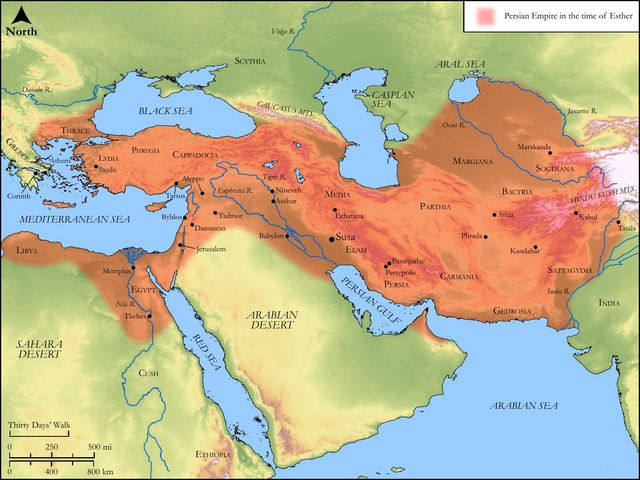
Where Esther reaches
The passages it leans on, and the ones that lean on it
Joseph, raised in a foreign court, saw God’s purpose in it: “it was not you that sent me hither, but God.”
Balaam foresaw Israel’s king “higher than Agag”; Haman the Agagite is set above all the princes.
Haman’s gallows in the psalm’s words: “He made a pit, and digged it, and is fallen into the ditch which he made.”
The same verb of reversal: “Thou hast turned for me my mourning into dancing.”
Herod echoes the Persian king’s promise, “unto the half of my kingdom,” and the request that follows is John the Baptist’s head.
Books Esther links to most
The Church Fathers on Esther
13 quotations from 8 writers before AD 800
Clement of Rome, writing to Corinth, held up Esther’s faith and fasting.
To no less danger did Esther, who was perfect in faith, expose herself, in order to save the twelve tribes of Israel that were to be destroyed. For by fasting and humiliation she begged the all-seeing Master of the ages, and he, seeing the meekness of her soul, rescued the people for whose sake she had faced danger.
Aphrahat read Mordecai as a figure of Jesus.
Mordecai was persecuted by the wicked Haman; and Jesus was persecuted by the rebellious people. Mordecai by his prayer delivered his people from the hands of Haman; and Jesus by his prayer delivered his people from the hands of Satan.
Athanasius kept Easter with Esther’s feast in mind.
And in the time of Esther the people kept a feast to the Lord because they had been delivered from a deadly decree. They called a feast, thanking and praising the Lord because he had changed the situation for them.
Keep studying
Articles